A birthday on the globe
19 June on the globe: what happened in the world on this day, and who was born
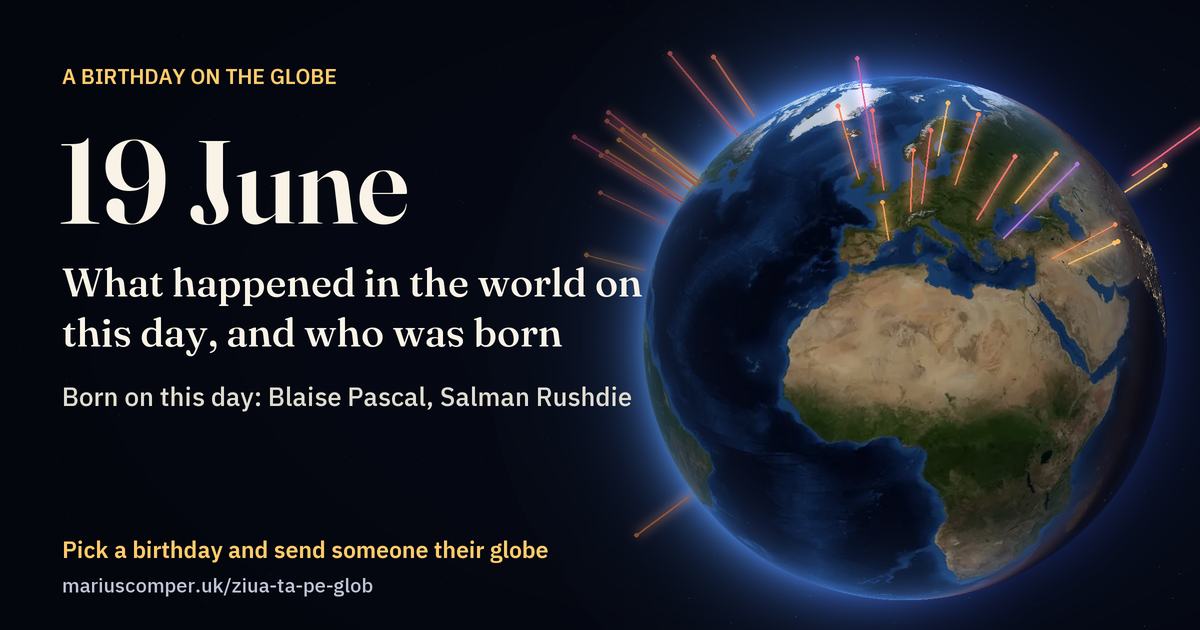
For 19 June, the English Wikipedia lists 52 events and 208 births. 30 of the events stand at their places as rays of light; four more are dashed circles, where the sentence links only to a country or a sea. The taller the ray, the longer ago it happened. The people born that day come further down, as blue points.
A birthday, yours or someone else’s:
Turn it into a greetingScroll: the globe turns to each place
The day you were born, on the globe.
Three things from your day
Scroll: your day first, then 19 June through the years
The Earth on 19 June
The picture on the globe was assembled by NASA from satellite photographs taken in June 2004: the snow, the ice and the green are those of the month.
On 19 June the Sun passes straight overhead at noon along the parallel of 23.4° north. In London, the day lasts about 16 hours 40 minutes.
Beyond 67° north the Sun no longer sets; beyond 67° south it no longer rises.
The line between day and night is tilted on the globe exactly as on this day of the year. On the dark side you can see the lights of towns.
Britain & Ireland · London
1811
The Carlton House Fête is held in London to celebrate the establishment of the Regency era.
On the map: London.
Europe · Grand Theatre, Warsaw
1926
King Roger, an opera about Roger II of Sicily by Karol Szymanowski, is premiered at the Grand Theatre in Warsaw.
On the map: Grand Theatre, Warsaw.
Europe · Storkyrkan
2010
The royal wedding of Victoria, Crown Princess of Sweden, and Daniel Westling took place in Stockholm Cathedral.
On the map: Storkyrkan.
Wikipedia: Wedding of Victoria, Crown Princess of Sweden, and Daniel Westling
Asia · First Council of Nicaea
325
The original Nicene Creed is adopted at the First Council of Nicaea.
On the map: the coordinates Wikidata gives for the article “First Council of Nicaea”.
North America · King's Chapel
1785
The Boston King's Chapel adopts James Freeman's revised prayer book, without the Nicene Creed, establishing it as the first Unitarian congregation in the United States.
On the map: King's Chapel.
North America · Washington, D.C.
1970
The international Patent Cooperation Treaty was signed, providing a unified procedure for filing patent applications to protect inventions in each of its contracting states.
On the map: Washington, D.C..
North America · 2005 United States Grand Prix
2005
Following a series of Michelin tire failures during the United States Grand Prix weekend at Indianapolis, and without an agreement being reached, 14 cars from seven teams in Michelin tires withdraw after completing the formation lap, leaving only six cars from three teams on Bridgestone tires to race.
On the map: the coordinates Wikidata gives for the article “2005 United States Grand Prix”.
19 June
What the other Wikipedias remember#
For these years the English list has nothing on this day. The events below come from the same day’s lists on Wikipedia in Chinese and Spanish and were translated for this page.
From Wikipedia in Chinese · Statue of Liberty
1885
The Statue of Liberty arrives in New York from France: a gift from France to the American people to celebrate the centenary of American independence.
On the map: Statue of Liberty.
Translated from the list on Wikipedia in Chinese.
From Wikipedia in Spanish · Turin
1999
The Italian city of Turin is chosen as host of the 2006 Winter Olympics.
On the map: Turin.
Translated from the list on Wikipedia in Spanish.
The article on Wikipedia in Spanish: Juegos Olímpicos de Turín 2006
19 June
Born on 19 June#
The English Wikipedia lists 208 births for this day. The blue points are the birthplaces of 60 of these people: those written about in the most Wikipedia editions, where Wikidata gives a place of birth.
Born on 19 June
1623
Blaise Pascal, French mathematician and physicist (died 1662)
Place of birth: birth house of Blaise Pascal.
Born on 19 June
1947
Salman Rushdie, Indian-English novelist and essayist
Place of birth: Mumbai.
Born on 19 June
1861
José Rizal, Filipino journalist, author, and poet (died 1896)
Born on 19 June
1922
Aage Bohr, Danish physicist and academic, Nobel Prize laureate (died 2009)
Place of birth: Copenhagen.
Born in Britain and Ireland
1897
Cyril Norman Hinshelwood, English chemist and academic, Nobel Prize laureate (died 1967)
Place of birth: London.
Born in Britain and Ireland
1834
Charles Spurgeon, English pastor and author (died 1892)
Place of birth: Kelvedon.
19 June
Number one in the charts that week
At the cinema
An animal recorded that day
The record can be seen in GBIF, which brings together wildlife records from around the world.
All your birthdays
The weather that day
Data: Met Office Hadley Centre (HadCET); NOAA (GHCN-Daily, Mauna Loa).
Above the Earth
Sources: Jonathan McDowell, GCAT (launches); GFZ Potsdam (Kp index). Days are counted in Universal Time.
Football that day
International matches played that day:
Source: the “International football results” dataset kept by Mart Jürisoo (CC0).
Also that day
The earthquake’s page at the USGS
Source: the USGS catalogue. The day is counted in Universal Time (UTC).
In those days
Make a link for someone
Type the name, pick the day and the year of birth. The link opens straight on their day, with their name in the greeting.
The link carries the name, date and place typed here; anyone who gets it can see them.
Put another birthday beside it
Your mother’s, your child’s, a friend’s: the two days appear side by side.
Below: 19 June through the years.
The whole globe of the day
Drag the globe to turn it. Touch a ray or a point to read what happened there.
Everything Wikipedia lists for 19 June
The list is the English Wikipedia’s, in its own wording, as it stood in October 2026. 18 events have no place on the map: the sentence links to no place with coordinates, only to places too wide to mark, or to several countries.
- 325
The original Nicene Creed is adopted at the First Council of Nicaea.
Asia · First Council of NicaeaWikipedia: First Council of Nicaea - 978
Byzantine forces loyal to emperor Basil II under Bardas Phokas the Younger defeat rebel forces under Bardas Skleros in the battle of Pankaleia (approximate date).
no place on the mapWikipedia: Battle of Pankaleia - 1306
The Earl of Pembroke's army defeats Bruce's Scottish army at the Battle of Methven.
Britain & Ireland · Battle of MethvenWikipedia: Battle of Methven - 1586
English colonists leave Roanoke Island, after failing to establish England's first permanent settlement in North America.
North America · Roanoke IslandWikipedia: Roanoke Island - 1718
At least 73,000 people die in the 1718 Tongwei–Gansu earthquake due to landslides in the Qing dynasty.
Asia · 1718 Tongwei–Gansu earthquakeWikipedia: 1718 Tongwei–Gansu earthquake - 1785
The Boston King's Chapel adopts James Freeman's revised prayer book, without the Nicene Creed, establishing it as the first Unitarian congregation in the United States.
North America · King's ChapelWikipedia: King's Chapel - 1791
The first New Church place of worship the Birmingham New Jerusalem Temple was dedicated on the 19th day of June, 1791, in Birmingham, England. The auspiciousness of this date was noted at the time.
no place on the mapWikipedia: Swedenborgianism - 1800
War of the Second Coalition: Battle of Höchstädt results in a French victory over Austria.
Europe · Battle of HöchstädtWikipedia: Battle of Höchstädt - 1811
The Carlton House Fête is held in London to celebrate the establishment of the Regency era.
Britain & Ireland · LondonWikipedia: Carlton House Fête - 1816
Battle of Seven Oaks between North West Company and Hudson's Bay Company, near Winnipeg, Manitoba, Canada.
North America · Battle of Seven OaksWikipedia: Battle of Seven Oaks - 1821
Decisive defeat of the Filiki Eteria by the Ottomans at Drăgășani (in Wallachia).
Europe · DrăgășaniWikipedia: Filiki Eteria - 1838
The Maryland province of the Jesuits contracted to sell 272 slaves to buyers in Louisiana in one of the largest slave sales in American history.
no place on the mapWikipedia: 1838 Jesuit slave sale - 1846
The first officially recorded, organized baseball game is played under Alexander Cartwright's rules on Hoboken, New Jersey's Elysian Fields with the New York Base Ball Club defeating the Knickerbockers 23–1. Cartwright umpired.
North America · Hoboken, New JerseyWikipedia: History of baseball in the United States - 1850
Princess Louise of the Netherlands marries Crown Prince Karl of Sweden–Norway.
Europe · Union between Sweden and NorwayWikipedia: Louise of the Netherlands - 1862
President Abraham Lincoln signs the Territorial Slavery Act of 1862, which prohibits slavery in all current and future United States territories.
no place on the mapWikipedia: Abraham Lincoln - 1865
Over two years after the Emancipation Proclamation, slaves in Galveston, Texas, United States, are officially informed of their freedom. The anniversary was officially celebrated in Texas and other states as Juneteenth. On June 17, 2021, Juneteenth officially became a federal holiday in the United States.
North America · Galveston, TexasWikipedia: Emancipation Proclamation - 1867
Maximilian I of the Second Mexican Empire is executed by a firing squad in Querétaro, Querétaro.
Latin America · QuerétaroWikipedia: Maximilian I of Mexico - 1875
The Herzegovinian rebellion against the Ottoman Empire begins.
Asia · Ottoman EmpireWikipedia: Herzegovina uprising - 1903
Benito Mussolini, at the time a radical Socialist, is arrested by Bern police for advocating a violent general strike.
Europe · BernWikipedia: Benito Mussolini - 1910
The first Father's Day is celebrated in Spokane, Washington.
North America · Spokane, WashingtonWikipedia: Father's Day - 1913
Natives Land Act, 1913 in South Africa implemented.
no place on the mapWikipedia: Natives Land Act, 1913 - 1921
The village of Knockcroghery, Ireland, is burned by British forces.
Britain & Ireland · KnockcrogheryWikipedia: Knockcroghery - 1926
King Roger, an opera about Roger II of Sicily by Karol Szymanowski, is premiered at the Grand Theatre in Warsaw.
Europe · Grand Theatre, WarsawWikipedia: Grand Theatre, Warsaw - 1934
The Communications Act of 1934 establishes the United States' Federal Communications Commission (FCC).
no place on the mapWikipedia: Communications Act of 1934 - 1939
American baseball player Lou Gehrig was diagnosed with amyotrophic lateral sclerosis, now commonly known in the United States as "Lou Gehrig's disease".
no place on the mapWikipedia: Lou Gehrig - 1943
The Philadelphia Eagles and Pittsburgh Steelers of the NFL merge for one season due to player shortages caused by World War II.
no place on the mapWikipedia: Steagles - 1945
The Smoke Tragedy leaves 355 workers dead in the underground copper mine of El Teniente, Chile.
Latin America · 1945 El Teniente mining accidentWikipedia: 1945 El Teniente mining accident - 1947
Pan Am Flight 121 crashes in the Syrian Desert near Mayadin, Syria, killing 15 and injuring 21.
Asia · Pan Am Flight 121Wikipedia: Pan Am Flight 121 - 1953
Cold War: Julius and Ethel Rosenberg are executed at Sing Sing, in New York.
North America · Sing SingWikipedia: Cold War - 1960
Charlotte Motor Speedway holds its first NASCAR race, the inaugural World 600.
North America · Charlotte Motor SpeedwayWikipedia: Coca-Cola 600 - 1961
Kuwait declares independence from the United Kingdom.
Asia · KuwaitWikipedia: Kuwait - 1964
The Civil Rights Act of 1964 is approved after surviving an 83-day filibuster in the United States Senate.
no place on the mapWikipedia: Civil Rights Act of 1964 - 1965
Nguyễn Cao Kỳ becomes Prime Minister of South Vietnam at the head of a military junta; General Nguyễn Văn Thiệu becomes the figurehead chief of state.
Asia · South VietnamWikipedia: Nguyễn Cao Kỳ - 1970
The international Patent Cooperation Treaty was signed, providing a unified procedure for filing patent applications to protect inventions in each of its contracting states.
North America · Washington, D.C.Wikipedia: Patent Cooperation Treaty - 1978
Garfield's first comic strip, originally published locally as Jon in 1976, goes into nationwide syndication.
no place on the mapWikipedia: Garfield - 1982
The People's Armed Police is de facto founded; it is officially established 10 months later on April 5, 1983.
no place on the mapWikipedia: People's Armed Police - 1985
Members of the Revolutionary Party of Central American Workers, dressed as Salvadoran soldiers, attack the Zona Rosa area of San Salvador.
Latin America · 1985 Zona Rosa attacksWikipedia: Revolutionary Party of Central American Workers - 1987
Aeroflot Flight N-528 crashes at Berdiansk Airport in present-day Ukraine, killing eight people.
Europe · Aeroflot Flight N-528Wikipedia: Aeroflot Flight N-528 - 1987
Basque separatist group ETA commits one of its most violent attacks, in which a bomb is set off in a supermarket, Hipercor, killing 21 and injuring 45.
Europe · Hipercor bombingWikipedia: Hipercor bombing - 1988
Pope John Paul II canonizes 117 Vietnamese Martyrs.
no place on the mapWikipedia: Pope John Paul II - 1990
The Communist Party of the Russian Soviet Federative Socialist Republic is founded in Moscow.
- 1990
The current international law defending indigenous peoples, Indigenous and Tribal Peoples Convention, 1989, is ratified for the first time by Norway.
no place on the mapWikipedia: Indigenous and Tribal Peoples Convention, 1989 - 1991
The last Soviet army units in Hungary are withdrawn.
no place on the mapWikipedia: Southern Group of Forces - 2005
Following a series of Michelin tire failures during the United States Grand Prix weekend at Indianapolis, and without an agreement being reached, 14 cars from seven teams in Michelin tires withdraw after completing the formation lap, leaving only six cars from three teams on Bridgestone tires to race.
North America · 2005 United States Grand PrixWikipedia: 2005 United States Grand Prix - 2007
The al-Khilani Mosque bombing in Baghdad leaves 78 people dead and another 218 injured.
Asia · BaghdadWikipedia: 2007 al-Khilani mosque bombing - 2009
Mass riots involving over 10,000 people and 10,000 police officers break out in Shishou, China, over the dubious circumstances surrounding the death of a local chef.
Asia · ShishouWikipedia: Shishou incident - 2009
War in North-West Pakistan: The Pakistani Armed Forces open Operation Rah-e-Nijat against the Taliban and other Islamist rebels in the South Waziristan area of the Federally Administered Tribal Areas.
no place on the mapWikipedia: Insurgency in Khyber Pakhtunkhwa - 2010
The royal wedding of Victoria, Crown Princess of Sweden, and Daniel Westling took place in Stockholm Cathedral.
- 2012
WikiLeaks founder Julian Assange requests asylum in London's Ecuadorian Embassy for fear of extradition to the US after publication of previously classified documents including footage of civilian killings by the US army; he will remain there until 2019.
Asia · July 12, 2007, Baghdad airstrikeWikipedia: July 12, 2007, Baghdad airstrike - 2018
Antwon Rose II is fatally shot in East Pittsburgh by East Pittsburgh Police Officer Michael Rosfeld after being involved in a near-fatal drive-by shooting.
North America · East Pittsburgh, PennsylvaniaWikipedia: Killing of Antwon Rose Jr. - 2018
The 10,000,000th United States Patent is issued.
no place on the mapWikipedia: Patent - 2020
Animal rights advocate Regan Russell is run over and killed by a transport truck outside of a pig slaughterhouse in Burlington, Ontario.
no place on the mapWikipedia: Death of Regan Russell
What the other Wikipedias remember
For these years the English list has nothing on this day. The events below come from the same day’s lists on Wikipedia in Chinese and Spanish and were translated for this page.
- 1885
The Statue of Liberty arrives in New York from France: a gift from France to the American people to celebrate the centenary of American independence.
- 1999
The Italian city of Turin is chosen as host of the 2006 Winter Olympics.
Europe · TurinTranslated from the list on Wikipedia in SpanishWikipedia: Juegos Olímpicos de Turín 2006
Who was born on 19 June
In order of how many Wikipedia editions have an article about each. The first 60 of 208 are shown.
- 1623
Blaise Pascal, French mathematician and physicist (died 1662)
birth house of Blaise PascalWikipedia: Blaise Pascal - 1945
Aung San Suu Kyi, Burmese politician, Nobel Prize laureate
- 1964
Boris Johnson, former Prime Minister of the United Kingdom and former Mayor of London
Upper East SideWikipedia: Boris Johnson - 1947
Salman Rushdie, Indian-English novelist and essayist
- 1566
James VI and I of the United Kingdom (died 1625)
Edinburgh CastleWikipedia: James VI and I - 1951
Ayman al-Zawahiri, Egyptian terrorist (died 2022)
- 1945
Radovan Karadžić, Serbian-Bosnian politician and convicted war criminal, 1st President of Republika Srpska
PetnjicaWikipedia: Radovan Karadžić - 1959
Christian Wulff, German lawyer and politician, 10th President of Germany
OsnabrückWikipedia: Christian Wulff - 1861
José Rizal, Filipino journalist, author, and poet (died 1896)
- 1941
Václav Klaus, Czech economist and politician, 2nd President of the Czech Republic
PragueWikipedia: Václav Klaus - 1922
Aage Bohr, Danish physicist and academic, Nobel Prize laureate (died 2009)
CopenhagenWikipedia: Aage Bohr - 1978
Zoe Saldaña, American actress
PassaicWikipedia: Zoe Saldaña - 1972
Jean Dujardin, French actor
Rueil-MalmaisonWikipedia: Jean Dujardin - 1896
Wallis Simpson, Duchess of Windsor, American wife of the former King Edward VIII of the United Kingdom, Duke of Windsor (died 1986)
Blue Ridge SummitWikipedia: Wallis Simpson - 1954
Kathleen Turner, American actress
SpringfieldWikipedia: Kathleen Turner - 1909
Osamu Dazai, Japanese author (died 1948)
KanagiWikipedia: Osamu Dazai - 1930
Gena Rowlands, American actress (died 2024)
MadisonWikipedia: Gena Rowlands - 1962
Paula Abdul, American singer-songwriter, dancer, actress, and presenter
San FernandoWikipedia: Paula Abdul - 1897
Cyril Norman Hinshelwood, English chemist and academic, Nobel Prize laureate (died 1967)
- 1906
Ernst Boris Chain, German-Irish biochemist and academic, Nobel Prize laureate (died 1979)
BerlinWikipedia: Ernst Chain - 1970
Rahul Gandhi, Indian politician
New DelhiWikipedia: Rahul Gandhi - 1978
Dirk Nowitzki, German basketball player
WürzburgWikipedia: Dirk Nowitzki - 1910
Paul Flory, American chemist and engineer, Nobel Prize laureate (died 1985)
SterlingWikipedia: Paul Flory - 1834
Charles Spurgeon, English pastor and author (died 1892)
KelvedonWikipedia: Charles Spurgeon - 1957
Anna Lindh, Swedish politician, 39th Swedish Minister of Foreign Affairs (died 2003)
Enskede-Årsta parishWikipedia: Anna Lindh - 1972
Robin Tunney, American actress
ChicagoWikipedia: Robin Tunney - 2002
Nuno Mendes, Portuguese footballer
SintraWikipedia: Nuno Mendes - 1983
Macklemore, American rapper
SeattleWikipedia: Macklemore - 1861
Douglas Haig, 1st Earl Haig, Scottish-English field marshal (died 1928)
Charlotte SquareWikipedia: Douglas Haig, 1st Earl Haig - 1984
Paul Dano, American actor
New York CityWikipedia: Paul Dano - 1957
Subcomandante Marcos, Mexican insurgent and EZLN leader
- 1967
Bjørn Dæhlie, Norwegian skier and businessman
Elverum MunicipalityWikipedia: Bjørn Dæhlie - 1764
José Gervasio Artigas, Uruguayan general and politician (died 1850)
MontevideoWikipedia: José Gervasio Artigas - 1948
Nick Drake, English singer-songwriter (died 1974)
YangonWikipedia: Nick Drake - 1944
Chico Buarque, Brazilian singer, composer, writer and poet
Rio de JaneiroWikipedia: Chico Buarque - 1993
KSI, English YouTuber
LondonWikipedia: KSI - 1877
Charles Coburn, American actor (died 1961)
SavannahWikipedia: Charles Coburn - 1975
Hugh Dancy, English actor and model
Stoke-on-TrentWikipedia: Hugh Dancy - 1985
José Ernesto Sosa, Argentinian footballer
CarcarañáWikipedia: José Sosa - 1903
Lou Gehrig, American baseball player (died 1941)
ManhattanWikipedia: Lou Gehrig - 1921
Louis Jourdan, French-American actor and singer (died 2015)
MarseilleWikipedia: Louis Jourdan - 1919
Pauline Kael, American film critic (died 2001)
PetalumaWikipedia: Pauline Kael - 1932
Pier Angeli, Italian actress, twin sister to Marisa Pavan (died 1971)
CagliariWikipedia: Pier Angeli - 1932
Marisa Pavan, Italian actress, twin sister to Pier Angeli (died 2023)
CagliariWikipedia: Marisa Pavan - 1917
Joshua Nkomo, Zimbabwean guerrilla leader and politician, Vice President of Zimbabwe (died 1999)
SemokweWikipedia: Joshua Nkomo - 1933
Viktor Patsayev, Kazakh engineer and astronaut (died 1971)
- 1937
André Glucksmann, French philosopher and author (died 2015)
Boulogne-BillancourtWikipedia: André Glucksmann - 1948
Phylicia Rashad, American actress
HoustonWikipedia: Phylicia Rashad - 1979
José Kléberson, Brazilian footballer
- 1783
Friedrich Sertürner, German chemist and pharmacist (died 1841)
Schloß NeuhausWikipedia: Friedrich Sertürner - 1865
May Whitty, English actress (died 1948)
LiverpoolWikipedia: May Whitty - 1983
Aidan Turner, Irish actor
ClondalkinWikipedia: Aidan Turner - 1958
Sergei Makarov, Russian-American ice hockey player and coach
ChelyabinskWikipedia: Sergei Makarov - 1905
Mildred Natwick, American actress (died 1994)
BaltimoreWikipedia: Mildred Natwick - 1928
Nancy Marchand, American actress (died 2000)
BuffaloWikipedia: Nancy Marchand - 1963
Laura Ingraham, American radio host and author
GlastonburyWikipedia: Laura Ingraham - 1595
Hargobind, sixth Sikh guru (died 1644)
Guru ki VadaliWikipedia: Guru Hargobind - 1846
Antonio Abetti, Italian astronomer and academic (died 1928)
Šempeter pri GoriciWikipedia: Antonio Abetti - 1891
John Heartfield, German photographer and activist (died 1968)
SchmargendorfWikipedia: John Heartfield - 1945
Tobias Wolff, American short story writer, memoirist, and novelist
BirminghamWikipedia: Tobias Wolff
What is celebrated on 19 June
- Christian feast day: Deodatus (or Didier) of Nevers (or of Jointures)
- Christian feast day: Gervasius and Protasius (Catholic Church)
- Christian feast day: Hildegrim of Châlons
- Christian feast day: Juliana Falconieri
- Christian feast day: Blessed Michelina of Pesaro
- Christian feast day: Rémy Isoré
- Christian feast day: Romuald
- Christian feast day: Ursicinus of Ravenna
- Christian feast day: Zosimus
- Christian feast day: June 19 (Eastern Orthodox liturgics)
- New Church Day
- Day of the Independent Hungary (Hungary)
- Feast of Forest (Palawan)
- Juneteenth (United States)
A greeting link for someone
Type a name and, if you like, the year of birth. The link opens with a greeting, and beside each event it says how old the person turned that day, or how many years before their birth it happened.
The name and the year go only into the link you send.
All 366 days
How the globe is made
Where the events come from
Each edition of this page uses the day’s list from Wikipedia in its own language: Romanian, English, Spanish, Chinese. The lists are written by volunteers and differ from one edition to the next; the text of each event is Wikipedia’s, with a link to the article. A row that appears twice in a list is shown once. The lists have not been checked event by event: they are Wikipedia’s, mistakes included.
For events before 1582, and for countries that moved to the Gregorian calendar later (Britain in 1752, Russia in 1918), the same day may be counted Old Style in one list and New Style in another.
The chapter “What the other Wikipedias remember” adds up to five events a day from the lists of the other three editions, only for years in which the English list has nothing on that day. They were translated for this page, passed the same filters as the tour, and are not counted among the events of the English list.
How an event gets onto the map
The place comes from Wikidata. If the sentence links to the article about the event itself (a battle, an opening, an earthquake), dated to the same year, the ray stands on its coordinates or on those of its location. Otherwise it stands on the first place the sentence links to: a town, a building, a mountain, an island. This second step can be wrong: sometimes the sentence only mentions the place. That is why the page says, under each event, which place the ray stands on.
When the sentence links to a single state or province, or to a single sea, lake or desert larger than 5,000 km², the globe shows a dashed circle, not a ray. The circle has the area Wikidata gives, with its radius kept between 1.2° and 16°, or a radius of 4.5° when Wikidata gives no area; it says only that the sentence links to that place. Organisations, ships, spacecraft, museum objects, rivers, mountain ranges, languages and continents are never used as places. When a sentence names several states and no exact place, the event stays in the list only.
What the height means
The height of a ray shows how many years have passed, on a logarithmic scale: 10 years, 100 years and 1,000 years are equal steps apart; anything older than about 2,600 years has the tallest ray. The colour runs from pale yellow for recent years to violet for antiquity.
Where the tour stops
In each region the tour stops at up to three events (five in Britain and Ireland), chosen mainly by three things: whether Wikipedia’s editors put the event in the “On this day” box of their main page (the English, Spanish and Chinese editions), how many Wikipedia editions have an article about it, and how many of the four lists include it. Events whose sentence or article is about a war, an attack, a crime or a disaster are left out of the tour; they stay in the whole list, in Wikipedia’s wording. The filter is a list of words and a list of Wikidata types, so it can miss some.
The tour of births names the people with articles in the most editions and leaves aside those whom the list or Wikidata describes as rulers, politicians, commanders, leaders of movements or criminals; they stay in the list.
The Earth and the Sun
The daytime images are NASA’s Blue Marble Next Generation mosaics, one for each month of 2004; the night side is Black Marble 2016. The tilt of the line between day and night is computed for the day; the hour is chosen so that the place being read is in daylight. The latitude where the Sun stands overhead is the average of the four years of the leap cycle; in a given year it can differ by up to 0.4°.
The day you were born
The number ones come from the weekly lists on Wikipedia: Billboard for the United States (from 1940; the Hot 100 from August 1958), the UK Singles Chart (from November 1952), Los 40 Principales for Spain (from July 1966) and, for Romania, the Romanian Top 100 and Airplay 100 (2001–2021, with missing weeks). The page shows the chart of the week in which the day of birth falls, with its date; Billboard and the UK chart are dated at the end of their week. For Romania before 2001 and for China these sources have no weekly chart.
The films are those that reached cinemas in the United States up to ten days before or three days after that day (some of them in a few cinemas at first), from the English Wikipedia’s yearly lists (from 1968), in order of how many editions have an article about them. The events “in those days” are the ones on the neighbouring days’ lists that carry the year of birth, passed through the same filter as the tour.
The day of birth, year included
The Moon, the star sign and the constellation are worked out by the page itself, for noon Universal Time on the day. The lit part of the Moon is rounded and can differ by a few per cent from that at the hour of birth. The sign follows the usual zodiac of twelve equal parts starting at the March equinox; the constellation is the one the Sun actually stood in front of, by the borders set by the International Astronomical Union, and within a day of a border the page does not name it. When the Sun changes sign while it is that day anywhere on Earth, the page gives the moment of crossing, rounded to ten minutes and accurate to within about a quarter of an hour, and the clock time in a few cities, with the time zone and summer time of that year.
The year in the Chinese calendar is the one your device’s own calendar gives for the date, checked against the Hong Kong Observatory’s tables. “All your birthdays” uses the same sources as the rest of the chapter for the same day in every year since the birth: the temperature, well-known launches that took place on that very day, matches of the teams the edition follows, snow deeper than 10 cm and strong geomagnetic storms. The three things at the top and the four on the picture are chosen in a fixed order (the song, the animal, a full Moon, a well-known launch before an ordinary earthquake); on the picture you can change them.
When the link carries a year of birth, the page adds a few things about that exact day. The weather is the Met Office’s Central England temperature record and the readings from New York’s Central Park; the “usual high” is the average of the daily highs of 1961–1990 for that date, with two days either side. The carbon dioxide figure is the monthly mean at the Mauna Loa observatory, where measurements begin in March 1958.
The earthquake is the one with the largest magnitude in the USGS catalogue for that day, counted in Universal Time. Before the 1960s the catalogue has gaps even above magnitude 5.5, so in the older years many days have no earthquake. The page gives only the magnitude and the place: the country the epicentre falls in or, when the epicentre is at sea within 300 km of a coast, the nearest country; farther out, only the ocean.
The launches are those that reached orbit or left for the Moon and the planets, from Jonathan McDowell’s GCAT catalogue. If nothing left that day, the page shows the nearest launch within three days before or after, and says how many days away it was. The geomagnetic storm appears only when the Kp index reached at least 5 in one of the day’s eight three-hour intervals.
The animal comes from GBIF: an observation made by a person (the animal seen or heard, or its tracks), dated to that exact day, with coordinates and a CC0 or CC BY licence. Only a few hundred well-known species are searched (mammals, birds, turtles, butterflies); of those noted that day, mammals and species with articles in many Wikipedia editions come first; birds noted almost every day, and species used recently, wait their turn. Observations dated 1 January are left out, because records without a day are often filed there. An observation shows that the animal was recorded there, not how many animals there were.
The matches are those between national teams. Only matches of England, Scotland, Wales, Northern Ireland, the Republic of Ireland, the United States, Canada and Australia are shown, along with those at the big final tournaments. The picture to send is drawn in the page from the day’s globe and the facts above, and stays on your device until you send it.
Sources
- Events, births and holidays: the day’s page on Wikipedia, text under CC BY-SA 4.0.
- Coordinates, places of birth and the number of editions: Wikidata (CC0).
- The Earth by day: NASA Blue Marble Next Generation. The Earth by night: NASA Black Marble 2016.
- Borders and regions: Natural Earth.
- World population and births per year: UN World Population Prospects 2024.
- Charts and films: Wikipedia’s lists for Billboard, the UK Singles Chart, Los 40 Principales, Romanian Top 100, Airplay 100 and American films by year (CC BY-SA 4.0).
- Weather: Met Office Hadley Centre, HadCET (Open Government Licence) and NOAA GHCN-Daily, New York Central Park. Carbon dioxide: NOAA Global Monitoring Laboratory, Mauna Loa.
- Earthquakes: the USGS catalogue. Launches: Jonathan McDowell, GCAT (CC BY). Kp index: GFZ Potsdam (CC BY 4.0). Matches: International football results, Mart Jürisoo (CC0).
- Animal observations: GBIF, with a link to each record; species names come from Wikidata.