A birthday on the globe
21 August on the globe: what happened in the world on this day, and who was born
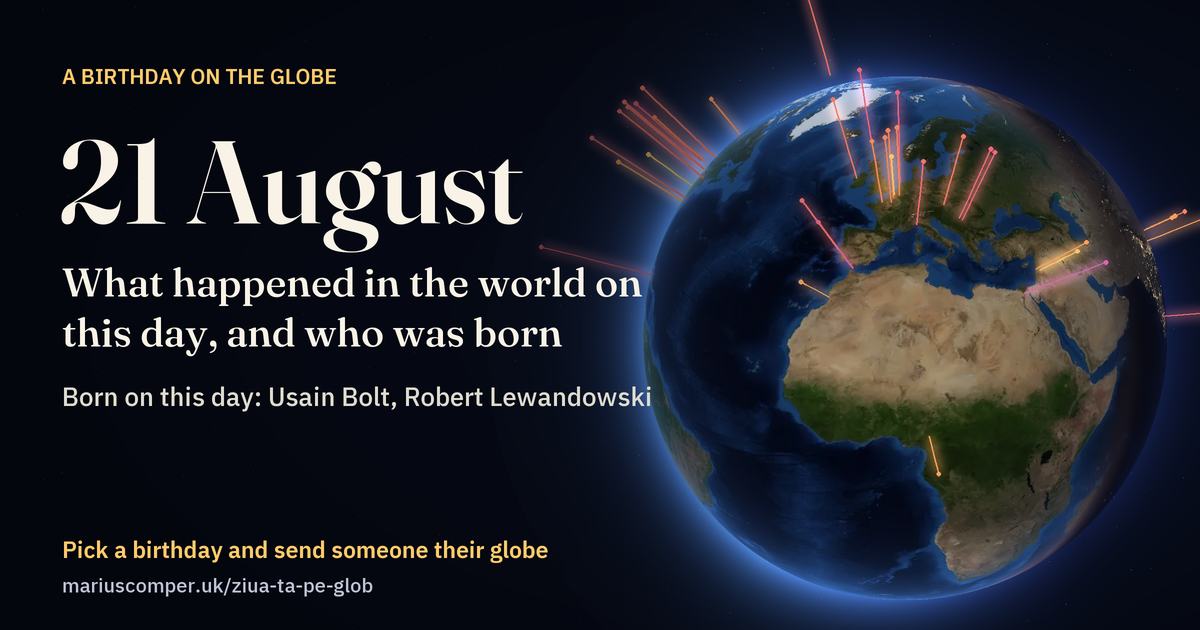
For 21 August, the English Wikipedia lists 57 events and 228 births. 38 of the events stand at their places as rays of light; four more are dashed circles, where the sentence links only to a country or a sea. The taller the ray, the longer ago it happened. The people born that day come further down, as blue points.
A birthday, yours or someone else’s:
Turn it into a greetingScroll: the globe turns to each place
The day you were born, on the globe.
Three things from your day
Scroll: your day first, then 21 August through the years
The Earth on 21 August
The picture on the globe was assembled by NASA from satellite photographs taken in August 2004: the snow, the ice and the green are those of the month.
On 21 August the Sun passes straight overhead at noon along the parallel of 12.1° north. In London, the day lasts about 14 hours 15 minutes.
Beyond 78° north the Sun no longer sets; beyond 78° south it no longer rises.
The line between day and night is tilted on the globe exactly as on this day of the year. On the dark side you can see the lights of towns.
Britain & Ireland · Knock, County Mayo
1879
The locals of Knock, County Mayo, Ireland report their having seen an apparition of the Virgin Mary. The apparition is later named "Our Lady of Knock" and the spot transformed into a Catholic pilgrimage site.
On the map: Knock, County Mayo.
Europe · Genoa
1789
The national colours of Italy first appeared on a tricolour cockade in Genoa.
On the map: Genoa.
Europe · Stadtpark, Vienna
1862
The Stadtpark, the first public park in Vienna, opens to the public.
On the map: Stadtpark, Vienna.
Europe · Louvre
1911
The Mona Lisa is stolen by Vincenzo Peruggia, a Louvre employee.
On the map: Louvre.
Also on the day’s list of Wikipedia in Spanish and Romanian.
Asia · Manila
1901
Six hundred American school teachers, Thomasites, arrived in Manila on the USAT Thomas.
On the map: Manila.
North America · Ottawa, Illinois
1858
The first of the Lincoln–Douglas debates is held in Ottawa, Illinois.
On the map: Ottawa, Illinois.
North America · Saratoga Springs, New York
1878
The American Bar Association is founded in Saratoga Springs, New York.
On the map: Saratoga Springs, New York.
North America · Solar eclipse of August 21, 2017
2017
A solar eclipse traverses the continental United States.
On the map: the coordinates Wikidata gives for the article “Solar eclipse of August 21, 2017”.
Oceans · Jarvis Island
1821
Jarvis Island is discovered by the crew of the ship, Eliza Frances.
On the map: Jarvis Island.
Also on the day’s list of Wikipedia in Spanish.
21 August
What the other Wikipedias remember#
For these years the English list has nothing on this day. The events below come from the same day’s lists on Wikipedia in Spanish and Chinese and were translated for this page.
From Wikipedia in Spanish · Bilbao
1913
In the city of Bilbao (Spain), the San Mamés Stadium opens.
On the map: Bilbao.
Translated from the list on Wikipedia in Spanish.
From Wikipedia in Chinese · Rio de Janeiro
2016
The closing ceremony of the 2016 Summer Olympic Games is held at the Maracanã Stadium in Rio de Janeiro, Brazil.
On the map: Rio de Janeiro.
Translated from the list on Wikipedia in Chinese.
21 August
Born on 21 August#
The English Wikipedia lists 228 births for this day. The blue points are the birthplaces of 60 of these people: those written about in the most Wikipedia editions, where Wikidata gives a place of birth.
Born on 21 August
1986
Usain Bolt, Jamaican sprinter
Place of birth: Sherwood Content.
Born on 21 August
1988
Robert Lewandowski, Polish footballer
Place of birth: Warsaw.
Born on 21 August
1973
Sergey Brin, Russian-American computer scientist and businessman, co-founded Google
Place of birth: Moscow.
Born on 21 August
1961
Stephen Hillenburg, American marine biologist, cartoonist, animator and creator of SpongeBob SquarePants (died 2018)
Place of birth: Fort Sill.
Born on 21 August
1789
Augustin-Louis Cauchy, French mathematician and academic (died 1857)
Place of birth: Paris.
Born in Britain and Ireland
1956
Kim Cattrall, English-Canadian actress
Place of birth: Mossley Hill.
Born in Britain and Ireland
1872
Aubrey Beardsley, English author and illustrator (died 1898)
Place of birth: Brighton.
Born in Britain and Ireland
1951
Glenn Hughes, English musician
Place of birth: Cannock.
21 August
Number one in the charts that week
At the cinema
An animal recorded that day
The record can be seen in GBIF, which brings together wildlife records from around the world.
All your birthdays
The weather that day
Data: Met Office Hadley Centre (HadCET); NOAA (GHCN-Daily, Mauna Loa).
Above the Earth
Sources: Jonathan McDowell, GCAT (launches); GFZ Potsdam (Kp index). Days are counted in Universal Time.
Football that day
International matches played that day:
Source: the “International football results” dataset kept by Mart Jürisoo (CC0).
Also that day
The earthquake’s page at the USGS
Source: the USGS catalogue. The day is counted in Universal Time (UTC).
In those days
Make a link for someone
Type the name, pick the day and the year of birth. The link opens straight on their day, with their name in the greeting.
The link carries the name, date and place typed here; anyone who gets it can see them.
Put another birthday beside it
Your mother’s, your child’s, a friend’s: the two days appear side by side.
Below: 21 August through the years.
The whole globe of the day
Drag the globe to turn it. Touch a ray or a point to read what happened there.
Everything Wikipedia lists for 21 August
The list is the English Wikipedia’s, in its own wording, as it stood in October 2026. 15 events have no place on the map: the sentence links to no place with coordinates, only to places too wide to mark, or to several countries.
- 959
Eraclus becomes the 25th bishop of Liège.
no place on the mapWikipedia: Eraclus - 1140
Song dynasty general Yue Fei defeats an army led by Jin dynasty general Wuzhu at the Battle of Yancheng during the Jin–Song Wars.
Asia · HenanWikipedia: Battle of Yancheng - 1169
Battle of the Blacks: Uprising by the black African forces of the Fatimid army, along with a number of Egyptian emirs and commoners, against Saladin.
Africa · CairoWikipedia: Battle of the Blacks - 1192
Minamoto no Yoritomo becomes Sei-i Taishōgun and the de facto ruler of Japan. (Traditional Japanese date: the 12th day of the seventh month in the third year of the Kenkyū (建久) era).
no place on the mapWikipedia: Minamoto no Yoritomo - 1331
King Stefan Uroš III, after months of anarchy, surrenders to his son and rival Stefan Dušan, who succeeds as King of Serbia.
no place on the mapWikipedia: Stefan Dečanski - 1415
Henry the Navigator leads Portuguese forces to victory over the Marinids at the Conquest of Ceuta.
Africa · Portuguese conquest of CeutaWikipedia: Portuguese conquest of Ceuta - 1673
The Dutch fleet defeats an Anglo-French fleet under Prince Rupert in the battle of Texel.
Europe · Battle of TexelWikipedia: Battle of Texel - 1680
Pueblo Indians capture Santa Fe from the Spanish during the Pueblo Revolt.
North America · Santa Fe, New MexicoWikipedia: Pueblo Revolt - 1689
The Battle of Dunkeld in Scotland.
Britain & Ireland · Battle of DunkeldWikipedia: Battle of Dunkeld - 1716
Seventh Ottoman–Venetian War: The arrival of naval reinforcements and the news of the Battle of Petrovaradin force the Ottomans to abandon the Siege of Corfu, thus preserving the Ionian Islands under Venetian rule.
Europe · Battle of PetrovaradinWikipedia: Battle of Petrovaradin - 1717
Austro-Turkish War: Austrian troops under Prince Eugene of Savoy captured the strategically important city of Belgrade from the Ottoman Empire.
Europe · Siege of BelgradeWikipedia: Austro-Turkish War - 1772
King Gustav III completes his coup d'état by adopting a new Constitution, ending half a century of parliamentary rule in Sweden and installing himself as an enlightened despot.
no place on the mapWikipedia: Age of Liberty - 1778
American Revolutionary War: British forces begin besieging the French outpost at Pondichéry.
Asia · Siege of PondicherryWikipedia: American Revolutionary War - 1789
The national colours of Italy first appeared on a tricolour cockade in Genoa.
Europe · GenoaWikipedia: National colours of Italy - 1791
Enslaved Africans in Saint-Domingue, led by Dutty Boukman, held a Vodou ceremony that became a pivotal act of resistance. This gathering sparked a mass uprising against slavery, marking the beginning of the Haitian Revolution.
Latin America · Bois CaïmanWikipedia: Bois Caïman - 1808
Battle of Vimeiro: British and Portuguese forces led by General Arthur Wellesley defeat French force under Major-General Jean-Andoche Junot near the village of Vimeiro, Portugal, the first Anglo-Portuguese victory of the Peninsular War.
Europe · Battle of VimeiroWikipedia: Battle of Vimeiro - 1810
Jean-Baptiste Bernadotte, Marshal of France, is elected Crown Prince of Sweden by the Swedish Riksdag of the Estates.
no place on the mapWikipedia: Charles XIV John - 1821
Jarvis Island is discovered by the crew of the ship, Eliza Frances.
Oceans · Jarvis IslandWikipedia: Jarvis Island - 1831
Nat Turner leads black slaves and free blacks in a rebellion in Southampton County, Virginia, which will claim the lives of 55 to 65 whites and about twice that number of blacks.
North America · Nat Turner's RebellionWikipedia: Nat Turner's Rebellion - 1852
Tlingit Indians destroy Fort Selkirk, Yukon Territory.
North America · Fort SelkirkWikipedia: Tlingit - 1858
The first of the Lincoln–Douglas debates is held in Ottawa, Illinois.
North America · Ottawa, IllinoisWikipedia: Lincoln–Douglas debates - 1862
The Stadtpark, the first public park in Vienna, opens to the public.
Europe · Stadtpark, ViennaWikipedia: Stadtpark, Vienna - 1863
Lawrence, Kansas is destroyed by pro-Confederate guerrillas known as Quantrill's Raiders.
North America · Lawrence MassacreWikipedia: Lawrence Massacre - 1878
The American Bar Association is founded in Saratoga Springs, New York.
North America · Saratoga Springs, New YorkWikipedia: American Bar Association - 1879
The locals of Knock, County Mayo, Ireland report their having seen an apparition of the Virgin Mary. The apparition is later named "Our Lady of Knock" and the spot transformed into a Catholic pilgrimage site.
Britain & Ireland · Knock, County MayoWikipedia: Knock, County Mayo - 1883
An F5 tornado strikes Rochester, Minnesota, leading to the creation of the Mayo Clinic.
North America · Rochester, MinnesotaWikipedia: 1883 Rochester tornado - 1888
The first successful adding machine in the United States is patented by William Seward Burroughs.
no place on the mapWikipedia: Adding machine - 1901
Six hundred American school teachers, Thomasites, arrived in Manila on the USAT Thomas.
Asia · ManilaWikipedia: Thomasites - 1911
The Mona Lisa is stolen by Vincenzo Peruggia, a Louvre employee.
Europe · LouvreWikipedia: Mona Lisa - 1914
World War I: The Battle of Charleroi, a successful German attack across the River Sambre that pre-empted a French offensive in the same area.
Europe · Battle of CharleroiWikipedia: World War I - 1918
World War I: The Second Battle of the Somme begins.
Europe · Second Battle of the SommeWikipedia: Second Battle of the Somme - 1942
World War II: The Guadalcanal campaign: American forces defeat an attack by Imperial Japanese Army soldiers in the Battle of the Tenaru.
Oceania · Battle of the TenaruWikipedia: Battle of the Tenaru - 1944
Dumbarton Oaks Conference, prelude to the United Nations, begins.
no place on the mapWikipedia: Dumbarton Oaks Conference - 1944
World War II: Canadian and Polish units capture the strategically important town of Falaise, Calvados, France.
Europe · Operation TractableWikipedia: Operation Tractable - 1945
Physicist Harry Daghlian is fatally irradiated in a criticality accident during an experiment with the Demon core at Los Alamos National Laboratory.
North America · Los Alamos National LaboratoryWikipedia: Demon core - 1957
The Soviet Union successfully conducts a long-range test flight of the R-7 Semyorka, the first intercontinental ballistic missile.
Asia · Soviet UnionWikipedia: Soviet Union - 1959
United States President Dwight D. Eisenhower signs an executive order proclaiming Hawaii the 50th state of the union. Hawaii's admission is currently commemorated by Hawaii Admission Day.
no place on the mapWikipedia: President of the United States - 1963
Xá Lợi Pagoda raids: The Army of the Republic of Vietnam Special Forces loyal to Ngô Đình Nhu, brother of President Ngo Dinh Diem, vandalizes Buddhist pagodas across the country, arresting thousands and leaving an estimated hundreds dead.
no place on the mapWikipedia: Xá Lợi Pagoda raids - 1965
The Socialist Republic of Romania is proclaimed, following the adoption of a new constitution.
no place on the mapWikipedia: Socialist Republic of Romania - 1968
Cold War: Nicolae Ceaușescu, leader of the Socialist Republic of Romania, publicly condemns the Soviet-led Warsaw Pact invasion of Czechoslovakia, encouraging the Romanian population to arm itself against possible Soviet reprisals.
Asia · Soviet UnionWikipedia: Warsaw Pact invasion of Czechoslovakia - 1968
James Anderson Jr. posthumously receives the first Medal of Honor to be awarded to an African American U.S. Marine.
no place on the mapWikipedia: United States Marine Corps - 1971
A bomb exploded in the Liberal Party campaign rally in Plaza Miranda, Manila, Philippines with several anti-Marcos political candidates injured.
Asia · Plaza Miranda bombingWikipedia: Plaza Miranda bombing - 1971
Six people were killed during an escape attempt and riot at San Quentin State Prison in California; the subsequent trial of six inmates was the longest in state history at the time.
North America · San Quentin Rehabilitation CenterWikipedia: San Quentin Six - 1982
Lebanese Civil War: The first troops of a multinational force lands in Beirut to oversee the Palestine Liberation Organization's withdrawal from Lebanon.
Asia · BeirutWikipedia: Lebanese Civil War - 1983
Philippine opposition leader Benigno Aquino Jr. is assassinated at Manila International Airport (now renamed Ninoy Aquino International Airport in his honor).
Asia · Ninoy Aquino International AirportWikipedia: Assassination of Ninoy Aquino - 1986
Carbon dioxide gas erupts from volcanic Lake Nyos in Cameroon, killing up to 1,800 people within a 20-kilometre (12 mi) range.
Africa · Lake NyosWikipedia: Volcano - 1988
The 6.9 Mw Nepal earthquake shakes the Nepal–India border with a maximum Mercalli intensity of VIII (Severe), leaving 709–1,450 people killed and thousands injured.
Asia · 1988 Nepal earthquakeWikipedia: 1988 Nepal earthquake - 1991
Coup attempt against Mikhail Gorbachev collapses.
no place on the mapWikipedia: 1991 Soviet coup attempt - 1991
Latvia declares renewal of its full independence after its occupation by the Soviet Union since 1940.
Europe · LatviaWikipedia: Latvia - 1993
NASA loses contact with the Mars Observer spacecraft.
no place on the mapWikipedia: NASA - 1994
Royal Air Maroc Flight 630 crashes in Douar Izounine, Morocco, killing all 44 people on board.
Africa · Royal Air Maroc Flight 630Wikipedia: Royal Air Maroc Flight 630 - 1995
Atlantic Southeast Airlines Flight 529, an Embraer EMB 120 Brasilia, attempts to divert to West Georgia Regional Airport after the left engine fails, but the aircraft crashes in Carroll County near Carrollton, Georgia, killing nine of the 29 people on board.
North America · Atlantic Southeast Airlines Flight 529Wikipedia: Atlantic Southeast Airlines Flight 529 - 2000
American golfer Tiger Woods wins the 82nd PGA Championship and becomes the first golfer since Ben Hogan in 1953 to win three majors in a calendar year.
no place on the mapWikipedia: PGA Championship - 2007
BioShock was released in North America, becoming a critical success and a demonstration of video games as an art form.
no place on the mapWikipedia: BioShock - 2013
Hundreds of people are reported killed by chemical attacks in the Ghouta region of Syria.
Asia · Ghouta chemical attackWikipedia: Ghouta chemical attack - 2015
Passengers on a Thalys train from Amsterdam to Paris confronted and subdued an attacker who attempted a mass shooting.
Europe · 2015 Thalys train attackWikipedia: 2015 Thalys train attack - 2017
A solar eclipse traverses the continental United States.
North America · Solar eclipse of August 21, 2017Wikipedia: Solar eclipse of August 21, 2017
What the other Wikipedias remember
For these years the English list has nothing on this day. The events below come from the same day’s lists on Wikipedia in Spanish and Chinese and were translated for this page.
- 1913
In the city of Bilbao (Spain), the San Mamés Stadium opens.
- 2016
The closing ceremony of the 2016 Summer Olympic Games is held at the Maracanã Stadium in Rio de Janeiro, Brazil.
Latin America · Rio de JaneiroTranslated from the list on Wikipedia in ChineseWikipedia: 2016年夏季奥林匹克运动会
Who was born on 21 August
In order of how many Wikipedia editions have an article about each. The first 60 of 228 are shown.
- 1986
Usain Bolt, Jamaican sprinter
Sherwood ContentWikipedia: Usain Bolt - 1988
Robert Lewandowski, Polish footballer
- 1963
Mohammed VI of Morocco, King of Morocco
- 1973
Sergey Brin, Russian-American computer scientist and businessman, co-founded Google
MoscowWikipedia: Sergey Brin - 1765
William IV, King of the United Kingdom (died 1837)
Buckingham PalaceWikipedia: William IV - 1961
Stephen Hillenburg, American marine biologist, cartoonist, animator and creator of SpongeBob SquarePants (died 2018)
Fort SillWikipedia: Stephen Hillenburg - 1789
Augustin-Louis Cauchy, French mathematician and academic (died 1857)
- 1165
Philip II of France (died 1223)
- 1938
Kenny Rogers, American singer-songwriter, guitarist, producer, and actor (died 2020)
HoustonWikipedia: Kenny Rogers - 1567
Francis de Sales, Swiss bishop and saint (died 1622)
Château de SalesWikipedia: Francis de Sales - 1798
Jules Michelet, French historian and philosopher (died 1874)
rue Saint-DenisWikipedia: Jules Michelet - 1936
Wilt Chamberlain, American basketball player and coach (died 1999)
PhiladelphiaWikipedia: Wilt Chamberlain - 1989
Hayden Panettiere, American actress (died 2026)
PalisadesWikipedia: Hayden Panettiere - 1917
Leonid Hurwicz, Polish-American economist and mathematician (died 2008)
- 1930
Princess Margaret, Countess of Snowdon (died 2002)
Glamis CastleWikipedia: Princess Margaret, Countess of Snowdon - 1967
Serj Tankian, Lebanese-born Armenian-American singer-songwriter, multi-instrumentalist, and record producer
BeirutWikipedia: Serj Tankian - 1984
Alizée, French singer
AjaccioWikipedia: Alizée - 1986
Paetongtarn Shinawatra, Thai politician and 31st Prime Minister of Thailand
- 1967
Carrie-Anne Moss, Canadian actress
BurnabyWikipedia: Carrie-Anne Moss - 1862
Emilio Salgari, Italian journalist and author (died 1911)
- 1904
Count Basie, American pianist, composer, and bandleader (died 1984)
Red BankWikipedia: Count Basie - 1939
Festus Mogae, Botswana economist and politician, third President of Botswana (died 2026)
SeroweWikipedia: Festus Mogae - 1956
Kim Cattrall, English-Canadian actress
Mossley HillWikipedia: Kim Cattrall - 1944
Peter Weir, Australian director, producer, and screenwriter
SydneyWikipedia: Peter Weir - 1858
Rudolf, Crown Prince of Austria (died 1889)
Laxenburg castlesWikipedia: Rudolf, Crown Prince of Austria - 1967
Charb, French journalist and cartoonist (died 2015)
Conflans-Sainte-HonorineWikipedia: Charb - 1643
Afonso VI of Portugal (died 1683)
Ribeira PalaceWikipedia: Afonso VI of Portugal - 1989
Aleix Vidal, Spanish footballer
PuigpelatWikipedia: Aleix Vidal - 1872
Aubrey Beardsley, English author and illustrator (died 1898)
BrightonWikipedia: Aubrey Beardsley - 1975
Alicia Witt, American actress and musician
WorcesterWikipedia: Alicia Witt - 1952
Joe Strummer, English singer-songwriter and guitarist (died 2002)
AnkaraWikipedia: Joe Strummer - 1988
Kacey Musgraves, American singer-songwriter and guitarist
MineolaWikipedia: Kacey Musgraves - 1909
Nikolay Bogolyubov, Russian mathematician and physicist (died 1992)
Nizhny NovgorodWikipedia: Nikolay Bogolyubov - 1990
Bo Burnham, American comedian, musician, actor, filmmaker and poet
HamiltonWikipedia: Bo Burnham - 1947
Mary Simon, Canadian diplomat and Inuit rights advocate, first indigenous Governor General of Canada
KangiqsualujjuaqWikipedia: Mary Simon - 1996
Karolína Muchová, Czech tennis player
OlomoucWikipedia: Karolína Muchová - 1991
Leandro Bacuna, Dutch footballer
GroningenWikipedia: Leandro Bacuna - 2002
Zion Suzuki, Japanese footballer
NewarkWikipedia: Zion Suzuki - 1725
Jean-Baptiste Greuze, French painter and educator (died 1805)
- 1985
Nicolás Almagro, Spanish tennis player
- 1951
Glenn Hughes, English musician
CannockWikipedia: Glenn Hughes - 1937
Donald Dewar, Scottish politician, first First Minister of Scotland (died 2000)
GlasgowWikipedia: Donald Dewar - 1992
Felipe Nasr, Brazilian race car driver
BrasíliaWikipedia: Felipe Nasr - 1937
Gustavo Noboa, Ecuadorian academic and politician, 51st President of Ecuador (died 2021)
GuayaquilWikipedia: Gustavo Noboa - 1979
Kelis, American singer-songwriter, producer, chef and author
- 1754
William Murdoch, Scottish engineer and inventor, created gas lighting (died 1839)
AyrshireWikipedia: William Murdoch - 1916
Consuelo Velázquez, Mexican pianist and songwriter (died 2005)
Ciudad GuzmánWikipedia: Consuelo Velázquez - 1927
Thomas S. Monson, American religious leader, 16th President of The Church of Jesus Christ of Latter-day Saints (died 2018)
Salt Lake CityWikipedia: Thomas S. Monson - 1944
Perry Christie, Bahamian politician, third Prime Minister of the Bahamas
- 1952
Jiří Paroubek, Czech soldier and politician, sixth Prime Minister of the Czech Republic
OlomoucWikipedia: Jiří Paroubek - 1956
Jon Tester, American farmer and politician
- 1992
RJ Mitte, American actor
JacksonWikipedia: RJ Mitte - 1933
Janet Baker, English soprano and educator
HatfieldWikipedia: Janet Baker - 1949
Loretta Devine, American actress and singer
HoustonWikipedia: Loretta Devine - 1970
Cathy Weseluck, Canadian actress
TorontoWikipedia: Cathy Weseluck - 1993
Millie Bright, English footballer
ChesterfieldWikipedia: Millie Bright - 1670
James FitzJames, 1st Duke of Berwick, French general and politician, Lord Lieutenant of Hampshire (died 1734)
- 1928
Art Farmer, American trumpet player and composer (died 1999)
Council BluffsWikipedia: Art Farmer - 1929
Ahmed Kathrada, South African politician and political prisoner (died 2017)
Schweizer-RenekeWikipedia: Ahmed Kathrada - 1945
Basil Poledouris, Greek-American composer, conductor (died 2006)
Kansas CityWikipedia: Basil Poledouris
What is celebrated on 21 August
- Christian Feast Day: Abraham of Smolensk (Eastern Orthodox Church)
- Christian Feast Day: Bernard of Alzira
- Christian Feast Day: Cyriaca
- Christian Feast Day: Euprepius of Verona
- Christian Feast Day: Maximilian of Antioch
- Christian Feast Day: Our Lady of Knock
- Christian Feast Day: Pope Pius X
- Christian Feast Day: Sidonius Apollinaris
- Christian Feast Day: Blessed Victoire Rasoamanarivo
- Christian Feast Day: August 21 (Eastern Orthodox liturgics)
- Ninoy Aquino Day (Philippines)
- Youth Day (Morocco)
- World Senior Citizen's Day
A greeting link for someone
Type a name and, if you like, the year of birth. The link opens with a greeting, and beside each event it says how old the person turned that day, or how many years before their birth it happened.
The name and the year go only into the link you send.
All 366 days
How the globe is made
Where the events come from
Each edition of this page uses the day’s list from Wikipedia in its own language: Romanian, English, Spanish, Chinese. The lists are written by volunteers and differ from one edition to the next; the text of each event is Wikipedia’s, with a link to the article. A row that appears twice in a list is shown once. The lists have not been checked event by event: they are Wikipedia’s, mistakes included.
For events before 1582, and for countries that moved to the Gregorian calendar later (Britain in 1752, Russia in 1918), the same day may be counted Old Style in one list and New Style in another.
The chapter “What the other Wikipedias remember” adds up to five events a day from the lists of the other three editions, only for years in which the English list has nothing on that day. They were translated for this page, passed the same filters as the tour, and are not counted among the events of the English list.
How an event gets onto the map
The place comes from Wikidata. If the sentence links to the article about the event itself (a battle, an opening, an earthquake), dated to the same year, the ray stands on its coordinates or on those of its location. Otherwise it stands on the first place the sentence links to: a town, a building, a mountain, an island. This second step can be wrong: sometimes the sentence only mentions the place. That is why the page says, under each event, which place the ray stands on.
When the sentence links to a single state or province, or to a single sea, lake or desert larger than 5,000 km², the globe shows a dashed circle, not a ray. The circle has the area Wikidata gives, with its radius kept between 1.2° and 16°, or a radius of 4.5° when Wikidata gives no area; it says only that the sentence links to that place. Organisations, ships, spacecraft, museum objects, rivers, mountain ranges, languages and continents are never used as places. When a sentence names several states and no exact place, the event stays in the list only.
What the height means
The height of a ray shows how many years have passed, on a logarithmic scale: 10 years, 100 years and 1,000 years are equal steps apart; anything older than about 2,600 years has the tallest ray. The colour runs from pale yellow for recent years to violet for antiquity.
Where the tour stops
In each region the tour stops at up to three events (five in Britain and Ireland), chosen mainly by three things: whether Wikipedia’s editors put the event in the “On this day” box of their main page (the English, Spanish and Chinese editions), how many Wikipedia editions have an article about it, and how many of the four lists include it. Events whose sentence or article is about a war, an attack, a crime or a disaster are left out of the tour; they stay in the whole list, in Wikipedia’s wording. The filter is a list of words and a list of Wikidata types, so it can miss some.
The tour of births names the people with articles in the most editions and leaves aside those whom the list or Wikidata describes as rulers, politicians, commanders, leaders of movements or criminals; they stay in the list.
The Earth and the Sun
The daytime images are NASA’s Blue Marble Next Generation mosaics, one for each month of 2004; the night side is Black Marble 2016. The tilt of the line between day and night is computed for the day; the hour is chosen so that the place being read is in daylight. The latitude where the Sun stands overhead is the average of the four years of the leap cycle; in a given year it can differ by up to 0.4°.
The day you were born
The number ones come from the weekly lists on Wikipedia: Billboard for the United States (from 1940; the Hot 100 from August 1958), the UK Singles Chart (from November 1952), Los 40 Principales for Spain (from July 1966) and, for Romania, the Romanian Top 100 and Airplay 100 (2001–2021, with missing weeks). The page shows the chart of the week in which the day of birth falls, with its date; Billboard and the UK chart are dated at the end of their week. For Romania before 2001 and for China these sources have no weekly chart.
The films are those that reached cinemas in the United States up to ten days before or three days after that day (some of them in a few cinemas at first), from the English Wikipedia’s yearly lists (from 1968), in order of how many editions have an article about them. The events “in those days” are the ones on the neighbouring days’ lists that carry the year of birth, passed through the same filter as the tour.
The day of birth, year included
The Moon, the star sign and the constellation are worked out by the page itself, for noon Universal Time on the day. The lit part of the Moon is rounded and can differ by a few per cent from that at the hour of birth. The sign follows the usual zodiac of twelve equal parts starting at the March equinox; the constellation is the one the Sun actually stood in front of, by the borders set by the International Astronomical Union, and within a day of a border the page does not name it. When the Sun changes sign while it is that day anywhere on Earth, the page gives the moment of crossing, rounded to ten minutes and accurate to within about a quarter of an hour, and the clock time in a few cities, with the time zone and summer time of that year.
The year in the Chinese calendar is the one your device’s own calendar gives for the date, checked against the Hong Kong Observatory’s tables. “All your birthdays” uses the same sources as the rest of the chapter for the same day in every year since the birth: the temperature, well-known launches that took place on that very day, matches of the teams the edition follows, snow deeper than 10 cm and strong geomagnetic storms. The three things at the top and the four on the picture are chosen in a fixed order (the song, the animal, a full Moon, a well-known launch before an ordinary earthquake); on the picture you can change them.
When the link carries a year of birth, the page adds a few things about that exact day. The weather is the Met Office’s Central England temperature record and the readings from New York’s Central Park; the “usual high” is the average of the daily highs of 1961–1990 for that date, with two days either side. The carbon dioxide figure is the monthly mean at the Mauna Loa observatory, where measurements begin in March 1958.
The earthquake is the one with the largest magnitude in the USGS catalogue for that day, counted in Universal Time. Before the 1960s the catalogue has gaps even above magnitude 5.5, so in the older years many days have no earthquake. The page gives only the magnitude and the place: the country the epicentre falls in or, when the epicentre is at sea within 300 km of a coast, the nearest country; farther out, only the ocean.
The launches are those that reached orbit or left for the Moon and the planets, from Jonathan McDowell’s GCAT catalogue. If nothing left that day, the page shows the nearest launch within three days before or after, and says how many days away it was. The geomagnetic storm appears only when the Kp index reached at least 5 in one of the day’s eight three-hour intervals.
The animal comes from GBIF: an observation made by a person (the animal seen or heard, or its tracks), dated to that exact day, with coordinates and a CC0 or CC BY licence. Only a few hundred well-known species are searched (mammals, birds, turtles, butterflies); of those noted that day, mammals and species with articles in many Wikipedia editions come first; birds noted almost every day, and species used recently, wait their turn. Observations dated 1 January are left out, because records without a day are often filed there. An observation shows that the animal was recorded there, not how many animals there were.
The matches are those between national teams. Only matches of England, Scotland, Wales, Northern Ireland, the Republic of Ireland, the United States, Canada and Australia are shown, along with those at the big final tournaments. The picture to send is drawn in the page from the day’s globe and the facts above, and stays on your device until you send it.
Sources
- Events, births and holidays: the day’s page on Wikipedia, text under CC BY-SA 4.0.
- Coordinates, places of birth and the number of editions: Wikidata (CC0).
- The Earth by day: NASA Blue Marble Next Generation. The Earth by night: NASA Black Marble 2016.
- Borders and regions: Natural Earth.
- World population and births per year: UN World Population Prospects 2024.
- Charts and films: Wikipedia’s lists for Billboard, the UK Singles Chart, Los 40 Principales, Romanian Top 100, Airplay 100 and American films by year (CC BY-SA 4.0).
- Weather: Met Office Hadley Centre, HadCET (Open Government Licence) and NOAA GHCN-Daily, New York Central Park. Carbon dioxide: NOAA Global Monitoring Laboratory, Mauna Loa.
- Earthquakes: the USGS catalogue. Launches: Jonathan McDowell, GCAT (CC BY). Kp index: GFZ Potsdam (CC BY 4.0). Matches: International football results, Mart Jürisoo (CC0).
- Animal observations: GBIF, with a link to each record; species names come from Wikidata.