A birthday on the globe
29 April on the globe: what happened in the world on this day, and who was born
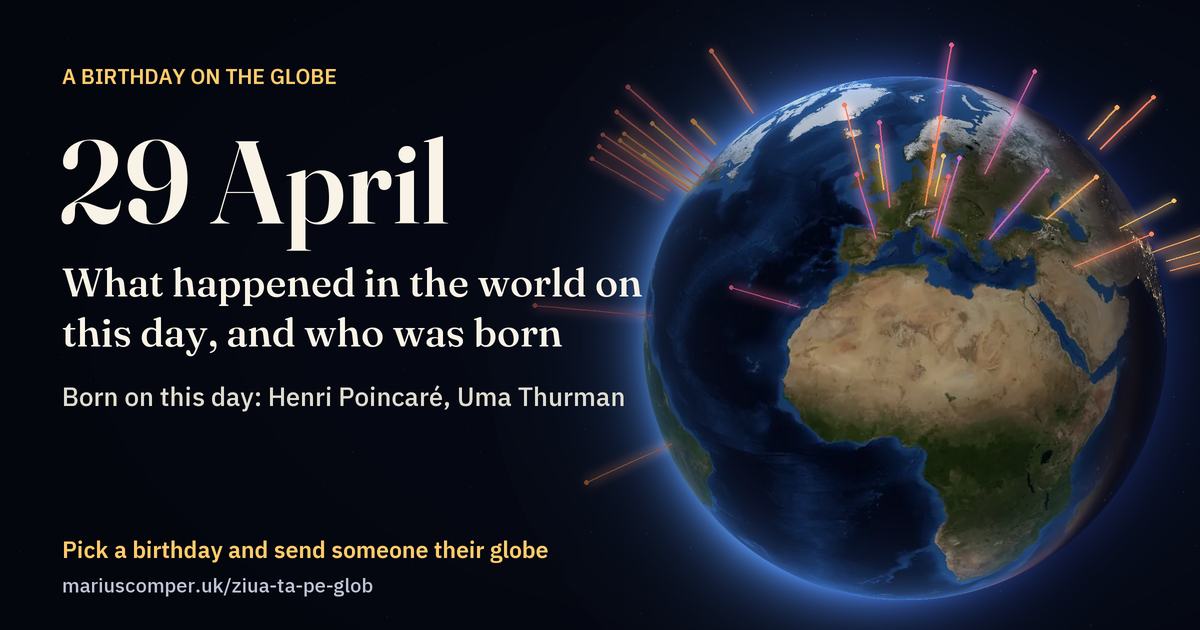
For 29 April, the English Wikipedia lists 55 events and 186 births. 37 of the events stand at their places as rays of light; three more are dashed circles, where the sentence links only to a country or a sea. The taller the ray, the longer ago it happened. The people born that day come further down, as blue points.
A birthday, yours or someone else’s:
Turn it into a greetingScroll: the globe turns to each place
The day you were born, on the globe.
Three things from your day
Scroll: your day first, then 29 April through the years
The Earth on 29 April
The picture on the globe was assembled by NASA from satellite photographs taken in April 2004: the snow, the ice and the green are those of the month.
On 29 April the Sun passes straight overhead at noon along the parallel of 14.6° north. In London, the day lasts about 14 hours 45 minutes.
Beyond 75° north the Sun no longer sets; beyond 75° south it no longer rises.
The line between day and night is tilted on the globe exactly as on this day of the year. On the dark side you can see the lights of towns.
Britain & Ireland · Wedding of Prince William and Catherine Middleton
2011
The wedding of Prince William and Catherine Middleton takes place at Westminster Abbey in London.
On the map: the coordinates Wikidata gives for the article “Wedding of Prince William and Catherine Middleton”.
Also on the day’s list of Wikipedia in Spanish, Romanian and Chinese.
Wikipedia: Wedding of Prince William and Catherine Middleton
Europe · 1669–1670 conclave
1670
Emilio Altieri is elected pope after a four-month conclave and takes the name Clement X.
On the map: 1669–1670 conclave.
Asia · Tsinghua University
1911
Tsinghua University, one of mainland China's leading universities, is founded.
On the map: Tsinghua University.
Also on the day’s list of Wikipedia in Romanian.
Oceania · Botany Bay
1770
James Cook arrives in Australia at Botany Bay, which he names.
On the map: Botany Bay.
Also on the day’s list of Wikipedia in Chinese.
North America · Lansing, Michigan
2004
The final Oldsmobile is built in Lansing, Michigan, ending 107 years of vehicle production.
On the map: Lansing, Michigan.
Also on the day’s list of Wikipedia in Spanish.
29 April
What the other Wikipedias remember#
For these years the English list has nothing on this day. The events below come from the same day’s lists on Wikipedia in Chinese and were translated for this page.
From Wikipedia in Chinese · Berlin
1882
The German inventor Werner von Siemens publicly demonstrates his invention, the world's first trolleybus, on the outskirts of Berlin.
On the map: Berlin.
Translated from the list on Wikipedia in Chinese.
29 April
Born on 29 April#
The English Wikipedia lists 186 births for this day. The blue points are the birthplaces of 60 of these people: those written about in the most Wikipedia editions, where Wikidata gives a place of birth.
Born on 29 April
1854
Henri Poincaré, French mathematician, physicist and engineer (died 1912)
Place of birth: Nancy.
Born on 29 April
1957
Daniel Day-Lewis, British actor
Place of birth: Kensington.
Born on 29 April
1958
Michelle Pfeiffer, American actress
Place of birth: Santa Ana.
Born on 29 April
1970
Andre Agassi, American tennis player
Place of birth: Las Vegas.
Born in Britain and Ireland
1879
Thomas Beecham, English conductor (died 1961)
Place of birth: St Helens.
Born in Britain and Ireland
1667
John Arbuthnot, Scottish-English physician and polymath (died 1735)
Place of birth: Inverbervie.
Born in Britain and Ireland
1991
Adam Smith, English footballer
Place of birth: London.
29 April
Number one in the charts that week
At the cinema
An animal recorded that day
The record can be seen in GBIF, which brings together wildlife records from around the world.
All your birthdays
The weather that day
Data: Met Office Hadley Centre (HadCET); NOAA (GHCN-Daily, Mauna Loa).
Above the Earth
Sources: Jonathan McDowell, GCAT (launches); GFZ Potsdam (Kp index). Days are counted in Universal Time.
Football that day
International matches played that day:
Source: the “International football results” dataset kept by Mart Jürisoo (CC0).
Also that day
The earthquake’s page at the USGS
Source: the USGS catalogue. The day is counted in Universal Time (UTC).
In those days
Make a link for someone
Type the name, pick the day and the year of birth. The link opens straight on their day, with their name in the greeting.
The link carries the name, date and place typed here; anyone who gets it can see them.
Put another birthday beside it
Your mother’s, your child’s, a friend’s: the two days appear side by side.
Below: 29 April through the years.
The whole globe of the day
Drag the globe to turn it. Touch a ray or a point to read what happened there.
Everything Wikipedia lists for 29 April
The list is the English Wikipedia’s, in its own wording, as it stood in October 2026. 15 events have no place on the map: the sentence links to no place with coordinates, only to places too wide to mark, or to several countries.
- 801
An earthquake in the Central Apennines hits Rome and Spoleto, damaging the basilica of San Paolo Fuori le Mura.
Europe · 801 Apennine earthquakeWikipedia: 801 Apennine earthquake - 1091
Battle of Levounion: The Pechenegs are defeated by Byzantine Emperor Alexios I Komnenos.
Asia · EnezWikipedia: Battle of Levounion - 1386
The Grand Duchy of Lithuania decisively won the Battle of the Vikhra River, forcibly making the Principality of Smolensk a vassal state.
Europe · Battle of the Vikhra RiverWikipedia: Battle of the Vikhra River - 1429
Joan of Arc arrives to relieve the Siege of Orléans.
Europe · Siege of OrléansWikipedia: Siege of Orléans - 1483
Gran Canaria, the main island of the Canary Islands, is conquered by the Kingdom of Castile.
Europe · Gran CanariaWikipedia: Gran Canaria - 1492
The Crown's decision to expel the Jews is announced in Zaragoza, Aragon, to the kingdom's procurators.
Europe · ZaragozaWikipedia: Expulsion of Jews from Spain - 1521
Swedish War of Liberation: Swedish troops defeat a Danish force in the Battle of Västerås.
Europe · Battle of VästeråsWikipedia: Battle of Västerås - 1670
Emilio Altieri is elected pope after a four-month conclave and takes the name Clement X.
Europe · 1669–1670 conclaveWikipedia: 1669–1670 conclave - 1760
French forces commence the siege of Quebec which is held by the British.
North America · Siege of QuebecWikipedia: Siege of Quebec - 1770
James Cook arrives in Australia at Botany Bay, which he names.
Oceania · Botany BayWikipedia: Botany Bay - 1781
American Revolutionary War: British and French ships clash in the Battle of Fort Royal off the coast of Martinique.
Europe · Battle of Fort RoyalWikipedia: Battle of Fort Royal - 1826
The galaxy Centaurus A or NGC 5128 is discovered by James Dunlop.
no place on the mapWikipedia: Centaurus A - 1861
Maryland in the American Civil War: Maryland's House of Delegates votes not to secede from the Union.
no place on the mapWikipedia: Maryland in the American Civil War - 1862
American Civil War: The Capture of New Orleans by Union forces under David Farragut.
North America · Capture of New OrleansWikipedia: American Civil War - 1862
American Civil War: The Siege of Corinth begins as Union forces under General Henry Halleck move to engage Confederate forces led by General P. G. T. Beauregard.
North America · Siege of CorinthWikipedia: Siege of Corinth - 1863
Confederate forts at Grand Gulf survived a bombardment by Union gunboats, preventing Ulysses S. Grant's troops from crossing the Mississippi River at that point.
North America · Battle of Grand GulfWikipedia: Battle of Grand Gulf - 1864
Theta Xi fraternity is founded at Rensselaer Polytechnic Institute, the only fraternity to be founded during the American Civil War.
North America · Rensselaer Polytechnic InstituteWikipedia: American Civil War - 1903
A landslide kills 70 people in Frank, in the District of Alberta, Canada.
North America · Frank SlideWikipedia: Frank Slide - 1910
The Parliament of the United Kingdom passes the People's Budget, the first budget in British history with the expressed intent of redistributing wealth among the British public.
no place on the mapWikipedia: Parliament of the United Kingdom - 1911
Tsinghua University, one of mainland China's leading universities, is founded.
Asia · Tsinghua UniversityWikipedia: Tsinghua University - 1916
Easter Rising: After six days of fighting, Irish rebel leaders surrender to British forces in Dublin, bringing the Easter Rising to an end.
Britain & Ireland · County MeathWikipedia: Easter Rising - 1916
World War I: The UK's 6th Indian Division surrenders to Ottoman Forces at the Siege of Kut in one of the largest surrenders of British forces up to that point.
Asia · Siege of KutWikipedia: World War I - 1922
Sixteen-year-old Lilian Salkeld became the first woman to walk from London to Brighton.
no place on the mapWikipedia: London to Brighton walk - 1943
After suffering train derailments, defections, and outbreaks of dysentery and typhoid fever which killed two members, the Brazilian football club Santa Cruz returned from their Suicidal Tour.
no place on the mapWikipedia: Suicidal Tour - 1944
Second World War: British agent Nancy Wake parachuted into Auvergne, France, becoming a liaison between the Special Operations Executive and the local Maquis group.
Europe · AuvergneWikipedia: World War II - 1945
Dachau concentration camp is liberated by United States troops.
Europe · Dachau concentration campWikipedia: Dachau concentration camp - 1945
World War II: Adolf Hitler marries his longtime partner Eva Braun in a Berlin bunker and designates Admiral Karl Dönitz as his successor.
Europe · FührerbunkerWikipedia: Adolf Hitler - 1945
World War II: Allied airdrops of food begin over German-occupied regions of the Netherlands.
no place on the mapWikipedia: Operations Manna, Chowhound, and Faust - 1945
World War II: The Surrender of Caserta is signed by the commander of German forces in Italy.
no place on the mapWikipedia: Surrender at Caserta - 1945
World War II: The U.S. Army liberated Dachau, the first Nazi concentration camp, and killed German prisoners of war.
Europe · Dachau liberation reprisalsWikipedia: Dachau liberation reprisals - 1946
The International Military Tribunal for the Far East convenes and indicts former Prime Minister of Japan Hideki Tojo and 28 former Japanese leaders for war crimes.
no place on the mapWikipedia: International Military Tribunal for the Far East - 1952
Pan Am Flight 202 crashes into the Amazon basin near Carolina, Maranhão, Brazil, killing 50 people.
Latin America · Pan Am Flight 202Wikipedia: Pan Am Flight 202 - 1953
The first U.S. experimental 3D television broadcast shows an episode of Space Patrol on Los Angeles ABC affiliate KECA-TV.
no place on the mapWikipedia: 3D television - 1967
After refusing induction into the United States Army the previous day, Muhammad Ali is stripped of his boxing title.
no place on the mapWikipedia: Muhammad Ali - 1968
The controversial Broadway musical Hair, a product of the counterculture of the 1960s, opened, with its songs becoming anthems of the anti-Vietnam War movement.
North America · Broadway theatreWikipedia: Counterculture of the 1960s - 1970
Vietnam War: United States and South Vietnamese forces invade Cambodia to interdict the Ho Chi Minh Trail in an attempt to cut off supplies to the Viet Cong and the North Vietnamese Army.
Asia · South VietnamWikipedia: Vietnam War - 1974
Watergate scandal: United States President Richard Nixon announces the release of edited transcripts of White House tape recordings relating to the scandal.
North America · White HouseWikipedia: White House - 1975
Vietnam War: Operation Frequent Wind: The U.S. begins to evacuate U.S. citizens from Saigon before an expected North Vietnamese takeover. U.S. involvement in the war comes to an end. This happens after the Bombing of Tan Son Nhut Air Base.
Asia · Tan Son Nhut Air BaseWikipedia: Bombing of Tan Son Nhut Air Base - 1975
Vietnam War: The North Vietnamese Army completes its capture of all parts of South Vietnam-held Trường Sa Islands.
no place on the mapWikipedia: East Sea Campaign - 1985
Space Shuttle Challenger is launched on STS-51-B.
no place on the mapWikipedia: Space Shuttle Challenger - 1986
A fire at the Central library of the Los Angeles Public Library damages or destroys 400,000 books and other items.
North America · Los Angeles Public LibraryWikipedia: Los Angeles Public Library - 1986
An assembly of Sikhs, known as a Sarbat Khalsa, officially declare independence for a state of Khalistan.
no place on the mapWikipedia: Sikhs - 1986
The United States Navy aircraft carrier USS Enterprise becomes the first nuclear-powered aircraft carrier to transit the Suez Canal, navigating from the Red Sea to the Mediterranean Sea to relieve the USS Coral Sea.
Asia · Red SeaWikipedia: Aircraft carrier - 1991
A cyclone strikes the Chittagong district of southeastern Bangladesh with winds of around 155 miles per hour (249 km/h), killing at least 138,000 people and leaving as many as ten million homeless.
Asia · ChittagongWikipedia: 1991 Bangladesh cyclone - 1991
The 7.0 Mw Racha earthquake affects Georgia with a maximum MSK intensity of IX (Destructive), killing 270 people.
Asia · 1991 Racha earthquakeWikipedia: 1991 Racha earthquake - 1992
Riots in Los Angeles begin, following the acquittal of police officers charged with excessive force in the beating of Rodney King. Over the next three days 63 people are killed and hundreds of buildings are destroyed.
North America · Los AngelesWikipedia: 1992 Los Angeles riots - 1995
Before a crowd of about 165,000 at the Rungrado 1st of May Stadium, Ric Flair and Antonio Inoki competed in the main event of Collision in Korea, the highest attended professional wrestling event of all time.
Asia · Rungrado 1st of May StadiumWikipedia: Collision in Korea - 1997
The Chemical Weapons Convention of 1993 enters into force, outlawing the production, stockpiling and use of chemical weapons by its signatories.
no place on the mapWikipedia: Chemical Weapons Convention - 2004
The final Oldsmobile is built in Lansing, Michigan, ending 107 years of vehicle production.
North America · Lansing, MichiganWikipedia: Oldsmobile - 2006
Cyclone Mala made landfall near Thandwe, Myanmar, causing 37 deaths.
Asia · ThandweWikipedia: Cyclone Mala - 2011
The wedding of Prince William and Catherine Middleton takes place at Westminster Abbey in London.
Britain & Ireland · Wedding of Prince William and Catherine MiddletonWikipedia: Wedding of Prince William and Catherine Middleton - 2013
A powerful explosion occurs in an office building in Prague, believed to have been caused by natural gas, and injures 43 people.
Europe · 2013 Prague explosionWikipedia: 2013 Prague explosion - 2013
National Airlines Flight 102, a Boeing 747-400 freighter aircraft, crashes during takeoff from Bagram Airfield in Parwan Province, Afghanistan, killing all seven people on board.
Asia · National Airlines Flight 102Wikipedia: National Airlines Flight 102 - 2015
A baseball game between the Baltimore Orioles and the Chicago White Sox sets the all-time low attendance mark for Major League Baseball. Zero fans were in attendance for the game, as the stadium was officially closed to the public due to the 2015 Baltimore protests.
North America · Oriole Park at Camden YardsWikipedia: 2015 Chicago White Sox–Baltimore Orioles crowdless game - 2015
The ringleaders of the Bali Nine were executed in Indonesia for attempting to smuggle 8.3 kg (18 lb) of heroin to Australia in 2005.
no place on the mapWikipedia: Bali Nine
What the other Wikipedias remember
For these years the English list has nothing on this day. The events below come from the same day’s lists on Wikipedia in Chinese and were translated for this page.
- 1882
The German inventor Werner von Siemens publicly demonstrates his invention, the world's first trolleybus, on the outskirts of Berlin.
Who was born on 29 April
In order of how many Wikipedia editions have an article about each. The first 60 of 186 are shown.
- 1901
Hirohito, Japanese emperor (died 1989)
Akasaka EstateWikipedia: Hirohito - 1854
Henri Poincaré, French mathematician, physicist and engineer (died 1912)
- 1968
Kolinda Grabar-Kitarović, Croatian politician and diplomat, 4th President of Croatia
- 1818
Alexander II of Russia (died 1881)
Small Nicholas PalaceWikipedia: Alexander II of Russia - 1970
Uma Thurman, American actress
- 1957
Daniel Day-Lewis, British actor
KensingtonWikipedia: Daniel Day-Lewis - 1958
Michelle Pfeiffer, American actress
Santa AnaWikipedia: Michelle Pfeiffer - 1970
Andre Agassi, American tennis player
Las VegasWikipedia: Andre Agassi - 1899
Duke Ellington, American pianist, composer and bandleader (died 1974)
Washington, D.C.Wikipedia: Duke Ellington - 1893
Harold Urey, American chemist and astronomer, Nobel Prize laureate (died 1981)
WalkertonWikipedia: Harold Urey - 1863
Constantine P. Cavafy, Egyptian-Greek journalist and poet (died 1933)
AlexandriaWikipedia: Constantine P. Cavafy - 1954
Jerry Seinfeld, American comedian, actor and producer
BrooklynWikipedia: Jerry Seinfeld - 1933
Willie Nelson, American singer-songwriter, guitarist, producer and actor
AbbottWikipedia: Willie Nelson - 1848
Raja Ravi Varma, Indian painter and academic (died 1906)
KilimanoorWikipedia: Raja Ravi Varma - 1863
William Randolph Hearst, American publisher and politician, founded the Hearst Corporation (died 1951)
San FranciscoWikipedia: William Randolph Hearst - 1936
Zubin Mehta, Indian conductor
MumbaiWikipedia: Zubin Mehta - 1907
Fred Zinnemann, Austrian-American director and producer (died 1997)
RzeszówWikipedia: Fred Zinnemann - 1938
Bernie Madoff, American businessman, financier and convicted felon (died 2021)
QueensWikipedia: Bernie Madoff - 1989
Domagoj Vida, Croatian footballer
OsijekWikipedia: Domagoj Vida - 2007
Infanta Sofía of Spain, Spanish princess
- 1895
Vladimir Propp, Russian scholar and critic (died 1970)
Saint PetersburgWikipedia: Vladimir Propp - 1917
Celeste Holm, American actress and singer (died 2012)
New York CityWikipedia: Celeste Holm - 1930
Jean Rochefort, French actor and director (died 2017)
20th arrondissement of ParisWikipedia: Jean Rochefort - 1996
Katherine Langford, Australian actress
- 1780
Charles Nodier, French librarian and author (died 1844)
BesançonWikipedia: Charles Nodier - 1940
Peter Diamond, American economist
New York CityWikipedia: Peter Diamond - 1987
Sara Errani, Italian tennis player
BolognaWikipedia: Sara Errani - 1934
Pedro Pires, Cape Verdean politician, 3rd President of Cape Verde
São FilipeWikipedia: Pedro Pires - 1936
Alejandra Pizarnik, Argentine poet (died 1972)
AvellanedaWikipedia: Alejandra Pizarnik - 1879
Thomas Beecham, English conductor (died 1961)
St HelensWikipedia: Thomas Beecham - 1955
Kate Mulgrew, American actress
DubuqueWikipedia: Kate Mulgrew - 1837
Georges Ernest Boulanger, French general and politician, French Minister of War (died 1891)
- 1875
Rafael Sabatini, Italian-English novelist and short story writer (died 1950)
- 1923
Irvin Kershner, American actor, director and producer (died 2010)
PhiladelphiaWikipedia: Irvin Kershner - 1978
Bob Bryan, American tennis player
CamarilloWikipedia: Bob Bryan - 2007
Mirra Andreeva, Russian tennis player
KrasnoyarskWikipedia: Mirra Andreeva - 1762
Jean-Baptiste Jourdan, French general and politician, French Minister of Foreign Affairs (died 1833)
- 1931
Frank Auerbach, German-British painter (died 2024)
- 1978
Mike Bryan, American tennis player
CamarilloWikipedia: Mike Bryan - 1989
Candace Owens, American political commentator and activist
White PlainsWikipedia: Candace Owens - 1999
Mateo Retegui, Argentine-Italian footballer
San FernandoWikipedia: Mateo Retegui - 1908
Jack Williamson, American author and academic (died 2006)
- 1957
Fiamē Naomi Mataʻafa, Samoan politician, 7th Prime Minister of Samoa
- 1969
Paul Adelstein, American actor and writer
ChicagoWikipedia: Paul Adelstein - 1917
Maya Deren, Ukrainian-American director, poet, and photographer (died 1961)
- 1922
Toots Thielemans, Belgian guitarist and harmonica player (died 2016)
Marolles - MarollenWikipedia: Toots Thielemans - 1885
Egon Erwin Kisch, Czech journalist and author (died 1948)
PragueWikipedia: Egon Kisch - 1950
Debbie Stabenow, American social worker and politician
GladwinWikipedia: Debbie Stabenow - 1983
Megan Boone, American actress
PetoskeyWikipedia: Megan Boone - 1988
Taoufik Makhloufi, Algerian athlete
Souk AhrasWikipedia: Taoufik Makhloufi - 1667
John Arbuthnot, Scottish-English physician and polymath (died 1735)
InverbervieWikipedia: John Arbuthnot - 1727
Jean-Georges Noverre, French actor and dancer (died 1810)
- 1955
Leslie Jordan, American actor, comedian, writer and singer (died 2022)
MemphisWikipedia: Leslie Jordan - 1909
Tom Ewell, American actor (died 1994)
OwensboroWikipedia: Tom Ewell - 1919
Gérard Oury, French actor, director and screenwriter (died 2006)
16th arrondissement of ParisWikipedia: Gérard Oury - 1979
Lee Dong-gook, South Korean footballer
PohangWikipedia: Lee Dong-gook - 1991
Adam Smith, English footballer
LondonWikipedia: Adam Smith - 2001
Danilo, Brazilian footballer
SalvadorWikipedia: Danilo - 2006
Xochitl Gomez, American actress
Los AngelesWikipedia: Xochitl Gomez - 1745
Oliver Ellsworth, American lawyer and politician, 3rd Chief Justice of the United States (died 1807)
WindsorWikipedia: Oliver Ellsworth
What is celebrated on 29 April
- Christian feast day: Catherine of Siena (Catholic, Lutheran and Anglican Church)
- Christian feast day: Hugh of Cluny
- Christian feast day: Robert of Molesme
- Christian feast day: Wilfrid II
- Christian feast day: April 29 (Eastern Orthodox liturgics)
- International Dance Day (UNESCO)
- Shōwa Day, traditionally the start of the Golden Week holiday period, which is April 29 and May 3–5. (Japan)
A greeting link for someone
Type a name and, if you like, the year of birth. The link opens with a greeting, and beside each event it says how old the person turned that day, or how many years before their birth it happened.
The name and the year go only into the link you send.
All 366 days
How the globe is made
Where the events come from
Each edition of this page uses the day’s list from Wikipedia in its own language: Romanian, English, Spanish, Chinese. The lists are written by volunteers and differ from one edition to the next; the text of each event is Wikipedia’s, with a link to the article. A row that appears twice in a list is shown once. The lists have not been checked event by event: they are Wikipedia’s, mistakes included.
For events before 1582, and for countries that moved to the Gregorian calendar later (Britain in 1752, Russia in 1918), the same day may be counted Old Style in one list and New Style in another.
The chapter “What the other Wikipedias remember” adds up to five events a day from the lists of the other three editions, only for years in which the English list has nothing on that day. They were translated for this page, passed the same filters as the tour, and are not counted among the events of the English list.
How an event gets onto the map
The place comes from Wikidata. If the sentence links to the article about the event itself (a battle, an opening, an earthquake), dated to the same year, the ray stands on its coordinates or on those of its location. Otherwise it stands on the first place the sentence links to: a town, a building, a mountain, an island. This second step can be wrong: sometimes the sentence only mentions the place. That is why the page says, under each event, which place the ray stands on.
When the sentence links to a single state or province, or to a single sea, lake or desert larger than 5,000 km², the globe shows a dashed circle, not a ray. The circle has the area Wikidata gives, with its radius kept between 1.2° and 16°, or a radius of 4.5° when Wikidata gives no area; it says only that the sentence links to that place. Organisations, ships, spacecraft, museum objects, rivers, mountain ranges, languages and continents are never used as places. When a sentence names several states and no exact place, the event stays in the list only.
What the height means
The height of a ray shows how many years have passed, on a logarithmic scale: 10 years, 100 years and 1,000 years are equal steps apart; anything older than about 2,600 years has the tallest ray. The colour runs from pale yellow for recent years to violet for antiquity.
Where the tour stops
In each region the tour stops at up to three events (five in Britain and Ireland), chosen mainly by three things: whether Wikipedia’s editors put the event in the “On this day” box of their main page (the English, Spanish and Chinese editions), how many Wikipedia editions have an article about it, and how many of the four lists include it. Events whose sentence or article is about a war, an attack, a crime or a disaster are left out of the tour; they stay in the whole list, in Wikipedia’s wording. The filter is a list of words and a list of Wikidata types, so it can miss some.
The tour of births names the people with articles in the most editions and leaves aside those whom the list or Wikidata describes as rulers, politicians, commanders, leaders of movements or criminals; they stay in the list.
The Earth and the Sun
The daytime images are NASA’s Blue Marble Next Generation mosaics, one for each month of 2004; the night side is Black Marble 2016. The tilt of the line between day and night is computed for the day; the hour is chosen so that the place being read is in daylight. The latitude where the Sun stands overhead is the average of the four years of the leap cycle; in a given year it can differ by up to 0.4°.
The day you were born
The number ones come from the weekly lists on Wikipedia: Billboard for the United States (from 1940; the Hot 100 from August 1958), the UK Singles Chart (from November 1952), Los 40 Principales for Spain (from July 1966) and, for Romania, the Romanian Top 100 and Airplay 100 (2001–2021, with missing weeks). The page shows the chart of the week in which the day of birth falls, with its date; Billboard and the UK chart are dated at the end of their week. For Romania before 2001 and for China these sources have no weekly chart.
The films are those that reached cinemas in the United States up to ten days before or three days after that day (some of them in a few cinemas at first), from the English Wikipedia’s yearly lists (from 1968), in order of how many editions have an article about them. The events “in those days” are the ones on the neighbouring days’ lists that carry the year of birth, passed through the same filter as the tour.
The day of birth, year included
The Moon, the star sign and the constellation are worked out by the page itself, for noon Universal Time on the day. The lit part of the Moon is rounded and can differ by a few per cent from that at the hour of birth. The sign follows the usual zodiac of twelve equal parts starting at the March equinox; the constellation is the one the Sun actually stood in front of, by the borders set by the International Astronomical Union, and within a day of a border the page does not name it. When the Sun changes sign while it is that day anywhere on Earth, the page gives the moment of crossing, rounded to ten minutes and accurate to within about a quarter of an hour, and the clock time in a few cities, with the time zone and summer time of that year.
The year in the Chinese calendar is the one your device’s own calendar gives for the date, checked against the Hong Kong Observatory’s tables. “All your birthdays” uses the same sources as the rest of the chapter for the same day in every year since the birth: the temperature, well-known launches that took place on that very day, matches of the teams the edition follows, snow deeper than 10 cm and strong geomagnetic storms. The three things at the top and the four on the picture are chosen in a fixed order (the song, the animal, a full Moon, a well-known launch before an ordinary earthquake); on the picture you can change them.
When the link carries a year of birth, the page adds a few things about that exact day. The weather is the Met Office’s Central England temperature record and the readings from New York’s Central Park; the “usual high” is the average of the daily highs of 1961–1990 for that date, with two days either side. The carbon dioxide figure is the monthly mean at the Mauna Loa observatory, where measurements begin in March 1958.
The earthquake is the one with the largest magnitude in the USGS catalogue for that day, counted in Universal Time. Before the 1960s the catalogue has gaps even above magnitude 5.5, so in the older years many days have no earthquake. The page gives only the magnitude and the place: the country the epicentre falls in or, when the epicentre is at sea within 300 km of a coast, the nearest country; farther out, only the ocean.
The launches are those that reached orbit or left for the Moon and the planets, from Jonathan McDowell’s GCAT catalogue. If nothing left that day, the page shows the nearest launch within three days before or after, and says how many days away it was. The geomagnetic storm appears only when the Kp index reached at least 5 in one of the day’s eight three-hour intervals.
The animal comes from GBIF: an observation made by a person (the animal seen or heard, or its tracks), dated to that exact day, with coordinates and a CC0 or CC BY licence. Only a few hundred well-known species are searched (mammals, birds, turtles, butterflies); of those noted that day, mammals and species with articles in many Wikipedia editions come first; birds noted almost every day, and species used recently, wait their turn. Observations dated 1 January are left out, because records without a day are often filed there. An observation shows that the animal was recorded there, not how many animals there were.
The matches are those between national teams. Only matches of England, Scotland, Wales, Northern Ireland, the Republic of Ireland, the United States, Canada and Australia are shown, along with those at the big final tournaments. The picture to send is drawn in the page from the day’s globe and the facts above, and stays on your device until you send it.
Sources
- Events, births and holidays: the day’s page on Wikipedia, text under CC BY-SA 4.0.
- Coordinates, places of birth and the number of editions: Wikidata (CC0).
- The Earth by day: NASA Blue Marble Next Generation. The Earth by night: NASA Black Marble 2016.
- Borders and regions: Natural Earth.
- World population and births per year: UN World Population Prospects 2024.
- Charts and films: Wikipedia’s lists for Billboard, the UK Singles Chart, Los 40 Principales, Romanian Top 100, Airplay 100 and American films by year (CC BY-SA 4.0).
- Weather: Met Office Hadley Centre, HadCET (Open Government Licence) and NOAA GHCN-Daily, New York Central Park. Carbon dioxide: NOAA Global Monitoring Laboratory, Mauna Loa.
- Earthquakes: the USGS catalogue. Launches: Jonathan McDowell, GCAT (CC BY). Kp index: GFZ Potsdam (CC BY 4.0). Matches: International football results, Mart Jürisoo (CC0).
- Animal observations: GBIF, with a link to each record; species names come from Wikidata.