A birthday on the globe
14 July on the globe: what happened in the world on this day, and who was born
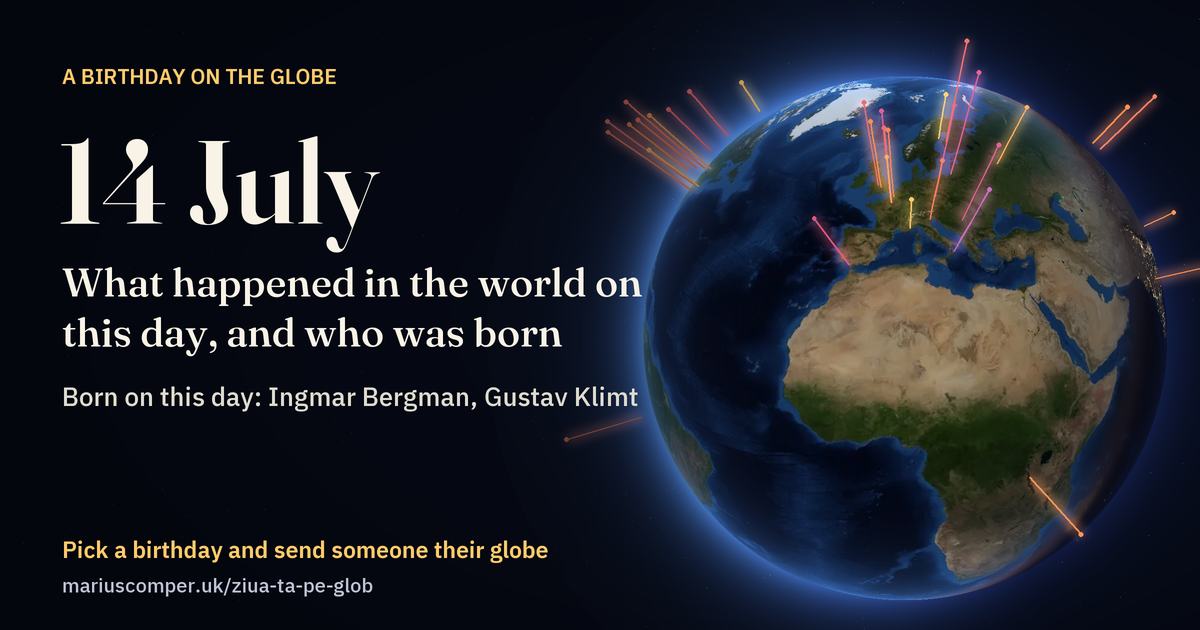
For 14 July, the English Wikipedia lists 47 events and 128 births. 33 of the events stand at their places as rays of light; four more are dashed circles, where the sentence links only to a country or a sea. The taller the ray, the longer ago it happened. The people born that day come further down, as blue points.
A birthday, yours or someone else’s:
Turn it into a greetingScroll: the globe turns to each place
The day you were born, on the globe.
Three things from your day
Scroll: your day first, then 14 July through the years
The Earth on 14 July
The picture on the globe was assembled by NASA from satellite photographs taken in July 2004: the snow, the ice and the green are those of the month.
On 14 July the Sun passes straight overhead at noon along the parallel of 21.7° north. In London, the day lasts about 16 hours 15 minutes.
Beyond 68° north the Sun no longer sets; beyond 68° south it no longer rises.
The line between day and night is tilted on the globe exactly as on this day of the year. On the dark side you can see the lights of towns.
Britain & Ireland · 1951 British Grand Prix
1951
Ferrari take their first Formula One grand prix victory at the British Grand Prix at Silverstone.
On the map: the coordinates Wikidata gives for the article “1951 British Grand Prix”.
Europe · Beauvais
1430
Joan of Arc, taken by the Burgundians in May, is handed over to Pierre Cauchon, the bishop of Beauvais.
On the map: Beauvais.
Europe · Storming of the Bastille
1789
Storming of the Bastille in Paris. This event escalates the widespread discontent into the French Revolution. Bastille Day is still celebrated annually in France.
On the map: the coordinates Wikidata gives for the article “Storming of the Bastille”.
Also on the day’s list of Wikipedia in Spanish, Romanian and Chinese.
Europe · Fête de la Fédération
1790
Inaugural Fête de la Fédération is held to celebrate the unity of the French people and the national reconciliation.
On the map: the coordinates Wikidata gives for the article “Fête de la Fédération”.
Also on the day’s list of Wikipedia in Spanish.
Africa · Gombe National Park
1960
Jane Goodall arrives at the Gombe Stream Reserve in present-day Tanzania to begin her study of chimpanzees in the wild.
On the map: Gombe National Park.
Also on the day’s list of Wikipedia in Chinese.
Asia · Wardha
1942
In the Wardha session of Congress, the "Quit India" resolution is approved, authorising Mahatma Gandhi to campaign for India's independence from Britain.
On the map: Wardha.
North America · Mission San Antonio de Padua
1771
Foundation of the Mission San Antonio de Padua in modern California by the Franciscan friar Junípero Serra.
On the map: Mission San Antonio de Padua.
Also on the day’s list of Wikipedia in Spanish.
North America · South Lawn
1911
Harry Atwood, an exhibition pilot for the Wright brothers, is greeted by president William Howard Taft after he lands his aeroplane on the South Lawn of the White House, having flown from Boston.
On the map: South Lawn.
North America · Diamond, Missouri
1943
In Diamond, Missouri, the George Washington Carver National Monument becomes the first United States National Monument in honor of an African American.
On the map: Diamond, Missouri.
14 July
What the other Wikipedias remember#
For these years the English list has nothing on this day. The events below come from the same day’s lists on Wikipedia in Spanish and were translated for this page.
From Wikipedia in Spanish · place de la Concorde
1979
In the Place de la Concorde in Paris (France), the musician Jean Michel Jarre stages an audiovisual concert gathering more than a million people in the open air to mark the success of his albums Oxygène and Équinoxe, beginning the era of mega-concerts.
On the map: place de la Concorde.
Translated from the list on Wikipedia in Spanish.
From Wikipedia in Spanish · Wimbledon Championships
2024
In London, United Kingdom, Carlos Alcaraz wins his second Wimbledon.
On the map: Wimbledon Championships.
Translated from the list on Wikipedia in Spanish.
The article on Wikipedia in Spanish: Campeonato de Wimbledon
14 July
Born on 14 July#
The English Wikipedia lists 128 births for this day. The blue points are the birthplaces of 60 of these people: those written about in the most Wikipedia editions, where Wikidata gives a place of birth.
Born on 14 July
1918
Ingmar Bergman, Swedish director, producer, and screenwriter (died 2007)
Place of birth: Uppsala.
Born on 14 July
1862
Gustav Klimt, Austrian painter and illustrator (died 1918)
Place of birth: Baumgarten.
Born on 14 July
1935
Ei-ichi Negishi, Japanese chemist (palladium-catalyzed cross couplings) and Nobel Prize winner (died 2021)
Place of birth: Hsinking.
Born on 14 July
1912
Woody Guthrie, American singer-songwriter and guitarist (died 1967)
Place of birth: Okemah.
Born on 14 July
1960
Angélique Kidjo, Beninese singer-songwriter, activist and actress
Place of birth: Ouidah.
Born in Britain and Ireland
1921
Geoffrey Wilkinson, English chemist and academic, Nobel Prize laureate (died 1996)
Place of birth: Todmorden.
Born in Britain and Ireland
1985
Phoebe Waller-Bridge, English actress and screenwriter
Place of birth: London.
Born in Britain and Ireland
1987
Adam Johnson, English footballer
Place of birth: Sunderland.
14 July
Number one in the charts that week
At the cinema
An animal recorded that day
The record can be seen in GBIF, which brings together wildlife records from around the world.
All your birthdays
The weather that day
Data: Met Office Hadley Centre (HadCET); NOAA (GHCN-Daily, Mauna Loa).
Above the Earth
Sources: Jonathan McDowell, GCAT (launches); GFZ Potsdam (Kp index). Days are counted in Universal Time.
Football that day
International matches played that day:
Source: the “International football results” dataset kept by Mart Jürisoo (CC0).
Also that day
The earthquake’s page at the USGS
Source: the USGS catalogue. The day is counted in Universal Time (UTC).
In those days
Make a link for someone
Type the name, pick the day and the year of birth. The link opens straight on their day, with their name in the greeting.
The link carries the name, date and place typed here; anyone who gets it can see them.
Put another birthday beside it
Your mother’s, your child’s, a friend’s: the two days appear side by side.
Below: 14 July through the years.
The whole globe of the day
Drag the globe to turn it. Touch a ray or a point to read what happened there.
Everything Wikipedia lists for 14 July
The list is the English Wikipedia’s, in its own wording, as it stood in October 2026. 10 events have no place on the map: the sentence links to no place with coordinates, only to places too wide to mark, or to several countries.
- 982
King Otto II and his Frankish army are defeated by the Muslim army of al-Qasim at Cape Colonna, Southern Italy.
Europe · Battle of StiloWikipedia: Battle of Stilo - 1223
Louis VIII becomes King of France upon the death of his father, Philip II.
no place on the mapWikipedia: Louis VIII of France - 1420
Battle of Vítkov Hill, decisive victory of Czech Hussite forces commanded by Jan Žižka against Crusade army led by Sigismund, Holy Roman Emperor.
Europe · Battle of Vítkov HillWikipedia: Battle of Vítkov Hill - 1430
Joan of Arc, taken by the Burgundians in May, is handed over to Pierre Cauchon, the bishop of Beauvais.
Europe · BeauvaisWikipedia: Joan of Arc - 1455
1454–1466 Thirteen Years' War: The Battle for Kneiphof ended with a decisive victory for the Teutonic Order.
Europe · KneiphofWikipedia: Battle for Kneiphof - 1456
John Hunyadi and his forces defeat the Ottoman fleet on the Danube, allowing them to reinforce and supply the besieged city of Belgrade.
Europe · Siege of BelgradeWikipedia: Siege of Belgrade - 1596
Anglo-Spanish War: English and Dutch troops sack the Spanish city of Cádiz before leaving the next day.
Europe · Capture of CádizWikipedia: Anglo-Spanish War - 1769
An expedition led by Gaspar de Portolá leaves its base in San Diego and sets out to find the Port of Monterey (now Monterey, California).
North America · San DiegoWikipedia: Portolá expedition - 1771
Foundation of the Mission San Antonio de Padua in modern California by the Franciscan friar Junípero Serra.
North America · Mission San Antonio de PaduaWikipedia: Mission San Antonio de Padua - 1789
Storming of the Bastille in Paris. This event escalates the widespread discontent into the French Revolution. Bastille Day is still celebrated annually in France.
Europe · Storming of the BastilleWikipedia: Storming of the Bastille - 1790
Inaugural Fête de la Fédération is held to celebrate the unity of the French people and the national reconciliation.
Europe · Fête de la FédérationWikipedia: Fête de la Fédération - 1791
Beginning of Priestley Riots (to 17 July) in Birmingham targeting Joseph Priestley as a supporter of the French Revolution.
Britain & Ireland · BirminghamWikipedia: Priestley Riots - 1798
The Sedition Act of 1798 becomes law in the United States making it a federal crime to write, publish, or utter false or malicious statements about the United States government.
no place on the mapWikipedia: Alien and Sedition Acts - 1808
The Finnish War: the Battle of Lapua is fought.
Europe · Battle of LapuaWikipedia: Battle of Lapua - 1853
Opening of the first major US world's fair, the Exhibition of the Industry of All Nations in New York City.
North America · Exhibition of the Industry of All NationsWikipedia: Exhibition of the Industry of All Nations - 1865
The first ascent of the Matterhorn is completed by Edward Whymper and his party, four of whom die on the descent.
no place on the mapWikipedia: First ascent of the Matterhorn - 1874
The Chicago Fire of 1874 burns down 47 acres of the city, destroying 812 buildings, killing 20, and resulting in the fire insurance industry demanding municipal reforms from Chicago's city council.
North America · Chicago Fire of 1874Wikipedia: Chicago Fire of 1874 - 1881
American outlaw Billy the Kid is shot and killed by Sheriff Pat Garrett in the Maxwell House at Fort Sumner, New Mexico.
North America · Fort SumnerWikipedia: Billy the Kid - 1900
Armies of the Eight-Nation Alliance capture Tientsin during the Boxer Rebellion.
Asia · Siege of the International LegationsWikipedia: Eight-Nation Alliance - 1902
Peruvian explorer and farmer Agustín Lizárraga discovers Machu Picchu, the "Lost City of the Incas".
Latin America · Machu PicchuWikipedia: Machu Picchu - 1902
The Campanile in St Mark's Square, Venice collapses, also demolishing the loggetta.
Europe · St Mark's CampanileWikipedia: Piazza San Marco - 1911
Harry Atwood, an exhibition pilot for the Wright brothers, is greeted by president William Howard Taft after he lands his aeroplane on the South Lawn of the White House, having flown from Boston.
North America · South LawnWikipedia: South Lawn - 1915
Beginning of the McMahon–Hussein Correspondence between Hussein bin Ali, Sharif of Mecca and the British official Henry McMahon concerning the Arab Revolt against the Ottoman Empire.
Asia · Ottoman EmpireWikipedia: Arab Revolt - 1916
World War I: Battle of Delville Wood begins as an action within the Battle of the Somme, lasting until 3 September 1916.
Europe · Battle of Delville WoodWikipedia: World War I - 1933
In a decree called the Gleichschaltung, Adolf Hitler abolishes all German political parties except the Nazis.
no place on the mapWikipedia: Gleichschaltung - 1933
Nazi eugenics programme begins with the proclamation of the Law for the Prevention of Hereditarily Diseased Offspring requiring the compulsory sterilization of any citizen who suffers from alleged genetic disorders.
no place on the mapWikipedia: Nazi eugenics - 1942
In the Wardha session of Congress, the "Quit India" resolution is approved, authorising Mahatma Gandhi to campaign for India's independence from Britain.
Asia · WardhaWikipedia: Wardha - 1943
In Diamond, Missouri, the George Washington Carver National Monument becomes the first United States National Monument in honor of an African American.
North America · Diamond, MissouriWikipedia: Diamond, Missouri - 1948
Palmiro Togliatti, leader of the Italian Communist Party, is shot and wounded near the Italian Parliament.
no place on the mapWikipedia: Palmiro Togliatti - 1950
Korean War: beginning of the Battle of Taejon.
Asia · Battle of TaejonWikipedia: Korean War - 1951
Ferrari take their first Formula One grand prix victory at the British Grand Prix at Silverstone.
Britain & Ireland · 1951 British Grand PrixWikipedia: 1951 British Grand Prix - 1957
Rawya Ateya takes her seat in the National Assembly of Egypt, thereby becoming the first female parliamentarian in the Arab world.
Africa · EgyptWikipedia: Rawya Ateya - 1958
In the 14 July Revolution in Iraq, the monarchy is overthrown by popular forces led by Abd al-Karim Qasim, who becomes the nation's new leader.
Asia · IraqWikipedia: 14 July Revolution - 1960
Jane Goodall arrives at the Gombe Stream Reserve in present-day Tanzania to begin her study of chimpanzees in the wild.
Africa · Gombe National ParkWikipedia: Gombe National Park - 1960
Northwest Orient Airlines Flight 1-11 ditches off Polillo Island in the Philippines, killing one person and injuring 44.
Asia · Polillo IslandWikipedia: Northwest Orient Airlines Flight 1-11 - 1965
Mariner 4 flyby of Mars takes the first close-up photos of another planet. The photographs take approximately six hours to be transmitted back to Earth.
no place on the mapWikipedia: Mariner 4 - 1983
Mario Bros. is released in Japan, beginning the popular Super Mario Bros franchise.
no place on the mapWikipedia: Mario Bros. - 1987
More than 100 mm (3.9 in) of rain fell in a two-and-a-half-hour period in parts of Montreal, causing severe flooding.
North America · Montreal flood of 1987Wikipedia: Montreal flood of 1987 - 2001
Australian criminal Bradley John Murdoch murders British tourist Peter Falconio and abducts his girlfriend in the Northern Territory.
Oceania · Northern TerritoryWikipedia: Bradley John Murdoch - 2001
Rus Flight 9633 crashes during takeoff from Chkalovsky Airport, killing all 10 people on board.
Europe · ChkalovskyWikipedia: Rus Flight 9633 - 2002
French president Jacques Chirac escapes an assassination attempt from Maxime Brunerie during a Bastille Day parade at Champs-Élysées.
Europe · Champs-ÉlyséesWikipedia: Jacques Chirac - 2003
Valerie Plame's identity as a CIA operative was leaked to and published by journalist Robert Novak.
no place on the mapWikipedia: Valerie Plame - 2013
Dedication of the statue of Rachel Carson, a sculpture of the environmentalist, in Woods Hole, Massachusetts.
North America · Woods Hole, MassachusettsWikipedia: Statue of Rachel Carson - 2014
Lightning strikes started four fires in the Methow Valley in the U.S. state of Washington, collectively known as the Carlton Complex Fire.
North America · Carlton Complex FireWikipedia: Methow River - 2015
NASA's New Horizons probe performs the first flyby of Pluto, and thus completes the initial survey of the Solar System.
no place on the mapWikipedia: NASA - 2016
A man ploughs a truck into a Bastille Day celebration in Nice, France, killing 86 people and injuring another 434 before being shot by police.
Europe · 2016 Nice truck attackWikipedia: 2016 Nice truck attack - 2019
A GippsAero GA8 Airvan crashes in Umeå, Sweden, killing all nine aboard.
Europe · UmeåWikipedia: 2019 Umeå GippsAero GA8 Airvan crash
What the other Wikipedias remember
For these years the English list has nothing on this day. The events below come from the same day’s lists on Wikipedia in Spanish and were translated for this page.
- 1979
In the Place de la Concorde in Paris (France), the musician Jean Michel Jarre stages an audiovisual concert gathering more than a million people in the open air to mark the success of his albums Oxygène and Équinoxe, beginning the era of mega-concerts.
Europe · place de la ConcordeTranslated from the list on Wikipedia in SpanishWikipedia: Plaza de la Concordia - 2024
In London, United Kingdom, Carlos Alcaraz wins his second Wimbledon.
Britain & Ireland · Wimbledon ChampionshipsTranslated from the list on Wikipedia in SpanishWikipedia: Campeonato de Wimbledon
Who was born on 14 July
In order of how many Wikipedia editions have an article about each. The first 60 of 128 are shown.
- 1913
Gerald Ford, American commander, lawyer, and politician, 38th President of the United States (died 2006)
Gerald R. Ford Birthsite and GardensWikipedia: Gerald Ford - 1918
Ingmar Bergman, Swedish director, producer, and screenwriter (died 2007)
UppsalaWikipedia: Ingmar Bergman - 1862
Gustav Klimt, Austrian painter and illustrator (died 1918)
BaumgartenWikipedia: Gustav Klimt - 1602
Cardinal Jules Mazarin, Italian-French cardinal and politician, chief minister of France from 5 December 1642 to 9 March 1661 (died 1661)
PescinaWikipedia: Cardinal Mazarin - 1988
Conor McGregor, Irish mixed martial artist
CrumlinWikipedia: Conor McGregor - 1743
Gavrila Derzhavin, Russian poet and politician (died 1816)
- 1977
Victoria, Crown Princess of Sweden
Karolinska University HospitalWikipedia: Victoria, Crown Princess of Sweden - 1935
Ei-ichi Negishi, Japanese chemist (palladium-catalyzed cross couplings) and Nobel Prize winner (died 2021)
HsinkingWikipedia: Ei-ichi Negishi - 1912
Woody Guthrie, American singer-songwriter and guitarist (died 1967)
OkemahWikipedia: Woody Guthrie - 1960
Angélique Kidjo, Beninese singer-songwriter, activist and actress
- 1816
Arthur de Gobineau, French writer who founded Gobinism to promote development of racism (died 1882)
Ville-d'AvrayWikipedia: Arthur de Gobineau - 1966
Matthew Fox, American actor
Abington TownshipWikipedia: Matthew Fox - 1937
Yoshirō Mori, Japanese journalist and politician, 55th Prime Minister of Japan
NeagariWikipedia: Yoshirō Mori - 1960
Jane Lynch, American actress (Glee), comedian, author, and game show host
Evergreen ParkWikipedia: Jane Lynch - 1868
Gertrude Bell, English archaeologist and political officer (died 1926)
WashingtonWikipedia: Gertrude Bell - 1889
Ante Pavelić, Croatian fascist dictator during World War II (died 1959)
BradinaWikipedia: Ante Pavelić - 1896
Buenaventura Durruti, Spanish soldier and anarchist (died 1936)
- 1984
Samir Handanović, Slovenian footballer
LjubljanaWikipedia: Samir Handanović - 1910
William Hanna, American animator, director, producer, and actor, co-founded Hanna-Barbera (died 2001)
MelroseWikipedia: William Hanna - 1942
Javier Solana, Spanish physicist and politician, Spanish Minister of Foreign Affairs
MadridWikipedia: Javier Solana - 1897
Plaek Phibunsongkhram, Thai military officer and politician, 3rd Prime Minister of Thailand (died 1964)
NonthaburiWikipedia: Plaek Phibunsongkhram - 1874
Abbas II of Egypt (died 1944)
AlexandriaWikipedia: Abbas II of Egypt - 1921
Geoffrey Wilkinson, English chemist and academic, Nobel Prize laureate (died 1996)
TodmordenWikipedia: Geoffrey Wilkinson - 1926
Harry Dean Stanton, American actor, musician, and singer (died 2017)
- 1939
Karel Gott, Czech singer-songwriter and actor (died 2019)
- 1454
Poliziano, Italian poet and scholar (died 1494)
MontepulcianoWikipedia: Poliziano - 1985
Phoebe Waller-Bridge, English actress and screenwriter
- 1903
Irving Stone, American author and educator (died 1989)
San FranciscoWikipedia: Irving Stone - 1987
Dan Reynolds, American singer-songwriter
Las VegasWikipedia: Dan Reynolds - 1801
Johannes Peter Müller, German physiologist and anatomist (died 1858)
- 1921
Sixto Durán Ballén, American-Ecuadorian architect and politician, 48th President of Ecuador (died 2016)
- 1960
Kyle Gass, American musician, comedian, and actor
Walnut CreekWikipedia: Kyle Gass - 1987
Adam Johnson, English footballer
SunderlandWikipedia: Adam Johnson - 926
Murakami, emperor of Japan (died 967)
Heian-kyōWikipedia: Emperor Murakami - 1610
Ferdinando II de' Medici, Grand Duke of Tuscany (died 1670)
- 1938
Moshe Safdie, Israel-Canadian-American architect
- 1928
Nancy Olson, American actress
MilwaukeeWikipedia: Nancy Olson - 1912
Northrop Frye, Canadian literary critic (died 1991)
SherbrookeWikipedia: Northrop Frye - 1947
Navin Ramgoolam, Mauritius physician and politician, 3rd Prime Minister of Mauritius
Port LouisWikipedia: Navin Ramgoolam - 1961
Jackie Earle Haley, American actor and director
NorthridgeWikipedia: Jackie Earle Haley - 1918
Jay Wright Forrester, American computer engineer and systems scientist (died 2016)
- 1930
Polly Bergen, American actress and singer (died 2014)
KnoxvilleWikipedia: Polly Bergen - 1885
Sisavang Vong, Laotian king (died 1959)
Luang PrabangWikipedia: Sisavang Vong - 1862
Florence Bascom, American geologist and educator (died 1945)
WilliamstownWikipedia: Florence Bascom - 1961
Howard Lutnick, American businessman, CEO of Cantor Fitzgerald, secretary of commerce in the Trump administration
JerichoWikipedia: Howard Lutnick - 1923
Dale Robertson, American actor (died 2013)
Oklahoma CountyWikipedia: Dale Robertson - 1923
René Favaloro, Argentine surgeon and cardiologist (died 2000)
La PlataWikipedia: René Favaloro - 1634
Pasquier Quesnel, French priest and theologian (died 1719)
- 1907
Chico Landi, Brazilian racing driver (died 1989)
São PauloWikipedia: Chico Landi - 1936
Robert F. Overmyer, American colonel, pilot, and astronaut (died 1996)
- 1948
Goodwill Zwelithini kaBhekuzulu, Zulu king (died 2021)
- 1918
Arthur Laurents, American director, screenwriter, and playwright (died 2011)
New York CityWikipedia: Arthur Laurents - 1938
Jerry Rubin, American activist, author, and businessman (died 1994)
CincinnatiWikipedia: Jerry Rubin - 1986
Dan Smith, British singer, songwriter and record producer
LondonWikipedia: Dan Smith - 1675
Claude Alexandre de Bonneval, French general (died 1747)
Château de Coussac-BonnevalWikipedia: Claude Alexandre, Count of Bonneval - 1898
Happy Chandler, American lawyer and politician, 49th Governor of Kentucky, second Commissioner of Baseball (died 1991)
CorydonWikipedia: Happy Chandler - 1922
Käbi Laretei, Estonian-Swedish concert pianist (died 2014)
- 1971
Bubba Ray Dudley, American professional wrestler
- 1988
Jérémy Stravius, French swimmer
AbbevilleWikipedia: Jérémy Stravius - 1945
Jim Gordon, American rock drummer and convicted murderer (died 2023)
Los AngelesWikipedia: Jim Gordon
What is celebrated on 14 July
- Christian feast day: Blessed Angeline of Marsciano
- Christian feast day: Gaspar de Bono
- Christian feast day: Camillus of Lellis (Roman Catholic Church, except in the United States)
- Christian feast day: Deusdedit of Canterbury
- Christian feast day: Francis Solanus
- Christian feast day: Blessed Ghébrē-Michael
- Christian feast day: John Keble (Church of England)
- Christian feast day: Samson Occom (Episcopal Church (United States)
- Christian feast day: July 14 (Eastern Orthodox liturgics)
- Bastille Day (France and dependencies)
- International Non-Binary People's Day
- Republic Day (Iraq)
- Victoria Day (Sweden). The birthday of Crown Princess Victoria is an official flag flying day in Sweden.
- North Korean Defectors' Day (in South Korea)
A greeting link for someone
Type a name and, if you like, the year of birth. The link opens with a greeting, and beside each event it says how old the person turned that day, or how many years before their birth it happened.
The name and the year go only into the link you send.
All 366 days
How the globe is made
Where the events come from
Each edition of this page uses the day’s list from Wikipedia in its own language: Romanian, English, Spanish, Chinese. The lists are written by volunteers and differ from one edition to the next; the text of each event is Wikipedia’s, with a link to the article. A row that appears twice in a list is shown once. The lists have not been checked event by event: they are Wikipedia’s, mistakes included.
For events before 1582, and for countries that moved to the Gregorian calendar later (Britain in 1752, Russia in 1918), the same day may be counted Old Style in one list and New Style in another.
The chapter “What the other Wikipedias remember” adds up to five events a day from the lists of the other three editions, only for years in which the English list has nothing on that day. They were translated for this page, passed the same filters as the tour, and are not counted among the events of the English list.
How an event gets onto the map
The place comes from Wikidata. If the sentence links to the article about the event itself (a battle, an opening, an earthquake), dated to the same year, the ray stands on its coordinates or on those of its location. Otherwise it stands on the first place the sentence links to: a town, a building, a mountain, an island. This second step can be wrong: sometimes the sentence only mentions the place. That is why the page says, under each event, which place the ray stands on.
When the sentence links to a single state or province, or to a single sea, lake or desert larger than 5,000 km², the globe shows a dashed circle, not a ray. The circle has the area Wikidata gives, with its radius kept between 1.2° and 16°, or a radius of 4.5° when Wikidata gives no area; it says only that the sentence links to that place. Organisations, ships, spacecraft, museum objects, rivers, mountain ranges, languages and continents are never used as places. When a sentence names several states and no exact place, the event stays in the list only.
What the height means
The height of a ray shows how many years have passed, on a logarithmic scale: 10 years, 100 years and 1,000 years are equal steps apart; anything older than about 2,600 years has the tallest ray. The colour runs from pale yellow for recent years to violet for antiquity.
Where the tour stops
In each region the tour stops at up to three events (five in Britain and Ireland), chosen mainly by three things: whether Wikipedia’s editors put the event in the “On this day” box of their main page (the English, Spanish and Chinese editions), how many Wikipedia editions have an article about it, and how many of the four lists include it. Events whose sentence or article is about a war, an attack, a crime or a disaster are left out of the tour; they stay in the whole list, in Wikipedia’s wording. The filter is a list of words and a list of Wikidata types, so it can miss some.
The tour of births names the people with articles in the most editions and leaves aside those whom the list or Wikidata describes as rulers, politicians, commanders, leaders of movements or criminals; they stay in the list.
The Earth and the Sun
The daytime images are NASA’s Blue Marble Next Generation mosaics, one for each month of 2004; the night side is Black Marble 2016. The tilt of the line between day and night is computed for the day; the hour is chosen so that the place being read is in daylight. The latitude where the Sun stands overhead is the average of the four years of the leap cycle; in a given year it can differ by up to 0.4°.
The day you were born
The number ones come from the weekly lists on Wikipedia: Billboard for the United States (from 1940; the Hot 100 from August 1958), the UK Singles Chart (from November 1952), Los 40 Principales for Spain (from July 1966) and, for Romania, the Romanian Top 100 and Airplay 100 (2001–2021, with missing weeks). The page shows the chart of the week in which the day of birth falls, with its date; Billboard and the UK chart are dated at the end of their week. For Romania before 2001 and for China these sources have no weekly chart.
The films are those that reached cinemas in the United States up to ten days before or three days after that day (some of them in a few cinemas at first), from the English Wikipedia’s yearly lists (from 1968), in order of how many editions have an article about them. The events “in those days” are the ones on the neighbouring days’ lists that carry the year of birth, passed through the same filter as the tour.
The day of birth, year included
The Moon, the star sign and the constellation are worked out by the page itself, for noon Universal Time on the day. The lit part of the Moon is rounded and can differ by a few per cent from that at the hour of birth. The sign follows the usual zodiac of twelve equal parts starting at the March equinox; the constellation is the one the Sun actually stood in front of, by the borders set by the International Astronomical Union, and within a day of a border the page does not name it. When the Sun changes sign while it is that day anywhere on Earth, the page gives the moment of crossing, rounded to ten minutes and accurate to within about a quarter of an hour, and the clock time in a few cities, with the time zone and summer time of that year.
The year in the Chinese calendar is the one your device’s own calendar gives for the date, checked against the Hong Kong Observatory’s tables. “All your birthdays” uses the same sources as the rest of the chapter for the same day in every year since the birth: the temperature, well-known launches that took place on that very day, matches of the teams the edition follows, snow deeper than 10 cm and strong geomagnetic storms. The three things at the top and the four on the picture are chosen in a fixed order (the song, the animal, a full Moon, a well-known launch before an ordinary earthquake); on the picture you can change them.
When the link carries a year of birth, the page adds a few things about that exact day. The weather is the Met Office’s Central England temperature record and the readings from New York’s Central Park; the “usual high” is the average of the daily highs of 1961–1990 for that date, with two days either side. The carbon dioxide figure is the monthly mean at the Mauna Loa observatory, where measurements begin in March 1958.
The earthquake is the one with the largest magnitude in the USGS catalogue for that day, counted in Universal Time. Before the 1960s the catalogue has gaps even above magnitude 5.5, so in the older years many days have no earthquake. The page gives only the magnitude and the place: the country the epicentre falls in or, when the epicentre is at sea within 300 km of a coast, the nearest country; farther out, only the ocean.
The launches are those that reached orbit or left for the Moon and the planets, from Jonathan McDowell’s GCAT catalogue. If nothing left that day, the page shows the nearest launch within three days before or after, and says how many days away it was. The geomagnetic storm appears only when the Kp index reached at least 5 in one of the day’s eight three-hour intervals.
The animal comes from GBIF: an observation made by a person (the animal seen or heard, or its tracks), dated to that exact day, with coordinates and a CC0 or CC BY licence. Only a few hundred well-known species are searched (mammals, birds, turtles, butterflies); of those noted that day, mammals and species with articles in many Wikipedia editions come first; birds noted almost every day, and species used recently, wait their turn. Observations dated 1 January are left out, because records without a day are often filed there. An observation shows that the animal was recorded there, not how many animals there were.
The matches are those between national teams. Only matches of England, Scotland, Wales, Northern Ireland, the Republic of Ireland, the United States, Canada and Australia are shown, along with those at the big final tournaments. The picture to send is drawn in the page from the day’s globe and the facts above, and stays on your device until you send it.
Sources
- Events, births and holidays: the day’s page on Wikipedia, text under CC BY-SA 4.0.
- Coordinates, places of birth and the number of editions: Wikidata (CC0).
- The Earth by day: NASA Blue Marble Next Generation. The Earth by night: NASA Black Marble 2016.
- Borders and regions: Natural Earth.
- World population and births per year: UN World Population Prospects 2024.
- Charts and films: Wikipedia’s lists for Billboard, the UK Singles Chart, Los 40 Principales, Romanian Top 100, Airplay 100 and American films by year (CC BY-SA 4.0).
- Weather: Met Office Hadley Centre, HadCET (Open Government Licence) and NOAA GHCN-Daily, New York Central Park. Carbon dioxide: NOAA Global Monitoring Laboratory, Mauna Loa.
- Earthquakes: the USGS catalogue. Launches: Jonathan McDowell, GCAT (CC BY). Kp index: GFZ Potsdam (CC BY 4.0). Matches: International football results, Mart Jürisoo (CC0).
- Animal observations: GBIF, with a link to each record; species names come from Wikidata.