A birthday on the globe
19 January on the globe: what happened in the world on this day, and who was born
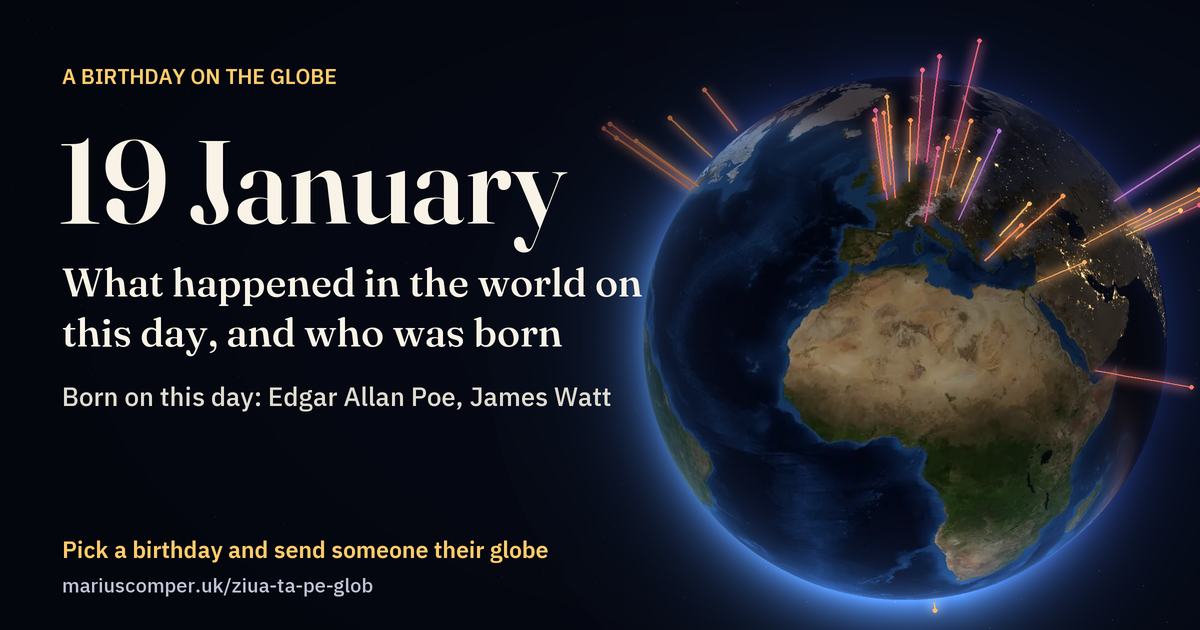
For 19 January, the English Wikipedia lists 58 events and 239 births. 33 of the events stand at their places as rays of light; three more are dashed circles, where the sentence links only to a country or a sea. The taller the ray, the longer ago it happened. The people born that day come further down, as blue points.
A birthday, yours or someone else’s:
Turn it into a greetingScroll: the globe turns to each place
The day you were born, on the globe.
Three things from your day
Scroll: your day first, then 19 January through the years
The Earth on 19 January
The picture on the globe was assembled by NASA from satellite photographs taken in January 2004: the snow, the ice and the green are those of the month.
On 19 January the Sun passes straight overhead at noon along the parallel of 20.4° south. In London, the day lasts about 8 hours 30 minutes.
Beyond 70° south the Sun no longer sets; beyond 70° north it no longer rises.
The line between day and night is tilted on the globe exactly as on this day of the year. On the dark side you can see the lights of towns.
Europe · Sirmium
379
Emperor Gratian elevates Flavius Theodosius at Sirmium to Augustus, and gives him authority over all the eastern provinces of the Roman Empire.
On the map: Sirmium.
Europe · Hämeenlinna
1639
Hämeenlinna (Swedish: Tavastehus) is granted privileges after it separated from the Vanaja parish as its own city in Tavastia.
On the map: Hämeenlinna.
Europe · Emden
1978
The last Volkswagen Beetle made in Germany leaves VW's plant in Emden. Beetle production in Latin America continues until 2003.
On the map: Emden.
Asia · San Agustin Church
1607
San Agustin Church in Manila is officially completed; it is the oldest church still standing in the Philippines.
On the map: San Agustin Church.
Asia · Exodus of Kashmiri Hindus
1990
Exodus of Kashmiri Pandits from the Kashmir Valley in Indian-administered Kashmir due to an insurgency.
On the map: Exodus of Kashmiri Hindus.
Asia · Hebron
1997
Yasser Arafat returns to Hebron after more than 30 years and joins celebrations over the handover of the last Israeli-controlled West Bank city.
On the map: Hebron.
Oceania · Botany Bay
1788
The second group of ships of the First Fleet arrive at Botany Bay.
On the map: Botany Bay.
North America · Roselle, New Jersey
1883
The first electric lighting system employing overhead wires, built by Thomas Edison, begins service at Roselle, New Jersey.
On the map: Roselle, New Jersey.
Also on the day’s list of Wikipedia in Spanish.
North America · Island No. 2
1909
A deed was recorded for David Hanbury to sell Island No. 2 in northern California to his brother John for $10 ($358.33 in 2025).
On the map: Island No. 2.
North America · Washington, D.C.
1960
Japan and the United States sign the US–Japan Mutual Security Treaty
On the map: Washington, D.C..
Wikipedia: Treaty of Mutual Cooperation and Security between the United States and Japan
Oceans · Pole of Inaccessibility research station
2007
Four-man Team N2i, using only skis and kites, completes a 1,093-mile (1,759 km) trek to reach the Antarctic pole of inaccessibility for the first time since 1965 and for the first time ever without mechanical assistance.
On the map: Pole of Inaccessibility research station.
Also on the day’s list of Wikipedia in Chinese.
19 January
What the other Wikipedias remember#
For these years the English list has nothing on this day. The events below come from the same day’s lists on Wikipedia in Chinese and were translated for this page.
From Wikipedia in Chinese · Seoul
2005
Lee Myung-bak, mayor of Seoul, announces that the Chinese name of the city is to be changed to "Shou'er" and that the term "Hancheng" will no longer be used.
On the map: Seoul.
Translated from the list on Wikipedia in Chinese.
19 January
Born on 19 January#
The English Wikipedia lists 239 births for this day. The blue points are the birthplaces of 60 of these people: those written about in the most Wikipedia editions, where Wikidata gives a place of birth.
Born on 19 January
1809
Edgar Allan Poe, American short story writer, poet, and critic (died 1849)
Born on 19 January
1736
James Watt, Scottish chemist and engineer (died 1819)
Place of birth: Greenock.
Born on 19 January
1839
Paul Cézanne, French painter (died 1906)
Place of birth: Aix-en-Provence.
Born on 19 January
1798
Auguste Comte, French economist, sociologist, and philosopher (died 1857)
Place of birth: Montpellier.
Born on 19 January
1946
Dolly Parton, American singer-songwriter and actress (died 2026)
Place of birth: Pittman Center.
Born in Britain and Ireland
1980
Jenson Button, English racing driver
Place of birth: Frome.
Born in Britain and Ireland
1946
Julian Barnes, English novelist, short story writer, essayist, and critic
Place of birth: Leicester.
Born in Britain and Ireland
1813
Henry Bessemer, English engineer and businessman (died 1898)
Place of birth: Charlton.
19 January
Number one in the charts that week
At the cinema
An animal recorded that day
The record can be seen in GBIF, which brings together wildlife records from around the world.
All your birthdays
The weather that day
Data: Met Office Hadley Centre (HadCET); NOAA (GHCN-Daily, Mauna Loa).
Above the Earth
Sources: Jonathan McDowell, GCAT (launches); GFZ Potsdam (Kp index). Days are counted in Universal Time.
Football that day
International matches played that day:
Source: the “International football results” dataset kept by Mart Jürisoo (CC0).
Also that day
The earthquake’s page at the USGS
Source: the USGS catalogue. The day is counted in Universal Time (UTC).
In those days
Make a link for someone
Type the name, pick the day and the year of birth. The link opens straight on their day, with their name in the greeting.
The link carries the name, date and place typed here; anyone who gets it can see them.
Put another birthday beside it
Your mother’s, your child’s, a friend’s: the two days appear side by side.
Below: 19 January through the years.
The whole globe of the day
Drag the globe to turn it. Touch a ray or a point to read what happened there.
Everything Wikipedia lists for 19 January
The list is the English Wikipedia’s, in its own wording, as it stood in October 2026. 22 events have no place on the map: the sentence links to no place with coordinates, only to places too wide to mark, or to several countries.
- 379
Emperor Gratian elevates Flavius Theodosius at Sirmium to Augustus, and gives him authority over all the eastern provinces of the Roman Empire.
Europe · SirmiumWikipedia: Gratian - 649
Conquest of Kucha: The forces of Kucha surrender after a forty-day siege led by Tang dynasty general Ashina She'er, establishing Tang control over the northern Tarim Basin in Xinjiang.
Asia · Tarim BasinWikipedia: Tang campaign against Kucha - 1419
Hundred Years' War: Rouen surrenders to Henry V of England, completing his reconquest of Normandy.
Europe · RouenWikipedia: Hundred Years' War - 1421
John VIII Palaiologos marries Sophia of Montferrat and is then crowned Byzantine co-emperor to his father Manuel II Palaiologos.
no place on the mapWikipedia: John VIII Palaiologos - 1511
The Italian Duchy of Mirandola surrenders to the Pope.
Europe · Siege of MirandolaWikipedia: Siege of Mirandola - 1520
Sten Sture the Younger, the Regent of Sweden, is mortally wounded at the Battle of Bogesund and dies on February 3.
Europe · Battle of BogesundWikipedia: Battle of Bogesund - 1607
San Agustin Church in Manila is officially completed; it is the oldest church still standing in the Philippines.
Asia · San Agustin ChurchWikipedia: San Agustin Church - 1639
Hämeenlinna (Swedish: Tavastehus) is granted privileges after it separated from the Vanaja parish as its own city in Tavastia.
Europe · HämeenlinnaWikipedia: Hämeenlinna - 1764
Bolle Willum Luxdorph records in his diary that a mail bomb, possibly the world's first, has severely injured the Danish Colonel Poulsen, residing at Børglum Abbey.
Europe · Børglum AbbeyWikipedia: Bolle Willum Luxdorph - 1764
John Wilkes is expelled from the British House of Commons for seditious libel.
no place on the mapWikipedia: John Wilkes - 1788
The second group of ships of the First Fleet arrive at Botany Bay.
Oceania · Botany BayWikipedia: First Fleet - 1795
The Batavian Republic is proclaimed in the Netherlands, replacing the Dutch Republic.
no place on the mapWikipedia: Batavian Republic - 1817
An army of 5,423 soldiers, led by General José de San Martín, crosses the Andes from Argentina to liberate Chile and then Peru.
no place on the mapWikipedia: Crossing of the Andes - 1829
Johann Wolfgang von Goethe's Faust: The First Part of the Tragedy receives its premiere performance.
no place on the mapWikipedia: Johann Wolfgang von Goethe - 1839
The British East India Company captures Aden.
Asia · AdenWikipedia: East India Company - 1853
Giuseppe Verdi's opera Il trovatore receives its premiere performance in Rome.
no place on the mapWikipedia: Giuseppe Verdi - 1861
American Civil War: Georgia joins South Carolina, Florida, Mississippi, and Alabama in declaring secession from the United States.
no place on the mapWikipedia: American Civil War - 1862
American Civil War: Battle of Mill Springs: The Confederacy suffers its first significant defeat in the conflict.
North America · Battle of Mill SpringsWikipedia: Battle of Mill Springs - 1871
Franco-Prussian War: In the Siege of Paris, Prussia wins the Battle of St. Quentin. Meanwhile, the French attempt to break the siege in the Battle of Buzenval will end unsuccessfully the following day.
Europe · Battle of St. QuentinWikipedia: Battle of St. Quentin - 1883
The first electric lighting system employing overhead wires, built by Thomas Edison, begins service at Roselle, New Jersey.
North America · Roselle, New JerseyWikipedia: Thomas Edison - 1899
Anglo-Egyptian Sudan is formed.
Africa · Anglo-Egyptian SudanWikipedia: Anglo-Egyptian Sudan - 1901
Queen Victoria, Queen of the United Kingdom, is stricken with paralysis. She dies three days later at the age of 81.
no place on the mapWikipedia: Queen Victoria - 1909
A deed was recorded for David Hanbury to sell Island No. 2 in northern California to his brother John for $10 ($358.33 in 2025).
North America · Island No. 2Wikipedia: Deed - 1915
Georges Claude patents the neon discharge tube for use in advertising.
no place on the mapWikipedia: Georges Claude - 1915
German strategic bombing during World War I: German zeppelins bomb the towns of Great Yarmouth and King's Lynn in the United Kingdom killing at least 20 people, in the first major aerial bombardment of a civilian target.
Britain & Ireland · Great YarmouthWikipedia: German bombing of Britain, 1914–1918 - 1917
Silvertown explosion: A blast at a munitions factory in London kills 73 and injures over 400. The resulting fire causes over £2,000,000 worth of damage.
Britain & Ireland · Silvertown explosionWikipedia: Silvertown explosion - 1920
The American Civil Liberties Union (ACLU) is founded.
no place on the mapWikipedia: American Civil Liberties Union - 1920
The United States Senate votes against joining the League of Nations.
no place on the mapWikipedia: United States Senate - 1937
Howard Hughes sets a new air record by flying from Los Angeles to New York City in seven hours, 28 minutes, 25 seconds.
no place on the mapWikipedia: Howard Hughes - 1941
World War II: HMS Greyhound and other escorts of convoy AS-12 sink Italian submarine Neghelli with all hands 64 kilometres (40 mi) northeast of Falkonera.
Europe · FalkoneraWikipedia: World War II - 1942
World War II: The Japanese conquest of Burma begins.
no place on the mapWikipedia: Japanese invasion of Burma - 1945
World War II: Soviet forces liberate the Łódź Ghetto. Of more than 200,000 inhabitants in 1940, fewer than 900 had survived the Nazi occupation.
Europe · Łódź GhettoWikipedia: Red Army - 1946
General Douglas MacArthur establishes the International Military Tribunal for the Far East in Tokyo to try Japanese war criminals.
no place on the mapWikipedia: Douglas MacArthur - 1953
Almost 72 percent of all television sets in the United States are tuned into I Love Lucy to watch Lucy give birth.
no place on the mapWikipedia: I Love Lucy - 1960
Japan and the United States sign the US–Japan Mutual Security Treaty
North America · Washington, D.C.Wikipedia: Treaty of Mutual Cooperation and Security between the United States and Japan - 1960
Scandinavian Airlines System Flight 871 crashes near Ankara Esenboğa Airport in Turkey, killing all 42 aboard.
Asia · Ankara Esenboğa AirportWikipedia: Scandinavian Airlines System Flight 871 - 1966
Indira Gandhi becomes India's first female prime minister.
Asia · IndiaWikipedia: Indira Gandhi - 1969
Student Jan Palach dies after setting himself on fire three days earlier in Prague's Wenceslas Square to protest about the invasion of Czechoslovakia by the Soviet Union in 1968. His funeral turns into another major protest.
Europe · PragueWikipedia: Warsaw Pact invasion of Czechoslovakia - 1972
The French newspaper L'Aurore revealed that the former Nazi SS officer Klaus Barbie, the "Butcher of Lyon", had been found to be living in Peru.
no place on the mapWikipedia: L'Aurore - 1975
An earthquake registering 6.8 Ms struck northern Himachal Pradesh in India, causing extensive damage to the region.
Asia · 1975 Kinnaur earthquakeWikipedia: 1975 Kinnaur earthquake - 1977
President Gerald Ford pardons Iva Toguri D'Aquino (a.k.a. "Tokyo Rose").
no place on the mapWikipedia: Gerald Ford - 1978
The last Volkswagen Beetle made in Germany leaves VW's plant in Emden. Beetle production in Latin America continues until 2003.
Europe · EmdenWikipedia: Volkswagen Beetle - 1981
Iran hostage crisis: United States and Iranian officials sign an agreement to release 52 American hostages after 14 months of captivity.
Asia · Iran hostage crisisWikipedia: Iran hostage crisis - 1988
Trans-Colorado Airlines Flight 2286 crashes in Bayfield, Colorado, killing nine.
North America · Trans-Colorado Airlines Flight 2286Wikipedia: Trans-Colorado Airlines Flight 2286 - 1990
Exodus of Kashmiri Pandits from the Kashmir Valley in Indian-administered Kashmir due to an insurgency.
Asia · Exodus of Kashmiri HindusWikipedia: Exodus of Kashmiri Hindus - 1991
Gulf War: Iraq fires a second Scud missile into Israel, causing 15 injuries.
Asia · IraqWikipedia: Gulf War - 1993
Czech Republic and Slovakia join the United Nations.
no place on the mapWikipedia: Czech Republic - 1995
After being struck by lightning the crew of Bristow Helicopters Flight 56C are forced to ditch. All 18 aboard are later rescued.
Oceans · Bristow Helicopters Flight 56CWikipedia: Bristow Helicopters Flight 56C - 1996
The barge North Cape oil spill occurs as an engine fire forces the tugboat Scandia ashore on Moonstone Beach in South Kingstown, Rhode Island.
North America · North Cape oil spillWikipedia: North Cape oil spill - 1997
Yasser Arafat returns to Hebron after more than 30 years and joins celebrations over the handover of the last Israeli-controlled West Bank city.
Asia · HebronWikipedia: West Bank - 1999
British Aerospace agrees to acquire the defence subsidiary of the General Electric Company, forming BAE Systems in November 1999.
no place on the mapWikipedia: British Aerospace - 2006
A Slovak Air Force Antonov An-24 crashes near Hejce, Hungary, killing 42.
Europe · 2006 Slovak Air Force Antonov An-24 crashWikipedia: 2006 Slovak Air Force Antonov An-24 crash - 2007
Four-man Team N2i, using only skis and kites, completes a 1,093-mile (1,759 km) trek to reach the Antarctic pole of inaccessibility for the first time since 1965 and for the first time ever without mechanical assistance.
Oceans · Pole of Inaccessibility research stationWikipedia: Henry Cookson - 2007
Turkish-Armenian journalist Hrant Dink is assassinated in front of his newspaper's Istanbul office by 17-year-old Turkish ultra-nationalist Ogün Samast.
Asia · Assassination of Hrant DinkWikipedia: Assassination of Hrant Dink - 2012
The Hong Kong-based file-sharing website Megaupload is shut down by the FBI.
no place on the mapWikipedia: Megaupload - 2014
A bomb attack on an army convoy in the city of Bannu kills at least 26 Pakistani soldiers and injures 38 others.
Asia · BannuWikipedia: 2014 Bannu bombing - 2024
The Japan Aerospace Exploration Agency's probe lands on the moon, making Japan the 5th country to land a spacecraft on the moon.
no place on the mapWikipedia: JAXA - 2025
Bytedance and sister companies are banned from the United States for "security concerns".
no place on the mapWikipedia: ByteDance
What the other Wikipedias remember
For these years the English list has nothing on this day. The events below come from the same day’s lists on Wikipedia in Chinese and were translated for this page.
- 2005
Lee Myung-bak, mayor of Seoul, announces that the Chinese name of the city is to be changed to "Shou'er" and that the term "Hancheng" will no longer be used.
Who was born on 19 January
In order of how many Wikipedia editions have an article about each. The first 60 of 239 are shown.
- 1809
Edgar Allan Poe, American short story writer, poet, and critic (died 1849)
- 1736
James Watt, Scottish chemist and engineer (died 1819)
GreenockWikipedia: James Watt - 1839
Paul Cézanne, French painter (died 1906)
Aix-en-ProvenceWikipedia: Paul Cézanne - 1798
Auguste Comte, French economist, sociologist, and philosopher (died 1857)
MontpellierWikipedia: Auguste Comte - 1946
Dolly Parton, American singer-songwriter and actress (died 2026)
Pittman CenterWikipedia: Dolly Parton - 1807
Robert E. Lee, American Confederate general (died 1870)
Stratford HallWikipedia: Robert E. Lee - 1943
Janis Joplin, American singer-songwriter (died 1970)
Port ArthurWikipedia: Janis Joplin - 1920
Javier Pérez de Cuéllar, Peruvian politician and diplomat, 135th Prime Minister of Peru (died 2020)
- 1980
Jenson Button, English racing driver
- 1544
Francis II of France (died 1560)
FontainebleauWikipedia: Francis II of France - 1912
Leonid Kantorovich, Russian mathematician and economist, Nobel Prize laureate (died 1986)
Saint PetersburgWikipedia: Leonid Kantorovich - 1946
Julian Barnes, English novelist, short story writer, essayist, and critic
LeicesterWikipedia: Julian Barnes - 1986
Claudio Marchisio, Italian footballer
- 1982
Pete Buttigieg, American politician
South BendWikipedia: Pete Buttigieg - 1992
Logan Lerman, American actor
Beverly HillsWikipedia: Logan Lerman - 1921
Patricia Highsmith, American novelist and short story writer (died 1995)
Fort WorthWikipedia: Patricia Highsmith - 1966
Stefan Edberg, Swedish tennis player and coach
VästervikWikipedia: Stefan Edberg - 1200
Dōgen Zenji, founder of Sōtō Zen (died 1253)
KogaWikipedia: Dōgen - 1994
Matthias Ginter, German footballer
Freiburg im BreisgauWikipedia: Matthias Ginter - 1863
Werner Sombart, German economist and sociologist (died 1941)
ErmslebenWikipedia: Werner Sombart - 1985
Damien Chazelle, American film director, screenwriter, and producer
ProvidenceWikipedia: Damien Chazelle - 1930
Tippi Hedren, American model, actress, and animal rights-welfare activist
New UlmWikipedia: Tippi Hedren - 1936
Ziaur Rahman, Bangladeshi general and politician, seventh President of Bangladesh (died 1981)
Bogura DistrictWikipedia: Ziaur Rahman - 1954
Cindy Sherman, American photographer and director
Glen RidgeWikipedia: Cindy Sherman - 1992
Mac Miller, American rapper (died 2018)
PittsburghWikipedia: Mac Miller - 1993
João Mário, Portuguese footballer
- 1999
Donyell Malen, Dutch footballer
WieringenWikipedia: Donyell Malen - 1954
Katey Sagal, American actress and singer
HollywoodWikipedia: Katey Sagal - 399
Pulcheria, Byzantine empress and saint (died 453)
ConstantinopleWikipedia: Pulcheria - 1969
Predrag Mijatović, Montenegrin footballer and manager
PodgoricaWikipedia: Predrag Mijatović - 1981
Lucho González, Argentinian footballer
Buenos AiresWikipedia: Lucho González - 1983
Hikaru Utada, American-Japanese singer-songwriter and producer
ManhattanWikipedia: Hikaru Utada - 1813
Henry Bessemer, English engineer and businessman (died 1898)
CharltonWikipedia: Henry Bessemer - 1937
Princess Birgitta of Sweden (died 2024)
Haga PalaceWikipedia: Princess Birgitta of Sweden - 1940
Paolo Borsellino, Italian lawyer and judge (died 1992)
PalermoWikipedia: Paolo Borsellino - 1851
Jacobus Kapteyn, Dutch astronomer and academic (died 1922)
UtrechtWikipedia: Jacobus Kapteyn - 1955
Simon Rattle, English-German orchestral conductor
LiverpoolWikipedia: Simon Rattle - 1963
John Bercow, English politician, Speaker of the House of Commons
EdgwareWikipedia: John Bercow - 1972
Drea de Matteo, American actress
- 1986
Moussa Sow, Senegalese footballer
Mantes-la-JolieWikipedia: Moussa Sow - 1922
Miguel Muñoz, Spanish footballer and manager (died 1990)
MadridWikipedia: Miguel Muñoz - 1878
Herbert Chapman, English footballer and manager (died 1934)
Kiveton ParkWikipedia: Herbert Chapman - 1879
Boris Savinkov, Russian soldier and author (died 1925)
KharkivWikipedia: Boris Savinkov - 1984
Karun Chandhok, Indian racing driver
ChennaiWikipedia: Karun Chandhok - 1976
Marsha Thomason, English actress
- 1988
JaVale McGee, American basketball player
- 1991
Petra Martić, Croatian tennis player
- 1966
Lena Philipsson, Swedish singer-songwriter
VetlandaWikipedia: Lena Philipsson - 1996
Jakub Jankto, Czech footballer
PragueWikipedia: Jakub Jankto - 1808
Lysander Spooner, American philosopher and author (died 1887)
- 1889
Sophie Taeuber-Arp, Swiss painter and sculptor (died 1943)
- 1932
Richard Lester, American-English director, producer, and screenwriter
PhiladelphiaWikipedia: Richard Lester - 1944
Thom Mayne, American architect and academic, designed the San Francisco Federal Building and Phare Tower
WaterburyWikipedia: Thom Mayne - 1971
Shawn Wayans, American actor, producer, and screenwriter
New York CityWikipedia: Shawn Wayans - 1979
Svetlana Khorkina, Russian gymnast and sportscaster
BelgorodWikipedia: Svetlana Khorkina - 1992
Shawn Johnson East, American gymnast
Des MoinesWikipedia: Shawn Johnson East - 1923
Jean Stapleton, American actress and singer (died 2013)
ManhattanWikipedia: Jean Stapleton - 1956
Susan Solomon, American atmospheric chemist
ChicagoWikipedia: Susan Solomon - 1969
Steve Staunton, Irish footballer and manager
DroghedaWikipedia: Steve Staunton - 1980
Luke Macfarlane, Canadian-American actor and singer
What is celebrated on 19 January
- Christian feast day: Bassianus of Lodi
- Christian feast day: Faustina and Liberata of Como
- Christian feast day: Henry of Uppsala
- Christian feast day: Marius, Martha, Audifax, and Abachum
- Christian feast day: Mark of Ephesus (Eastern Orthodox Church)
- Christian feast day: Pontianus of Spoleto
- Christian feast day: Wulfstan, Bishop of Worcester
- Christian feast day: January 19 (Eastern Orthodox liturgics)
- Confederate Heroes Day (Texas), and its related observance: Robert E. Lee Day (Alabama, Arkansas, Florida, Georgia and Mississippi)
- Husband's Day (Iceland)
- Kokborok Day (Tripura, India)
- Theophany / Epiphany (Eastern and Oriental Orthodoxy), and its related observances: Timkat, or 20 during Leap Year (Ethiopian Orthodox)
- Theophany / Epiphany (Eastern and Oriental Orthodoxy), and its related observances: Vodici or Baptism of Jesus (North Macedonia)
A greeting link for someone
Type a name and, if you like, the year of birth. The link opens with a greeting, and beside each event it says how old the person turned that day, or how many years before their birth it happened.
The name and the year go only into the link you send.
All 366 days
How the globe is made
Where the events come from
Each edition of this page uses the day’s list from Wikipedia in its own language: Romanian, English, Spanish, Chinese. The lists are written by volunteers and differ from one edition to the next; the text of each event is Wikipedia’s, with a link to the article. A row that appears twice in a list is shown once. The lists have not been checked event by event: they are Wikipedia’s, mistakes included.
For events before 1582, and for countries that moved to the Gregorian calendar later (Britain in 1752, Russia in 1918), the same day may be counted Old Style in one list and New Style in another.
The chapter “What the other Wikipedias remember” adds up to five events a day from the lists of the other three editions, only for years in which the English list has nothing on that day. They were translated for this page, passed the same filters as the tour, and are not counted among the events of the English list.
How an event gets onto the map
The place comes from Wikidata. If the sentence links to the article about the event itself (a battle, an opening, an earthquake), dated to the same year, the ray stands on its coordinates or on those of its location. Otherwise it stands on the first place the sentence links to: a town, a building, a mountain, an island. This second step can be wrong: sometimes the sentence only mentions the place. That is why the page says, under each event, which place the ray stands on.
When the sentence links to a single state or province, or to a single sea, lake or desert larger than 5,000 km², the globe shows a dashed circle, not a ray. The circle has the area Wikidata gives, with its radius kept between 1.2° and 16°, or a radius of 4.5° when Wikidata gives no area; it says only that the sentence links to that place. Organisations, ships, spacecraft, museum objects, rivers, mountain ranges, languages and continents are never used as places. When a sentence names several states and no exact place, the event stays in the list only.
What the height means
The height of a ray shows how many years have passed, on a logarithmic scale: 10 years, 100 years and 1,000 years are equal steps apart; anything older than about 2,600 years has the tallest ray. The colour runs from pale yellow for recent years to violet for antiquity.
Where the tour stops
In each region the tour stops at up to three events (five in Britain and Ireland), chosen mainly by three things: whether Wikipedia’s editors put the event in the “On this day” box of their main page (the English, Spanish and Chinese editions), how many Wikipedia editions have an article about it, and how many of the four lists include it. Events whose sentence or article is about a war, an attack, a crime or a disaster are left out of the tour; they stay in the whole list, in Wikipedia’s wording. The filter is a list of words and a list of Wikidata types, so it can miss some.
The tour of births names the people with articles in the most editions and leaves aside those whom the list or Wikidata describes as rulers, politicians, commanders, leaders of movements or criminals; they stay in the list.
The Earth and the Sun
The daytime images are NASA’s Blue Marble Next Generation mosaics, one for each month of 2004; the night side is Black Marble 2016. The tilt of the line between day and night is computed for the day; the hour is chosen so that the place being read is in daylight. The latitude where the Sun stands overhead is the average of the four years of the leap cycle; in a given year it can differ by up to 0.4°.
The day you were born
The number ones come from the weekly lists on Wikipedia: Billboard for the United States (from 1940; the Hot 100 from August 1958), the UK Singles Chart (from November 1952), Los 40 Principales for Spain (from July 1966) and, for Romania, the Romanian Top 100 and Airplay 100 (2001–2021, with missing weeks). The page shows the chart of the week in which the day of birth falls, with its date; Billboard and the UK chart are dated at the end of their week. For Romania before 2001 and for China these sources have no weekly chart.
The films are those that reached cinemas in the United States up to ten days before or three days after that day (some of them in a few cinemas at first), from the English Wikipedia’s yearly lists (from 1968), in order of how many editions have an article about them. The events “in those days” are the ones on the neighbouring days’ lists that carry the year of birth, passed through the same filter as the tour.
The day of birth, year included
The Moon, the star sign and the constellation are worked out by the page itself, for noon Universal Time on the day. The lit part of the Moon is rounded and can differ by a few per cent from that at the hour of birth. The sign follows the usual zodiac of twelve equal parts starting at the March equinox; the constellation is the one the Sun actually stood in front of, by the borders set by the International Astronomical Union, and within a day of a border the page does not name it. When the Sun changes sign while it is that day anywhere on Earth, the page gives the moment of crossing, rounded to ten minutes and accurate to within about a quarter of an hour, and the clock time in a few cities, with the time zone and summer time of that year.
The year in the Chinese calendar is the one your device’s own calendar gives for the date, checked against the Hong Kong Observatory’s tables. “All your birthdays” uses the same sources as the rest of the chapter for the same day in every year since the birth: the temperature, well-known launches that took place on that very day, matches of the teams the edition follows, snow deeper than 10 cm and strong geomagnetic storms. The three things at the top and the four on the picture are chosen in a fixed order (the song, the animal, a full Moon, a well-known launch before an ordinary earthquake); on the picture you can change them.
When the link carries a year of birth, the page adds a few things about that exact day. The weather is the Met Office’s Central England temperature record and the readings from New York’s Central Park; the “usual high” is the average of the daily highs of 1961–1990 for that date, with two days either side. The carbon dioxide figure is the monthly mean at the Mauna Loa observatory, where measurements begin in March 1958.
The earthquake is the one with the largest magnitude in the USGS catalogue for that day, counted in Universal Time. Before the 1960s the catalogue has gaps even above magnitude 5.5, so in the older years many days have no earthquake. The page gives only the magnitude and the place: the country the epicentre falls in or, when the epicentre is at sea within 300 km of a coast, the nearest country; farther out, only the ocean.
The launches are those that reached orbit or left for the Moon and the planets, from Jonathan McDowell’s GCAT catalogue. If nothing left that day, the page shows the nearest launch within three days before or after, and says how many days away it was. The geomagnetic storm appears only when the Kp index reached at least 5 in one of the day’s eight three-hour intervals.
The animal comes from GBIF: an observation made by a person (the animal seen or heard, or its tracks), dated to that exact day, with coordinates and a CC0 or CC BY licence. Only a few hundred well-known species are searched (mammals, birds, turtles, butterflies); of those noted that day, mammals and species with articles in many Wikipedia editions come first; birds noted almost every day, and species used recently, wait their turn. Observations dated 1 January are left out, because records without a day are often filed there. An observation shows that the animal was recorded there, not how many animals there were.
The matches are those between national teams. Only matches of England, Scotland, Wales, Northern Ireland, the Republic of Ireland, the United States, Canada and Australia are shown, along with those at the big final tournaments. The picture to send is drawn in the page from the day’s globe and the facts above, and stays on your device until you send it.
Sources
- Events, births and holidays: the day’s page on Wikipedia, text under CC BY-SA 4.0.
- Coordinates, places of birth and the number of editions: Wikidata (CC0).
- The Earth by day: NASA Blue Marble Next Generation. The Earth by night: NASA Black Marble 2016.
- Borders and regions: Natural Earth.
- World population and births per year: UN World Population Prospects 2024.
- Charts and films: Wikipedia’s lists for Billboard, the UK Singles Chart, Los 40 Principales, Romanian Top 100, Airplay 100 and American films by year (CC BY-SA 4.0).
- Weather: Met Office Hadley Centre, HadCET (Open Government Licence) and NOAA GHCN-Daily, New York Central Park. Carbon dioxide: NOAA Global Monitoring Laboratory, Mauna Loa.
- Earthquakes: the USGS catalogue. Launches: Jonathan McDowell, GCAT (CC BY). Kp index: GFZ Potsdam (CC BY 4.0). Matches: International football results, Mart Jürisoo (CC0).
- Animal observations: GBIF, with a link to each record; species names come from Wikidata.