A birthday on the globe
31 October on the globe: what happened in the world on this day, and who was born
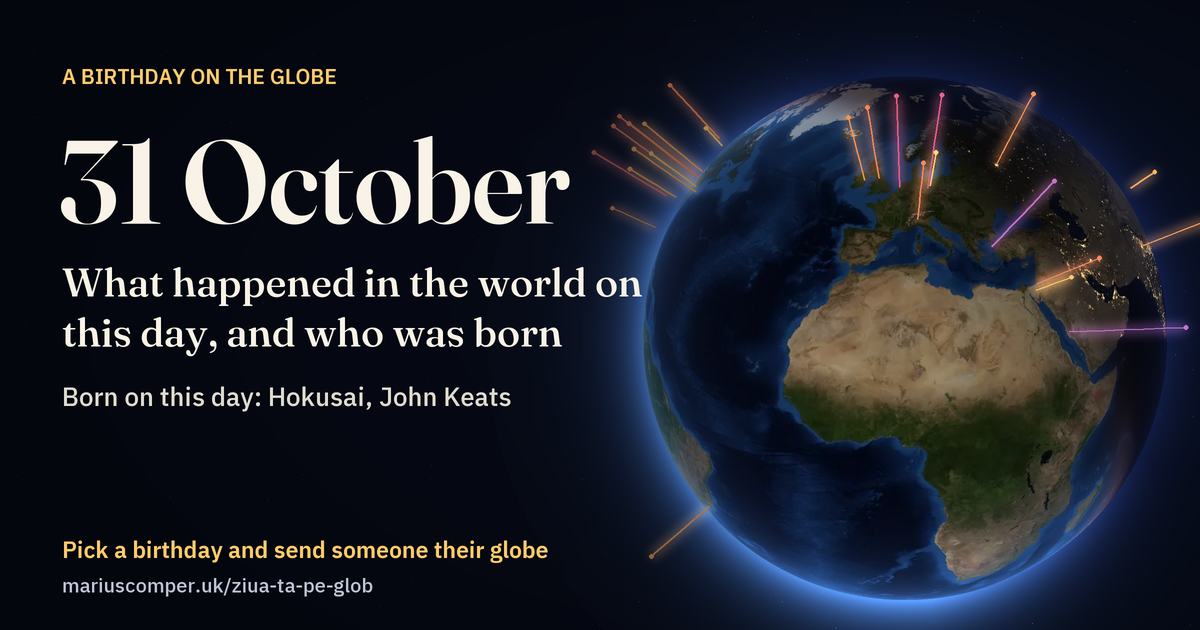
For 31 October, the English Wikipedia lists 50 events and 244 births. 27 of the events stand at their places as rays of light; seven more are dashed circles, where the sentence links only to a country or a sea. The taller the ray, the longer ago it happened. The people born that day come further down, as blue points.
A birthday, yours or someone else’s:
Turn it into a greetingScroll: the globe turns to each place
The day you were born, on the globe.
Three things from your day
Scroll: your day first, then 31 October through the years
The Earth on 31 October
The picture on the globe was assembled by NASA from satellite photographs taken in October 2004: the snow, the ice and the green are those of the month.
On 31 October the Sun passes straight overhead at noon along the parallel of 14.1° south. In London, the day lasts about 9 hours 45 minutes.
Beyond 76° south the Sun no longer sets; beyond 76° north it no longer rises.
The line between day and night is tilted on the globe exactly as on this day of the year. On the dark side you can see the lights of towns.
Europe · Leiden University Library
1587
Leiden University Library opens its doors after its founding in 1575.
On the map: Leiden University Library.
Europe · Milan
1924
World Savings Day is announced in Milan, Italy by the Members of the Association at the 1st International Savings Bank Congress (World Society of Savings Banks).
On the map: Milan.
Oceania · Marble Bar, Western Australia
1923
The first of 160 consecutive days of 100° Fahrenheit at Marble Bar, Western Australia.
On the map: Marble Bar, Western Australia.
Oceania · Melbourne
1999
Yachtsman Jesse Martin returns to Melbourne after 11 months of circumnavigating the world, solo, non-stop and unassisted.
On the map: Melbourne.
North America · Mount Rushmore
1941
After 14 years of work, Mount Rushmore is completed.
On the map: Mount Rushmore.
Also on the day’s list of Wikipedia in Chinese.
31 October
What the other Wikipedias remember#
For these years the English list has nothing on this day. The events below come from the same day’s lists on Wikipedia in Spanish and Chinese and were translated for this page.
From Wikipedia in Spanish · Rome
1512
In Rome, the frescoes of the Sistine Chapel of the Apostolic Palace, painted by Michelangelo, are unveiled.
On the map: Rome.
Translated from the list on Wikipedia in Spanish.
From Wikipedia in Chinese · Narmada district
2018
The Statue of Unity, commemorating Sardar Vallabhbhai Patel, a leader of the Indian independence movement, is officially inaugurated in Narmada district, Gujarat. At 182 metres, it is the tallest statue in the world.
On the map: Narmada district.
Translated from the list on Wikipedia in Chinese.
31 October
Born on 31 October#
The English Wikipedia lists 244 births for this day. The blue points are the birthplaces of 59 of these people: those written about in the most Wikipedia editions, where Wikidata gives a place of birth.
Born on 31 October
1760
Katsushika Hokusai, Japanese artist and printmaker (died 1849)
Place of birth: Honjo.
Born on 31 October
1795
John Keats, English poet (died 1821)
Place of birth: Moorgate.
Born on 31 October
1632
Johannes Vermeer, Dutch painter (died 1675)
Place of birth: Delft.
Born on 31 October
1961
Peter Jackson, New Zealand actor, director, producer, and screenwriter
Place of birth: Wellington.
Born on 31 October
1950
Zaha Hadid, Iraqi-English architect and academic, designed the Bridge Pavilion (died 2016)
Place of birth: Baghdad.
Born in Britain and Ireland
1997
Marcus Rashford, English footballer
Place of birth: Manchester.
Born in Britain and Ireland
1925
John Pople, English-American chemist and academic, Nobel Prize laureate (died 2004)
Place of birth: Burnham-on-Sea.
Born in Britain and Ireland
1946
Stephen Rea, Irish actor
Place of birth: Belfast.
31 October
Number one in the charts that week
At the cinema
An animal recorded that day
The record can be seen in GBIF, which brings together wildlife records from around the world.
All your birthdays
The weather that day
Data: Met Office Hadley Centre (HadCET); NOAA (GHCN-Daily, Mauna Loa).
Above the Earth
Sources: Jonathan McDowell, GCAT (launches); GFZ Potsdam (Kp index). Days are counted in Universal Time.
Football that day
International matches played that day:
Source: the “International football results” dataset kept by Mart Jürisoo (CC0).
Also that day
The earthquake’s page at the USGS
Source: the USGS catalogue. The day is counted in Universal Time (UTC).
In those days
Make a link for someone
Type the name, pick the day and the year of birth. The link opens straight on their day, with their name in the greeting.
The link carries the name, date and place typed here; anyone who gets it can see them.
Put another birthday beside it
Your mother’s, your child’s, a friend’s: the two days appear side by side.
Below: 31 October through the years.
The whole globe of the day
Drag the globe to turn it. Touch a ray or a point to read what happened there.
Everything Wikipedia lists for 31 October
The list is the English Wikipedia’s, in its own wording, as it stood in October 2026. 16 events have no place on the map: the sentence links to no place with coordinates, only to places too wide to mark, or to several countries.
- 475
Romulus Augustulus is proclaimed Western Roman Emperor.
no place on the mapWikipedia: Romulus Augustulus - 683
During the Siege of Mecca, the Kaaba catches fire and is burned down.
Asia · Siege of MeccaWikipedia: Siege of Mecca - 802
Empress Irene is deposed and banished to Lesbos. Conspirators place Nikephoros, the minister of finance, on the Byzantine throne.
Europe · LesbosWikipedia: Lesbos - 932
Abbasid caliph al-Muqtadir is killed while fighting against the forces of general Mu'nis al-Muzaffar. Al-Muqtadir's brother al-Qahir is chosen to succeed him.
no place on the mapWikipedia: List of Abbasid caliphs - 1517
Protestant Reformation: Martin Luther posts his 95 Theses on the door of the Castle Church in Wittenberg.
Europe · All Saints' Church, WittenbergWikipedia: Reformation - 1587
Leiden University Library opens its doors after its founding in 1575.
Europe · Leiden University LibraryWikipedia: Leiden University Library - 1822
Emperor Agustín de Iturbide attempts to dissolve the Congress of the Mexican Empire.
Latin America · First Mexican EmpireWikipedia: Agustín de Iturbide - 1837
Approximately 300 Muscogee die in the steamboat Monmouth disaster on the Trail of Tears in the United States.
North America · Steamboat Monmouth disasterWikipedia: Steamboat Monmouth disaster - 1863
The New Zealand Wars resume as British forces in New Zealand led by General Duncan Cameron begin their Invasion of the Waikato.
Britain & Ireland · British EmpireWikipedia: Invasion of the Waikato - 1864
Nevada is admitted as the 36th U.S. state.
North America · NevadaWikipedia: Nevada - 1895
The strongest earthquake in the Midwestern United States since 1812 strikes near Charleston, Missouri, causing damage and killing at least two.
North America · 1895 Charleston earthquakeWikipedia: 1895 Charleston earthquake - 1903
The Purdue Wreck, a railroad train collision in Indianapolis, kills 17 people, including 14 players of the Purdue University football team.
North America · IndianapolisWikipedia: Purdue wreck - 1907
The Parliament of Finland approved the Prohibition Act, but the law was not implemented because it was not ratified by Tsar Nicholas II of Russia.
no place on the mapWikipedia: Parliament of Finland - 1913
Dedication of the Lincoln Highway, the first automobile highway across United States.
no place on the mapWikipedia: Lincoln Highway - 1913
The Indianapolis Streetcar Strike and subsequent riot begins.
no place on the mapWikipedia: Indianapolis streetcar strike of 1913 - 1917
World War I: Battle of Beersheba: The "last successful cavalry charge in history".
Asia · Battle of BeershebaWikipedia: World War I - 1918
World War I: The Aster Revolution terminates the Austro-Hungarian Compromise of 1867, and Hungary achieves full sovereignty.
no place on the mapWikipedia: Aster Revolution - 1922
Benito Mussolini is made Prime Minister of Italy.
no place on the mapWikipedia: Benito Mussolini - 1923
The first of 160 consecutive days of 100° Fahrenheit at Marble Bar, Western Australia.
Oceania · Marble Bar, Western AustraliaWikipedia: Fahrenheit - 1924
World Savings Day is announced in Milan, Italy by the Members of the Association at the 1st International Savings Bank Congress (World Society of Savings Banks).
Europe · MilanWikipedia: World Savings Day - 1938
Great Depression: In an effort to restore investor confidence, the New York Stock Exchange unveils a fifteen-point program aimed to upgrade protection for the investing public.
no place on the mapWikipedia: New York Stock Exchange - 1940
World War II: The Battle of Britain ends, causing Germany to abandon Operation Sea Lion.
Britain & Ireland · Battle of BritainWikipedia: Battle of Britain - 1941
After 14 years of work, Mount Rushmore is completed.
North America · Mount RushmoreWikipedia: Mount Rushmore - 1941
World War II: The destroyer USS Reuben James is torpedoed by a German U-boat near Iceland, killing more than 100 U.S. Navy sailors. It is the first U.S. Navy vessel sunk by enemy action in WWII.
no place on the mapWikipedia: USS Reuben James - 1943
World War II: An F4U Corsair accomplishes the first successful radar-guided interception by a United States Navy or Marine Corps aircraft.
no place on the mapWikipedia: United States Navy - 1956
Hungarian Revolution of 1956: A Revolutionary Headquarters is established in Hungary. Following Imre Nagy's announcement of October 30, banned non-Communist political parties are reformed, and the MDP is replaced by the MSZMP. József Mindszenty is released from prison. The Soviet Politburo makes the decision to crush the Revolution.
Europe · Hungarian People's RepublicWikipedia: Hungarian Revolution of 1956 - 1956
Suez Crisis: The United Kingdom and France begin bombing Egypt to force the reopening of the Suez Canal.
Africa · Republic of EgyptWikipedia: Suez Crisis - 1961
In the Soviet Union, Joseph Stalin's body is removed from Lenin's Mausoleum, and is buried near the Kremlin Wall under a plain white marker.
Europe · Lenin's MausoleumWikipedia: Soviet Union - 1963
Indiana State Fairgrounds Coliseum gas explosion: A gas explosion at the Indiana State Fairgrounds Coliseum in Indianapolis kills 81 people and injures another 400 during an ice show.
North America · 1963 Indiana State Fairgrounds Coliseum gas explosionWikipedia: 1963 Indiana State Fairgrounds Coliseum gas explosion - 1968
Great Drought of 1968: Amidst a collapse of hydropower President of Chile Eduardo Frei Montalva decrees the establishment of daylight saving time.
no place on the mapWikipedia: Great Drought of 1968 - 1968
Vietnam War October surprise: Citing progress with the Paris peace talks, US President Lyndon B. Johnson announces to the nation that he has ordered a complete cessation of "all air, naval, and artillery bombardment of North Vietnam" effective November 1.
Asia · North VietnamWikipedia: Vietnam War - 1973
Three Provisional Irish Republican Army members escape from Mountjoy Prison, Dublin aboard a hijacked helicopter that landed in the exercise yard.
Britain & Ireland · Mountjoy Prison helicopter escapeWikipedia: Mountjoy Prison helicopter escape - 1979
Western Airlines Flight 2605 crashes on landing in Mexico City, killing 73 people.
Latin America · Western Airlines Flight 2605Wikipedia: Western Airlines Flight 2605 - 1984
Indian Prime Minister Indira Gandhi is assassinated by two Sikh security guards. Riots break out in New Delhi and other cities and around 3,000 Sikhs are killed.
Asia · Assassination of Indira GandhiWikipedia: Assassination of Indira Gandhi - 1994
American Eagle Flight 4184 crashes near Roselawn, Indiana killing all 68 people on board.
North America · American Eagle Flight 4184Wikipedia: American Eagle Flight 4184 - 1996
TAM Transportes Aéreos Regionais Flight 402 crashes in São Paulo, Brazil, killing 99 people.
Latin America · TAM Transportes Aéreos Regionais Flight 402Wikipedia: TAM Transportes Aéreos Regionais Flight 402 - 1996
TG4, the world's first Irish language television station, began broadcasting.
no place on the mapWikipedia: TG4 - 1998
Iraq disarmament crisis begins: Iraq announces it would no longer cooperate with United Nations weapons inspectors.
Asia · IraqWikipedia: Iraq disarmament crisis - 1999
EgyptAir Flight 990 crashes into the Atlantic Ocean near Nantucket, killing all 217 people on board.
North America · EgyptAir Flight 990Wikipedia: EgyptAir Flight 990 - 1999
Yachtsman Jesse Martin returns to Melbourne after 11 months of circumnavigating the world, solo, non-stop and unassisted.
Oceania · MelbourneWikipedia: Yacht - 2000
Singapore Airlines Flight 006 crashes on takeoff from Taipei, killing 83.
Asia · Singapore Airlines Flight 006Wikipedia: Singapore Airlines Flight 006 - 2000
Soyuz TM-31 launches, carrying the first resident crew to the International Space Station. The ISS has been crewed continuously since then.
no place on the mapWikipedia: Soyuz TM-31 - 2002
A federal grand jury in Houston, Texas indicts former Enron chief financial officer Andrew Fastow on 78 counts of wire fraud, money laundering, conspiracy and obstruction of justice related to the collapse of his ex-employer.
North America · HoustonWikipedia: Houston - 2003
Mahathir Mohamad resigns as Prime Minister of Malaysia and is replaced by Deputy Prime Minister Abdullah Ahmad Badawi, marking an end to Mahathir's 22 years in power.
no place on the mapWikipedia: Mahathir Mohamad - 2005
The discovery of the Plutonian moons Nix and Hydra, based on photographs taken by the Hubble Space Telescope nearly five months prior, was announced.
no place on the mapWikipedia: Moons of Pluto - 2011
The global population of humans reaches seven billion. This day is now recognized by the United Nations as the Day of Seven Billion.
no place on the mapWikipedia: Day of Seven Billion - 2014
During a test flight, the VSS Enterprise, a Virgin Galactic experimental spaceflight test vehicle, suffers a catastrophic in-flight breakup and crashes in the Mojave Desert, California.
North America · VSS Enterprise crashWikipedia: VSS Enterprise crash - 2015
Metrojet Flight 9268 is bombed over the northern Sinai Peninsula, killing all 224 people on board.
Africa · Metrojet Flight 9268Wikipedia: Metrojet Flight 9268 - 2017
A truck drives into a crowd in Lower Manhattan, New York City, killing eight people.
North America · 2017 New York City truck attackWikipedia: 2017 New York City truck attack - 2020
Berlin Brandenburg Airport opens its doors after nearly 10 years of delays due to construction issues and project corruption.
Europe · Berlin Brandenburg AirportWikipedia: Berlin Brandenburg Airport
What the other Wikipedias remember
For these years the English list has nothing on this day. The events below come from the same day’s lists on Wikipedia in Spanish and Chinese and were translated for this page.
- 1512
In Rome, the frescoes of the Sistine Chapel of the Apostolic Palace, painted by Michelangelo, are unveiled.
- 2018
The Statue of Unity, commemorating Sardar Vallabhbhai Patel, a leader of the Indian independence movement, is officially inaugurated in Narmada district, Gujarat. At 182 metres, it is the tallest statue in the world.
Who was born on 31 October
In order of how many Wikipedia editions have an article about each. The first 60 of 244 are shown.
- 1760
Katsushika Hokusai, Japanese artist and printmaker (died 1849)
HonjoWikipedia: Hokusai - 1795
John Keats, English poet (died 1821)
MoorgateWikipedia: John Keats - 1887
Chiang Kai-shek, Chinese general and politician, 1st President of the Republic of China (died 1975)
- 1632
Johannes Vermeer, Dutch painter (died 1675)
- 1961
Peter Jackson, New Zealand actor, director, producer, and screenwriter
WellingtonWikipedia: Peter Jackson - 1950
Zaha Hadid, Iraqi-English architect and academic, designed the Bridge Pavilion (died 2016)
BaghdadWikipedia: Zaha Hadid - 1922
Norodom Sihanouk, Cambodian politician, 1st Prime Minister of Cambodia (died 2012)
Phnom PenhWikipedia: Norodom Sihanouk - 1947
Herman Van Rompuy, Belgian academic and politician, 66th Prime Minister of Belgium
EtterbeekWikipedia: Herman Van Rompuy - 1964
Marco van Basten, Dutch footballer and manager
UtrechtWikipedia: Marco van Basten - 1930
Michael Collins, American general, pilot, and astronaut (died 2021)
- 1997
Marcus Rashford, English footballer
ManchesterWikipedia: Marcus Rashford - 1815
Karl Weierstrass, German mathematician and academic (died 1897)
OstenfeldeWikipedia: Karl Weierstrass - 1892
Alexander Alekhine, Russian chess player and author (died 1946)
- 1875
Vallabhbhai Patel, Indian lawyer, freedom fighter and politician, 1st Deputy Prime Minister of India (died 1950)
- 1705
Pope Clement XIV (died 1774)
Santarcangelo di RomagnaWikipedia: Pope Clement XIV - 1835
Adolf von Baeyer, German chemist and academic, Nobel Prize laureate (died 1917)
- 1929
Bud Spencer, Italian swimmer, actor, and screenwriter (died 2016)
NaplesWikipedia: Bud Spencer - 1963
Dunga, Brazilian footballer and manager
IjuíWikipedia: Dunga - 1960
Reza Pahlavi, Crown Prince of Iran
TehranWikipedia: Reza Pahlavi - 2005
Leonor, Princess of Asturias
- 2002
Ansu Fati
BissauWikipedia: Ansu Fati - 1942
David Ogden Stiers, American actor (died 2018)
- 1963
Rob Schneider, American actor and comedian
San FranciscoWikipedia: Rob Schneider - 1925
John Pople, English-American chemist and academic, Nobel Prize laureate (died 2004)
Burnham-on-SeaWikipedia: John Pople - 1711
Laura Bassi, Italian physician, physicist, and academic (died 1778)
- 1920
Fritz Walter, German footballer (died 2002)
KaiserslauternWikipedia: Fritz Walter - 2000
Willow Smith, American singer, actress, and dancer
Los AngelesWikipedia: Willow Smith - 1391
Edward, King of Portugal (died 1438)
- 1424
Władysław III, king of Poland (died 1444)
- 1876
Natalie Clifford Barney, American poet and playwright (died 1972)
- 1976
Guti, Spanish footballer
MadridWikipedia: Guti - 1838
Luís I of Portugal (died 1889)
- 1963
Dermot Mulroney, American actor
AlexandriaWikipedia: Dermot Mulroney - 1345
Ferdinand I, king of Portugal (died 1383)
- 1950
John Candy, Canadian actor, producer, and screenwriter (died 1994)
TorontoWikipedia: John Candy - 1472
Wang Yangming, Chinese Neo-Confucian scholar (died 1529)
Yuyao CityWikipedia: Wang Yangming - 1979
Simão Sabrosa, Portuguese footballer
Freguesia de ConstantimWikipedia: Simão Sabrosa - 1993
Letitia Wright, Guyanese-British actress
GeorgetownWikipedia: Letitia Wright - 1922
Barbara Bel Geddes, American actress (died 2005)
New York CityWikipedia: Barbara Bel Geddes - 1895
B. H. Liddell Hart, English soldier, historian, and theorist (died 1970)
8th arrondissement of ParisWikipedia: B. H. Liddell Hart - 1920
Helmut Newton, German-Australian photographer (died 2004)
BerlinWikipedia: Helmut Newton - 1851
Louise of Sweden (died 1926)
Stockholm PalaceWikipedia: Louise of Sweden - 1976
Piper Perabo, American actress and producer
DallasWikipedia: Piper Perabo - 1946
Stephen Rea, Irish actor
BelfastWikipedia: Stephen Rea - 1883
Marie Laurencin, French painter and illustrator (died 1956)
10ᵗʰ arrondissement of ParisWikipedia: Marie Laurencin - 1988
Sébastien Buemi, Swiss race car driver
- 1935
David Harvey, English-American geographer and academic
GillinghamWikipedia: David Harvey - 1967
Vanilla Ice, American rapper, television personality, and real estate investor
DallasWikipedia: Vanilla Ice - 1936
Michael Landon, American actor, director, producer, and screenwriter (died 1991)
Forest HillsWikipedia: Michael Landon - 1965
Denis Irwin, Irish footballer and journalist
- 1939
Ali Farka Touré, Malian singer-songwriter and guitarist (died 2006)
TimbuktuWikipedia: Ali Farka Touré - 1941
Sally Kirkland, American actress (died 2025)
New York CityWikipedia: Sally Kirkland - 1959
Neal Stephenson, American author
Fort MeadeWikipedia: Neal Stephenson - 1931
Dan Rather, American journalist
WhartonWikipedia: Dan Rather - 1961
Larry Mullen, Jr., Irish musician, songwriter, and actor
- 1620
John Evelyn, English gardener and author (died 1706)
WottonWikipedia: John Evelyn - 1636
Ferdinand Maria, Elector of Bavaria (died 1679)
- 1638
Meindert Hobbema, Dutch painter (died 1709)
AmsterdamWikipedia: Meindert Hobbema - 1981
Frank Iero, American singer-songwriter and guitarist
BellevilleWikipedia: Frank Iero - 1985
Kerron Clement, American hurdler and sprinter
Port of SpainWikipedia: Kerron Clement
What is celebrated on 31 October
- Christian feast day: Alphonsus Rodriguez
- Christian feast day: Ampliatus
- Christian feast day: Begu
- Christian feast day: Erc of Slane (in Cornwall)
- Christian feast day: Foillan (in Namur)
- Christian feast day: Martin Luther (Anglican Communion)
- Christian feast day: Paul Shinji Sasaki and Philip Lindel Tsen (Episcopal Church)
- Christian feast day: Quentin
- Christian feast day: Blessed Theodore Romzha (Ruthenian Catholic Church)
- Christian feast day: Wolfgang of Regensburg
- Christian feast day: October 31 (Eastern Orthodox liturgics)
- Día de la Canción Criolla (Peru)
- Earliest day on which All Saints Day can fall, while November 6 is the latest; celebrated on Saturday between October 31 and November 6 (Finland, Sweden)
- Halloween and related celebrations: Allantide (Cornwall)
A greeting link for someone
Type a name and, if you like, the year of birth. The link opens with a greeting, and beside each event it says how old the person turned that day, or how many years before their birth it happened.
The name and the year go only into the link you send.
All 366 days
How the globe is made
Where the events come from
Each edition of this page uses the day’s list from Wikipedia in its own language: Romanian, English, Spanish, Chinese. The lists are written by volunteers and differ from one edition to the next; the text of each event is Wikipedia’s, with a link to the article. A row that appears twice in a list is shown once. The lists have not been checked event by event: they are Wikipedia’s, mistakes included.
For events before 1582, and for countries that moved to the Gregorian calendar later (Britain in 1752, Russia in 1918), the same day may be counted Old Style in one list and New Style in another.
The chapter “What the other Wikipedias remember” adds up to five events a day from the lists of the other three editions, only for years in which the English list has nothing on that day. They were translated for this page, passed the same filters as the tour, and are not counted among the events of the English list.
How an event gets onto the map
The place comes from Wikidata. If the sentence links to the article about the event itself (a battle, an opening, an earthquake), dated to the same year, the ray stands on its coordinates or on those of its location. Otherwise it stands on the first place the sentence links to: a town, a building, a mountain, an island. This second step can be wrong: sometimes the sentence only mentions the place. That is why the page says, under each event, which place the ray stands on.
When the sentence links to a single state or province, or to a single sea, lake or desert larger than 5,000 km², the globe shows a dashed circle, not a ray. The circle has the area Wikidata gives, with its radius kept between 1.2° and 16°, or a radius of 4.5° when Wikidata gives no area; it says only that the sentence links to that place. Organisations, ships, spacecraft, museum objects, rivers, mountain ranges, languages and continents are never used as places. When a sentence names several states and no exact place, the event stays in the list only.
What the height means
The height of a ray shows how many years have passed, on a logarithmic scale: 10 years, 100 years and 1,000 years are equal steps apart; anything older than about 2,600 years has the tallest ray. The colour runs from pale yellow for recent years to violet for antiquity.
Where the tour stops
In each region the tour stops at up to three events (five in Britain and Ireland), chosen mainly by three things: whether Wikipedia’s editors put the event in the “On this day” box of their main page (the English, Spanish and Chinese editions), how many Wikipedia editions have an article about it, and how many of the four lists include it. Events whose sentence or article is about a war, an attack, a crime or a disaster are left out of the tour; they stay in the whole list, in Wikipedia’s wording. The filter is a list of words and a list of Wikidata types, so it can miss some.
The tour of births names the people with articles in the most editions and leaves aside those whom the list or Wikidata describes as rulers, politicians, commanders, leaders of movements or criminals; they stay in the list.
The Earth and the Sun
The daytime images are NASA’s Blue Marble Next Generation mosaics, one for each month of 2004; the night side is Black Marble 2016. The tilt of the line between day and night is computed for the day; the hour is chosen so that the place being read is in daylight. The latitude where the Sun stands overhead is the average of the four years of the leap cycle; in a given year it can differ by up to 0.4°.
The day you were born
The number ones come from the weekly lists on Wikipedia: Billboard for the United States (from 1940; the Hot 100 from August 1958), the UK Singles Chart (from November 1952), Los 40 Principales for Spain (from July 1966) and, for Romania, the Romanian Top 100 and Airplay 100 (2001–2021, with missing weeks). The page shows the chart of the week in which the day of birth falls, with its date; Billboard and the UK chart are dated at the end of their week. For Romania before 2001 and for China these sources have no weekly chart.
The films are those that reached cinemas in the United States up to ten days before or three days after that day (some of them in a few cinemas at first), from the English Wikipedia’s yearly lists (from 1968), in order of how many editions have an article about them. The events “in those days” are the ones on the neighbouring days’ lists that carry the year of birth, passed through the same filter as the tour.
The day of birth, year included
The Moon, the star sign and the constellation are worked out by the page itself, for noon Universal Time on the day. The lit part of the Moon is rounded and can differ by a few per cent from that at the hour of birth. The sign follows the usual zodiac of twelve equal parts starting at the March equinox; the constellation is the one the Sun actually stood in front of, by the borders set by the International Astronomical Union, and within a day of a border the page does not name it. When the Sun changes sign while it is that day anywhere on Earth, the page gives the moment of crossing, rounded to ten minutes and accurate to within about a quarter of an hour, and the clock time in a few cities, with the time zone and summer time of that year.
The year in the Chinese calendar is the one your device’s own calendar gives for the date, checked against the Hong Kong Observatory’s tables. “All your birthdays” uses the same sources as the rest of the chapter for the same day in every year since the birth: the temperature, well-known launches that took place on that very day, matches of the teams the edition follows, snow deeper than 10 cm and strong geomagnetic storms. The three things at the top and the four on the picture are chosen in a fixed order (the song, the animal, a full Moon, a well-known launch before an ordinary earthquake); on the picture you can change them.
When the link carries a year of birth, the page adds a few things about that exact day. The weather is the Met Office’s Central England temperature record and the readings from New York’s Central Park; the “usual high” is the average of the daily highs of 1961–1990 for that date, with two days either side. The carbon dioxide figure is the monthly mean at the Mauna Loa observatory, where measurements begin in March 1958.
The earthquake is the one with the largest magnitude in the USGS catalogue for that day, counted in Universal Time. Before the 1960s the catalogue has gaps even above magnitude 5.5, so in the older years many days have no earthquake. The page gives only the magnitude and the place: the country the epicentre falls in or, when the epicentre is at sea within 300 km of a coast, the nearest country; farther out, only the ocean.
The launches are those that reached orbit or left for the Moon and the planets, from Jonathan McDowell’s GCAT catalogue. If nothing left that day, the page shows the nearest launch within three days before or after, and says how many days away it was. The geomagnetic storm appears only when the Kp index reached at least 5 in one of the day’s eight three-hour intervals.
The animal comes from GBIF: an observation made by a person (the animal seen or heard, or its tracks), dated to that exact day, with coordinates and a CC0 or CC BY licence. Only a few hundred well-known species are searched (mammals, birds, turtles, butterflies); of those noted that day, mammals and species with articles in many Wikipedia editions come first; birds noted almost every day, and species used recently, wait their turn. Observations dated 1 January are left out, because records without a day are often filed there. An observation shows that the animal was recorded there, not how many animals there were.
The matches are those between national teams. Only matches of England, Scotland, Wales, Northern Ireland, the Republic of Ireland, the United States, Canada and Australia are shown, along with those at the big final tournaments. The picture to send is drawn in the page from the day’s globe and the facts above, and stays on your device until you send it.
Sources
- Events, births and holidays: the day’s page on Wikipedia, text under CC BY-SA 4.0.
- Coordinates, places of birth and the number of editions: Wikidata (CC0).
- The Earth by day: NASA Blue Marble Next Generation. The Earth by night: NASA Black Marble 2016.
- Borders and regions: Natural Earth.
- World population and births per year: UN World Population Prospects 2024.
- Charts and films: Wikipedia’s lists for Billboard, the UK Singles Chart, Los 40 Principales, Romanian Top 100, Airplay 100 and American films by year (CC BY-SA 4.0).
- Weather: Met Office Hadley Centre, HadCET (Open Government Licence) and NOAA GHCN-Daily, New York Central Park. Carbon dioxide: NOAA Global Monitoring Laboratory, Mauna Loa.
- Earthquakes: the USGS catalogue. Launches: Jonathan McDowell, GCAT (CC BY). Kp index: GFZ Potsdam (CC BY 4.0). Matches: International football results, Mart Jürisoo (CC0).
- Animal observations: GBIF, with a link to each record; species names come from Wikidata.