A birthday on the globe
18 March on the globe: what happened in the world on this day, and who was born
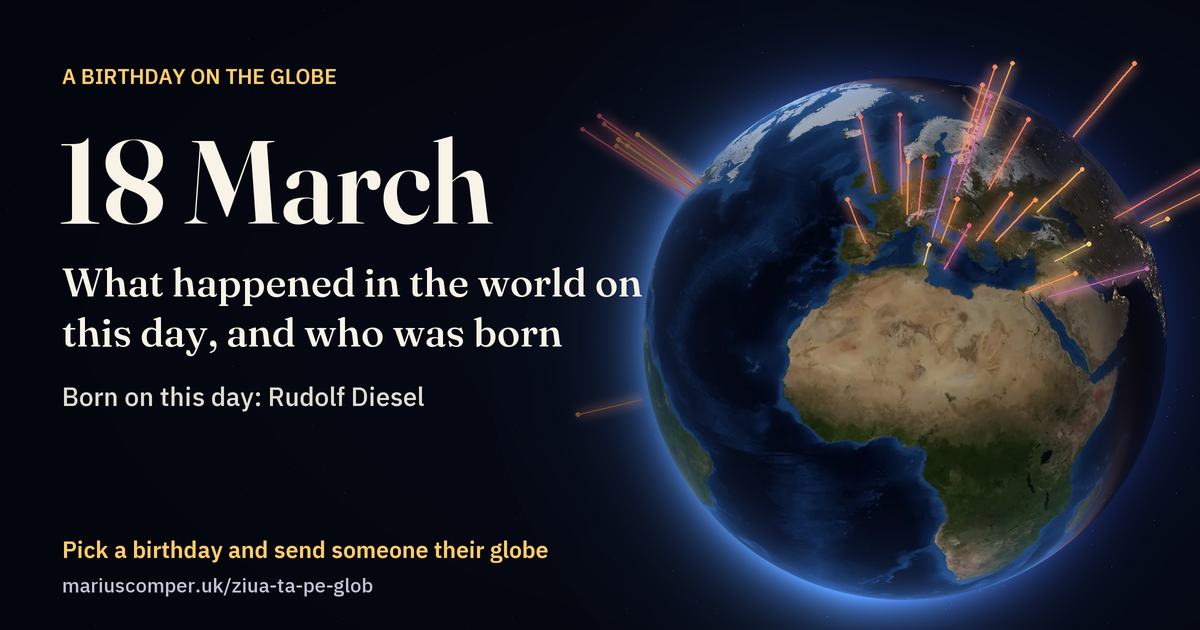
For 18 March, the English Wikipedia lists 71 events and 240 births. 33 of the events stand at their places as rays of light; nine more are dashed circles, where the sentence links only to a country or a sea. The taller the ray, the longer ago it happened. The people born that day come further down, as blue points.
A birthday, yours or someone else’s:
Turn it into a greetingScroll: the globe turns to each place
The day you were born, on the globe.
Three things from your day
Scroll: your day first, then 18 March through the years
The Earth on 18 March
The picture on the globe was assembled by NASA from satellite photographs taken in March 2004: the snow, the ice and the green are those of the month.
On 18 March the Sun passes straight overhead at noon along the parallel of 0.7° south. In London, the day lasts about 12 hours 5 minutes.
The line between day and night is tilted on the globe exactly as on this day of the year. On the dark side you can see the lights of towns.
Europe · Valletta
1571
Valletta is made the capital city of Malta.
On the map: Valletta.
Also on the day’s list of Wikipedia in Romanian.
Europe · House with Chimaeras
1901
The construction of the House with Chimaeras commenced in Kyiv.
On the map: House with Chimaeras.
Also on the day’s list of Wikipedia in Chinese.
Europe · Riga
1921
The second Peace of Riga is signed between Poland and the Soviet Union.
On the map: Riga.
Also on the day’s list of Wikipedia in Chinese.
North America · Philadelphia
1848
The premiere of William Henry Fry's Leonora in Philadelphia is the first known performance of a grand opera by an American composer.
On the map: Philadelphia.
North America · United States Congress
1968
Gold standard: The U.S. Congress repeals the requirement for a gold reserve to back US currency.
On the map: United States Congress.
18 March
Born on 18 March#
The English Wikipedia lists 240 births for this day. The blue points are the birthplaces of 60 of these people: those written about in the most Wikipedia editions, where Wikidata gives a place of birth.
Born on 18 March
1858
Rudolf Diesel, German engineer, invented the Diesel engine (died 1913)
Place of birth: Paris.
Born on 18 March
1844
Nikolai Rimsky-Korsakov, Russian composer and academic (died 1908)
Place of birth: Tikhvin.
Born on 18 March
1932
John Updike, American novelist, short story writer, and critic (died 2009)
Place of birth: Reading.
Born on 18 March
1842
Stéphane Mallarmé, French poet and critic (died 1898)
Place of birth: Paris.
Born on 18 March
1959
Luc Besson, French director, producer, and screenwriter, founded EuropaCorp
Place of birth: 15th arrondissement of Paris.
Born in Britain and Ireland
1989
Lily Collins, English-American actress
Place of birth: Guildford.
Born in Britain and Ireland
1905
Robert Donat, English actor (died 1958)
Place of birth: Withington.
Born in Britain and Ireland
1939
Ron Atkinson, English footballer and manager
Place of birth: Liverpool.
18 March
Number one in the charts that week
At the cinema
An animal recorded that day
The record can be seen in GBIF, which brings together wildlife records from around the world.
All your birthdays
The weather that day
Data: Met Office Hadley Centre (HadCET); NOAA (GHCN-Daily, Mauna Loa).
Above the Earth
Sources: Jonathan McDowell, GCAT (launches); GFZ Potsdam (Kp index). Days are counted in Universal Time.
Football that day
International matches played that day:
Source: the “International football results” dataset kept by Mart Jürisoo (CC0).
Also that day
The earthquake’s page at the USGS
Source: the USGS catalogue. The day is counted in Universal Time (UTC).
In those days
Make a link for someone
Type the name, pick the day and the year of birth. The link opens straight on their day, with their name in the greeting.
The link carries the name, date and place typed here; anyone who gets it can see them.
Put another birthday beside it
Your mother’s, your child’s, a friend’s: the two days appear side by side.
Below: 18 March through the years.
The whole globe of the day
Drag the globe to turn it. Touch a ray or a point to read what happened there.
Everything Wikipedia lists for 18 March
The list is the English Wikipedia’s, in its own wording, as it stood in October 2026. 29 events have no place on the map: the sentence links to no place with coordinates, only to places too wide to mark, or to several countries.
- 37
Roman Senate annuls Tiberius' will and proclaims Gaius Julius Caesar Augustus Germanicus (aka Caligula = Little Boots) emperor.
no place on the mapWikipedia: Tiberius - 363
A fire began in Rome that resulted in the destruction of the Temple of Apollo Palatinus.
Europe · Temple of Apollo PalatinusWikipedia: Temple of Apollo Palatinus - 417
Pope Zosimus is elected following the death of Pope Innocent I.
no place on the mapWikipedia: Pope Zosimus - 1068
An earthquake in the Levant and the Arabian Peninsula leaves up to 20,000 dead.
Asia · 1068 Near East earthquakesWikipedia: 1068 Near East earthquakes - 1229
Frederick II, Holy Roman Emperor, declares himself King of Jerusalem in the Sixth Crusade.
no place on the mapWikipedia: Sixth Crusade - 1241
First Mongol invasion of Poland: Mongols overwhelm Polish armies in Kraków in the Battle of Chmielnik and plunder the city.
Europe · ChmielnikWikipedia: Battle of Chmielnik - 1277
Charles I of Anjou acquired a claim on the Kingdom of Jerusalem in exchange for a significant sum of money.
no place on the mapWikipedia: Charles I of Anjou - 1314
Jacques de Molay, the 23rd and final Grand Master of the Knights Templar, is burned at the stake.
no place on the mapWikipedia: Knights Templar - 1438
Albert II of Habsburg becomes King of the Romans.
no place on the mapWikipedia: Albert II of Germany - 1571
Valletta is made the capital city of Malta.
Europe · VallettaWikipedia: Valletta - 1608
Susenyos is formally crowned Emperor of Ethiopia.
Africa · EthiopiaWikipedia: Susenyos I - 1644
The Third Anglo-Powhatan War begins in the Colony of Virginia.
North America · Colony of VirginiaWikipedia: Anglo-Powhatan Wars - 1673
English lord John Berkeley sells his half of New Jersey to the Quakers.
North America · New JerseyWikipedia: John Berkeley, 1st Baron Berkeley of Stratton - 1741
New York governor George Clarke's complex at Fort George is burned in an arson attack, starting the New York Conspiracy of 1741.
North America · Fort AmsterdamWikipedia: New York Conspiracy of 1741 - 1766
American Revolution: The British Parliament repeals the Stamp Act.
no place on the mapWikipedia: American Revolution - 1793
Flanders Campaign of the French Revolution, Battle of Neerwinden.
Europe · Battle of NeerwindenWikipedia: Low Countries theatre of the War of the First Coalition - 1793
The first modern republic in Germany, the Republic of Mainz, is declared by Andreas Joseph Hofmann.
no place on the mapWikipedia: Republic - 1834
Six farm labourers from Tolpuddle, Dorset, England are sentenced to be transported to Australia for forming a trade union.
Britain & Ireland · TolpuddleWikipedia: Tolpuddle Martyrs - 1838
The British soldier-explorer John Wood came close to rediscovering the ancient Greco-Bactrian city of Ai-Khanoum in modern Afghanistan.
Asia · Ai-KhanoumWikipedia: John Wood - 1848
Revolutions of 1848: A rebellion arises in Milan which in five days of street fighting drove Marshal Radetzky and his Austrian soldiers from the city.
Europe · Five Days of MilanWikipedia: Revolutions of 1848 - 1848
The premiere of William Henry Fry's Leonora in Philadelphia is the first known performance of a grand opera by an American composer.
North America · PhiladelphiaWikipedia: William Henry Fry - 1861
Spain would annex annex the Dominican Republic, which would last for four years.
no place on the mapWikipedia: Spanish annexation of the Dominican Republic - 1865
American Civil War: The Congress of the Confederate States adjourns for the last time.
North America · United StatesWikipedia: American Civil War - 1871
Declaration of the Paris Commune; President of the French Republic, Adolphe Thiers, orders the evacuation of Paris.
no place on the mapWikipedia: Paris Commune - 1892
Canadian governor general Lord Stanley of Preston pledged to donate an award to Canada's top-ranked amateur ice hockey club, now known as the Stanley Cup, the oldest professional sports trophy in North America.
no place on the mapWikipedia: Frederick Stanley, 16th Earl of Derby - 1899
Phoebe, a satellite of Saturn, becomes the first to be discovered with photographs, taken in August 1898, by William Henry Pickering.
no place on the mapWikipedia: Phoebe - 1901
The Kumasi Mutiny of 1901 begins.
no place on the mapWikipedia: Kumasi Mutiny of 1901 - 1901
The construction of the House with Chimaeras commenced in Kyiv.
Europe · House with ChimaerasWikipedia: House with Chimaeras - 1902
Macario Sakay issues Presidential Order No. 1 of his Tagalog Republic.
no place on the mapWikipedia: Macario Sakay - 1906
Romanian inventor Traian Vuia became the first person to fly a heavier-than-air monoplane with an unassisted takeoff.
no place on the mapWikipedia: Traian Vuia - 1913
King George I of Greece is assassinated in the recently liberated city of Thessaloniki.
Europe · ThessalonikiWikipedia: George I of Greece - 1915
World War I: During the Battle of Gallipoli, three battleships are sunk during a failed British and French naval attack on the Dardanelles.
no place on the mapWikipedia: World War I - 1921
Mongolian Revolution of 1921: The Mongolian People's Army defeats local Chinese forces at Altanbulag, Selenge (then known as Maimachen). This battle was seen as the birthday of the People's Army and completed the expulsion of Chinese militants in Mongolia.
Asia · Altanbulag, SelengeWikipedia: Mongolian Revolution of 1921 - 1921
The Kronstadt rebellion is suppressed by the Red Army.
Europe · Kronstadt rebellionWikipedia: Kronstadt rebellion - 1921
The second Peace of Riga is signed between Poland and the Soviet Union.
Europe · RigaWikipedia: Treaty of Riga - 1922
In India, Mohandas Gandhi is sentenced to six years in prison for civil disobedience, of which he serves only two.
no place on the mapWikipedia: Mahatma Gandhi - 1925
The 1925 Tri-State tornado hits the Midwestern states of Missouri, Illinois, and Indiana, killing 695 people.
no place on the mapWikipedia: 1925 Tri-State tornado - 1937
Spanish Civil War: Spanish Republican forces defeat the Italians at the Battle of Guadalajara.
Europe · Battle of GuadalajaraWikipedia: Battle of Guadalajara - 1937
The New London School explosion in New London, Texas, kills 300 people, mostly children.
North America · New London School explosionWikipedia: New London School explosion - 1938
Mexico creates Pemex by expropriating all foreign-owned oil reserves and facilities.
no place on the mapWikipedia: Mexican oil expropriation - 1940
World War II: Adolf Hitler and Benito Mussolini meet at the Brenner Pass in the Alps and agree to form an alliance against France and the United Kingdom.
Europe · AlpsWikipedia: World War II - 1942
The War Relocation Authority is established in the United States to take Japanese Americans into custody.
no place on the mapWikipedia: War Relocation Authority - 1944
Mount Vesuvius in Italy erupts, killing 26 people, causing thousands to flee their homes, and destroying dozens of Allied bombers.
Europe · Mount VesuviusWikipedia: Mount Vesuvius - 1945
World War II: 40th Infantry Division, spearheaded by the 185th US Infantry Regiment, lands unopposed in Tigbauan, forcing the Japanese forces to surrender and General Macario Peralta and Gen. Gen. Eichelberger to declare the Liberation of Panay, Romblon and Guimaras.
Asia · TigbauanWikipedia: Tigbauan - 1948
Soviet consultants leave Yugoslavia in the first sign of the Tito–Stalin split.
no place on the mapWikipedia: Tito–Stalin split - 1953
An earthquake hits western Turkey, killing at least 1,070 people.
Asia · 1953 Yenice–Gönen earthquakeWikipedia: 1953 Yenice–Gönen earthquake - 1959
The Hawaii Admission Act is signed into law.
no place on the mapWikipedia: Hawaii Admission Act - 1959
Tibetan uprising: After the 14th Dalai Lama sought refuge at Sera Monastery in Lhasa, Tibet, Chinese forces bombarded the monastery, inflicting severe destruction and killing hundreds of Buddhist monks.
Asia · Lhasa DistrictWikipedia: 1959 Tibetan uprising - 1962
The Évian Accords end the Algerian War of Independence, which had begun in 1954.
Europe · Évian AccordsWikipedia: Évian Accords - 1965
Cosmonaut Alexei Leonov, leaving his spacecraft Voskhod 2 for 12 minutes, becomes the first person to walk in space.
no place on the mapWikipedia: Astronaut - 1966
United Arab Airlines Flight 749 crashes on approach to Cairo International Airport in Cairo, Egypt, killing 30 people.
Africa · Cairo International AirportWikipedia: United Arab Airlines Flight 749 - 1967
The supertanker Torrey Canyon runs aground off the Cornish coast.
no place on the mapWikipedia: Oil tanker - 1968
Gold standard: The U.S. Congress repeals the requirement for a gold reserve to back US currency.
North America · United States CongressWikipedia: United States Congress - 1969
The United States begins secretly bombing the Sihanouk Trail in Cambodia, used by communist forces to infiltrate South Vietnam.
no place on the mapWikipedia: Operation Menu - 1970
Lon Nol ousts Prince Norodom Sihanouk of Cambodia.
Asia · CambodiaWikipedia: 1970 Cambodian coup d'état - 1970
U.S. postal workers began an eight-day strike after Congress raised their wages by only 4 percent despite increasing its own pay by 41 percent.
North America · United States CongressWikipedia: 1970 United States postal strike - 1971
Peru: A landslide crashes into Yanawayin Lake, killing 200 people at the mining camp of Chungar.
Latin America · Yanawayin LakeWikipedia: Peru - 1974
Güzel İstanbul, a nude sculpture by Gürdal Duyar in Istanbul, is torn down in the middle of the night.
no place on the mapWikipedia: Güzel İstanbul - 1977
The punk group the Clash released their first single, "White Riot", described as their "most controversial song" due to its lyrics about class economics and race.
no place on the mapWikipedia: The Clash - 1980
A Vostok-2M rocket at Plesetsk Cosmodrome Site 43 explodes during a fueling operation, killing 48 people.
Europe · 1980 Plesetsk launch pad disasterWikipedia: 1980 Plesetsk launch pad disaster - 1985
The first episode of the soap opera Neighbours was broadcast on the Seven Network, later becoming the longest-running drama in Australian television history.
no place on the mapWikipedia: Television in Australia - 1990
Germans in the German Democratic Republic vote in the first democratic elections in the former communist dictatorship.
Europe · East GermanyWikipedia: 1990 East German general election - 1990
In the largest art theft in US history, 12 paintings, collectively worth around $500 million, are stolen from the Isabella Stewart Gardner Museum in Boston.
North America · Isabella Stewart Gardner Museum theftWikipedia: Isabella Stewart Gardner Museum theft - 1994
Bosnia's Bosniaks and Croats sign the Washington Agreement, ending war between the Croatian Republic of Herzeg-Bosnia and the Republic of Bosnia and Herzegovina, and establishing the Federation of Bosnia and Herzegovina.
North America · Washington, D.C.Wikipedia: Washington Agreement - 1996
A nightclub fire in Quezon City, Philippines kills 162 people.
Asia · Ozone Disco fireWikipedia: Ozone Disco fire - 1997
The tail of a Russian Antonov An-24 charter plane breaks off while en route to Turkey, causing the plane to crash and killing all 50 people on board.
Europe · Stavropolskaya Aktsionernaya Avia Flight 1023Wikipedia: Stavropolskaya Aktsionernaya Avia Flight 1023 - 2005
As per a court order, the feeding tube of Terri Schiavo, an American woman who suffered brain damage, was removed at the request of her husband, fueling a worldwide debate on euthanasia.
no place on the mapWikipedia: Court order - 2014
The parliaments of Russia and Crimea sign an accession treaty.
Europe · CrimeaWikipedia: 2014 Russian annexation of Crimea - 2015
The Bardo National Museum in Tunisia is attacked by gunmen. Twenty-four people, almost all tourists, are killed, and at least 50 other people are wounded.
Africa · Bardo National Museum attackWikipedia: Bardo National Museum attack - 2019
Syrian civil war: The U.S. Air Force carried out an airstrike in al-Baghuz Fawqani, killing as many as 80, a disputed number of whom were civilians.
Asia · 2019 U.S. airstrike in BaghuzWikipedia: 2019 U.S. airstrike in Baghuz - 2025
Israel launches widespread aerial bombardments and attacks on the Gaza Strip, killing at least 591 people, including children.
Asia · Gaza StripWikipedia: March 2025 Israeli attacks on the Gaza Strip
Who was born on 18 March
In order of how many Wikipedia editions have an article about each. The first 60 of 240 are shown.
- 1837
Grover Cleveland, American lawyer and politician, 22nd and 24th President of the United States (died 1908)
Grover Cleveland BirthplaceWikipedia: Grover Cleveland - 1869
Neville Chamberlain, English businessman and politician, Prime Minister of the United Kingdom (died 1940)
BirminghamWikipedia: Neville Chamberlain - 1858
Rudolf Diesel, German engineer, invented the Diesel engine (died 1913)
- 1844
Nikolai Rimsky-Korsakov, Russian composer and academic (died 1908)
- 1932
John Updike, American novelist, short story writer, and critic (died 2009)
ReadingWikipedia: John Updike - 1936
F. W. de Klerk, South African lawyer and politician, former State President of South Africa, Nobel Prize laureate (died 2021)
JohannesburgWikipedia: F. W. de Klerk - 1842
Stéphane Mallarmé, French poet and critic (died 1898)
- 1959
Luc Besson, French director, producer, and screenwriter, founded EuropaCorp
15th arrondissement of ParisWikipedia: Luc Besson - 1782
John C. Calhoun, American lawyer and politician, 7th Vice President of the United States (died 1850)
AbbevilleWikipedia: John C. Calhoun - 1874
Nikolai Berdyaev, Russian-French philosopher and theologian (died 1948)
ObukhivWikipedia: Nikolai Berdyaev - 1989
Lily Collins, English-American actress
GuildfordWikipedia: Lily Collins - 1979
Adam Levine, American singer-songwriter, guitarist, and television personality
Los AngelesWikipedia: Adam Levine - 1928
Fidel V. Ramos, Filipino general and politician, 12th President of the Philippines (died 2022)
LingayenWikipedia: Fidel V. Ramos - 1970
Queen Latifah, American rapper, producer, and actress
NewarkWikipedia: Queen Latifah - 1813
Christian Friedrich Hebbel, German poet and playwright (died 1864)
WesselburenWikipedia: Friedrich Hebbel - 1828
Randal Cremer, English activist and politician, Nobel Prize laureate (died 1908)
FarehamWikipedia: Randal Cremer - 1950
Brad Dourif, American actor
HuntingtonWikipedia: Brad Dourif - 1963
Vanessa L. Williams, American model, actress, and singer
The BronxWikipedia: Vanessa Williams - 1495
Mary Tudor, Queen of France (died 1533)
Richmond PalaceWikipedia: Mary Tudor, Queen of France - 1609
Frederick III of Denmark (died 1670)
HaderslevWikipedia: Frederick III of Denmark - 1903
Galeazzo Ciano, Italian journalist and politician, Italian Minister of Foreign Affairs (died 1944)
LivornoWikipedia: Galeazzo Ciano - 1893
Wilfred Owen, English soldier and poet (died 1918)
OswestryWikipedia: Wilfred Owen - 1634
Madame de La Fayette, French author (died 1693)
- 1905
Robert Donat, English actor (died 1958)
WithingtonWikipedia: Robert Donat - 1956
Ingemar Stenmark, Swedish skier
- 1969
Vasyl Ivanchuk, Ukrainian chess player
KopychyntsiWikipedia: Vasyl Ivanchuk - 1938
Shashi Kapoor, Indian actor and producer (died 2017)
KolkataWikipedia: Shashi Kapoor - 1999
Diogo Dalot, Portuguese footballer
- 1877
Edgar Cayce, American mystic and psychic (died 1945)
HopkinsvilleWikipedia: Edgar Cayce - 1981
Fabian Cancellara, Swiss cyclist
Wohlen bei BernWikipedia: Fabian Cancellara - 1982
Timo Glock, German race car driver
LindenfelsWikipedia: Timo Glock - 1997
Ciara Bravo, American actress
AlexandriaWikipedia: Ciara Bravo - 1959
Irene Cara, American singer-songwriter and actress (died 2022)
The BronxWikipedia: Irene Cara - 1977
Willy Sagnol, French footballer and manager
Saint-ÉtienneWikipedia: Willy Sagnol - 1690
Christian Goldbach, Prussian-German mathematician and academic (died 1764)
KönigsbergWikipedia: Christian Goldbach - 1913
René Clément, French director and screenwriter (died 1996)
BordeauxWikipedia: René Clément - 1926
Peter Graves, American actor and director (died 2010)
MinneapolisWikipedia: Peter Graves - 1981
Tom Starke, German footballer
DresdenWikipedia: Tom Starke - 1780
Miloš Obrenović, Serbian prince (died 1860)
Gornja DobrinjaWikipedia: Miloš Obrenović - 1941
Wilson Pickett, American singer-songwriter (died 2006)
PrattvilleWikipedia: Wilson Pickett - 1964
Bonnie Blair, American speed skater
CornwallWikipedia: Bonnie Blair - 1939
Ron Atkinson, English footballer and manager
LiverpoolWikipedia: Ron Atkinson - 1981
Tora Berger, Norwegian biathlete
HønefossWikipedia: Tora Berger - 1986
Lykke Li, Swedish singer-songwriter
Sofia church parishWikipedia: Lykke Li - 1957
Christer Fuglesang, Swedish physicist and astronaut
- 1913
Werner Mölders, German colonel and pilot (died 1941)
GelsenkirchenWikipedia: Werner Mölders - 1976
Giovanna Antonelli, Brazilian actress and producer
Rio de JaneiroWikipedia: Giovanna Antonelli - 1980
Sébastien Frey, French footballer
Thonon-les-BainsWikipedia: Sébastien Frey - 1075
Al-Zamakhshari, Persian scholar and theologian (died 1144)
ZamakhsharWikipedia: Al-Zamakhshari - 1980
Sophia Myles, English actress
LondonWikipedia: Sophia Myles - 1922
Seymour Martin Lipset, American sociologist and academic (died 2006)
- 1966
Jerry Cantrell, American singer-songwriter and guitarist
- 1972
Reince Priebus, American lawyer and politician
- 1977
Danny Murphy, English footballer and sportscaster
ChesterWikipedia: Danny Murphy - 1984
Simone Padoin, Italian footballer
Gemona del FriuliWikipedia: Simone Padoin - 1987
Rebecca Soni, American swimmer
FreeholdWikipedia: Rebecca Soni - 1922
Egon Bahr, German journalist and politician, Federal Minister for Special Affairs of Germany (died 2015)
TreffurtWikipedia: Egon Bahr - 1968
Temur Ketsbaia, Georgian footballer and manager
- 1578
Adam Elsheimer, German painter (died 1610)
FrankfurtWikipedia: Adam Elsheimer - 1949
Åse Kleveland, Norwegian singer and politician, Norwegian Minister of Culture
StockholmWikipedia: Åse Kleveland
What is celebrated on 18 March
- Anniversary of the Oil Expropriation (Mexico)
- Christian feast day: Blessed Aimée-Adèle Le Bouteiller
- Christian feast day: Alexander of Jerusalem
- Christian feast day: Anselm of Lucca
- Christian feast day: Cyril of Jerusalem
- Christian feast day: Edward the Martyr
- Christian feast day: Fridianus
- Christian feast day: Salvator
- Christian feast day: March 18 (Eastern Orthodox liturgics)
- Flag Day (Aruba)
- Gallipoli Memorial Day (Turkey)
- Men's and Soldiers' Day (Mongolia)
- Ordnance Factories' Day (India)
- Sheelah's Day (Ireland, Canada, Australia)
A greeting link for someone
Type a name and, if you like, the year of birth. The link opens with a greeting, and beside each event it says how old the person turned that day, or how many years before their birth it happened.
The name and the year go only into the link you send.
All 366 days
How the globe is made
Where the events come from
Each edition of this page uses the day’s list from Wikipedia in its own language: Romanian, English, Spanish, Chinese. The lists are written by volunteers and differ from one edition to the next; the text of each event is Wikipedia’s, with a link to the article. A row that appears twice in a list is shown once. The lists have not been checked event by event: they are Wikipedia’s, mistakes included.
For events before 1582, and for countries that moved to the Gregorian calendar later (Britain in 1752, Russia in 1918), the same day may be counted Old Style in one list and New Style in another.
The chapter “What the other Wikipedias remember” adds up to five events a day from the lists of the other three editions, only for years in which the English list has nothing on that day. They were translated for this page, passed the same filters as the tour, and are not counted among the events of the English list.
How an event gets onto the map
The place comes from Wikidata. If the sentence links to the article about the event itself (a battle, an opening, an earthquake), dated to the same year, the ray stands on its coordinates or on those of its location. Otherwise it stands on the first place the sentence links to: a town, a building, a mountain, an island. This second step can be wrong: sometimes the sentence only mentions the place. That is why the page says, under each event, which place the ray stands on.
When the sentence links to a single state or province, or to a single sea, lake or desert larger than 5,000 km², the globe shows a dashed circle, not a ray. The circle has the area Wikidata gives, with its radius kept between 1.2° and 16°, or a radius of 4.5° when Wikidata gives no area; it says only that the sentence links to that place. Organisations, ships, spacecraft, museum objects, rivers, mountain ranges, languages and continents are never used as places. When a sentence names several states and no exact place, the event stays in the list only.
What the height means
The height of a ray shows how many years have passed, on a logarithmic scale: 10 years, 100 years and 1,000 years are equal steps apart; anything older than about 2,600 years has the tallest ray. The colour runs from pale yellow for recent years to violet for antiquity.
Where the tour stops
In each region the tour stops at up to three events (five in Britain and Ireland), chosen mainly by three things: whether Wikipedia’s editors put the event in the “On this day” box of their main page (the English, Spanish and Chinese editions), how many Wikipedia editions have an article about it, and how many of the four lists include it. Events whose sentence or article is about a war, an attack, a crime or a disaster are left out of the tour; they stay in the whole list, in Wikipedia’s wording. The filter is a list of words and a list of Wikidata types, so it can miss some.
The tour of births names the people with articles in the most editions and leaves aside those whom the list or Wikidata describes as rulers, politicians, commanders, leaders of movements or criminals; they stay in the list.
The Earth and the Sun
The daytime images are NASA’s Blue Marble Next Generation mosaics, one for each month of 2004; the night side is Black Marble 2016. The tilt of the line between day and night is computed for the day; the hour is chosen so that the place being read is in daylight. The latitude where the Sun stands overhead is the average of the four years of the leap cycle; in a given year it can differ by up to 0.4°.
The day you were born
The number ones come from the weekly lists on Wikipedia: Billboard for the United States (from 1940; the Hot 100 from August 1958), the UK Singles Chart (from November 1952), Los 40 Principales for Spain (from July 1966) and, for Romania, the Romanian Top 100 and Airplay 100 (2001–2021, with missing weeks). The page shows the chart of the week in which the day of birth falls, with its date; Billboard and the UK chart are dated at the end of their week. For Romania before 2001 and for China these sources have no weekly chart.
The films are those that reached cinemas in the United States up to ten days before or three days after that day (some of them in a few cinemas at first), from the English Wikipedia’s yearly lists (from 1968), in order of how many editions have an article about them. The events “in those days” are the ones on the neighbouring days’ lists that carry the year of birth, passed through the same filter as the tour.
The day of birth, year included
The Moon, the star sign and the constellation are worked out by the page itself, for noon Universal Time on the day. The lit part of the Moon is rounded and can differ by a few per cent from that at the hour of birth. The sign follows the usual zodiac of twelve equal parts starting at the March equinox; the constellation is the one the Sun actually stood in front of, by the borders set by the International Astronomical Union, and within a day of a border the page does not name it. When the Sun changes sign while it is that day anywhere on Earth, the page gives the moment of crossing, rounded to ten minutes and accurate to within about a quarter of an hour, and the clock time in a few cities, with the time zone and summer time of that year.
The year in the Chinese calendar is the one your device’s own calendar gives for the date, checked against the Hong Kong Observatory’s tables. “All your birthdays” uses the same sources as the rest of the chapter for the same day in every year since the birth: the temperature, well-known launches that took place on that very day, matches of the teams the edition follows, snow deeper than 10 cm and strong geomagnetic storms. The three things at the top and the four on the picture are chosen in a fixed order (the song, the animal, a full Moon, a well-known launch before an ordinary earthquake); on the picture you can change them.
When the link carries a year of birth, the page adds a few things about that exact day. The weather is the Met Office’s Central England temperature record and the readings from New York’s Central Park; the “usual high” is the average of the daily highs of 1961–1990 for that date, with two days either side. The carbon dioxide figure is the monthly mean at the Mauna Loa observatory, where measurements begin in March 1958.
The earthquake is the one with the largest magnitude in the USGS catalogue for that day, counted in Universal Time. Before the 1960s the catalogue has gaps even above magnitude 5.5, so in the older years many days have no earthquake. The page gives only the magnitude and the place: the country the epicentre falls in or, when the epicentre is at sea within 300 km of a coast, the nearest country; farther out, only the ocean.
The launches are those that reached orbit or left for the Moon and the planets, from Jonathan McDowell’s GCAT catalogue. If nothing left that day, the page shows the nearest launch within three days before or after, and says how many days away it was. The geomagnetic storm appears only when the Kp index reached at least 5 in one of the day’s eight three-hour intervals.
The animal comes from GBIF: an observation made by a person (the animal seen or heard, or its tracks), dated to that exact day, with coordinates and a CC0 or CC BY licence. Only a few hundred well-known species are searched (mammals, birds, turtles, butterflies); of those noted that day, mammals and species with articles in many Wikipedia editions come first; birds noted almost every day, and species used recently, wait their turn. Observations dated 1 January are left out, because records without a day are often filed there. An observation shows that the animal was recorded there, not how many animals there were.
The matches are those between national teams. Only matches of England, Scotland, Wales, Northern Ireland, the Republic of Ireland, the United States, Canada and Australia are shown, along with those at the big final tournaments. The picture to send is drawn in the page from the day’s globe and the facts above, and stays on your device until you send it.
Sources
- Events, births and holidays: the day’s page on Wikipedia, text under CC BY-SA 4.0.
- Coordinates, places of birth and the number of editions: Wikidata (CC0).
- The Earth by day: NASA Blue Marble Next Generation. The Earth by night: NASA Black Marble 2016.
- Borders and regions: Natural Earth.
- World population and births per year: UN World Population Prospects 2024.
- Charts and films: Wikipedia’s lists for Billboard, the UK Singles Chart, Los 40 Principales, Romanian Top 100, Airplay 100 and American films by year (CC BY-SA 4.0).
- Weather: Met Office Hadley Centre, HadCET (Open Government Licence) and NOAA GHCN-Daily, New York Central Park. Carbon dioxide: NOAA Global Monitoring Laboratory, Mauna Loa.
- Earthquakes: the USGS catalogue. Launches: Jonathan McDowell, GCAT (CC BY). Kp index: GFZ Potsdam (CC BY 4.0). Matches: International football results, Mart Jürisoo (CC0).
- Animal observations: GBIF, with a link to each record; species names come from Wikidata.