A birthday on the globe
27 April on the globe: what happened in the world on this day, and who was born
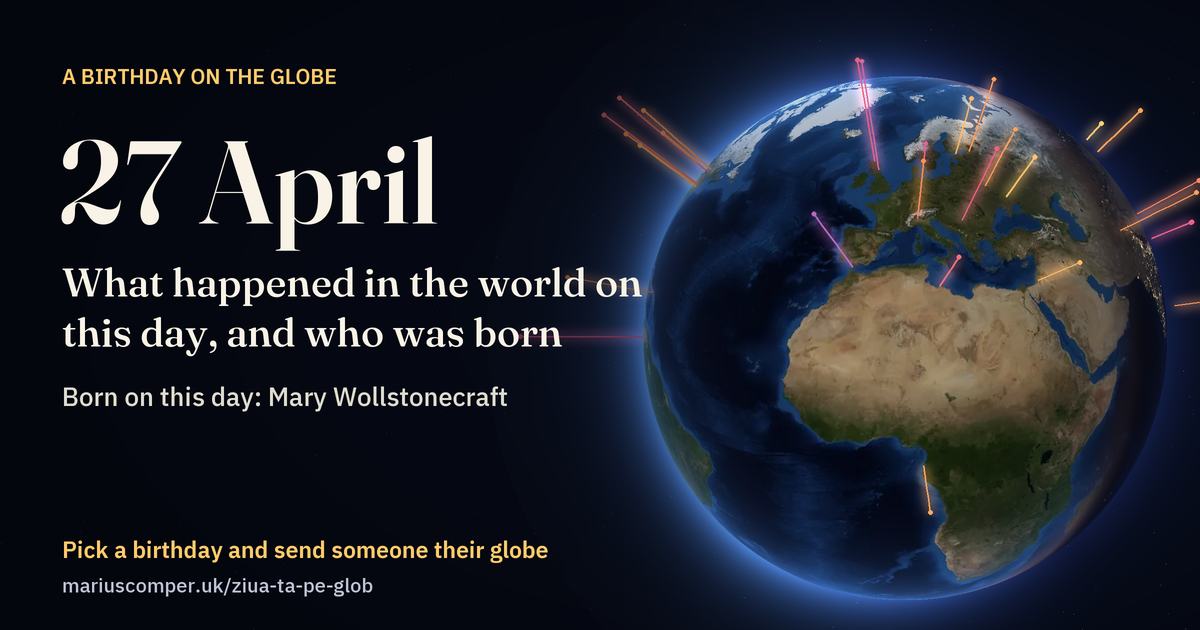
For 27 April, the English Wikipedia lists 57 events and 187 births. 29 of the events stand at their places as rays of light; seven more are dashed circles, where the sentence links only to a country or a sea. The taller the ray, the longer ago it happened. The people born that day come further down, as blue points.
A birthday, yours or someone else’s:
Turn it into a greetingScroll: the globe turns to each place
The day you were born, on the globe.
Three things from your day
Scroll: your day first, then 27 April through the years
The Earth on 27 April
The picture on the globe was assembled by NASA from satellite photographs taken in April 2004: the snow, the ice and the green are those of the month.
On 27 April the Sun passes straight overhead at noon along the parallel of 14.0° north. In London, the day lasts about 14 hours 35 minutes.
Beyond 76° north the Sun no longer sets; beyond 76° south it no longer rises.
The line between day and night is tilted on the globe exactly as on this day of the year. On the dark side you can see the lights of towns.
Europe · Belgrade
1595
The relics of Saint Sava are incinerated in Belgrade on the Vračar plateau by Ottoman Grand Vizier Sinan Pasha; the site of the incineration is now the location of the Church of Saint Sava, one of the largest Orthodox churches in the world
On the map: Belgrade.
Asia · Cebu City
1565
Cebu is established becoming the first Spanish settlement in the Philippines.
On the map: Cebu City.
Also on the day’s list of Wikipedia in Spanish and Chinese.
Asia · Jerusalem
2007
Israeli archaeologists discover the tomb of Herod the Great south of Jerusalem.
On the map: Jerusalem.
Latin America · Bogotá
1539
Official founding of the city of Bogotá, New Granada (nowadays Colombia), by Nikolaus Federmann and Sebastián de Belalcázar.
On the map: Bogotá.
Also on the day’s list of Wikipedia in Spanish.
North America · Expo 67
1967
Expo 67 officially opens in Montreal, Quebec, Canada with a large opening ceremony broadcast around the world. It opens to the public the next day.
On the map: the coordinates Wikidata gives for the article “Expo 67”.
Also on the day’s list of Wikipedia in Spanish.
North America · One World Trade Center
2006
Construction begins on the Freedom Tower (later renamed One World Trade Center) in New York City.
On the map: One World Trade Center.
Also on the day’s list of Wikipedia in Spanish and Chinese.
27 April
What the other Wikipedias remember#
For these years the English list has nothing on this day. The events below come from the same day’s lists on Wikipedia in Spanish and Chinese and were translated for this page.
From Wikipedia in Spanish · Algiers
1832
Near Algiers, the Foreign Legion (a group of mercenaries) fights in battle for the first time.
On the map: Algiers.
Translated from the list on Wikipedia in Spanish.
The article on Wikipedia in Spanish: Legión Extranjera Francesa
From Wikipedia in Spanish · Cornell University
1865
The Senate of the State of New York creates Cornell University.
On the map: Cornell University.
Translated from the list on Wikipedia in Spanish.
From Wikipedia in Chinese · London
1908
The 1908 Summer Olympic Games open in London.
On the map: London.
Translated from the list on Wikipedia in Chinese.
From Wikipedia in Spanish · Barcelona
1984
In Barcelona (Spain), the first Ibiza car rolls off the Seat assembly line.
On the map: Barcelona.
Translated from the list on Wikipedia in Spanish.
27 April
Born on 27 April#
The English Wikipedia lists 187 births for this day. The blue points are the birthplaces of 60 of these people: those written about in the most Wikipedia editions, where Wikidata gives a place of birth.
Born on 27 April
1759
Mary Wollstonecraft, English philosopher, historian, and novelist (died 1797)
Place of birth: Spitalfields.
Born on 27 April
1820
Herbert Spencer, English biologist, anthropologist, sociologist, and philosopher (died 1903)
Place of birth: Derby.
Born on 27 April
1791
Samuel Morse, American painter and inventor, co-invented the Morse code (died 1872)
Place of birth: Charlestown.
Born on 27 April
1891
Sergei Prokofiev, Russian pianist, composer, and conductor (died 1953)
Place of birth: Sontsivka.
Born on 27 April
1941
Fethullah Gülen, Turkish preacher and theologian (died 2024)
Place of birth: Pasinler district.
Born in Britain and Ireland
1976
Sally Hawkins, English actress
Place of birth: Dulwich.
Born in Britain and Ireland
1986
Jenna Coleman, English actress
Place of birth: Blackpool.
Born in Britain and Ireland
1987
William Moseley, English actor
Place of birth: Sheepscombe.
27 April
Number one in the charts that week
At the cinema
An animal recorded that day
The record can be seen in GBIF, which brings together wildlife records from around the world.
All your birthdays
The weather that day
Data: Met Office Hadley Centre (HadCET); NOAA (GHCN-Daily, Mauna Loa).
Above the Earth
Sources: Jonathan McDowell, GCAT (launches); GFZ Potsdam (Kp index). Days are counted in Universal Time.
Football that day
International matches played that day:
Source: the “International football results” dataset kept by Mart Jürisoo (CC0).
Also that day
The earthquake’s page at the USGS
Source: the USGS catalogue. The day is counted in Universal Time (UTC).
In those days
Make a link for someone
Type the name, pick the day and the year of birth. The link opens straight on their day, with their name in the greeting.
The link carries the name, date and place typed here; anyone who gets it can see them.
Put another birthday beside it
Your mother’s, your child’s, a friend’s: the two days appear side by side.
Below: 27 April through the years.
The whole globe of the day
Drag the globe to turn it. Touch a ray or a point to read what happened there.
Everything Wikipedia lists for 27 April
The list is the English Wikipedia’s, in its own wording, as it stood in October 2026. 21 events have no place on the map: the sentence links to no place with coordinates, only to places too wide to mark, or to several countries.
- 247
Philip the Arab marks the millennium of Rome with a celebration of the ludi saeculares.
no place on the mapWikipedia: Secular Games - 395
Emperor Arcadius marries Aelia Eudoxia, daughter of the Frankish general Flavius Bauto. She becomes one of the more powerful Roman empresses of Late Antiquity.
no place on the mapWikipedia: Arcadius - 630
Shahrbaraz usurped the throne of the Sasanian Empire from Ardashir III, but was himself killed six weeks later.
Asia · Sasanian EmpireWikipedia: Shahrbaraz - 711
Islamic conquest of Hispania: Moorish troops led by Tariq ibn Ziyad land at Gibraltar to begin their invasion of the Iberian Peninsula (Al-Andalus).
Europe · GibraltarWikipedia: Muslim conquest of the Iberian Peninsula - 1296
First War of Scottish Independence: John Balliol's Scottish army is defeated by an English army commanded by John de Warenne, 6th Earl of Surrey at the Battle of Dunbar.
Britain & Ireland · Battle of DunbarWikipedia: Battle of Dunbar - 1509
Pope Julius II places the Italian state of Venice under interdict.
Europe · Republic of VeniceWikipedia: Pope Julius II - 1521
Battle of Mactan: Explorer Ferdinand Magellan is killed by natives in the Philippines led by chief Lapulapu.
Asia · Battle of MactanWikipedia: Battle of Mactan - 1522
A Spanish-Imperial army defeats French-Venetian army in the battle of Bicocca. The battle marks the end of dominance of Swiss mercenaries on the battlefield and is one of the first where firearms play a decisive role.
Europe · Battle of BicoccaWikipedia: Battle of Bicocca - 1539
Official founding of the city of Bogotá, New Granada (nowadays Colombia), by Nikolaus Federmann and Sebastián de Belalcázar.
Latin America · BogotáWikipedia: Bogotá - 1565
Cebu is established becoming the first Spanish settlement in the Philippines.
Asia · Cebu CityWikipedia: Cebu City - 1595
The relics of Saint Sava are incinerated in Belgrade on the Vračar plateau by Ottoman Grand Vizier Sinan Pasha; the site of the incineration is now the location of the Church of Saint Sava, one of the largest Orthodox churches in the world
Europe · BelgradeWikipedia: Saint Sava - 1650
The Battle of Carbisdale: A Royalist army from Orkney invades mainland Scotland but is defeated by a Covenanter army.
Britain & Ireland · Battle of CarbisdaleWikipedia: Battle of Carbisdale - 1667
Blind and impoverished, John Milton sells Paradise Lost to a printer for £10, so that it could be entered into the Stationers' Register.
no place on the mapWikipedia: John Milton - 1777
American Revolutionary War: British Army regulars defeated Patriot militias in the Battle of Ridgefield, galvanizing resistance in the Connecticut Colony.
North America · Battle of RidgefieldWikipedia: Battle of Ridgefield - 1805
First Barbary War: United States Marines and Berbers attack the Tripolitan city of Derna (The "shores of Tripoli" in the Marines' Hymn).
Africa · Tripoli, LibyaWikipedia: First Barbary War - 1810
Ludwig van Beethoven composed his Bagatelle No. 25 in A minor, better known as "Für Elise" , one of his most popular compositions.
no place on the mapWikipedia: Ludwig van Beethoven - 1813
War of 1812: American troops capture York, the capital of Upper Canada, in the Battle of York.
North America · Battle of YorkWikipedia: Battle of York - 1848
The French National Assembly under Victor Schœlcher proclaims the abolition of slavery within France and it's colonies following the February Revolution.
no place on the mapWikipedia: French Revolution of 1848 - 1861
American President Abraham Lincoln suspends the writ of habeas corpus.
no place on the mapWikipedia: President of the United States - 1904
Chris Watson became the first prime minister of Australia from the Australian Labor Party.
no place on the mapWikipedia: Chris Watson - 1906
The State Duma of the Russian Empire meets for the first time.
Asia · Russian EmpireWikipedia: State Duma - 1909
Sultan of Ottoman Empire Abdul Hamid II is overthrown, and is succeeded by his brother, Mehmed V.
Asia · Ottoman EmpireWikipedia: Sultan - 1911
The Second Canton Uprising takes place in Guangzhou, Qing China, but is suppressed.
Asia · GuangzhouWikipedia: Second Guangzhou Uprising - 1927
Carabineros de Chile (Chilean national police force and gendarmerie) are created.
Latin America · ChileWikipedia: Carabineros de Chile - 1936
The United Auto Workers (UAW) gains autonomy from the American Federation of Labor.
no place on the mapWikipedia: United Auto Workers - 1936
The trilogy The Adventure Girls, by the children's author Clair Blank, was copyrighted by A. L. Burt.
no place on the mapWikipedia: The Adventure Girls - 1941
World War II: German troops enter Athens.
no place on the mapWikipedia: World War II - 1945
World War II: Benito Mussolini is arrested by Italian partisans in Dongo, while attempting escape disguised as a German soldier.
Europe · Dongo, LombardyWikipedia: Benito Mussolini - 1945
World War II: The last German formations withdraw from Finland to Norway. The Lapland War and thus, World War II in Finland, comes to an end and the Raising the Flag on the Three-Country Cairn photograph is taken.
no place on the mapWikipedia: Lapland War - 1949
In response to the treatment of Lorenzo Gamboa under the White Australia policy, the Philippine House of Representatives passed a bill banning Australians from the country.
no place on the mapWikipedia: Lorenzo Gamboa - 1953
Operation Moolah offers $50,000 to any pilot who defects with a fully mission-capable Mikoyan-Gurevich MiG-15 to South Korea. The first pilot was to receive $100,000.
no place on the mapWikipedia: Operation Moolah - 1961
Prime Minister Milton Margai led the Sierra Leone Colony and Protectorate to independence from the United Kingdom.
Africa · Sierra Leone Colony and ProtectorateWikipedia: Milton Margai - 1965
Indonesia–Malaysia confrontation: British forces repelled a surprise Indonesian attack on a base at Plaman Mapu in Sarawak.
Asia · Battle of Plaman MapuWikipedia: Battle of Plaman Mapu - 1967
Expo 67 officially opens in Montreal, Quebec, Canada with a large opening ceremony broadcast around the world. It opens to the public the next day.
North America · Expo 67Wikipedia: Expo 67 - 1974
One hundred nine people are killed in a plane crash near Pulkovo Airport.
Europe · 1974 Leningrad Ilyushin Il-18 crashWikipedia: 1974 Leningrad Ilyushin Il-18 crash - 1976
Thirty-seven people are killed when American Airlines Flight 625 crashes at Cyril E. King Airport in Saint Thomas, U.S. Virgin Islands.
Latin America · American Airlines Flight 625Wikipedia: American Airlines Flight 625 - 1978
John Ehrlichman, a former aide to U.S. President Richard Nixon, is released from the Federal Correctional Institution, Safford, Arizona, after serving 18 months for Watergate-related crimes.
North America · Federal Correctional Institution, SaffordWikipedia: Federal Correctional Institution, Safford - 1978
The Saur Revolution begins in Afghanistan, ending the following morning with the murder of Afghan President Mohammed Daoud Khan and the establishment of the Democratic Republic of Afghanistan.
Asia · Saur RevolutionWikipedia: Saur Revolution - 1978
Willow Island disaster: In the deadliest construction accident in United States history, 51 construction workers are killed when a cooling tower under construction collapses at the Pleasants Power Station in Willow Island, West Virginia.
North America · Willow Island disasterWikipedia: Willow Island disaster - 1985
The black-ball final, one of the most famous snooker matches in history, began between Steve Davis and Dennis Taylor.
no place on the mapWikipedia: 1985 World Snooker Championship final - 1986
The city of Pripyat and surrounding areas are evacuated due to the Chernobyl disaster.
Europe · Chernobyl disasterWikipedia: Chernobyl disaster - 1987
The U.S. Department of Justice bars Austrian President Kurt Waldheim (and his wife, Elisabeth, who had also been a Nazi) from entering the US, charging that he had aided in the deportations and executions of thousands of Jews and others as a German Army officer during World War II.
no place on the mapWikipedia: World War II - 1989
The April 27 demonstrations, student-led protests responding to the April 26 Editorial, during the Tiananmen Square protests of 1989.
Asia · 1989 Tiananmen Square protests and massacreWikipedia: April 27 demonstrations - 1992
Betty Boothroyd becomes the first woman to be elected Speaker of the British House of Commons in its 700-year history.
no place on the mapWikipedia: 1992 Speaker of the British House of Commons election - 1992
The Federal Republic of Yugoslavia, comprising Serbia and Montenegro, is proclaimed.
no place on the mapWikipedia: Serbia and Montenegro - 1992
The Russian Federation and 12 other former Soviet republics become members of the International Monetary Fund and the World Bank.
Asia · RussiaWikipedia: Russia - 1993
Most of the Zambia national football team lose their lives in a plane crash off Libreville, Gabon en route to Dakar, Senegal to play a 1994 FIFA World Cup qualifying match against Senegal.
Africa · 1993 Zambia national football team plane crashWikipedia: 1993 Zambia national football team plane crash - 1994
South African general election: The first democratic general election in South Africa, in which black citizens could vote. The Interim Constitution comes into force.This marked the end of Apartheid.
no place on the mapWikipedia: 1994 South African general election - 1997
American spree killer Andrew Cunanan murdered Jeffrey Trail, a former friend and a Gulf War veteran, who became the first victim of Cunanan's killing spree.
no place on the mapWikipedia: Andrew Cunanan - 2005
Airbus A380 aircraft has its maiden test flight.
no place on the mapWikipedia: Airbus A380 - 2006
Construction begins on the Freedom Tower (later renamed One World Trade Center) in New York City.
North America · One World Trade CenterWikipedia: One World Trade Center - 2007
Estonian authorities remove the Bronze Soldier, a Soviet Red Army war memorial in Tallinn, amid political controversy with Russia.
Europe · Bronze Soldier of TallinnWikipedia: Bronze Soldier of Tallinn - 2007
Israeli archaeologists discover the tomb of Herod the Great south of Jerusalem.
Asia · JerusalemWikipedia: Israel - 2011
The 2011 Super Outbreak devastates parts of the Southeastern United States, especially the states of Alabama, Mississippi, Georgia, and Tennessee. Two hundred five tornadoes touched down on April 27 alone, killing more than 300 and injuring hundreds more.
no place on the mapWikipedia: 2011 Super Outbreak - 2012
At least four explosions hit the Ukrainian city of Dnipropetrovsk with at least 27 people injured.
Europe · 2012 Dnipropetrovsk explosionsWikipedia: 2012 Dnipropetrovsk explosions - 2018
The Panmunjom Declaration is signed between North and South Korea, officially declaring their intentions to end the Korean conflict.
Asia · Korean conflictWikipedia: Panmunjom Declaration - 2026
A train crash kills at least 15 people and injures 84 others near Jakarta, Indonesia.
Asia · JakartaWikipedia: 2026 Bekasi train collision
What the other Wikipedias remember
For these years the English list has nothing on this day. The events below come from the same day’s lists on Wikipedia in Spanish and Chinese and were translated for this page.
- 1832
Near Algiers, the Foreign Legion (a group of mercenaries) fights in battle for the first time.
Africa · AlgiersTranslated from the list on Wikipedia in SpanishWikipedia: Legión Extranjera Francesa - 1865
The Senate of the State of New York creates Cornell University.
North America · Cornell UniversityTranslated from the list on Wikipedia in SpanishWikipedia: Universidad Cornell - 1908
The 1908 Summer Olympic Games open in London.
- 1984
In Barcelona (Spain), the first Ibiza car rolls off the Seat assembly line.
Who was born on 27 April
In order of how many Wikipedia editions have an article about each. The first 60 of 187 are shown.
- 1822
Ulysses S. Grant, American general and politician, 18th President of the United States (died 1885)
Point PleasantWikipedia: Ulysses S. Grant - 1759
Mary Wollstonecraft, English philosopher, historian, and novelist (died 1797)
SpitalfieldsWikipedia: Mary Wollstonecraft - 1820
Herbert Spencer, English biologist, anthropologist, sociologist, and philosopher (died 1903)
- 1967
Willem-Alexander, King of the Netherlands
University Medical Center UtrechtWikipedia: Willem-Alexander of the Netherlands - 1791
Samuel Morse, American painter and inventor, co-invented the Morse code (died 1872)
CharlestownWikipedia: Samuel Morse - 1891
Sergei Prokofiev, Russian pianist, composer, and conductor (died 1953)
SontsivkaWikipedia: Sergei Prokofiev - 1941
Fethullah Gülen, Turkish preacher and theologian (died 2024)
Pasinler districtWikipedia: Fethullah Gülen - 1593
Mumtaz Mahal, Mughal empress buried at the Taj Mahal (died 1631)
- 1932
Anouk Aimée, French actress (died 2024)
17th arrondissement of ParisWikipedia: Anouk Aimée - 1927
Coretta Scott King, African-American activist and author (died 2006)
- 1969
Cory Booker, African-American lawyer and politician
Washington, D.C.Wikipedia: Cory Booker - 1955
Eric Schmidt, American engineer and businessman
Washington, D.C.Wikipedia: Eric Schmidt - 1976
Sally Hawkins, English actress
DulwichWikipedia: Sally Hawkins - 1986
Dinara Safina, Russian tennis player
MoscowWikipedia: Dinara Safina - 1910
Chiang Ching-kuo, Chinese politician, 3rd President of the Republic of China (died 1988)
Fenghua DistrictWikipedia: Chiang Ching-kuo - 1932
Casey Kasem, American disc jockey, radio celebrity, and voice actor; co-created American Top 40 (died 2014)
DetroitWikipedia: Casey Kasem - 1935
Theodoros Angelopoulos, Greek director, producer, and screenwriter (died 2012)
- 1948
Frank Abagnale Jr., American security consultant and criminal
BronxvilleWikipedia: Frank Abagnale - 1701
Charles Emmanuel III, King of Sardinia (died 1773)
- 1989
Lars Bender, German footballer
RosenheimWikipedia: Lars Bender - 1988
Lizzo, American singer and rapper
DetroitWikipedia: Lizzo - 1991
Lara Gut, Swiss skier
SorengoWikipedia: Lara Gut-Behrami - 1998
Cristian Romero, Argentine footballer
CórdobaWikipedia: Cristian Romero - 1954
Frank Bainimarama, Fijian commander and politician, 8th Prime Minister of Fiji
TailevuWikipedia: Frank Bainimarama - 1989
Sven Bender, German footballer
RosenheimWikipedia: Sven Bender - 1848
Otto, King of Bavaria (died 1916)
- 1896
Wallace Carothers, American chemist and inventor of nylon (died 1937)
BurlingtonWikipedia: Wallace Carothers - 1937
Sandy Dennis, American actress (died 1992)
HastingsWikipedia: Sandy Dennis - 1986
Jenna Coleman, English actress
BlackpoolWikipedia: Jenna Coleman - 1748
Adamantios Korais, Greek-French philosopher and scholar (died 1833)
- 1939
Stanisław Dziwisz, Polish cardinal
Raba WyżnaWikipedia: Stanisław Dziwisz - 1987
William Moseley, English actor
SheepscombeWikipedia: William Moseley - 1995
Nick Kyrgios, Australian tennis player
CanberraWikipedia: Nick Kyrgios - 1893
Draža Mihailović, Serbian general (died 1946)
IvanjicaWikipedia: Draža Mihailović - 1922
Jack Klugman, American actor (died 2012)
PhiladelphiaWikipedia: Jack Klugman - 2002
Anthony Elanga, Swedish footballer
- 85 BC
Decimus Junius Brutus Albinus, Roman politician and general (died 43 BC)
Ancient RomeWikipedia: Decimus Junius Brutus Albinus - 1840
Edward Whymper, English-French mountaineer, explorer, author, and illustrator (died 1911)
- 1913
Philip Abelson, American physicist and author (died 2004)
- 1951
Ace Frehley, American guitarist and songwriter (died 2025)
The BronxWikipedia: Ace Frehley - 1853
Jules Lemaître, French playwright and critic (died 1914)
VennecyWikipedia: Jules Lemaître - 1984
Patrick Stump, American musician, singer, and songwriter
EvanstonWikipedia: Patrick Stump - 1952
Ari Vatanen, Finnish race car driver and politician
TuupovaaraWikipedia: Ari Vatanen - 1959
Sheena Easton, Scottish-American singer-songwriter, actress, and producer
BellshillWikipedia: Sheena Easton - 1966
Yoshihiro Togashi, Japanese illustrator
Shinjō-shiWikipedia: Yoshihiro Togashi - 1980
Sybille Bammer, Austrian tennis player
- 1904
Cecil Day-Lewis, Anglo-Irish poet and author (died 1972)
County LaoisWikipedia: Cecil Day-Lewis - 1943
Helmut Marko, Austrian race car driver and manager
- 1952
George Gervin, American basketball player
DetroitWikipedia: George Gervin - 1953
Arielle Dombasle, French-American actress and model
HartfordWikipedia: Arielle Dombasle - 2005
Mathys Tel, French footballer
SarcellesWikipedia: Mathys Tel - 1912
Zohra Sehgal, Indian actress, dancer, and choreographer (died 2014)
SaharanpurWikipedia: Zohra Sehgal - 1920
Guido Cantelli, Italian conductor (died 1956)
- 1929
Nina Ponomaryova, Russian discus thrower and coach (died 2016)
Nizhny TagilWikipedia: Nina Ponomaryova - 1976
Walter Pandiani, Uruguayan footballer
MontevideoWikipedia: Walter Pandiani - 1812
Friedrich von Flotow, German composer (died 1883)
TeutendorfWikipedia: Friedrich von Flotow - 1857
Theodor Kittelsen, Norwegian painter and illustrator (died 1914)
KragerøWikipedia: Theodor Kittelsen - 1904
Nikos Zachariadis, Greek politician (died 1973)
- 1913
Luz Long, German long jumper and soldier (died 1943)
LeipzigWikipedia: Luz Long - 1948
Josef Hickersberger, Austrian footballer, coach, and manager
AmstettenWikipedia: Josef Hickersberger
What is celebrated on 27 April
- Christian feast days: Assicus
- Christian feast days: Floribert of Liège
- Christian feast days: John of Constantinople
- Christian feast days: Liberalis of Treviso
- Christian feast days: Blessed María Antonia Bandrés Elósegui
- Christian feast days: Blessed Osanna of Cattaro
- Christian feast days: Pedro Armengol
- Christian feast days: Pollio
- Christian feast days: Virgin of Montserrat, co-patroness of Catalonia
- Christian feast days: Zita
- Christian feast days: Origen Adamantius
- Christian feast days: April 27 (Eastern Orthodox liturgics)
- Day of Russian Parliamentarism (Russia)
- Day of the Uprising Against the Occupying Forces (Slovenia)
A greeting link for someone
Type a name and, if you like, the year of birth. The link opens with a greeting, and beside each event it says how old the person turned that day, or how many years before their birth it happened.
The name and the year go only into the link you send.
All 366 days
How the globe is made
Where the events come from
Each edition of this page uses the day’s list from Wikipedia in its own language: Romanian, English, Spanish, Chinese. The lists are written by volunteers and differ from one edition to the next; the text of each event is Wikipedia’s, with a link to the article. A row that appears twice in a list is shown once. The lists have not been checked event by event: they are Wikipedia’s, mistakes included.
For events before 1582, and for countries that moved to the Gregorian calendar later (Britain in 1752, Russia in 1918), the same day may be counted Old Style in one list and New Style in another.
The chapter “What the other Wikipedias remember” adds up to five events a day from the lists of the other three editions, only for years in which the English list has nothing on that day. They were translated for this page, passed the same filters as the tour, and are not counted among the events of the English list.
How an event gets onto the map
The place comes from Wikidata. If the sentence links to the article about the event itself (a battle, an opening, an earthquake), dated to the same year, the ray stands on its coordinates or on those of its location. Otherwise it stands on the first place the sentence links to: a town, a building, a mountain, an island. This second step can be wrong: sometimes the sentence only mentions the place. That is why the page says, under each event, which place the ray stands on.
When the sentence links to a single state or province, or to a single sea, lake or desert larger than 5,000 km², the globe shows a dashed circle, not a ray. The circle has the area Wikidata gives, with its radius kept between 1.2° and 16°, or a radius of 4.5° when Wikidata gives no area; it says only that the sentence links to that place. Organisations, ships, spacecraft, museum objects, rivers, mountain ranges, languages and continents are never used as places. When a sentence names several states and no exact place, the event stays in the list only.
What the height means
The height of a ray shows how many years have passed, on a logarithmic scale: 10 years, 100 years and 1,000 years are equal steps apart; anything older than about 2,600 years has the tallest ray. The colour runs from pale yellow for recent years to violet for antiquity.
Where the tour stops
In each region the tour stops at up to three events (five in Britain and Ireland), chosen mainly by three things: whether Wikipedia’s editors put the event in the “On this day” box of their main page (the English, Spanish and Chinese editions), how many Wikipedia editions have an article about it, and how many of the four lists include it. Events whose sentence or article is about a war, an attack, a crime or a disaster are left out of the tour; they stay in the whole list, in Wikipedia’s wording. The filter is a list of words and a list of Wikidata types, so it can miss some.
The tour of births names the people with articles in the most editions and leaves aside those whom the list or Wikidata describes as rulers, politicians, commanders, leaders of movements or criminals; they stay in the list.
The Earth and the Sun
The daytime images are NASA’s Blue Marble Next Generation mosaics, one for each month of 2004; the night side is Black Marble 2016. The tilt of the line between day and night is computed for the day; the hour is chosen so that the place being read is in daylight. The latitude where the Sun stands overhead is the average of the four years of the leap cycle; in a given year it can differ by up to 0.4°.
The day you were born
The number ones come from the weekly lists on Wikipedia: Billboard for the United States (from 1940; the Hot 100 from August 1958), the UK Singles Chart (from November 1952), Los 40 Principales for Spain (from July 1966) and, for Romania, the Romanian Top 100 and Airplay 100 (2001–2021, with missing weeks). The page shows the chart of the week in which the day of birth falls, with its date; Billboard and the UK chart are dated at the end of their week. For Romania before 2001 and for China these sources have no weekly chart.
The films are those that reached cinemas in the United States up to ten days before or three days after that day (some of them in a few cinemas at first), from the English Wikipedia’s yearly lists (from 1968), in order of how many editions have an article about them. The events “in those days” are the ones on the neighbouring days’ lists that carry the year of birth, passed through the same filter as the tour.
The day of birth, year included
The Moon, the star sign and the constellation are worked out by the page itself, for noon Universal Time on the day. The lit part of the Moon is rounded and can differ by a few per cent from that at the hour of birth. The sign follows the usual zodiac of twelve equal parts starting at the March equinox; the constellation is the one the Sun actually stood in front of, by the borders set by the International Astronomical Union, and within a day of a border the page does not name it. When the Sun changes sign while it is that day anywhere on Earth, the page gives the moment of crossing, rounded to ten minutes and accurate to within about a quarter of an hour, and the clock time in a few cities, with the time zone and summer time of that year.
The year in the Chinese calendar is the one your device’s own calendar gives for the date, checked against the Hong Kong Observatory’s tables. “All your birthdays” uses the same sources as the rest of the chapter for the same day in every year since the birth: the temperature, well-known launches that took place on that very day, matches of the teams the edition follows, snow deeper than 10 cm and strong geomagnetic storms. The three things at the top and the four on the picture are chosen in a fixed order (the song, the animal, a full Moon, a well-known launch before an ordinary earthquake); on the picture you can change them.
When the link carries a year of birth, the page adds a few things about that exact day. The weather is the Met Office’s Central England temperature record and the readings from New York’s Central Park; the “usual high” is the average of the daily highs of 1961–1990 for that date, with two days either side. The carbon dioxide figure is the monthly mean at the Mauna Loa observatory, where measurements begin in March 1958.
The earthquake is the one with the largest magnitude in the USGS catalogue for that day, counted in Universal Time. Before the 1960s the catalogue has gaps even above magnitude 5.5, so in the older years many days have no earthquake. The page gives only the magnitude and the place: the country the epicentre falls in or, when the epicentre is at sea within 300 km of a coast, the nearest country; farther out, only the ocean.
The launches are those that reached orbit or left for the Moon and the planets, from Jonathan McDowell’s GCAT catalogue. If nothing left that day, the page shows the nearest launch within three days before or after, and says how many days away it was. The geomagnetic storm appears only when the Kp index reached at least 5 in one of the day’s eight three-hour intervals.
The animal comes from GBIF: an observation made by a person (the animal seen or heard, or its tracks), dated to that exact day, with coordinates and a CC0 or CC BY licence. Only a few hundred well-known species are searched (mammals, birds, turtles, butterflies); of those noted that day, mammals and species with articles in many Wikipedia editions come first; birds noted almost every day, and species used recently, wait their turn. Observations dated 1 January are left out, because records without a day are often filed there. An observation shows that the animal was recorded there, not how many animals there were.
The matches are those between national teams. Only matches of England, Scotland, Wales, Northern Ireland, the Republic of Ireland, the United States, Canada and Australia are shown, along with those at the big final tournaments. The picture to send is drawn in the page from the day’s globe and the facts above, and stays on your device until you send it.
Sources
- Events, births and holidays: the day’s page on Wikipedia, text under CC BY-SA 4.0.
- Coordinates, places of birth and the number of editions: Wikidata (CC0).
- The Earth by day: NASA Blue Marble Next Generation. The Earth by night: NASA Black Marble 2016.
- Borders and regions: Natural Earth.
- World population and births per year: UN World Population Prospects 2024.
- Charts and films: Wikipedia’s lists for Billboard, the UK Singles Chart, Los 40 Principales, Romanian Top 100, Airplay 100 and American films by year (CC BY-SA 4.0).
- Weather: Met Office Hadley Centre, HadCET (Open Government Licence) and NOAA GHCN-Daily, New York Central Park. Carbon dioxide: NOAA Global Monitoring Laboratory, Mauna Loa.
- Earthquakes: the USGS catalogue. Launches: Jonathan McDowell, GCAT (CC BY). Kp index: GFZ Potsdam (CC BY 4.0). Matches: International football results, Mart Jürisoo (CC0).
- Animal observations: GBIF, with a link to each record; species names come from Wikidata.