A birthday on the globe
8 April on the globe: what happened in the world on this day, and who was born
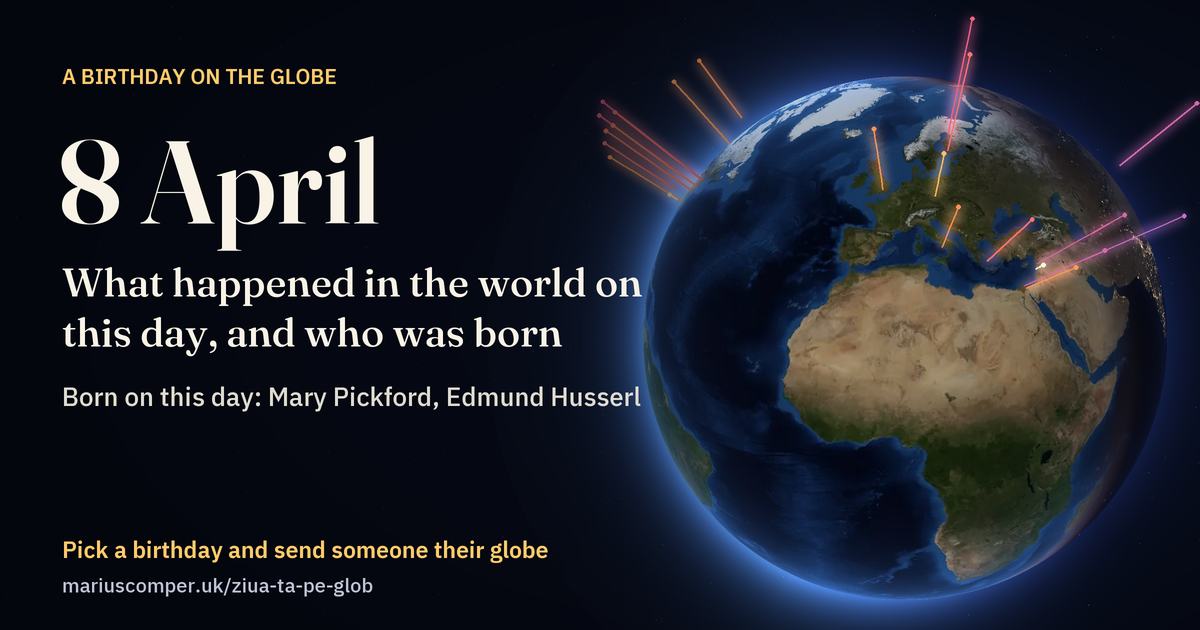
For 8 April, the English Wikipedia lists 46 events and 242 births. 23 of the events stand at their places as rays of light; three more are dashed circles, where the sentence links only to a country or a sea. The taller the ray, the longer ago it happened. The people born that day come further down, as blue points.
A birthday, yours or someone else’s:
Turn it into a greetingScroll: the globe turns to each place
The day you were born, on the globe.
Three things from your day
Scroll: your day first, then 8 April through the years
The Earth on 8 April
The picture on the globe was assembled by NASA from satellite photographs taken in April 2004: the snow, the ice and the green are those of the month.
On 8 April the Sun passes straight overhead at noon along the parallel of 7.4° north. In London, the day lasts about 13 hours 25 minutes.
Beyond 83° north the Sun no longer sets; beyond 83° south it no longer rises.
The line between day and night is tilted on the globe exactly as on this day of the year. On the dark side you can see the lights of towns.
Europe · Turku
1812
Czar Alexander I, the Russian Emperor and the Grand Duke of Finland, officially announces the transfer of the status of the Finnish capital from Turku to Helsinki.
On the map: Turku.
Europe · Milos
1820
The Venus de Milo is discovered on the Aegean island of Milos.
On the map: Milos.
Also on the day’s list of Wikipedia in Romanian and Chinese.
Europe · Prague
2010
U.S. President Barack Obama and Russian President Dmitry Medvedev sign the New START Treaty.
On the map: Prague.
Latin America · Solar eclipse of April 8, 2024
2024
Solar eclipse: A total solar eclipse takes place at the Moon's ascending node, visible across North America.
On the map: the coordinates Wikidata gives for the article “Solar eclipse of April 8, 2024”.
Also on the day’s list of Wikipedia in Spanish and Chinese.
North America · Albany, New York
1630
Kiliaen van Rensselaer purchased land near present-day Albany, New York, to establish Rensselaerswyck, which became the most successful patroonship under the Dutch West India Company.
On the map: Albany, New York.
North America · Supreme Court of the United States
1895
In Pollock v. Farmers' Loan & Trust Co. the Supreme Court of the United States declares unapportioned income tax to be unconstitutional.
On the map: Supreme Court of the United States.
North America · Midtown Manhattan
1904
Longacre Square in Midtown Manhattan was renamed Times Square after the New York Times building.
On the map: Midtown Manhattan.
Also on the day’s list of Wikipedia in Spanish and Chinese.
Oceans · Solar eclipse of April 8, 2005
2005
A solar eclipse occurs, visible over areas of the Pacific Ocean and Latin American countries such as Costa Rica, Panama, Colombia and Venezuela.
On the map: the coordinates Wikidata gives for the article “Solar eclipse of April 8, 2005”.
8 April
What the other Wikipedias remember#
For these years the English list has nothing on this day. The events below come from the same day’s lists on Wikipedia in Romanian and were translated for this page.
From Wikipedia in Romanian · Belgrade
1999
Thousands of people form human shields on three bridges in Belgrade and Novi Sad to protect them against NATO air raids.
On the map: Belgrade.
Translated from the list on Wikipedia in Romanian.
8 April
Born on 8 April#
The English Wikipedia lists 242 births for this day. The blue points are the birthplaces of 60 of these people: those written about in the most Wikipedia editions, where Wikidata gives a place of birth.
Born on 8 April
1892
Mary Pickford, Canadian-American actress, producer, screenwriter and co-founder of United Artists (died 1979)
Place of birth: Toronto.
Born on 8 April
1859
Edmund Husserl, German Jewish-Austrian mathematician and philosopher (died 1938)
Place of birth: Prostějov.
Born on 8 April
1911
Emil Cioran, Romanian-French philosopher and academic (died 1995)
Place of birth: Rășinari.
Born on 8 April
1929
Jacques Brel, Belgian singer-songwriter and actor (died 1978)
Born on 8 April
1911
Melvin Calvin, American chemist and academic, Nobel Prize laureate (died 1997)
Place of birth: Saint Paul.
Born in Britain and Ireland
1941
Vivienne Westwood, English fashion designer (died 2022)
Place of birth: Hollingworth.
Born in Britain and Ireland
1904
John Hicks, English economist and academic, Nobel Prize laureate (died 1989)
Place of birth: Leamington Spa.
Born in Britain and Ireland
1963
Julian Lennon, English singer-songwriter
Place of birth: Liverpool.
8 April
Number one in the charts that week
At the cinema
An animal recorded that day
The record can be seen in GBIF, which brings together wildlife records from around the world.
All your birthdays
The weather that day
Data: Met Office Hadley Centre (HadCET); NOAA (GHCN-Daily, Mauna Loa).
Above the Earth
Sources: Jonathan McDowell, GCAT (launches); GFZ Potsdam (Kp index). Days are counted in Universal Time.
Football that day
International matches played that day:
Source: the “International football results” dataset kept by Mart Jürisoo (CC0).
Also that day
The earthquake’s page at the USGS
Source: the USGS catalogue. The day is counted in Universal Time (UTC).
In those days
Make a link for someone
Type the name, pick the day and the year of birth. The link opens straight on their day, with their name in the greeting.
The link carries the name, date and place typed here; anyone who gets it can see them.
Put another birthday beside it
Your mother’s, your child’s, a friend’s: the two days appear side by side.
Below: 8 April through the years.
The whole globe of the day
Drag the globe to turn it. Touch a ray or a point to read what happened there.
Everything Wikipedia lists for 8 April
The list is the English Wikipedia’s, in its own wording, as it stood in October 2026. 20 events have no place on the map: the sentence links to no place with coordinates, only to places too wide to mark, or to several countries.
- 217
Roman emperor Caracalla is assassinated and is succeeded by his Praetorian Guard prefect, Marcus Opellius Macrinus.
no place on the mapWikipedia: Roman emperor - 876
The Battle of Dayr al-'Aqul saves Baghdad from the Saffarids.
Asia · Battle of Dayr al-AqulWikipedia: Battle of Dayr al-Aqul - 1139
Roger II of Sicily is excommunicated by Innocent II for supporting Anacletus II as pope for seven years, even though Roger had already publicly recognized Innocent's claim to the papacy.
no place on the mapWikipedia: Roger II of Sicily - 1143
Manuel I Komnenos succeeds his father John II Komnenos as Byzantine Emperor.
no place on the mapWikipedia: Manuel I Komnenos - 1232
Mongol–Jin War: The Mongols begin their siege on Kaifeng, the capital of the Jin dynasty.
Asia · Siege of KaifengWikipedia: Siege of Kaifeng - 1250
Seventh Crusade: Ayyubids of Egypt capture King Louis IX of France in the Battle of Fariskur.
Africa · Battle of FariskurWikipedia: Battle of Fariskur - 1271
Fall of Krak des Chevaliers: In Syria, sultan Baibars conquers the Krak des Chevaliers.
Asia · Fall of Krak des ChevaliersWikipedia: Fall of Krak des Chevaliers - 1605
The city of Oulu, Finland, is founded by Charles IX of Sweden.
Europe · OuluWikipedia: Oulu - 1630
Kiliaen van Rensselaer purchased land near present-day Albany, New York, to establish Rensselaerswyck, which became the most successful patroonship under the Dutch West India Company.
North America · Albany, New YorkWikipedia: Kiliaen van Rensselaer - 1730
Shearith Israel, the first synagogue in continental North America, is dedicated.
North America · Congregation Shearith IsraelWikipedia: Congregation Shearith Israel - 1812
Czar Alexander I, the Russian Emperor and the Grand Duke of Finland, officially announces the transfer of the status of the Finnish capital from Turku to Helsinki.
Europe · TurkuWikipedia: Alexander I of Russia - 1820
The Venus de Milo is discovered on the Aegean island of Milos.
Europe · MilosWikipedia: Milos - 1832
Black Hawk War: Around 300 United States 6th Infantry troops leave St. Louis, Missouri to fight the Sauk Native Americans.
North America · St. LouisWikipedia: Black Hawk War - 1864
American Civil War: Late-arriving reinforcements helped Confederate forces rout the Union Army at the Battle of Mansfield.
North America · Battle of MansfieldWikipedia: American Civil War - 1866
Austro-Prussian War: Italy and Prussia sign a secret alliance against the Austrian Empire.
no place on the mapWikipedia: Austro-Prussian War - 1886
William Ewart Gladstone introduces the first Irish Home Rule Bill into the British House of Commons.
no place on the mapWikipedia: Government of Ireland Bill 1886 - 1895
In Pollock v. Farmers' Loan & Trust Co. the Supreme Court of the United States declares unapportioned income tax to be unconstitutional.
North America · Supreme Court of the United StatesWikipedia: Supreme Court of the United States - 1904
Longacre Square in Midtown Manhattan was renamed Times Square after the New York Times building.
North America · Midtown ManhattanWikipedia: Midtown Manhattan - 1904
The French Third Republic and the United Kingdom of Great Britain and Ireland sign the Entente cordiale.
no place on the mapWikipedia: Entente Cordiale - 1911
American cartoonist Winsor McCay released the silent short film Little Nemo (featured), one of the earliest animated films.
no place on the mapWikipedia: Winsor McCay - 1917
World War I: German naval officer Wilhelm Werner murdered 19 captured crew members of the British cargo ship Torrington by submerging U-55 when they were on deck.
no place on the mapWikipedia: World War I - 1933
The Australian state of Western Australia votes to secede from the federation in a non-binding referendum, although efforts to implement the result prove unsuccessful.
Oceania · Western AustraliaWikipedia: 1933 Western Australian secession referendum - 1940
The Central Committee of the Mongolian People's Revolutionary Party elects Yumjaagiin Tsedenbal as General Secretary, marking the beginning of his 44-year-long tenure as de facto leader of Mongolia.
no place on the mapWikipedia: Mongolian People's Party - 1942
World War II: The United States Army Air Forces flew its first mission from India over the Hump (the eastern end of the Himalayas) to deliver materiel to China.
Asia · HimalayasWikipedia: The Hump - 1943
Otto and Elise Hampel were executed in Berlin for performing acts of resistance against Nazism.
no place on the mapWikipedia: Otto and Elise Hampel - 1954
A Royal Canadian Air Force Canadair Harvard collides with a Trans-Canada Airlines Canadair North Star over Moose Jaw, Saskatchewan, killing 37 people.
North America · Moose JawWikipedia: Trans-Canada Air Lines Flight 9 - 1954
South African Airways Flight 201: A de Havilland DH.106 Comet 1 crashes into the sea during night killing 21 people.
Europe · South African Airways Flight 201Wikipedia: South African Airways Flight 201 - 1959
A team of computer manufacturers, users, and university people led by Grace Hopper meets to discuss the creation of a new programming language that would be called COBOL.
no place on the mapWikipedia: Grace Hopper - 1959
The Organization of American States drafts an agreement to create the Inter-American Development Bank.
no place on the mapWikipedia: Organization of American States - 1960
The Netherlands and West Germany sign an agreement to negotiate the return of German land annexed by the Dutch in return for 280 million German marks as Wiedergutmachung.
no place on the mapWikipedia: Deutsche Mark - 1961
A large explosion on board the MV Dara in the Persian Gulf killed 238 people.
Asia · Persian GulfWikipedia: MV Dara - 1968
BOAC Flight 712 catches fire shortly after takeoff. As a result of her actions in the accident, Barbara Jane Harrison is awarded a posthumous George Cross, the only GC awarded to a woman in peacetime.
Britain & Ireland · BOAC Flight 712Wikipedia: BOAC Flight 712 - 1970
Bahr El-Baqar primary school bombing: Israeli bombers strike an Egyptian school. Forty-six children are killed.
Africa · Bahr El-Baqar primary school bombingWikipedia: Bahr El-Baqar primary school bombing - 1973
The Progress Party was founded in a movie theater in Oslo, Norway.
no place on the mapWikipedia: Progress Party - 1974
Hank Aaron passes Babe Ruth as the all-time leader in career home runs by hitting his 715th home run off of Al Downing at Atlanta-Fulton County Stadium.
North America · Atlanta–Fulton County StadiumWikipedia: Hank Aaron - 1975
Voyageurs National Park is established by the U.S. Congress.
North America · Voyageurs National ParkWikipedia: Voyageurs National Park - 1990
The conservative New Democracy party of Constantine Mitsotakis is elected in the Greek parliamentary election.
no place on the mapWikipedia: 1990 Greek parliamentary election - 1993
The Space Shuttle Discovery is launched on mission STS-56.
no place on the mapWikipedia: Space Shuttle Discovery - 2002
The Space Shuttle Atlantis is launched on mission STS-110, carrying the S0 truss to the International Space Station. Astronaut Jerry L. Ross also becomes the first person to fly on seven spaceflights.
no place on the mapWikipedia: Space Shuttle Atlantis - 2005
A solar eclipse occurs, visible over areas of the Pacific Ocean and Latin American countries such as Costa Rica, Panama, Colombia and Venezuela.
Oceans · Solar eclipse of April 8, 2005Wikipedia: Solar eclipse of April 8, 2005 - 2008
On board Soyuz TMA-12, Yi So-yeon became the first Korean astronaut.
no place on the mapWikipedia: Soyuz TMA-12 - 2010
U.S. President Barack Obama and Russian President Dmitry Medvedev sign the New START Treaty.
Europe · PragueWikipedia: New START - 2014
Windows XP reaches its standard End Of Life and is no longer supported.
no place on the mapWikipedia: Windows XP - 2020
Bernie Sanders ends his presidential campaign, leaving Joe Biden as the Democratic Party's nominee.
no place on the mapWikipedia: Bernie Sanders - 2024
Solar eclipse: A total solar eclipse takes place at the Moon's ascending node, visible across North America.
Latin America · Solar eclipse of April 8, 2024Wikipedia: Solar eclipse of April 8, 2024 - 2026
Operation Eternal Darkness: Hours after a ceasefire to the Iran war, Israeli attacks on Lebanon kill at least 357 and injures more than 1200 people in the largest airstrikes of the Lebanon war.
Asia · BeirutWikipedia: 8 April 2026 Israeli attacks on Lebanon
What the other Wikipedias remember
For these years the English list has nothing on this day. The events below come from the same day’s lists on Wikipedia in Romanian and were translated for this page.
- 1999
Thousands of people form human shields on three bridges in Belgrade and Novi Sad to protect them against NATO air raids.
Who was born on 8 April
In order of how many Wikipedia editions have an article about each. The first 60 of 242 are shown.
- 1938
Kofi Annan, Ghanaian economist and diplomat, 7th Secretary-General of the United Nations (died 2018)
KumasiWikipedia: Kofi Annan - 1892
Mary Pickford, Canadian-American actress, producer, screenwriter and co-founder of United Artists (died 1979)
TorontoWikipedia: Mary Pickford - 1859
Edmund Husserl, German Jewish-Austrian mathematician and philosopher (died 1938)
ProstějovWikipedia: Edmund Husserl - 1605
Philip IV of Spain (died 1665)
Valladolid Royal PalaceWikipedia: Philip IV of Spain - 1911
Emil Cioran, Romanian-French philosopher and academic (died 1995)
RășinariWikipedia: Emil Cioran - 1929
Jacques Brel, Belgian singer-songwriter and actor (died 1978)
- 1918
Betty Ford, American wife of Gerald Ford, 40th First Lady of the United States (died 2011)
ChicagoWikipedia: Betty Ford - 1875
Albert I of Belgium (died 1934)
Palace of the Count of FlandersWikipedia: Albert I of Belgium - 1911
Melvin Calvin, American chemist and academic, Nobel Prize laureate (died 1997)
Saint PaulWikipedia: Melvin Calvin - 1966
Robin Wright, American actress, director, producer
DallasWikipedia: Robin Wright - 1968
Patricia Arquette, American actress and director
ChicagoWikipedia: Patricia Arquette - 1986
Igor Akinfeev, Russian footballer
VidnoyeWikipedia: Igor Akinfeev - 1818
Christian IX, King of Denmark (died 1906)
Gottorf CastleWikipedia: Christian IX - 1941
Vivienne Westwood, English fashion designer (died 2022)
HollingworthWikipedia: Vivienne Westwood - 1904
John Hicks, English economist and academic, Nobel Prize laureate (died 1989)
Leamington SpaWikipedia: John Hicks - 1912
Sonja Henie, Norwegian-American figure skater and actress (died 1969)
Oslo MunicipalityWikipedia: Sonja Henie - 1692
Giuseppe Tartini, Italian violinist and composer (died 1770)
- 1919
Ian Smith, Zimbabwean lieutenant and politician, 1st Prime Minister of Rhodesia (died 2007)
ShurugwiWikipedia: Ian Smith - 1950
Grzegorz Lato, Polish footballer and coach
MalborkWikipedia: Grzegorz Lato - 1974
Chris Kyle, American sniper and memoirist (died 2013)
OdessaWikipedia: Chris Kyle - 1320
Peter I of Portugal (died 1367)
- 1936
Ghassan Kanafani, Palestinian author and politician (died 1972)
- 1892
Richard Neutra, Austrian-American architect, designer of the Los Angeles County Hall of Records (died 1970)
- 1955
Barbara Kingsolver, American novelist, essayist and poet
AnnapolisWikipedia: Barbara Kingsolver - 1951
Geir Haarde, Icelandic economist, journalist, and politician, 23rd Prime Minister of Iceland
ReykjavíkWikipedia: Geir Haarde - 1982
Allu Arjun, Indian actor
ChennaiWikipedia: Allu Arjun - 1818
August Wilhelm von Hofmann, German chemist and academic (died 1892)
- 1909
John Fante, American author and screenwriter (died 1983)
BoulderWikipedia: John Fante - 1940
John Havlicek, American basketball player (died 2019)
Martins FerryWikipedia: John Havlicek - 1963
Julian Lennon, English singer-songwriter
LiverpoolWikipedia: Julian Lennon - 1975
Anouk, Dutch singer
The HagueWikipedia: Anouk - 1914
María Félix, Yaqui/Basque-Mexican actress (died 2002)
ÁlamosWikipedia: María Félix - 1974
Nayden Todorov, Bulgarian conductor and culture minister
PlovdivWikipedia: Nayden Todorov - 1980
Katee Sackhoff, American actress
PortlandWikipedia: Katee Sackhoff - 1798
Dionysios Solomos, Greek poet and author (died 1857)
ZakynthosWikipedia: Dionysios Solomos - 1979
Alexi Laiho, Finnish singer-songwriter and guitarist (died 2020)
- 1947
Pascal Lamy, French businessman and politician, European Commissioner for Trade
Levallois-PerretWikipedia: Pascal Lamy - 1987
Royston Drenthe, Dutch footballer
RotterdamWikipedia: Royston Drenthe - 1966
Mazinho, Brazilian footballer, coach, and manager
Santa RitaWikipedia: Mazinho - 1973
Emma Caulfield, American actress
San DiegoWikipedia: Emma Caulfield - 1981
Taylor Kitsch, Canadian actor and model
KelownaWikipedia: Taylor Kitsch - 1869
Harvey Cushing, American surgeon and academic (died 1939)
ClevelandWikipedia: Harvey Cushing - 1926
Jürgen Moltmann, German theologian and academic (died 2024)
HamburgWikipedia: Jürgen Moltmann - 1931
John Gavin, American actor and diplomat, United States Ambassador to Mexico (died 2018)
Los AngelesWikipedia: John Gavin - 1937
Seymour Hersh, American journalist and author
ChicagoWikipedia: Seymour Hersh - 1962
Izzy Stradlin, American guitarist and songwriter
LafayetteWikipedia: Izzy Stradlin - 1963
Dean Norris, American actor
South BendWikipedia: Dean Norris - 1972
Sergei Magnitsky, Russian lawyer and accountant (died 2009)
- 1982
Gennady Golovkin, Kazakhstani boxer
KaragandaWikipedia: Gennady Golovkin - 1960
John Schneider, American actor and country singer
Mount KiscoWikipedia: John Schneider - 1912
Alois Brunner, Austrian-German SS officer (died 2001 or 2010)
Deutsch KaltenbrunnWikipedia: Alois Brunner - 1921
Franco Corelli, Italian tenor and actor (died 2003)
- 1972
Paul Gray, American bass player and songwriter (died 2010)
Los AngelesWikipedia: Paul Gray - 1995
Cedi Osman, Turkish professional basketball player
- 2002
Skai Jackson, American actress
Staten IslandWikipedia: Skai Jackson - 1920
Carmen McRae, American singer-songwriter, pianist, and actress (died 1994)
- 1966
Mark Blundell, English race car driver
BarnetWikipedia: Mark Blundell - 1947
Steve Howe, English guitarist, songwriter, and producer
LondonWikipedia: Steve Howe - 1949
John Madden, English director and producer
PortsmouthWikipedia: John Madden - 1955
Ron Johnson, American businessman and politician
MankatoWikipedia: Ron Johnson
What is celebrated on 8 April
- Buddha's Birthday, also known as Hana Matsuri, "Flower Festival" (Japan)
- Christian feast day: Anne Ayres (Episcopal Church (USA))
- Christian feast day: Blessed August Czartoryski
- Christian feast day: Constantina
- Christian feast day: Pope Dionysius of Alexandria
- Christian feast day: Julie Billiart of Namur
- Christian feast day: Perpetuus
- Christian feast day: Walter of Pontoise
- Christian feast day: William Augustus Muhlenberg (Episcopal Church (USA))
- Christian feast day: April 8 (Eastern Orthodox liturgics)
- Earliest day on which Fast and Prayer Day can fall, while April 14 is the latest; celebrated on the second Friday in April (Liberia)
- International Romani Day
A greeting link for someone
Type a name and, if you like, the year of birth. The link opens with a greeting, and beside each event it says how old the person turned that day, or how many years before their birth it happened.
The name and the year go only into the link you send.
All 366 days
How the globe is made
Where the events come from
Each edition of this page uses the day’s list from Wikipedia in its own language: Romanian, English, Spanish, Chinese. The lists are written by volunteers and differ from one edition to the next; the text of each event is Wikipedia’s, with a link to the article. A row that appears twice in a list is shown once. The lists have not been checked event by event: they are Wikipedia’s, mistakes included.
For events before 1582, and for countries that moved to the Gregorian calendar later (Britain in 1752, Russia in 1918), the same day may be counted Old Style in one list and New Style in another.
The chapter “What the other Wikipedias remember” adds up to five events a day from the lists of the other three editions, only for years in which the English list has nothing on that day. They were translated for this page, passed the same filters as the tour, and are not counted among the events of the English list.
How an event gets onto the map
The place comes from Wikidata. If the sentence links to the article about the event itself (a battle, an opening, an earthquake), dated to the same year, the ray stands on its coordinates or on those of its location. Otherwise it stands on the first place the sentence links to: a town, a building, a mountain, an island. This second step can be wrong: sometimes the sentence only mentions the place. That is why the page says, under each event, which place the ray stands on.
When the sentence links to a single state or province, or to a single sea, lake or desert larger than 5,000 km², the globe shows a dashed circle, not a ray. The circle has the area Wikidata gives, with its radius kept between 1.2° and 16°, or a radius of 4.5° when Wikidata gives no area; it says only that the sentence links to that place. Organisations, ships, spacecraft, museum objects, rivers, mountain ranges, languages and continents are never used as places. When a sentence names several states and no exact place, the event stays in the list only.
What the height means
The height of a ray shows how many years have passed, on a logarithmic scale: 10 years, 100 years and 1,000 years are equal steps apart; anything older than about 2,600 years has the tallest ray. The colour runs from pale yellow for recent years to violet for antiquity.
Where the tour stops
In each region the tour stops at up to three events (five in Britain and Ireland), chosen mainly by three things: whether Wikipedia’s editors put the event in the “On this day” box of their main page (the English, Spanish and Chinese editions), how many Wikipedia editions have an article about it, and how many of the four lists include it. Events whose sentence or article is about a war, an attack, a crime or a disaster are left out of the tour; they stay in the whole list, in Wikipedia’s wording. The filter is a list of words and a list of Wikidata types, so it can miss some.
The tour of births names the people with articles in the most editions and leaves aside those whom the list or Wikidata describes as rulers, politicians, commanders, leaders of movements or criminals; they stay in the list.
The Earth and the Sun
The daytime images are NASA’s Blue Marble Next Generation mosaics, one for each month of 2004; the night side is Black Marble 2016. The tilt of the line between day and night is computed for the day; the hour is chosen so that the place being read is in daylight. The latitude where the Sun stands overhead is the average of the four years of the leap cycle; in a given year it can differ by up to 0.4°.
The day you were born
The number ones come from the weekly lists on Wikipedia: Billboard for the United States (from 1940; the Hot 100 from August 1958), the UK Singles Chart (from November 1952), Los 40 Principales for Spain (from July 1966) and, for Romania, the Romanian Top 100 and Airplay 100 (2001–2021, with missing weeks). The page shows the chart of the week in which the day of birth falls, with its date; Billboard and the UK chart are dated at the end of their week. For Romania before 2001 and for China these sources have no weekly chart.
The films are those that reached cinemas in the United States up to ten days before or three days after that day (some of them in a few cinemas at first), from the English Wikipedia’s yearly lists (from 1968), in order of how many editions have an article about them. The events “in those days” are the ones on the neighbouring days’ lists that carry the year of birth, passed through the same filter as the tour.
The day of birth, year included
The Moon, the star sign and the constellation are worked out by the page itself, for noon Universal Time on the day. The lit part of the Moon is rounded and can differ by a few per cent from that at the hour of birth. The sign follows the usual zodiac of twelve equal parts starting at the March equinox; the constellation is the one the Sun actually stood in front of, by the borders set by the International Astronomical Union, and within a day of a border the page does not name it. When the Sun changes sign while it is that day anywhere on Earth, the page gives the moment of crossing, rounded to ten minutes and accurate to within about a quarter of an hour, and the clock time in a few cities, with the time zone and summer time of that year.
The year in the Chinese calendar is the one your device’s own calendar gives for the date, checked against the Hong Kong Observatory’s tables. “All your birthdays” uses the same sources as the rest of the chapter for the same day in every year since the birth: the temperature, well-known launches that took place on that very day, matches of the teams the edition follows, snow deeper than 10 cm and strong geomagnetic storms. The three things at the top and the four on the picture are chosen in a fixed order (the song, the animal, a full Moon, a well-known launch before an ordinary earthquake); on the picture you can change them.
When the link carries a year of birth, the page adds a few things about that exact day. The weather is the Met Office’s Central England temperature record and the readings from New York’s Central Park; the “usual high” is the average of the daily highs of 1961–1990 for that date, with two days either side. The carbon dioxide figure is the monthly mean at the Mauna Loa observatory, where measurements begin in March 1958.
The earthquake is the one with the largest magnitude in the USGS catalogue for that day, counted in Universal Time. Before the 1960s the catalogue has gaps even above magnitude 5.5, so in the older years many days have no earthquake. The page gives only the magnitude and the place: the country the epicentre falls in or, when the epicentre is at sea within 300 km of a coast, the nearest country; farther out, only the ocean.
The launches are those that reached orbit or left for the Moon and the planets, from Jonathan McDowell’s GCAT catalogue. If nothing left that day, the page shows the nearest launch within three days before or after, and says how many days away it was. The geomagnetic storm appears only when the Kp index reached at least 5 in one of the day’s eight three-hour intervals.
The animal comes from GBIF: an observation made by a person (the animal seen or heard, or its tracks), dated to that exact day, with coordinates and a CC0 or CC BY licence. Only a few hundred well-known species are searched (mammals, birds, turtles, butterflies); of those noted that day, mammals and species with articles in many Wikipedia editions come first; birds noted almost every day, and species used recently, wait their turn. Observations dated 1 January are left out, because records without a day are often filed there. An observation shows that the animal was recorded there, not how many animals there were.
The matches are those between national teams. Only matches of England, Scotland, Wales, Northern Ireland, the Republic of Ireland, the United States, Canada and Australia are shown, along with those at the big final tournaments. The picture to send is drawn in the page from the day’s globe and the facts above, and stays on your device until you send it.
Sources
- Events, births and holidays: the day’s page on Wikipedia, text under CC BY-SA 4.0.
- Coordinates, places of birth and the number of editions: Wikidata (CC0).
- The Earth by day: NASA Blue Marble Next Generation. The Earth by night: NASA Black Marble 2016.
- Borders and regions: Natural Earth.
- World population and births per year: UN World Population Prospects 2024.
- Charts and films: Wikipedia’s lists for Billboard, the UK Singles Chart, Los 40 Principales, Romanian Top 100, Airplay 100 and American films by year (CC BY-SA 4.0).
- Weather: Met Office Hadley Centre, HadCET (Open Government Licence) and NOAA GHCN-Daily, New York Central Park. Carbon dioxide: NOAA Global Monitoring Laboratory, Mauna Loa.
- Earthquakes: the USGS catalogue. Launches: Jonathan McDowell, GCAT (CC BY). Kp index: GFZ Potsdam (CC BY 4.0). Matches: International football results, Mart Jürisoo (CC0).
- Animal observations: GBIF, with a link to each record; species names come from Wikidata.