A birthday on the globe
20 April on the globe: what happened in the world on this day, and who was born
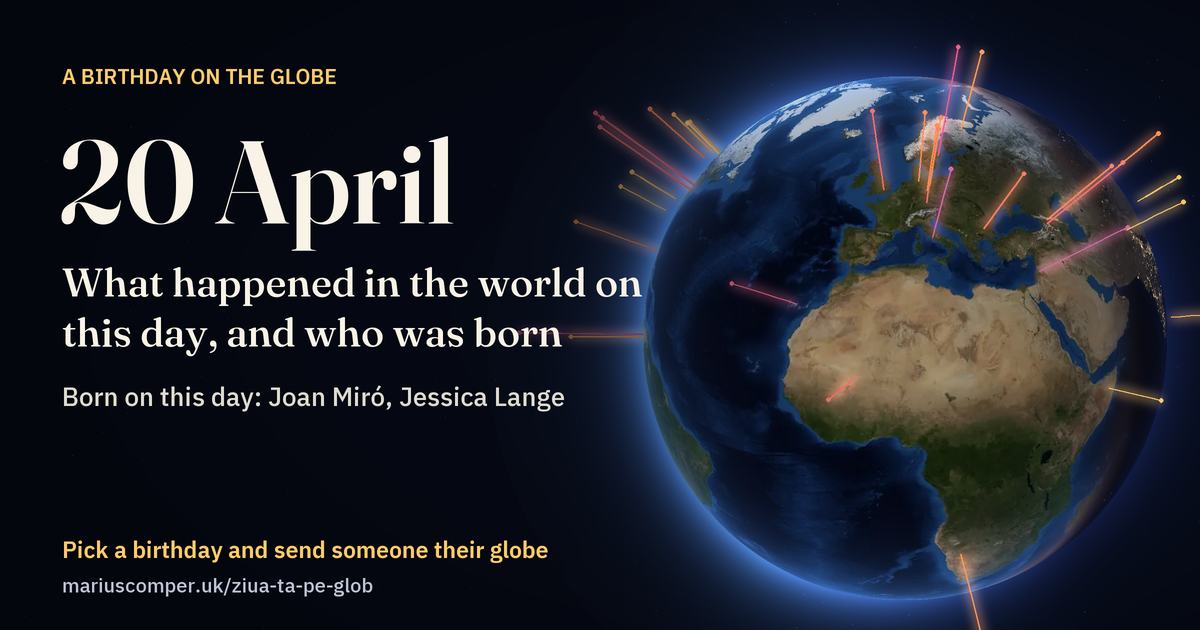
For 20 April, the English Wikipedia lists 57 events and 163 births. 32 of the events stand at their places as rays of light; four more are dashed circles, where the sentence links only to a country or a sea. The taller the ray, the longer ago it happened. The people born that day come further down, as blue points.
A birthday, yours or someone else’s:
Turn it into a greetingScroll: the globe turns to each place
The day you were born, on the globe.
Three things from your day
Scroll: your day first, then 20 April through the years
The Earth on 20 April
The picture on the globe was assembled by NASA from satellite photographs taken in April 2004: the snow, the ice and the green are those of the month.
On 20 April the Sun passes straight overhead at noon along the parallel of 11.7° north. In London, the day lasts about 14 hours 10 minutes.
Beyond 78° north the Sun no longer sets; beyond 78° south it no longer rises.
The line between day and night is tilted on the globe exactly as on this day of the year. On the dark side you can see the lights of towns.
Europe · Sapienza University of Rome
1303
The Sapienza University of Rome is instituted by a bull of Pope Boniface VIII.
On the map: Sapienza University of Rome.
Also on the day’s list of Wikipedia in Romanian.
Europe · Stockholm
1535
A complex halo display is observed over Stockholm, Sweden, inspiring the Vädersolstavlan ("The Sundog painting"), the earliest depiction of such an event, and the oldest colour depiction of the city.
On the map: Stockholm.
Also on the day’s list of Wikipedia in Chinese.
Africa · Timbuktu
1828
René Caillié becomes the second non-Muslim to enter Timbuktu, following Major Gordon Laing. He would also be the first to return alive.
On the map: Timbuktu.
Asia · South Ossetian Autonomous Oblast
1922
The Soviet government creates the South Ossetian Autonomous Oblast within the Georgian SSR.
On the map: South Ossetian Autonomous Oblast.
Also on the day’s list of Wikipedia in Chinese.
North America · New Amsterdam
1657
Freedom of religion is granted to the Jews of New Amsterdam (later New York City).
On the map: New Amsterdam.
North America · Federal Hall
1789
George Washington arrives at Grays Ferry, Philadelphia, while en route to Manhattan for his inauguration.
On the map: Federal Hall.
North America · United States Congress
1836
U.S. Congress passes an act creating the Wisconsin Territory.
On the map: United States Congress.
20 April
What the other Wikipedias remember#
For these years the English list has nothing on this day. The events below come from the same day’s lists on Wikipedia in Spanish and were translated for this page.
From Wikipedia in Spanish · Seville
1763
In Seville (Spain), the Real Maestranza bullring is inaugurated, and will come to be called the Cathedral of Bullfighting.
On the map: Seville.
Translated from the list on Wikipedia in Spanish.
From Wikipedia in Spanish · Braunau am Inn
1889
In Braunau am Inn, Adolf Hitler is born, future leader of Germany from 1933 to 1945.
On the map: Braunau am Inn.
Translated from the list on Wikipedia in Spanish.
From Wikipedia in Spanish · Seville Expo '92
1992
In Seville (Spain), the Seville Universal Exposition is inaugurated.
On the map: Seville Expo '92.
Translated from the list on Wikipedia in Spanish.
The article on Wikipedia in Spanish: Exposición Universal de Sevilla de 1992
20 April
Born on 20 April#
The English Wikipedia lists 163 births for this day. The blue points are the birthplaces of 60 of these people: those written about in the most Wikipedia editions, where Wikidata gives a place of birth.
Born on 20 April
1893
Joan Miró, Spanish painter and sculptor (died 1983)
Place of birth: Barcelona.
Born on 20 April
1964
Andy Serkis, English actor and director
Place of birth: Ruislip.
Born on 20 April
1893
Harold Lloyd, American actor, comedian, and producer (died 1971)
Place of birth: Burchard.
Born in Britain and Ireland
1949
Veronica Cartwright, English-American actress
Place of birth: Bristol.
Born in Britain and Ireland
1826
Dinah Craik, English author and poet (died 1887)
Place of birth: Stoke-on-Trent.
Born in Britain and Ireland
1924
Leslie Phillips, English actor and producer (died 2022)
Place of birth: Tottenham.
20 April
Number one in the charts that week
At the cinema
An animal recorded that day
The record can be seen in GBIF, which brings together wildlife records from around the world.
All your birthdays
The weather that day
Data: Met Office Hadley Centre (HadCET); NOAA (GHCN-Daily, Mauna Loa).
Above the Earth
Sources: Jonathan McDowell, GCAT (launches); GFZ Potsdam (Kp index). Days are counted in Universal Time.
Football that day
International matches played that day:
Source: the “International football results” dataset kept by Mart Jürisoo (CC0).
Also that day
The earthquake’s page at the USGS
Source: the USGS catalogue. The day is counted in Universal Time (UTC).
In those days
Make a link for someone
Type the name, pick the day and the year of birth. The link opens straight on their day, with their name in the greeting.
The link carries the name, date and place typed here; anyone who gets it can see them.
Put another birthday beside it
Your mother’s, your child’s, a friend’s: the two days appear side by side.
Below: 20 April through the years.
The whole globe of the day
Drag the globe to turn it. Touch a ray or a point to read what happened there.
Everything Wikipedia lists for 20 April
The list is the English Wikipedia’s, in its own wording, as it stood in October 2026. 21 events have no place on the map: the sentence links to no place with coordinates, only to places too wide to mark, or to several countries.
- 1152
After an eight-year conflict, Baldwin III of Jerusalem wins sole control of the Kingdom of Jerusalem from his mother Melisende.
no place on the mapWikipedia: Baldwin III of Jerusalem - 1303
The Bahri Mamluks defeat the Ilkhanate in the battle of Marj al-Saffar, marking the end of the Mongol incursions into Syria.
Asia · Battle of Marj al-SaffarWikipedia: Battle of Marj al-Saffar - 1303
The Sapienza University of Rome is instituted by a bull of Pope Boniface VIII.
Europe · Sapienza University of RomeWikipedia: Sapienza University of Rome - 1535
A complex halo display is observed over Stockholm, Sweden, inspiring the Vädersolstavlan ("The Sundog painting"), the earliest depiction of such an event, and the oldest colour depiction of the city.
Europe · StockholmWikipedia: Vädersolstavlan - 1537
Bacatá, the main settlement of the Muisca Confederation in present-day Colombia, was conquered by Spanish conquistadors led by Gonzalo Jiménez de Quesada.
Latin America · Altiplano CundiboyacenseWikipedia: Spanish conquest of the Muisca - 1653
Oliver Cromwell dissolves England's Rump Parliament.
no place on the mapWikipedia: Oliver Cromwell - 1657
English Admiral Robert Blake destroys a Spanish silver fleet, under heavy fire from the shore, at the Battle of Santa Cruz de Tenerife.
Europe · Battle of Santa Cruz de TenerifeWikipedia: Battle of Santa Cruz de Tenerife - 1657
Freedom of religion is granted to the Jews of New Amsterdam (later New York City).
North America · New AmsterdamWikipedia: New Amsterdam - 1752
Start of Konbaung–Hanthawaddy War, a new phase in the Burmese Civil War (1740–57).
no place on the mapWikipedia: Konbaung–Hanthawaddy War - 1770
The Georgian king, Erekle II, abandoned by his Russian ally Count Totleben, wins a victory over Ottoman forces at Aspindza.
Asia · Battle of AspindzaWikipedia: Battle of Aspindza - 1789
George Washington arrives at Grays Ferry, Philadelphia, while en route to Manhattan for his inauguration.
North America · Federal HallWikipedia: First inauguration of George Washington - 1792
France declares war against the "King of Hungary and Bohemia", the beginning of the French Revolutionary Wars.
no place on the mapWikipedia: French Revolutionary Wars - 1800
The Septinsular Republic is established.
Europe · Septinsular RepublicWikipedia: Septinsular Republic - 1809
Two Austrian army corps in Bavaria are defeated by a First French Empire army led by Napoleon at the Battle of Abensberg on the second day of a four-day campaign that ended in a French victory.
Europe · Battle of AbensbergWikipedia: Battle of Abensberg - 1818
Four days after the Court of King's Bench upheld an English murder suspect's right to a trial by battle in Ashford v Thornton, the plaintiff declined to fight, allowing the defendant to go free.
Britain & Ireland · Court of King's BenchWikipedia: Court of King's Bench - 1828
René Caillié becomes the second non-Muslim to enter Timbuktu, following Major Gordon Laing. He would also be the first to return alive.
Africa · TimbuktuWikipedia: René Caillié - 1836
U.S. Congress passes an act creating the Wisconsin Territory.
North America · United States CongressWikipedia: United States Congress - 1861
American Civil War: Robert E. Lee resigns his commission in the United States Army in order to command the forces of the state of Virginia.
North America · VirginiaWikipedia: American Civil War - 1861
Thaddeus S. C. Lowe, attempting to display the value of balloons, makes record journey, flying 900 miles from Cincinnati to South Carolina.
no place on the mapWikipedia: Thaddeus S. C. Lowe - 1862
Louis Pasteur and Claude Bernard complete the experiment disproving the theory of spontaneous generation.
no place on the mapWikipedia: Louis Pasteur - 1865
Astronomer Angelo Secchi demonstrates the Secchi disk, which measures water clarity, aboard Pope Pius IX's yacht, the L'Immaculata Concezion.
no place on the mapWikipedia: Angelo Secchi - 1876
The April Uprising begins. Its suppression shocks European opinion, and Bulgarian independence becomes a condition for ending the Russo-Turkish War.
Europe · April Uprising of 1876Wikipedia: April Uprising of 1876 - 1884
Pope Leo XIII publishes the encyclical Humanum genus, condemning Freemasonry.
no place on the mapWikipedia: Humanum genus - 1898
U.S. President William McKinley signs a joint resolution to Congress for declaration of war against Spain, beginning the Spanish–American War.
Oceans · Caribbean SeaWikipedia: Spanish–American War - 1902
Pierre and Marie Curie refine radium chloride.
no place on the mapWikipedia: Pierre Curie - 1908
Opening day of competition in the New South Wales Rugby League.
no place on the mapWikipedia: New South Wales Rugby League - 1914
Nineteen men, women, and children participating in a strike are killed in the Ludlow Massacre during the Colorado Coalfield War.
North America · Ludlow MassacreWikipedia: Ludlow Massacre - 1918
World War I: Manfred von Richthofen, a.k.a. The Red Baron, shoots down his 79th and 80th victims, his final victories before his death the following day.
no place on the mapWikipedia: World War I - 1922
The Soviet government creates the South Ossetian Autonomous Oblast within the Georgian SSR.
Asia · South Ossetian Autonomous OblastWikipedia: Soviet Union - 1939
Adolf Hitler's 50th birthday was celebrated as a national holiday in Nazi Germany.
Europe · Nazi GermanyWikipedia: Adolf Hitler's 50th birthday - 1939
Billie Holiday recorded the song "Strange Fruit", which later became an emblem of the civil rights movement.
no place on the mapWikipedia: Billie Holiday - 1942
World War II: German and Italian forces began a large-scale counter-insurgency operation in occupied Yugoslavia.
no place on the mapWikipedia: World War II - 1945
Twenty Jewish children used in medical experiments at Neuengamme are killed in the basement of the Bullenhuser Damm school.
Europe · Neuengamme concentration campWikipedia: Nazi human experimentation - 1945
World War II: Führerbunker: On his 56th birthday Adolf Hitler makes his last trip to the surface to award Iron Crosses to boy soldiers of the Hitler Youth.
Europe · FührerbunkerWikipedia: Führerbunker - 1945
World War II: U.S. troops capture Leipzig, Germany, only to later cede the city to the Soviet Union.
Europe · LeipzigWikipedia: World War II - 1946
The League of Nations officially dissolves, giving most of its power to the United Nations.
no place on the mapWikipedia: League of Nations - 1949
Amethyst incident: The People's Liberation Army attacks HMS Amethyst (F116) travelling to the British embassy in Nanjing during the Chinese Civil War.
Asia · Amethyst incidentWikipedia: Chinese Civil War - 1961
Cold War: Failure of the Bay of Pigs Invasion of US-backed Cuban exiles against Cuba.
Latin America · Bay of Pigs InvasionWikipedia: Bay of Pigs Invasion - 1968
English politician Enoch Powell makes his controversial "Rivers of Blood" speech.
no place on the mapWikipedia: Rivers of Blood speech - 1968
Pierre Trudeau was sworn in as prime minister of Canada, succeeding Lester B. Pearson.
no place on the mapWikipedia: Pierre Trudeau - 1968
South African Airways Flight 228 crashes near J.G. Strijdom Airport in South West Africa (now Hosea Kutako International Airport in Namibia), killing 123 people.
Africa · South African Airways Flight 228Wikipedia: South African Airways Flight 228 - 1972
Apollo program: The Apollo 16 Lunar Module Orion, commanded by John Young and piloted by Charles Duke, lands on the Moon.
no place on the mapWikipedia: Apollo program - 1978
Korean Air Lines Flight 902 was shot down after violating Soviet airspace and was forced to make an emergency landing.
Europe · Korean Air Lines Flight 902Wikipedia: Korean Air Lines Flight 902 - 1985
University of California, Riverside 1985 laboratory raid: Animal Liberation Front rescues 467 animals being tested in a lab at University of California, Riverside in Riverside, California, causing $700,000 in damages to the laboratory, in advocacy for animal rights.
North America · University of California, RiversideWikipedia: University of California, Riverside 1985 laboratory raid - 1998
Air France Flight 422 crashes after taking off from El Dorado International Airport in Bogotá, Colombia, killing all 53 people on board.
Latin America · Air France Flight 422Wikipedia: Air France Flight 422 - 1999
Columbine High School massacre: Eric Harris and Dylan Klebold kill 14 people and injure 23 others before committing suicide at Columbine High School in Columbine, Colorado.
North America · Columbine High School massacreWikipedia: Columbine High School massacre - 2004
The Nicoll Highway in Singapore collapses, killing four workers.
Asia · Nicoll Highway collapseWikipedia: Nicoll Highway collapse - 2007
Johnson Space Center shooting: William Phillips barricades himself with a handgun in NASA's Johnson Space Center in Houston, Texas, before killing a male hostage and himself.
North America · Johnson Space Center shootingWikipedia: Johnson Space Center shooting - 2008
Danica Patrick wins the Indy Japan 300, becoming the first female driver in history to win an Indy car race.
no place on the mapWikipedia: Indy Japan 300 - 2008
Fernando Lugo became the first candidate not from the Colorado Party candidate to be elected President of Paraguay in 61 years.
no place on the mapWikipedia: 2008 Paraguayan general election - 2010
The Deepwater Horizon drilling rig explodes in the Gulf of Mexico, killing eleven workers and beginning an oil spill that lasted six months.
North America · Deepwater Horizon explosionWikipedia: Deepwater Horizon explosion - 2012
One hundred twenty-seven people are killed when a plane crashes in a residential area near the Benazir Bhutto International Airport near Islamabad, Pakistan.
Asia · Bhoja Air Flight 213Wikipedia: Bhoja Air Flight 213 - 2013
A 6.6-magnitude earthquake strikes Lushan County, Ya'an, in China's Sichuan province, killing at least 193 people and injuring thousands.
Asia · 2013 Lushan earthquakeWikipedia: 2013 Lushan earthquake - 2015
Ten people are killed in a bomb attack on a convoy carrying food supplies to a United Nations compound in Garowe in the Somali region of Puntland.
Africa · Garowe attackWikipedia: Garowe attack - 2020
For the first time in history, oil prices drop below zero, an effect of the 2020 Russia-Saudi Arabia oil price war.
no place on the mapWikipedia: 2020 Russia–Saudi Arabia oil price war - 2021
State of Minnesota v. Derek Michael Chauvin: Derek Chauvin is found guilty of all charges in the murder of George Floyd by the Fourth Judicial District Court of Minnesota.
North America · Murder of George FloydWikipedia: Murder of George Floyd - 2023
SpaceX's Starship rocket, the largest and most powerful rocket ever built, launches for the first time. It explodes four minutes into flight.
no place on the mapWikipedia: SpaceX Starship
What the other Wikipedias remember
For these years the English list has nothing on this day. The events below come from the same day’s lists on Wikipedia in Spanish and were translated for this page.
- 1763
In Seville (Spain), the Real Maestranza bullring is inaugurated, and will come to be called the Cathedral of Bullfighting.
- 1889
In Braunau am Inn, Adolf Hitler is born, future leader of Germany from 1933 to 1945.
- 1992
In Seville (Spain), the Seville Universal Exposition is inaugurated.
Europe · Seville Expo '92Translated from the list on Wikipedia in SpanishWikipedia: Exposición Universal de Sevilla de 1992
Who was born on 20 April
In order of how many Wikipedia editions have an article about each. The first 60 of 163 are shown.
- 1889
Adolf Hitler, Austrian-born German politician, Führer of Nazi Germany (died 1945)
Braunau am InnWikipedia: Adolf Hitler - 1808
Napoleon III, French politician, 1st President of France, Emperor of French Second Empire (died 1873)
- 1893
Joan Miró, Spanish painter and sculptor (died 1983)
BarcelonaWikipedia: Joan Miró - 1939
Gro Harlem Brundtland, Norwegian physician and politician, 22nd Prime Minister of Norway–
Bærum MunicipalityWikipedia: Gro Harlem Brundtland - 1949
Jessica Lange, American actress
CloquetWikipedia: Jessica Lange - 1964
Andy Serkis, English actor and director
RuislipWikipedia: Andy Serkis - 1893
Harold Lloyd, American actor, comedian, and producer (died 1971)
BurchardWikipedia: Harold Lloyd - 1937
George Takei, American actor
Los AngelesWikipedia: George Takei - 1969
Felix Baumgartner, Austrian daredevil (died 2025)
SalzburgWikipedia: Felix Baumgartner - 1983
Miranda Kerr, Australian model
SydneyWikipedia: Miranda Kerr - 1927
K. Alex Müller, Swiss physicist and academic, Nobel Prize laureate (died 2023)
- 1955
Svante Pääbo, Swedish geneticist and Nobel Laureate
Hedvig Eleonora and Oscar ParishWikipedia: Svante Pääbo - 1918
Kai Siegbahn, Swedish physicist and academic, Nobel Prize laureate (died 2007)
- 1949
Massimo D'Alema, Italian journalist and politician, 76th Prime Minister of Italy
- 1972
Carmen Electra, American model and actress
SharonvilleWikipedia: Carmen Electra - 1840
Odilon Redon, French painter and illustrator (died 1916)
BordeauxWikipedia: Odilon Redon - 1586
Rose of Lima, Peruvian mystic and saint (died 1617)
- 1941
Ryan O'Neal, American actor (died 2023)
Los AngelesWikipedia: Ryan O'Neal - 1839
Carol I of Romania, King of Romania (died 1914)
SigmaringenWikipedia: Carol I of Romania - 1895
Henry de Montherlant, French essayist, novelist, and dramatist (died 1972)
7th arrondissement of ParisWikipedia: Henry de Montherlant - 1945
Thein Sein, Burmese general and politician, 8th President of Burma
Ngapudaw TownshipWikipedia: Thein Sein - 1997
Alexander Zverev, German tennis player
HamburgWikipedia: Alexander Zverev - 1927
Phil Hill, American race car driver (died 2008)
MiamiWikipedia: Phil Hill - 1950
Alexander Lebed, Russian general and politician (died 2002)
NovocherkasskWikipedia: Alexander Lebed - 1964
Crispin Glover, American actor and filmmaker
New York CityWikipedia: Crispin Glover - 1967
Mike Portnoy, American drummer and songwriter
Long BeachWikipedia: Mike Portnoy - 1745
Philippe Pinel, French physician and psychiatrist (died 1826)
JonquièresWikipedia: Philippe Pinel - 1951
Luther Vandross, American singer-songwriter and producer (died 2005)
New York CityWikipedia: Luther Vandross - 1890
Adolf Schärf, Austrian soldier and politician, 6th President of Austria (died 1965)
MikulovWikipedia: Adolf Schärf - 1923
Tito Puente, American drummer and producer (died 2000)
New York CityWikipedia: Tito Puente - 1947
Viktor Suvorov, Russian intelligence officer, historian, and author
BarabashWikipedia: Viktor Suvorov - 1949
Veronica Cartwright, English-American actress
- 1966
David Chalmers, Australian philosopher and academic
- 1970
Shemar Moore, American actor
OaklandWikipedia: Shemar Moore - 1908
Lionel Hampton, American vibraphone player, pianist, bandleader, and actor (died 2002)
LouisvilleWikipedia: Lionel Hampton - 1938
Betty Cuthbert, Australian sprinter (died 2017)
- 1943
Edie Sedgwick, American model and actress (died 1971)
Santa BarbaraWikipedia: Edie Sedgwick - 1920
John Paul Stevens, American lawyer and jurist, Associate Justice of the Supreme Court of the United States (died 2019)
ChicagoWikipedia: John Paul Stevens - 1633
Emperor Go-Kōmyō of Japan (died 1654)
- 1826
Dinah Craik, English author and poet (died 1887)
Stoke-on-TrentWikipedia: Dinah Craik - 1966
David Filo, American businessman, co-founded Yahoo!
WisconsinWikipedia: David Filo - 1924
Leslie Phillips, English actor and producer (died 2022)
TottenhamWikipedia: Leslie Phillips - 1924
Nina Foch, Dutch-American actress (died 2008)
LeidenWikipedia: Nina Foch - 1913
Willi Hennig, German biologist and entomologist (died 1976)
DürrhennersdorfWikipedia: Willi Hennig - 1923
Mother Angelica, American nun and broadcaster, founded Eternal Word Television Network (died 2016)
- 1955
Donald Pettit, American engineer and astronaut
SilvertonWikipedia: Donald Pettit - 1936
Pat Roberts, American captain, journalist, and politician
TopekaWikipedia: Pat Roberts - 1884
Daniel Varoujan, Armenian poet and educator (died 1915)
DörteylülWikipedia: Daniel Varoujan - 1943
John Eliot Gardiner, English conductor and director
Fontmell MagnaWikipedia: John Eliot Gardiner - 1950
N. Chandrababu Naidu, Indian politician, 13th Chief Minister of Andhra Pradesh
Naravari PalleWikipedia: N. Chandrababu Naidu - 1958
Viacheslav Fetisov, Russian ice hockey player and coach
- 1850
Daniel Chester French, American sculptor, designed the Lincoln statue (died 1931)
- 1889
Prince Erik, Duke of Västmanland (died 1918)
Drottningholm PalaceWikipedia: Prince Erik, Duke of Västmanland - 1937
Jiří Dienstbier, Czech journalist and politician, Czech Minister of Foreign Affairs (died 2011)
- 1915
Israel Epstein, Chinese-Polish journalist and member of the Chinese Communist Party (died 2005)
- 1953
Sebastian Faulks, English journalist and author
DonningtonWikipedia: Sebastian Faulks - 1544
Renata of Lorraine, Duchess consort of Bavaria (died 1602)
- 1884
Princess Beatrice of Saxe-Coburg and Gotha (died 1966)
- 1904
Bruce Cabot, American actor (died 1972)
CarlsbadWikipedia: Bruce Cabot - 1963
Rachel Whiteread, English sculptor
What is celebrated on 20 April
- Christian feast day: Agnes of Montepulciano
- Christian feast day: Pope Anicetus
- Christian feast day: Blessed Anastazy Jakub Pankiewicz
- Christian feast day: Beuno
- Christian feast day: Blessed James Bell and John Finch
- Christian feast day: Johannes Bugenhagen (Lutheran)
- Christian feast day: Marcellinus of Gaul
- Christian feast day: Blessed Muiris Mac Ionrachtaigh
- Christian feast day: Theotimos
- Christian feast day: April 20 (Eastern Orthodox liturgics)
- 420 (cannabis culture)
- Evacuee Flag Day (Finland)
- UN Chinese Language Day (United Nations)
A greeting link for someone
Type a name and, if you like, the year of birth. The link opens with a greeting, and beside each event it says how old the person turned that day, or how many years before their birth it happened.
The name and the year go only into the link you send.
All 366 days
How the globe is made
Where the events come from
Each edition of this page uses the day’s list from Wikipedia in its own language: Romanian, English, Spanish, Chinese. The lists are written by volunteers and differ from one edition to the next; the text of each event is Wikipedia’s, with a link to the article. A row that appears twice in a list is shown once. The lists have not been checked event by event: they are Wikipedia’s, mistakes included.
For events before 1582, and for countries that moved to the Gregorian calendar later (Britain in 1752, Russia in 1918), the same day may be counted Old Style in one list and New Style in another.
The chapter “What the other Wikipedias remember” adds up to five events a day from the lists of the other three editions, only for years in which the English list has nothing on that day. They were translated for this page, passed the same filters as the tour, and are not counted among the events of the English list.
How an event gets onto the map
The place comes from Wikidata. If the sentence links to the article about the event itself (a battle, an opening, an earthquake), dated to the same year, the ray stands on its coordinates or on those of its location. Otherwise it stands on the first place the sentence links to: a town, a building, a mountain, an island. This second step can be wrong: sometimes the sentence only mentions the place. That is why the page says, under each event, which place the ray stands on.
When the sentence links to a single state or province, or to a single sea, lake or desert larger than 5,000 km², the globe shows a dashed circle, not a ray. The circle has the area Wikidata gives, with its radius kept between 1.2° and 16°, or a radius of 4.5° when Wikidata gives no area; it says only that the sentence links to that place. Organisations, ships, spacecraft, museum objects, rivers, mountain ranges, languages and continents are never used as places. When a sentence names several states and no exact place, the event stays in the list only.
What the height means
The height of a ray shows how many years have passed, on a logarithmic scale: 10 years, 100 years and 1,000 years are equal steps apart; anything older than about 2,600 years has the tallest ray. The colour runs from pale yellow for recent years to violet for antiquity.
Where the tour stops
In each region the tour stops at up to three events (five in Britain and Ireland), chosen mainly by three things: whether Wikipedia’s editors put the event in the “On this day” box of their main page (the English, Spanish and Chinese editions), how many Wikipedia editions have an article about it, and how many of the four lists include it. Events whose sentence or article is about a war, an attack, a crime or a disaster are left out of the tour; they stay in the whole list, in Wikipedia’s wording. The filter is a list of words and a list of Wikidata types, so it can miss some.
The tour of births names the people with articles in the most editions and leaves aside those whom the list or Wikidata describes as rulers, politicians, commanders, leaders of movements or criminals; they stay in the list.
The Earth and the Sun
The daytime images are NASA’s Blue Marble Next Generation mosaics, one for each month of 2004; the night side is Black Marble 2016. The tilt of the line between day and night is computed for the day; the hour is chosen so that the place being read is in daylight. The latitude where the Sun stands overhead is the average of the four years of the leap cycle; in a given year it can differ by up to 0.4°.
The day you were born
The number ones come from the weekly lists on Wikipedia: Billboard for the United States (from 1940; the Hot 100 from August 1958), the UK Singles Chart (from November 1952), Los 40 Principales for Spain (from July 1966) and, for Romania, the Romanian Top 100 and Airplay 100 (2001–2021, with missing weeks). The page shows the chart of the week in which the day of birth falls, with its date; Billboard and the UK chart are dated at the end of their week. For Romania before 2001 and for China these sources have no weekly chart.
The films are those that reached cinemas in the United States up to ten days before or three days after that day (some of them in a few cinemas at first), from the English Wikipedia’s yearly lists (from 1968), in order of how many editions have an article about them. The events “in those days” are the ones on the neighbouring days’ lists that carry the year of birth, passed through the same filter as the tour.
The day of birth, year included
The Moon, the star sign and the constellation are worked out by the page itself, for noon Universal Time on the day. The lit part of the Moon is rounded and can differ by a few per cent from that at the hour of birth. The sign follows the usual zodiac of twelve equal parts starting at the March equinox; the constellation is the one the Sun actually stood in front of, by the borders set by the International Astronomical Union, and within a day of a border the page does not name it. When the Sun changes sign while it is that day anywhere on Earth, the page gives the moment of crossing, rounded to ten minutes and accurate to within about a quarter of an hour, and the clock time in a few cities, with the time zone and summer time of that year.
The year in the Chinese calendar is the one your device’s own calendar gives for the date, checked against the Hong Kong Observatory’s tables. “All your birthdays” uses the same sources as the rest of the chapter for the same day in every year since the birth: the temperature, well-known launches that took place on that very day, matches of the teams the edition follows, snow deeper than 10 cm and strong geomagnetic storms. The three things at the top and the four on the picture are chosen in a fixed order (the song, the animal, a full Moon, a well-known launch before an ordinary earthquake); on the picture you can change them.
When the link carries a year of birth, the page adds a few things about that exact day. The weather is the Met Office’s Central England temperature record and the readings from New York’s Central Park; the “usual high” is the average of the daily highs of 1961–1990 for that date, with two days either side. The carbon dioxide figure is the monthly mean at the Mauna Loa observatory, where measurements begin in March 1958.
The earthquake is the one with the largest magnitude in the USGS catalogue for that day, counted in Universal Time. Before the 1960s the catalogue has gaps even above magnitude 5.5, so in the older years many days have no earthquake. The page gives only the magnitude and the place: the country the epicentre falls in or, when the epicentre is at sea within 300 km of a coast, the nearest country; farther out, only the ocean.
The launches are those that reached orbit or left for the Moon and the planets, from Jonathan McDowell’s GCAT catalogue. If nothing left that day, the page shows the nearest launch within three days before or after, and says how many days away it was. The geomagnetic storm appears only when the Kp index reached at least 5 in one of the day’s eight three-hour intervals.
The animal comes from GBIF: an observation made by a person (the animal seen or heard, or its tracks), dated to that exact day, with coordinates and a CC0 or CC BY licence. Only a few hundred well-known species are searched (mammals, birds, turtles, butterflies); of those noted that day, mammals and species with articles in many Wikipedia editions come first; birds noted almost every day, and species used recently, wait their turn. Observations dated 1 January are left out, because records without a day are often filed there. An observation shows that the animal was recorded there, not how many animals there were.
The matches are those between national teams. Only matches of England, Scotland, Wales, Northern Ireland, the Republic of Ireland, the United States, Canada and Australia are shown, along with those at the big final tournaments. The picture to send is drawn in the page from the day’s globe and the facts above, and stays on your device until you send it.
Sources
- Events, births and holidays: the day’s page on Wikipedia, text under CC BY-SA 4.0.
- Coordinates, places of birth and the number of editions: Wikidata (CC0).
- The Earth by day: NASA Blue Marble Next Generation. The Earth by night: NASA Black Marble 2016.
- Borders and regions: Natural Earth.
- World population and births per year: UN World Population Prospects 2024.
- Charts and films: Wikipedia’s lists for Billboard, the UK Singles Chart, Los 40 Principales, Romanian Top 100, Airplay 100 and American films by year (CC BY-SA 4.0).
- Weather: Met Office Hadley Centre, HadCET (Open Government Licence) and NOAA GHCN-Daily, New York Central Park. Carbon dioxide: NOAA Global Monitoring Laboratory, Mauna Loa.
- Earthquakes: the USGS catalogue. Launches: Jonathan McDowell, GCAT (CC BY). Kp index: GFZ Potsdam (CC BY 4.0). Matches: International football results, Mart Jürisoo (CC0).
- Animal observations: GBIF, with a link to each record; species names come from Wikidata.