A birthday on the globe
3 May on the globe: what happened in the world on this day, and who was born
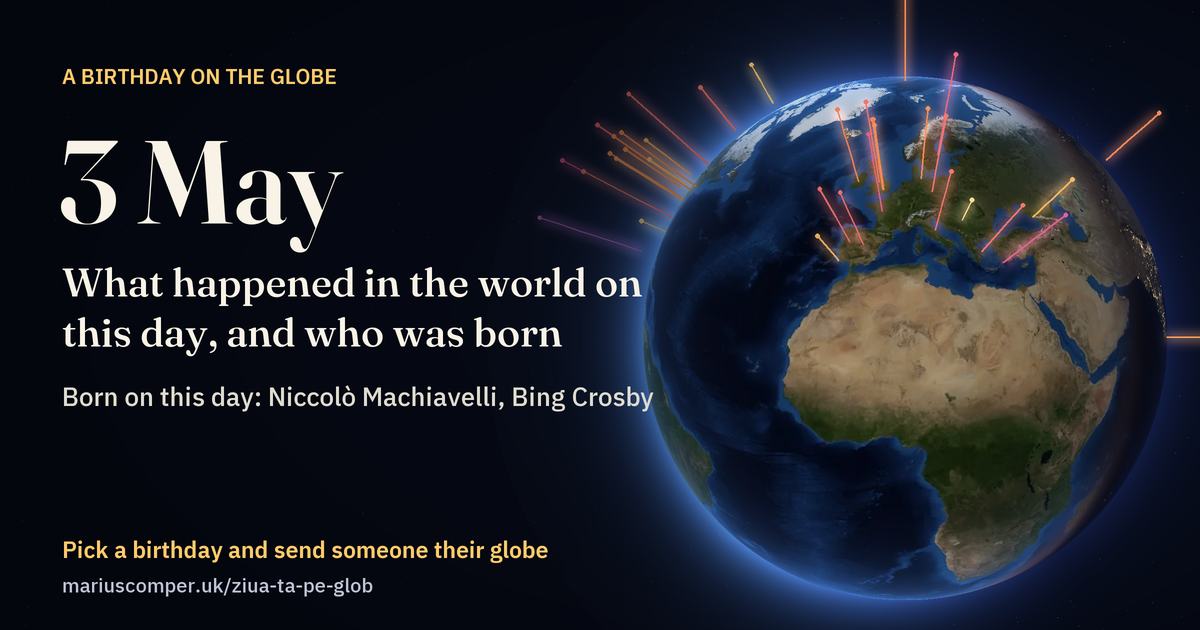
For 3 May, the English Wikipedia lists 57 events and 182 births. 36 of the events stand at their places as rays of light; four more are dashed circles, where the sentence links only to a country or a sea. The taller the ray, the longer ago it happened. The people born that day come further down, as blue points.
A birthday, yours or someone else’s:
Turn it into a greetingScroll: the globe turns to each place
The day you were born, on the globe.
Three things from your day
Scroll: your day first, then 3 May through the years
The Earth on 3 May
The picture on the globe was assembled by NASA from satellite photographs taken in May 2004: the snow, the ice and the green are those of the month.
On 3 May the Sun passes straight overhead at noon along the parallel of 15.8° north. In London, the day lasts about 15 hours.
Beyond 74° north the Sun no longer sets; beyond 74° south it no longer rises.
The line between day and night is tilted on the globe exactly as on this day of the year. On the dark side you can see the lights of towns.
Britain & Ireland · Benty Grange
1848
The boar-crested Anglo-Saxon Benty Grange helmet is discovered in a barrow on the Benty Grange farm in Derbyshire.
On the map: Benty Grange.
Britain & Ireland · Royal Academy Summer Exhibition
1911
Edith Maryon's statuette The Dance of Anitra, one of the few of her works known to survive in private hands, was exhibited at the Royal Academy of Arts.
On the map: Royal Academy Summer Exhibition.
Britain & Ireland · RAF Northolt
1915
The oldest Royal Air Force station in continuous operation, RAF Northolt, opened as home to No. 4 Reserve Aeroplane Squadron.
On the map: RAF Northolt.
Britain & Ireland · Southern Ireland
1921
Ireland is partitioned under British law by the Government of Ireland Act 1920, creating Northern Ireland and Southern Ireland.
On the map: Southern Ireland.
Britain & Ireland · Royal Festival Hall
1951
London's Royal Festival Hall opens with the Festival of Britain.
On the map: Royal Festival Hall.
Europe · Solar eclipse of May 3, 1715
1715
A total solar eclipse is visible across northern Europe and northern Asia, as predicted by Edmond Halley to within four minutes accuracy.
On the map: the coordinates Wikidata gives for the article “Solar eclipse of May 3, 1715”.
Europe · National and Kapodistrian University of Athens
1837
The University of Athens is founded in Athens, Greece.
On the map: National and Kapodistrian University of Athens.
Also on the day’s list of Wikipedia in Chinese.
Latin America · Yaxchilan
752
Mayan king Bird Jaguar IV of Yaxchilan in modern-day Chiapas, Mexico, assumes the throne.
On the map: Yaxchilan.
North America · Washington, D.C.
1802
Washington, D.C. is incorporated as a city after Congress abolishes the Board of Commissioners, the District's founding government. The "City of Washington" is given a mayor-council form of government.
On the map: Washington, D.C..
North America · Supreme Court of the United States
1948
The U.S. Supreme Court rules in Shelley v. Kraemer that covenants prohibiting the sale of real estate to blacks and other minorities are legally unenforceable.
On the map: Supreme Court of the United States.
North America · Brooklyn
1957
Walter O'Malley, the owner of the Brooklyn Dodgers, agrees to move the team from Brooklyn to Los Angeles.
On the map: Brooklyn.
Oceans · North Pole
1952
Lieutenant Colonels Joseph O. Fletcher and William P. Benedict of the United States land a plane at the North Pole.
On the map: North Pole.
3 May
What the other Wikipedias remember#
For these years the English list has nothing on this day. The events below come from the same day’s lists on Wikipedia in Spanish and Romanian and were translated for this page.
From Wikipedia in Spanish · Argentine Patagonia
1902
In Argentine Patagonia, a presidential decree gives official status as a foundation to the Patagonian settlement named San Carlos de Bariloche.
On the map: Argentine Patagonia.
Translated from the list on Wikipedia in Spanish.
From Wikipedia in Romanian · Bucharest
1996
Javier Solana, Secretary General of NATO, makes his first visit to Bucharest.
On the map: Bucharest.
Translated from the list on Wikipedia in Romanian.
3 May
Born on 3 May#
The English Wikipedia lists 182 births for this day. The blue points are the birthplaces of 58 of these people: those written about in the most Wikipedia editions, where Wikidata gives a place of birth.
Born on 3 May
1469
Niccolò Machiavelli, Italian historian and philosopher (died 1527)
Place of birth: Florence.
Born on 3 May
1903
Bing Crosby, American singer and actor (died 1977)
Place of birth: Tacoma.
Born on 3 May
1933
James Brown, American singer-songwriter, producer, and actor (died 2006)
Place of birth: Augusta.
Born on 3 May
1933
Steven Weinberg, American physicist and academic, Nobel Prize laureate (died 2021)
Place of birth: New York City.
Born on 3 May
1919
Pete Seeger, American singer-songwriter, guitarist, and activist (died 2014)
Place of birth: New York City.
Born in Britain and Ireland
1892
George Paget Thomson, English physicist and academic, Nobel Prize laureate (died 1975)
Place of birth: Cambridge.
Born in Britain and Ireland
1896
Dodie Smith, English author and playwright (died 1990)
Place of birth: Whitefield.
Born in Britain and Ireland
1950
Mary Hopkin, Welsh singer-songwriter
Place of birth: Pontardawe.
3 May
Number one in the charts that week
At the cinema
An animal recorded that day
The record can be seen in GBIF, which brings together wildlife records from around the world.
All your birthdays
The weather that day
Data: Met Office Hadley Centre (HadCET); NOAA (GHCN-Daily, Mauna Loa).
Above the Earth
Sources: Jonathan McDowell, GCAT (launches); GFZ Potsdam (Kp index). Days are counted in Universal Time.
Football that day
International matches played that day:
Source: the “International football results” dataset kept by Mart Jürisoo (CC0).
Also that day
The earthquake’s page at the USGS
Source: the USGS catalogue. The day is counted in Universal Time (UTC).
In those days
Make a link for someone
Type the name, pick the day and the year of birth. The link opens straight on their day, with their name in the greeting.
The link carries the name, date and place typed here; anyone who gets it can see them.
Put another birthday beside it
Your mother’s, your child’s, a friend’s: the two days appear side by side.
Below: 3 May through the years.
The whole globe of the day
Drag the globe to turn it. Touch a ray or a point to read what happened there.
Everything Wikipedia lists for 3 May
The list is the English Wikipedia’s, in its own wording, as it stood in October 2026. 17 events have no place on the map: the sentence links to no place with coordinates, only to places too wide to mark, or to several countries.
- 752
Mayan king Bird Jaguar IV of Yaxchilan in modern-day Chiapas, Mexico, assumes the throne.
Latin America · YaxchilanWikipedia: Yaxun Bʼalam IV - 996
German king Otto III chooses his cousin Bruno of Carinthia as pope following the death of Pope John XV. Bruno becomes pope under the name Gregory V.
no place on the mapWikipedia: Otto III, Holy Roman Emperor - 1481
The largest of three earthquakes strikes the island of Rhodes and causes an estimated 30,000 casualties.
Europe · 1481 Rhodes earthquakeWikipedia: 1481 Rhodes earthquake - 1491
Kongo monarch Nkuwu Nzinga is baptised by Portuguese missionaries, adopting the baptismal name of João I.
no place on the mapWikipedia: Kingdom of Kongo - 1568
Angered by the brutal onslaught of Spanish troops at Fort Caroline, a French force burns the San Mateo fort and massacres hundreds of Spaniards.
North America · Fort CarolineWikipedia: Fort Caroline - 1616
Treaty of Loudun ends a French civil war.
Europe · LoudunWikipedia: Treaty of Loudun - 1715
A total solar eclipse is visible across northern Europe and northern Asia, as predicted by Edmond Halley to within four minutes accuracy.
Europe · Solar eclipse of May 3, 1715Wikipedia: Solar eclipse of May 3, 1715 - 1791
The Constitution of May 3 (the first modern constitution in Europe) is proclaimed by the Sejm of Polish–Lithuanian Commonwealth.
Europe · Polish–Lithuanian CommonwealthWikipedia: Constitution of 3 May 1791 - 1802
Washington, D.C. is incorporated as a city after Congress abolishes the Board of Commissioners, the District's founding government. The "City of Washington" is given a mayor-council form of government.
North America · Washington, D.C.Wikipedia: United States Congress - 1808
Finnish War: Sweden loses the fortress of Sveaborg to Russia.
no place on the mapWikipedia: Finnish War - 1808
Peninsular War: The Madrid rebels who rose up on May 2 are executed near Príncipe Pío hill.
Europe · Dos de Mayo UprisingWikipedia: Dos de Mayo Uprising - 1811
The Anglo-Portuguese army under Lord Wellington tries to halt a larger French army under Marshal Masséna marching to relieve Almeida in the Battle of Fuentes de Oñoro. After intense fighting, the French are repulsed.
Europe · Blockade of AlmeidaWikipedia: Blockade of Almeida - 1815
Neapolitan War: Joachim Murat, King of Naples, is defeated by the Austrians at the Battle of Tolentino, the decisive engagement of the war.
Europe · Battle of TolentinoWikipedia: Neapolitan War - 1830
The Canterbury and Whitstable Railway is opened; it is the first steam-hauled passenger railway to issue season tickets and include a tunnel.
no place on the mapWikipedia: Canterbury and Whitstable Railway - 1837
The University of Athens is founded in Athens, Greece.
Europe · National and Kapodistrian University of AthensWikipedia: National and Kapodistrian University of Athens - 1845
A long-running feud between two towns in Wisconsin came to a head when a schooner crashed into a bridge; they later merged to form the city of Milwaukee.
North America · MilwaukeeWikipedia: Wisconsin - 1848
The boar-crested Anglo-Saxon Benty Grange helmet is discovered in a barrow on the Benty Grange farm in Derbyshire.
Britain & Ireland · Benty GrangeWikipedia: Anglo-Saxons - 1849
The May Uprising in Dresden begins: The last of the German revolutions of 1848–49.
Europe · DresdenWikipedia: May Uprising in Dresden - 1855
American adventurer William Walker departs from San Francisco with about 60 men to conquer Nicaragua.
North America · San FranciscoWikipedia: William Walker - 1901
The Great Fire of 1901 begins in Jacksonville, Florida.
North America · Great Fire of 1901Wikipedia: Great Fire of 1901 - 1911
Edith Maryon's statuette The Dance of Anitra, one of the few of her works known to survive in private hands, was exhibited at the Royal Academy of Arts.
Britain & Ireland · Royal Academy Summer ExhibitionWikipedia: Royal Academy Summer Exhibition - 1913
Raja Harishchandra, the first full-length Indian feature film, is released, marking the beginning of the Indian film industry.
no place on the mapWikipedia: Cinema of India - 1915
The oldest Royal Air Force station in continuous operation, RAF Northolt, opened as home to No. 4 Reserve Aeroplane Squadron.
Britain & Ireland · RAF NortholtWikipedia: Royal Air Force - 1920
A Bolshevik coup fails in the Democratic Republic of Georgia.
Asia · Democratic Republic of GeorgiaWikipedia: 1920 Georgian coup attempt - 1921
Ireland is partitioned under British law by the Government of Ireland Act 1920, creating Northern Ireland and Southern Ireland.
Britain & Ireland · Southern IrelandWikipedia: Partition of Ireland - 1921
West Virginia becomes the first state to legislate a broad sales tax, but does not implement it until a number of years later due to enforcement issues.
North America · West VirginiaWikipedia: West Virginia - 1928
The Jinan incident begins with the deaths of twelve Japanese civilians by Chinese forces in Jinan, China, which leads to Japanese retaliation and the deaths of over 2,000 Chinese civilians in the following days.
Asia · JinanWikipedia: Jinan incident - 1939
The All India Forward Bloc is formed by Netaji Subhas Chandra Bose.
no place on the mapWikipedia: All India Forward Bloc - 1942
World War II: Japanese naval troops invade Tulagi Island in the Solomon Islands during the first part of Operation Mo that results in the Battle of the Coral Sea between Japanese forces and forces from the United States and Australia.
Oceania · Invasion of TulagiWikipedia: Invasion of Tulagi - 1945
World War II: Sinking of the prison ships Cap Arcona, Thielbek and Deutschland by the Royal Air Force in Lübeck Bay, resulting in more than 7,000 deaths.
Europe · Bay of LübeckWikipedia: Prison ship - 1947
New post-war Japanese constitution goes into effect.
no place on the mapWikipedia: Constitution of Japan - 1948
The U.S. Supreme Court rules in Shelley v. Kraemer that covenants prohibiting the sale of real estate to blacks and other minorities are legally unenforceable.
North America · Supreme Court of the United StatesWikipedia: Supreme Court of the United States - 1951
London's Royal Festival Hall opens with the Festival of Britain.
Britain & Ireland · Royal Festival HallWikipedia: Festival of Britain - 1951
The United States Senate Committee on Armed Services and United States Senate Committee on Foreign Relations begin their closed door hearings into the relief of Douglas MacArthur by U.S. President Harry Truman.
no place on the mapWikipedia: Relief of Douglas MacArthur - 1952
Lieutenant Colonels Joseph O. Fletcher and William P. Benedict of the United States land a plane at the North Pole.
Oceans · North PoleWikipedia: Lieutenant colonel - 1952
The Kentucky Derby is televised nationally for the first time, on the CBS network.
no place on the mapWikipedia: Kentucky Derby - 1953
Two men are rescued from a semitrailer that crashed over the side of the Pit River Bridge before it fell into the Sacramento River. Amateur photographer Virginia Schau photographs "Rescue on Pit River Bridge", the first and only winning submission for the Pulitzer Prize for Photography to have been taken by a woman.
no place on the mapWikipedia: Semi-trailer - 1957
Walter O'Malley, the owner of the Brooklyn Dodgers, agrees to move the team from Brooklyn to Los Angeles.
North America · BrooklynWikipedia: Walter O'Malley - 1960
The Off-Broadway show The Fantasticks premiered, eventually becoming the world's longest-running musical, with 17,162 performances across 42 years.
no place on the mapWikipedia: Off-Broadway - 1963
The police force in Birmingham, Alabama switches tactics and responds with violent force to stop the "Birmingham campaign" protesters. Images of the violent suppression are transmitted worldwide, bringing new-found attention to the civil rights movement.
North America · Birmingham, AlabamaWikipedia: Birmingham, Alabama - 1968
Eighty-five people are killed when Braniff International Airways Flight 352 crashes near Dawson, Texas.
North America · Braniff International Airways Flight 352Wikipedia: Braniff International Airways Flight 352 - 1971
Erich Honecker becomes First Secretary of the Socialist Unity Party of Germany, remaining in power until 1989.
no place on the mapWikipedia: Erich Honecker - 1978
The first unsolicited bulk commercial email (which would later become known as "spam") is sent by a Digital Equipment Corporation marketing representative to every ARPANET address on the west coast of the United States.
no place on the mapWikipedia: Email - 1979
The Conservative Party wins the United Kingdom general election. The following day, Margaret Thatcher becomes the first female British Prime Minister.
no place on the mapWikipedia: 1979 United Kingdom general election - 1986
Twenty-one people are killed and forty-one are injured after a bomb explodes on Air Lanka Flight 512 at Colombo airport in Sri Lanka.
Asia · Air Lanka Flight 512Wikipedia: Air Lanka Flight 512 - 1987
A crash by Bobby Allison at the Talladega Superspeedway, Alabama fencing at the start-finish line would lead NASCAR to develop the restrictor plate for the following season both at Daytona International Speedway and Talladega.
North America · Talladega SuperspeedwayWikipedia: Bobby Allison - 1999
Infiltration of Pakistani soldiers on Indian side results in the Kargil War.
no place on the mapWikipedia: Kargil War - 1999
The southwestern portion of Oklahoma City is devastated by an F5 tornado, killing forty-five people, injuring 665, and causing $1 billion in damage. The tornado is one of 66 from the 1999 Oklahoma tornado outbreak. This tornado also produces the highest wind speed ever recorded, measured at 484 ± 32 kilometres per hour (301 ± 20 mph). In meteorology, the term "May 3" is synonymous with the F5 tornado.
North America · 1999 Bridge Creek–Moore tornadoWikipedia: 1999 Bridge Creek–Moore tornado - 2000
The sport of geocaching begins, with the first cache placed and the coordinates from a GPS posted on Usenet.
no place on the mapWikipedia: Geocaching - 2001
The United States loses its seat on the U.N. Human Rights Commission for the first time since the commission was formed in 1947.
no place on the mapWikipedia: United Nations Commission on Human Rights - 2006
Armavia Flight 967 crashes into the Black Sea near Sochi International Airport in Sochi, Russia, killing 113 people.
Europe · Armavia Flight 967Wikipedia: Armavia Flight 967 - 2007
The three-year-old British girl Madeleine McCann disappears in Praia da Luz, Portugal, starting "the most heavily reported missing-person case in modern history".
Europe · Disappearance of Madeleine McCannWikipedia: Disappearance of Madeleine McCann - 2015
Two gunmen launch an attempted attack on an anti-Islam event in Garland, Texas, which was held in response to the Charlie Hebdo shooting.
North America · 2015 Curtis Culwell Center attackWikipedia: 2015 Curtis Culwell Center attack - 2016
Eighty-eight thousand people are evacuated from their homes in Fort McMurray, Alberta, Canada as a wildfire rips through the community, destroying approximately 2,400 homes and buildings.
North America · Fort McMurrayWikipedia: 2016 Fort McMurray wildfire - 2021
Twenty-six people are killed and ninety-eight are injured after an elevated section of the Mexico City Metro collapses.
Latin America · Mexico City MetroWikipedia: Mexico City Metro overpass collapse - 2023
Ethnic violence breaks out between the Meitei and the Kuki Zo people in the state of Manipur.
Asia · ManipurWikipedia: Manipur conflict - 2023
Nine students and a security guard are killed in the Belgrade school shooting, the first attack of its kind in Serbia.
Europe · Belgrade school shootingWikipedia: Belgrade school shooting
What the other Wikipedias remember
For these years the English list has nothing on this day. The events below come from the same day’s lists on Wikipedia in Spanish and Romanian and were translated for this page.
- 1902
In Argentine Patagonia, a presidential decree gives official status as a foundation to the Patagonian settlement named San Carlos de Bariloche.
Latin America · Argentine PatagoniaTranslated from the list on Wikipedia in SpanishWikipedia: Patagonia - 1996
Javier Solana, Secretary General of NATO, makes his first visit to Bucharest.
Who was born on 3 May
In order of how many Wikipedia editions have an article about each. The first 60 of 182 are shown.
- 1469
Niccolò Machiavelli, Italian historian and philosopher (died 1527)
FlorenceWikipedia: Niccolò Machiavelli - 1898
Golda Meir, Ukrainian-Israeli educator and politician, 4th Prime Minister of Israel (died 1978)
UkraineWikipedia: Golda Meir - 1903
Bing Crosby, American singer and actor (died 1977)
TacomaWikipedia: Bing Crosby - 1933
James Brown, American singer-songwriter, producer, and actor (died 2006)
AugustaWikipedia: James Brown - 1933
Steven Weinberg, American physicist and academic, Nobel Prize laureate (died 2021)
New York CityWikipedia: Steven Weinberg - 1919
Pete Seeger, American singer-songwriter, guitarist, and activist (died 2014)
New York CityWikipedia: Pete Seeger - 1892
George Paget Thomson, English physicist and academic, Nobel Prize laureate (died 1975)
CambridgeWikipedia: George Paget Thomson - 1902
Alfred Kastler, German-French physicist and poet, Nobel Prize laureate (died 1984)
GuebwillerWikipedia: Alfred Kastler - 1826
Charles XV of Sweden (died 1872)
StockholmWikipedia: Charles XV - 1906
Mary Astor, American actress (died 1987)
QuincyWikipedia: Mary Astor - 1941
Nona Gaprindashvili, Georgian chess player, Women's World Champion, 1962-1978
- 1849
Bernhard von Bülow, German soldier and politician, Chancellor of Germany (died 1929)
Klein FlottbekWikipedia: Bernhard von Bülow - 612
Constantine III, Byzantine emperor (died 641)
- 2003
Florian Wirtz, German footballer
PulheimWikipedia: Florian Wirtz - 1975
Christina Hendricks, American actress and model
KnoxvilleWikipedia: Christina Hendricks - 2001
Rachel Zegler, American actress and singer
HackensackWikipedia: Rachel Zegler - 1985
Ezequiel Lavezzi, Argentinian footballer
Villa Gobernador GálvezWikipedia: Ezequiel Lavezzi - 1873
Pavlo Skoropadskyi, German-Ukrainian general and politician, Hetman of Ukraine (died 1945)
WiesbadenWikipedia: Pavlo Skoropadsky - 1917
Kiro Gligorov, Macedonian politician and first president of the Republic of Macedonia (died 2012)
- 1996
Alex Iwobi, Nigerian footballer
- 1921
Sugar Ray Robinson, American boxer (died 1989)
- 1942
Věra Čáslavská, Czech gymnast and coach (died 2016)
- 1761
August von Kotzebue, German playwright and author (died 1819)
Gelbes SchlossWikipedia: August von Kotzebue - 1860
Vito Volterra, Italian mathematician and physicist (died 1940)
AnconaWikipedia: Vito Volterra - 1965
Mikhail Prokhorov, Russian businessman
- 1961
Leyla Zana, Kurdish activist and politician
SilvanWikipedia: Leyla Zana - 1986
Pom Klementieff, French actress
Quebec CityWikipedia: Pom Klementieff - 1678
Amaro Pargo, Spanish corsair (died 1747)
San Cristóbal de La LagunaWikipedia: Amaro Pargo - 1934
Georges Moustaki, Egyptian-French singer-songwriter and guitarist (died 2013)
AlexandriaWikipedia: Georges Moustaki - 1989
Katinka Hosszú, Hungarian swimmer
- 1934
Frankie Valli, American singer and actor
NewarkWikipedia: Frankie Valli - 1917
George Gaynes, Finnish-American actor (died 2016)
HelsinkiWikipedia: George Gaynes - 1940
David Koch, American engineer, businessman, and philanthropist (died 2019)
WichitaWikipedia: David Koch - 1896
Dodie Smith, English author and playwright (died 1990)
WhitefieldWikipedia: Dodie Smith - 1889
Beulah Bondi, American actress (died 1981)
ValparaisoWikipedia: Beulah Bondi - 1924
Yehuda Amichai, German-Israeli author and poet (died 2000)
WürzburgWikipedia: Yehuda Amichai - 1950
Mary Hopkin, Welsh singer-songwriter
PontardaweWikipedia: Mary Hopkin - 1961
Steve McClaren, English footballer and manager
FulfordWikipedia: Steve McClaren - 1849
Jacob Riis, Danish-American journalist and photographer (died 1914)
- 1996
Domantas Sabonis, Lithuanian-American basketball player
PortlandWikipedia: Domantas Sabonis - 1886
Marcel Dupré, French organist and composer (died 1971)
- 1930
Juan Gelman, Argentinian poet and author (died 2014)
Buenos AiresWikipedia: Juan Gelman - 1943
Jim Risch, American lawyer and politician, 31st Governor of Idaho
MilwaukeeWikipedia: Jim Risch - 1415
Cecily Neville, Duchess of York (died 1495)
Raby CastleWikipedia: Cecily Neville, Duchess of York - 1764
Princess Élisabeth of France (died 1794)
VersaillesWikipedia: Élisabeth of France - 1877
Karl Abraham, German psychoanalyst and author (died 1925)
BremenWikipedia: Karl Abraham - 1951
Christopher Cross, American singer-songwriter and producer
San AntonioWikipedia: Christopher Cross - 1276
Louis, Count of Évreux, son of King Philip III of France (died 1319)
- 1446
Margaret of York (died 1503)
Fotheringhay CastleWikipedia: Margaret of York - 1913
William Inge, American playwright and novelist (died 1973)
IndependenceWikipedia: William Inge - 1949
Ron Wyden, American academic and politician
WichitaWikipedia: Ron Wyden - 1951
Tatyana Tolstaya, Russian author and publicist
Saint PetersburgWikipedia: Tatyana Tolstaya - 1995
Anwar El Ghazi, Dutch footballer
BarendrechtWikipedia: Anwar El Ghazi - 1975
Dulé Hill, American actor
East BrunswickWikipedia: Dulé Hill - 1983
Romeo Castelen, Dutch footballer
ParamariboWikipedia: Romeo Castelen - 1996
Noah Munck, American actor
Mission ViejoWikipedia: Noah Munck - 1695
Henri Pitot, French physicist and engineer, invented the Pitot tube (died 1771)
AramonWikipedia: Henri Pitot - 1860
John Scott Haldane, British physiologist and researcher (died 1936)
EdinburghWikipedia: John Scott Haldane - 1893
Konstantine Gamsakhurdia, Georgian author (died 1975)
Dzveli AbashaWikipedia: Konstantine Gamsakhurdia - 1896
V. K. Krishna Menon, Indian lawyer, jurist, and politician, Indian Minister of Defence (died 1974)
ThalasseryWikipedia: V. K. Krishna Menon
What is celebrated on 3 May
- Christian feast day: Abhai (Syriac Orthodox Church)
- Christian feast day: Blessed Emilia Bicchieri
- Christian feast day: Juvenal of Narni
- Christian feast day: Marie-Léonie Paradis
- Christian feast day: Moura and Timothy (Catholic and Coptic Church)
- Christian feast day: Philip and James the Lesser
- Christian feast day: Pope Alexander I
- Christian feast day: Sarah the Martyr (Coptic Church)
- Christian feast day: The Most Holy Virgin Mary, Queen of Poland
- Christian feast day: Theodosius of Kiev (Catholic and Eastern Orthodox Church)
- Christian feast day: May 3 (Eastern Orthodox liturgics)
- Constitution Memorial Day (Japan)
- Constitution Day (Poland)
- Finding of the Holy Cross-related observances: Fiesta de las Cruces (Spain and Hispanic America)
A greeting link for someone
Type a name and, if you like, the year of birth. The link opens with a greeting, and beside each event it says how old the person turned that day, or how many years before their birth it happened.
The name and the year go only into the link you send.
All 366 days
How the globe is made
Where the events come from
Each edition of this page uses the day’s list from Wikipedia in its own language: Romanian, English, Spanish, Chinese. The lists are written by volunteers and differ from one edition to the next; the text of each event is Wikipedia’s, with a link to the article. A row that appears twice in a list is shown once. The lists have not been checked event by event: they are Wikipedia’s, mistakes included.
For events before 1582, and for countries that moved to the Gregorian calendar later (Britain in 1752, Russia in 1918), the same day may be counted Old Style in one list and New Style in another.
The chapter “What the other Wikipedias remember” adds up to five events a day from the lists of the other three editions, only for years in which the English list has nothing on that day. They were translated for this page, passed the same filters as the tour, and are not counted among the events of the English list.
How an event gets onto the map
The place comes from Wikidata. If the sentence links to the article about the event itself (a battle, an opening, an earthquake), dated to the same year, the ray stands on its coordinates or on those of its location. Otherwise it stands on the first place the sentence links to: a town, a building, a mountain, an island. This second step can be wrong: sometimes the sentence only mentions the place. That is why the page says, under each event, which place the ray stands on.
When the sentence links to a single state or province, or to a single sea, lake or desert larger than 5,000 km², the globe shows a dashed circle, not a ray. The circle has the area Wikidata gives, with its radius kept between 1.2° and 16°, or a radius of 4.5° when Wikidata gives no area; it says only that the sentence links to that place. Organisations, ships, spacecraft, museum objects, rivers, mountain ranges, languages and continents are never used as places. When a sentence names several states and no exact place, the event stays in the list only.
What the height means
The height of a ray shows how many years have passed, on a logarithmic scale: 10 years, 100 years and 1,000 years are equal steps apart; anything older than about 2,600 years has the tallest ray. The colour runs from pale yellow for recent years to violet for antiquity.
Where the tour stops
In each region the tour stops at up to three events (five in Britain and Ireland), chosen mainly by three things: whether Wikipedia’s editors put the event in the “On this day” box of their main page (the English, Spanish and Chinese editions), how many Wikipedia editions have an article about it, and how many of the four lists include it. Events whose sentence or article is about a war, an attack, a crime or a disaster are left out of the tour; they stay in the whole list, in Wikipedia’s wording. The filter is a list of words and a list of Wikidata types, so it can miss some.
The tour of births names the people with articles in the most editions and leaves aside those whom the list or Wikidata describes as rulers, politicians, commanders, leaders of movements or criminals; they stay in the list.
The Earth and the Sun
The daytime images are NASA’s Blue Marble Next Generation mosaics, one for each month of 2004; the night side is Black Marble 2016. The tilt of the line between day and night is computed for the day; the hour is chosen so that the place being read is in daylight. The latitude where the Sun stands overhead is the average of the four years of the leap cycle; in a given year it can differ by up to 0.4°.
The day you were born
The number ones come from the weekly lists on Wikipedia: Billboard for the United States (from 1940; the Hot 100 from August 1958), the UK Singles Chart (from November 1952), Los 40 Principales for Spain (from July 1966) and, for Romania, the Romanian Top 100 and Airplay 100 (2001–2021, with missing weeks). The page shows the chart of the week in which the day of birth falls, with its date; Billboard and the UK chart are dated at the end of their week. For Romania before 2001 and for China these sources have no weekly chart.
The films are those that reached cinemas in the United States up to ten days before or three days after that day (some of them in a few cinemas at first), from the English Wikipedia’s yearly lists (from 1968), in order of how many editions have an article about them. The events “in those days” are the ones on the neighbouring days’ lists that carry the year of birth, passed through the same filter as the tour.
The day of birth, year included
The Moon, the star sign and the constellation are worked out by the page itself, for noon Universal Time on the day. The lit part of the Moon is rounded and can differ by a few per cent from that at the hour of birth. The sign follows the usual zodiac of twelve equal parts starting at the March equinox; the constellation is the one the Sun actually stood in front of, by the borders set by the International Astronomical Union, and within a day of a border the page does not name it. When the Sun changes sign while it is that day anywhere on Earth, the page gives the moment of crossing, rounded to ten minutes and accurate to within about a quarter of an hour, and the clock time in a few cities, with the time zone and summer time of that year.
The year in the Chinese calendar is the one your device’s own calendar gives for the date, checked against the Hong Kong Observatory’s tables. “All your birthdays” uses the same sources as the rest of the chapter for the same day in every year since the birth: the temperature, well-known launches that took place on that very day, matches of the teams the edition follows, snow deeper than 10 cm and strong geomagnetic storms. The three things at the top and the four on the picture are chosen in a fixed order (the song, the animal, a full Moon, a well-known launch before an ordinary earthquake); on the picture you can change them.
When the link carries a year of birth, the page adds a few things about that exact day. The weather is the Met Office’s Central England temperature record and the readings from New York’s Central Park; the “usual high” is the average of the daily highs of 1961–1990 for that date, with two days either side. The carbon dioxide figure is the monthly mean at the Mauna Loa observatory, where measurements begin in March 1958.
The earthquake is the one with the largest magnitude in the USGS catalogue for that day, counted in Universal Time. Before the 1960s the catalogue has gaps even above magnitude 5.5, so in the older years many days have no earthquake. The page gives only the magnitude and the place: the country the epicentre falls in or, when the epicentre is at sea within 300 km of a coast, the nearest country; farther out, only the ocean.
The launches are those that reached orbit or left for the Moon and the planets, from Jonathan McDowell’s GCAT catalogue. If nothing left that day, the page shows the nearest launch within three days before or after, and says how many days away it was. The geomagnetic storm appears only when the Kp index reached at least 5 in one of the day’s eight three-hour intervals.
The animal comes from GBIF: an observation made by a person (the animal seen or heard, or its tracks), dated to that exact day, with coordinates and a CC0 or CC BY licence. Only a few hundred well-known species are searched (mammals, birds, turtles, butterflies); of those noted that day, mammals and species with articles in many Wikipedia editions come first; birds noted almost every day, and species used recently, wait their turn. Observations dated 1 January are left out, because records without a day are often filed there. An observation shows that the animal was recorded there, not how many animals there were.
The matches are those between national teams. Only matches of England, Scotland, Wales, Northern Ireland, the Republic of Ireland, the United States, Canada and Australia are shown, along with those at the big final tournaments. The picture to send is drawn in the page from the day’s globe and the facts above, and stays on your device until you send it.
Sources
- Events, births and holidays: the day’s page on Wikipedia, text under CC BY-SA 4.0.
- Coordinates, places of birth and the number of editions: Wikidata (CC0).
- The Earth by day: NASA Blue Marble Next Generation. The Earth by night: NASA Black Marble 2016.
- Borders and regions: Natural Earth.
- World population and births per year: UN World Population Prospects 2024.
- Charts and films: Wikipedia’s lists for Billboard, the UK Singles Chart, Los 40 Principales, Romanian Top 100, Airplay 100 and American films by year (CC BY-SA 4.0).
- Weather: Met Office Hadley Centre, HadCET (Open Government Licence) and NOAA GHCN-Daily, New York Central Park. Carbon dioxide: NOAA Global Monitoring Laboratory, Mauna Loa.
- Earthquakes: the USGS catalogue. Launches: Jonathan McDowell, GCAT (CC BY). Kp index: GFZ Potsdam (CC BY 4.0). Matches: International football results, Mart Jürisoo (CC0).
- Animal observations: GBIF, with a link to each record; species names come from Wikidata.