A birthday on the globe
19 April on the globe: what happened in the world on this day, and who was born
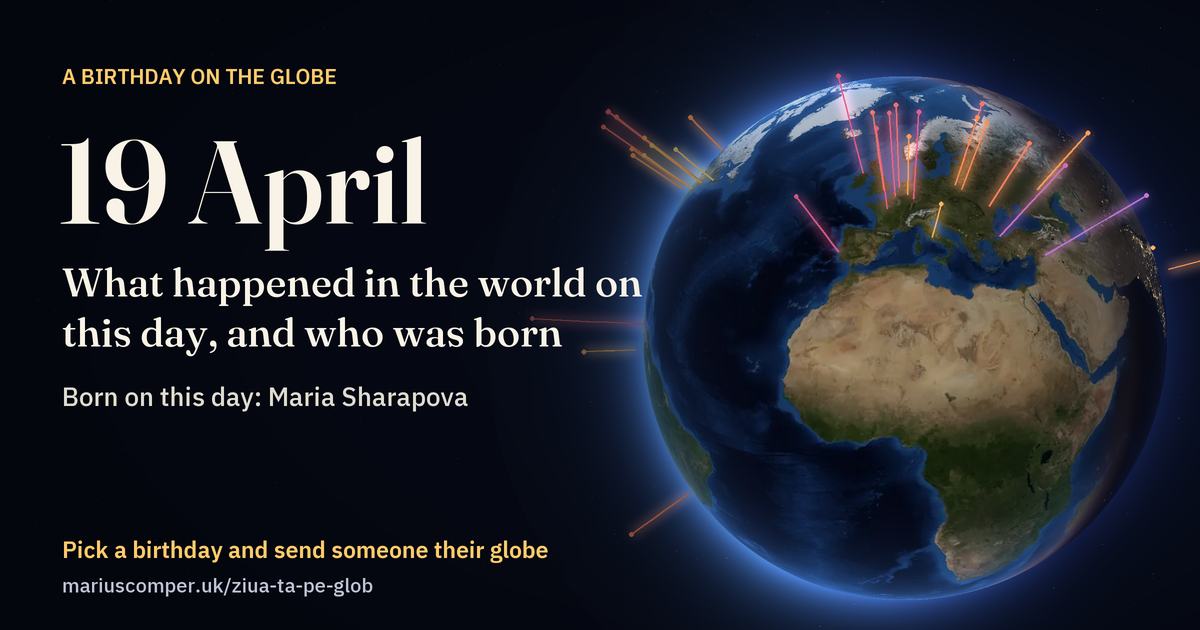
For 19 April, the English Wikipedia lists 55 events and 120 births. 32 of the events stand at their places as rays of light; three more are dashed circles, where the sentence links only to a country or a sea. The taller the ray, the longer ago it happened. The people born that day come further down, as blue points.
A birthday, yours or someone else’s:
Turn it into a greetingScroll: the globe turns to each place
The day you were born, on the globe.
Three things from your day
Scroll: your day first, then 19 April through the years
The Earth on 19 April
The picture on the globe was assembled by NASA from satellite photographs taken in April 2004: the snow, the ice and the green are those of the month.
On 19 April the Sun passes straight overhead at noon along the parallel of 11.3° north. In London, the day lasts about 14 hours 10 minutes.
Beyond 79° north the Sun no longer sets; beyond 79° south it no longer rises.
The line between day and night is tilted on the globe exactly as on this day of the year. On the dark side you can see the lights of towns.
Britain & Ireland · Treaty of London
1839
The Treaty of London establishes Belgium as a kingdom and guarantees its neutrality.
On the map: the coordinates Wikidata gives for the article “Treaty of London”.
Also on the day’s list of Wikipedia in Spanish and Chinese.
Europe · Blois
1572
England and France sign an alliance against Spain in the treaty of Blois.
On the map: Blois.
Europe · The Hague
1782
John Adams secures Dutch recognition of the United States as an independent government. The house which he had purchased in The Hague becomes the first American embassy.
On the map: The Hague.
Also on the day’s list of Wikipedia in Spanish and Chinese.
Europe · 2005 conclave
2005
Cardinal Joseph Ratzinger is elected to the papacy and becomes Pope Benedict XVI.
On the map: the coordinates Wikidata gives for the article “2005 conclave”.
Also on the day’s list of Wikipedia in Romanian and Chinese.
Latin America · Caracas
1810
Venezuela achieves home rule: Vicente Emparán, Governor of the Captaincy General is removed by the people of Caracas and a junta is installed.
On the map: Caracas.
Also on the day’s list of Wikipedia in Spanish.
19 April
What the other Wikipedias remember#
For these years the English list has nothing on this day. The events below come from the same day’s lists on Wikipedia in Chinese and Spanish and were translated for this page.
From Wikipedia in Chinese · Rome
1909
The Roman Catholic Church canonises Joan of Arc as a saint.
On the map: Rome.
Translated from the list on Wikipedia in Chinese.
From Wikipedia in Spanish · Bilbao
1911
In Bilbao, a company is formed to build the direct railways from Madrid to Valencia and from Madrid to Bilbao.
On the map: Bilbao.
Translated from the list on Wikipedia in Spanish.
19 April
Born on 19 April#
The English Wikipedia lists 120 births for this day. The blue points are the birthplaces of 60 of these people: those written about in the most Wikipedia editions, where Wikidata gives a place of birth.
Born on 19 April
1987
Maria Sharapova, Russian tennis player
Place of birth: Nyagan.
Born on 19 April
1832
José Echegaray, Spanish poet and playwright, Nobel Prize laureate (died 1916)
Place of birth: Madrid.
Born on 19 April
1978
James Franco, American actor, director, producer, and screenwriter
Place of birth: Palo Alto.
Born on 19 April
1957
Mukesh Ambani, Indian businessman, chairman of Reliance Industries
Place of birth: Aden.
Born in Britain and Ireland
1946
Tim Curry, English actor and singer (died 2026)
Place of birth: Grappenhall.
Born in Britain and Ireland
1987
Joe Hart, English footballer
Place of birth: Shrewsbury.
Born in Britain and Ireland
1935
Dudley Moore, English actor, comedian, and pianist (died 2002)
Place of birth: Hammersmith.
19 April
Number one in the charts that week
At the cinema
An animal recorded that day
The record can be seen in GBIF, which brings together wildlife records from around the world.
All your birthdays
The weather that day
Data: Met Office Hadley Centre (HadCET); NOAA (GHCN-Daily, Mauna Loa).
Above the Earth
Sources: Jonathan McDowell, GCAT (launches); GFZ Potsdam (Kp index). Days are counted in Universal Time.
Football that day
International matches played that day:
Source: the “International football results” dataset kept by Mart Jürisoo (CC0).
Also that day
The earthquake’s page at the USGS
Source: the USGS catalogue. The day is counted in Universal Time (UTC).
In those days
Make a link for someone
Type the name, pick the day and the year of birth. The link opens straight on their day, with their name in the greeting.
The link carries the name, date and place typed here; anyone who gets it can see them.
Put another birthday beside it
Your mother’s, your child’s, a friend’s: the two days appear side by side.
Below: 19 April through the years.
The whole globe of the day
Drag the globe to turn it. Touch a ray or a point to read what happened there.
Everything Wikipedia lists for 19 April
The list is the English Wikipedia’s, in its own wording, as it stood in October 2026. 20 events have no place on the map: the sentence links to no place with coordinates, only to places too wide to mark, or to several countries.
- 65
The freedman Milichus betrays Piso's plot to kill the Emperor Nero and all of the conspirators are arrested.
no place on the mapWikipedia: Freedman - 531
Battle of Callinicum: A Byzantine army under Belisarius is defeated by the Persians at Raqqa (northern Syria).
Asia · Battle of CallinicumWikipedia: Battle of Callinicum - 1024
Election of Pope John XIX following the death of his brother Pope Benedict VIII.
no place on the mapWikipedia: Pope John XIX - 1042
Following the attempt of Byzantine Emperor Michael V Kalaphates to depose his wife and empress Zoe Porphyrogenita, a popular uprising in Constantinople breaks out with the intention to restore her.
Asia · ConstantinopleWikipedia: List of Byzantine emperors - 1506
The Lisbon Massacre begins, in which about two thousand Jews who had been forcibly converted to Christianity are slaughtered by Portuguese Catholics.
Europe · Lisbon massacreWikipedia: Lisbon massacre - 1529
Beginning of the Protestant Reformation: After the Second Diet of Speyer bans Lutheranism, a group of rulers (German: Fürst) and independent cities protest the reinstatement of the Edict of Worms.
Europe · Diet of WormsWikipedia: Diet of Speyer - 1539
The Treaty of Frankfurt between Protestants and the Holy Roman Emperor is signed.
no place on the mapWikipedia: Treaty of Frankfurt - 1572
England and France sign an alliance against Spain in the treaty of Blois.
Europe · BloisWikipedia: Treaty of Blois - 1608
In Ireland, O'Doherty's Rebellion is launched by the Burning of Derry.
Britain & Ireland · DerryWikipedia: O'Doherty's rebellion - 1677
The French army captures the town of Cambrai held by Spanish troops.
Europe · Siege of CambraiWikipedia: Siege of Cambrai - 1713
With no living male heirs, Charles VI, Holy Roman Emperor, issues the Pragmatic Sanction of 1713 to ensure that Habsburg lands and the Austrian throne would be inheritable by a female; his daughter and successor, Maria Theresa, was not born until 1717.
Europe · Habsburg monarchyWikipedia: Pragmatic Sanction of 1713 - 1770
Captain James Cook, still holding the rank of lieutenant, sights the eastern coast of what is now Australia.
no place on the mapWikipedia: James Cook - 1770
Marie Antoinette marries Louis XVI in a proxy wedding.
no place on the mapWikipedia: Marie Antoinette - 1773
The Polish Partition Sejm met to discuss the First Partition of Poland, carried out the previous year by Russia, Prussia and Austria.
no place on the mapWikipedia: First Partition of Poland - 1775
American Revolutionary War: Following the Battles of Lexington and Concord, the Siege of Boston begins with American militias blocking land access to the British-held city.
North America · Siege of BostonWikipedia: Siege of Boston - 1775
American Revolutionary War: The war begins during the Battles of Lexington and Concord with a victory of American minutemen and other militia over British forces, later referred to as the "shot heard round the world".
North America · Battles of Lexington and ConcordWikipedia: Battles of Lexington and Concord - 1782
John Adams secures Dutch recognition of the United States as an independent government. The house which he had purchased in The Hague becomes the first American embassy.
Europe · The HagueWikipedia: John Adams - 1809
An Austrian corps is defeated by the forces of the Duchy of Warsaw in the Battle of Raszyn, part of the struggles of the Fifth Coalition. On the same day the Austrian main army is defeated by a First French Empire Corps led by Louis-Nicolas Davout at the Battle of Teugen-Hausen in Bavaria, part of a four-day campaign that ended in a French victory.
Europe · Battle of RaszynWikipedia: Battle of Raszyn - 1810
Venezuela achieves home rule: Vicente Emparán, Governor of the Captaincy General is removed by the people of Caracas and a junta is installed.
Latin America · CaracasWikipedia: Supreme Junta - 1818
French physicist Augustin Fresnel signs his preliminary "Note on the Theory of Diffraction" (deposited on the following day). The document ends with what we now call the Fresnel integrals.
no place on the mapWikipedia: Augustin-Jean Fresnel - 1839
The Treaty of London establishes Belgium as a kingdom and guarantees its neutrality.
Britain & Ireland · Treaty of LondonWikipedia: Treaty of London - 1861
American Civil War: Baltimore riot of 1861: A pro-Secession mob in Baltimore attacks United States Army troops marching through the city.
North America · BaltimoreWikipedia: American Civil War - 1875
The Minute Man was unveiled as part of the centennial celebration of the Battles of Lexington and Concord.
North America · The Minute ManWikipedia: Battles of Lexington and Concord - 1903
The Kishinev pogrom in Kishinev (Bessarabia) begins, forcing tens of thousands of Jews to later seek refuge in Palestine and the Western world.
Europe · Kishinev pogromWikipedia: Kishinev pogrom - 1925
Colo-Colo, the most successful and popular soccer football team in the South American nation of Chile, was founded at the El Llano Stadium in San Miguel, Santiago, by footballer David Arellano and some of his teammates who had also left the Deportes Magallanes club.
Latin America · Estadio Monumental David ArellanoWikipedia: Estadio Monumental David Arellano - 1927
Mae West is sentenced to ten days in jail for obscenity for her play Sex.
no place on the mapWikipedia: Mae West - 1936
The Jaffa riots commence, initiating the 1936–1939 Arab revolt in Palestine.
Asia · Mandatory PalestineWikipedia: 1936–1939 Arab revolt in Palestine - 1942
World War II: In German-occupied Poland, the Majdan-Tatarski ghetto is established, situated between the Lublin Ghetto and a Majdanek subcamp.
Europe · Lublin GhettoWikipedia: World War II - 1943
World War II: In German-occupied Poland, the Warsaw Ghetto Uprising begins, after German troops enter the Warsaw Ghetto to round up the remaining Jews.
Europe · Warsaw Ghetto UprisingWikipedia: Warsaw Ghetto Uprising - 1956
Actress Grace Kelly marries Prince Rainier of Monaco.
no place on the mapWikipedia: Grace Kelly - 1960
Students in South Korea hold a nationwide pro-democracy protest against president Syngman Rhee, eventually forcing him to resign.
no place on the mapWikipedia: April Revolution - 1971
Charles Manson is sentenced to death (later commuted to life imprisonment) for conspiracy in the Tate–LaBianca murders.
North America · Tate–LaBianca murdersWikipedia: Tate–LaBianca murders - 1971
Launch of Salyut 1, the first space station.
no place on the mapWikipedia: Salyut 1 - 1971
Sierra Leone becomes a republic, and Siaka Stevens the president.
Africa · Sierra LeoneWikipedia: Sierra Leone - 1971
The Doors released L.A. Woman, their final album during their lead vocalist Jim Morrison's lifetime.
no place on the mapWikipedia: The Doors - 1973
The Portuguese Socialist Party is founded in the German town of Bad Münstereifel.
Europe · Bad MünstereifelWikipedia: Socialist Party - 1975
India's first satellite Aryabhata launched in orbit from Kapustin Yar, Russia.
Europe · Kapustin YarWikipedia: India - 1975
South Vietnamese forces withdraw from the town of Xuan Loc in the last major battle of the Vietnam War.
Asia · Battle of Xuân LộcWikipedia: Vietnam War - 1976
A violent F5 tornado strikes around Brownwood, Texas, injuring 11 people. Two people were thrown at least 1,000 yards (910 m) by the tornado and survived uninjured.
North America · Brownwood, TexasWikipedia: 1976 Brownwood tornado - 1984
"Advance Australia Fair", written by Scottish-born composer Peter Dodds McCormick, officially replaced "God Save the Queen" as Australia's national anthem.
no place on the mapWikipedia: Advance Australia Fair - 1985
Two hundred ATF and FBI agents lay siege to the compound of the white supremacist survivalist group The Covenant, the Sword, and the Arm of the Lord in Arkansas; the CSA surrenders two days later.
no place on the mapWikipedia: Bureau of Alcohol, Tobacco, Firearms and Explosives - 1987
The fictional Simpson family made their first appearance in the short "Good Night", aired in a segment of the The Tracey Ullman Show.
no place on the mapWikipedia: Simpson family - 1989
A gun turret explodes on the USS Iowa, killing 47 sailors.
no place on the mapWikipedia: USS Iowa turret explosion - 1993
The 51-day FBI siege of the Branch Davidian building in Waco, Texas, US, ends when a fire breaks out. Seventy-six Davidians, including 18 children under age 10, died in the fire.
North America · Waco siegeWikipedia: Waco siege - 1995
Oklahoma City bombing: The Alfred P. Murrah Federal Building in Oklahoma City, US, is bombed, killing 168 people including 19 children under the age of six.
North America · Oklahoma City bombingWikipedia: Oklahoma City bombing - 1999
The German Bundestag returns to Berlin.
no place on the mapWikipedia: Decision on the Capital of Germany - 2000
Air Philippines Flight 541 crashes in Samal, Davao del Norte, killing all 131 people on board.
Asia · Air Philippines Flight 541Wikipedia: Air Philippines Flight 541 - 2001
Space Shuttle Endeavour is launched on STS-100 carrying the Canadarm2 to the International Space Station.
no place on the mapWikipedia: Space Shuttle Endeavour - 2005
Cardinal Joseph Ratzinger is elected to the papacy and becomes Pope Benedict XVI.
Europe · 2005 conclaveWikipedia: 2005 conclave - 2008
The Quito Ultratumba nightclub fire in Quito, Ecuador, kills 19 people and injures at least 24 more.
Latin America · Quito Ultratumba nightclub fireWikipedia: Quito Ultratumba nightclub fire - 2011
Fidel Castro resigns as First Secretary of the Communist Party of Cuba after holding the title since July 1961.
no place on the mapWikipedia: Fidel Castro - 2013
Boston Marathon bombing suspect Tamerlan Tsarnaev is killed in a shootout with police. His brother Dzhokhar is later captured hiding in a boat inside a backyard in the suburb of Watertown.
North America · Boston Marathon bombingWikipedia: Boston Marathon bombing - 2015
Freddie Gray, a 25-year-old African American, died of injuries sustained while in the custody of the Baltimore Police Department.
North America · BaltimoreWikipedia: Killing of Freddie Gray - 2020
A killing spree in Nova Scotia, Canada, leaves 22 people and the perpetrator dead, making it the deadliest rampage in the country's history.
North America · 2020 Nova Scotia attacksWikipedia: 2020 Nova Scotia attacks - 2021
The Ingenuity helicopter becomes the first aircraft to achieve flight on another planet.
no place on the mapWikipedia: Ingenuity
What the other Wikipedias remember
For these years the English list has nothing on this day. The events below come from the same day’s lists on Wikipedia in Chinese and Spanish and were translated for this page.
- 1909
The Roman Catholic Church canonises Joan of Arc as a saint.
- 1911
In Bilbao, a company is formed to build the direct railways from Madrid to Valencia and from Madrid to Bilbao.
Who was born on 19 April
In order of how many Wikipedia editions have an article about each. The first 60 of 120 are shown.
- 1939
Ali Khamenei, Supreme Leader of Iran (died 2026)
MashhadWikipedia: Ali Khamenei - 1987
Maria Sharapova, Russian tennis player
- 1832
José Echegaray, Spanish poet and playwright, Nobel Prize laureate (died 1916)
- 1979
Kate Hudson, American actress
Los AngelesWikipedia: Kate Hudson - 1882
Getúlio Vargas, Brazilian lawyer and politician, 14th President of Brazil (died 1954)
São BorjaWikipedia: Getúlio Vargas - 1978
James Franco, American actor, director, producer, and screenwriter
Palo AltoWikipedia: James Franco - 1968
Mswati III, King (Ngwenyama) of Eswatini (Swaziland)
ManziniWikipedia: Mswati III - 1957
Mukesh Ambani, Indian businessman, chairman of Reliance Industries
- 1972
Rivaldo Vitor Borba Ferreira, Brazilian footballer
RecifeWikipedia: Rivaldo - 1912
Glenn T. Seaborg, American chemist and academic, Nobel Prize laureate (died 1999)
IshpemingWikipedia: Glenn T. Seaborg - 1960
Gustavo Petro, Colombian politician, 34th and current President of Colombia
Ciénaga de OroWikipedia: Gustavo Petro - 1946
Tim Curry, English actor and singer (died 2026)
GrappenhallWikipedia: Tim Curry - 1933
Jayne Mansfield, American model and actress (died 1967)
Bryn MawrWikipedia: Jayne Mansfield - 1793
Ferdinand I of Austria (died 1875)
- 1968
Ashley Judd, American actress
Granada HillsWikipedia: Ashley Judd - 1932
Fernando Botero, Colombian painter and sculptor (died 2023)
MedellínWikipedia: Fernando Botero - 1981
Hayden Christensen, Canadian actor
VancouverWikipedia: Hayden Christensen - 1987
Joe Hart, English footballer
ShrewsburyWikipedia: Joe Hart - 1937
Joseph Estrada, Filipino politician, 13th President of the Philippines
- 1922
Erich Hartmann, German colonel and pilot (died 1993)
WeissachWikipedia: Erich Hartmann - 1935
Dudley Moore, English actor, comedian, and pianist (died 2002)
HammersmithWikipedia: Dudley Moore - 1944
James Heckman, American economist and academic, Nobel Prize laureate
ChicagoWikipedia: James Heckman - 1897
Jiroemon Kimura, Japanese super-centenarian, oldest verified man ever (died 2013)
Kyōtango-shiWikipedia: Jiroemon Kimura - 1936
Wilfried Martens, Belgian politician, 60th Prime Minister of Belgium (died 2013)
SleidingeWikipedia: Wilfried Martens - 1954
Trevor Francis, English footballer and manager (died 2023)
PlymouthWikipedia: Trevor Francis - 1686
Vasily Tatishchev, Russian ethnographer and politician (died 1750)
- 1970
Kelly Holmes, English athlete and double Olympic champion
PemburyWikipedia: Kelly Holmes - 1883
Richard von Mises, Austrian-American mathematician and physicist (died 1953)
- 1982
Ali Wong, American comedian and actress
San FranciscoWikipedia: Ali Wong - 1989
Simu Liu, Canadian actor
HarbinWikipedia: Simu Liu - 2001
PinkPantheress, British singer-songwriter and record producer
- 1721
Roger Sherman, American lawyer and politician (died 1793)
NewtonWikipedia: Roger Sherman - 1986
Candace Parker, American basketball player
St. LouisWikipedia: Candace Parker - 1452
Frederick IV, King of Naples (died 1504)
- 1658
Johann Wilhelm, Elector Palatine, German husband of Archduchess Maria Anna Josepha of Austria (died 1716)
- 1889
Otto Georg Thierack, German jurist and politician (died 1946)
- 1902
Veniamin Kaverin, Russian author and screenwriter (died 1989)
- 1925
Hugh O'Brian, American actor (died 2016)
RochesterWikipedia: Hugh O'Brian - 1965
Suge Knight, American record executive
ComptonWikipedia: Suge Knight - 1991
Kelly Olynyk, Canadian basketball player
TorontoWikipedia: Kelly Olynyk - 1903
Eliot Ness, American law enforcement agent (died 1957)
ChicagoWikipedia: Eliot Ness - 1892
Germaine Tailleferre, French composer and educator (died 1983)
Saint-Maur-des-FossésWikipedia: Germaine Tailleferre - 1898
Constance Talmadge, American actress and producer (died 1973)
BrooklynWikipedia: Constance Talmadge - 1899
George O'Brien, American actor (died 1985)
San FranciscoWikipedia: George O'Brien - 1917
Sven Hassel, Danish-German soldier and author (died 2012)
NyhuseWikipedia: Sven Hassel - 1928
Alexis Korner, British blues musician and radio broadcaster (died 1984)
- 1951
Jóannes Eidesgaard, Faroese educator and politician, Prime Minister of the Faroe Islands
TvøroyriWikipedia: Jóannes Eidesgaard - 1835
Julius Krohn, Finnish poet and journalist (died 1888)
VyborgWikipedia: Julius Krohn - 1913
Ken Carpenter, American discus thrower and coach (died 1984)
ComptonWikipedia: Ken Carpenter - 1928
Azlan Shah of Perak, Yang di-Pertuan Agong of Malaysia (died 2014)
Batu GajahWikipedia: Azlan Shah of Perak - 2002
Loren Gray, American singer and internet personality
PottstownWikipedia: Loren Gray - 1920
Julien Ries, Belgian cardinal (died 2013)
FouchesWikipedia: Julien Ries - 1974
Madeleine Peyroux, American French jazz and blues singer-songwriter
- 1633
Willem Drost, Dutch painter (died 1659)
AmsterdamWikipedia: Willem Drost - 1872
Alice Salomon, German social reformer (died 1948)
BerlinWikipedia: Alice Salomon - 1941
Michel Roux, French-English chef and author (died 2020)
CharollesWikipedia: Michel Roux - 1990
Kim Chiu, Filipino actress, singer, and dancer
TaclobanWikipedia: Kim Chiu - 1603
Michel Le Tellier, French politician, French Minister of Defence (died 1685)
- 1900
Richard Hughes, English author, poet, and playwright (died 1976)
WeybridgeWikipedia: Richard Hughes - 1921
Roberto Tucci, Italian Jesuit leader, cardinal, and theologian (died 2015)
NaplesWikipedia: Roberto Tucci
What is celebrated on 19 April
- Christian feast day: Ælfheah of Canterbury (Anglican, Catholic, Orthodox)
- Christian feast day: Conrad of Ascoli
- Christian feast day: Emma of Lesum
- Christian feast day: Expeditus
- Christian feast day: George of Antioch
- Christian feast day: Olaus and Laurentius Petri (Lutheran)
- Christian feast day: Pope Leo IX
- Christian feast day: Ursmar
- Christian feast day: April 19 (Eastern Orthodox liturgics)
A greeting link for someone
Type a name and, if you like, the year of birth. The link opens with a greeting, and beside each event it says how old the person turned that day, or how many years before their birth it happened.
The name and the year go only into the link you send.
All 366 days
How the globe is made
Where the events come from
Each edition of this page uses the day’s list from Wikipedia in its own language: Romanian, English, Spanish, Chinese. The lists are written by volunteers and differ from one edition to the next; the text of each event is Wikipedia’s, with a link to the article. A row that appears twice in a list is shown once. The lists have not been checked event by event: they are Wikipedia’s, mistakes included.
For events before 1582, and for countries that moved to the Gregorian calendar later (Britain in 1752, Russia in 1918), the same day may be counted Old Style in one list and New Style in another.
The chapter “What the other Wikipedias remember” adds up to five events a day from the lists of the other three editions, only for years in which the English list has nothing on that day. They were translated for this page, passed the same filters as the tour, and are not counted among the events of the English list.
How an event gets onto the map
The place comes from Wikidata. If the sentence links to the article about the event itself (a battle, an opening, an earthquake), dated to the same year, the ray stands on its coordinates or on those of its location. Otherwise it stands on the first place the sentence links to: a town, a building, a mountain, an island. This second step can be wrong: sometimes the sentence only mentions the place. That is why the page says, under each event, which place the ray stands on.
When the sentence links to a single state or province, or to a single sea, lake or desert larger than 5,000 km², the globe shows a dashed circle, not a ray. The circle has the area Wikidata gives, with its radius kept between 1.2° and 16°, or a radius of 4.5° when Wikidata gives no area; it says only that the sentence links to that place. Organisations, ships, spacecraft, museum objects, rivers, mountain ranges, languages and continents are never used as places. When a sentence names several states and no exact place, the event stays in the list only.
What the height means
The height of a ray shows how many years have passed, on a logarithmic scale: 10 years, 100 years and 1,000 years are equal steps apart; anything older than about 2,600 years has the tallest ray. The colour runs from pale yellow for recent years to violet for antiquity.
Where the tour stops
In each region the tour stops at up to three events (five in Britain and Ireland), chosen mainly by three things: whether Wikipedia’s editors put the event in the “On this day” box of their main page (the English, Spanish and Chinese editions), how many Wikipedia editions have an article about it, and how many of the four lists include it. Events whose sentence or article is about a war, an attack, a crime or a disaster are left out of the tour; they stay in the whole list, in Wikipedia’s wording. The filter is a list of words and a list of Wikidata types, so it can miss some.
The tour of births names the people with articles in the most editions and leaves aside those whom the list or Wikidata describes as rulers, politicians, commanders, leaders of movements or criminals; they stay in the list.
The Earth and the Sun
The daytime images are NASA’s Blue Marble Next Generation mosaics, one for each month of 2004; the night side is Black Marble 2016. The tilt of the line between day and night is computed for the day; the hour is chosen so that the place being read is in daylight. The latitude where the Sun stands overhead is the average of the four years of the leap cycle; in a given year it can differ by up to 0.4°.
The day you were born
The number ones come from the weekly lists on Wikipedia: Billboard for the United States (from 1940; the Hot 100 from August 1958), the UK Singles Chart (from November 1952), Los 40 Principales for Spain (from July 1966) and, for Romania, the Romanian Top 100 and Airplay 100 (2001–2021, with missing weeks). The page shows the chart of the week in which the day of birth falls, with its date; Billboard and the UK chart are dated at the end of their week. For Romania before 2001 and for China these sources have no weekly chart.
The films are those that reached cinemas in the United States up to ten days before or three days after that day (some of them in a few cinemas at first), from the English Wikipedia’s yearly lists (from 1968), in order of how many editions have an article about them. The events “in those days” are the ones on the neighbouring days’ lists that carry the year of birth, passed through the same filter as the tour.
The day of birth, year included
The Moon, the star sign and the constellation are worked out by the page itself, for noon Universal Time on the day. The lit part of the Moon is rounded and can differ by a few per cent from that at the hour of birth. The sign follows the usual zodiac of twelve equal parts starting at the March equinox; the constellation is the one the Sun actually stood in front of, by the borders set by the International Astronomical Union, and within a day of a border the page does not name it. When the Sun changes sign while it is that day anywhere on Earth, the page gives the moment of crossing, rounded to ten minutes and accurate to within about a quarter of an hour, and the clock time in a few cities, with the time zone and summer time of that year.
The year in the Chinese calendar is the one your device’s own calendar gives for the date, checked against the Hong Kong Observatory’s tables. “All your birthdays” uses the same sources as the rest of the chapter for the same day in every year since the birth: the temperature, well-known launches that took place on that very day, matches of the teams the edition follows, snow deeper than 10 cm and strong geomagnetic storms. The three things at the top and the four on the picture are chosen in a fixed order (the song, the animal, a full Moon, a well-known launch before an ordinary earthquake); on the picture you can change them.
When the link carries a year of birth, the page adds a few things about that exact day. The weather is the Met Office’s Central England temperature record and the readings from New York’s Central Park; the “usual high” is the average of the daily highs of 1961–1990 for that date, with two days either side. The carbon dioxide figure is the monthly mean at the Mauna Loa observatory, where measurements begin in March 1958.
The earthquake is the one with the largest magnitude in the USGS catalogue for that day, counted in Universal Time. Before the 1960s the catalogue has gaps even above magnitude 5.5, so in the older years many days have no earthquake. The page gives only the magnitude and the place: the country the epicentre falls in or, when the epicentre is at sea within 300 km of a coast, the nearest country; farther out, only the ocean.
The launches are those that reached orbit or left for the Moon and the planets, from Jonathan McDowell’s GCAT catalogue. If nothing left that day, the page shows the nearest launch within three days before or after, and says how many days away it was. The geomagnetic storm appears only when the Kp index reached at least 5 in one of the day’s eight three-hour intervals.
The animal comes from GBIF: an observation made by a person (the animal seen or heard, or its tracks), dated to that exact day, with coordinates and a CC0 or CC BY licence. Only a few hundred well-known species are searched (mammals, birds, turtles, butterflies); of those noted that day, mammals and species with articles in many Wikipedia editions come first; birds noted almost every day, and species used recently, wait their turn. Observations dated 1 January are left out, because records without a day are often filed there. An observation shows that the animal was recorded there, not how many animals there were.
The matches are those between national teams. Only matches of England, Scotland, Wales, Northern Ireland, the Republic of Ireland, the United States, Canada and Australia are shown, along with those at the big final tournaments. The picture to send is drawn in the page from the day’s globe and the facts above, and stays on your device until you send it.
Sources
- Events, births and holidays: the day’s page on Wikipedia, text under CC BY-SA 4.0.
- Coordinates, places of birth and the number of editions: Wikidata (CC0).
- The Earth by day: NASA Blue Marble Next Generation. The Earth by night: NASA Black Marble 2016.
- Borders and regions: Natural Earth.
- World population and births per year: UN World Population Prospects 2024.
- Charts and films: Wikipedia’s lists for Billboard, the UK Singles Chart, Los 40 Principales, Romanian Top 100, Airplay 100 and American films by year (CC BY-SA 4.0).
- Weather: Met Office Hadley Centre, HadCET (Open Government Licence) and NOAA GHCN-Daily, New York Central Park. Carbon dioxide: NOAA Global Monitoring Laboratory, Mauna Loa.
- Earthquakes: the USGS catalogue. Launches: Jonathan McDowell, GCAT (CC BY). Kp index: GFZ Potsdam (CC BY 4.0). Matches: International football results, Mart Jürisoo (CC0).
- Animal observations: GBIF, with a link to each record; species names come from Wikidata.