A birthday on the globe
29 July on the globe: what happened in the world on this day, and who was born
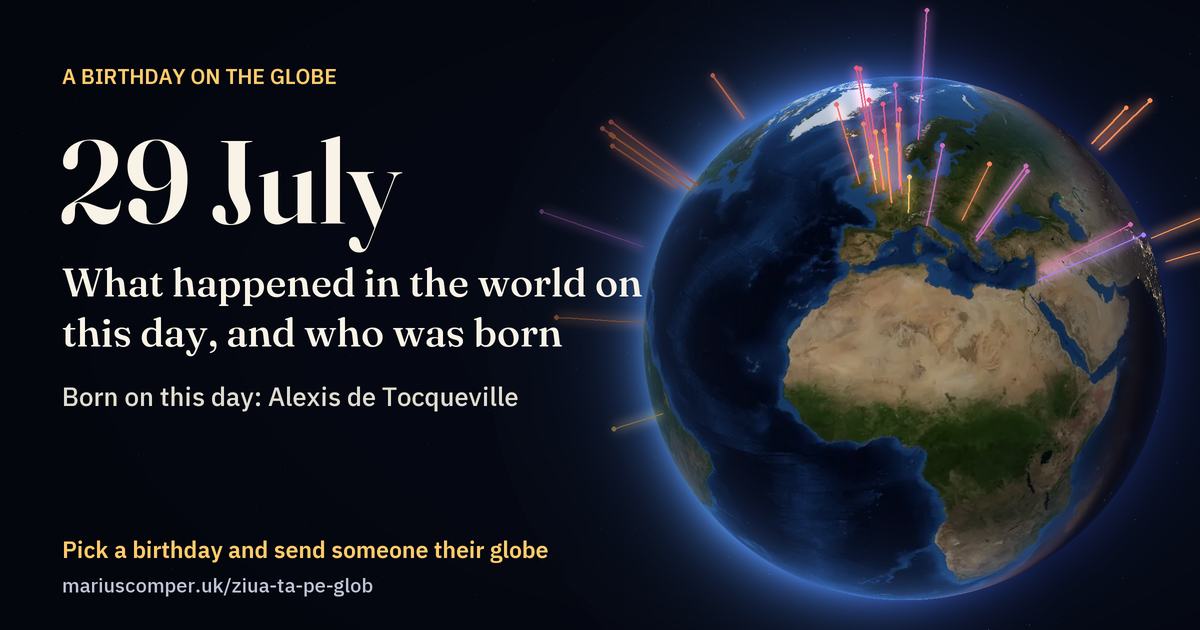
For 29 July, the English Wikipedia lists 66 events and 238 births. 34 of the events stand at their places as rays of light; three more are dashed circles, where the sentence links only to a country or a sea. The taller the ray, the longer ago it happened. The people born that day come further down, as blue points.
A birthday, yours or someone else’s:
Turn it into a greetingScroll: the globe turns to each place
The day you were born, on the globe.
Three things from your day
Scroll: your day first, then 29 July through the years
The Earth on 29 July
The picture on the globe was assembled by NASA from satellite photographs taken in July 2004: the snow, the ice and the green are those of the month.
On 29 July the Sun passes straight overhead at noon along the parallel of 18.7° north. In London, the day lasts about 15 hours 35 minutes.
Beyond 71° north the Sun no longer sets; beyond 71° south it no longer rises.
The line between day and night is tilted on the globe exactly as on this day of the year. On the dark side you can see the lights of towns.
Britain & Ireland · Holyrood Palace
1565
The widowed Mary, Queen of Scots marries Henry Stuart, Lord Darnley, Duke of Albany, at Holyrood Palace, Edinburgh, Scotland, in a Catholic ceremony.
On the map: Holyrood Palace.
Also on the day’s list of Wikipedia in Spanish.
Wikipedia: Wedding of Mary, Queen of Scots, and Henry Stuart, Lord Darnley
Britain & Ireland · Stirling
1567
The infant James VI is crowned King of Scotland at Stirling.
On the map: Stirling.
Also on the day’s list of Wikipedia in Spanish.
Britain & Ireland · London Borough of Hillingdon
1602
Elizabeth I visits Harefield Place at Hillingdon and the Harefield Entertainment is performed.
On the map: London Borough of Hillingdon.
Britain & Ireland · St Paul's Cathedral
1981
A worldwide television audience of around 750 million people watch the wedding of Charles, Prince of Wales, and Lady Diana Spencer at St Paul's Cathedral in London.
On the map: St Paul's Cathedral.
Also on the day’s list of Wikipedia in Spanish and Chinese.
Europe · Arc de Triomphe
1836
Inauguration of the Arc de Triomphe in Paris, France.
On the map: Arc de Triomphe.
Also on the day’s list of Wikipedia in Spanish, Romanian and Chinese.
Latin America · Palenque
615
Pakal ascends the throne of Palenque at the age of 12.
On the map: Palenque.
North America · Old Saybrook, Connecticut
1871
The Connecticut Valley Railroad opens between Old Saybrook, Connecticut and Hartford, Connecticut in the United States.
On the map: Old Saybrook, Connecticut.
North America · Link River Dam
1920
Construction of the Link River Dam begins as part of the Klamath Reclamation Project.
On the map: Link River Dam.
29 July
What the other Wikipedias remember#
For these years the English list has nothing on this day. The events below come from the same day’s lists on Wikipedia in Spanish and Chinese and were translated for this page.
From Wikipedia in Spanish · Seville
1525
In what is now the territory of Colombia, the Sevillian adelantado Rodrigo de Bastidas founds the village of Santa Marta.
On the map: Seville.
Translated from the list on Wikipedia in Spanish.
From Wikipedia in Chinese · New York City
1962
Work begins on renovating the exterior facade of the Empire State Building in New York, United States.
On the map: New York City.
Translated from the list on Wikipedia in Chinese.
29 July
Born on 29 July#
The English Wikipedia lists 238 births for this day. The blue points are the birthplaces of 60 of these people: those written about in the most Wikipedia editions, where Wikidata gives a place of birth.
Born on 29 July
1805
Alexis de Tocqueville, French historian and philosopher (died 1859)
Place of birth: Paris.
Born on 29 July
1898
Isidor Isaac Rabi, American physicist and academic, Nobel Prize Laureate (died 1988)
Place of birth: Rymanów.
Born on 29 July
1900
Eyvind Johnson, Swedish novelist and short story writer, Nobel Prize Laureate (died 1976)
Place of birth: Boden.
Born on 29 July
1927
Harry Mulisch, Dutch author, poet, and playwright (died 2010)
Place of birth: Haarlem.
Born on 29 July
1817
Ivan Aivazovsky, Armenian-Russian painter and illustrator (died 1900)
Place of birth: Feodosiia.
Born in Britain and Ireland
1941
David Warner, English actor (died 2022)
Place of birth: Manchester.
Born in Britain and Ireland
1962
Carl Cox, English DJ and producer
Place of birth: Oldham.
Born in Britain and Ireland
1963
Graham Poll, English footballer, referee, and journalist
Place of birth: Hitchin.
29 July
Number one in the charts that week
At the cinema
An animal recorded that day
The record can be seen in GBIF, which brings together wildlife records from around the world.
All your birthdays
The weather that day
Data: Met Office Hadley Centre (HadCET); NOAA (GHCN-Daily, Mauna Loa).
Above the Earth
Sources: Jonathan McDowell, GCAT (launches); GFZ Potsdam (Kp index). Days are counted in Universal Time.
Football that day
International matches played that day:
Source: the “International football results” dataset kept by Mart Jürisoo (CC0).
Also that day
The earthquake’s page at the USGS
Source: the USGS catalogue. The day is counted in Universal Time (UTC).
In those days
Make a link for someone
Type the name, pick the day and the year of birth. The link opens straight on their day, with their name in the greeting.
The link carries the name, date and place typed here; anyone who gets it can see them.
Put another birthday beside it
Your mother’s, your child’s, a friend’s: the two days appear side by side.
Below: 29 July through the years.
The whole globe of the day
Drag the globe to turn it. Touch a ray or a point to read what happened there.
Everything Wikipedia lists for 29 July
The list is the English Wikipedia’s, in its own wording, as it stood in October 2026. 29 events have no place on the map: the sentence links to no place with coordinates, only to places too wide to mark, or to several countries.
- 587 BC
The Neo-Babylonian Empire sacks Jerusalem and destroys the First Temple.
Asia · Siege of JerusalemWikipedia: Siege of Jerusalem - 238
The Praetorian guard revolts against emperors Balbinus and Pupienus and arrests them.
no place on the mapWikipedia: Praetorian Guard - 615
Pakal ascends the throne of Palenque at the age of 12.
Latin America · PalenqueWikipedia: Kʼinich Janaabʼ Pakal - 904
Sack of Thessalonica: Saracen raiders under Leo of Tripoli sack Thessaloniki, the Byzantine Empire's second-largest city, after a short siege, and plunder it for a week.
Europe · Sack of ThessalonicaWikipedia: Sack of Thessalonica - 923
Battle of Firenzuola: Lombard forces under King Rudolph II and Adalbert I, margrave of Ivrea, defeat the dethroned Emperor Berengar I of Italy at Firenzuola (Tuscany).
Europe · FirenzuolaWikipedia: Battle of Fiorenzuola - 1014
Byzantine–Bulgarian wars: Battle of Kleidion: Byzantine emperor Basil II inflicts a decisive defeat on the Bulgarian army, and his subsequent treatment of 15,000 prisoners reportedly causes Tsar Samuil of Bulgaria to die of a heart attack less than three months later, on October 6.
Europe · Battle of KleidionWikipedia: Battle of Kleidion - 1018
Count Dirk III defeats an army sent by Emperor Henry II in the Battle of Vlaardingen.
Europe · VlaardingenWikipedia: Battle of Vlaardingen - 1030
Ladejarl-Fairhair succession wars: Battle of Stiklestad: King Olaf II fights and dies trying to regain his Norwegian throne from the Danes.
Europe · Battle of StiklestadWikipedia: Battle of Stiklestad - 1148
The Siege of Damascus ends in a decisive crusader defeat and leads to the disintegration of the Second Crusade.
Asia · Siege of DamascusWikipedia: Siege of Damascus - 1565
The widowed Mary, Queen of Scots marries Henry Stuart, Lord Darnley, Duke of Albany, at Holyrood Palace, Edinburgh, Scotland, in a Catholic ceremony.
Britain & Ireland · Holyrood PalaceWikipedia: Wedding of Mary, Queen of Scots, and Henry Stuart, Lord Darnley - 1567
The infant James VI is crowned King of Scotland at Stirling.
Britain & Ireland · StirlingWikipedia: James VI and I - 1588
Anglo-Spanish War: Battle of Gravelines: English naval forces under the command of Lord Charles Howard and Sir Francis Drake defeat the Spanish Armada off the coast of Gravelines, France.
Europe · GravelinesWikipedia: Anglo-Spanish War - 1602
Elizabeth I visits Harefield Place at Hillingdon and the Harefield Entertainment is performed.
Britain & Ireland · London Borough of HillingdonWikipedia: Elizabeth I - 1693
War of the Grand Alliance: Battle of Landen: France wins a victory over Allied forces in the Netherlands.
Europe · Battle of LandenWikipedia: Nine Years' War - 1775
Founding of the U.S. Army Judge Advocate General's Corps: General George Washington appoints William Tudor as Judge Advocate of the Continental Army.
no place on the mapWikipedia: United States Army Judge Advocate General's Corps - 1818
French physicist Augustin Fresnel submits his prizewinning "Memoir on the Diffraction of Light", precisely accounting for the limited extent to which light spreads into shadows, and thereby demolishing the oldest objection to the wave theory of light.
no place on the mapWikipedia: Augustin-Jean Fresnel - 1832
An Egyptian army under Ibrahim Pascha defeats a larger Ottoman army in the battle of Belen Pass.
no place on the mapWikipedia: Battle of Belen Pass - 1836
Inauguration of the Arc de Triomphe in Paris, France.
Europe · Arc de TriompheWikipedia: Arc de Triomphe - 1848
Great Famine of Ireland: Tipperary Revolt: In County Tipperary, Ireland, then in the United Kingdom, an unsuccessful nationalist revolt against British rule is put down by police.
Britain & Ireland · Young Ireland rebellionWikipedia: Young Ireland rebellion - 1851
Annibale de Gasparis discovers asteroid 15 Eunomia.
no place on the mapWikipedia: Annibale de Gasparis - 1858
United States and Japan sign the Harris Treaty.
no place on the mapWikipedia: Treaty of Amity and Commerce - 1862
American Civil War: Confederate spy Belle Boyd is arrested by Union troops and detained at the Old Capitol Prison in Washington, D.C.
North America · Old Brick CapitolWikipedia: American Civil War - 1871
The Connecticut Valley Railroad opens between Old Saybrook, Connecticut and Hartford, Connecticut in the United States.
North America · Old Saybrook, ConnecticutWikipedia: Valley Railroad - 1899
The First Hague Convention is signed.
no place on the mapWikipedia: Hague Conventions of 1899 and 1907 - 1900
In Italy, King Umberto I of Italy is assassinated by the anarchist Gaetano Bresci. His son, Victor Emmanuel III, 31 years old, succeeds to the throne.
no place on the mapWikipedia: Umberto I of Italy - 1901
Land lottery begins in Oklahoma.
North America · OklahomaWikipedia: Oklahoma - 1907
Sir Robert Baden-Powell sets up the Brownsea Island Scout camp in Poole Harbour on the south coast of England. The camp runs from August 1 to August 9 and is regarded as the foundation of the Scouting movement.
Britain & Ireland · Brownsea Island Scout campWikipedia: Poole Harbour - 1910
The two-day Slocum massacre commences in Texas, a race riot in which more than 100 African Americans are murdered.
North America · Slocum massacreWikipedia: Slocum massacre - 1911
In a case later termed a "legal lynching", Will P. Brady obtained a guilty verdict and death sentence against 15-year-old León Martínez Jr., five days after his arrest for killing a white woman.
no place on the mapWikipedia: La Matanza - 1914
The Cape Cod Canal opened.
no place on the mapWikipedia: Cape Cod Canal - 1914
The first shots of World War I were fired by the Austro-Hungarian river monitor Bodrog on Serbian defences near Belgrade.
Europe · BelgradeWikipedia: River monitor - 1920
Construction of the Link River Dam begins as part of the Klamath Reclamation Project.
North America · Link River DamWikipedia: Link River Dam - 1921
Adolf Hitler becomes leader of the National Socialist German Workers' Party.
no place on the mapWikipedia: Adolf Hitler - 1932
Great Depression: In Washington, D.C., troops disperse the last of the "Bonus Army" of World War I veterans using arson, bayonets, sabers, tanks, tear gas, and vomit gas.
North America · Bonus ArmyWikipedia: Bonus Army - 1937
Tongzhou mutiny: In Tongzhou, China, the East Hebei Army attacks Japanese troops and civilians.
Asia · Tongzhou mutinyWikipedia: Tongzhou mutiny - 1938
The Essential Commodities Reserves Act, which allowed the British government to build up reserves of essential commodities in anticipation of war, received royal assent.
no place on the mapWikipedia: Essential Commodities Reserves Act 1938 - 1945
The BBC Light Programme radio station is launched for mainstream light entertainment and music.
no place on the mapWikipedia: BBC Light Programme - 1947
A gas explosion in Harrisonburg, Virginia kills 11 and injures 30.
North America · 1947 Harrisonburg explosionWikipedia: 1947 Harrisonburg explosion - 1948
Olympic Games: The Games of the XIV Olympiad: After a hiatus of 12 years caused by World War II, the first Summer Olympics to be held since the 1936 Summer Olympics in Berlin, open in London.
no place on the mapWikipedia: 1948 Summer Olympics - 1950
Korean War: After four days, the No Gun Ri Massacre ends when the US Army 7th Cavalry Regiment is withdrawn.
Asia · No Gun Ri massacreWikipedia: Korean War - 1954
The Fellowship of the Ring, the first part of J. R. R. Tolkien's novel The Lord of the Rings, was published by Allen & Unwin.
no place on the mapWikipedia: The Fellowship of the Ring - 1957
The International Atomic Energy Agency is established.
no place on the mapWikipedia: International Atomic Energy Agency - 1957
Tonight Starring Jack Paar premieres on NBC with Jack Paar beginning the modern day talk show.
no place on the mapWikipedia: Tonight Starring Jack Paar - 1958
U.S. President Dwight D. Eisenhower signs into law the National Aeronautics and Space Act, which creates the National Aeronautics and Space Administration (NASA).
no place on the mapWikipedia: Dwight D. Eisenhower - 1965
Vietnam War: The first 4,000 101st Airborne Division paratroopers arrive in Vietnam, landing at Cam Ranh Bay.
Asia · Cam Ranh BayWikipedia: Vietnam War - 1967
During the fourth day of celebrating its 400th anniversary, the city of Caracas, Venezuela is shaken by an earthquake, leaving approximately 500 dead.
Latin America · 1967 Caracas earthquakeWikipedia: 1967 Caracas earthquake - 1967
Vietnam War: Off the coast of North Vietnam the USS Forrestal catches on fire in the worst U.S. naval disaster since World War II, killing 134.
Asia · 1967 USS Forrestal fireWikipedia: 1967 USS Forrestal fire - 1972
Two Avianca Douglas DC-3 airliners collide over Colombia, killing 38.
no place on the mapWikipedia: 1972 Las Palomas mid-air collision - 1973
Driver Roger Williamson is killed during the Dutch Grand Prix, after a suspected tire failure causes his car to pitch into the barriers at high speed.
Europe · 1973 Dutch Grand PrixWikipedia: 1973 Dutch Grand Prix - 1973
Greeks vote to abolish the monarchy, beginning the first period of the Metapolitefsi.
no place on the mapWikipedia: 1973 Greek republic referendum - 1976
In New York City, David Berkowitz (a.k.a. the "Son of Sam") kills one person and seriously wounds another in the first of a series of attacks.
no place on the mapWikipedia: David Berkowitz - 1980
Iran adopts a new "holy" flag after the Islamic Revolution.
no place on the mapWikipedia: Iranian Revolution - 1981
A worldwide television audience of around 750 million people watch the wedding of Charles, Prince of Wales, and Lady Diana Spencer at St Paul's Cathedral in London.
Britain & Ireland · St Paul's CathedralWikipedia: Wedding of Prince Charles and Lady Diana Spencer - 1981
After impeachment on June 21, Abolhassan Banisadr flees with Massoud Rajavi to Paris, in an Iranian Air Force Boeing 707, piloted by Colonel Behzad Moezzi, to form the National Council of Resistance of Iran.
Europe · ParisWikipedia: Abolhassan Banisadr - 1985
Space Shuttle Challenger launches on STS-51-F. The shuttle ends up in a lower orbit than planned due to an engine failure during ascent.
no place on the mapWikipedia: Space Shuttle Challenger - 1987
British Prime Minister Margaret Thatcher and President of France François Mitterrand sign the agreement to build a tunnel under the English Channel (Channel Tunnel).
no place on the mapWikipedia: Margaret Thatcher - 1987
Prime Minister of India Rajiv Gandhi and President of Sri Lanka J. R. Jayewardene sign the Indo-Sri Lanka Accord on ethnic issues.
no place on the mapWikipedia: Rajiv Gandhi - 1993
The Supreme Court of Israel acquits alleged Nazi death camp guard John Demjanjuk of all charges and he is set free.
no place on the mapWikipedia: Supreme Court of Israel - 1996
The child protection portion of the Communications Decency Act is struck down by a U.S. federal court as too broad.
no place on the mapWikipedia: Communications Decency Act - 2005
Astronomers announce their discovery of the dwarf planet Eris.
no place on the mapWikipedia: Eris - 2010
An overloaded passenger ferry capsizes on the Kasai River in Bandundu Province, Democratic Republic of the Congo, resulting in at least 80 deaths.
Africa · Bandundu ProvinceWikipedia: 2010 Kasai River ferry capsizing - 2013
Two passenger trains collide in the Swiss municipality of Granges-près-Marnand near Lausanne injuring 25 people.
Europe · Granges-près-MarnandWikipedia: Granges-près-Marnand train crash - 2015
The first piece of suspected debris from Malaysia Airlines Flight 370 is discovered on Réunion Island.
Europe · RéunionWikipedia: Malaysia Airlines Flight 370 - 2019
The 2019 Altamira prison riot between rival Brazilian drug gangs leaves 62 dead.
Latin America · 2019 Altamira prison riotWikipedia: 2019 Altamira prison riot - 2021
The International Space Station temporarily spins out of control, moving the ISS 45 degrees out of attitude, following an engine malfunction of Russian module Nauka.
no place on the mapWikipedia: International Space Station - 2024
Three children are stabbed to death and 10 other people injured at a dance studio in Southport, England. This incident, coupled with widespread online misinformation, leads to various racially motivated riots across the UK.
Britain & Ireland · 2024 Southport stabbingsWikipedia: 2024 Southport stabbings
What the other Wikipedias remember
For these years the English list has nothing on this day. The events below come from the same day’s lists on Wikipedia in Spanish and Chinese and were translated for this page.
- 1525
In what is now the territory of Colombia, the Sevillian adelantado Rodrigo de Bastidas founds the village of Santa Marta.
- 1962
Work begins on renovating the exterior facade of the Empire State Building in New York, United States.
Who was born on 29 July
In order of how many Wikipedia editions have an article about each. The first 60 of 238 are shown.
- 1883
Benito Mussolini, Italian fascist revolutionary and politician, 27th Prime Minister of Italy (died 1945)
PredappioWikipedia: Benito Mussolini - 1905
Dag Hammarskjöld, Swedish economist and diplomat, 2nd Secretary-General of the United Nations, Nobel Prize Laureate (died 1961)
JönköpingWikipedia: Dag Hammarskjöld - 1981
Fernando Alonso, Spanish race car driver
- 1805
Alexis de Tocqueville, French historian and philosopher (died 1859)
- 1898
Isidor Isaac Rabi, American physicist and academic, Nobel Prize Laureate (died 1988)
RymanówWikipedia: Isidor Rabi - 1900
Eyvind Johnson, Swedish novelist and short story writer, Nobel Prize Laureate (died 1976)
- 1927
Harry Mulisch, Dutch author, poet, and playwright (died 2010)
HaarlemWikipedia: Harry Mulisch - 1817
Ivan Aivazovsky, Armenian-Russian painter and illustrator (died 1900)
FeodosiiaWikipedia: Ivan Aivazovsky - 1925
Mikis Theodorakis, Greek composer (died 2021)
- 1905
Clara Bow, American actress (died 1965)
BrooklynWikipedia: Clara Bow - 1974
Josh Radnor, American actor and musician
ColumbusWikipedia: Josh Radnor - 1885
Theda Bara, American actress (died 1955)
CincinnatiWikipedia: Theda Bara - 1937
Daniel McFadden, American economist and academic, Nobel Prize Laureate
RaleighWikipedia: Daniel McFadden - 1945
Mircea Lucescu, Romanian footballer, coach, and manager (died 2026)
BucharestWikipedia: Mircea Lucescu - 1959
Sanjay Dutt, Indian actor, singer, and producer
- 1982
Allison Mack, American actress and criminal
PreetzWikipedia: Allison Mack - 1892
William Powell, American actor and singer (died 1984)
PittsburghWikipedia: William Powell - 1941
David Warner, English actor (died 2022)
ManchesterWikipedia: David Warner - 1992
Djibril Sidibé, French footballer
- 869
Muhammad al-Mahdi, The 12th Imam of Muslims (Shiites) (died 941)
SamarraWikipedia: Muhammad al-Mahdi - 1846
Isabel, Brazilian princess (died 1921)
Rio de JaneiroWikipedia: Isabel, Princess Imperial of Brazil - 1957
Nellie Kim, Russian gymnast and coach
ShurabWikipedia: Nellie Kim - 1993
Ayoze Pérez, Spanish footballer
Santa Cruz de TenerifeWikipedia: Ayoze Pérez - 1841
Gerhard Armauer Hansen, Norwegian physician (died 1912)
Bergen MunicipalityWikipedia: Gerhard Armauer Hansen - 1904
J. R. D. Tata, French-Indian pilot and businessman, founded Tata Motors and Tata Global Beverages (died 1993)
ParisWikipedia: JRD Tata - 1980
Fernando González, Chilean tennis player
SantiagoWikipedia: Fernando González - 1998
Tijjani Reijnders, Dutch footballer
- 1356
Martin the Elder, king of Aragon, Valencia and Majorca (died 1410)
PerpignanWikipedia: Martin of Aragon - 1849
Max Nordau, Hungarian physician, author, and critic, co-founded the World Zionist Organization (died 1923)
- 1888
Vladimir K. Zworykin, Russian-American inventor, engineer, invented the cathode ray tube system (died 1982)
- 1953
Ken Burns, American director and producer
BrooklynWikipedia: Ken Burns - 1984
Wilson Palacios, Honduran footballer
La CeibaWikipedia: Wilson Palacios - 1985
Besart Berisha, Albanian footballer
PristinaWikipedia: Besart Berisha - 1994
Daniele Rugani, Italian footballer
- 1973
Stephen Dorff, American actor and producer
AtlantaWikipedia: Stephen Dorff - 1972
Wil Wheaton, American actor, producer, and screenwriter
BurbankWikipedia: Wil Wheaton - 2003
Renato Veiga, Portuguese footballer
LisbonWikipedia: Renato Veiga - 1942
Tony Sirico, American actor (died 2022)
BrooklynWikipedia: Tony Sirico - 1988
Tarjei Bø, Norwegian biathlete
Stryn MunicipalityWikipedia: Tarjei Bø - 1921
Chris Marker, French photographer and journalist (died 2012)
Neuilly-sur-SeineWikipedia: Chris Marker - 1869
Booth Tarkington, American novelist and dramatist (died 1946)
IndianapolisWikipedia: Booth Tarkington - 1913
Erich Priebke, German war criminal, leader of the 1944 Ardeatine massacre (died 2013)
HennigsdorfWikipedia: Erich Priebke - 1917
Rochus Misch, German SS officer (died 2013)
Stare SiołkowiceWikipedia: Rochus Misch - 1953
Geddy Lee, Canadian musician
North YorkWikipedia: Geddy Lee - 1166
Henry II, French nobleman and king of Jerusalem (died 1197)
- 1936
Elizabeth Dole, American lawyer and politician, 20th United States Secretary of Labor
SalisburyWikipedia: Elizabeth Dole - 1966
Martina McBride, American singer-songwriter and producer
- 1962
Carl Cox, English DJ and producer
OldhamWikipedia: Carl Cox - 1876
Maria Ouspenskaya, Russian-American actress and acting teacher (died 1949)
- 1906
Thelma Todd, American actress and singer (died 1935)
LawrenceWikipedia: Thelma Todd - 1949
Jamil Mahuad, Ecuadorian lawyer and politician, 51st President of Ecuador
- 1963
Alexandra Paul, American actress and producer
New York CityWikipedia: Alexandra Paul - 1963
Graham Poll, English footballer, referee, and journalist
HitchinWikipedia: Graham Poll - 1605
Simon Dach, German poet and hymn-writer (died 1659)
KlaipėdaWikipedia: Simon Dach - 1984
Oh Beom-seok, South Korean footballer
PohangWikipedia: Oh Beom-seok - 1916
Charlie Christian, American guitarist (died 1942)
- 1955
Jean-Hugues Anglade, French actor, director, and screenwriter
- 1966
Sally Gunnell, English hurdler and sportscaster
ChigwellWikipedia: Sally Gunnell - 1905
Stanley Kunitz, American poet and translator (died 2006)
WorcesterWikipedia: Stanley Kunitz - 1932
Nancy Kassebaum, American businesswoman and politician (died 2026)
What is celebrated on 29 July
- Christian feast day: Lazarus of Bethany
- Christian feast day: Lupus of Troyes
- Christian feast day: Martha of Bethany (Catholic, Anglican, and Lutheran Church)
- Christian feast day: Mary of Bethany
- Christian feast day: Olaf II of Norway
- Christian feast day: Simplicius, Faustinus and Beatrix
- Christian feast day: William Pinchon
- Christian feast day: July 29 (Eastern Orthodox liturgics)
- Earliest day on which Somer's Day can fall, while August 4 is the latest; celebrated on Friday before the first Monday in August. (Bermuda)
- International Tiger Day
- Mohun Bagan Day (India)
- National Anthem Day (Romania)
- National Thai Language Day (Thailand)
- Ólavsøka or Olsok, opening of the Løgting session. (Faroe Islands and the Nordic countries)
A greeting link for someone
Type a name and, if you like, the year of birth. The link opens with a greeting, and beside each event it says how old the person turned that day, or how many years before their birth it happened.
The name and the year go only into the link you send.
All 366 days
How the globe is made
Where the events come from
Each edition of this page uses the day’s list from Wikipedia in its own language: Romanian, English, Spanish, Chinese. The lists are written by volunteers and differ from one edition to the next; the text of each event is Wikipedia’s, with a link to the article. A row that appears twice in a list is shown once. The lists have not been checked event by event: they are Wikipedia’s, mistakes included.
For events before 1582, and for countries that moved to the Gregorian calendar later (Britain in 1752, Russia in 1918), the same day may be counted Old Style in one list and New Style in another.
The chapter “What the other Wikipedias remember” adds up to five events a day from the lists of the other three editions, only for years in which the English list has nothing on that day. They were translated for this page, passed the same filters as the tour, and are not counted among the events of the English list.
How an event gets onto the map
The place comes from Wikidata. If the sentence links to the article about the event itself (a battle, an opening, an earthquake), dated to the same year, the ray stands on its coordinates or on those of its location. Otherwise it stands on the first place the sentence links to: a town, a building, a mountain, an island. This second step can be wrong: sometimes the sentence only mentions the place. That is why the page says, under each event, which place the ray stands on.
When the sentence links to a single state or province, or to a single sea, lake or desert larger than 5,000 km², the globe shows a dashed circle, not a ray. The circle has the area Wikidata gives, with its radius kept between 1.2° and 16°, or a radius of 4.5° when Wikidata gives no area; it says only that the sentence links to that place. Organisations, ships, spacecraft, museum objects, rivers, mountain ranges, languages and continents are never used as places. When a sentence names several states and no exact place, the event stays in the list only.
What the height means
The height of a ray shows how many years have passed, on a logarithmic scale: 10 years, 100 years and 1,000 years are equal steps apart; anything older than about 2,600 years has the tallest ray. The colour runs from pale yellow for recent years to violet for antiquity.
Where the tour stops
In each region the tour stops at up to three events (five in Britain and Ireland), chosen mainly by three things: whether Wikipedia’s editors put the event in the “On this day” box of their main page (the English, Spanish and Chinese editions), how many Wikipedia editions have an article about it, and how many of the four lists include it. Events whose sentence or article is about a war, an attack, a crime or a disaster are left out of the tour; they stay in the whole list, in Wikipedia’s wording. The filter is a list of words and a list of Wikidata types, so it can miss some.
The tour of births names the people with articles in the most editions and leaves aside those whom the list or Wikidata describes as rulers, politicians, commanders, leaders of movements or criminals; they stay in the list.
The Earth and the Sun
The daytime images are NASA’s Blue Marble Next Generation mosaics, one for each month of 2004; the night side is Black Marble 2016. The tilt of the line between day and night is computed for the day; the hour is chosen so that the place being read is in daylight. The latitude where the Sun stands overhead is the average of the four years of the leap cycle; in a given year it can differ by up to 0.4°.
The day you were born
The number ones come from the weekly lists on Wikipedia: Billboard for the United States (from 1940; the Hot 100 from August 1958), the UK Singles Chart (from November 1952), Los 40 Principales for Spain (from July 1966) and, for Romania, the Romanian Top 100 and Airplay 100 (2001–2021, with missing weeks). The page shows the chart of the week in which the day of birth falls, with its date; Billboard and the UK chart are dated at the end of their week. For Romania before 2001 and for China these sources have no weekly chart.
The films are those that reached cinemas in the United States up to ten days before or three days after that day (some of them in a few cinemas at first), from the English Wikipedia’s yearly lists (from 1968), in order of how many editions have an article about them. The events “in those days” are the ones on the neighbouring days’ lists that carry the year of birth, passed through the same filter as the tour.
The day of birth, year included
The Moon, the star sign and the constellation are worked out by the page itself, for noon Universal Time on the day. The lit part of the Moon is rounded and can differ by a few per cent from that at the hour of birth. The sign follows the usual zodiac of twelve equal parts starting at the March equinox; the constellation is the one the Sun actually stood in front of, by the borders set by the International Astronomical Union, and within a day of a border the page does not name it. When the Sun changes sign while it is that day anywhere on Earth, the page gives the moment of crossing, rounded to ten minutes and accurate to within about a quarter of an hour, and the clock time in a few cities, with the time zone and summer time of that year.
The year in the Chinese calendar is the one your device’s own calendar gives for the date, checked against the Hong Kong Observatory’s tables. “All your birthdays” uses the same sources as the rest of the chapter for the same day in every year since the birth: the temperature, well-known launches that took place on that very day, matches of the teams the edition follows, snow deeper than 10 cm and strong geomagnetic storms. The three things at the top and the four on the picture are chosen in a fixed order (the song, the animal, a full Moon, a well-known launch before an ordinary earthquake); on the picture you can change them.
When the link carries a year of birth, the page adds a few things about that exact day. The weather is the Met Office’s Central England temperature record and the readings from New York’s Central Park; the “usual high” is the average of the daily highs of 1961–1990 for that date, with two days either side. The carbon dioxide figure is the monthly mean at the Mauna Loa observatory, where measurements begin in March 1958.
The earthquake is the one with the largest magnitude in the USGS catalogue for that day, counted in Universal Time. Before the 1960s the catalogue has gaps even above magnitude 5.5, so in the older years many days have no earthquake. The page gives only the magnitude and the place: the country the epicentre falls in or, when the epicentre is at sea within 300 km of a coast, the nearest country; farther out, only the ocean.
The launches are those that reached orbit or left for the Moon and the planets, from Jonathan McDowell’s GCAT catalogue. If nothing left that day, the page shows the nearest launch within three days before or after, and says how many days away it was. The geomagnetic storm appears only when the Kp index reached at least 5 in one of the day’s eight three-hour intervals.
The animal comes from GBIF: an observation made by a person (the animal seen or heard, or its tracks), dated to that exact day, with coordinates and a CC0 or CC BY licence. Only a few hundred well-known species are searched (mammals, birds, turtles, butterflies); of those noted that day, mammals and species with articles in many Wikipedia editions come first; birds noted almost every day, and species used recently, wait their turn. Observations dated 1 January are left out, because records without a day are often filed there. An observation shows that the animal was recorded there, not how many animals there were.
The matches are those between national teams. Only matches of England, Scotland, Wales, Northern Ireland, the Republic of Ireland, the United States, Canada and Australia are shown, along with those at the big final tournaments. The picture to send is drawn in the page from the day’s globe and the facts above, and stays on your device until you send it.
Sources
- Events, births and holidays: the day’s page on Wikipedia, text under CC BY-SA 4.0.
- Coordinates, places of birth and the number of editions: Wikidata (CC0).
- The Earth by day: NASA Blue Marble Next Generation. The Earth by night: NASA Black Marble 2016.
- Borders and regions: Natural Earth.
- World population and births per year: UN World Population Prospects 2024.
- Charts and films: Wikipedia’s lists for Billboard, the UK Singles Chart, Los 40 Principales, Romanian Top 100, Airplay 100 and American films by year (CC BY-SA 4.0).
- Weather: Met Office Hadley Centre, HadCET (Open Government Licence) and NOAA GHCN-Daily, New York Central Park. Carbon dioxide: NOAA Global Monitoring Laboratory, Mauna Loa.
- Earthquakes: the USGS catalogue. Launches: Jonathan McDowell, GCAT (CC BY). Kp index: GFZ Potsdam (CC BY 4.0). Matches: International football results, Mart Jürisoo (CC0).
- Animal observations: GBIF, with a link to each record; species names come from Wikidata.