A birthday on the globe
30 October on the globe: what happened in the world on this day, and who was born
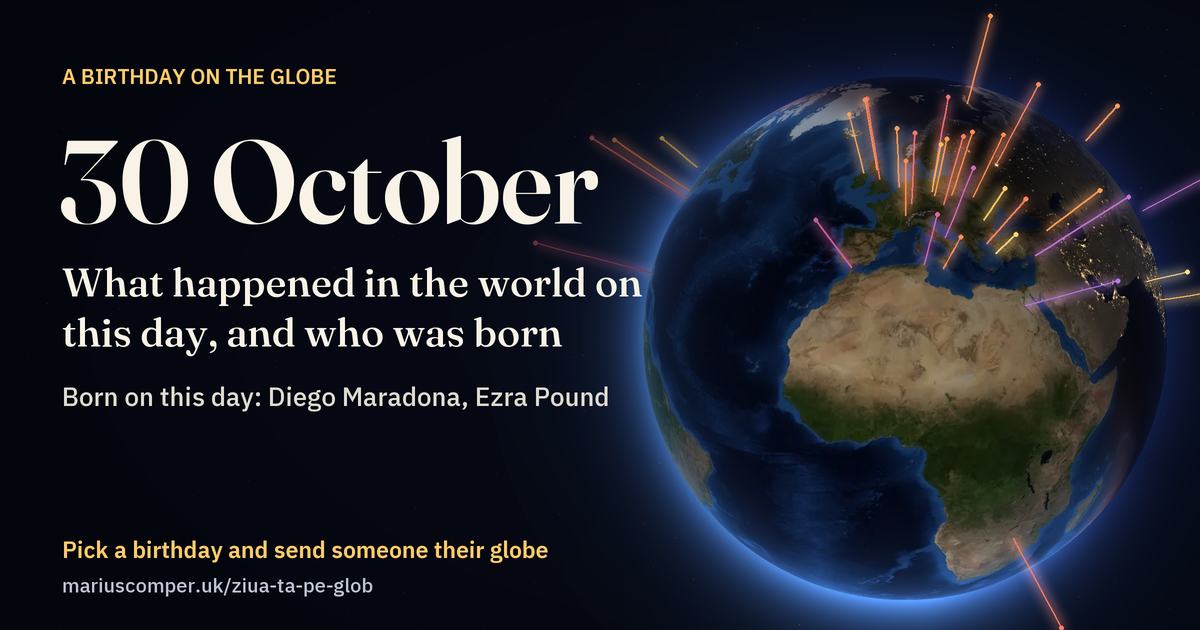
For 30 October, the English Wikipedia lists 54 events and 259 births. 34 of the events stand at their places as rays of light; three more are dashed circles, where the sentence links only to a country or a sea. The taller the ray, the longer ago it happened. The people born that day come further down, as blue points.
A birthday, yours or someone else’s:
Turn it into a greetingScroll: the globe turns to each place
The day you were born, on the globe.
Three things from your day
Scroll: your day first, then 30 October through the years
The Earth on 30 October
The picture on the globe was assembled by NASA from satellite photographs taken in October 2004: the snow, the ice and the green are those of the month.
On 30 October the Sun passes straight overhead at noon along the parallel of 13.8° south. In London, the day lasts about 9 hours 50 minutes.
Beyond 76° south the Sun no longer sets; beyond 76° north it no longer rises.
The line between day and night is tilted on the globe exactly as on this day of the year. On the dark side you can see the lights of towns.
Britain & Ireland · Royal Infirmary of Edinburgh
1960
At the Royal Infirmary of Edinburgh, Michael Woodruff performed the first successful kidney transplantation in the United Kingdom.
On the map: Royal Infirmary of Edinburgh.
Europe · Duma
1905
Tsar Nicholas II issues the October Manifesto, nominally granting the Russian peoples basic civil liberties and the right to form a duma. (October 17 in the Julian calendar)
On the map: Duma.
Europe · Geneva
1947
The General Agreement on Tariffs and Trade (GATT), the foundation of the World Trade Organization (WTO), is founded.
On the map: Geneva.
Also on the day’s list of Wikipedia in Chinese.
Africa · Antinoöpolis
130
Emperor Hadrian establishes the city of Antinoöpolis on the Nile in honour of his companion Antinous, creating a new Hellenizing foundation in Roman Egypt.
On the map: Antinoöpolis.
Africa · Bulawayo
1888
The Rudd Concession is granted by Matabeleland to agents of Cecil Rhodes.
On the map: Bulawayo.
Oceania · Victoria Derby
1965
English model Jean Shrimpton wore a controversially short minidress to Derby Day at Flemington Racecourse in Melbourne, Australia – a pivotal moment of the introduction of the miniskirt to women's fashion.
On the map: Victoria Derby.
30 October
Born on 30 October#
The English Wikipedia lists 259 births for this day. The blue points are the birthplaces of 59 of these people: those written about in the most Wikipedia editions, where Wikidata gives a place of birth.
Born on 30 October
1960
Diego Maradona, Argentinian footballer, coach, and manager (died 2020)
Place of birth: Lanús Partido.
Born on 30 October
1885
Ezra Pound, American poet and critic (died 1972)
Place of birth: Hailey.
Born on 30 October
1871
Paul Valéry, French poet and philosopher (died 1945)
Place of birth: Sète.
Born on 30 October
1632
Christopher Wren, English physicist, mathematician, and architect, designed St Paul's Cathedral (died 1723)
Place of birth: East Knoyle.
Born on 30 October
1981
Ivanka Trump, American model and businesswoman
Place of birth: Manhattan.
Born in Britain and Ireland
1989
Ashley Barnes, Austrian-English footballer
Place of birth: Bath.
30 October
Number one in the charts that week
At the cinema
An animal recorded that day
The record can be seen in GBIF, which brings together wildlife records from around the world.
All your birthdays
The weather that day
Data: Met Office Hadley Centre (HadCET); NOAA (GHCN-Daily, Mauna Loa).
Above the Earth
Sources: Jonathan McDowell, GCAT (launches); GFZ Potsdam (Kp index). Days are counted in Universal Time.
Football that day
International matches played that day:
Source: the “International football results” dataset kept by Mart Jürisoo (CC0).
Also that day
The earthquake’s page at the USGS
Source: the USGS catalogue. The day is counted in Universal Time (UTC).
In those days
Make a link for someone
Type the name, pick the day and the year of birth. The link opens straight on their day, with their name in the greeting.
The link carries the name, date and place typed here; anyone who gets it can see them.
Put another birthday beside it
Your mother’s, your child’s, a friend’s: the two days appear side by side.
Below: 30 October through the years.
The whole globe of the day
Drag the globe to turn it. Touch a ray or a point to read what happened there.
Everything Wikipedia lists for 30 October
The list is the English Wikipedia’s, in its own wording, as it stood in October 2026. 17 events have no place on the map: the sentence links to no place with coordinates, only to places too wide to mark, or to several countries.
- 130
Emperor Hadrian establishes the city of Antinoöpolis on the Nile in honour of his companion Antinous, creating a new Hellenizing foundation in Roman Egypt.
Africa · AntinoöpolisWikipedia: Hadrian - 637
Arab–Byzantine wars: Antioch surrenders to the Rashidun Caliphate after the Battle of the Iron Bridge.
Asia · Battle of the Iron BridgeWikipedia: Battle of the Iron Bridge - 758
Guangzhou is sacked by Arab and Persian pirates.
Asia · GuangzhouWikipedia: Guangzhou - 1137
Ranulf of Apulia defeats Roger II of Sicily at the Battle of Rignano, securing his position as duke until his death two years later.
Europe · Battle of RignanoWikipedia: Battle of Rignano - 1270
The Eighth Crusade ends by an agreement between Charles I of Anjou (replacing his deceased brother King Louis IX of France) and the Hafsid dynasty of Tunis, Tunisia.
Africa · TunisWikipedia: Eighth Crusade - 1340
Reconquista: Portuguese and Castilian forces halt a Muslim invasion at the Battle of Río Salado.
Europe · Battle of Río SaladoWikipedia: Battle of Río Salado - 1657
Anglo-Spanish War: Spanish forces fail to retake Jamaica at the Battle of Ocho Rios.
Latin America · Battle of Ocho RiosWikipedia: Battle of Ocho Rios - 1806
War of the Fourth Coalition: Convinced that he is facing a much larger force, Prussian General von Romberg, commanding 5,300 men, surrenders the city of Stettin to 800 French soldiers.
Europe · SzczecinWikipedia: War of the Fourth Coalition - 1817
Simón Bolívar becomes President of the Third Republic of Venezuela.
Latin America · Third Republic of VenezuelaWikipedia: Simón Bolívar - 1831
Nat Turner is arrested for leading the bloodiest slave rebellion in United States history.
North America · Nat Turner's RebellionWikipedia: Nat Turner's Rebellion - 1836
Louis Napoleon launches the unsuccessful Strasbourg Coup to overthrow the July Monarchy in France
Europe · StrasbourgWikipedia: Strasbourg Coup - 1858
Approximately 20 people die in Bradford, England, UK, after being poisoned from ingesting sweets that had been accidentally adulterated with arsenic trioxide.
Britain & Ireland · 1858 Bradford sweets poisoningWikipedia: 1858 Bradford sweets poisoning - 1863
Danish Prince Vilhelm arrives in Athens to assume his throne as George I, King of the Hellenes.
no place on the mapWikipedia: George I of Greece - 1864
Second War of Schleswig: The Treaty of Vienna is signed, by which Denmark relinquishes one province each to Prussia and Austria.
Europe · ViennaWikipedia: Treaty of Vienna - 1888
The Rudd Concession is granted by Matabeleland to agents of Cecil Rhodes.
Africa · BulawayoWikipedia: Rudd Concession - 1905
Tsar Nicholas II issues the October Manifesto, nominally granting the Russian peoples basic civil liberties and the right to form a duma. (October 17 in the Julian calendar)
Europe · DumaWikipedia: Nicholas II - 1918
World War I: Lands of the Crown of Saint Stephen, a state union of Kingdom of Hungary and Triune Kingdom of Croatia, Slavonia and Dalmatia is abolished with decisions of Croatian and Hungarian parliaments.
no place on the mapWikipedia: Lands of the Crown of Saint Stephen - 1918
World War I: The Ottoman Empire signs the Armistice of Mudros with the Allies.
Europe · Armistice of MudrosWikipedia: World War I - 1920
The Communist Party of Australia is founded in Sydney.
no place on the mapWikipedia: Communist Party of Australia - 1938
Orson Welles broadcasts a radio adaptation of H. G. Wells's The War of the Worlds, causing a massive panic in some of the audience in the United States.
no place on the mapWikipedia: Orson Welles - 1941
Holocaust: Fifteen hundred Jews from Pidhaytsi are sent by Nazis to Bełżec extermination camp.
Europe · PidhaitsiWikipedia: The Holocaust - 1941
President Roosevelt approves $1 billion in Lend-Lease aid to the Allied nations.
no place on the mapWikipedia: Franklin D. Roosevelt - 1942
World War II: Lt. Tony Fasson and Able Seaman Colin Grazier drown while taking code books from the sinking German submarine U-559.
no place on the mapWikipedia: World War II - 1944
Holocaust: Anne and Margot Frank are deported from Auschwitz to the Bergen-Belsen concentration camp, where they die from disease the following year, shortly before the end of WWII.
Europe · Auschwitz concentration campWikipedia: Bergen-Belsen concentration camp - 1947
The General Agreement on Tariffs and Trade (GATT), the foundation of the World Trade Organization (WTO), is founded.
Europe · GenevaWikipedia: General Agreement on Tariffs and Trade - 1948
A luzzu fishing boat overloaded with passengers capsizes and sinks in the Gozo Channel off Qala, Gozo, Malta, killing 23 of the 27 people on board.
Europe · 1948 Gozo luzzu disasterWikipedia: 1948 Gozo luzzu disaster - 1953
President Eisenhower approves the top-secret document NSC 162/2 concerning the maintenance of a strong nuclear deterrent force against the Soviet Union.
no place on the mapWikipedia: Dwight D. Eisenhower - 1956
Hungarian Revolution: The government of Imre Nagy recognizes newly established revolutionary workers' councils. Army officer Béla Király leads anti-Soviet militias in an attack on the headquarters of the Hungarian Working People's Party.
Europe · Hungarian People's RepublicWikipedia: Hungarian Revolution of 1956 - 1959
Piedmont Airlines Flight 349 crashes on approach to Charlottesville–Albemarle Airport in Albemarle County, Virginia, killing 26 of the 27 on board.
North America · Piedmont Airlines Flight 349Wikipedia: Piedmont Airlines Flight 349 - 1960
At the Royal Infirmary of Edinburgh, Michael Woodruff performed the first successful kidney transplantation in the United Kingdom.
Britain & Ireland · Royal Infirmary of EdinburghWikipedia: Royal Infirmary of Edinburgh - 1961
The Soviet Union detonates the Tsar Bomba, the most powerful explosive device ever detonated.
Europe · Tsar BombaWikipedia: Tsar Bomba - 1965
English model Jean Shrimpton wore a controversially short minidress to Derby Day at Flemington Racecourse in Melbourne, Australia – a pivotal moment of the introduction of the miniskirt to women's fashion.
Oceania · Victoria DerbyWikipedia: White shift dress of Jean Shrimpton - 1968
A squad of 120 North Korean Army commandos land in boats along a 25-mile long section of the eastern coast of South Korea in a failed attempt to overthrow the dictatorship of Park Chung Hee and bring about the reunification of Korea.
Asia · Uljin CountyWikipedia: Uljin–Samcheok Landings - 1973
The Bosphorus Bridge in Turkey is completed, connecting the continents of Europe and Asia over the Bosphorus for the second time.
no place on the mapWikipedia: Bosphorus Bridge - 1975
Forty-five people are killed when Inex-Adria Aviopromet Flight 450 crashes into Suchdol, Prague, while on approach to Prague Ruzyně Airport (now Václav Havel Airport Prague) in Czechoslovakia (present-day Czech Republic).
Europe · Inex-Adria Aviopromet Flight 450Wikipedia: Inex-Adria Aviopromet Flight 450 - 1975
Prince Juan Carlos I of Spain becomes acting head of state, taking over for the country's ailing dictator, Gen. Francisco Franco.
no place on the mapWikipedia: Juan Carlos I - 1980
El Salvador and Honduras agree to put the border dispute fought over in 1969's Football War before the International Court of Justice.
Europe · International Court of JusticeWikipedia: Football War - 1983
A magnitude 6.6 earthquake in the Turkish provinces of Erzurum and Kars leaves approximately 1,340 people dead.
Asia · 1983 Erzurum earthquakeWikipedia: 1983 Erzurum earthquake - 1983
The first democratic elections in Argentina, after seven years of military rule, are held.
no place on the mapWikipedia: 1983 Argentine general election - 1985
Space Shuttle Challenger lifts off for mission STS-61-A, its final successful mission.
no place on the mapWikipedia: Space Shuttle Challenger - 1991
The Israeli-Palestinian conflict: The Madrid Conference commences in an effort to revive peace negotiations between Israel and Palestine.
no place on the mapWikipedia: Israeli–Palestinian conflict - 1993
The Troubles: Three members of the Ulster Defence Association opened fire in a crowded pub during a Halloween party, killing eight people and wounding nineteen others.
Britain & Ireland · Greysteel massacreWikipedia: The Troubles - 1995
Quebec citizens narrowly vote (50.58% to 49.42%) in favour of remaining a province of Canada in their second referendum on national sovereignty.
North America · QuebecWikipedia: 1995 Quebec referendum - 2001
Michael Jackson released Invincible, his final studio album and the most expensive album ever produced.
no place on the mapWikipedia: Michael Jackson - 2002
After his terminal-cancer diagnosis, Warren Zevon made his last public appearance on the Late Show with David Letterman, giving the advice to "enjoy every sandwich".
no place on the mapWikipedia: Warren Zevon on the Late Show with David Letterman in 2002 - 2005
The rebuilt Dresden Frauenkirche (destroyed in the firebombing of Dresden during World War II) is reconsecrated after a thirteen-year rebuilding project.
Europe · Frauenkirche, DresdenWikipedia: Bombing of Dresden - 2010
American comedians Jon Stewart and Stephen Colbert hosted the Rally to Restore Sanity and/or Fear in Washington, D.C.
no place on the mapWikipedia: Jon Stewart - 2013
Forty-five people are killed and seven injured after a bus catches fire in Mahabubnagar district, Andhra Pradesh (present-day Telangana), India.
Asia · Mahabubnagar districtWikipedia: 2013 Mahabubnagar bus accident - 2014
Four people are killed when a Beechcraft Super King Air crashes at Wichita Dwight D. Eisenhower National Airport in Wichita, Kansas.
North America · 2014 Wichita King Air crashWikipedia: 2014 Wichita King Air crash - 2014
Sweden becomes the first European Union member state to officially recognize Palestine as an independent and sovereign state.
no place on the mapWikipedia: Palestine - 2015
A fire in a nightclub in the Romanian capital of Bucharest kills sixty-four people and leaves more than 147 injured.
Europe · Colectiv nightclub fireWikipedia: Colectiv nightclub fire - 2020
A magnitude 7.0 earthquake strikes the Aegean Sea between Greece and Turkey, triggering a tsunami. At least 119 people die mainly due to collapsed buildings.
Europe · 2020 Aegean Sea earthquakeWikipedia: 2020 Aegean Sea earthquake - 2022
A pedestrian suspension bridge collapses in the city of Morbi, Gujarat, leading to the deaths of at least 135 people.
Asia · 2022 Morbi bridge collapseWikipedia: 2022 Morbi bridge collapse - 2023
First rescue of a prisoner during the Israeli invasion of Gaza.
no place on the mapWikipedia: Rescue of Ori Megidish
Who was born on 30 October
In order of how many Wikipedia editions have an article about each. The first 60 of 259 are shown.
- 1735
John Adams, American lawyer and politician, 2nd President of the United States (died 1826)
BraintreeWikipedia: John Adams - 1960
Diego Maradona, Argentinian footballer, coach, and manager (died 2020)
Lanús PartidoWikipedia: Diego Maradona - 1885
Ezra Pound, American poet and critic (died 1972)
HaileyWikipedia: Ezra Pound - 1871
Paul Valéry, French poet and philosopher (died 1945)
- 1632
Christopher Wren, English physicist, mathematician, and architect, designed St Paul's Cathedral (died 1723)
East KnoyleWikipedia: Christopher Wren - 1981
Ivanka Trump, American model and businesswoman
ManhattanWikipedia: Ivanka Trump - 1839
Alfred Sisley, French-English painter (died 1899)
former 4th arrondissement of ParisWikipedia: Alfred Sisley - 1895
Gerhard Domagk, German pathologist and bacteriologist, Nobel Prize laureate (died 1964)
- 1941
Theodor W. Hänsch, German physicist and academic, Nobel Prize laureate
HeidelbergWikipedia: Theodor W. Hänsch - 1762
André Chénier, Turkish-French poet and playwright (died 1794)
GalataWikipedia: André Chénier - 1873
Francisco I. Madero, Mexican businessman and politician, 33rd President of Mexico (died 1913)
Parras de la FuenteWikipedia: Francisco I. Madero - 1906
Giuseppe Farina, Italian race car driver (died 1966)
- 1900
Ragnar Granit, Finnish-Swedish physiologist and academic, Nobel Prize laureate (died 1991)
RiihimäkiWikipedia: Ragnar Granit - 1937
Claude Lelouch, French actor, director, producer, and screenwriter
9th arrondissement of ParisWikipedia: Claude Lelouch - 1741
Angelica Kauffman, painter (died 1807)
- 1932
Louis Malle, French director, producer, and screenwriter (died 1995)
ThumeriesWikipedia: Louis Malle - 1751
Richard Brinsley Sheridan, Irish-English poet, playwright, and politician, Treasurer of the Navy (died 1816)
- 1896
Ruth Gordon, American actress and screenwriter (died 1985)
QuincyWikipedia: Ruth Gordon - 1908
Dmitry Ustinov, Marshal of the Soviet Union (died 1984)
- 1928
Daniel Nathans, American microbiologist and academic, Nobel Prize laureate (died 1999)
WilmingtonWikipedia: Daniel Nathans - 1935
Ágota Kristóf, Hungarian-Swiss author (died 2011)
CsikvándWikipedia: Ágota Kristóf - 1909
Homi J. Bhabha, Indian-French physicist and academic (died 1966)
- 1939
Leland H. Hartwell, American biologist and academic, Nobel Prize laureate
Los AngelesWikipedia: Leland H. Hartwell - 1895
Dickinson W. Richards, American physician and physiologist, Nobel Prize laureate (died 1973)
- 1981
Jun Ji-hyun, South Korean model and actress
- 1882
Günther von Kluge, Polish-German field marshal (died 1944)
- 1893
Roland Freisler, German soldier, lawyer, and judge (died 1945)
- 1973
Edge, Canadian wrestler and actor
OrangevilleWikipedia: Edge - 1939
Grace Slick, American singer-songwriter and model
Highland ParkWikipedia: Grace Slick - 1945
Henry Winkler, American actor, comedian, director, and producer
New York CityWikipedia: Henry Winkler - 1996
Devin Booker, American basketball player
Grand RapidsWikipedia: Devin Booker - 1982
Clémence Poésy, French actress and model
L'Haÿ-les-RosesWikipedia: Clémence Poésy - 1861
Antoine Bourdelle, French sculptor and painter (died 1929)
MontaubanWikipedia: Antoine Bourdelle - 1910
Miguel Hernández, Spanish poet and playwright (died 1942)
OrihuelaWikipedia: Miguel Hernández - 1970
Nia Long, American actress
BrooklynWikipedia: Nia Long - 1978
Matthew Morrison, American singer-songwriter and actor
Fort OrdWikipedia: Matthew Morrison - 39 BC
Julia the Elder, Roman daughter of Augustus (died 14 AD)
Ancient RomeWikipedia: Julia the Elder - 1962
Stefan Kuntz, German footballer and manager
NeunkirchenWikipedia: Stefan Kuntz - 1971
Fredi Bobic, Slovenian-German footballer and manager
MariborWikipedia: Fredi Bobic - 1985
Ragnar Klavan, Estonian footballer
ViljandiWikipedia: Ragnar Klavan - 1668
Sophia Charlotte of Hanover (died 1705)
- 1894
Jean Rostand, French biologist and philosopher (died 1977)
17th arrondissement of ParisWikipedia: Jean Rostand - 1906
Hermann Fegelein, German general (died 1945)
AnsbachWikipedia: Hermann Fegelein - 1986
Thomas Morgenstern, Austrian ski jumper
Spittal an der DrauWikipedia: Thomas Morgenstern - 1988
Janel Parrish, American actress and singer
- 1882
William Halsey Jr., American admiral (died 1959)
ElizabethWikipedia: William Halsey Jr. - 1969
Stanislav Gross, Czech lawyer and politician, 5th Prime Minister of the Czech Republic (died 2015)
- 1957
Kevin Pollak, American actor, game show host, and producer
San FranciscoWikipedia: Kevin Pollak - 1987
Ashley Graham, American model
LincolnWikipedia: Ashley Graham - 1989
Nastia Liukin, Russian-American gymnast and actress
MoscowWikipedia: Nastia Liukin - 1917
Maurice Trintignant, French race car driver (died 2005)
Sainte-Cécile-les-VignesWikipedia: Maurice Trintignant - 1917
Nikolai Ogarkov, Russian field marshal (died 1994)
MolokovoWikipedia: Nikolai Ogarkov - 1989
Ashley Barnes, Austrian-English footballer
- 1218
Emperor Chūkyō of Japan (died 1234)
- 1951
Harry Hamlin, American actor
PasadenaWikipedia: Harry Hamlin - 1991
Tomáš Satoranský, Czech basketball player
Prague 4Wikipedia: Tomáš Satoranský - 1906
Alexander Gode, German-American linguist and translator (died 1970)
- 1930
Néstor Almendros, Spanish-American director and cinematographer (died 1992)
BarcelonaWikipedia: Néstor Almendros - 1513
Jacques Amyot, French bishop and translator (died 1593)
birthplace of Jacques AmyotWikipedia: Jacques Amyot - 1911
Ruth Hussey, American actress (died 2005)
ProvidenceWikipedia: Ruth Hussey
What is celebrated on 30 October
- Anniversary of the Declaration of the Slovak Nation (Slovakia)
- Christian feast day: Ethelnoth (Egelnoth) the Good
- Christian feast day: Blessed Dominic Collins (Catholic, Ireland, Society of Jesus)
- Christian feast day: Gerard of Potenza
- Christian feast day: Blessed Maria Teresa of St. Joseph
- Christian feast day: John Wycliffe (Episcopal Church (USA))
- Christian feast day: Marcellus of Tangier
- Christian feast day: Saturninus of Cagliari
- Christian feast day: Serapion of Antioch
- Christian feast day: Talarican (Tarkin)
- Christian feast day: Theonistus
- Christian feast day: Zenobios and Zenobia
- Christian feast day: October 30 (Eastern Orthodox liturgics)
- Day of Remembrance of the Victims of Political Repressions (former Soviet republics, except Ukraine)
A greeting link for someone
Type a name and, if you like, the year of birth. The link opens with a greeting, and beside each event it says how old the person turned that day, or how many years before their birth it happened.
The name and the year go only into the link you send.
All 366 days
How the globe is made
Where the events come from
Each edition of this page uses the day’s list from Wikipedia in its own language: Romanian, English, Spanish, Chinese. The lists are written by volunteers and differ from one edition to the next; the text of each event is Wikipedia’s, with a link to the article. A row that appears twice in a list is shown once. The lists have not been checked event by event: they are Wikipedia’s, mistakes included.
For events before 1582, and for countries that moved to the Gregorian calendar later (Britain in 1752, Russia in 1918), the same day may be counted Old Style in one list and New Style in another.
The chapter “What the other Wikipedias remember” adds up to five events a day from the lists of the other three editions, only for years in which the English list has nothing on that day. They were translated for this page, passed the same filters as the tour, and are not counted among the events of the English list.
How an event gets onto the map
The place comes from Wikidata. If the sentence links to the article about the event itself (a battle, an opening, an earthquake), dated to the same year, the ray stands on its coordinates or on those of its location. Otherwise it stands on the first place the sentence links to: a town, a building, a mountain, an island. This second step can be wrong: sometimes the sentence only mentions the place. That is why the page says, under each event, which place the ray stands on.
When the sentence links to a single state or province, or to a single sea, lake or desert larger than 5,000 km², the globe shows a dashed circle, not a ray. The circle has the area Wikidata gives, with its radius kept between 1.2° and 16°, or a radius of 4.5° when Wikidata gives no area; it says only that the sentence links to that place. Organisations, ships, spacecraft, museum objects, rivers, mountain ranges, languages and continents are never used as places. When a sentence names several states and no exact place, the event stays in the list only.
What the height means
The height of a ray shows how many years have passed, on a logarithmic scale: 10 years, 100 years and 1,000 years are equal steps apart; anything older than about 2,600 years has the tallest ray. The colour runs from pale yellow for recent years to violet for antiquity.
Where the tour stops
In each region the tour stops at up to three events (five in Britain and Ireland), chosen mainly by three things: whether Wikipedia’s editors put the event in the “On this day” box of their main page (the English, Spanish and Chinese editions), how many Wikipedia editions have an article about it, and how many of the four lists include it. Events whose sentence or article is about a war, an attack, a crime or a disaster are left out of the tour; they stay in the whole list, in Wikipedia’s wording. The filter is a list of words and a list of Wikidata types, so it can miss some.
The tour of births names the people with articles in the most editions and leaves aside those whom the list or Wikidata describes as rulers, politicians, commanders, leaders of movements or criminals; they stay in the list.
The Earth and the Sun
The daytime images are NASA’s Blue Marble Next Generation mosaics, one for each month of 2004; the night side is Black Marble 2016. The tilt of the line between day and night is computed for the day; the hour is chosen so that the place being read is in daylight. The latitude where the Sun stands overhead is the average of the four years of the leap cycle; in a given year it can differ by up to 0.4°.
The day you were born
The number ones come from the weekly lists on Wikipedia: Billboard for the United States (from 1940; the Hot 100 from August 1958), the UK Singles Chart (from November 1952), Los 40 Principales for Spain (from July 1966) and, for Romania, the Romanian Top 100 and Airplay 100 (2001–2021, with missing weeks). The page shows the chart of the week in which the day of birth falls, with its date; Billboard and the UK chart are dated at the end of their week. For Romania before 2001 and for China these sources have no weekly chart.
The films are those that reached cinemas in the United States up to ten days before or three days after that day (some of them in a few cinemas at first), from the English Wikipedia’s yearly lists (from 1968), in order of how many editions have an article about them. The events “in those days” are the ones on the neighbouring days’ lists that carry the year of birth, passed through the same filter as the tour.
The day of birth, year included
The Moon, the star sign and the constellation are worked out by the page itself, for noon Universal Time on the day. The lit part of the Moon is rounded and can differ by a few per cent from that at the hour of birth. The sign follows the usual zodiac of twelve equal parts starting at the March equinox; the constellation is the one the Sun actually stood in front of, by the borders set by the International Astronomical Union, and within a day of a border the page does not name it. When the Sun changes sign while it is that day anywhere on Earth, the page gives the moment of crossing, rounded to ten minutes and accurate to within about a quarter of an hour, and the clock time in a few cities, with the time zone and summer time of that year.
The year in the Chinese calendar is the one your device’s own calendar gives for the date, checked against the Hong Kong Observatory’s tables. “All your birthdays” uses the same sources as the rest of the chapter for the same day in every year since the birth: the temperature, well-known launches that took place on that very day, matches of the teams the edition follows, snow deeper than 10 cm and strong geomagnetic storms. The three things at the top and the four on the picture are chosen in a fixed order (the song, the animal, a full Moon, a well-known launch before an ordinary earthquake); on the picture you can change them.
When the link carries a year of birth, the page adds a few things about that exact day. The weather is the Met Office’s Central England temperature record and the readings from New York’s Central Park; the “usual high” is the average of the daily highs of 1961–1990 for that date, with two days either side. The carbon dioxide figure is the monthly mean at the Mauna Loa observatory, where measurements begin in March 1958.
The earthquake is the one with the largest magnitude in the USGS catalogue for that day, counted in Universal Time. Before the 1960s the catalogue has gaps even above magnitude 5.5, so in the older years many days have no earthquake. The page gives only the magnitude and the place: the country the epicentre falls in or, when the epicentre is at sea within 300 km of a coast, the nearest country; farther out, only the ocean.
The launches are those that reached orbit or left for the Moon and the planets, from Jonathan McDowell’s GCAT catalogue. If nothing left that day, the page shows the nearest launch within three days before or after, and says how many days away it was. The geomagnetic storm appears only when the Kp index reached at least 5 in one of the day’s eight three-hour intervals.
The animal comes from GBIF: an observation made by a person (the animal seen or heard, or its tracks), dated to that exact day, with coordinates and a CC0 or CC BY licence. Only a few hundred well-known species are searched (mammals, birds, turtles, butterflies); of those noted that day, mammals and species with articles in many Wikipedia editions come first; birds noted almost every day, and species used recently, wait their turn. Observations dated 1 January are left out, because records without a day are often filed there. An observation shows that the animal was recorded there, not how many animals there were.
The matches are those between national teams. Only matches of England, Scotland, Wales, Northern Ireland, the Republic of Ireland, the United States, Canada and Australia are shown, along with those at the big final tournaments. The picture to send is drawn in the page from the day’s globe and the facts above, and stays on your device until you send it.
Sources
- Events, births and holidays: the day’s page on Wikipedia, text under CC BY-SA 4.0.
- Coordinates, places of birth and the number of editions: Wikidata (CC0).
- The Earth by day: NASA Blue Marble Next Generation. The Earth by night: NASA Black Marble 2016.
- Borders and regions: Natural Earth.
- World population and births per year: UN World Population Prospects 2024.
- Charts and films: Wikipedia’s lists for Billboard, the UK Singles Chart, Los 40 Principales, Romanian Top 100, Airplay 100 and American films by year (CC BY-SA 4.0).
- Weather: Met Office Hadley Centre, HadCET (Open Government Licence) and NOAA GHCN-Daily, New York Central Park. Carbon dioxide: NOAA Global Monitoring Laboratory, Mauna Loa.
- Earthquakes: the USGS catalogue. Launches: Jonathan McDowell, GCAT (CC BY). Kp index: GFZ Potsdam (CC BY 4.0). Matches: International football results, Mart Jürisoo (CC0).
- Animal observations: GBIF, with a link to each record; species names come from Wikidata.