A birthday on the globe
29 November on the globe: what happened in the world on this day, and who was born
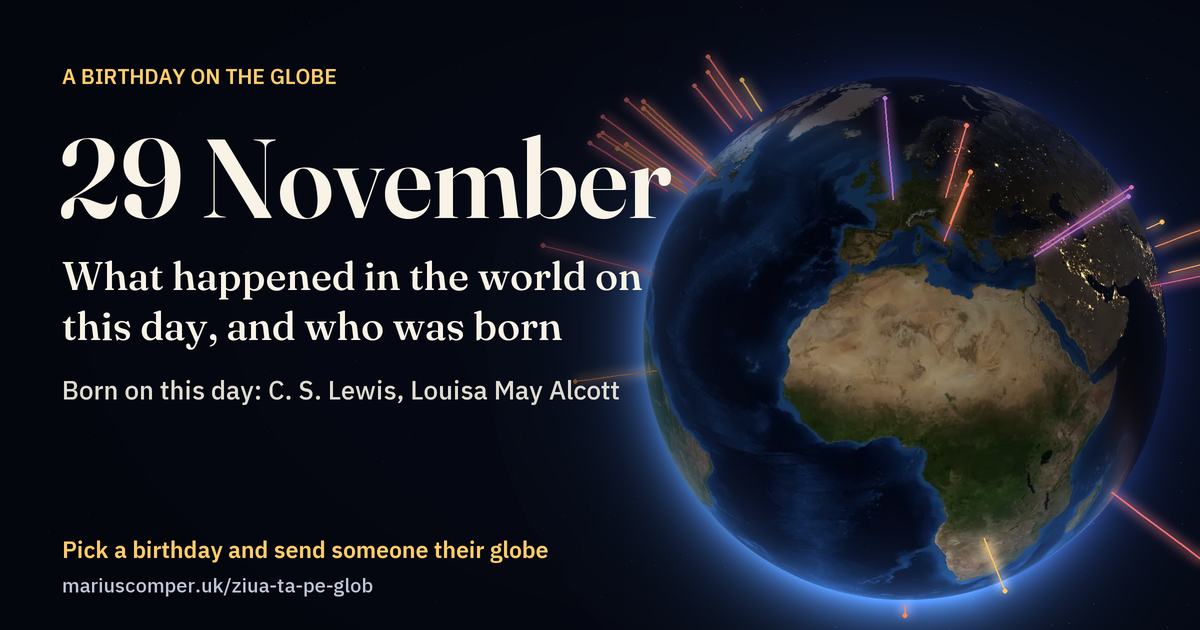
For 29 November, the English Wikipedia lists 51 events and 217 births. 29 of the events stand at their places as rays of light; nine more are dashed circles, where the sentence links only to a country or a sea. The taller the ray, the longer ago it happened. The people born that day come further down, as blue points.
A birthday, yours or someone else’s:
Turn it into a greetingScroll: the globe turns to each place
The day you were born, on the globe.
Three things from your day
Scroll: your day first, then 29 November through the years
The Earth on 29 November
The picture on the globe was assembled by NASA from satellite photographs taken in November 2004: the snow, the ice and the green are those of the month.
On 29 November the Sun passes straight overhead at noon along the parallel of 21.5° south. In London, the day lasts about 8 hours 15 minutes.
Beyond 69° south the Sun no longer sets; beyond 69° north it no longer rises.
The line between day and night is tilted on the globe exactly as on this day of the year. On the dark side you can see the lights of towns.
Europe · Olomouc
1850
The treaty, Punctation of Olmütz, is signed in Olomouc. Prussia capitulates to Austria, which will take over the leadership of the German Confederation.
On the map: Olomouc.
North America · San Jose, California
1777
San Jose, California, is founded as Pueblo de San José de Guadalupe by José Joaquín Moraga. It is the first civilian settlement, or pueblo, in Alta California.
On the map: San Jose, California.
Also on the day’s list of Wikipedia in Chinese.
North America · Tellico Dam
1979
The controversial Tellico Dam project by the Tennessee Valley Authority is completed despite being ordered to shut down from the Supreme Court of the United States' decision in Tennessee Valley Authority v. Hill.
On the map: Tellico Dam.
Oceans · South Pole
1929
U.S. Admiral Richard E. Byrd leads the first expedition to fly over the South Pole.
On the map: South Pole.
Also on the day’s list of Wikipedia in Spanish, Romanian and Chinese.
29 November
What the other Wikipedias remember#
For these years the English list has nothing on this day. The events below come from the same day’s lists on Wikipedia in Chinese and Spanish and were translated for this page.
From Wikipedia in Chinese · Seoul
1394
Yi Seong-gye moves the capital from Kaesong to Hanyang and formally names it Hanseong.
On the map: Seoul.
Translated from the list on Wikipedia in Chinese.
From Wikipedia in Spanish · Rome
1560
In Rome, Pope Pius IV issues the bull convoking the Council of Trent.
On the map: Rome.
Translated from the list on Wikipedia in Spanish.
29 November
Born on 29 November#
The English Wikipedia lists 217 births for this day. The blue points are the birthplaces of 60 of these people: those written about in the most Wikipedia editions, where Wikidata gives a place of birth.
Born on 29 November
1898
C. S. Lewis, British novelist, poet, and critic (died 1963)
Place of birth: Belfast.
Born on 29 November
1832
Louisa May Alcott, American novelist and poet (died 1888)
Place of birth: Germantown.
Born on 29 November
1973
Ryan Giggs, Welsh footballer and manager
Place of birth: Cardiff.
Born on 29 November
1949
Garry Shandling, American comedian, actor, and screenwriter (died 2016)
Place of birth: Chicago.
Born on 29 November
1803
Christian Doppler, Austrian mathematician and physicist (died 1853)
Place of birth: Salzburg.
Born in Britain and Ireland
1627
John Ray, English biologist and botanist (died 1705)
Place of birth: Black Notley.
Born in Britain and Ireland
1982
Gemma Chan, English actress
Place of birth: Guy's Hospital.
Born in Britain and Ireland
1849
John Ambrose Fleming, English physicist and engineer (died 1945)
Place of birth: Lancaster.
29 November
Number one in the charts that week
At the cinema
An animal recorded that day
The record can be seen in GBIF, which brings together wildlife records from around the world.
All your birthdays
The weather that day
Data: Met Office Hadley Centre (HadCET); NOAA (GHCN-Daily, Mauna Loa).
Above the Earth
Sources: Jonathan McDowell, GCAT (launches); GFZ Potsdam (Kp index). Days are counted in Universal Time.
Football that day
International matches played that day:
Source: the “International football results” dataset kept by Mart Jürisoo (CC0).
Also that day
The earthquake’s page at the USGS
Source: the USGS catalogue. The day is counted in Universal Time (UTC).
In those days
Make a link for someone
Type the name, pick the day and the year of birth. The link opens straight on their day, with their name in the greeting.
The link carries the name, date and place typed here; anyone who gets it can see them.
Put another birthday beside it
Your mother’s, your child’s, a friend’s: the two days appear side by side.
Below: 29 November through the years.
The whole globe of the day
Drag the globe to turn it. Touch a ray or a point to read what happened there.
Everything Wikipedia lists for 29 November
The list is the English Wikipedia’s, in its own wording, as it stood in October 2026. 13 events have no place on the map: the sentence links to no place with coordinates, only to places too wide to mark, or to several countries.
- 528
Antioch suffers its second major earthquake in two years, killing thousands and destroying its remaining edifice.
Asia · 528 Antioch earthquakeWikipedia: 528 Antioch earthquake - 561
Following the death of King Chlothar I at Compiègne, his four sons, Charibert I, Guntram, Sigebert I and Chilperic I, divide the Frankish Kingdom.
Europe · CompiègneWikipedia: Chlothar I - 618
The Tang dynasty scores a decisive victory over their rival Xue Rengao at the Battle of Qianshuiyuan.
no place on the mapWikipedia: Battle of Qianshuiyuan - 903
The Abbasid army under Muhammad ibn Sulayman al-Katib defeats the Qarmatians at the Battle of Hama.
Asia · Abbasid CaliphateWikipedia: Battle of Hama - 1114
A large earthquake damages the areas of the Crusaders in the Middle East. Antioch, Mamistra, Marash and Edessa are hit by the shocks.
Asia · 1114 Marash earthquakeWikipedia: 1114 Marash earthquake - 1549
The papal conclave of 1549–50 begins.
no place on the mapWikipedia: 1549–1550 conclave - 1612
The Battle of Swally takes place, which loosens the Portuguese Empire's hold on India.
Asia · Battle of SwallyWikipedia: Battle of Swally - 1729
Natchez Indians massacre 138 Frenchmen, 35 French women, and 56 children at Fort Rosalie, near the site of modern-day Natchez, Mississippi.
North America · Fort RosalieWikipedia: Natchez revolt - 1732
The magnitude 6.6 Irpinia earthquake causes 1,940 deaths in the former Kingdom of Naples, southern Italy.
Europe · 1732 Irpinia earthquakeWikipedia: 1732 Irpinia earthquake - 1776
During the American Revolutionary War, the Battle of Fort Cumberland, Nova Scotia, comes to an end with the arrival of British reinforcements.
North America · Battle of Fort CumberlandWikipedia: Battle of Fort Cumberland - 1777
San Jose, California, is founded as Pueblo de San José de Guadalupe by José Joaquín Moraga. It is the first civilian settlement, or pueblo, in Alta California.
North America · San Jose, CaliforniaWikipedia: San Jose, California - 1781
The crew of the British slave ship Zong murders 54 Africans by dumping them into the sea to claim insurance, beginning the Zong massacre.
Latin America · Zong massacreWikipedia: Zong massacre - 1783
A 5.3 magnitude earthquake strikes New Jersey.
North America · 1783 New Jersey earthquakeWikipedia: 1783 New Jersey earthquake - 1807
John VI of Portugal flees Lisbon from advancing Napoleonic forces during the Peninsular War, transferring the Portuguese court to Brazil.
no place on the mapWikipedia: Peninsular War - 1810
Napoleonic Wars: British troops rendezvoused at Grand Baie to launch an invasion of Isle de France, now known as Mauritius.
Oceans · Grand BaieWikipedia: Napoleonic Wars - 1830
An armed rebellion against Russia's rule in Poland begins.
Europe · Congress PolandWikipedia: November Uprising - 1847
Missionaries Dr. Marcus Whitman, his wife Narcissa, and 15 others are killed by Cayuse and Umatilla Indians, causing the Cayuse War.
North America · Whitman massacreWikipedia: Whitman massacre - 1847
The Sonderbund is defeated by the joint forces of other Swiss cantons under General Guillaume-Henri Dufour.
no place on the mapWikipedia: Sonderbund War - 1850
The treaty, Punctation of Olmütz, is signed in Olomouc. Prussia capitulates to Austria, which will take over the leadership of the German Confederation.
Europe · OlomoucWikipedia: Punctation of Olmütz - 1854
An estimated crowd of more than 10,000 demonstrators swore allegiance to the Eureka Flag as a symbol of defiance in advance of the Eureka Rebellion in Ballarat, Australia.
Oceania · Eureka RebellionWikipedia: Eureka Rebellion - 1863
American Civil War: Union forces under General Ambrose Burnside successfully defend Knoxville, Tennessee from an attack by Confederate forces under General James Longstreet in the Battle of Fort Sanders during the Siege of Knoxville.
North America · Battle of Fort SandersWikipedia: American Civil War - 1864
American Civil War: The Confederate Army of Tennessee misses an opportunity to crush the Union Army of the Ohio in the Battle of Spring Hill during the Franklin–Nashville campaign.
North America · Battle of Spring HillWikipedia: Battle of Spring Hill - 1864
Colorado War: Colorado volunteers led by Colonel John Chivington massacre at least 150 Cheyenne and Arapaho noncombatants at Sand Creek inside Colorado Territory.
North America · Sand Creek massacreWikipedia: Colorado War - 1872
The Modoc War begins with the Battle of Lost River.
North America · Battle of Lost RiverWikipedia: Battle of Lost River - 1877
Thomas Edison demonstrates his phonograph for the first time.
no place on the mapWikipedia: Thomas Edison - 1890
The Meiji Constitution goes into effect in Japan, and the first Diet convenes.
no place on the mapWikipedia: Meiji Constitution - 1899
FC Barcelona is founded by Catalan, Spanish and Englishmen. It later develops into one of Spanish and world football's most iconic and strongest teams.
no place on the mapWikipedia: FC Barcelona - 1920
The Armenian Revolutionary Committee declares Armenia to be a Soviet Socialist Republic, starting 71 years of Soviet rule in Armenia
Asia · ArmeniaWikipedia: Revolutionary committee - 1924
The Bronx County Bird Club was formed and would go on to lead the Audubon Society's Christmas Bird Count in the eastern US for three years in a row.
no place on the mapWikipedia: Bronx County Bird Club - 1929
U.S. Admiral Richard E. Byrd leads the first expedition to fly over the South Pole.
Oceans · South PoleWikipedia: Richard E. Byrd - 1943
The second session of the Anti-Fascist Council for the National Liberation of Yugoslavia (AVNOJ), held to determine the post-war ordering of the country, concludes in Jajce (present-day Bosnia and Herzegovina).
- 1944
Albania is liberated by the Partisans.
Europe · AlbaniaWikipedia: Albania - 1945
The Federal People's Republic of Yugoslavia is declared.
Europe · Socialist Federal Republic of YugoslaviaWikipedia: Socialist Federal Republic of Yugoslavia - 1947
French forces carry out a massacre at Mỹ Trạch, Vietnam during the First Indochina War.
Asia · Mỹ Trạch massacreWikipedia: Mỹ Trạch massacre - 1947
The United Nations General Assembly approve the United Nations Partition Plan for Palestine.
Asia · Mandatory PalestineWikipedia: Mandatory Palestine - 1952
U.S. President-elect Dwight D. Eisenhower fulfills a campaign promise by traveling to Korea to find out what can be done to end the conflict.
no place on the mapWikipedia: Dwight D. Eisenhower - 1961
Enos, a chimpanzee, is launched into space. The spacecraft orbits the Earth twice and splashes down off the coast of Puerto Rico.
Latin America · Puerto RicoWikipedia: Enos - 1963
"I Want to Hold Your Hand", recorded on October 17, 1963, is released by the Beatles in the United Kingdom.
Britain & Ireland · United KingdomWikipedia: I Want to Hold Your Hand - 1963
Trans-Canada Air Lines Flight 831 crashes shortly after takeoff from Montreal-Dorval International Airport, killing all 118 people on board.
North America · Trans-Canada Air Lines Flight 831Wikipedia: Trans-Canada Air Lines Flight 831 - 1963
U.S. President Lyndon B. Johnson establishes the Warren Commission to investigate the assassination of President John F. Kennedy.
North America · Assassination of John F. KennedyWikipedia: Assassination of John F. Kennedy - 1967
U.S. Secretary of Defense Robert McNamara announces his resignation.
no place on the mapWikipedia: United States Secretary of Defense - 1972
Atari releases Pong, the first commercially successful video game.
no place on the mapWikipedia: Atari, Inc. - 1979
The controversial Tellico Dam project by the Tennessee Valley Authority is completed despite being ordered to shut down from the Supreme Court of the United States' decision in Tennessee Valley Authority v. Hill.
North America · Tellico DamWikipedia: Supreme Court of the United States - 1982
Michael Jackson releases Thriller, the best-selling music album of all time.
no place on the mapWikipedia: Michael Jackson - 1986
The Surinamese military attacks the village of Moiwana during the Suriname Guerrilla War, killing at least 39 civilians, mostly women and children.
Latin America · MoiwanaWikipedia: Surinamese Civil War - 1987
North Korean agents plant a bomb on Korean Air Flight 858, which kills all 115 passengers and crew.
Asia · Korean Air Flight 858Wikipedia: Korean Air Flight 858 - 2007
The Armed Forces of the Philippines lay siege to the Peninsula Manila after soldiers led by Senator Antonio Trillanes stage a mutiny.
Asia · The Peninsula ManilaWikipedia: Manila Peninsula siege - 2009
Maurice Clemmons shoots and kills four police officers inside a coffee shop in Lakewood, Washington.
North America · 2009 Lakewood shootingWikipedia: 2009 Lakewood shooting - 2012
In resolution 67/19, the United Nations General Assembly voted to accord the status of a non-member observer state to Palestine.
Asia · PalestineWikipedia: Palestine - 2013
LAM Mozambique Airlines 470 crashes in the Bwabata National Park in a pilot mass murder-suicide, killing all 33 people on board.
Africa · LAM Mozambique Airlines Flight 470Wikipedia: LAM Mozambique Airlines Flight 470 - 2025
The Government of Jordan officially announces the launch of the Amra City development project during a site visit by the Prime Minister.
no place on the mapWikipedia: Politics of Jordan
What the other Wikipedias remember
For these years the English list has nothing on this day. The events below come from the same day’s lists on Wikipedia in Chinese and Spanish and were translated for this page.
- 1394
Yi Seong-gye moves the capital from Kaesong to Hanyang and formally names it Hanseong.
- 1560
In Rome, Pope Pius IV issues the bull convoking the Council of Trent.
Who was born on 29 November
In order of how many Wikipedia editions have an article about each. The first 60 of 217 are shown.
- 1932
Jacques Chirac, French soldier and politician, 22nd President of France (died 2019)
- 1898
C. S. Lewis, British novelist, poet, and critic (died 1963)
BelfastWikipedia: C. S. Lewis - 1832
Louisa May Alcott, American novelist and poet (died 1888)
GermantownWikipedia: Louisa May Alcott - 1835
Empress Dowager Cixi of China (died 1908)
- 1973
Ryan Giggs, Welsh footballer and manager
CardiffWikipedia: Ryan Giggs - 1949
Garry Shandling, American comedian, actor, and screenwriter (died 2016)
ChicagoWikipedia: Garry Shandling - 1803
Christian Doppler, Austrian mathematician and physicist (died 1853)
SalzburgWikipedia: Christian Doppler - 1976
Chadwick Boseman, American actor and playwright (died 2020)
AndersonWikipedia: Chadwick Boseman - 1958
John Dramani Mahama, Ghanaian historian and politician, 4th President of Ghana
- 1797
Gaetano Donizetti, Italian composer (died 1848)
BergamoWikipedia: Gaetano Donizetti - 1926
Beji Caid Essebsi, Tunisian lawyer and politician, President of Tunisia (died 2019)
Sidi Bou SaidWikipedia: Beji Caid Essebsi - 1964
Don Cheadle, American actor and producer
Kansas CityWikipedia: Don Cheadle - 1976
Anna Faris, American actress
BaltimoreWikipedia: Anna Faris - 1856
Theobald von Bethmann Hollweg, German lawyer and politician, 5th Chancellor of Germany (died 1921)
HohenfinowWikipedia: Theobald von Bethmann Hollweg - 1802
Wilhelm Hauff, German poet and author (died 1827)
StuttgartWikipedia: Wilhelm Hauff - 1825
Jean-Martin Charcot, French neurologist and psychologist (died 1893)
rue du Faubourg-PoissonnièreWikipedia: Jean-Martin Charcot - 1627
John Ray, English biologist and botanist (died 1705)
Black NotleyWikipedia: John Ray - 1874
Egas Moniz, Portuguese physician and neurologist, Nobel Prize laureate (died 1955)
- 1955
Hassan Sheikh Mohamud, Somali politician, 8th president of Somalia
JalalaqsiWikipedia: Hassan Sheikh Mohamud - 1979
The Game, American rapper
ComptonWikipedia: The Game - 1899
Emma Morano, Italian supercentenarian, oldest Italian person ever (died 2017)
CiviascoWikipedia: Emma Morano - 1982
Gemma Chan, English actress
Guy's HospitalWikipedia: Gemma Chan - 1762
Pierre André Latreille, French zoologist (died 1833)
Brive-la-GaillardeWikipedia: Pierre André Latreille - 1959
Rahm Emanuel, American businessman and politician, 55th Mayor of Chicago
ChicagoWikipedia: Rahm Emanuel - 1905
Marcel Lefebvre, French-Swiss archbishop and theologian (died 1991)
TourcoingWikipedia: Marcel Lefebvre - 1947
Petra Kelly, German activist and politician (died 1992)
GünzburgWikipedia: Petra Kelly - 1957
Janet Napolitano, American politician, lawyer, and university administrator
New York CityWikipedia: Janet Napolitano - 1961
Tom Sizemore, American actor (died 2023)
DetroitWikipedia: Tom Sizemore - 1849
John Ambrose Fleming, English physicist and engineer (died 1945)
LancasterWikipedia: John Ambrose Fleming - 1918
Madeleine L'Engle, American author and poet (died 2007)
New York CityWikipedia: Madeleine L'Engle - 1995
Laura Marano, American actress and singer
Los AngelesWikipedia: Laura Marano - 1895
William Tubman, Liberian lawyer and politician, 19th President of Liberia (died 1971)
- 1933
James Rosenquist, American painter and illustrator (died 2017)
Grand ForksWikipedia: James Rosenquist - 1982
Lucas Black, American actor
DecaturWikipedia: Lucas Black - 1978
Lauren German, American actress
Huntington BeachWikipedia: Lauren German - 1933
John Mayall, English singer-songwriter, guitarist, and producer (died 2024)
MacclesfieldWikipedia: John Mayall - 1781
Andrés Bello, Venezuelan poet and philosopher (died 1865)
CaracasWikipedia: Andrés Bello - 1799
Amos Bronson Alcott, American philosopher and academic (died 1888)
- 1803
Gottfried Semper, German architect and academic, designed the Semper Opera House (died 1879)
HamburgWikipedia: Gottfried Semper - 1952
Jeff Fahey, American actor and producer
- 1961
Kim Delaney, American actress
PhiladelphiaWikipedia: Kim Delaney - 1843
Gertrude Jekyll, British horticulturist and writer (died 1932)
- 1959
Richard Borcherds, South African-English mathematician and academic
Cape TownWikipedia: Richard Borcherds - 1966
John Layfield, American wrestler, football player, and news commentator
SweetwaterWikipedia: John Layfield - 1969
Tomas Brolin, Swedish footballer
HudiksvallWikipedia: Tomas Brolin - 1952
John D. Barrow, English cosmologist, theoretical physicist, and mathematician (died 2020)
- 1338
Lionel of Antwerp, 1st Duke of Clarence, Belgian-English politician, Lord Lieutenant of Ireland (died 1368)
- 1946
Silvio Rodríguez, Cuban singer-songwriter and guitarist
San Antonio de los BañosWikipedia: Silvio Rodríguez - 1962
Andrew McCarthy, American actor and director
WestfieldWikipedia: Andrew McCarthy - 1977
Andy Beshear, American attorney and politician, 63rd Governor of Kentucky
LouisvilleWikipedia: Andy Beshear - 1876
Nellie Tayloe Ross, American educator and politician, 14th Governor of Wyoming (died 1977)
St. JosephWikipedia: Nellie Tayloe Ross - 1949
Jerry Lawler, American wrestler and sportscaster
MemphisWikipedia: Jerry Lawler - 1957
Jean-Philippe Toussaint, Belgian novelist, photographer and filmmaker
- 1891
Julius Raab, Austrian engineer and politician, 19th Chancellor of Austria (died 1964)
St. PöltenWikipedia: Julius Raab - 1895
Busby Berkeley, American director and choreographer (died 1976)
Los AngelesWikipedia: Busby Berkeley - 1980
Janina Gavankar, American actress and singer
- 1990
Diego Boneta, Mexican actor and singer
Mexico CityWikipedia: Diego Boneta - 2002
Yunus Musah, American soccer player
New York CityWikipedia: Yunus Musah - 1857
Theodor Escherich, German-Austrian pediatrician and academic (died 1911)
AnsbachWikipedia: Theodor Escherich - 1915
Billy Strayhorn, American pianist and composer (died 1967)
What is celebrated on 29 November
- Christian feast day: Brendan of Birr
- Christian feast day: Francis Fasani
- Christian feast day: Illuminata
- Christian feast day: Radboud of Utrecht
- Christian feast day: Saturnin
- Christian feast day: November 29 (Eastern Orthodox liturgics)
- International Day of Solidarity with the Palestinian People (United Nations)
- Liberation Day or Dita e Çlirimit (Albania)
- Republic Day (Yugoslavia)
- Unity Day (Vanuatu)
- William Tubman's Birthday (Liberia)
A greeting link for someone
Type a name and, if you like, the year of birth. The link opens with a greeting, and beside each event it says how old the person turned that day, or how many years before their birth it happened.
The name and the year go only into the link you send.
All 366 days
How the globe is made
Where the events come from
Each edition of this page uses the day’s list from Wikipedia in its own language: Romanian, English, Spanish, Chinese. The lists are written by volunteers and differ from one edition to the next; the text of each event is Wikipedia’s, with a link to the article. A row that appears twice in a list is shown once. The lists have not been checked event by event: they are Wikipedia’s, mistakes included.
For events before 1582, and for countries that moved to the Gregorian calendar later (Britain in 1752, Russia in 1918), the same day may be counted Old Style in one list and New Style in another.
The chapter “What the other Wikipedias remember” adds up to five events a day from the lists of the other three editions, only for years in which the English list has nothing on that day. They were translated for this page, passed the same filters as the tour, and are not counted among the events of the English list.
How an event gets onto the map
The place comes from Wikidata. If the sentence links to the article about the event itself (a battle, an opening, an earthquake), dated to the same year, the ray stands on its coordinates or on those of its location. Otherwise it stands on the first place the sentence links to: a town, a building, a mountain, an island. This second step can be wrong: sometimes the sentence only mentions the place. That is why the page says, under each event, which place the ray stands on.
When the sentence links to a single state or province, or to a single sea, lake or desert larger than 5,000 km², the globe shows a dashed circle, not a ray. The circle has the area Wikidata gives, with its radius kept between 1.2° and 16°, or a radius of 4.5° when Wikidata gives no area; it says only that the sentence links to that place. Organisations, ships, spacecraft, museum objects, rivers, mountain ranges, languages and continents are never used as places. When a sentence names several states and no exact place, the event stays in the list only.
What the height means
The height of a ray shows how many years have passed, on a logarithmic scale: 10 years, 100 years and 1,000 years are equal steps apart; anything older than about 2,600 years has the tallest ray. The colour runs from pale yellow for recent years to violet for antiquity.
Where the tour stops
In each region the tour stops at up to three events (five in Britain and Ireland), chosen mainly by three things: whether Wikipedia’s editors put the event in the “On this day” box of their main page (the English, Spanish and Chinese editions), how many Wikipedia editions have an article about it, and how many of the four lists include it. Events whose sentence or article is about a war, an attack, a crime or a disaster are left out of the tour; they stay in the whole list, in Wikipedia’s wording. The filter is a list of words and a list of Wikidata types, so it can miss some.
The tour of births names the people with articles in the most editions and leaves aside those whom the list or Wikidata describes as rulers, politicians, commanders, leaders of movements or criminals; they stay in the list.
The Earth and the Sun
The daytime images are NASA’s Blue Marble Next Generation mosaics, one for each month of 2004; the night side is Black Marble 2016. The tilt of the line between day and night is computed for the day; the hour is chosen so that the place being read is in daylight. The latitude where the Sun stands overhead is the average of the four years of the leap cycle; in a given year it can differ by up to 0.4°.
The day you were born
The number ones come from the weekly lists on Wikipedia: Billboard for the United States (from 1940; the Hot 100 from August 1958), the UK Singles Chart (from November 1952), Los 40 Principales for Spain (from July 1966) and, for Romania, the Romanian Top 100 and Airplay 100 (2001–2021, with missing weeks). The page shows the chart of the week in which the day of birth falls, with its date; Billboard and the UK chart are dated at the end of their week. For Romania before 2001 and for China these sources have no weekly chart.
The films are those that reached cinemas in the United States up to ten days before or three days after that day (some of them in a few cinemas at first), from the English Wikipedia’s yearly lists (from 1968), in order of how many editions have an article about them. The events “in those days” are the ones on the neighbouring days’ lists that carry the year of birth, passed through the same filter as the tour.
The day of birth, year included
The Moon, the star sign and the constellation are worked out by the page itself, for noon Universal Time on the day. The lit part of the Moon is rounded and can differ by a few per cent from that at the hour of birth. The sign follows the usual zodiac of twelve equal parts starting at the March equinox; the constellation is the one the Sun actually stood in front of, by the borders set by the International Astronomical Union, and within a day of a border the page does not name it. When the Sun changes sign while it is that day anywhere on Earth, the page gives the moment of crossing, rounded to ten minutes and accurate to within about a quarter of an hour, and the clock time in a few cities, with the time zone and summer time of that year.
The year in the Chinese calendar is the one your device’s own calendar gives for the date, checked against the Hong Kong Observatory’s tables. “All your birthdays” uses the same sources as the rest of the chapter for the same day in every year since the birth: the temperature, well-known launches that took place on that very day, matches of the teams the edition follows, snow deeper than 10 cm and strong geomagnetic storms. The three things at the top and the four on the picture are chosen in a fixed order (the song, the animal, a full Moon, a well-known launch before an ordinary earthquake); on the picture you can change them.
When the link carries a year of birth, the page adds a few things about that exact day. The weather is the Met Office’s Central England temperature record and the readings from New York’s Central Park; the “usual high” is the average of the daily highs of 1961–1990 for that date, with two days either side. The carbon dioxide figure is the monthly mean at the Mauna Loa observatory, where measurements begin in March 1958.
The earthquake is the one with the largest magnitude in the USGS catalogue for that day, counted in Universal Time. Before the 1960s the catalogue has gaps even above magnitude 5.5, so in the older years many days have no earthquake. The page gives only the magnitude and the place: the country the epicentre falls in or, when the epicentre is at sea within 300 km of a coast, the nearest country; farther out, only the ocean.
The launches are those that reached orbit or left for the Moon and the planets, from Jonathan McDowell’s GCAT catalogue. If nothing left that day, the page shows the nearest launch within three days before or after, and says how many days away it was. The geomagnetic storm appears only when the Kp index reached at least 5 in one of the day’s eight three-hour intervals.
The animal comes from GBIF: an observation made by a person (the animal seen or heard, or its tracks), dated to that exact day, with coordinates and a CC0 or CC BY licence. Only a few hundred well-known species are searched (mammals, birds, turtles, butterflies); of those noted that day, mammals and species with articles in many Wikipedia editions come first; birds noted almost every day, and species used recently, wait their turn. Observations dated 1 January are left out, because records without a day are often filed there. An observation shows that the animal was recorded there, not how many animals there were.
The matches are those between national teams. Only matches of England, Scotland, Wales, Northern Ireland, the Republic of Ireland, the United States, Canada and Australia are shown, along with those at the big final tournaments. The picture to send is drawn in the page from the day’s globe and the facts above, and stays on your device until you send it.
Sources
- Events, births and holidays: the day’s page on Wikipedia, text under CC BY-SA 4.0.
- Coordinates, places of birth and the number of editions: Wikidata (CC0).
- The Earth by day: NASA Blue Marble Next Generation. The Earth by night: NASA Black Marble 2016.
- Borders and regions: Natural Earth.
- World population and births per year: UN World Population Prospects 2024.
- Charts and films: Wikipedia’s lists for Billboard, the UK Singles Chart, Los 40 Principales, Romanian Top 100, Airplay 100 and American films by year (CC BY-SA 4.0).
- Weather: Met Office Hadley Centre, HadCET (Open Government Licence) and NOAA GHCN-Daily, New York Central Park. Carbon dioxide: NOAA Global Monitoring Laboratory, Mauna Loa.
- Earthquakes: the USGS catalogue. Launches: Jonathan McDowell, GCAT (CC BY). Kp index: GFZ Potsdam (CC BY 4.0). Matches: International football results, Mart Jürisoo (CC0).
- Animal observations: GBIF, with a link to each record; species names come from Wikidata.