A birthday on the globe
14 September on the globe: what happened in the world on this day, and who was born
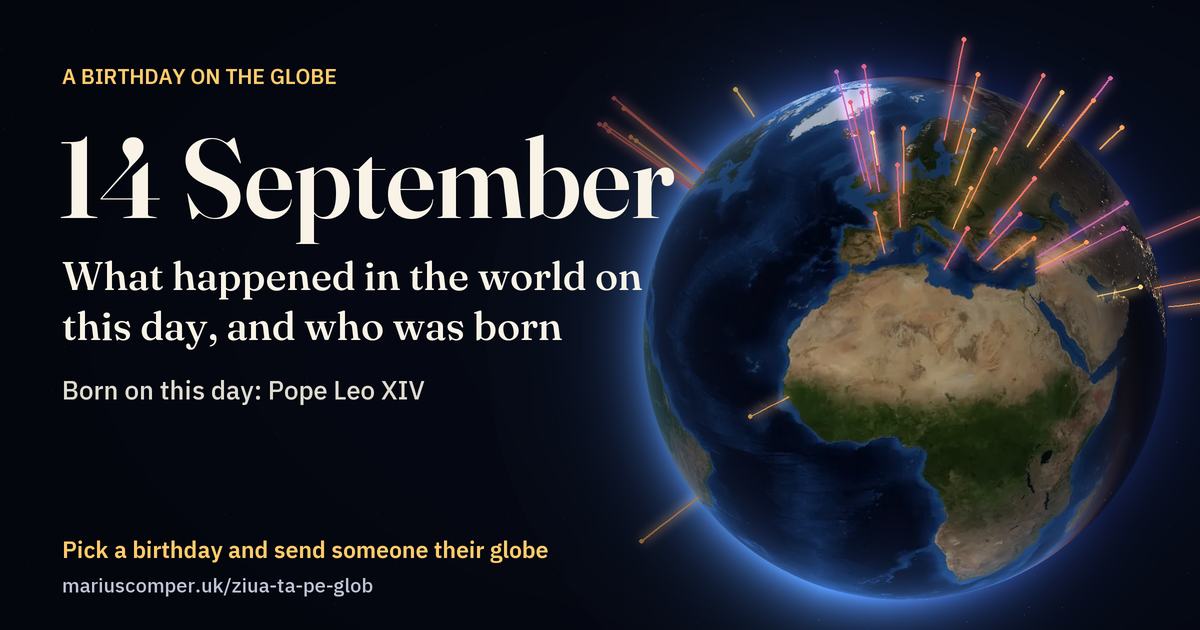
For 14 September, the English Wikipedia lists 64 events and 280 births. 39 of the events stand at their places as rays of light; four more are dashed circles, where the sentence links only to a country or a sea. The taller the ray, the longer ago it happened. The people born that day come further down, as blue points.
A birthday, yours or someone else’s:
Turn it into a greetingScroll: the globe turns to each place
The day you were born, on the globe.
Three things from your day
Scroll: your day first, then 14 September through the years
The Earth on 14 September
The picture on the globe was assembled by NASA from satellite photographs taken in September 2004: the snow, the ice and the green are those of the month.
On 14 September the Sun passes straight overhead at noon along the parallel of 3.4° north. In London, the day lasts about 12 hours 45 minutes.
Beyond 87° north the Sun no longer sets; beyond 87° south it no longer rises.
The line between day and night is tilted on the globe exactly as on this day of the year. On the dark side you can see the lights of towns.
Britain & Ireland · Bishop Gore School
1682
Bishop Gore School, one of the oldest schools in Wales, is founded.
On the map: Bishop Gore School.
Europe · Fort Manoel
1723
Grand Master António Manoel de Vilhena lays down the first stone of Fort Manoel in Malta.
On the map: Fort Manoel.
Europe · Avignon
1791
The Papal States lose Avignon to Revolutionary France.
On the map: Avignon.
Europe · Croatian Republic of Herzeg-Bosnia
1992
The Constitutional Court of Bosnia and Herzegovina declares the breakaway Croatian Republic of Herzeg-Bosnia to be illegal.
On the map: Croatian Republic of Herzeg-Bosnia.
Also on the day’s list of Wikipedia in Romanian.
Asia · Tyre, Lebanon
1210
Maria of Montferrat, Queen of Jerusalem, marries French baron John of Brienne, who is later crowned king on 30 October in Tyre.
On the map: Tyre, Lebanon.
Asia · Penang
1985
Penang Bridge, the longest bridge in Malaysia, connecting the island of Penang to the mainland, opens to traffic.
On the map: Penang.
North America · LIGO
2015
The first observation of gravitational waves is made, announced by the LIGO and Virgo collaborations on 11 February 2016.
On the map: LIGO.
Also on the day’s list of Wikipedia in Spanish and Romanian.
14 September
Born on 14 September#
The English Wikipedia lists 280 births for this day. The blue points are the birthplaces of 59 of these people: those written about in the most Wikipedia editions, where Wikidata gives a place of birth.
Born on 14 September
1769
Alexander von Humboldt, German geographer and explorer (died 1859)
Place of birth: Berlin.
Born on 14 September
1983
Amy Winehouse, British singer-songwriter, musician, and businesswoman (died 2011)
Place of birth: Chase Farm Hospital.
Born on 14 September
1947
Sam Neill, New Zealand actor (died 2026)
Place of birth: Omagh.
Born on 14 September
1937
Renzo Piano, Italian architect and engineer, designed The Shard and The New York Times Building
Place of birth: Genoa.
Born in Britain and Ireland
1997
Dominic Solanke, English footballer
Place of birth: Reading.
Born in Britain and Ireland
1804
John Gould, English ornithologist and illustrator (died 1881)
Place of birth: Lyme Regis.
Born in Britain and Ireland
1956
Ray Wilkins, English footballer and manager (died 2018)
Place of birth: Hillingdon.
14 September
Number one in the charts that week
At the cinema
An animal recorded that day
The record can be seen in GBIF, which brings together wildlife records from around the world.
All your birthdays
The weather that day
Data: Met Office Hadley Centre (HadCET); NOAA (GHCN-Daily, Mauna Loa).
Above the Earth
Sources: Jonathan McDowell, GCAT (launches); GFZ Potsdam (Kp index). Days are counted in Universal Time.
Football that day
International matches played that day:
Source: the “International football results” dataset kept by Mart Jürisoo (CC0).
Also that day
The earthquake’s page at the USGS
Source: the USGS catalogue. The day is counted in Universal Time (UTC).
In those days
Make a link for someone
Type the name, pick the day and the year of birth. The link opens straight on their day, with their name in the greeting.
The link carries the name, date and place typed here; anyone who gets it can see them.
Put another birthday beside it
Your mother’s, your child’s, a friend’s: the two days appear side by side.
Below: 14 September through the years.
The whole globe of the day
Drag the globe to turn it. Touch a ray or a point to read what happened there.
Everything Wikipedia lists for 14 September
The list is the English Wikipedia’s, in its own wording, as it stood in October 2026. 21 events have no place on the map: the sentence links to no place with coordinates, only to places too wide to mark, or to several countries.
- 81
Domitian became Emperor of the Roman Empire upon the death of his brother Titus.
Europe · Roman EmpireWikipedia: Domitian - 775
Leo IV the Khazar becomes Byzantine Emperor following the death of his father Constantine V.
no place on the mapWikipedia: Leo IV the Khazar - 786
"Night of the three Caliphs": Harun al-Rashid becomes the Abbasid caliph upon the death of his brother al-Hadi. Birth of Harun's son al-Ma'mun.
no place on the mapWikipedia: Harun al-Rashid - 919
Battle of Islandbridge: High King Niall Glúndub is killed while leading an Irish coalition against the Vikings of Uí Ímair, led by King Sitric Cáech.
Britain & Ireland · Battle of IslandbridgeWikipedia: Battle of Islandbridge - 987
Bardas Phokas the Younger rebels against Byzantine emperor Basil II and declares himself emperor.
no place on the mapWikipedia: Bardas Phokas the Younger - 1115
Roger of Salerno's Crusader army defeats a numerically superior Seljuk army in the battle of Sarmin
Asia · Battle of SarminWikipedia: Battle of Sarmin - 1141
An army of queen Matilda defeats and disperses an army of empress Matilda which was besieging Winchester. Robert of Gloucester is captured and exchanged for king Stephen, husband of queen Matilda.
Britain & Ireland · Rout of WinchesterWikipedia: Rout of Winchester - 1146
Seljuk atabeg Imad al-Din Zengi of Mosul is assassinated by a slave and succeeded by his quarrelling sons.
Asia · Seljuk EmpireWikipedia: Seljuk Empire - 1180
Genpei War: In the Battle of Ishibashiyama in Japan, the new military commander of the Minamoto clan, Minamoto no Yoritomo, is routed by Ōba Kagechika of the Taira clan.
Asia · Battle of IshibashiyamaWikipedia: Battle of Ishibashiyama - 1210
Maria of Montferrat, Queen of Jerusalem, marries French baron John of Brienne, who is later crowned king on 30 October in Tyre.
Asia · Tyre, LebanonWikipedia: Maria of Montferrat - 1226
The first recorded instance of the Catholic practice of perpetual Eucharistic adoration formally begins in Avignon, France.
no place on the mapWikipedia: Catholic Church - 1402
Battle of Homildon Hill: An invading Scottish army under Murdoch Stewart, Duke of Albany and Archibald, Earl Douglas is decimated by a contingent of 500 English archers under the command of George, Earl of March and Henry Percy, 1st Earl of Northumberland.
Britain & Ireland · Battle of Homildon HillWikipedia: Battle of Homildon Hill - 1682
Bishop Gore School, one of the oldest schools in Wales, is founded.
Britain & Ireland · Bishop Gore SchoolWikipedia: Bishop Gore School - 1685
Morean War: the Battle of Kalamata ends in a Venetian victory over the forces of the Ottoman Empire under the Kapudan Pasha.
Europe · Battle of KalamataWikipedia: Battle of Kalamata - 1723
Grand Master António Manoel de Vilhena lays down the first stone of Fort Manoel in Malta.
Europe · Fort ManoelWikipedia: António Manoel de Vilhena - 1741
George Frideric Handel completes his oratorio Messiah.
no place on the mapWikipedia: George Frideric Handel - 1752
The British Empire adopts the Gregorian calendar, skipping eleven days (the previous day was September 2).
no place on the mapWikipedia: Adoption of the Gregorian calendar - 1763
Seneca warriors defeat British forces at the Battle of Devil's Hole during Pontiac's War.
North America · Battle of Devil's HoleWikipedia: Battle of Devil's Hole - 1782
American Revolutionary War: Review of the French troops under General Rochambeau by General George Washington at Verplanck's Point, New York.
no place on the mapWikipedia: American Revolutionary War - 1791
The Papal States lose Avignon to Revolutionary France.
Europe · AvignonWikipedia: Papal States - 1808
Finnish War: Russians defeat the Swedes at the Battle of Oravais.
Europe · Battle of OravaisWikipedia: Battle of Oravais - 1812
Napoleonic Wars: The French Grande Armée enters Moscow. The Fire of Moscow begins as soon as Russian troops leave the city.
Europe · Fire of MoscowWikipedia: Napoleonic Wars - 1814
Battle of Baltimore: The poem Defence of Fort McHenry is written by Francis Scott Key. The poem is later used as the lyrics of The Star-Spangled Banner.
North America · Battle of BaltimoreWikipedia: Battle of Baltimore - 1829
The Ottoman Empire signs the Treaty of Adrianople with Russia, thus ending the Russo-Turkish War.
Asia · Treaty of AdrianopleWikipedia: Treaty of Adrianople - 1846
Jang Bahadur and his brothers massacre about 40 members of the Nepalese palace court.
Asia · Basantapur Durbar SquareWikipedia: Kot massacre - 1862
American Civil War: The Battle of South Mountain, part of the Maryland Campaign, is fought.
North America · Battle of South MountainWikipedia: American Civil War - 1863
American Civil War: The Little Rock campaign ended with the Union Army capturing Little Rock, Arkansas.
North America · Little Rock, ArkansasWikipedia: American Civil War - 1901
U.S. president William McKinley dies after being mortally wounded on September 6 by anarchist Leon Czolgosz and is succeeded by Vice President Theodore Roosevelt.
North America · Assassination of William McKinleyWikipedia: Assassination of William McKinley - 1911
Russian Premier Pyotr Stolypin is shot by Dmitry Bogrov while attending a performance of Rimsky-Korsakov's The Tale of Tsar Saltan at the Kiev Opera House, in the presence of Tsar Nicholas II.
no place on the mapWikipedia: Pyotr Stolypin - 1914
HMAS AE1, the Royal Australian Navy's first submarine, is lost at sea with all hands near East New Britain, Papua New Guinea.
Oceania · East New Britain ProvinceWikipedia: HMAS AE1 - 1917
The Russian Empire is formally replaced by the Russian Republic.
no place on the mapWikipedia: Russian Empire - 1936
Raoul Villain, who assassinated the French Socialist Jean Jaurès, is himself killed by Spanish Republicans in Ibiza.
Europe · IbizaWikipedia: Raoul Villain - 1939
World War II: The Estonian military boards the Polish submarine ORP Orzeł in Tallinn, sparking a diplomatic incident that the Soviet Union will later use to justify the annexation of Estonia.
Europe · TallinnWikipedia: Orzeł incident - 1940
Ip massacre: The Hungarian Army, supported by local Hungarians, kill 158 Romanian civilians in Ip, Sălaj, a village in Northern Transylvania, an act of ethnic cleansing.
Europe · Ip massacreWikipedia: Ip massacre - 1943
World War II: The Wehrmacht starts a three-day retaliatory operation targeting several Greek villages in the region of Viannos, whose death toll would eventually exceed 500 persons.
Europe · Viannos massacresWikipedia: Viannos massacres - 1944
World War II: Maastricht becomes the first Dutch city to be liberated by allied forces.
Europe · MaastrichtWikipedia: Maastricht - 1948
The Indian Army captures the city of Aurangabad as part of Operation Polo.
Asia · AurangabadWikipedia: Indian annexation of Hyderabad - 1954
In a top secret nuclear test, a Soviet Tu-4 bomber drops a 40 kiloton atomic weapon just north of Totskoye village.
Europe · Totskoye nuclear exerciseWikipedia: Totskoye nuclear exercise - 1958
The first two German post-war rockets, designed by the German engineer Ernst Mohr, reach the upper atmosphere.
no place on the mapWikipedia: Mohr Rocket - 1960
Congo Crisis: Mobutu Sese Seko seizes power in a military coup, suspending parliament and the constitution.
no place on the mapWikipedia: Congo Crisis - 1960
The Organization of Petroleum Exporting Countries (OPEC) is founded.
no place on the mapWikipedia: OPEC - 1975
The first American saint, Elizabeth Ann Seton, is canonized by Pope Paul VI.
no place on the mapWikipedia: Elizabeth Ann Seton - 1979
Afghan leader Nur Muhammad Taraki is assassinated upon the order of Hafizullah Amin, who becomes the new General Secretary of the People's Democratic Party.
no place on the mapWikipedia: List of heads of state of Afghanistan - 1982
President-elect of Lebanon Bachir Gemayel is assassinated.
Asia · AshrafiehWikipedia: Assassination of Bachir Gemayel - 1984
Joe Kittinger becomes the first person to fly a gas balloon alone across the Atlantic Ocean.
no place on the mapWikipedia: Joseph Kittinger - 1985
Penang Bridge, the longest bridge in Malaysia, connecting the island of Penang to the mainland, opens to traffic.
Asia · PenangWikipedia: Penang Bridge - 1989
The Standard Gravure shooting where Joseph T. Wesbecker, a 47-year-old pressman, killed eight people and injured 12 people at his former workplace, Standard Gravure, before committing suicide.
North America · Standard Gravure shootingWikipedia: Standard Gravure shooting - 1989
Typhoon Sarah dissipated after causing extensive damage along an erratic path across the Western Pacific, killing 71 in Taiwan, the Philippines, and the Gotō Islands.
Asia · Gotō IslandsWikipedia: Typhoon Sarah - 1992
The Constitutional Court of Bosnia and Herzegovina declares the breakaway Croatian Republic of Herzeg-Bosnia to be illegal.
Europe · Croatian Republic of Herzeg-BosniaWikipedia: Bosnia and Herzegovina - 1993
Lufthansa Flight 2904, an Airbus A320, crashes into an embankment after overshooting the runway at Okęcie International Airport (now Warsaw Chopin Airport), killing two people.
Europe · Lufthansa Flight 2904Wikipedia: Lufthansa Flight 2904 - 1994
The rest of the Major League Baseball season is canceled because of a strike.
no place on the mapWikipedia: 1994 Major League Baseball season - 1997
Eighty-one killed as five bogies of the Ahmedabad–Howrah Express plunge into a river in Bilaspur district of Madhya Pradesh, India.
Asia · Madhya PradeshWikipedia: Howrah–Ahmedabad Superfast Express - 1998
Telecommunications companies MCI Communications and WorldCom complete their $37 billion merger to form MCI WorldCom.
no place on the mapWikipedia: MCI Communications - 1999
Kiribati, Nauru and Tonga join the United Nations.
no place on the mapWikipedia: Kiribati - 2000
Microsoft releases Windows Me.
no place on the mapWikipedia: Microsoft - 2001
Historic National Prayer Service held at Washington National Cathedral for victims of the September 11 attacks. A similar service is held in Canada on Parliament Hill, the largest vigil ever held in the nation's capital.
North America · ShanksvilleWikipedia: September 11 attacks - 2002
Total Linhas Aéreas Flight 5561 crashes near Paranapanema, Brazil, killing both pilots on board.
Latin America · Total Linhas Aéreas Flight 5561Wikipedia: Total Linhas Aéreas Flight 5561 - 2003
Bissau-Guinean President Kumba Ialá is ousted from power in a bloodless military coup led by General Veríssimo Correia Seabra.
Africa · 2003 Guinea-Bissau coup d'étatWikipedia: 2003 Guinea-Bissau coup d'état - 2003
In a referendum, Estonia approves joining the European Union.
no place on the mapWikipedia: 2003 Estonian European Union membership referendum - 2007
Prelude to the 2008 financial crisis: Northern Rock bank experiences the first bank run in the United Kingdom in 150 years.
no place on the mapWikipedia: 2008 financial crisis - 2008
Aeroflot Flight 821, a Boeing 737-500, crashes into a section of the Trans-Siberian Railway while on approach to Perm International Airport, in Perm, Russia, killing all 88 people on board.
Europe · Aeroflot Flight 821Wikipedia: Aeroflot Flight 821 - 2015
The first observation of gravitational waves is made, announced by the LIGO and Virgo collaborations on 11 February 2016.
North America · LIGOWikipedia: LIGO - 2019
Yemen's Houthi rebels claim responsibility for an attack on Saudi Arabian oil facilities.
Asia · Abqaiq–Khurais attackWikipedia: Houthi insurgency - 2022
Death of Queen Elizabeth II: The Queen's coffin is taken from Buckingham Palace, placed on a gun carriage of The King's Troop Royal Horse Artillery and moved in a procession to Westminster Hall for her lying in state over the next four days with the queue of mourners stretching for miles along the River Thames.
Britain & Ireland · Balmoral CastleWikipedia: Death and state funeral of Elizabeth II
Who was born on 14 September
In order of how many Wikipedia editions have an article about each. The first 60 of 280 are shown.
- 1955
Pope Leo XIV
ChicagoWikipedia: Pope Leo XIV - 1769
Alexander von Humboldt, German geographer and explorer (died 1859)
- 1983
Amy Winehouse, British singer-songwriter, musician, and businesswoman (died 2011)
Chase Farm HospitalWikipedia: Amy Winehouse - 1580
Francisco de Quevedo, Spanish poet and politician (died 1645)
- 1947
Sam Neill, New Zealand actor (died 2026)
OmaghWikipedia: Sam Neill - 1937
Renzo Piano, Italian architect and engineer, designed The Shard and The New York Times Building
- 1879
Margaret Sanger, American nurse and activist (died 1966)
CorningWikipedia: Margaret Sanger - 1791
Franz Bopp, German linguist and academic (died 1867)
- 1486
Heinrich Cornelius Agrippa, German theologian, astrologer, and alchemist (died 1535)
- 208
Diadumenian, Roman emperor (died 218)
- 768
Al-Ma'mun, Abbasid caliph, 7th (died 833)
BaghdadWikipedia: Al-Ma'mun - 1864
Robert Cecil, 1st Viscount Cecil of Chelwood, English lawyer and politician, Under-Secretary of State for Foreign Affairs, Nobel Prize laureate (died 1958)
Cavendish SquareWikipedia: Robert Cecil, Viscount Cecil of Chelwood - 1979
Ivica Olić, Croatian footballer
- 1990
Douglas Costa, Brazilian footballer
Sapucaia do SulWikipedia: Douglas Costa - 1913
Jacobo Árbenz, Guatemalan captain and politician, President of Guatemala (died 1971)
QuetzaltenangoWikipedia: Jacobo Árbenz - 1920
Lawrence Klein, American economist and academic, Nobel Prize laureate (died 2013)
- 1978
Ron DeSantis, American politician, 46th Governor of Florida
- 1936
Ferid Murad, American physician and pharmacologist, Nobel Prize laureate (died 2023)
WhitingWikipedia: Ferid Murad - 1956
Kostas Karamanlis, Greek lawyer and politician, 181st Prime Minister of Greece
- 1974
Hicham El Guerrouj, Moroccan runner
- 1920
Mario Benedetti, Uruguayan journalist and author (died 2009)
Paso de los TorosWikipedia: Mario Benedetti - 1926
Michel Butor, French author and critic (died 2016)
Mons-en-BarœulWikipedia: Michel Butor - 1944
Günter Netzer, German footballer and manager
MönchengladbachWikipedia: Günter Netzer - 1988
Martin Fourcade, French biathlete
- 1928
Alberto Korda, Cuban photographer (died 2001)
HavanaWikipedia: Alberto Korda - 1978
Carmen Kass, Estonian model and actress
TallinnWikipedia: Carmen Kass - 1886
Jan Masaryk, Czech soldier and politician, Czech Minister of Foreign Affairs (died 1948)
VinohradyWikipedia: Jan Masaryk - 1989
Lee Jong-suk, South Korean actor and model
- 1989
Jimmy Butler, American basketball player
HoustonWikipedia: Jimmy Butler - 1997
Dominic Solanke, English footballer
ReadingWikipedia: Dominic Solanke - 1737
Michael Haydn, Austrian singer and composer (died 1806)
RohrauWikipedia: Michael Haydn - 1804
John Gould, English ornithologist and illustrator (died 1881)
Lyme RegisWikipedia: John Gould - 1974
Sunday Oliseh, Nigerian footballer and manager
Port HarcourtWikipedia: Sunday Oliseh - 1955
Geraldine Brooks, Australian-American novelist and journalist
- 1956
Ray Wilkins, English footballer and manager (died 2018)
HillingdonWikipedia: Ray Wilkins - 1984
Ayushmann Khurrana, Indian actor, singer and anchor
ChandigarhWikipedia: Ayushmann Khurrana - 1986
Steven Naismith, Scottish footballer
- 1618
Peter Lely, Dutch-English painter (died 1680)
- 1891
Ivan Matveyevich Vinogradov, Russian mathematician and academic (died 1983)
- 1981
Miyavi, Japanese singer-songwriter, guitarist, and producer
OsakaWikipedia: Miyavi - 1997
Benjamin Ingrosso, Swedish singer and songwriter
Hedvig Eleonora and Oscar ParishWikipedia: Benjamin Ingrosso - 1401
Maria of Castile, Queen consort of Aragon and Naples (died 1458)
SegoviaWikipedia: Maria of Castile - 1910
Jack Hawkins, English actor and producer (died 1973)
Wood GreenWikipedia: Jack Hawkins - 1960
Callum Keith Rennie, English-Canadian actor and producer
SunderlandWikipedia: Callum Keith Rennie - 1968
Grant Shapps, English politician
WatfordWikipedia: Grant Shapps - 1977
Malik Bendjelloul, Swedish director and producer (died 2014)
Ystad church parishWikipedia: Malik Bendjelloul - 1547
Johan van Oldenbarnevelt, Dutch politician (died 1619)
AmersfoortWikipedia: Johan van Oldenbarnevelt - 1880
Archie Hahn, American sprinter, football player, and coach (died 1955)
DodgevilleWikipedia: Archie Hahn - 1985
Aya Ueto, Japanese actress and singer
TokyoWikipedia: Aya Ueto - 1774
Lord William Bentinck, English general and politician, 14th Governor-General of India (died 1839)
BuckinghamshireWikipedia: Lord William Bentinck - 1930
Allan Bloom, American philosopher and academic (died 1992)
IndianapolisWikipedia: Allan Bloom - 1934
Sarah Kofman, French philosopher and academic (died 1994)
10ᵗʰ arrondissement of ParisWikipedia: Sarah Kofman - 1986
Ai Takahashi, Japanese singer and actress
- 1867
Charles Dana Gibson, American illustrator (died 1944)
- 1543
Claudio Acquaviva, Italian priest, 5th Superior General of the Society of Jesus (died 1615)
- 1938
Nicol Williamson, Scottish actor (died 2011)
HamiltonWikipedia: Nicol Williamson - 1970
Francesco Casagrande, Italian cyclist
FlorenceWikipedia: Francesco Casagrande - 1991
Nana, South Korean singer, actress and model
CheongjuWikipedia: Nana - 1883
Richard Gerstl, Austrian painter and illustrator (died 1908)
- 1909
Peter Scott, English ornithologist, painter, and sailor (died 1989)
LondonWikipedia: Peter Scott
What is celebrated on 14 September
- Christian feast day: Aelia Flaccilla (Eastern Orthodox Church)
- Christian feast day: Albert of Vercelli
- Christian feast day: Cormac mac Cuilennáin (or of Cashel)
- Christian feast day: Crescentius of Rome
- Christian feast day: Feast of the Cross (Christianity) Elevation of the Holy Cross (Eastern Orthodox)
- Christian feast day: Lord of Miracles of Buga
- Christian feast day: Gabriel-Taurin Dufresse (one of the Martyr Saints of China)
- Christian feast day: Maternus of Cologne
- Christian feast day: Notburga
- Christian feast day: September 14 (Eastern Orthodox liturgics)
- Engineer's Day (Romania)
- Hindi Day (Hindi-speaking states of India)
- Mobilized Servicemen Day (Ukraine)
- San Jacinto Day (Nicaragua)
A greeting link for someone
Type a name and, if you like, the year of birth. The link opens with a greeting, and beside each event it says how old the person turned that day, or how many years before their birth it happened.
The name and the year go only into the link you send.
All 366 days
How the globe is made
Where the events come from
Each edition of this page uses the day’s list from Wikipedia in its own language: Romanian, English, Spanish, Chinese. The lists are written by volunteers and differ from one edition to the next; the text of each event is Wikipedia’s, with a link to the article. A row that appears twice in a list is shown once. The lists have not been checked event by event: they are Wikipedia’s, mistakes included.
For events before 1582, and for countries that moved to the Gregorian calendar later (Britain in 1752, Russia in 1918), the same day may be counted Old Style in one list and New Style in another.
The chapter “What the other Wikipedias remember” adds up to five events a day from the lists of the other three editions, only for years in which the English list has nothing on that day. They were translated for this page, passed the same filters as the tour, and are not counted among the events of the English list.
How an event gets onto the map
The place comes from Wikidata. If the sentence links to the article about the event itself (a battle, an opening, an earthquake), dated to the same year, the ray stands on its coordinates or on those of its location. Otherwise it stands on the first place the sentence links to: a town, a building, a mountain, an island. This second step can be wrong: sometimes the sentence only mentions the place. That is why the page says, under each event, which place the ray stands on.
When the sentence links to a single state or province, or to a single sea, lake or desert larger than 5,000 km², the globe shows a dashed circle, not a ray. The circle has the area Wikidata gives, with its radius kept between 1.2° and 16°, or a radius of 4.5° when Wikidata gives no area; it says only that the sentence links to that place. Organisations, ships, spacecraft, museum objects, rivers, mountain ranges, languages and continents are never used as places. When a sentence names several states and no exact place, the event stays in the list only.
What the height means
The height of a ray shows how many years have passed, on a logarithmic scale: 10 years, 100 years and 1,000 years are equal steps apart; anything older than about 2,600 years has the tallest ray. The colour runs from pale yellow for recent years to violet for antiquity.
Where the tour stops
In each region the tour stops at up to three events (five in Britain and Ireland), chosen mainly by three things: whether Wikipedia’s editors put the event in the “On this day” box of their main page (the English, Spanish and Chinese editions), how many Wikipedia editions have an article about it, and how many of the four lists include it. Events whose sentence or article is about a war, an attack, a crime or a disaster are left out of the tour; they stay in the whole list, in Wikipedia’s wording. The filter is a list of words and a list of Wikidata types, so it can miss some.
The tour of births names the people with articles in the most editions and leaves aside those whom the list or Wikidata describes as rulers, politicians, commanders, leaders of movements or criminals; they stay in the list.
The Earth and the Sun
The daytime images are NASA’s Blue Marble Next Generation mosaics, one for each month of 2004; the night side is Black Marble 2016. The tilt of the line between day and night is computed for the day; the hour is chosen so that the place being read is in daylight. The latitude where the Sun stands overhead is the average of the four years of the leap cycle; in a given year it can differ by up to 0.4°.
The day you were born
The number ones come from the weekly lists on Wikipedia: Billboard for the United States (from 1940; the Hot 100 from August 1958), the UK Singles Chart (from November 1952), Los 40 Principales for Spain (from July 1966) and, for Romania, the Romanian Top 100 and Airplay 100 (2001–2021, with missing weeks). The page shows the chart of the week in which the day of birth falls, with its date; Billboard and the UK chart are dated at the end of their week. For Romania before 2001 and for China these sources have no weekly chart.
The films are those that reached cinemas in the United States up to ten days before or three days after that day (some of them in a few cinemas at first), from the English Wikipedia’s yearly lists (from 1968), in order of how many editions have an article about them. The events “in those days” are the ones on the neighbouring days’ lists that carry the year of birth, passed through the same filter as the tour.
The day of birth, year included
The Moon, the star sign and the constellation are worked out by the page itself, for noon Universal Time on the day. The lit part of the Moon is rounded and can differ by a few per cent from that at the hour of birth. The sign follows the usual zodiac of twelve equal parts starting at the March equinox; the constellation is the one the Sun actually stood in front of, by the borders set by the International Astronomical Union, and within a day of a border the page does not name it. When the Sun changes sign while it is that day anywhere on Earth, the page gives the moment of crossing, rounded to ten minutes and accurate to within about a quarter of an hour, and the clock time in a few cities, with the time zone and summer time of that year.
The year in the Chinese calendar is the one your device’s own calendar gives for the date, checked against the Hong Kong Observatory’s tables. “All your birthdays” uses the same sources as the rest of the chapter for the same day in every year since the birth: the temperature, well-known launches that took place on that very day, matches of the teams the edition follows, snow deeper than 10 cm and strong geomagnetic storms. The three things at the top and the four on the picture are chosen in a fixed order (the song, the animal, a full Moon, a well-known launch before an ordinary earthquake); on the picture you can change them.
When the link carries a year of birth, the page adds a few things about that exact day. The weather is the Met Office’s Central England temperature record and the readings from New York’s Central Park; the “usual high” is the average of the daily highs of 1961–1990 for that date, with two days either side. The carbon dioxide figure is the monthly mean at the Mauna Loa observatory, where measurements begin in March 1958.
The earthquake is the one with the largest magnitude in the USGS catalogue for that day, counted in Universal Time. Before the 1960s the catalogue has gaps even above magnitude 5.5, so in the older years many days have no earthquake. The page gives only the magnitude and the place: the country the epicentre falls in or, when the epicentre is at sea within 300 km of a coast, the nearest country; farther out, only the ocean.
The launches are those that reached orbit or left for the Moon and the planets, from Jonathan McDowell’s GCAT catalogue. If nothing left that day, the page shows the nearest launch within three days before or after, and says how many days away it was. The geomagnetic storm appears only when the Kp index reached at least 5 in one of the day’s eight three-hour intervals.
The animal comes from GBIF: an observation made by a person (the animal seen or heard, or its tracks), dated to that exact day, with coordinates and a CC0 or CC BY licence. Only a few hundred well-known species are searched (mammals, birds, turtles, butterflies); of those noted that day, mammals and species with articles in many Wikipedia editions come first; birds noted almost every day, and species used recently, wait their turn. Observations dated 1 January are left out, because records without a day are often filed there. An observation shows that the animal was recorded there, not how many animals there were.
The matches are those between national teams. Only matches of England, Scotland, Wales, Northern Ireland, the Republic of Ireland, the United States, Canada and Australia are shown, along with those at the big final tournaments. The picture to send is drawn in the page from the day’s globe and the facts above, and stays on your device until you send it.
Sources
- Events, births and holidays: the day’s page on Wikipedia, text under CC BY-SA 4.0.
- Coordinates, places of birth and the number of editions: Wikidata (CC0).
- The Earth by day: NASA Blue Marble Next Generation. The Earth by night: NASA Black Marble 2016.
- Borders and regions: Natural Earth.
- World population and births per year: UN World Population Prospects 2024.
- Charts and films: Wikipedia’s lists for Billboard, the UK Singles Chart, Los 40 Principales, Romanian Top 100, Airplay 100 and American films by year (CC BY-SA 4.0).
- Weather: Met Office Hadley Centre, HadCET (Open Government Licence) and NOAA GHCN-Daily, New York Central Park. Carbon dioxide: NOAA Global Monitoring Laboratory, Mauna Loa.
- Earthquakes: the USGS catalogue. Launches: Jonathan McDowell, GCAT (CC BY). Kp index: GFZ Potsdam (CC BY 4.0). Matches: International football results, Mart Jürisoo (CC0).
- Animal observations: GBIF, with a link to each record; species names come from Wikidata.