A birthday on the globe
15 December on the globe: what happened in the world on this day, and who was born
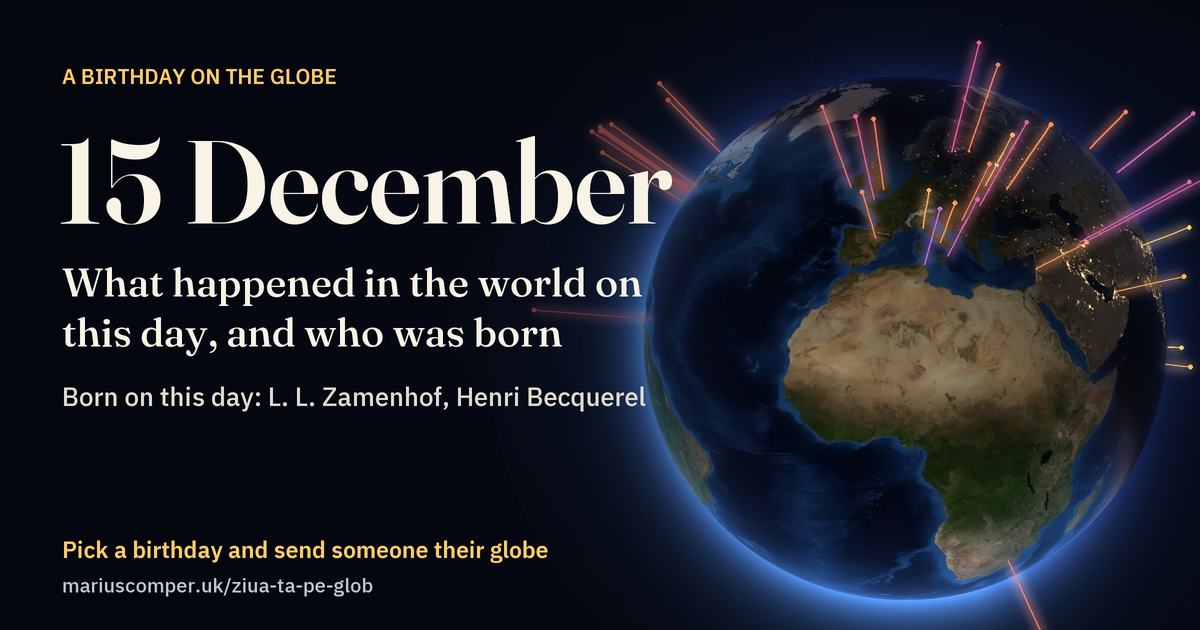
For 15 December, the English Wikipedia lists 56 events and 171 births. 36 of the events stand at their places as rays of light; three more are dashed circles, where the sentence links only to a country or a sea. The taller the ray, the longer ago it happened. The people born that day come further down, as blue points.
A birthday, yours or someone else’s:
Turn it into a greetingScroll: the globe turns to each place
The day you were born, on the globe.
Three things from your day
Scroll: your day first, then 15 December through the years
The Earth on 15 December
The picture on the globe was assembled by NASA from satellite photographs taken in December 2004: the snow, the ice and the green are those of the month.
On 15 December the Sun passes straight overhead at noon along the parallel of 23.2° south. In London, the day lasts about 7 hours 50 minutes.
Beyond 67° south the Sun no longer sets; beyond 67° north it no longer rises.
The line between day and night is tilted on the globe exactly as on this day of the year. On the dark side you can see the lights of towns.
Britain & Ireland · London Underground
1906
The London Underground's Great Northern, Piccadilly and Brompton Railway opens.
On the map: London Underground.
Europe · Ekenäs, Finland
1546
The town of Ekenäs (Finnish: Tammisaari) is founded by King Gustav Vasa of Sweden.
On the map: Ekenäs, Finland.
Europe · Pushkin House
1905
The Pushkin House is established in Saint Petersburg, Russia, to preserve the cultural heritage of Alexander Pushkin.
On the map: Pushkin House.
Europe · Leaning Tower of Pisa
2001
The Leaning Tower of Pisa reopens after 11 years and $27,000,000 spent to stabilize it, without fixing its famous lean.
On the map: Leaning Tower of Pisa.
Also on the day’s list of Wikipedia in Romanian.
North America · Virginia General Assembly
1791
The United States Bill of Rights becomes law when ratified by the Virginia General Assembly.
On the map: Virginia General Assembly.
North America · Pipe Spring National Monument
1871
Sixteen-year-old telegraphist Ella Stewart keys and sends the first telegraphed message from Arizona Territory at the Deseret Telegraph Company office in Pipe Spring.
On the map: Pipe Spring National Monument.
North America · Loew's Grand Theatre
1939
Gone with the Wind (highest inflation adjusted grossing film) receives its premiere at Loew's Grand Theatre in Atlanta, Georgia, United States.
On the map: Loew's Grand Theatre.
Also on the day’s list of Wikipedia in Romanian and Chinese.
15 December
What the other Wikipedias remember#
For these years the English list has nothing on this day. The events below come from the same day’s lists on Wikipedia in Chinese and were translated for this page.
From Wikipedia in Chinese · Hsinchu Science Park
1980
The Hsinchu Science Park in Taiwan is officially established, and subsequently develops into a major global centre for contract manufacturing of high-tech products.
On the map: Hsinchu Science Park.
Translated from the list on Wikipedia in Chinese.
15 December
Born on 15 December#
The English Wikipedia lists 171 births for this day. The blue points are the birthplaces of 60 of these people: those written about in the most Wikipedia editions, where Wikidata gives a place of birth.
Born on 15 December
1859
L. L. Zamenhof, Polish linguist and ophthalmologist, created Esperanto (died 1917)
Place of birth: Białystok.
Born on 15 December
1852
Henri Becquerel, French physicist and chemist, Nobel Prize laureate (died 1908)
Place of birth: Paris.
Born on 15 December
1832
Gustave Eiffel, French architect and engineer, co-designed the Eiffel Tower (died 1923)
Place of birth: Dijon.
Born on 15 December
1907
Oscar Niemeyer, Brazilian architect, designed the United Nations Headquarters and the Cathedral of Brasília (died 2012)
Place of birth: Rio de Janeiro.
Born on 15 December
1923
Freeman Dyson, English-American physicist and mathematician (died 2020)
Place of birth: Crowthorne.
Born in Britain and Ireland
1992
Jesse Lingard, English footballer
Place of birth: Warrington.
Born in Britain and Ireland
1930
Edna O'Brien, Irish novelist, playwright, poet and short story writer (died 2024)
Place of birth: Tuamgraney.
Born in Britain and Ireland
1982
Charlie Cox, English actor
Place of birth: Westminster.
15 December
Number one in the charts that week
At the cinema
An animal recorded that day
The record can be seen in GBIF, which brings together wildlife records from around the world.
All your birthdays
The weather that day
Data: Met Office Hadley Centre (HadCET); NOAA (GHCN-Daily, Mauna Loa).
Above the Earth
Sources: Jonathan McDowell, GCAT (launches); GFZ Potsdam (Kp index). Days are counted in Universal Time.
Football that day
International matches played that day:
Source: the “International football results” dataset kept by Mart Jürisoo (CC0).
Also that day
The earthquake’s page at the USGS
Source: the USGS catalogue. The day is counted in Universal Time (UTC).
In those days
Make a link for someone
Type the name, pick the day and the year of birth. The link opens straight on their day, with their name in the greeting.
The link carries the name, date and place typed here; anyone who gets it can see them.
Put another birthday beside it
Your mother’s, your child’s, a friend’s: the two days appear side by side.
Below: 15 December through the years.
The whole globe of the day
Drag the globe to turn it. Touch a ray or a point to read what happened there.
Everything Wikipedia lists for 15 December
The list is the English Wikipedia’s, in its own wording, as it stood in October 2026. 17 events have no place on the map: the sentence links to no place with coordinates, only to places too wide to mark, or to several countries.
- 533
Vandalic War: Byzantine general Belisarius defeats the Vandals, commanded by King Gelimer, at the Battle of Tricamarum.
Africa · Battle of TricamarumWikipedia: Battle of Tricamarum - 687
Pope Sergius I is elected as a compromise between antipopes Paschal and Theodore.
no place on the mapWikipedia: Pope Sergius I - 1025
Constantine VIII becomes sole emperor of the Byzantine Empire, 63 years after being crowned co-emperor.
Asia · Byzantine EmpireWikipedia: Constantine VIII - 1161
Jin–Song wars: Military officers conspire against the emperor Wanyan Liang of the Jin dynasty after a military defeat at the Battle of Caishi, and assassinate the emperor at his camp.
Asia · Battle of CaishiWikipedia: Battle of Caishi - 1167
Sicilian Chancellor Stephen du Perche moves the royal court to Messina to prevent a rebellion.
Europe · MessinaWikipedia: Kingdom of Sicily - 1256
Mongol forces under Hulagu enter and dismantle the Nizari Ismaili (Assassin) stronghold at Alamut Castle (in present-day Iran) as part of their offensive on Islamic southwest Asia.
Asia · Alamut CastleWikipedia: Order of Assassins - 1270
The Nizari Ismaili garrison of Gerdkuh, Persia surrender after 17 years to the Mongols.
Asia · GerdkuhWikipedia: Mongol campaign against the Nizaris - 1467
Stephen III of Moldavia defeats Matthias Corvinus of Hungary, with the latter being injured thrice, at the Battle of Baia.
Europe · Battle of BaiaWikipedia: Battle of Baia - 1546
The town of Ekenäs (Finnish: Tammisaari) is founded by King Gustav Vasa of Sweden.
Europe · Ekenäs, FinlandWikipedia: Ekenäs, Finland - 1651
Castle Cornet in Guernsey, the last stronghold which had supported the King in the Third English Civil War, surrenders.
Britain & Ireland · Castle CornetWikipedia: Castle Cornet - 1778
American Revolutionary War: British and French fleets clash in the Battle of St. Lucia.
Latin America · Battle of St. LuciaWikipedia: Battle of St. Lucia - 1791
The United States Bill of Rights becomes law when ratified by the Virginia General Assembly.
North America · Virginia General AssemblyWikipedia: United States Bill of Rights - 1796
War of the First Coalition: The French navy launched an expedition to Ireland to assist the Society of United Irishmen in a rebellion against the British.
Britain & Ireland · French expedition to IrelandWikipedia: French expedition to Ireland - 1836
The U.S. Patent Office building in Washington, D.C., nearly burns to the ground, destroying all 9,957 patents issued by the federal government to that date, as well as 7,000 related patent models.
North America · 1836 U.S. Patent Office fireWikipedia: 1836 U.S. Patent Office fire - 1862
American Civil War: The Battle of Fredericksburg ends in a Union defeat as General Ambrose Burnside withdraws the Army of the Potomac across the Rappahannock River.
North America · Battle of FredericksburgWikipedia: American Civil War - 1864
American Civil War: The Battle of Nashville begins at Nashville, Tennessee, and ends the following day with the destruction of the Confederate Army of Tennessee under General John Bell Hood as a fighting force by the Union Army of the Cumberland under General George H. Thomas.
North America · Battle of NashvilleWikipedia: Battle of Nashville - 1869
The short-lived Republic of Ezo is proclaimed in the Ezo area of Japan. It is the first attempt to establish a democracy in Japan.
no place on the mapWikipedia: Republic of Ezo - 1871
Sixteen-year-old telegraphist Ella Stewart keys and sends the first telegraphed message from Arizona Territory at the Deseret Telegraph Company office in Pipe Spring.
North America · Pipe Spring National MonumentWikipedia: Telegraphist - 1890
Hunkpapa Lakota leader Sitting Bull is killed on Standing Rock Indian Reservation, leading to the Wounded Knee Massacre.
North America · Wounded Knee MassacreWikipedia: Wounded Knee Massacre - 1893
Symphony No. 9 ("From the New World" a.k.a. the "New World Symphony") by Antonín Dvořák premieres in a public afternoon rehearsal at Carnegie Hall in New York City, followed by a concert premiere on the evening of December 16.
North America · Carnegie HallWikipedia: Symphony No. 9 - 1899
British Army forces are defeated at the Battle of Colenso in Natal, South Africa, the third and final battle fought during the Black Week of the Second Boer War.
Africa · Second Battle of ColensoWikipedia: Second Battle of Colenso - 1903
Italian American food cart vendor Italo Marchiony receives a U.S. patent for inventing a machine that makes ice cream cones.
no place on the mapWikipedia: Italian Americans - 1905
The Pushkin House is established in Saint Petersburg, Russia, to preserve the cultural heritage of Alexander Pushkin.
Europe · Pushkin HouseWikipedia: Pushkin House - 1906
The London Underground's Great Northern, Piccadilly and Brompton Railway opens.
Britain & Ireland · London UndergroundWikipedia: London Underground - 1914
A gas explosion at Mitsubishi Hōjō coal mine, in Kyushu, Japan, kills 687.
Asia · Hōjō Coal Mine DisasterWikipedia: Hōjō Coal Mine Disaster - 1914
World War I: The Serbian Army recaptures Belgrade from the invading Austro-Hungarian Army.
Europe · BelgradeWikipedia: World War I - 1917
World War I: An armistice between Russia and the Central Powers is signed.
no place on the mapWikipedia: Armistice between Russia and the Central Powers - 1933
Anarchist insurrection suppressed in Zaragoza, Spain.
Europe · ZaragozaWikipedia: Anarchist insurrection of December 1933 - 1939
Gone with the Wind (highest inflation adjusted grossing film) receives its premiere at Loew's Grand Theatre in Atlanta, Georgia, United States.
North America · Loew's Grand TheatreWikipedia: Gone with the Wind - 1941
The Holocaust in Ukraine: German troops murder over 15,000 Jews at Drobytsky Yar, a ravine southeast of the city of Kharkiv.
Europe · KharkivWikipedia: The Holocaust in Ukraine - 1942
World War II: The Battle of Mount Austen, the Galloping Horse, and the Sea Horse begins during the Guadalcanal campaign.
Oceania · Battle of Mount Austen, the Galloping Horse, and the Sea HorseWikipedia: World War II - 1943
World War II: The Battle of Arawe begins during the New Britain campaign.
Oceania · Battle of AraweWikipedia: Battle of Arawe - 1944
World War II: a single-engine UC-64A Norseman aeroplane carrying United States Army Air Forces Major Glenn Miller is lost in a flight over the English Channel.
no place on the mapWikipedia: Noorduyn Norseman - 1945
Occupation of Japan/Shinto Directive: General Douglas MacArthur orders that Shinto be abolished as the state religion of Japan.
no place on the mapWikipedia: Occupation of Japan - 1946
U.S.-backed Iranian troops brought an end to the Iran crisis when they marched on the breakaway Republic of Mahabad and recaptured the territory.
Asia · IranWikipedia: Iran crisis of 1946 - 1960
King Mahendra of Nepal suspends the country's constitution, dissolves parliament, dismisses the cabinet, and imposes direct rule.
no place on the mapWikipedia: Mahendra of Nepal - 1960
Richard Pavlick is arrested for plotting to assassinate U.S. President-Elect John F. Kennedy.
no place on the mapWikipedia: Richard Paul Pavlick - 1961
Eichmann trial: Adolf Eichmann is sentenced to death after being found guilty by an Israeli court of 15 criminal charges, including charges of crimes against humanity, crimes against the Jewish people, and membership of an outlawed organization.
no place on the mapWikipedia: Eichmann trial - 1965
Project Gemini: Gemini 6A, crewed by Wally Schirra and Thomas Stafford, is launched from Cape Kennedy, Florida. Four orbits later, it achieves the first space rendezvous, with Gemini 7.
North America · FloridaWikipedia: Project Gemini - 1967
The Silver Bridge collapses, killing 46 people.
no place on the mapWikipedia: Silver Bridge - 1970
Soviet spacecraft Venera 7 successfully lands on Venus. It is the first successful soft landing on another planet.
no place on the mapWikipedia: List of landings on extraterrestrial bodies - 1973
John Paul Getty III, grandson of American billionaire J. Paul Getty, is found alive near Naples, Italy, after being kidnapped by an Italian gang on July 10.
Europe · NaplesWikipedia: John Paul Getty III - 1973
The American Psychiatric Association votes 13–0 to remove homosexuality from its official list of psychiatric disorders, the Diagnostic and Statistical Manual of Mental Disorders.
no place on the mapWikipedia: American Psychiatric Association - 1978
U.S. President Jimmy Carter announces that the United States will recognize the People's Republic of China and sever diplomatic relations with the Republic of China (Taiwan).
no place on the mapWikipedia: Jimmy Carter - 1981
A suicide car bombing targeting the Iraqi embassy in Beirut, Lebanon, levels the embassy and kills 61 people, including Iraq's ambassador to Lebanon. The attack is considered the first modern suicide bombing.
Asia · 1981 Iraqi embassy bombing in BeirutWikipedia: 1981 Iraqi embassy bombing in Beirut - 1989
Second Optional Protocol to the International Covenant on Civil and Political Rights relating the abolition of capital punishment is adopted.
- 1993
The Troubles: The Downing Street Declaration is issued by British Prime Minister John Major and Irish Taoiseach Albert Reynolds.
no place on the mapWikipedia: The Troubles - 1997
Tajikistan Airlines Flight 3183 crashes in the desert near Sharjah, United Arab Emirates, killing 85.
Asia · Tajikistan Airlines Flight 3183Wikipedia: Tajikistan Airlines Flight 3183 - 2000
The third reactor at the Chernobyl Nuclear Power Plant is shut down.
Europe · Chernobyl Nuclear Power PlantWikipedia: Chernobyl Nuclear Power Plant - 2001
The Leaning Tower of Pisa reopens after 11 years and $27,000,000 spent to stabilize it, without fixing its famous lean.
Europe · Leaning Tower of PisaWikipedia: Leaning Tower of Pisa - 2005
Introduction of the Lockheed Martin F-22 Raptor into USAF active service.
no place on the mapWikipedia: Lockheed Martin F-22 Raptor - 2010
A boat carrying 90 asylum seekers crashes into rocks off the coast of Christmas Island, Australia, killing 48 people.
Asia · 2010 Christmas Island boat disasterWikipedia: 2010 Christmas Island boat disaster - 2013
The South Sudanese Civil War begins when opposition leaders Dr. Riek Machar, Pagan Amum and Rebecca Nyandeng vote to boycott the meeting of the National Liberation Council at Nyakuron.
no place on the mapWikipedia: South Sudanese Civil War - 2014
Gunman Man Haron Monis takes 18 hostages inside a café in Martin Place for 16 hours in Sydney. Monis and two hostages are killed when police raid the café the following morning.
Oceania · Lindt Cafe siegeWikipedia: Lindt Cafe siege - 2017
A 6.5Mwearthquake strikes the Indonesian island of Java in the city of Tasikmalaya, resulting in four deaths.
Asia · 2017 Java earthquakeWikipedia: 2017 Java earthquake - 2019
Citizenship Amendment Act protests: 10 to 15 local women blockaded a major road in Delhi, India, to protest the exclusion of Muslims from the amended Citizenship Act.
Asia · DelhiWikipedia: Shaheen Bagh protest
What the other Wikipedias remember
For these years the English list has nothing on this day. The events below come from the same day’s lists on Wikipedia in Chinese and were translated for this page.
- 1980
The Hsinchu Science Park in Taiwan is officially established, and subsequently develops into a major global centre for contract manufacturing of high-tech products.
Who was born on 15 December
In order of how many Wikipedia editions have an article about each. The first 60 of 171 are shown.
- 1859
L. L. Zamenhof, Polish linguist and ophthalmologist, created Esperanto (died 1917)
BiałystokWikipedia: L. L. Zamenhof - 37
Nero, Roman emperor (died 68)
AntiumWikipedia: Nero - 1852
Henri Becquerel, French physicist and chemist, Nobel Prize laureate (died 1908)
- 1832
Gustave Eiffel, French architect and engineer, co-designed the Eiffel Tower (died 1923)
- 1907
Oscar Niemeyer, Brazilian architect, designed the United Nations Headquarters and the Cathedral of Brasília (died 2012)
Rio de JaneiroWikipedia: Oscar Niemeyer - 130
Lucius Verus, Roman emperor (died 169)
- 1923
Freeman Dyson, English-American physicist and mathematician (died 2020)
CrowthorneWikipedia: Freeman Dyson - 1986
Keylor Navas, Costa Rican footballer
CartagoWikipedia: Keylor Navas - 1916
Maurice Wilkins, New Zealand-English physicist and biologist, Nobel Prize laureate (died 2004)
PongaroaWikipedia: Maurice Wilkins - 1860
Niels Ryberg Finsen, Faroese-Danish physician and educator, Nobel Prize laureate (died 1904)
TórshavnWikipedia: Niels Ryberg Finsen - 1892
J. Paul Getty, American-English businessman and art collector, founded Getty Oil (died 1976)
MinneapolisWikipedia: J. Paul Getty - 1981
Roman Pavlyuchenko, Russian footballer
Mostovskoy, Krasnodar KraiWikipedia: Roman Pavlyuchenko - 1933
Tim Conway, American comedian, actor, producer, and screenwriter (died 2019)
WilloughbyWikipedia: Tim Conway - 1992
Jesse Lingard, English footballer
WarringtonWikipedia: Jesse Lingard - 1928
Friedensreich Hundertwasser, Austrian-New Zealand painter and architect (died 2000)
- 1949
Don Johnson, American actor
Flat CreekWikipedia: Don Johnson - 1984
Martin Škrtel, Slovak footballer
HandlováWikipedia: Martin Škrtel - 1861
Pehr Evind Svinhufvud, Finnish lawyer, judge, and politician, 3rd President of Finland (died 1944)
- 1996
Oleksandr Zinchenko, Ukrainian footballer
RadomyshlWikipedia: Oleksandr Zinchenko - 1952
Allan Simonsen, Danish footballer and manager
- 1979
Adam Brody, American actor
San DiegoWikipedia: Adam Brody - 1930
Edna O'Brien, Irish novelist, playwright, poet and short story writer (died 2024)
TuamgraneyWikipedia: Edna O'Brien - 1972
Lee Jung-jae, South Korean actor
- 1982
Charlie Cox, English actor
WestminsterWikipedia: Charlie Cox - 1988
Steven Nzonzi, French footballer
La Garenne-ColombesWikipedia: Steven Nzonzi - 1992
Alex Telles, Brazilian footballer
Caxias do SulWikipedia: Alex Telles - 1970
Michael Shanks, Canadian actor, screenwriter and director
VancouverWikipedia: Michael Shanks - 1981
Michelle Dockery, English actress
Rush Green HospitalWikipedia: Michelle Dockery - 1976
Baichung Bhutia, Indian footballer and manager
TinkitamWikipedia: Bhaichung Bhutia - 1954
Mark Warner, American businessman and politician, 69th Governor of Virginia
IndianapolisWikipedia: Mark Warner - 1997
Maude Apatow, American actress
Los AngelesWikipedia: Maude Apatow - 1888
Maxwell Anderson, American journalist and playwright (died 1959)
AtlanticWikipedia: Maxwell Anderson - 1992
Maximiliano Meza, Argentine footballer
General Paz DepartmentWikipedia: Maximiliano Meza - 1610
David Teniers the Younger, Flemish painter (died 1690)
- 1899
Harold Abrahams, English sprinter, lawyer, and journalist (died 1978)
BedfordWikipedia: Harold Abrahams - 1918
Jeff Chandler, American actor (died 1961)
BrooklynWikipedia: Jeff Chandler - 1963
Helen Slater, American actress
BethpageWikipedia: Helen Slater - 1936
Joe D'Amato, Italian director and producer (died 1999)
- 1951
Joe Jordan, Scottish footballer and manager
CarlukeWikipedia: Joe Jordan - 1972
Stuart Townsend, Irish actor
- 1911
Stan Kenton, American pianist and composer (died 1979)
WichitaWikipedia: Stan Kenton - 1928
Ida Haendel, Polish-English violinist and educator (died 2020)
- 1952
Julie Taymor, American director, producer, and screenwriter
NewtonWikipedia: Julie Taymor - 1969
Ralph Ineson, English actor
- 1977
Mehmet Aurélio, Brazilian-Turkish footballer and manager
Rio de JaneiroWikipedia: Mehmet Aurélio - 1983
Ronnie Radke, American singer-songwriter, guitarist, and producer
Las VegasWikipedia: Ronnie Radke - 1944
Chico Mendes, Brazilian trade union leader and activist (died 1988)
XapuriWikipedia: Chico Mendes - 1955
Paul Simonon, English singer-songwriter and bass player
LondonWikipedia: Paul Simonon - 1983
Camilla Luddington, English actress
- 1931
Klaus Rifbjerg, Danish author and poet (died 2015)
CopenhagenWikipedia: Klaus Rifbjerg - 1942
Kathleen Blanco, American educator and politician, 54th Governor of Louisiana (died 2019)
New IberiaWikipedia: Kathleen Blanco - 1973
Surya Bonaly, French figure skater
- 1986
Kim Junsu, South Korean singer-songwriter and dancer
GoyangWikipedia: Kim Junsu - 1447
Albert IV, Duke of Bavaria (died 1508)
- 1946
Carmine Appice, American drummer and songwriter
Staten IslandWikipedia: Carmine Appice - 1968
Garrett Wang, American actor
RiversideWikipedia: Garrett Wang - 1657
Michel Richard Delalande, French organist and composer (died 1726)
- 1921
Alan Freed, American radio host (died 1965)
JohnstownWikipedia: Alan Freed - 1953
Robert Charles Wilson, American-Canadian author
WhittierWikipedia: Robert Charles Wilson - 1907
Gordon Douglas, American actor, director, and screenwriter (died 1993)
New York CityWikipedia: Gordon Douglas
What is celebrated on 15 December
- Bill of Rights Day (United States) 2nd Amendment Day (South Carolina)
- Christian feast day: Drina Martyrs
- Christian feast day: Drostan (Aberdeen Breviary)
- Christian feast day: John Horden and Robert McDonald (Episcopal Church (USA))
- Christian feast day: Maria Crocifissa di Rosa
- Christian feast day: Mesmin
- Christian feast day: Valerian of Abbenza
- Christian feast day: Virginia Centurione Bracelli
- Christian feast day: December 15 (Eastern Orthodox liturgics)
- Homecoming Day (Alderney)
- Kingdom Day (Netherlands), moves to December 16 if the 15th is on a Sunday
- Zamenhof Day (International Esperanto Community)
- World Turkic Language Family Day (UNESCO)
A greeting link for someone
Type a name and, if you like, the year of birth. The link opens with a greeting, and beside each event it says how old the person turned that day, or how many years before their birth it happened.
The name and the year go only into the link you send.
All 366 days
How the globe is made
Where the events come from
Each edition of this page uses the day’s list from Wikipedia in its own language: Romanian, English, Spanish, Chinese. The lists are written by volunteers and differ from one edition to the next; the text of each event is Wikipedia’s, with a link to the article. A row that appears twice in a list is shown once. The lists have not been checked event by event: they are Wikipedia’s, mistakes included.
For events before 1582, and for countries that moved to the Gregorian calendar later (Britain in 1752, Russia in 1918), the same day may be counted Old Style in one list and New Style in another.
The chapter “What the other Wikipedias remember” adds up to five events a day from the lists of the other three editions, only for years in which the English list has nothing on that day. They were translated for this page, passed the same filters as the tour, and are not counted among the events of the English list.
How an event gets onto the map
The place comes from Wikidata. If the sentence links to the article about the event itself (a battle, an opening, an earthquake), dated to the same year, the ray stands on its coordinates or on those of its location. Otherwise it stands on the first place the sentence links to: a town, a building, a mountain, an island. This second step can be wrong: sometimes the sentence only mentions the place. That is why the page says, under each event, which place the ray stands on.
When the sentence links to a single state or province, or to a single sea, lake or desert larger than 5,000 km², the globe shows a dashed circle, not a ray. The circle has the area Wikidata gives, with its radius kept between 1.2° and 16°, or a radius of 4.5° when Wikidata gives no area; it says only that the sentence links to that place. Organisations, ships, spacecraft, museum objects, rivers, mountain ranges, languages and continents are never used as places. When a sentence names several states and no exact place, the event stays in the list only.
What the height means
The height of a ray shows how many years have passed, on a logarithmic scale: 10 years, 100 years and 1,000 years are equal steps apart; anything older than about 2,600 years has the tallest ray. The colour runs from pale yellow for recent years to violet for antiquity.
Where the tour stops
In each region the tour stops at up to three events (five in Britain and Ireland), chosen mainly by three things: whether Wikipedia’s editors put the event in the “On this day” box of their main page (the English, Spanish and Chinese editions), how many Wikipedia editions have an article about it, and how many of the four lists include it. Events whose sentence or article is about a war, an attack, a crime or a disaster are left out of the tour; they stay in the whole list, in Wikipedia’s wording. The filter is a list of words and a list of Wikidata types, so it can miss some.
The tour of births names the people with articles in the most editions and leaves aside those whom the list or Wikidata describes as rulers, politicians, commanders, leaders of movements or criminals; they stay in the list.
The Earth and the Sun
The daytime images are NASA’s Blue Marble Next Generation mosaics, one for each month of 2004; the night side is Black Marble 2016. The tilt of the line between day and night is computed for the day; the hour is chosen so that the place being read is in daylight. The latitude where the Sun stands overhead is the average of the four years of the leap cycle; in a given year it can differ by up to 0.4°.
The day you were born
The number ones come from the weekly lists on Wikipedia: Billboard for the United States (from 1940; the Hot 100 from August 1958), the UK Singles Chart (from November 1952), Los 40 Principales for Spain (from July 1966) and, for Romania, the Romanian Top 100 and Airplay 100 (2001–2021, with missing weeks). The page shows the chart of the week in which the day of birth falls, with its date; Billboard and the UK chart are dated at the end of their week. For Romania before 2001 and for China these sources have no weekly chart.
The films are those that reached cinemas in the United States up to ten days before or three days after that day (some of them in a few cinemas at first), from the English Wikipedia’s yearly lists (from 1968), in order of how many editions have an article about them. The events “in those days” are the ones on the neighbouring days’ lists that carry the year of birth, passed through the same filter as the tour.
The day of birth, year included
The Moon, the star sign and the constellation are worked out by the page itself, for noon Universal Time on the day. The lit part of the Moon is rounded and can differ by a few per cent from that at the hour of birth. The sign follows the usual zodiac of twelve equal parts starting at the March equinox; the constellation is the one the Sun actually stood in front of, by the borders set by the International Astronomical Union, and within a day of a border the page does not name it. When the Sun changes sign while it is that day anywhere on Earth, the page gives the moment of crossing, rounded to ten minutes and accurate to within about a quarter of an hour, and the clock time in a few cities, with the time zone and summer time of that year.
The year in the Chinese calendar is the one your device’s own calendar gives for the date, checked against the Hong Kong Observatory’s tables. “All your birthdays” uses the same sources as the rest of the chapter for the same day in every year since the birth: the temperature, well-known launches that took place on that very day, matches of the teams the edition follows, snow deeper than 10 cm and strong geomagnetic storms. The three things at the top and the four on the picture are chosen in a fixed order (the song, the animal, a full Moon, a well-known launch before an ordinary earthquake); on the picture you can change them.
When the link carries a year of birth, the page adds a few things about that exact day. The weather is the Met Office’s Central England temperature record and the readings from New York’s Central Park; the “usual high” is the average of the daily highs of 1961–1990 for that date, with two days either side. The carbon dioxide figure is the monthly mean at the Mauna Loa observatory, where measurements begin in March 1958.
The earthquake is the one with the largest magnitude in the USGS catalogue for that day, counted in Universal Time. Before the 1960s the catalogue has gaps even above magnitude 5.5, so in the older years many days have no earthquake. The page gives only the magnitude and the place: the country the epicentre falls in or, when the epicentre is at sea within 300 km of a coast, the nearest country; farther out, only the ocean.
The launches are those that reached orbit or left for the Moon and the planets, from Jonathan McDowell’s GCAT catalogue. If nothing left that day, the page shows the nearest launch within three days before or after, and says how many days away it was. The geomagnetic storm appears only when the Kp index reached at least 5 in one of the day’s eight three-hour intervals.
The animal comes from GBIF: an observation made by a person (the animal seen or heard, or its tracks), dated to that exact day, with coordinates and a CC0 or CC BY licence. Only a few hundred well-known species are searched (mammals, birds, turtles, butterflies); of those noted that day, mammals and species with articles in many Wikipedia editions come first; birds noted almost every day, and species used recently, wait their turn. Observations dated 1 January are left out, because records without a day are often filed there. An observation shows that the animal was recorded there, not how many animals there were.
The matches are those between national teams. Only matches of England, Scotland, Wales, Northern Ireland, the Republic of Ireland, the United States, Canada and Australia are shown, along with those at the big final tournaments. The picture to send is drawn in the page from the day’s globe and the facts above, and stays on your device until you send it.
Sources
- Events, births and holidays: the day’s page on Wikipedia, text under CC BY-SA 4.0.
- Coordinates, places of birth and the number of editions: Wikidata (CC0).
- The Earth by day: NASA Blue Marble Next Generation. The Earth by night: NASA Black Marble 2016.
- Borders and regions: Natural Earth.
- World population and births per year: UN World Population Prospects 2024.
- Charts and films: Wikipedia’s lists for Billboard, the UK Singles Chart, Los 40 Principales, Romanian Top 100, Airplay 100 and American films by year (CC BY-SA 4.0).
- Weather: Met Office Hadley Centre, HadCET (Open Government Licence) and NOAA GHCN-Daily, New York Central Park. Carbon dioxide: NOAA Global Monitoring Laboratory, Mauna Loa.
- Earthquakes: the USGS catalogue. Launches: Jonathan McDowell, GCAT (CC BY). Kp index: GFZ Potsdam (CC BY 4.0). Matches: International football results, Mart Jürisoo (CC0).
- Animal observations: GBIF, with a link to each record; species names come from Wikidata.