A birthday on the globe
5 October on the globe: what happened in the world on this day, and who was born
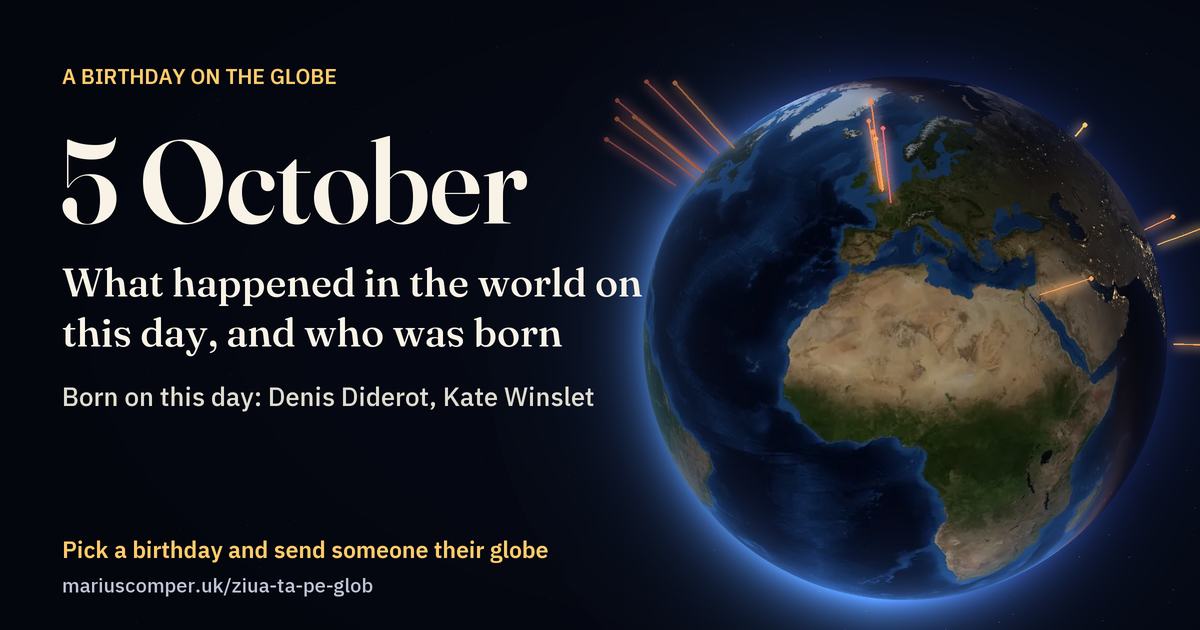
For 5 October, the English Wikipedia lists 53 events and 254 births. 18 of the events stand at their places as rays of light; four more are dashed circles, where the sentence links only to a country or a sea. The taller the ray, the longer ago it happened. The people born that day come further down, as blue points.
A birthday, yours or someone else’s:
Turn it into a greetingScroll: the globe turns to each place
The day you were born, on the globe.
Three things from your day
Scroll: your day first, then 5 October through the years
The Earth on 5 October
The picture on the globe was assembled by NASA from satellite photographs taken in October 2004: the snow, the ice and the green are those of the month.
On 5 October the Sun passes straight overhead at noon along the parallel of 4.7° south. In London, the day lasts about 11 hours 25 minutes.
Beyond 85° south the Sun no longer sets; beyond 85° north it no longer rises.
The line between day and night is tilted on the globe exactly as on this day of the year. On the dark side you can see the lights of towns.
Asia · Polytechnic University of the Philippines
1978
Brother Eddie Villanueva and 15 others from the Polytechnic University of the Philippines begin the Jesus Is Lord Church.
On the map: Polytechnic University of the Philippines.
Oceania · Melbourne
1990
After 150 years The Herald newspaper in Melbourne, Australia, is published for the last time as a separate newspaper.
On the map: Melbourne.
North America · Wright Flyer III
1905
The Wright brothers pilot the Wright Flyer III in a new world record flight of 24 miles in 39 minutes.
On the map: Wright Flyer III.
North America · Enrico Fermi Nuclear Generating Station
1966
A reactor at the Enrico Fermi Nuclear Generating Station near Detroit suffers a partial meltdown.
On the map: Enrico Fermi Nuclear Generating Station.
5 October
Born on 5 October#
The English Wikipedia lists 254 births for this day. The blue points are the birthplaces of 60 of these people: those written about in the most Wikipedia editions, where Wikidata gives a place of birth.
Born on 5 October
1713
Denis Diderot, French philosopher and critic (died 1784)
Place of birth: Langres.
Born on 5 October
1882
Robert H. Goddard, American physicist, engineer, and academic (died 1945)
Place of birth: Worcester.
Born on 5 October
1958
Neil deGrasse Tyson, American astrophysicist, cosmologist, and author
Place of birth: Manhattan.
Born on 5 October
1919
Donald Pleasence, English actor (died 1995)
Place of birth: Worksop.
Born in Britain and Ireland
1967
Guy Pearce, English-Australian actor
Place of birth: Ely.
Born in Britain and Ireland
1951
Bob Geldof, Irish singer-songwriter and actor
Place of birth: Dún Laoghaire.
Born in Britain and Ireland
1952
Clive Barker, English author, director, producer, and screenwriter
Place of birth: Liverpool.
5 October
Number one in the charts that week
At the cinema
An animal recorded that day
The record can be seen in GBIF, which brings together wildlife records from around the world.
All your birthdays
The weather that day
Data: Met Office Hadley Centre (HadCET); NOAA (GHCN-Daily, Mauna Loa).
Above the Earth
Sources: Jonathan McDowell, GCAT (launches); GFZ Potsdam (Kp index). Days are counted in Universal Time.
Football that day
International matches played that day:
Source: the “International football results” dataset kept by Mart Jürisoo (CC0).
Also that day
The earthquake’s page at the USGS
Source: the USGS catalogue. The day is counted in Universal Time (UTC).
In those days
Make a link for someone
Type the name, pick the day and the year of birth. The link opens straight on their day, with their name in the greeting.
The link carries the name, date and place typed here; anyone who gets it can see them.
Put another birthday beside it
Your mother’s, your child’s, a friend’s: the two days appear side by side.
Below: 5 October through the years.
The whole globe of the day
Drag the globe to turn it. Touch a ray or a point to read what happened there.
Everything Wikipedia lists for 5 October
The list is the English Wikipedia’s, in its own wording, as it stood in October 2026. 31 events have no place on the map: the sentence links to no place with coordinates, only to places too wide to mark, or to several countries.
- 610
Heraclius arrives at Constantinople, kills Byzantine Emperor Phocas, and becomes emperor.
no place on the mapWikipedia: Heraclius - 816
King Louis the Pious is crowned emperor of the Holy Roman Empire by the Pope.
no place on the mapWikipedia: Louis the Pious - 869
The Fourth Council of Constantinople is convened to depose patriarch Photios I.
no place on the mapWikipedia: Fourth Council of Constantinople - 1143
With the signing of the Treaty of Zamora, King Alfonso VII of León and Castile recognises Portugal as a Kingdom.
no place on the mapWikipedia: Treaty of Zamora - 1450
Louis IX, Duke of Bavaria expels Jews from his jurisdiction.
no place on the mapWikipedia: Louis IX of Bavaria - 1465
King Louis XI of France is forced to sign the treaty of Conflans.
no place on the mapWikipedia: Treaty of Conflans - 1607
Assassins attempt to kill Venetian statesman and scientist Paolo Sarpi.
no place on the mapWikipedia: Paolo Sarpi - 1672
Jan Sobieski, Grand Hetman of the Polish Crown, begins his successful military campaign against the Tartars following their rebellion and an invasion by the Ottoman Empire.
Asia · Ottoman EmpireWikipedia: John III Sobieski - 1789
French Revolution: The Women's March on Versailles effectively terminates royal authority.
Europe · VersaillesWikipedia: Women's March on Versailles - 1813
War of 1812: The Army of the Northwest defeats a British and Native Canadian force threatening Detroit.
North America · Battle of the ThamesWikipedia: Battle of the Thames - 1838
A Cherokee band attacked settlers near Larissa, Texas, killing or abducting 18 people.
North America · Killough massacreWikipedia: Killough massacre - 1869
The Eastman tunnel, in Minnesota, United States, collapses during construction, causing a landslide that nearly destroys St. Anthony Falls.
North America · Eastman tunnelWikipedia: Eastman tunnel - 1869
The Saxby Gale devastates the Bay of Fundy region in Canada.
no place on the mapWikipedia: 1869 Saxby Gale - 1877
The Nez Perce War in the northwestern United States comes to an end.
no place on the mapWikipedia: Nez Perce War - 1900
Peace congress in Paris condemns British policy in South Africa and asserts Boer Republic's right to self-determination.
Africa · South African RepublicWikipedia: South African Republic - 1903
Samuel Griffith became the first Chief Justice of Australia, while Edmund Barton and Richard O'Connor became the first Puisne Justices of the High Court of Australia.
no place on the mapWikipedia: High Court of Australia - 1905
The Wright brothers pilot the Wright Flyer III in a new world record flight of 24 miles in 39 minutes.
North America · Wright Flyer IIIWikipedia: Wright brothers - 1910
In a revolution in Portugal the monarchy is overthrown and a republic is declared.
Europe · PortugalWikipedia: 5 October 1910 revolution - 1911
The Kowloon–Canton Railway commences service.
no place on the mapWikipedia: Kowloon–Canton Railway - 1914
World War I: An aircraft successfully destroys another aircraft with gunfire for the first time.
no place on the mapWikipedia: World War I - 1921
The World Series is broadcast on radio for the first time.
no place on the mapWikipedia: 1921 World Series - 1930
British airship R101 crashes in France en route to India on its maiden voyage killing 48 people.
no place on the mapWikipedia: R101 - 1931
Clyde Edward Pangborn and Hugh Herndon, Jr. make the first nonstop flight across the Pacific Ocean in the plane Miss Veedol.
no place on the mapWikipedia: Clyde Pangborn - 1936
The Jarrow March sets off for London.
Britain & Ireland · Jarrow MarchWikipedia: Jarrow March - 1937
Six days after retiring from the Queen's College, Oxford, Robert Howard Hodgkin was elected its provost due to the sudden death of B. H. Streeter.
Britain & Ireland · The Queen's College, OxfordWikipedia: The Queen's College, Oxford - 1938
Holocaust: In Nazi Germany, Jews' passports are invalidated.
no place on the mapWikipedia: The Holocaust - 1943
World War II: Pacific Theater: Ninety-eight American POWs are executed by Japanese forces on Wake Island.
Oceans · Wake IslandWikipedia: World War II - 1944
The Provisional Government of the French Republic enfranchises women.
Europe · Provisional Government of the French RepublicWikipedia: Provisional Government of the French Republic - 1945
A six-month strike by Hollywood set decorators turns into a bloody riot at the gates of the Warner Brothers studio.
no place on the mapWikipedia: Hollywood Black Friday - 1947
President Truman makes the first televised Oval Office address.
no place on the mapWikipedia: United States Oval Office Address - 1962
The first Beatles single "Love Me Do" is released in Britain.
no place on the mapWikipedia: The Beatles - 1962
The first of the James Bond film series, based on the novels by Ian Fleming, Dr. No, is released in Britain.
no place on the mapWikipedia: James Bond - 1963
The United States suspends the Commercial Import Program in response to repression of the Buddhist majority by the regime of President Ngo Dinh Diem.
no place on the mapWikipedia: Buddhist crisis - 1966
A reactor at the Enrico Fermi Nuclear Generating Station near Detroit suffers a partial meltdown.
North America · Enrico Fermi Nuclear Generating StationWikipedia: Enrico Fermi Nuclear Generating Station - 1968
A Northern Ireland Civil Rights Association march in Derry is violently suppressed by police.
no place on the mapWikipedia: Northern Ireland Civil Rights Association - 1970
The British Trade Commissioner, James Cross, is kidnapped by members of the Front de libération du Québec, triggering the October Crisis in Canada.
North America · October CrisisWikipedia: October Crisis - 1970
The Public Broadcasting Service (PBS) is founded in the United States.
no place on the mapWikipedia: PBS - 1974
Bombs planted by the PIRA in pubs in Guildford kill four British soldiers and one civilian.
Britain & Ireland · Guildford pub bombingsWikipedia: Guildford pub bombings - 1978
Brother Eddie Villanueva and 15 others from the Polytechnic University of the Philippines begin the Jesus Is Lord Church.
Asia · Polytechnic University of the PhilippinesWikipedia: Eddie Villanueva - 1982
Tylenol products are recalled after bottles in Chicago laced with cyanide cause seven deaths.
no place on the mapWikipedia: Chicago Tylenol murders - 1984
Marc Garneau becomes the first Canadian in space.
no place on the mapWikipedia: Marc Garneau - 1985
Seven Israeli vacationers, including four children, are killed in a mass shooting at Ras Burqa in the Sinai Peninsula by an Egyptian soldier.
Africa · Ras Burqa massacreWikipedia: Ras Burqa massacre - 1986
Eugene Hasenfus's plane was shot down by Nicaraguan forces while carrying weapons to the Contra rebels on behalf of the U.S. government; he was subsequently captured, leading to an international controversy.
no place on the mapWikipedia: Corporate Air Services HPF821 - 1988
A Chilean opposition coalition defeats Augusto Pinochet in his re-election attempt.
no place on the mapWikipedia: 1988 Chilean presidential referendum - 1988
During the United States vice-presidential debate, Democratic candidate Lloyd Bentsen told his opponent Dan Quayle, "Senator, you're no Jack Kennedy."
no place on the mapWikipedia: Lloyd Bentsen - 1990
After 150 years The Herald newspaper in Melbourne, Australia, is published for the last time as a separate newspaper.
Oceania · MelbourneWikipedia: The Herald - 1991
An Indonesian Air Force C-130 crash kills 135 people.
Asia · 1991 Jakarta Indonesian Air Force C-130 crashWikipedia: 1991 Jakarta Indonesian Air Force C-130 crash - 1994
Swiss police find the bodies of 48 members of the Order of the Solar Temple, who had died in a cult mass murder-suicide.
no place on the mapWikipedia: 1994 Solar Temple massacres - 1999
The Ladbroke Grove rail crash in West London kills 31 people.
Britain & Ireland · West LondonWikipedia: Ladbroke Grove rail crash - 2000
Mass demonstrations in Serbia force the resignation of Slobodan Milošević.
no place on the mapWikipedia: Overthrow of Slobodan Milošević - 2011
In the Mekong River massacre, two Chinese cargo boats are hijacked and 13 crew members murdered.
Asia · Mekong River massacreWikipedia: Mekong River massacre - 2014
Formula One racing driver Jules Bianchi crashed at the Japanese Grand Prix, sustaining fatal head injuries that would kill him the following year.
Asia · 2014 Japanese Grand PrixWikipedia: 2014 Japanese Grand Prix - 2021
Windows 11 is released to the general public.
no place on the mapWikipedia: Windows 11
Who was born on 5 October
In order of how many Wikipedia editions have an article about each. The first 60 of 254 are shown.
- 1713
Denis Diderot, French philosopher and critic (died 1784)
LangresWikipedia: Denis Diderot - 1936
Václav Havel, Czech poet, playwright, and politician, 1st President of the Czech Republic (died 2011)
PragueWikipedia: Václav Havel - 1975
Kate Winslet, English actress
ReadingWikipedia: Kate Winslet - 1829
Chester A. Arthur, American general, lawyer, and politician, 21st President of the United States (died 1886)
FairfieldWikipedia: Chester A. Arthur - 1952
Imran Khan, Pakistani cricketer and politician, 22nd Prime Minister of Pakistan
LahoreWikipedia: Imran Khan - 1976
Ramzan Kadyrov, Russian-Chechen general and politician, 3rd President of the Chechen Republic
Akhmat-YurtWikipedia: Ramzan Kadyrov - 1882
Robert H. Goddard, American physicist, engineer, and academic (died 1945)
WorcesterWikipedia: Robert H. Goddard - 1958
Neil deGrasse Tyson, American astrophysicist, cosmologist, and author
ManhattanWikipedia: Neil deGrasse Tyson - 1919
Donald Pleasence, English actor (died 1995)
WorksopWikipedia: Donald Pleasence - 1983
Jesse Eisenberg, American actor and writer
- 1781
Bernard Bolzano, Czech mathematician and philosopher (died 1848)
- 1957
Bernie Mac, American actor, comedian, producer, and screenwriter (died 2008)
ChicagoWikipedia: Bernie Mac - 1967
Guy Pearce, English-Australian actor
- 1923
Glynis Johns, British actress and singer (died 2024)
PretoriaWikipedia: Glynis Johns - 1930
Reinhard Selten, German economist and mathematician, Nobel Prize laureate (died 2016)
WrocławWikipedia: Reinhard Selten - 1960
Careca, Brazilian footballer
AraraquaraWikipedia: Careca - 1902
Ray Kroc, American businessman and philanthropist (died 1984)
Oak ParkWikipedia: Ray Kroc - 1887
René Cassin, French judge and academic, Nobel Prize laureate (died 1976)
BayonneWikipedia: René Cassin - 1951
Bob Geldof, Irish singer-songwriter and actor
Dún LaoghaireWikipedia: Bob Geldof - 1965
Mario Lemieux, Canadian ice hockey player
MontrealWikipedia: Mario Lemieux - 1952
Clive Barker, English author, director, producer, and screenwriter
LiverpoolWikipedia: Clive Barker - 1977
Konstantin Zyryanov, Russian footballer
- 1941
Eduardo Duhalde, Argentinian lawyer and politician, 50th President of Argentina
Lomas de ZamoraWikipedia: Eduardo Duhalde - 1992
Kevin Magnussen, Danish racing driver
RoskildeWikipedia: Kevin Magnussen - 1879
Francis Peyton Rous, American pathologist and virologist, Nobel Prize laureate (died 1970)
BaltimoreWikipedia: Francis Peyton Rous - 1998
Exequiel Palacios, Argentine footballer
FamailláWikipedia: Exequiel Palacios - 1947
Brian Johnson, English singer and songwriter
DunstonWikipedia: Brian Johnson - 1951
Karen Allen, American actress
CarrolltonWikipedia: Karen Allen - 1987
Kevin Mirallas, Belgian footballer
- 1658
Mary of Modena, Queen Consort of England, Scotland and Ireland (died 1718)
Ducal Palace of ModenaWikipedia: Mary of Modena - 1949
Peter Ackroyd, English biographer, novelist and critic
LondonWikipedia: Peter Ackroyd - 1703
Jonathan Edwards, American pastor and theologian (died 1758)
East WindsorWikipedia: Jonathan Edwards - 1930
Pavel Popovich, Ukrainian general, pilot, and cosmonaut (died 2009)
- 1712
Francesco Guardi, Italian painter (died 1793)
- 1973
Cédric Villani, French mathematician and academic
Brive-la-GaillardeWikipedia: Cédric Villani - 1929
Richard F. Gordon Jr., American captain, pilot, and astronaut (died 2017)
- 1917
Magda Szabó, Hungarian author and poet (died 2007)
DebrecenWikipedia: Magda Szabó - 2006
Jacob Tremblay, Canadian actor
VancouverWikipedia: Jacob Tremblay - 1971
Mauricio Pellegrino, Argentinian footballer and manager
- 1274
Al-Dhahabi, Syrian scholar and historian (died 1348)
Kafr BatnaWikipedia: Al-Dhahabi - 1841
Philipp Mainländer, German philosopher (died 1876)
Offenbach am MainWikipedia: Philipp Mainländer - 1972
Grant Hill, American basketball player and actor
DallasWikipedia: Grant Hill - 1987
Tim Ream, American soccer player
St. LouisWikipedia: Tim Ream - 1878
Louise Dresser, American actress (died 1965)
EvansvilleWikipedia: Louise Dresser - 1922
Jock Stein, Scottish footballer and manager (died 1985)
HamiltonWikipedia: Jock Stein - 1983
Nicky Hilton, American socialite, fashion designer, and model
New York CityWikipedia: Nicky Hilton - 1922
José Froilán González, Argentinian racing driver (died 2013)
ArrecifesWikipedia: José Froilán González - 1960
Daniel Baldwin, American actor, director, and producer
MassapequaWikipedia: Daniel Baldwin - 1975
Parminder Nagra, English actress
LeicesterWikipedia: Parminder Nagra - 1979
Vince Grella, Australian footballer
City of Greater DandenongWikipedia: Vince Grella - 1984
Kenwyne Jones, Trinidadian footballer
Point FortinWikipedia: Kenwyne Jones - 1989
Travis Kelce, American football player
WestlakeWikipedia: Travis Kelce - 1377
Louis II of Anjou (died 1417)
ToulouseWikipedia: Louis II of Anjou - 1908
Joshua Logan, American director and screenwriter (died 1988)
TexarkanaWikipedia: Joshua Logan - 1943
Ben Cardin, American lawyer and politician
BaltimoreWikipedia: Ben Cardin - 1947
Michèle Pierre-Louis, Haitian politician, 14th Prime Minister of Haiti
- 1950
Jeff Conaway, American actor and singer (died 2011)
ManhattanWikipedia: Jeff Conaway - 1848
Guido von List, Austrian-German journalist and poet (died 1919)
- 1923
Stig Dagerman, Swedish journalist and author (died 1954)
Älvkarleby congregationWikipedia: Stig Dagerman - 1939
A. R. Penck, German painter and sculptor (died 2017)
DresdenWikipedia: A. R. Penck
What is celebrated on 5 October
- World Space Week (October 4–10)
- Armed Forces Day (Indonesia)
- Christian feast day: Anna Schäffer
- Christian feast day: Charitina of Amisus
- Christian feast day: Faustina Kowalska
- Christian feast day: Flora of Beaulieu
- Christian feast day: Bartolo Longo
- Christian feast day: Hor and Susia (Coptic Orthodox Church of Alexandria)
- Christian feast day: Placid and Maurus
- Christian feast day: Placidus (martyr)
- Christian feast day: Blessed William Hartley
- Christian feast day: October 5 (Eastern Orthodox liturgics)
- Constitution Day (Vanuatu)
- Engineer's Day (Bolivia)
A greeting link for someone
Type a name and, if you like, the year of birth. The link opens with a greeting, and beside each event it says how old the person turned that day, or how many years before their birth it happened.
The name and the year go only into the link you send.
All 366 days
How the globe is made
Where the events come from
Each edition of this page uses the day’s list from Wikipedia in its own language: Romanian, English, Spanish, Chinese. The lists are written by volunteers and differ from one edition to the next; the text of each event is Wikipedia’s, with a link to the article. A row that appears twice in a list is shown once. The lists have not been checked event by event: they are Wikipedia’s, mistakes included.
For events before 1582, and for countries that moved to the Gregorian calendar later (Britain in 1752, Russia in 1918), the same day may be counted Old Style in one list and New Style in another.
The chapter “What the other Wikipedias remember” adds up to five events a day from the lists of the other three editions, only for years in which the English list has nothing on that day. They were translated for this page, passed the same filters as the tour, and are not counted among the events of the English list.
How an event gets onto the map
The place comes from Wikidata. If the sentence links to the article about the event itself (a battle, an opening, an earthquake), dated to the same year, the ray stands on its coordinates or on those of its location. Otherwise it stands on the first place the sentence links to: a town, a building, a mountain, an island. This second step can be wrong: sometimes the sentence only mentions the place. That is why the page says, under each event, which place the ray stands on.
When the sentence links to a single state or province, or to a single sea, lake or desert larger than 5,000 km², the globe shows a dashed circle, not a ray. The circle has the area Wikidata gives, with its radius kept between 1.2° and 16°, or a radius of 4.5° when Wikidata gives no area; it says only that the sentence links to that place. Organisations, ships, spacecraft, museum objects, rivers, mountain ranges, languages and continents are never used as places. When a sentence names several states and no exact place, the event stays in the list only.
What the height means
The height of a ray shows how many years have passed, on a logarithmic scale: 10 years, 100 years and 1,000 years are equal steps apart; anything older than about 2,600 years has the tallest ray. The colour runs from pale yellow for recent years to violet for antiquity.
Where the tour stops
In each region the tour stops at up to three events (five in Britain and Ireland), chosen mainly by three things: whether Wikipedia’s editors put the event in the “On this day” box of their main page (the English, Spanish and Chinese editions), how many Wikipedia editions have an article about it, and how many of the four lists include it. Events whose sentence or article is about a war, an attack, a crime or a disaster are left out of the tour; they stay in the whole list, in Wikipedia’s wording. The filter is a list of words and a list of Wikidata types, so it can miss some.
The tour of births names the people with articles in the most editions and leaves aside those whom the list or Wikidata describes as rulers, politicians, commanders, leaders of movements or criminals; they stay in the list.
The Earth and the Sun
The daytime images are NASA’s Blue Marble Next Generation mosaics, one for each month of 2004; the night side is Black Marble 2016. The tilt of the line between day and night is computed for the day; the hour is chosen so that the place being read is in daylight. The latitude where the Sun stands overhead is the average of the four years of the leap cycle; in a given year it can differ by up to 0.4°.
The day you were born
The number ones come from the weekly lists on Wikipedia: Billboard for the United States (from 1940; the Hot 100 from August 1958), the UK Singles Chart (from November 1952), Los 40 Principales for Spain (from July 1966) and, for Romania, the Romanian Top 100 and Airplay 100 (2001–2021, with missing weeks). The page shows the chart of the week in which the day of birth falls, with its date; Billboard and the UK chart are dated at the end of their week. For Romania before 2001 and for China these sources have no weekly chart.
The films are those that reached cinemas in the United States up to ten days before or three days after that day (some of them in a few cinemas at first), from the English Wikipedia’s yearly lists (from 1968), in order of how many editions have an article about them. The events “in those days” are the ones on the neighbouring days’ lists that carry the year of birth, passed through the same filter as the tour.
The day of birth, year included
The Moon, the star sign and the constellation are worked out by the page itself, for noon Universal Time on the day. The lit part of the Moon is rounded and can differ by a few per cent from that at the hour of birth. The sign follows the usual zodiac of twelve equal parts starting at the March equinox; the constellation is the one the Sun actually stood in front of, by the borders set by the International Astronomical Union, and within a day of a border the page does not name it. When the Sun changes sign while it is that day anywhere on Earth, the page gives the moment of crossing, rounded to ten minutes and accurate to within about a quarter of an hour, and the clock time in a few cities, with the time zone and summer time of that year.
The year in the Chinese calendar is the one your device’s own calendar gives for the date, checked against the Hong Kong Observatory’s tables. “All your birthdays” uses the same sources as the rest of the chapter for the same day in every year since the birth: the temperature, well-known launches that took place on that very day, matches of the teams the edition follows, snow deeper than 10 cm and strong geomagnetic storms. The three things at the top and the four on the picture are chosen in a fixed order (the song, the animal, a full Moon, a well-known launch before an ordinary earthquake); on the picture you can change them.
When the link carries a year of birth, the page adds a few things about that exact day. The weather is the Met Office’s Central England temperature record and the readings from New York’s Central Park; the “usual high” is the average of the daily highs of 1961–1990 for that date, with two days either side. The carbon dioxide figure is the monthly mean at the Mauna Loa observatory, where measurements begin in March 1958.
The earthquake is the one with the largest magnitude in the USGS catalogue for that day, counted in Universal Time. Before the 1960s the catalogue has gaps even above magnitude 5.5, so in the older years many days have no earthquake. The page gives only the magnitude and the place: the country the epicentre falls in or, when the epicentre is at sea within 300 km of a coast, the nearest country; farther out, only the ocean.
The launches are those that reached orbit or left for the Moon and the planets, from Jonathan McDowell’s GCAT catalogue. If nothing left that day, the page shows the nearest launch within three days before or after, and says how many days away it was. The geomagnetic storm appears only when the Kp index reached at least 5 in one of the day’s eight three-hour intervals.
The animal comes from GBIF: an observation made by a person (the animal seen or heard, or its tracks), dated to that exact day, with coordinates and a CC0 or CC BY licence. Only a few hundred well-known species are searched (mammals, birds, turtles, butterflies); of those noted that day, mammals and species with articles in many Wikipedia editions come first; birds noted almost every day, and species used recently, wait their turn. Observations dated 1 January are left out, because records without a day are often filed there. An observation shows that the animal was recorded there, not how many animals there were.
The matches are those between national teams. Only matches of England, Scotland, Wales, Northern Ireland, the Republic of Ireland, the United States, Canada and Australia are shown, along with those at the big final tournaments. The picture to send is drawn in the page from the day’s globe and the facts above, and stays on your device until you send it.
Sources
- Events, births and holidays: the day’s page on Wikipedia, text under CC BY-SA 4.0.
- Coordinates, places of birth and the number of editions: Wikidata (CC0).
- The Earth by day: NASA Blue Marble Next Generation. The Earth by night: NASA Black Marble 2016.
- Borders and regions: Natural Earth.
- World population and births per year: UN World Population Prospects 2024.
- Charts and films: Wikipedia’s lists for Billboard, the UK Singles Chart, Los 40 Principales, Romanian Top 100, Airplay 100 and American films by year (CC BY-SA 4.0).
- Weather: Met Office Hadley Centre, HadCET (Open Government Licence) and NOAA GHCN-Daily, New York Central Park. Carbon dioxide: NOAA Global Monitoring Laboratory, Mauna Loa.
- Earthquakes: the USGS catalogue. Launches: Jonathan McDowell, GCAT (CC BY). Kp index: GFZ Potsdam (CC BY 4.0). Matches: International football results, Mart Jürisoo (CC0).
- Animal observations: GBIF, with a link to each record; species names come from Wikidata.