A birthday on the globe
3 September on the globe: what happened in the world on this day, and who was born
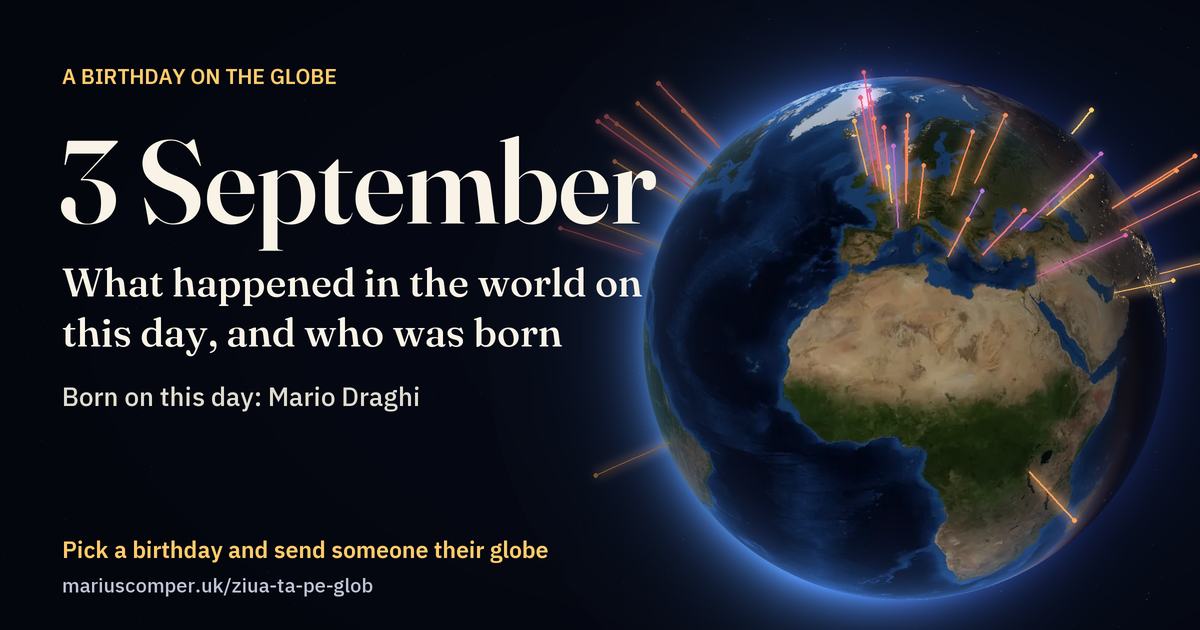
For 3 September, the English Wikipedia lists 60 events and 236 births. 39 of the events stand at their places as rays of light; four more are dashed circles, where the sentence links only to a country or a sea. The taller the ray, the longer ago it happened. The people born that day come further down, as blue points.
A birthday, yours or someone else’s:
Turn it into a greetingScroll: the globe turns to each place
The day you were born, on the globe.
Three things from your day
Scroll: your day first, then 3 September through the years
The Earth on 3 September
The picture on the globe was assembled by NASA from satellite photographs taken in September 2004: the snow, the ice and the green are those of the month.
On 3 September the Sun passes straight overhead at noon along the parallel of 7.5° north. In London, the day lasts about 13 hours 30 minutes.
Beyond 82° north the Sun no longer sets; beyond 82° south it no longer rises.
The line between day and night is tilted on the globe exactly as on this day of the year. On the dark side you can see the lights of towns.
Britain & Ireland · Westminster Abbey
1189
Richard I of England (a.k.a. Richard "the Lionheart") is crowned at Westminster.
On the map: Westminster Abbey.
Also on the day’s list of Wikipedia in Spanish and Romanian.
Europe · 1950 Italian Grand Prix
1950
"Nino" Farina becomes the first Formula One Drivers' champion after winning the 1950 Italian Grand Prix.
On the map: the coordinates Wikidata gives for the article “1950 Italian Grand Prix”.
Europe · Paris Agreement
2016
The U.S. and China, together responsible for 40% of the world's carbon emissions, both formally ratify the Paris global climate agreement.
On the map: Paris Agreement.
Also on the day’s list of Wikipedia in Romanian.
Asia · Ismoil Somoni Peak
1933
Yevgeniy Abalakov is the first man to reach the highest point in the Soviet Union, Communism Peak (now called Ismoil Somoni Peak and situated in Tajikistan) (7495 m).
On the map: Ismoil Somoni Peak.
Oceania · Royal Exhibition Building
1901
At the Royal Exhibition Building in Melbourne, the flag of Australia flew for the first time.
On the map: Royal Exhibition Building.
Also on the day’s list of Wikipedia in Chinese.
North America · Parliament Hill
1936
The Guild of Carillonneurs in North America was founded in Parliament Hill, Ottawa, Canada.
On the map: Parliament Hill.
3 September
What the other Wikipedias remember#
For these years the English list has nothing on this day. The events below come from the same day’s lists on Wikipedia in Spanish and were translated for this page.
From Wikipedia in Spanish · Paris
1938
At a congress of delegates held in Paris, the Fourth International is founded and the Transitional Programme drawn up by Leon Trotsky is approved.
On the map: Paris.
Translated from the list on Wikipedia in Spanish.
From Wikipedia in Spanish · European Convention on Human Rights
1953
In Europe, the European Convention on Human Rights enters into force.
On the map: European Convention on Human Rights.
Translated from the list on Wikipedia in Spanish.
The article on Wikipedia in Spanish: Convención Europea de Derechos Humanos
From Wikipedia in Spanish · Cape Town
1986
In South Africa, the bishop and 1984 Nobel Peace Prize laureate Desmond Tutu is officially named Anglican Archbishop of Cape Town.
On the map: Cape Town.
Translated from the list on Wikipedia in Spanish.
3 September
Born on 3 September#
The English Wikipedia lists 236 births for this day. The blue points are the birthplaces of 60 of these people: those written about in the most Wikipedia editions, where Wikidata gives a place of birth.
Born on 3 September
1947
Mario Draghi, Italian banker and economist
Place of birth: Rome.
Born on 3 September
1905
Carl David Anderson, American physicist and academic, Nobel Prize laureate (died 1991)
Place of birth: New York City.
Born on 3 September
1965
Charlie Sheen, American actor and producer
Place of birth: New York City.
Born on 3 September
1988
Jérôme Boateng, Ghanaian-German footballer
Place of birth: West Berlin.
Born on 3 September
1940
Eduardo Galeano, Uruguayan journalist and author (died 2015)
Place of birth: Montevideo.
Born in Britain and Ireland
1970
Gareth Southgate, English footballer and manager
Place of birth: Watford.
Born in Britain and Ireland
1814
James Joseph Sylvester, English mathematician and academic (died 1897)
Place of birth: London.
Born in Britain and Ireland
1985
Scott Carson, English footballer
Place of birth: Whitehaven.
3 September
Number one in the charts that week
At the cinema
An animal recorded that day
The record can be seen in GBIF, which brings together wildlife records from around the world.
All your birthdays
The weather that day
Data: Met Office Hadley Centre (HadCET); NOAA (GHCN-Daily, Mauna Loa).
Above the Earth
Sources: Jonathan McDowell, GCAT (launches); GFZ Potsdam (Kp index). Days are counted in Universal Time.
Football that day
International matches played that day:
Source: the “International football results” dataset kept by Mart Jürisoo (CC0).
Also that day
The earthquake’s page at the USGS
Source: the USGS catalogue. The day is counted in Universal Time (UTC).
In those days
Make a link for someone
Type the name, pick the day and the year of birth. The link opens straight on their day, with their name in the greeting.
The link carries the name, date and place typed here; anyone who gets it can see them.
Put another birthday beside it
Your mother’s, your child’s, a friend’s: the two days appear side by side.
Below: 3 September through the years.
The whole globe of the day
Drag the globe to turn it. Touch a ray or a point to read what happened there.
Everything Wikipedia lists for 3 September
The list is the English Wikipedia’s, in its own wording, as it stood in October 2026. 17 events have no place on the map: the sentence links to no place with coordinates, only to places too wide to mark, or to several countries.
- 36 BC
In the Battle of Naulochus, Marcus Vipsanius Agrippa, admiral of Octavian, defeats Sextus Pompey, son of Pompey, thus ending Pompeian resistance to the Second Triumvirate.
Europe · Battle of NaulochusWikipedia: Battle of Naulochus - 301
San Marino, one of the smallest nations in the world and the world's oldest republic still in existence, is founded by Saint Marinus.
Europe · San MarinoWikipedia: San Marino - 590
Consecration of Pope Gregory I (Gregory the Great).
no place on the mapWikipedia: Pope Gregory I - 673
King Wamba of the Visigoths puts down a revolt by Hilderic, governor of Nîmes (France) and rival for the throne.
Europe · NîmesWikipedia: Wamba - 863
Major Byzantine victory under general Petronas at the Battle of Lalakaon against an Arab raid under emir Umar al-Aqta, who is killed in battle.
Asia · PaphlagoniaWikipedia: Battle of Lalakaon - 1189
Richard I of England (a.k.a. Richard "the Lionheart") is crowned at Westminster.
Britain & Ireland · Westminster AbbeyWikipedia: Richard I of England - 1260
The Mamluks defeat the Mongols at the Battle of Ain Jalut in Palestine, marking their first decisive defeat and the point of maximum expansion of the Mongol Empire.
Asia · Battle of Ain JalutWikipedia: Battle of Ain Jalut - 1335
At the congress of Visegrád Charles I of Hungary mediates a reconciliation between two neighboring monarchs, John of Bohemia and Casimir III of Poland.
no place on the mapWikipedia: Charles I of Hungary - 1411
The Treaty of Selymbria is concluded between the Ottoman Empire and the Republic of Venice.
no place on the mapWikipedia: Treaty of Selymbria - 1650
Victory over the royalists in the Battle of Dunbar opens the way to Edinburgh for the New Model Army during the English invasion of Scotland.
Britain & Ireland · Battle of DunbarWikipedia: Battle of Dunbar - 1651
The Battle of Worcester is the last significant action in the Wars of the Three Kingdoms.
Britain & Ireland · Battle of WorcesterWikipedia: Battle of Worcester - 1658
The death of Oliver Cromwell; Richard Cromwell becomes Lord Protector of England.
no place on the mapWikipedia: Oliver Cromwell - 1666
The Royal Exchange burns down in the Great Fire of London.
Britain & Ireland · Royal Exchange, LondonWikipedia: Great Fire of London - 1777
American Revolutionary War: During the Battle of Cooch's Bridge, the Flag of the United States is flown in battle for the first time.
North America · Battle of Cooch's BridgeWikipedia: Battle of Cooch's Bridge - 1783
American Revolutionary War: The war ends with the signing of the Treaty of Paris by the United States and the Kingdom of Great Britain.
Europe · ParisWikipedia: Treaty of Paris - 1798
The week long battle of St. George's Caye begins between Spain and Britain off the coast of Belize.
Latin America · Battle of St. George's CayeWikipedia: Battle of St. George's Caye - 1812
Twenty-four settlers are killed in the Pigeon Roost Massacre in Indiana.
North America · Pigeon Roost State Historic SiteWikipedia: Pigeon Roost State Historic Site - 1838
Future abolitionist Frederick Douglass escapes from slavery.
no place on the mapWikipedia: Abolitionism in the United States - 1843
King Otto of Greece is forced to grant a constitution following an uprising in Athens.
Europe · Old Royal PalaceWikipedia: Greek Constitution of 1844 - 1855
American Indian Wars: In Nebraska, 700 soldiers under United States General William S. Harney avenge the Grattan massacre by attacking a Sioux village and killing 100 men, women and children.
North America · Grattan massacreWikipedia: Grattan massacre - 1861
American Civil War: Confederate General Leonidas Polk invades neutral Kentucky, prompting the state legislature to ask for Union assistance.
no place on the mapWikipedia: American Civil War - 1870
Franco-Prussian War: The Siege of Metz begins, resulting in a decisive Prussian victory on October 23.
Europe · Siege of MetzWikipedia: Siege of Metz - 1878
Over 640 die when the crowded pleasure boat Princess Alice collides with the Bywell Castle in the River Thames.
no place on the mapWikipedia: Sinking of SS Princess Alice - 1879
Siege of the British Residency in Kabul: British envoy Sir Louis Cavagnari and 72 men of the Guides are massacred by Afghan troops while defending the British Residency in Kabul. Their heroism and loyalty became famous and revered throughout the British Empire.
Asia · Siege of the British Residency in KabulWikipedia: Siege of the British Residency in Kabul - 1895
John Brallier becomes the first openly paid professional American football player, when he was paid US$10 by David Berry, to play for the Latrobe Athletic Association in a 12–0 win over the Jeanette Athletic Association.
no place on the mapWikipedia: John Brallier - 1901
At the Royal Exhibition Building in Melbourne, the flag of Australia flew for the first time.
Oceania · Royal Exhibition BuildingWikipedia: Royal Exhibition Building - 1911
A fire that started on Fraser's Million Dollar Pier destroys six to eight square blocks of Ocean Park, California.
North America · Fraser's Million Dollar PierWikipedia: Fraser's Million Dollar Pier - 1914
French composer Albéric Magnard is killed defending his estate against invading German soldiers.
no place on the mapWikipedia: Albéric Magnard - 1914
Wilhelm, Prince of Albania leaves the country after just six months due to opposition to his rule.
no place on the mapWikipedia: Wilhelm, Prince of Albania - 1914
World War I: Start of the Battle of Grand Couronné, a German assault against French positions on high ground near the city of Nancy.
Europe · Battle of Grand CouronnéWikipedia: World War I - 1916
World War I: Leefe Robinson destroys the German airship Schütte-Lanz SL 11 over Cuffley, north of London; this is the first German airship to be shot down on British soil.
Britain & Ireland · CuffleyWikipedia: Leefe Robinson - 1925
USS Shenandoah, the United States' first American-built rigid airship, is destroyed in a squall line over Noble County, Ohio. Fourteen of her 42-man crew perished, including her commander, Zachary Lansdowne.
North America · Noble County, OhioWikipedia: USS Shenandoah - 1933
Yevgeniy Abalakov is the first man to reach the highest point in the Soviet Union, Communism Peak (now called Ismoil Somoni Peak and situated in Tajikistan) (7495 m).
Asia · Ismoil Somoni PeakWikipedia: Yevgeniy Abalakov - 1935
Sir Malcolm Campbell reaches a speed of 304.331 miles per hour on the Bonneville Salt Flats in Utah, becoming the first person to drive an automobile over 300 mph.
North America · UtahWikipedia: Malcolm Campbell - 1936
The Guild of Carillonneurs in North America was founded in Parliament Hill, Ottawa, Canada.
North America · Parliament HillWikipedia: Parliament Hill - 1939
World War II: France, the United Kingdom, New Zealand and Australia declare war on Germany after the invasion of Poland, forming the Allied nations. The Viceroy of India also declares war, but without consulting the provincial legislatures.
no place on the mapWikipedia: World War II - 1939
World War II: The United Kingdom and France begin a naval blockade of Germany that lasts until the end of the war. This also marks the beginning of the Battle of the Atlantic.
no place on the mapWikipedia: Battle of the Atlantic - 1941
The Holocaust: Karl Fritzsch, deputy camp commandant of the Auschwitz concentration camp, experiments with the use of Zyklon B in the gassing of Soviet POWs.
Europe · Auschwitz concentration campWikipedia: The Holocaust - 1941
The mass expulsion of Soviet Germans from the Volga German ASSR began.
Europe · Volga German Autonomous Soviet Socialist RepublicWikipedia: Deportation of Soviet Germans - 1942
World War II: In response to news of its coming liquidation, Dov Lopatyn leads an uprising in the Ghetto of Lakhva (present-day Belarus).
Europe · Łachwa GhettoWikipedia: Łachwa Ghetto - 1943
World War II: British and Canadian troops land on the Italian mainland. On the same day, Walter Bedell Smith and Giuseppe Castellano sign the Armistice of Cassibile, although it is not announced for another five days.
Europe · Reggio CalabriaWikipedia: Operation Baytown - 1944
Holocaust: Diarist Anne Frank and her family are placed on the last transport train from the Westerbork transit camp to the Auschwitz concentration camp, arriving three days later.
Europe · Westerbork transit campWikipedia: Westerbork transit camp - 1945
A three-day celebration begins in China, following the Victory over Japan Day on September 2.
no place on the mapWikipedia: Victory over Japan Day - 1950
"Nino" Farina becomes the first Formula One Drivers' champion after winning the 1950 Italian Grand Prix.
Europe · 1950 Italian Grand PrixWikipedia: 1950 Italian Grand Prix - 1954
The People's Liberation Army begins shelling the Republic of China-controlled islands of Quemoy, starting the First Taiwan Strait Crisis.
Asia · KinmenWikipedia: First Taiwan Strait Crisis - 1967
Dagen H in Sweden: Traffic changes from driving on the left to driving on the right overnight.
no place on the mapWikipedia: Dagen H - 1971
Qatar becomes an independent state.
Asia · QatarWikipedia: Qatar - 1976
Viking program: The American Viking 2 spacecraft lands at Utopia Planitia on Mars.
no place on the mapWikipedia: Viking program - 1978
During the Rhodesian Bush War a group of ZIPRA guerrillas shot down civilian Vickers Viscount aircraft (Air Rhodesia Flight 825) with a Soviet-made SAM Strela-2; of 56 passengers and crew 38 people died in crash, 10 were massacred by the guerrillas at the site.
no place on the mapWikipedia: Air Rhodesia Flight 825 - 1981
The Convention on the Elimination of All Forms of Discrimination Against Women, an international bill of rights for women, is instituted by the United Nations.
- 1987
In a coup d'état in Burundi, President Jean-Baptiste Bagaza is deposed by Major Pierre Buyoya.
Africa · BujumburaWikipedia: 1987 Burundian coup d'état - 1989
Cubana de Aviación Flight 9046 crashes into a residential area of Havana shortly after takeoff from José Martí International Airport, killing 150.
Latin America · Cubana de Aviación Flight 9046Wikipedia: Cubana de Aviación Flight 9046 - 1989
Varig Flight 254 crashes in the Amazon rainforest near São José do Xingu in Brazil, killing 12.
Latin America · Varig Flight 254Wikipedia: Varig Flight 254 - 1991
A fire killed 25 people locked inside a burning chicken processing plant in Hamlet, North Carolina, U.S.
North America · Hamlet chicken processing plant fireWikipedia: Hamlet chicken processing plant fire - 1997
Vietnam Airlines Flight 815 (Tupolev Tu-134) crashes on approach into Phnom Penh airport, killing 64.
Asia · Vietnam Airlines Flight 815Wikipedia: Vietnam Airlines Flight 815 - 2001
In Belfast, Protestant loyalists begin a picket of Holy Cross, a Catholic primary school for girls.
Britain & Ireland · BelfastWikipedia: Belfast - 2004
Beslan school siege ends, resulting in over 330 fatalities, including 186 children.
Europe · Beslan school siegeWikipedia: Beslan school siege - 2010
After taking off from Dubai International Airport, UPS Airlines Flight 6 develops an in-flight fire in the cargo hold and crashes near Nad Al Sheba, killing both crew members on board.
Asia · UPS Airlines Flight 6Wikipedia: UPS Airlines Flight 6 - 2016
The U.S. and China, together responsible for 40% of the world's carbon emissions, both formally ratify the Paris global climate agreement.
Europe · Paris AgreementWikipedia: Paris Agreement - 2017
North Korea conducts its sixth and most powerful nuclear test.
Asia · 2017 North Korean nuclear testWikipedia: 2017 North Korean nuclear test
What the other Wikipedias remember
For these years the English list has nothing on this day. The events below come from the same day’s lists on Wikipedia in Spanish and were translated for this page.
- 1938
At a congress of delegates held in Paris, the Fourth International is founded and the Transitional Programme drawn up by Leon Trotsky is approved.
- 1953
In Europe, the European Convention on Human Rights enters into force.
Europe · European Convention on Human RightsTranslated from the list on Wikipedia in SpanishWikipedia: Convención Europea de Derechos Humanos - 1986
In South Africa, the bishop and 1984 Nobel Peace Prize laureate Desmond Tutu is officially named Anglican Archbishop of Cape Town.
Who was born on 3 September
In order of how many Wikipedia editions have an article about each. The first 60 of 236 are shown.
- 1947
Mario Draghi, Italian banker and economist
- 1936
Zine El Abidine Ben Ali, Tunisian soldier and politician, 2nd President of Tunisia (died 2019)
Hammam SousseWikipedia: Zine El Abidine Ben Ali - 1905
Carl David Anderson, American physicist and academic, Nobel Prize laureate (died 1991)
New York CityWikipedia: Carl David Anderson - 1965
Charlie Sheen, American actor and producer
New York CityWikipedia: Charlie Sheen - 1988
Jérôme Boateng, Ghanaian-German footballer
West BerlinWikipedia: Jérôme Boateng - 1900
Urho Kekkonen, Finnish journalist, lawyer, and politician, 8th President of Finland (died 1986)
Lepikon torppaWikipedia: Urho Kekkonen - 1940
Eduardo Galeano, Uruguayan journalist and author (died 2015)
MontevideoWikipedia: Eduardo Galeano - 1938
Ryōji Noyori, Japanese chemist and academic, Nobel Prize laureate
AshiyaWikipedia: Ryōji Noyori - 1869
Fritz Pregl, Slovenian chemist and physician, Nobel Prize laureate (died 1930)
LjubljanaWikipedia: Fritz Pregl - 1875
Ferdinand Porsche, Austrian-German engineer and businessman, founded Porsche (died 1951)
LiberecWikipedia: Ferdinand Porsche - 1899
Frank Macfarlane Burnet, Australian virologist and academic, Nobel Prize laureate (died 1985)
TraralgonWikipedia: Macfarlane Burnet - 1979
Júlio César, Brazilian footballer
Duque de CaxiasWikipedia: Júlio César - 1971
Kiran Desai, Indian-American author
New DelhiWikipedia: Kiran Desai - 1856
Louis Sullivan, American architect and educator, designed the Carson, Pirie, Scott and Company Building (died 1924)
- 1953
Jean-Pierre Jeunet, French director, producer, and screenwriter
Le CoteauWikipedia: Jean-Pierre Jeunet - 1957
Sadhguru, Indian yogi, mystic
MysoreWikipedia: Sadhguru - 1970
Gareth Southgate, English footballer and manager
WatfordWikipedia: Gareth Southgate - 1926
Irene Papas, Greek actress (died 2022)
- 1995
Niklas Süle, German footballer
FrankfurtWikipedia: Niklas Süle - 1941
Sergei Dovlatov, Russian-American journalist and author (died 1990)
- 1814
James Joseph Sylvester, English mathematician and academic (died 1897)
- 1948
Levy Mwanawasa, Zambian lawyer and politician, 3rd President of Zambia (died 2008)
MufuliraWikipedia: Levy Mwanawasa - 1975
Redfoo, American singer-songwriter, producer, and dancer
Los AngelesWikipedia: Redfoo - 1977
Olof Mellberg, Swedish footballer
GullspångWikipedia: Olof Mellberg - 1781
Eugène de Beauharnais, French general and politician (died 1824)
- 1947
Kjell Magne Bondevik, Norwegian minister and politician, 26th Prime Minister of Norway
Molde MunicipalityWikipedia: Kjell Magne Bondevik - 1851
Olga Constantinovna of Russia, Queen consort of the Hellenes (died 1926)
- 1913
Alan Ladd, American actor and producer (died 1964)
Hot SpringsWikipedia: Alan Ladd - 1993
Dominic Thiem, Austrian tennis player
Wiener NeustadtWikipedia: Dominic Thiem - 1984
Garrett Hedlund, American actor
- 1985
Scott Carson, English footballer
WhitehavenWikipedia: Scott Carson - 1928
Gaston Thorn, Luxembourg lawyer and politician, 8th Prime Minister of Luxembourg (died 2007)
LuxembourgWikipedia: Gaston Thorn - 1947
Gérard Houllier, French footballer and coach (died 2020)
ThérouanneWikipedia: Gérard Houllier - 1963
Malcolm Gladwell, Canadian journalist, essayist, and critic
FarehamWikipedia: Malcolm Gladwell - 2003
Jack Dylan Grazer, American actor
Los AngelesWikipedia: Jack Dylan Grazer - 1992
Sakshi Malik, Indian wrestler
RohtakWikipedia: Sakshi Malik - 1996
Yoane Wissa, French-Congolese footballer
Épinay-sous-SénartWikipedia: Yoane Wissa - 1908
Lev Pontryagin, Russian mathematician and academic (died 1988)
- 1969
Noah Baumbach, American actor, director, producer, and screenwriter
BrooklynWikipedia: Noah Baumbach - 2001
Kaia Gerber, American model and actress
Los AngelesWikipedia: Kaia Gerber - 1932
Eileen Brennan, American actress and singer (died 2013)
Los AngelesWikipedia: Eileen Brennan - 1949
José Pékerman, Argentine footballer, coach, and manager
Villa DomínguezWikipedia: José Pékerman - 1695
Pietro Antonio Locatelli, Italian violin player and composer (died 1764)
BergamoWikipedia: Pietro Locatelli - 1943
Valerie Perrine, American model and actress (died 2026)
GalvestonWikipedia: Valerie Perrine - 1957
Steve Schirripa, American actor and producer
BensonhurstWikipedia: Steve Schirripa - 1971
Paolo Montero, Uruguayan footballer and manager
MontevideoWikipedia: Paolo Montero - 1940
Pauline Collins, English actress (died 2025)
ExmouthWikipedia: Pauline Collins - 1986
Shaun White, American snowboarder, skateboarder, and guitarist
San DiegoWikipedia: Shaun White - 1934
Freddie King, American singer-songwriter and guitarist (died 1976)
GilmerWikipedia: Freddie King - 1910
Maurice Papon, French civil servant and convicted war criminal (died 2007)
Gretz-ArmainvilliersWikipedia: Maurice Papon - 1979
Tomo Miličević, Bosnian-American guitarist
SarajevoWikipedia: Tomo Miličević - 1878
Dorothea Douglass Lambert Chambers, English tennis player (died 1960)
- 1952
Shakti Kapoor, Indian actor
- 1965
Costas Mandylor, Australian actor
MelbourneWikipedia: Costas Mandylor - 1996
Joy, South Korean idol and actress
Jeju IslandWikipedia: Joy - 1034
Emperor Go-Sanjō of Japan (died 1073)
Heian-kyōWikipedia: Emperor Go-Sanjō - 1910
Kitty Carlisle, American actress, singer, socialite, and game show panelist (died 2007)
New OrleansWikipedia: Kitty Carlisle - 1929
Whitey Bulger, American organized crime boss (died 2018)
- 1955
Steve Jones, English singer-songwriter and guitarist
Shepherd's BushWikipedia: Steve Jones - 2000
Brandon Williams, English footballer
ManchesterWikipedia: Brandon Williams
What is celebrated on 3 September
- Christian feast day: Blessed Bartholomew Gutierrez
- Christian feast day: Blessed Brigida Morello Zancano
- Christian feast day: Mansuetus of Toul
- Christian feast day: Marinus
- Christian feast day: Phoebe
- Christian feast day: Pope Gregory I
- Christian feast day: Remaclus
- Christian feast day: Prudence Crandall (Episcopal Church (USA))
- Christian feast day: September 3 (Eastern Orthodox liturgics)
- China's victory over Japan commemoration related observances: Armed Forces Day (Republic of China)
- China's victory over Japan commemoration related observances: V-J Day (People's Republic of China)
- Feast of San Marino and the Republic, celebrates the foundation of the Republic of San Marino in 301.
- Flag Day (Australia)
- Independence Day, celebrates the second independence of Qatar from the United Kingdom in 1971.
A greeting link for someone
Type a name and, if you like, the year of birth. The link opens with a greeting, and beside each event it says how old the person turned that day, or how many years before their birth it happened.
The name and the year go only into the link you send.
All 366 days
How the globe is made
Where the events come from
Each edition of this page uses the day’s list from Wikipedia in its own language: Romanian, English, Spanish, Chinese. The lists are written by volunteers and differ from one edition to the next; the text of each event is Wikipedia’s, with a link to the article. A row that appears twice in a list is shown once. The lists have not been checked event by event: they are Wikipedia’s, mistakes included.
For events before 1582, and for countries that moved to the Gregorian calendar later (Britain in 1752, Russia in 1918), the same day may be counted Old Style in one list and New Style in another.
The chapter “What the other Wikipedias remember” adds up to five events a day from the lists of the other three editions, only for years in which the English list has nothing on that day. They were translated for this page, passed the same filters as the tour, and are not counted among the events of the English list.
How an event gets onto the map
The place comes from Wikidata. If the sentence links to the article about the event itself (a battle, an opening, an earthquake), dated to the same year, the ray stands on its coordinates or on those of its location. Otherwise it stands on the first place the sentence links to: a town, a building, a mountain, an island. This second step can be wrong: sometimes the sentence only mentions the place. That is why the page says, under each event, which place the ray stands on.
When the sentence links to a single state or province, or to a single sea, lake or desert larger than 5,000 km², the globe shows a dashed circle, not a ray. The circle has the area Wikidata gives, with its radius kept between 1.2° and 16°, or a radius of 4.5° when Wikidata gives no area; it says only that the sentence links to that place. Organisations, ships, spacecraft, museum objects, rivers, mountain ranges, languages and continents are never used as places. When a sentence names several states and no exact place, the event stays in the list only.
What the height means
The height of a ray shows how many years have passed, on a logarithmic scale: 10 years, 100 years and 1,000 years are equal steps apart; anything older than about 2,600 years has the tallest ray. The colour runs from pale yellow for recent years to violet for antiquity.
Where the tour stops
In each region the tour stops at up to three events (five in Britain and Ireland), chosen mainly by three things: whether Wikipedia’s editors put the event in the “On this day” box of their main page (the English, Spanish and Chinese editions), how many Wikipedia editions have an article about it, and how many of the four lists include it. Events whose sentence or article is about a war, an attack, a crime or a disaster are left out of the tour; they stay in the whole list, in Wikipedia’s wording. The filter is a list of words and a list of Wikidata types, so it can miss some.
The tour of births names the people with articles in the most editions and leaves aside those whom the list or Wikidata describes as rulers, politicians, commanders, leaders of movements or criminals; they stay in the list.
The Earth and the Sun
The daytime images are NASA’s Blue Marble Next Generation mosaics, one for each month of 2004; the night side is Black Marble 2016. The tilt of the line between day and night is computed for the day; the hour is chosen so that the place being read is in daylight. The latitude where the Sun stands overhead is the average of the four years of the leap cycle; in a given year it can differ by up to 0.4°.
The day you were born
The number ones come from the weekly lists on Wikipedia: Billboard for the United States (from 1940; the Hot 100 from August 1958), the UK Singles Chart (from November 1952), Los 40 Principales for Spain (from July 1966) and, for Romania, the Romanian Top 100 and Airplay 100 (2001–2021, with missing weeks). The page shows the chart of the week in which the day of birth falls, with its date; Billboard and the UK chart are dated at the end of their week. For Romania before 2001 and for China these sources have no weekly chart.
The films are those that reached cinemas in the United States up to ten days before or three days after that day (some of them in a few cinemas at first), from the English Wikipedia’s yearly lists (from 1968), in order of how many editions have an article about them. The events “in those days” are the ones on the neighbouring days’ lists that carry the year of birth, passed through the same filter as the tour.
The day of birth, year included
The Moon, the star sign and the constellation are worked out by the page itself, for noon Universal Time on the day. The lit part of the Moon is rounded and can differ by a few per cent from that at the hour of birth. The sign follows the usual zodiac of twelve equal parts starting at the March equinox; the constellation is the one the Sun actually stood in front of, by the borders set by the International Astronomical Union, and within a day of a border the page does not name it. When the Sun changes sign while it is that day anywhere on Earth, the page gives the moment of crossing, rounded to ten minutes and accurate to within about a quarter of an hour, and the clock time in a few cities, with the time zone and summer time of that year.
The year in the Chinese calendar is the one your device’s own calendar gives for the date, checked against the Hong Kong Observatory’s tables. “All your birthdays” uses the same sources as the rest of the chapter for the same day in every year since the birth: the temperature, well-known launches that took place on that very day, matches of the teams the edition follows, snow deeper than 10 cm and strong geomagnetic storms. The three things at the top and the four on the picture are chosen in a fixed order (the song, the animal, a full Moon, a well-known launch before an ordinary earthquake); on the picture you can change them.
When the link carries a year of birth, the page adds a few things about that exact day. The weather is the Met Office’s Central England temperature record and the readings from New York’s Central Park; the “usual high” is the average of the daily highs of 1961–1990 for that date, with two days either side. The carbon dioxide figure is the monthly mean at the Mauna Loa observatory, where measurements begin in March 1958.
The earthquake is the one with the largest magnitude in the USGS catalogue for that day, counted in Universal Time. Before the 1960s the catalogue has gaps even above magnitude 5.5, so in the older years many days have no earthquake. The page gives only the magnitude and the place: the country the epicentre falls in or, when the epicentre is at sea within 300 km of a coast, the nearest country; farther out, only the ocean.
The launches are those that reached orbit or left for the Moon and the planets, from Jonathan McDowell’s GCAT catalogue. If nothing left that day, the page shows the nearest launch within three days before or after, and says how many days away it was. The geomagnetic storm appears only when the Kp index reached at least 5 in one of the day’s eight three-hour intervals.
The animal comes from GBIF: an observation made by a person (the animal seen or heard, or its tracks), dated to that exact day, with coordinates and a CC0 or CC BY licence. Only a few hundred well-known species are searched (mammals, birds, turtles, butterflies); of those noted that day, mammals and species with articles in many Wikipedia editions come first; birds noted almost every day, and species used recently, wait their turn. Observations dated 1 January are left out, because records without a day are often filed there. An observation shows that the animal was recorded there, not how many animals there were.
The matches are those between national teams. Only matches of England, Scotland, Wales, Northern Ireland, the Republic of Ireland, the United States, Canada and Australia are shown, along with those at the big final tournaments. The picture to send is drawn in the page from the day’s globe and the facts above, and stays on your device until you send it.
Sources
- Events, births and holidays: the day’s page on Wikipedia, text under CC BY-SA 4.0.
- Coordinates, places of birth and the number of editions: Wikidata (CC0).
- The Earth by day: NASA Blue Marble Next Generation. The Earth by night: NASA Black Marble 2016.
- Borders and regions: Natural Earth.
- World population and births per year: UN World Population Prospects 2024.
- Charts and films: Wikipedia’s lists for Billboard, the UK Singles Chart, Los 40 Principales, Romanian Top 100, Airplay 100 and American films by year (CC BY-SA 4.0).
- Weather: Met Office Hadley Centre, HadCET (Open Government Licence) and NOAA GHCN-Daily, New York Central Park. Carbon dioxide: NOAA Global Monitoring Laboratory, Mauna Loa.
- Earthquakes: the USGS catalogue. Launches: Jonathan McDowell, GCAT (CC BY). Kp index: GFZ Potsdam (CC BY 4.0). Matches: International football results, Mart Jürisoo (CC0).
- Animal observations: GBIF, with a link to each record; species names come from Wikidata.