A birthday on the globe
7 June on the globe: what happened in the world on this day, and who was born
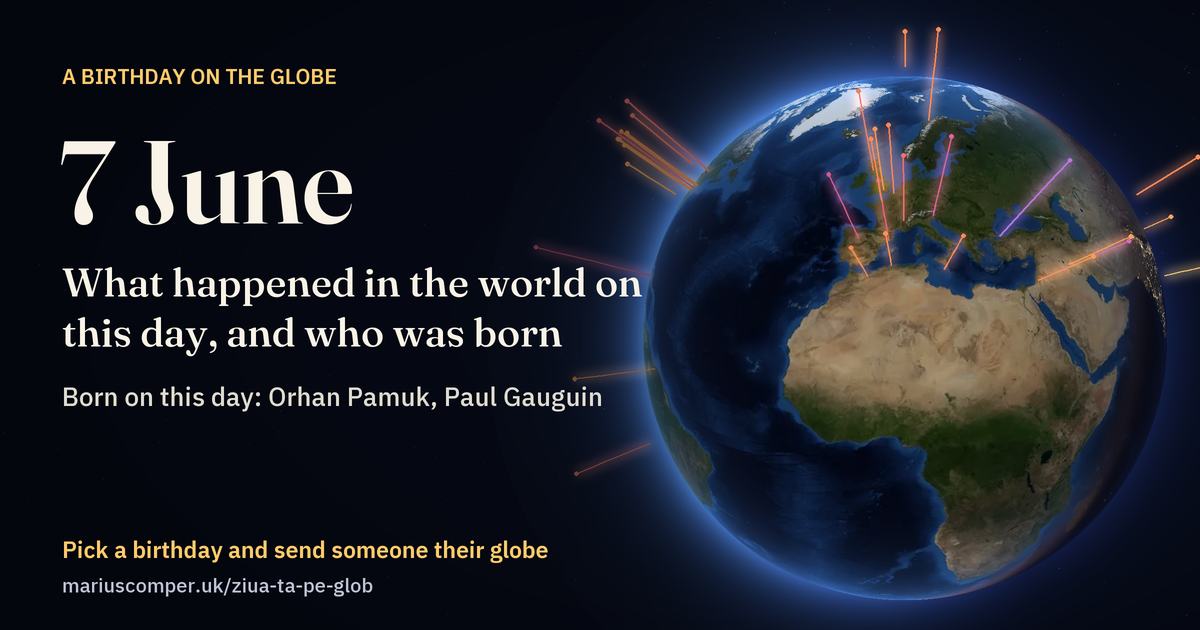
For 7 June, the English Wikipedia lists 57 events and 115 births. 34 of the events stand at their places as rays of light; nine more are dashed circles, where the sentence links only to a country or a sea. The taller the ray, the longer ago it happened. The people born that day come further down, as blue points.
A birthday, yours or someone else’s:
Turn it into a greetingScroll: the globe turns to each place
The day you were born, on the globe.
Three things from your day
Scroll: your day first, then 7 June through the years
The Earth on 7 June
The picture on the globe was assembled by NASA from satellite photographs taken in June 2004: the snow, the ice and the green are those of the month.
On 7 June the Sun passes straight overhead at noon along the parallel of 22.8° north. In London, the day lasts about 16 hours 30 minutes.
Beyond 67° north the Sun no longer sets; beyond 67° south it no longer rises.
The line between day and night is tilted on the globe exactly as on this day of the year. On the dark side you can see the lights of towns.
Britain & Ireland · Glasgow
1906
Cunard Line's RMS Lusitania is launched from the John Brown Shipyard, Glasgow (Clydebank), Scotland.
On the map: Glasgow.
Also on the day’s list of Wikipedia in Chinese.
Britain & Ireland · Hyde Park, London
1969
In their only UK concert, the rock supergroup Blind Faith, featuring Eric Clapton, Steve Winwood and Ginger Baker, debuted in London's Hyde Park in front of 100,000 fans.
On the map: Hyde Park, London.
Also on the day’s list of Wikipedia in Chinese.
Europe · Tordesillas
1494
Spain and Portugal sign the Treaty of Tordesillas which divides the New World between the two countries.
On the map: Tordesillas.
Also on the day’s list of Wikipedia in Spanish, Romanian and Chinese.
Asia · Istanbul
421
Emperor Theodosius II marries Aelia Eudocia at Constantinople (Byzantine Empire).
On the map: Istanbul.
North America · United States Declaration of Independence
1776
American Revolution: Richard Henry Lee proposes the "Lee Resolution" to the Second Continental Congress, with the motion being seconded by John Adams and leading to the United States Declaration of Independence.
On the map: the coordinates Wikidata gives for the article “United States Declaration of Independence”.
North America · Broadway theatre
1955
Lux Radio Theatre signs off the air permanently. The show launched in New York in 1934, and featured radio adaptations of Broadway shows and popular films.
On the map: Broadway theatre.
7 June
What the other Wikipedias remember#
For these years the English list has nothing on this day. The events below come from the same day’s lists on Wikipedia in Chinese and were translated for this page.
From Wikipedia in Chinese · Beijing
2008
Zhang Shaohan is invited to take part in the Beijing Olympic torch relay, becoming the first Taiwanese entertainer to be a torchbearer.
On the map: Beijing.
Translated from the list on Wikipedia in Chinese.
From Wikipedia in Chinese · French Open
2009
In the men's singles final of the 2009 French Open, the Swiss champion Federer sweeps aside the tournament's biggest dark horse, Söderling, 3-0, and lifts the Musketeers' Cup at Roland Garros for the first time in his career. With this he not only equals Sampras's record of 14 Grand Slam titles, but also becomes the sixth player in history to complete a career Grand Slam.
On the map: French Open.
Translated from the list on Wikipedia in Chinese.
7 June
Born on 7 June#
The English Wikipedia lists 115 births for this day. The blue points are the birthplaces of 60 of these people: those written about in the most Wikipedia editions, where Wikidata gives a place of birth.
Born on 7 June
1952
Orhan Pamuk, Turkish-American novelist, screenwriter, and academic, Nobel Prize laureate
Place of birth: Istanbul.
Born on 7 June
1848
Paul Gauguin, French painter and sculptor (died 1903)
Place of birth: Paris.
Born on 7 June
1958
Prince, American singer-songwriter, multi-instrumentalist, producer, and actor (died 2016)
Place of birth: Minneapolis.
Born on 7 June
1862
Philipp Lenard, Slovak-German physicist and academic, Nobel Prize laureate (died 1947)
Place of birth: Bratislava.
Born in Britain and Ireland
1940
Tom Jones, Welsh singer and actor
Place of birth: Pontypridd.
Born in Britain and Ireland
1974
Bear Grylls, English adventurer, author, and television host
Place of birth: Donaghadee.
Born in Britain and Ireland
1909
Jessica Tandy, English-American actress (died 1994)
Place of birth: London.
7 June
Number one in the charts that week
At the cinema
An animal recorded that day
The record can be seen in GBIF, which brings together wildlife records from around the world.
All your birthdays
The weather that day
Data: Met Office Hadley Centre (HadCET); NOAA (GHCN-Daily, Mauna Loa).
Above the Earth
Sources: Jonathan McDowell, GCAT (launches); GFZ Potsdam (Kp index). Days are counted in Universal Time.
Football that day
International matches played that day:
Source: the “International football results” dataset kept by Mart Jürisoo (CC0).
Also that day
The earthquake’s page at the USGS
Source: the USGS catalogue. The day is counted in Universal Time (UTC).
In those days
Make a link for someone
Type the name, pick the day and the year of birth. The link opens straight on their day, with their name in the greeting.
The link carries the name, date and place typed here; anyone who gets it can see them.
Put another birthday beside it
Your mother’s, your child’s, a friend’s: the two days appear side by side.
Below: 7 June through the years.
The whole globe of the day
Drag the globe to turn it. Touch a ray or a point to read what happened there.
Everything Wikipedia lists for 7 June
The list is the English Wikipedia’s, in its own wording, as it stood in October 2026. 14 events have no place on the map: the sentence links to no place with coordinates, only to places too wide to mark, or to several countries.
- 421
Emperor Theodosius II marries Aelia Eudocia at Constantinople (Byzantine Empire).
Asia · IstanbulWikipedia: Theodosius II - 879
Pope John VIII recognises the Duchy of Croatia under Duke Branimir as an independent state.
no place on the mapWikipedia: Pope John VIII - 1002
Henry II, a cousin of Emperor Otto III, is elected and crowned King of Germany.
Europe · Kingdom of GermanyWikipedia: Henry II, Holy Roman Emperor - 1099
First Crusade: The Siege of Jerusalem begins.
Asia · Siege of JerusalemWikipedia: First Crusade - 1420
Troops of the Republic of Venice capture Udine, ending the independence of the Patria del Friuli.
Europe · UdineWikipedia: Republic of Venice - 1494
Spain and Portugal sign the Treaty of Tordesillas which divides the New World between the two countries.
Europe · TordesillasWikipedia: Treaty of Tordesillas - 1614
The second parliament of James I of England ends after two months of deadlock and without passing any bills.
no place on the mapWikipedia: Addled Parliament - 1628
The Petition of Right, a major English constitutional document, is granted royal assent by Charles I and becomes law.
no place on the mapWikipedia: Petition of Right - 1640
Corpus de Sang in Barcelona: Catalan reapers riot against Spanish Royal soldiers and officers, killing the Viceroy of Catalonia, Dalmau de Queralt. Escalation of hostilities between the Principality of Catalonia and the Spanish Monarchy, leading to the Reapers' War.
Europe · Corpus de SangWikipedia: Corpus de Sang - 1654
Louis XIV is crowned King of France.
Europe · Kingdom of FranceWikipedia: Louis XIV - 1692
Port Royal, Jamaica, is hit by a catastrophic earthquake; in just three minutes, 1,600 people are killed and 3,000 are seriously injured.
Latin America · 1692 Jamaica earthquakeWikipedia: 1692 Jamaica earthquake - 1776
American Revolution: Richard Henry Lee proposes the "Lee Resolution" to the Second Continental Congress, with the motion being seconded by John Adams and leading to the United States Declaration of Independence.
North America · United States Declaration of IndependenceWikipedia: American Revolution - 1788
French Revolution: Day of the Tiles: Civilians in Grenoble toss roof tiles and various objects down upon royal troops.
Europe · Day of the TilesWikipedia: French Revolution - 1800
David Thompson reaches the mouth of the Saskatchewan River in Manitoba.
North America · ManitobaWikipedia: David Thompson - 1810
The newspaper Gazeta de Buenos Ayres is first published in Argentina.
Latin America · ArgentinaWikipedia: Gazeta de Buenos-Ayres - 1832
Asian cholera reaches Quebec, brought by Irish immigrants, and kills about 6,000 people in Lower Canada.
North America · QuebecWikipedia: 1826–1837 cholera pandemic - 1832
The Great Reform Act of England and Wales receives royal assent.
no place on the mapWikipedia: Reform Act 1832 - 1862
The United States and the United Kingdom agree in the Lyons–Seward Treaty to suppress the African slave trade.
Britain & Ireland · United KingdomWikipedia: Lyons–Seward Treaty of 1862 - 1866
One thousand eight hundred Fenian raiders are repelled back to the United States after looting and plundering the Saint-Armand and Frelighsburg areas of Canada East.
North America · Saint-Armand, QuebecWikipedia: Fenian raids - 1880
War of the Pacific: The Battle of Arica, the assault and capture of Morro de Arica (Arica Cape), ends the Campaña del Desierto (Desert Campaign).
Latin America · AricaWikipedia: Battle of Arica - 1892
Homer Plessy is arrested for refusing to leave his seat in the "whites-only" car of a train; he lost the resulting court case, Plessy v. Ferguson.
no place on the mapWikipedia: Plessy v. Ferguson - 1899
American Temperance crusader Carrie Nation begins her campaign of vandalizing alcohol-serving establishments by destroying the inventory in a saloon in Kiowa, Kansas.
North America · Kiowa, KansasWikipedia: Temperance movement in the United States - 1900
American temperance activist Carrie Nation entered a saloon in Kiowa, Kansas, and destroyed its stock of alcoholic beverages with rocks.
North America · Kiowa, KansasWikipedia: Temperance movement in the United States - 1905
Norway's parliament dissolves its union with Sweden. The vote was confirmed by a national plebiscite on August 13 of that year.
no place on the mapWikipedia: Dissolution of the union between Norway and Sweden - 1906
Cunard Line's RMS Lusitania is launched from the John Brown Shipyard, Glasgow (Clydebank), Scotland.
Britain & Ireland · GlasgowWikipedia: Glasgow - 1917
World War I: Battle of Messines: Allied soldiers detonate a series of mines underneath German trenches at Messines Ridge, killing 10,000 German troops.
Europe · Battle of MessinesWikipedia: World War I - 1919
Sette Giugno: Nationalist riots break out in Valletta, the capital of Malta. British soldiers fire into the crowd, killing four people.
Europe · VallettaWikipedia: Sette Giugno - 1929
The Lateran Treaty is ratified, bringing Vatican City into existence.
Europe · Vatican CityWikipedia: Lateran Treaty - 1938
Second Sino-Japanese War: The Chinese Nationalist government creates the 1938 Yellow River flood to halt Japanese forces. Five hundred thousand to nine hundred thousand civilians are killed.
Asia · Central ChinaWikipedia: 1938 Yellow River flood - 1938
The Douglas DC-4E makes its first test flight.
no place on the mapWikipedia: Douglas DC-4E - 1940
King Haakon VII, Crown Prince Olav and the Norwegian government leave Tromsø and go into exile in London. They return exactly five years later.
Europe · TromsøWikipedia: Haakon VII - 1942
World War II: Aleutian Islands Campaign: Imperial Japanese soldiers begin occupying the American islands of Attu and Kiska, in the Aleutian Islands off Alaska.
North America · Aleutian Islands campaignWikipedia: Aleutian Islands campaign - 1942
World War II: The Battle of Midway ends in American victory.
Oceans · Battle of MidwayWikipedia: World War II - 1944
World War II: Battle of Normandy: At Ardenne Abbey, members of the SS Division Hitlerjugend massacre 23 Canadian prisoners of war.
Europe · Ardenne Abbey massacreWikipedia: Ardenne Abbey massacre - 1945
King Haakon VII of Norway returns from exactly five years in exile during World War II.
no place on the mapWikipedia: Haakon VII - 1946
The United Kingdom's BBC returns to broadcasting its television service, which has been off air for seven years because of World War II.
no place on the mapWikipedia: BBC - 1948
Anti-Jewish riots in Oujda and Jerada take place.
Africa · 1948 anti-Jewish riots in Oujda and JeradaWikipedia: 1948 anti-Jewish riots in Oujda and Jerada - 1948
Edvard Beneš resigns as President of Czechoslovakia rather than signing the Ninth-of-May Constitution, making his nation a Communist state.
Europe · CzechoslovakiaWikipedia: Edvard Beneš - 1948
In Shostakovich v. Twentieth Century-Fox Film Corp., a New York trial court declined to issue a permanent injunction in favor of several Soviet composers against the distribution of The Iron Curtain, the first anti-Soviet Hollywood film of the Cold War era.
no place on the mapWikipedia: Cinema of the United States - 1955
Lux Radio Theatre signs off the air permanently. The show launched in New York in 1934, and featured radio adaptations of Broadway shows and popular films.
North America · Broadway theatreWikipedia: Lux Radio Theatre - 1962
The Organisation Armée Secrète (OAS) sets fire to the University of Algiers library building, destroying about 500,000 books.
Africa · University of Algiers 1Wikipedia: Organisation armée secrète - 1965
The Supreme Court of the United States hands down its decision in Griswold v. Connecticut, prohibiting the states from criminalizing the use of contraception by married couples.
North America · Supreme Court of the United StatesWikipedia: Supreme Court of the United States - 1967
Six-Day War: Israeli soldiers enter Jerusalem.
Asia · JerusalemWikipedia: Six-Day War - 1969
In their only UK concert, the rock supergroup Blind Faith, featuring Eric Clapton, Steve Winwood and Ginger Baker, debuted in London's Hyde Park in front of 100,000 fans.
Britain & Ireland · Hyde Park, LondonWikipedia: Blind Faith - 1971
Allegheny Airlines Flight 485 crashes on approach to Tweed New Haven Airport in New Haven, Connecticut, killing 28 of 31 aboard.
North America · Allegheny Airlines Flight 485Wikipedia: Allegheny Airlines Flight 485 - 1971
The Alcohol, Tobacco, and Firearms Division of the U.S. Internal Revenue Service raids the home of Ken Ballew for illegal possession of hand grenades.
North America · Silver SpringWikipedia: Ken Ballew raid - 1971
The United States Supreme Court overturns the conviction of Paul Cohen for disturbing the peace, setting the precedent that vulgar writing is protected under the First Amendment to the United States Constitution.
no place on the mapWikipedia: First Amendment to the United States Constitution - 1975
Sony launches Betamax, the first videocassette recorder format.
no place on the mapWikipedia: Sony - 1975
The inaugural edition of the Cricket World Cup, the premier international championship of men's One Day International cricket, began in England.
Britain & Ireland · EnglandWikipedia: 1975 Cricket World Cup - 1977
Five hundred million people watch the high day of the Silver Jubilee of Queen Elizabeth II begin on television.
no place on the mapWikipedia: Silver Jubilee of Elizabeth II - 1981
The Israeli Air Force destroys Iraq's Osiraq nuclear reactor during Operation Opera.
Asia · Operation OperaWikipedia: Operation Opera - 1982
Priscilla Presley opens Graceland to the public; the bathroom where Elvis Presley died five years earlier is kept off-limits.
North America · GracelandWikipedia: Priscilla Presley - 1989
Surinam Airways Flight 764 crashes on approach to Paramaribo-Zanderij International Airport in Suriname because of pilot error, killing 176 of 187 aboard.
Latin America · Surinam Airways Flight 764Wikipedia: Surinam Airways Flight 764 - 1991
Mount Pinatubo erupts, generating an ash column 7 kilometres (4.3 mi) high.
Asia · 1991 eruption of Mount PinatuboWikipedia: 1991 eruption of Mount Pinatubo - 1998
White supremacists murdered James Byrd Jr., an African American, by chaining him behind a pickup truck and dragging him along an asphalt road in Jasper, Texas.
North America · JasperWikipedia: Murder of James Byrd Jr. - 2000
The United Nations defines the Blue Line as the border between Israel and Lebanon.
no place on the mapWikipedia: Israel - 2017
A Myanmar Air Force Shaanxi Y-8 crashes into the Andaman Sea near Dawei, Myanmar, killing all 122 aboard.
Asia · 2017 Myanmar Air Force Shaanxi Y-8 crashWikipedia: 2017 Myanmar Air Force Shaanxi Y-8 crash
What the other Wikipedias remember
For these years the English list has nothing on this day. The events below come from the same day’s lists on Wikipedia in Chinese and were translated for this page.
- 2008
Zhang Shaohan is invited to take part in the Beijing Olympic torch relay, becoming the first Taiwanese entertainer to be a torchbearer.
- 2009
In the men's singles final of the 2009 French Open, the Swiss champion Federer sweeps aside the tournament's biggest dark horse, Söderling, 3-0, and lifts the Musketeers' Cup at Roland Garros for the first time in his career. With this he not only equals Sampras's record of 14 Grand Slam titles, but also becomes the sixth player in history to complete a career Grand Slam.
Who was born on 7 June
In order of how many Wikipedia editions have an article about each. The first 60 of 115 are shown.
- 1952
Orhan Pamuk, Turkish-American novelist, screenwriter, and academic, Nobel Prize laureate
IstanbulWikipedia: Orhan Pamuk - 1848
Paul Gauguin, French painter and sculptor (died 1903)
- 1959
Mike Pence, 48th Vice President of the United States, 50th Governor of Indiana
ColumbusWikipedia: Mike Pence - 1958
Prince, American singer-songwriter, multi-instrumentalist, producer, and actor (died 2016)
MinneapolisWikipedia: Prince - 1862
Philipp Lenard, Slovak-German physicist and academic, Nobel Prize laureate (died 1947)
BratislavaWikipedia: Philipp Lenard - 1952
Liam Neeson, Irish-American actor
BallymenaWikipedia: Liam Neeson - 1917
Dean Martin, American singer, actor, and producer (died 1995)
SteubenvilleWikipedia: Dean Martin - 1896
Imre Nagy, Hungarian soldier and politician, 44th Prime Minister of Hungary (died 1958)
KaposvárWikipedia: Imre Nagy - 1940
Tom Jones, Welsh singer and actor
PontypriddWikipedia: Tom Jones - 1970
Cafu, Brazilian footballer
ItaquaquecetubaWikipedia: Cafu - 1974
Bear Grylls, English adventurer, author, and television host
DonaghadeeWikipedia: Bear Grylls - 1990
Iggy Azalea, Australian rapper, singer, songwriter, and model
SydneyWikipedia: Iggy Azalea - 1896
Robert S. Mulliken, American physicist and chemist, Nobel Prize laureate (died 1986)
NewburyportWikipedia: Robert S. Mulliken - 1909
Jessica Tandy, English-American actress (died 1994)
LondonWikipedia: Jessica Tandy - 1972
Karl Urban, New Zealand actor
WellingtonWikipedia: Karl Urban - 1837
Alois Hitler, Austrian civil servant (died 1903)
StronesWikipedia: Alois Hitler - 1975
Allen Iverson, American basketball player
HamptonWikipedia: Allen Iverson - 1502
John III of Portugal (died 1557)
Castle of Saint GeorgeWikipedia: John III of Portugal - 1991
Emily Ratajkowski, American model and actress
WestminsterWikipedia: Emily Ratajkowski - 1909
Virginia Apgar, American anesthesiologist and pediatrician, developed the Apgar test (died 1974)
WestfieldWikipedia: Virginia Apgar - 1868
Charles Rennie Mackintosh, Scottish painter and architect (died 1928)
- 1945
Wolfgang Schüssel, Austrian lawyer and politician, 26th Chancellor of Austria
- 1988
Michael Cera, Canadian actor and musician
BramptonWikipedia: Michael Cera - 1770
Robert Jenkinson, 2nd Earl of Liverpool, English politician, Prime Minister of the United Kingdom (died 1828)
- 1979
Anna Torv, Australian actress
MelbourneWikipedia: Anna Torv - 1929
John Turner, Canadian lawyer and politician, 17th Prime Minister of Canada (died 2020)
RichmondWikipedia: John Turner - 1967
Muhsin Hendricks, South African imam, Islamic scholar and LGBT activist
Cape TownWikipedia: Muhsin Hendricks - 1899
Elizabeth Bowen, Anglo-Irish author and critic (died 1973)
- 1917
Gwendolyn Brooks, American poet (died 2000)
- 1879
Knud Rasmussen, Danish anthropologist and explorer (died 1933)
IlulissatWikipedia: Knud Rasmussen - 1928
James Ivory, American director, producer, and screenwriter
BerkeleyWikipedia: James Ivory - 1965
Damien Hirst, English painter and art collector
BristolWikipedia: Damien Hirst - 1954
Louise Erdrich, American novelist and poet
Little FallsWikipedia: Louise Erdrich - 1962
Lance Reddick, American actor (died 2023)
BaltimoreWikipedia: Lance Reddick - 1965
Mick Foley, American wrestler
BloomingtonWikipedia: Mick Foley - 1422
Federico da Montefeltro, Italian condottiero (died 1482)
- 1845
Leopold Auer, Hungarian violinist, composer, and conductor (died 1930)
VeszprémWikipedia: Leopold Auer - 1886
Henri Coandă, Romanian engineer, designed the Coandă-1910 (died 1972)
BucharestWikipedia: Henri Coandă - 1993
George Ezra, English singer-songwriter
HertfordWikipedia: George Ezra - 1757
Georgiana Cavendish, Duchess of Devonshire (died 1806)
- 1955
William Forsythe, American actor
BrooklynWikipedia: William Forsythe - 1967
Dave Navarro, American musician and television personality
Santa MonicaWikipedia: Dave Navarro - 1905
James J. Braddock, American world heavyweight boxing champion (died 1974)
Hell's KitchenWikipedia: James J. Braddock - 1957
Juan Luis Guerra, Dominican singer, composer, and record producer
San Pedro de MacorísWikipedia: Juan Luis Guerra - 1897
George Szell, Hungarian-American conductor and composer (died 1970)
BudapestWikipedia: George Szell - 1951
Philip Davis, Bahamian politician, 5th Prime Minister of the Bahamas
NassauWikipedia: Philip Davis - 1981
Larisa Oleynik, American actress
Santa ClaraWikipedia: Larisa Oleynik - 1931
Virginia McKenna, English actress and author
MaryleboneWikipedia: Virginia McKenna - 1778
Beau Brummell, English cricketer and fashion designer (died 1840)
Downing StreetWikipedia: Beau Brummell - 1936
Pippo Baudo, Italian television presenter (died 2025)
Militello in Val di CataniaWikipedia: Pippo Baudo - 1831
Amelia Edwards, English journalist and author (died 1892)
- 1893
Gillis Grafström, Swedish figure skater and architect (died 1938)
Hedvig Eleonora parishWikipedia: Gillis Grafström - 1920
Georges Marchais, French mechanic and politician (died 1997)
La HoguetteWikipedia: Georges Marchais - 1943
Nikki Giovanni, American poet, writer and activist (died 2024)
KnoxvilleWikipedia: Nikki Giovanni - 1993
Swae Lee, American rapper
InglewoodWikipedia: Swae Lee - 1938
Ian St John, Scottish international footballer and manager (died 2021)
MotherwellWikipedia: Ian St John - 1943
"Superstar" Billy Graham, American wrestler (died 2023)
- 1992
Jordan Clarkson, Filipino-American basketball player
- 1991
Fetty Wap, American rapper, singer, and songwriter
PatersonWikipedia: Fetty Wap - 1811
James Young Simpson, Scottish obstetrician (died 1870)
BathgateWikipedia: James Young Simpson
What is celebrated on 7 June
- Christian feast day: Blessed Anne of Saint Bartholomew
- Christian feast day: Antonio Maria Gianelli
- Christian feast day: Colmán of Dromore
- Christian feast day: Gottschalk
- Christian feast day: Landulf of Yariglia (Asti)
- Christian feast day: Meriasek
- Christian feast day: Paul I of Constantinople
- Christian feast day: Robert of Newminster
- Christian feast day: Chief Seattle (Lutheran Church)
- Christian feast day: Blessed Marie-Thérèse de Soubiran La Louvière
- Christian feast day: Commemoration Day of St John the Forerunner (Armenian Apostolic Church)
- Christian feast day: Pioneers of the Episcopal Anglican Church of Brazil (Episcopal Church (USA))
- Christian feast day: June 7 (Eastern Orthodox liturgics)
- Battle of Arica Day (Arica y Parinacota Region, Chile)
A greeting link for someone
Type a name and, if you like, the year of birth. The link opens with a greeting, and beside each event it says how old the person turned that day, or how many years before their birth it happened.
The name and the year go only into the link you send.
All 366 days
How the globe is made
Where the events come from
Each edition of this page uses the day’s list from Wikipedia in its own language: Romanian, English, Spanish, Chinese. The lists are written by volunteers and differ from one edition to the next; the text of each event is Wikipedia’s, with a link to the article. A row that appears twice in a list is shown once. The lists have not been checked event by event: they are Wikipedia’s, mistakes included.
For events before 1582, and for countries that moved to the Gregorian calendar later (Britain in 1752, Russia in 1918), the same day may be counted Old Style in one list and New Style in another.
The chapter “What the other Wikipedias remember” adds up to five events a day from the lists of the other three editions, only for years in which the English list has nothing on that day. They were translated for this page, passed the same filters as the tour, and are not counted among the events of the English list.
How an event gets onto the map
The place comes from Wikidata. If the sentence links to the article about the event itself (a battle, an opening, an earthquake), dated to the same year, the ray stands on its coordinates or on those of its location. Otherwise it stands on the first place the sentence links to: a town, a building, a mountain, an island. This second step can be wrong: sometimes the sentence only mentions the place. That is why the page says, under each event, which place the ray stands on.
When the sentence links to a single state or province, or to a single sea, lake or desert larger than 5,000 km², the globe shows a dashed circle, not a ray. The circle has the area Wikidata gives, with its radius kept between 1.2° and 16°, or a radius of 4.5° when Wikidata gives no area; it says only that the sentence links to that place. Organisations, ships, spacecraft, museum objects, rivers, mountain ranges, languages and continents are never used as places. When a sentence names several states and no exact place, the event stays in the list only.
What the height means
The height of a ray shows how many years have passed, on a logarithmic scale: 10 years, 100 years and 1,000 years are equal steps apart; anything older than about 2,600 years has the tallest ray. The colour runs from pale yellow for recent years to violet for antiquity.
Where the tour stops
In each region the tour stops at up to three events (five in Britain and Ireland), chosen mainly by three things: whether Wikipedia’s editors put the event in the “On this day” box of their main page (the English, Spanish and Chinese editions), how many Wikipedia editions have an article about it, and how many of the four lists include it. Events whose sentence or article is about a war, an attack, a crime or a disaster are left out of the tour; they stay in the whole list, in Wikipedia’s wording. The filter is a list of words and a list of Wikidata types, so it can miss some.
The tour of births names the people with articles in the most editions and leaves aside those whom the list or Wikidata describes as rulers, politicians, commanders, leaders of movements or criminals; they stay in the list.
The Earth and the Sun
The daytime images are NASA’s Blue Marble Next Generation mosaics, one for each month of 2004; the night side is Black Marble 2016. The tilt of the line between day and night is computed for the day; the hour is chosen so that the place being read is in daylight. The latitude where the Sun stands overhead is the average of the four years of the leap cycle; in a given year it can differ by up to 0.4°.
The day you were born
The number ones come from the weekly lists on Wikipedia: Billboard for the United States (from 1940; the Hot 100 from August 1958), the UK Singles Chart (from November 1952), Los 40 Principales for Spain (from July 1966) and, for Romania, the Romanian Top 100 and Airplay 100 (2001–2021, with missing weeks). The page shows the chart of the week in which the day of birth falls, with its date; Billboard and the UK chart are dated at the end of their week. For Romania before 2001 and for China these sources have no weekly chart.
The films are those that reached cinemas in the United States up to ten days before or three days after that day (some of them in a few cinemas at first), from the English Wikipedia’s yearly lists (from 1968), in order of how many editions have an article about them. The events “in those days” are the ones on the neighbouring days’ lists that carry the year of birth, passed through the same filter as the tour.
The day of birth, year included
The Moon, the star sign and the constellation are worked out by the page itself, for noon Universal Time on the day. The lit part of the Moon is rounded and can differ by a few per cent from that at the hour of birth. The sign follows the usual zodiac of twelve equal parts starting at the March equinox; the constellation is the one the Sun actually stood in front of, by the borders set by the International Astronomical Union, and within a day of a border the page does not name it. When the Sun changes sign while it is that day anywhere on Earth, the page gives the moment of crossing, rounded to ten minutes and accurate to within about a quarter of an hour, and the clock time in a few cities, with the time zone and summer time of that year.
The year in the Chinese calendar is the one your device’s own calendar gives for the date, checked against the Hong Kong Observatory’s tables. “All your birthdays” uses the same sources as the rest of the chapter for the same day in every year since the birth: the temperature, well-known launches that took place on that very day, matches of the teams the edition follows, snow deeper than 10 cm and strong geomagnetic storms. The three things at the top and the four on the picture are chosen in a fixed order (the song, the animal, a full Moon, a well-known launch before an ordinary earthquake); on the picture you can change them.
When the link carries a year of birth, the page adds a few things about that exact day. The weather is the Met Office’s Central England temperature record and the readings from New York’s Central Park; the “usual high” is the average of the daily highs of 1961–1990 for that date, with two days either side. The carbon dioxide figure is the monthly mean at the Mauna Loa observatory, where measurements begin in March 1958.
The earthquake is the one with the largest magnitude in the USGS catalogue for that day, counted in Universal Time. Before the 1960s the catalogue has gaps even above magnitude 5.5, so in the older years many days have no earthquake. The page gives only the magnitude and the place: the country the epicentre falls in or, when the epicentre is at sea within 300 km of a coast, the nearest country; farther out, only the ocean.
The launches are those that reached orbit or left for the Moon and the planets, from Jonathan McDowell’s GCAT catalogue. If nothing left that day, the page shows the nearest launch within three days before or after, and says how many days away it was. The geomagnetic storm appears only when the Kp index reached at least 5 in one of the day’s eight three-hour intervals.
The animal comes from GBIF: an observation made by a person (the animal seen or heard, or its tracks), dated to that exact day, with coordinates and a CC0 or CC BY licence. Only a few hundred well-known species are searched (mammals, birds, turtles, butterflies); of those noted that day, mammals and species with articles in many Wikipedia editions come first; birds noted almost every day, and species used recently, wait their turn. Observations dated 1 January are left out, because records without a day are often filed there. An observation shows that the animal was recorded there, not how many animals there were.
The matches are those between national teams. Only matches of England, Scotland, Wales, Northern Ireland, the Republic of Ireland, the United States, Canada and Australia are shown, along with those at the big final tournaments. The picture to send is drawn in the page from the day’s globe and the facts above, and stays on your device until you send it.
Sources
- Events, births and holidays: the day’s page on Wikipedia, text under CC BY-SA 4.0.
- Coordinates, places of birth and the number of editions: Wikidata (CC0).
- The Earth by day: NASA Blue Marble Next Generation. The Earth by night: NASA Black Marble 2016.
- Borders and regions: Natural Earth.
- World population and births per year: UN World Population Prospects 2024.
- Charts and films: Wikipedia’s lists for Billboard, the UK Singles Chart, Los 40 Principales, Romanian Top 100, Airplay 100 and American films by year (CC BY-SA 4.0).
- Weather: Met Office Hadley Centre, HadCET (Open Government Licence) and NOAA GHCN-Daily, New York Central Park. Carbon dioxide: NOAA Global Monitoring Laboratory, Mauna Loa.
- Earthquakes: the USGS catalogue. Launches: Jonathan McDowell, GCAT (CC BY). Kp index: GFZ Potsdam (CC BY 4.0). Matches: International football results, Mart Jürisoo (CC0).
- Animal observations: GBIF, with a link to each record; species names come from Wikidata.