A birthday on the globe
20 October on the globe: what happened in the world on this day, and who was born
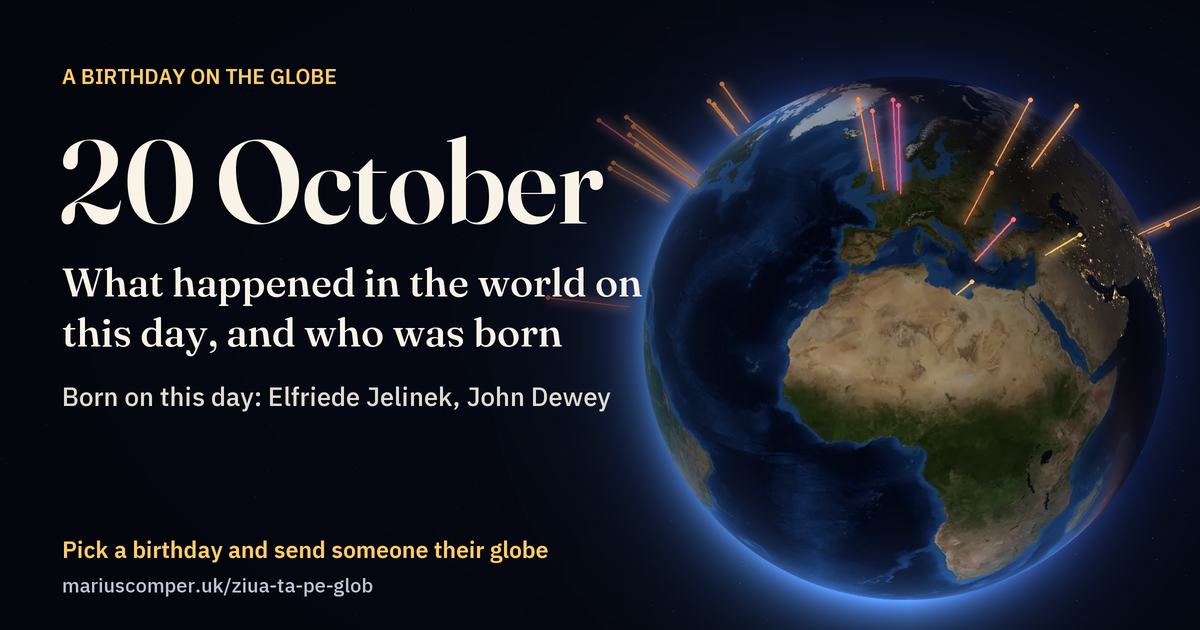
For 20 October, the English Wikipedia lists 45 events and 246 births. 24 of the events stand at their places as rays of light; one more is a dashed circle, where the sentence links only to a country or a sea. The taller the ray, the longer ago it happened. The people born that day come further down, as blue points.
A birthday, yours or someone else’s:
Turn it into a greetingScroll: the globe turns to each place
The day you were born, on the globe.
Three things from your day
Scroll: your day first, then 20 October through the years
The Earth on 20 October
The picture on the globe was assembled by NASA from satellite photographs taken in October 2004: the snow, the ice and the green are those of the month.
On 20 October the Sun passes straight overhead at noon along the parallel of 10.3° south. In London, the day lasts about 10 hours 25 minutes.
Beyond 80° south the Sun no longer sets; beyond 80° north it no longer rises.
The line between day and night is tilted on the globe exactly as on this day of the year. On the dark side you can see the lights of towns.
Britain & Ireland · London
1818
The Convention of 1818 is signed between the United States and the United Kingdom, which settles the Canada–United States border on the 49th parallel for most of its length.
On the map: London.
Also on the day’s list of Wikipedia in Romanian and Chinese.
Oceania · Sydney Opera House
1973
The Sydney Opera House is opened by Elizabeth II after 14 years of construction.
On the map: Sydney Opera House.
Also on the day’s list of Wikipedia in Spanish and Chinese.
North America · Boone Pickens Stadium
1951
The "Johnny Bright incident" occurs during a football game between the Drake Bulldogs and Oklahoma A&M Aggies.
On the map: Boone Pickens Stadium.
North America · Patterson–Gimlin film
1967
Roger Patterson and Robert Gimlin filmed an unidentified subject, which they claimed was Bigfoot, at Six Rivers National Forest in California.
On the map: Patterson–Gimlin film.
North America · SLAC National Accelerator Laboratory
1969
Experimental results from the Stanford Linear Accelerator Center were published showing that protons were composed of smaller particles, the first evidence of quarks.
On the map: SLAC National Accelerator Laboratory.
20 October
What the other Wikipedias remember#
For these years the English list has nothing on this day. The events below come from the same day’s lists on Wikipedia in Chinese, Spanish and Romanian and were translated for this page.
From Wikipedia in Chinese · La Paz
1548
La Paz, the capital of Bolivia, is founded. "La Paz" means "peace" in Spanish.
On the map: La Paz.
Translated from the list on Wikipedia in Chinese.
From Wikipedia in Spanish · Athens
1888
In Athens, Greece, the Fourth Zappas Olympic Games, the first attempt to revive the ancient Olympic Games, are officially opened.
On the map: Athens.
Translated from the list on Wikipedia in Spanish.
The article on Wikipedia in Spanish: Juegos Olímpicos de Zappas
From Wikipedia in Romanian · Ankara
1921
France and Turkey sign the Treaty of Ankara, by which France recognises the provisional Turkish government in Ankara as a negotiating partner.
On the map: Ankara.
Translated from the list on Wikipedia in Romanian.
From Wikipedia in Spanish · Barcelona
1979
In Barcelona (Spain), La Masía, the youth academy of Futbol Club Barcelona, opens.
On the map: Barcelona.
Translated from the list on Wikipedia in Spanish.
20 October
Born on 20 October#
The English Wikipedia lists 246 births for this day. The blue points are the birthplaces of 60 of these people: those written about in the most Wikipedia editions, where Wikidata gives a place of birth.
Born on 20 October
1946
Elfriede Jelinek, Austrian author and playwright, Nobel Prize laureate
Place of birth: Mürzzuschlag.
Born on 20 October
1859
John Dewey, American psychologist and philosopher (died 1952)
Place of birth: Burlington.
Born on 20 October
1891
James Chadwick, English physicist and academic, Nobel Prize laureate (died 1974)
Place of birth: Bollington.
Born on 20 October
1971
Snoop Dogg, American rapper, producer, and actor
Place of birth: Long Beach.
Born on 20 October
1740
Isabelle de Charrière, Dutch author and poet (died 1805)
Place of birth: Zuylen Castle.
Born in Britain and Ireland
1956
Danny Boyle, English director, producer, and screenwriter
Place of birth: Radcliffe.
Born in Britain and Ireland
1961
Ian Rush, Welsh footballer and manager
Place of birth: St Asaph.
Born in Britain and Ireland
1997
Ademola Lookman, Nigerian footballer
Place of birth: Wandsworth.
20 October
Number one in the charts that week
At the cinema
An animal recorded that day
The record can be seen in GBIF, which brings together wildlife records from around the world.
All your birthdays
The weather that day
Data: Met Office Hadley Centre (HadCET); NOAA (GHCN-Daily, Mauna Loa).
Above the Earth
Sources: Jonathan McDowell, GCAT (launches); GFZ Potsdam (Kp index). Days are counted in Universal Time.
Football that day
International matches played that day:
Source: the “International football results” dataset kept by Mart Jürisoo (CC0).
Also that day
The earthquake’s page at the USGS
Source: the USGS catalogue. The day is counted in Universal Time (UTC).
In those days
Make a link for someone
Type the name, pick the day and the year of birth. The link opens straight on their day, with their name in the greeting.
The link carries the name, date and place typed here; anyone who gets it can see them.
Put another birthday beside it
Your mother’s, your child’s, a friend’s: the two days appear side by side.
Below: 20 October through the years.
The whole globe of the day
Drag the globe to turn it. Touch a ray or a point to read what happened there.
Everything Wikipedia lists for 20 October
The list is the English Wikipedia’s, in its own wording, as it stood in October 2026. 20 events have no place on the map: the sentence links to no place with coordinates, only to places too wide to mark, or to several countries.
- 1568
The Spanish Duke of Alba defeats a Dutch rebel force under William the Silent.
Europe · Battle of JodoigneWikipedia: Battle of Jodoigne - 1572
Eighty Years' War: Three thousand Spanish soldiers wade through fifteen miles of water in one night to effect the relief of Goes.
Europe · Relief of GoesWikipedia: Relief of Goes - 1740
France, Prussia, Bavaria and Saxony refuse to honour the Pragmatic Sanction, and the War of the Austrian Succession begins.
no place on the mapWikipedia: Pragmatic Sanction of 1713 - 1774
American Revolution: The Continental Association, a nonconsumption and nonimportation agreement against the British Isles and the British West Indies, is adopted by the First Continental Congress.
North America · Carpenters' HallWikipedia: American Revolution - 1781
The Patent of Toleration, providing limited freedom of worship, is approved in Austria.
no place on the mapWikipedia: Patent of Toleration - 1803
The United States Senate ratifies the Louisiana Purchase.
no place on the mapWikipedia: Louisiana Purchase - 1818
The Convention of 1818 is signed between the United States and the United Kingdom, which settles the Canada–United States border on the 49th parallel for most of its length.
Britain & Ireland · LondonWikipedia: Treaty of 1818 - 1827
Greek War of Independence: In the Battle of Navarino, a combined Turkish and Egyptian fleet is defeated by British, French and Russian naval forces in the last significant battle fought with wooden sailing ships.
Europe · Battle of NavarinoWikipedia: Battle of Navarino - 1883
Peru and Chile sign the Treaty of Ancón, by which the Tarapacá province is ceded to the latter, bringing an end to Peru's involvement in the War of the Pacific.
Latin America · AncónWikipedia: Treaty of Ancón - 1904
Chile and Bolivia sign the Treaty of Peace and Friendship, delimiting the border between the two countries.
no place on the mapWikipedia: Treaty of Peace and Friendship - 1910
British ocean liner RMS Olympic is launched.
no place on the mapWikipedia: Ocean liner - 1935
The Long March, a mammoth retreat undertaken by the armed forces of the Chinese Communist Party a year prior, ends.
no place on the mapWikipedia: Long March - 1936
British woman Mabel Freer was refused entry to Australia after failing a dictation test given in Italian, leading to a debate over Australia's immigration policy.
no place on the mapWikipedia: Immigration Restriction Act 1901 - 1939
Pope Pius XII published his first encyclical, Summi Pontificatus, which critiqued ideologies such as racism, cultural superiority and totalitarianism.
no place on the mapWikipedia: Pope Pius XII - 1941
World War II: Thousands of civilians in German-occupied Serbia are murdered in the Kragujevac massacre.
Europe · Kragujevac massacreWikipedia: Kragujevac massacre - 1944
Liquefied natural gas leaks from storage tanks in Cleveland and then explodes, leveling 30 blocks and killing 130 people.
North America · Cleveland East Ohio Gas explosionWikipedia: Cleveland East Ohio Gas explosion - 1944
World War II: American general Douglas MacArthur fulfills his promise to return to the Philippines when he comes ashore during the Battle of Leyte.
Asia · Battle of LeyteWikipedia: Battle of Leyte - 1944
World War II: The Soviet Red Army and Yugoslav Partisans liberate Belgrade.
no place on the mapWikipedia: Belgrade offensive - 1947
Cold War: The House Un-American Activities Committee begins its investigation into Communist infiltration of the Hollywood film industry, resulting in a blacklist that prevents some from working in the industry for years.
no place on the mapWikipedia: Cold War - 1948
A KLM Lockheed L-049 Constellation crashes on approach to Glasgow Prestwick Airport, killing 40.
Britain & Ireland · 1948 KLM Constellation air disasterWikipedia: 1948 KLM Constellation air disaster - 1951
The "Johnny Bright incident" occurs during a football game between the Drake Bulldogs and Oklahoma A&M Aggies.
North America · Boone Pickens StadiumWikipedia: Johnny Bright incident - 1952
The Governor of Kenya Evelyn Baring declares a state of emergency and begins arresting hundreds of suspected leaders of the Mau Mau Uprising.
Africa · Kenya ColonyWikipedia: Mau Mau rebellion - 1961
The Soviet Navy performs the first armed test of a submarine-launched ballistic missile, launching an R-13 from a Golf-class submarine.
no place on the mapWikipedia: Soviet Navy - 1962
China launches simultaneous offensives in Ladakh and across the McMahon Line, igniting the Sino-Indian War.
no place on the mapWikipedia: Sino-Indian War - 1967
Roger Patterson and Robert Gimlin filmed an unidentified subject, which they claimed was Bigfoot, at Six Rivers National Forest in California.
North America · Patterson–Gimlin filmWikipedia: Patterson–Gimlin film - 1969
Experimental results from the Stanford Linear Accelerator Center were published showing that protons were composed of smaller particles, the first evidence of quarks.
North America · SLAC National Accelerator LaboratoryWikipedia: SLAC National Accelerator Laboratory - 1973
The Sydney Opera House is opened by Elizabeth II after 14 years of construction.
Oceania · Sydney Opera HouseWikipedia: Sydney Opera House - 1973
Watergate scandal: "Saturday Night Massacre": United States President Richard Nixon fires U.S. Attorney General Elliot Richardson and Deputy Attorney General William Ruckelshaus after they refuse to fire special prosecutor Archibald Cox, who is finally fired by Solicitor General Robert Bork.
no place on the mapWikipedia: Saturday Night Massacre - 1976
The Luling–Destrehan Ferry MV George Prince is struck by the Norwegian freighter SS Frosta while crossing the Mississippi River in St. Charles Parish, Louisiana. Seventy-eight passengers and crew die, and only 18 people aboard the ferry survive.
North America · MV George Prince ferry disasterWikipedia: MV George Prince ferry disaster - 1977
A plane carrying the rock band Lynyrd Skynyrd crashes in woodland in Mississippi, United States. Six people, including three band members, are killed.
North America · Lynyrd Skynyrd plane crashWikipedia: Lynyrd Skynyrd plane crash - 1981
Two police officers and a Brink's armored car guard are killed during an armed robbery carried out by members of the Black Liberation Army and Weather Underground in Nanuet, New York.
North America · 1981 Brink's robberyWikipedia: 1981 Brink's robbery - 1982
During the UEFA Cup match between FC Spartak Moscow and HFC Haarlem, 66 people are crushed to death in the Luzhniki disaster.
Europe · Luzhniki disasterWikipedia: Luzhniki disaster - 1984
The Spanish trawler Sonia sank in British waters after a five-hour chase by the Irish Naval Service patrol vessel Aisling, during which almost 600 shots were fired.
no place on the mapWikipedia: Sinking of the Spanish trawler Sonia - 1986
Aeroflot Flight 6502 crashes while landing at Kuibyshev Airport (now Kuromoch International Airport) in Kuibyshev (now present-day Samara, Russia), killing 70 people.
Europe · Aeroflot Flight 6502Wikipedia: Aeroflot Flight 6502 - 1991
A 6.8 Mw earthquake strikes the Uttarkashi region of India, killing more than 1,000 people.
Asia · 1991 Uttarkashi earthquakeWikipedia: 1991 Uttarkashi earthquake - 1991
A massive firestorm breaks out in the hills of Oakland and Berkeley, California killing 25 people and destroying more than 3,000 homes, apartments and condominiums.
North America · Oakland firestorm of 1991Wikipedia: Firestorm - 1995
Space Shuttle Columbia launches on STS-73.
no place on the mapWikipedia: Space Shuttle Columbia - 2002
Top Gear, the revived popular British TV motoring magazine, premieres on BBC.
no place on the mapWikipedia: Top Gear - 2003
The Sloan Great Wall, once the largest cosmic structures known to humanity, is discovered by students at Princeton University.
North America · Princeton UniversityWikipedia: Princeton University - 2005
The general conference of the United Nations Educational, Scientific and Cultural Organization (UNESCO) passes the Convention on the Protection and Promotion of the Diversity of Cultural Expressions.
no place on the mapWikipedia: UNESCO - 2011
Libyan Crisis: Rebel forces capture Libyan dictator Muammar Gaddafi and his son Mutassim in his hometown of Sirte and kill them shortly thereafter, ending the first Libyan civil war.
Africa · Killing of Muammar GaddafiWikipedia: Killing of Muammar Gaddafi - 2017
Syrian civil war: The Syrian Democratic Forces (SDF) declare victory in the Raqqa campaign.
Asia · Raqqa campaignWikipedia: Raqqa campaign - 2022
Liz Truss steps down as British Prime Minister and leader of the Conservative Party amid the country's political crisis, serving for the least time of any British Prime Minister (49 days).
no place on the mapWikipedia: Liz Truss - 2022
Protests broke out across Chad after President Mahamat Déby declared his intentions to extend his rule by another two years.
no place on the mapWikipedia: 2022 Chadian protests - 2024
Prabowo Subianto and Gibran Rakabuming Raka were sworn in as president and vice president of Indonesia, becoming the oldest and the youngest person to assume respective offices.
no place on the mapWikipedia: Prabowo Subianto
What the other Wikipedias remember
For these years the English list has nothing on this day. The events below come from the same day’s lists on Wikipedia in Chinese, Spanish and Romanian and were translated for this page.
- 1548
La Paz, the capital of Bolivia, is founded. "La Paz" means "peace" in Spanish.
- 1888
In Athens, Greece, the Fourth Zappas Olympic Games, the first attempt to revive the ancient Olympic Games, are officially opened.
Europe · AthensTranslated from the list on Wikipedia in SpanishWikipedia: Juegos Olímpicos de Zappas - 1921
France and Turkey sign the Treaty of Ankara, by which France recognises the provisional Turkish government in Ankara as a negotiating partner.
- 1979
In Barcelona (Spain), La Masía, the youth academy of Futbol Club Barcelona, opens.
Who was born on 20 October
In order of how many Wikipedia editions have an article about each. The first 60 of 246 are shown.
- 1964
Kamala Harris, American politician and lawyer, 49th Vice President of the United States
Oakland Medical CenterWikipedia: Kamala Harris - 1854
Arthur Rimbaud, French soldier and poet (died 1891)
CharlevilleWikipedia: Arthur Rimbaud - 1946
Elfriede Jelinek, Austrian author and playwright, Nobel Prize laureate
MürzzuschlagWikipedia: Elfriede Jelinek - 1859
John Dewey, American psychologist and philosopher (died 1952)
BurlingtonWikipedia: John Dewey - 1891
James Chadwick, English physicist and academic, Nobel Prize laureate (died 1974)
BollingtonWikipedia: James Chadwick - 1971
Snoop Dogg, American rapper, producer, and actor
Long BeachWikipedia: Snoop Dogg - 1740
Isabelle de Charrière, Dutch author and poet (died 1805)
Zuylen CastleWikipedia: Isabelle de Charrière - 1958
Viggo Mortensen, American-Danish actor and producer
WatertownWikipedia: Viggo Mortensen - 1819
Báb, Iranian religious leader, founded Bábism (died 1850)
ShirazWikipedia: Báb - 1956
Danny Boyle, English director, producer, and screenwriter
RadcliffeWikipedia: Danny Boyle - 1942
Christiane Nüsslein-Volhard, German biologist and geneticist, Nobel Prize laureate
- 1784
Henry John Temple, 3rd Viscount Palmerston, English academic and politician, Prime Minister of the United Kingdom (died 1865)
- 1882
Bela Lugosi, Hungarian-American actor (died 1956)
- 1951
Claudio Ranieri, Italian footballer and manager
- 1979
John Krasinski, American actor, director, and producer
- 1677
Stanisław Leszczyński, King of Poland (died 1766)
- 1971
Dannii Minogue, Australian singer-songwriter and actress
MelbourneWikipedia: Dannii Minogue - 1963
Julie Payette, Canadian engineer, astronaut, and 29th Governor General of Canada
MontrealWikipedia: Julie Payette - 1988
Candice Swanepoel, South African supermodel and philanthropist
Mooi RiverWikipedia: Candice Swanepoel - 1992
Mattia De Sciglio, Italian footballer
- 1950
Tom Petty, American singer-songwriter, guitarist, and producer (died 2017)
GainesvilleWikipedia: Tom Petty - 1961
Ian Rush, Welsh footballer and manager
St AsaphWikipedia: Ian Rush - 1997
Ademola Lookman, Nigerian footballer
WandsworthWikipedia: Ademola Lookman - 1997
Daizen Maeda, Japanese footballer
TaishiWikipedia: Daizen Maeda - 1874
Charles Ives, American composer (died 1954)
DanburyWikipedia: Charles Ives - 1917
Stéphane Hessel, German-French activist and diplomat (died 2013)
- 1923
Otfried Preußler, German author (died 2013)
LiberecWikipedia: Otfried Preußler - 1917
Jean-Pierre Melville, French actor, director, producer, and screenwriter (died 1973)
9th arrondissement of ParisWikipedia: Jean-Pierre Melville - 1983
Michel Vorm, Dutch footballer
IJsselsteinWikipedia: Michel Vorm - 1780
Pauline Bonaparte, French sister of Napoleon (died 1825)
AjaccioWikipedia: Pauline Bonaparte - 1965
William Zabka, American actor and producer
New York CityWikipedia: William Zabka - 1977
Hun Manet, Cambodian politician and military officer, 33rd Prime Minister of Cambodia
Memot DistrictWikipedia: Hun Manet - 1949
Valeriy Borzov, Ukrainian-Russian sprinter
- 1620
Aelbert Cuyp, Dutch painter (died 1691)
DordrechtWikipedia: Aelbert Cuyp - 1955
Thomas Newman, American composer and conductor
Los AngelesWikipedia: Thomas Newman - 2002
Yéremy Pino, Spanish footballer
Las Palmas de Gran CanariaWikipedia: Yéremy Pino - 1989
Jess Glynne, English singer-songwriter
LondonWikipedia: Jess Glynne - 1997
Andrey Rublev, Russian tennis player
MoscowWikipedia: Andrey Rublev - 1920
Janet Jagan, 6th President of Guyana (died 2009)
ChicagoWikipedia: Janet Jagan - 1925
Art Buchwald, American soldier and journalist (died 2007)
Mount VernonWikipedia: Art Buchwald - 1554
Bálint Balassi, Hungarian writer and noble (died 1594)
- 1976
Dan Fogler, American actor, director, producer, and screenwriter
BrooklynWikipedia: Dan Fogler - 2003
Carney Chukwuemeka, English footballer
EisenstadtWikipedia: Carney Chukwuemeka - 1925
Roger Hanin, Algerian-French actor, director, and screenwriter (died 2015)
AlgiersWikipedia: Roger Hanin - 1935
Jerry Orbach, American actor and singer (died 2004)
New York CityWikipedia: Jerry Orbach - 1931
Mickey Mantle, American baseball player and sportscaster (died 1995)
SpavinawWikipedia: Mickey Mantle - 1616
Thomas Bartholin, Danish physician, mathematician, and theologian (died 1680)
CopenhagenWikipedia: Thomas Bartholin - 1972
Brian Schatz, American academic and politician, 11th Lieutenant Governor of Hawaii
Ann ArborWikipedia: Brian Schatz - 1976
Nicola Legrottaglie, Italian footballer and manager
Gioia del ColleWikipedia: Nicola Legrottaglie - 1900
Ismail al-Azhari, Sudanese politician, 3rd President of Sudan (died 1969)
OmdurmanWikipedia: Ismail al-Azhari - 1937
Wanda Jackson, American singer-songwriter and guitarist
- 1938
Dolores Hart, American actress and nun
ChicagoWikipedia: Dolores Hart - 1955
Sheldon Whitehouse, American politician
ManhattanWikipedia: Sheldon Whitehouse - 1981
Dimitrios Papadopoulos, Greek footballer
- 1999
YoungBoy Never Broke Again, American rapper
Baton RougeWikipedia: YoungBoy Never Broke Again - 1946
Lucien Van Impe, Belgian cyclist
Erpe-MereWikipedia: Lucien Van Impe - 1958
Scott Hall, American wrestler (died 2022)
St. Mary's CountyWikipedia: Scott Hall - 1978
Virender Sehwag, Indian cricketer
- 1822
Thomas Hughes, English lawyer and judge (died 1896)
OxfordshireWikipedia: Thomas Hughes - 1957
Hilda Solis, American academic and politician, 25th United States Secretary of Labor
Los AngelesWikipedia: Hilda Solis
What is celebrated on 20 October
- Christian feast days: Acca of Hexham
- Christian feast days: Aderald
- Christian feast days: Artemius
- Christian feast days: Caprasius of Agen
- Christian feast days: Hedwig (in Canada, moved from Oct. 16)
- Christian feast days: Irene of Tomar
- Christian feast days: Magdalene of Nagasaki
- Christian feast days: Margaret Marie Alacoque (in Canada, moved from Oct. 16)
- Christian feast days: Paul of the Cross (in USA, moved from Oct. 19)
- Christian feast days: Maria Bertilla Boscardin
- Christian feast days: Mater Admirabilis
- Christian feast days: October 20 (Eastern Orthodox liturgics)
- Arbor Day (Czech Republic)
- Heroes' Day (Kenya)
A greeting link for someone
Type a name and, if you like, the year of birth. The link opens with a greeting, and beside each event it says how old the person turned that day, or how many years before their birth it happened.
The name and the year go only into the link you send.
All 366 days
How the globe is made
Where the events come from
Each edition of this page uses the day’s list from Wikipedia in its own language: Romanian, English, Spanish, Chinese. The lists are written by volunteers and differ from one edition to the next; the text of each event is Wikipedia’s, with a link to the article. A row that appears twice in a list is shown once. The lists have not been checked event by event: they are Wikipedia’s, mistakes included.
For events before 1582, and for countries that moved to the Gregorian calendar later (Britain in 1752, Russia in 1918), the same day may be counted Old Style in one list and New Style in another.
The chapter “What the other Wikipedias remember” adds up to five events a day from the lists of the other three editions, only for years in which the English list has nothing on that day. They were translated for this page, passed the same filters as the tour, and are not counted among the events of the English list.
How an event gets onto the map
The place comes from Wikidata. If the sentence links to the article about the event itself (a battle, an opening, an earthquake), dated to the same year, the ray stands on its coordinates or on those of its location. Otherwise it stands on the first place the sentence links to: a town, a building, a mountain, an island. This second step can be wrong: sometimes the sentence only mentions the place. That is why the page says, under each event, which place the ray stands on.
When the sentence links to a single state or province, or to a single sea, lake or desert larger than 5,000 km², the globe shows a dashed circle, not a ray. The circle has the area Wikidata gives, with its radius kept between 1.2° and 16°, or a radius of 4.5° when Wikidata gives no area; it says only that the sentence links to that place. Organisations, ships, spacecraft, museum objects, rivers, mountain ranges, languages and continents are never used as places. When a sentence names several states and no exact place, the event stays in the list only.
What the height means
The height of a ray shows how many years have passed, on a logarithmic scale: 10 years, 100 years and 1,000 years are equal steps apart; anything older than about 2,600 years has the tallest ray. The colour runs from pale yellow for recent years to violet for antiquity.
Where the tour stops
In each region the tour stops at up to three events (five in Britain and Ireland), chosen mainly by three things: whether Wikipedia’s editors put the event in the “On this day” box of their main page (the English, Spanish and Chinese editions), how many Wikipedia editions have an article about it, and how many of the four lists include it. Events whose sentence or article is about a war, an attack, a crime or a disaster are left out of the tour; they stay in the whole list, in Wikipedia’s wording. The filter is a list of words and a list of Wikidata types, so it can miss some.
The tour of births names the people with articles in the most editions and leaves aside those whom the list or Wikidata describes as rulers, politicians, commanders, leaders of movements or criminals; they stay in the list.
The Earth and the Sun
The daytime images are NASA’s Blue Marble Next Generation mosaics, one for each month of 2004; the night side is Black Marble 2016. The tilt of the line between day and night is computed for the day; the hour is chosen so that the place being read is in daylight. The latitude where the Sun stands overhead is the average of the four years of the leap cycle; in a given year it can differ by up to 0.4°.
The day you were born
The number ones come from the weekly lists on Wikipedia: Billboard for the United States (from 1940; the Hot 100 from August 1958), the UK Singles Chart (from November 1952), Los 40 Principales for Spain (from July 1966) and, for Romania, the Romanian Top 100 and Airplay 100 (2001–2021, with missing weeks). The page shows the chart of the week in which the day of birth falls, with its date; Billboard and the UK chart are dated at the end of their week. For Romania before 2001 and for China these sources have no weekly chart.
The films are those that reached cinemas in the United States up to ten days before or three days after that day (some of them in a few cinemas at first), from the English Wikipedia’s yearly lists (from 1968), in order of how many editions have an article about them. The events “in those days” are the ones on the neighbouring days’ lists that carry the year of birth, passed through the same filter as the tour.
The day of birth, year included
The Moon, the star sign and the constellation are worked out by the page itself, for noon Universal Time on the day. The lit part of the Moon is rounded and can differ by a few per cent from that at the hour of birth. The sign follows the usual zodiac of twelve equal parts starting at the March equinox; the constellation is the one the Sun actually stood in front of, by the borders set by the International Astronomical Union, and within a day of a border the page does not name it. When the Sun changes sign while it is that day anywhere on Earth, the page gives the moment of crossing, rounded to ten minutes and accurate to within about a quarter of an hour, and the clock time in a few cities, with the time zone and summer time of that year.
The year in the Chinese calendar is the one your device’s own calendar gives for the date, checked against the Hong Kong Observatory’s tables. “All your birthdays” uses the same sources as the rest of the chapter for the same day in every year since the birth: the temperature, well-known launches that took place on that very day, matches of the teams the edition follows, snow deeper than 10 cm and strong geomagnetic storms. The three things at the top and the four on the picture are chosen in a fixed order (the song, the animal, a full Moon, a well-known launch before an ordinary earthquake); on the picture you can change them.
When the link carries a year of birth, the page adds a few things about that exact day. The weather is the Met Office’s Central England temperature record and the readings from New York’s Central Park; the “usual high” is the average of the daily highs of 1961–1990 for that date, with two days either side. The carbon dioxide figure is the monthly mean at the Mauna Loa observatory, where measurements begin in March 1958.
The earthquake is the one with the largest magnitude in the USGS catalogue for that day, counted in Universal Time. Before the 1960s the catalogue has gaps even above magnitude 5.5, so in the older years many days have no earthquake. The page gives only the magnitude and the place: the country the epicentre falls in or, when the epicentre is at sea within 300 km of a coast, the nearest country; farther out, only the ocean.
The launches are those that reached orbit or left for the Moon and the planets, from Jonathan McDowell’s GCAT catalogue. If nothing left that day, the page shows the nearest launch within three days before or after, and says how many days away it was. The geomagnetic storm appears only when the Kp index reached at least 5 in one of the day’s eight three-hour intervals.
The animal comes from GBIF: an observation made by a person (the animal seen or heard, or its tracks), dated to that exact day, with coordinates and a CC0 or CC BY licence. Only a few hundred well-known species are searched (mammals, birds, turtles, butterflies); of those noted that day, mammals and species with articles in many Wikipedia editions come first; birds noted almost every day, and species used recently, wait their turn. Observations dated 1 January are left out, because records without a day are often filed there. An observation shows that the animal was recorded there, not how many animals there were.
The matches are those between national teams. Only matches of England, Scotland, Wales, Northern Ireland, the Republic of Ireland, the United States, Canada and Australia are shown, along with those at the big final tournaments. The picture to send is drawn in the page from the day’s globe and the facts above, and stays on your device until you send it.
Sources
- Events, births and holidays: the day’s page on Wikipedia, text under CC BY-SA 4.0.
- Coordinates, places of birth and the number of editions: Wikidata (CC0).
- The Earth by day: NASA Blue Marble Next Generation. The Earth by night: NASA Black Marble 2016.
- Borders and regions: Natural Earth.
- World population and births per year: UN World Population Prospects 2024.
- Charts and films: Wikipedia’s lists for Billboard, the UK Singles Chart, Los 40 Principales, Romanian Top 100, Airplay 100 and American films by year (CC BY-SA 4.0).
- Weather: Met Office Hadley Centre, HadCET (Open Government Licence) and NOAA GHCN-Daily, New York Central Park. Carbon dioxide: NOAA Global Monitoring Laboratory, Mauna Loa.
- Earthquakes: the USGS catalogue. Launches: Jonathan McDowell, GCAT (CC BY). Kp index: GFZ Potsdam (CC BY 4.0). Matches: International football results, Mart Jürisoo (CC0).
- Animal observations: GBIF, with a link to each record; species names come from Wikidata.