A birthday on the globe
24 July on the globe: what happened in the world on this day, and who was born
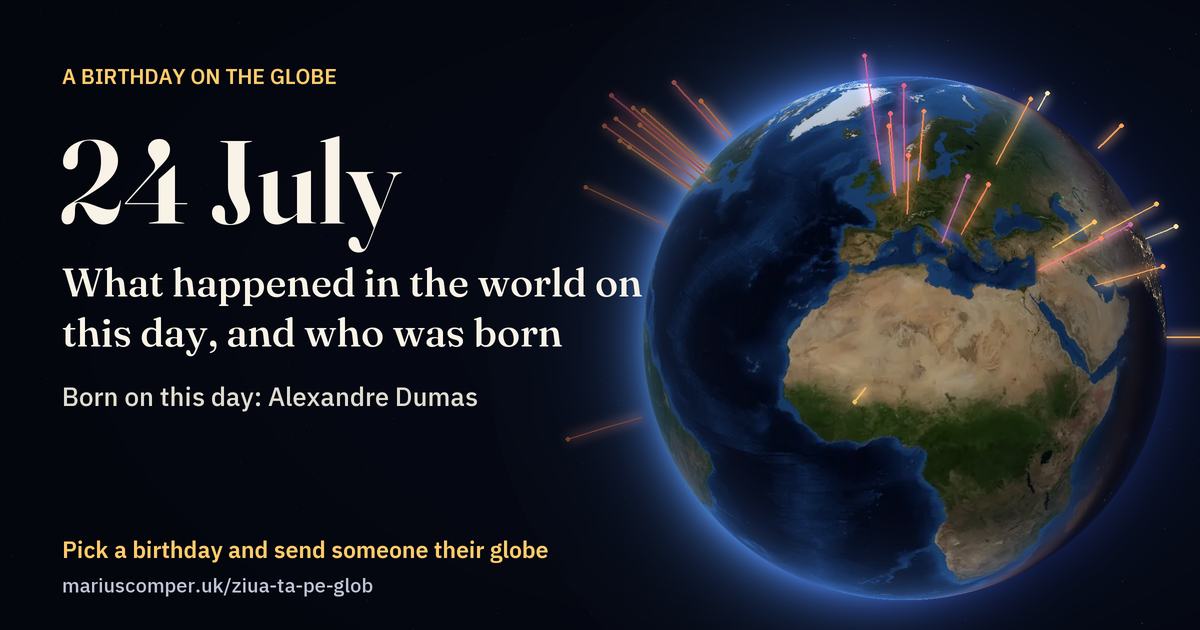
For 24 July, the English Wikipedia lists 52 events and 174 births. 32 of the events stand at their places as rays of light; four more are dashed circles, where the sentence links only to a country or a sea. The taller the ray, the longer ago it happened. The people born that day come further down, as blue points.
A birthday, yours or someone else’s:
Turn it into a greetingScroll: the globe turns to each place
The day you were born, on the globe.
Three things from your day
Scroll: your day first, then 24 July through the years
The Earth on 24 July
The picture on the globe was assembled by NASA from satellite photographs taken in July 2004: the snow, the ice and the green are those of the month.
On 24 July the Sun passes straight overhead at noon along the parallel of 19.8° north. In London, the day lasts about 15 hours 50 minutes.
Beyond 70° north the Sun no longer sets; beyond 70° south it no longer rises.
The line between day and night is tilted on the globe exactly as on this day of the year. On the dark side you can see the lights of towns.
Europe · Olympiysky Sports Complex
1980
The Quietly Confident Quartet of Australia wins the men's 4 x 100 metre medley relay at the Moscow Olympics, the only time the United States has not won the swimming event at Olympic level.
On the map: Olympiysky Sports Complex.
Also on the day’s list of Wikipedia in Chinese.
Latin America · Machu Picchu
1911
Hiram Bingham III re-discovers Machu Picchu, "the Lost City of the Incas".
On the map: Machu Picchu.
Also on the day’s list of Wikipedia in Spanish, Romanian and Chinese.
North America · Fort Pontchartrain du Détroit
1701
Antoine de la Mothe Cadillac founds the trading post at Fort Pontchartrain, which later becomes the city of Detroit.
On the map: Fort Pontchartrain du Détroit.
Also on the day’s list of Wikipedia in Spanish and Chinese.
North America · Salt Lake City
1847
After 17 months of travel, Brigham Young leads 148 Mormon pioneers into Salt Lake Valley, resulting in the establishment of Salt Lake City.
On the map: Salt Lake City.
Also on the day’s list of Wikipedia in Chinese.
North America · Montreal City Hall
1967
During an official state visit to Canada, French President Charles de Gaulle declares to a crowd of over 100,000 in Montreal: Vive le Québec libre! ("Long live free Quebec!"); the statement angered the Canadian government and many Anglophone Canadians.
On the map: Montreal City Hall.
Also on the day’s list of Wikipedia in Chinese.
24 July
What the other Wikipedias remember#
For these years the English list has nothing on this day. The events below come from the same day’s lists on Wikipedia in Romanian and were translated for this page.
From Wikipedia in Romanian · Hagia Sophia
2020
The first Friday prayers are held at Hagia Sophia, marking the building's return to use as a mosque.
On the map: Hagia Sophia.
Translated from the list on Wikipedia in Romanian.
The article on Wikipedia in Romanian: Hagia Sofia din Istanbul
24 July
Born on 24 July#
The English Wikipedia lists 174 births for this day. The blue points are the birthplaces of 60 of these people: those written about in the most Wikipedia editions, where Wikidata gives a place of birth.
Born on 24 July
1802
Alexandre Dumas, French novelist and playwright (died 1870)
Place of birth: Villers-Cotterêts.
Born on 24 July
1969
Jennifer Lopez, American actress, singer, and dancer
Place of birth: The Bronx.
Born on 24 July
1897
Amelia Earhart, American pilot and author (died 1937)
Place of birth: Atchison.
Born on 24 July
1857
Henrik Pontoppidan, Danish journalist and author, Nobel Prize laureate (died 1943)
Place of birth: Fredericia.
Born on 24 July
1895
Robert Graves, English poet, novelist, critic (died 1985)
Place of birth: Wimbledon.
Born in Britain and Ireland
1725
John Newton, English sailor and priest (died 1807)
Place of birth: London.
Born in Britain and Ireland
1966
Martin Keown, English footballer and coach
Place of birth: Oxford.
Born in Britain and Ireland
1958
Jim Leighton, Scottish footballer and coach
Place of birth: Johnstone.
24 July
Number one in the charts that week
At the cinema
An animal recorded that day
The record can be seen in GBIF, which brings together wildlife records from around the world.
All your birthdays
The weather that day
Data: Met Office Hadley Centre (HadCET); NOAA (GHCN-Daily, Mauna Loa).
Above the Earth
Sources: Jonathan McDowell, GCAT (launches); GFZ Potsdam (Kp index). Days are counted in Universal Time.
Football that day
International matches played that day:
Source: the “International football results” dataset kept by Mart Jürisoo (CC0).
Also that day
The earthquake’s page at the USGS
Source: the USGS catalogue. The day is counted in Universal Time (UTC).
In those days
Make a link for someone
Type the name, pick the day and the year of birth. The link opens straight on their day, with their name in the greeting.
The link carries the name, date and place typed here; anyone who gets it can see them.
Put another birthday beside it
Your mother’s, your child’s, a friend’s: the two days appear side by side.
Below: 24 July through the years.
The whole globe of the day
Drag the globe to turn it. Touch a ray or a point to read what happened there.
Everything Wikipedia lists for 24 July
The list is the English Wikipedia’s, in its own wording, as it stood in October 2026. 16 events have no place on the map: the sentence links to no place with coordinates, only to places too wide to mark, or to several countries.
- 1132
Battle of Nocera between Ranulf II of Alife and Roger II of Sicily.
Europe · Battle of NoceraWikipedia: Battle of Nocera - 1148
Louis VII of France lays siege to Damascus during the Second Crusade.
Asia · Siege of DamascusWikipedia: Siege of Damascus - 1304
Wars of Scottish Independence: Fall of Stirling Castle: King Edward I of England takes the stronghold using the War Wolf.
no place on the mapWikipedia: Wars of Scottish Independence - 1411
Battle of Harlaw, one of the bloodiest battles in Scotland, takes place.
Britain & Ireland · Battle of HarlawWikipedia: Battle of Harlaw - 1412
Behnam Hadloyo becomes Syriac Orthodox Patriarch of Mardin.
no place on the mapWikipedia: Ignatius Behnam Hadloyo - 1487
Citizens of Leeuwarden, Netherlands, strike against a ban on foreign beer.
Europe · LeeuwardenWikipedia: Leeuwarden - 1534
French explorer Jacques Cartier plants a cross on the Gaspé Peninsula and takes possession of the territory in the name of Francis I of France.
no place on the mapWikipedia: Jacques Cartier - 1567
Mary, Queen of Scots, is forced to abdicate and be replaced by her one-year-old son James VI.
no place on the mapWikipedia: Accession and Coronation Act 1567 - 1701
Antoine de la Mothe Cadillac founds the trading post at Fort Pontchartrain, which later becomes the city of Detroit.
North America · Fort Pontchartrain du DétroitWikipedia: Antoine de la Mothe Cadillac - 1712
War of the Spanish Succession: The French under Marshal Villars win a decisive victory over Eugene of Savoy at Denain.
Europe · Battle of DenainWikipedia: Battle of Denain - 1847
After 17 months of travel, Brigham Young leads 148 Mormon pioneers into Salt Lake Valley, resulting in the establishment of Salt Lake City.
North America · Salt Lake CityWikipedia: Brigham Young - 1847
Richard March Hoe, American inventor, patents the rotary-type printing press.
no place on the mapWikipedia: Richard March Hoe - 1864
American Civil War: Battle of Kernstown: Confederate General Jubal Early defeats Union troops led by General George Crook in an effort to keep them out of the Shenandoah Valley.
North America · Second Battle of KernstownWikipedia: American Civil War - 1866
Reconstruction: Tennessee becomes the first U.S. state to be readmitted to Congress following the American Civil War.
North America · TennesseeWikipedia: Reconstruction era - 1901
O. Henry is released from prison in Columbus, Ohio, after serving three years for embezzlement from a bank.
North America · Columbus, OhioWikipedia: O. Henry - 1910
The Ottoman Empire captures the city of Shkodër, putting down the Albanian Revolt of 1910.
Europe · ShkodërWikipedia: Ottoman Empire - 1911
Hiram Bingham III re-discovers Machu Picchu, "the Lost City of the Incas".
Latin America · Machu PicchuWikipedia: Machu Picchu - 1915
The passenger ship SS Eastland capsizes while tied to a dock in the Chicago River. A total of 844 passengers and crew are killed in the largest loss of life disaster from a single shipwreck on the Great Lakes.
North America · Great LakesWikipedia: SS Eastland - 1920
Franco-Syrian War: At the Battle of Maysalun, forces of the Arab Kingdom of Syria were defeated by a French army moving to occupy the territory allocated to them by the San Remo conference.
Asia · Battle of MaysalunWikipedia: Battle of Maysalun - 1922
The draft of the British Mandate of Palestine is formally confirmed by the Council of the League of Nations; it came into effect on 26 September 1923.
Asia · Mandatory PalestineWikipedia: Mandatory Palestine - 1923
The Treaty of Lausanne, settling the boundaries of modern Turkey, is signed in Switzerland by Greece, Bulgaria and other countries that fought in World War I.
Europe · LausanneWikipedia: Treaty of Lausanne - 1924
Themistoklis Sofoulis becomes Prime Minister of Greece.
no place on the mapWikipedia: Themistoklis Sofoulis - 1927
The Menin Gate war memorial is unveiled at Ypres.
Europe · Menin GateWikipedia: Menin Gate - 1929
The Kellogg–Briand Pact, renouncing war as an instrument of foreign policy, goes into effect (it is first signed in Paris on August 27, 1928, by most leading world powers).
no place on the mapWikipedia: Kellogg–Briand Pact - 1935
The Dust Bowl heat wave reaches its peak, sending temperatures to 109 °F (43 °C) in Chicago and 104 °F (40 °C) in Milwaukee.
North America · ChicagoWikipedia: Dust Bowl - 1943
World War II: Operation Gomorrah begins: British and Canadian aeroplanes bomb Hamburg by night, and American planes bomb the city by day. By the end of the operation in November, 9,000 tons of explosives will have killed more than 30,000 people and destroyed 280,000 buildings.
Europe · Bombing of Hamburg in World War IIWikipedia: Bombing of Hamburg in World War II - 1948
Australia set a world record for the highest successful run-chase in Test cricket history during the Fourth Test of the Ashes series against England.
no place on the mapWikipedia: Fourth Test, 1948 Ashes series - 1950
Cape Canaveral Air Force Station begins operations with the launch of a Bumper rocket.
North America · Cape Canaveral Space Force StationWikipedia: Cape Canaveral Space Force Station - 1959
At the opening of the American National Exhibition in Moscow, U.S. vice president Richard Nixon and Soviet premier Nikita Khrushchev have a "Kitchen Debate".
no place on the mapWikipedia: American National Exhibition - 1963
The ship Bluenose II is launched in Lunenburg, Nova Scotia. The schooner is a major Canadian symbol.
North America · Lunenburg, Nova ScotiaWikipedia: Bluenose II - 1966
Michael Pelkey makes the first BASE jump from El Capitan along with Brian Schubert. Both came out with broken bones. BASE jumping has now been banned from El Cap.
North America · El CapitanWikipedia: Michael Pelkey - 1967
During an official state visit to Canada, French President Charles de Gaulle declares to a crowd of over 100,000 in Montreal: Vive le Québec libre! ("Long live free Quebec!"); the statement angered the Canadian government and many Anglophone Canadians.
North America · Montreal City HallWikipedia: Vive le Québec libre - 1969
Apollo program: Apollo 11 splashes down safely in the Pacific Ocean.
no place on the mapWikipedia: Apollo program - 1974
The Metapolitefsi period began with Konstantinos Karamanlis taking office as Prime Minister of Greece after the collapse of the military junta.
no place on the mapWikipedia: Greek junta - 1974
Watergate scandal: The United States Supreme Court unanimously rules that President Richard Nixon does not have the authority to withhold subpoenaed White House tapes and they order him to surrender the tapes to the Watergate special prosecutor.
North America · Supreme Court of the United StatesWikipedia: Supreme Court of the United States - 1977
End of a four-day-long Libyan–Egyptian War.
no place on the mapWikipedia: Egyptian–Libyan War - 1980
The Quietly Confident Quartet of Australia wins the men's 4 x 100 metre medley relay at the Moscow Olympics, the only time the United States has not won the swimming event at Olympic level.
Europe · Olympiysky Sports ComplexWikipedia: Australia at the 1980 Summer Olympics - 1982
Heavy rain causes a mudslide that destroys a bridge at Nagasaki, Japan, killing 299.
Asia · NagasakiWikipedia: Nagasaki - 1983
George Brett, playing for the Kansas City Royals against the New York Yankees, has a game-winning home run nullified in the "Pine Tar Incident".
no place on the mapWikipedia: George Brett - 1983
The Black July anti-Tamil riots begin in Sri Lanka, killing between 400 and 3,000. Black July is generally regarded as the beginning of the Sri Lankan Civil War.
Asia · Sri LankaWikipedia: Black July - 1987
Hulda Crooks, at 91 years of age, climbs Mt. Fuji. Crooks became the oldest person to climb Japan's highest peak.
no place on the mapWikipedia: Hulda Crooks - 1987
US supertanker SS Bridgeton collides with mines laid by IRGC, causing a 43-square-meter dent in the body of the oil tanker.
Asia · Bridgeton incidentWikipedia: Bridgeton incident - 1998
Russell Eugene Weston Jr. bursts into the United States Capitol and opens fire, killing two police officers. He is later ruled to be incompetent to stand trial.
North America · 1998 United States Capitol shootingWikipedia: 1998 United States Capitol shooting - 1999
Air Fiji flight 121 crashes while en route to Nadi, Fiji, killing all 17 people on board.
Oceania · NadiWikipedia: Air Fiji Flight 121 - 2001
The Bandaranaike Airport attack is carried out by 14 Tamil Tiger commandos, resulting in military and civilian casualties and destroyed aircraft.
Asia · Bandaranaike Airport attackWikipedia: Bandaranaike Airport attack - 2009
Aria Air Flight 1525 crashes at Mashhad International Airport, killing 16.
Asia · Aria Air Flight 1525Wikipedia: Aria Air Flight 1525 - 2012
Syrian civil war: The People's Protection Units (YPG) capture the city of Girkê Legê.
Asia · Al-MuabbadaWikipedia: Syrian civil war - 2013
Santiago de Compostela derailment: A high-speed train derails in Spain rounding a curve with an 80 km/h (50 mph) speed limit at 190 km/h (120 mph), killing 78 passengers.
no place on the mapWikipedia: Santiago de Compostela derailment - 2014
Air Algérie Flight 5017 loses contact with air traffic controllers 50 minutes after takeoff. It was travelling between Ouagadougou, Burkina Faso and Algiers. The wreckage is later found in Mali. All 116 people on board are killed.
Africa · Air Algérie Flight 5017Wikipedia: Air Algérie Flight 5017 - 2019
Boris Johnson becomes Prime Minister of the United Kingdom after defeating Jeremy Hunt in a leadership contest, succeeding Theresa May.
no place on the mapWikipedia: 2019 Conservative Party leadership election - 2024
A Saurya Airlines Bombardier CRJ200 crashes during takeoff from Tribhuvan International Airport in Kathmandu, Nepal, killing 18.
Asia · 2024 Saurya Airlines Bombardier CRJ200 crashWikipedia: 2024 Saurya Airlines Bombardier CRJ200 crash - 2025
Angara Airlines Flight 2311 crashes on approach to Tynda Airport, killing all 48 people on board.
Asia · Angara Airlines Flight 2311Wikipedia: Angara Airlines Flight 2311
What the other Wikipedias remember
For these years the English list has nothing on this day. The events below come from the same day’s lists on Wikipedia in Romanian and were translated for this page.
- 2020
The first Friday prayers are held at Hagia Sophia, marking the building's return to use as a mosque.
Asia · Hagia SophiaTranslated from the list on Wikipedia in RomanianWikipedia: Hagia Sofia din Istanbul
Who was born on 24 July
In order of how many Wikipedia editions have an article about each. The first 60 of 174 are shown.
- 1783
Simón Bolívar, Venezuelan commander and politician, second President of Venezuela, and liberation leader for much of South America (died 1830)
CaracasWikipedia: Simón Bolívar - 1802
Alexandre Dumas, French novelist and playwright (died 1870)
Villers-CotterêtsWikipedia: Alexandre Dumas - 1969
Jennifer Lopez, American actress, singer, and dancer
The BronxWikipedia: Jennifer Lopez - 1897
Amelia Earhart, American pilot and author (died 1937)
AtchisonWikipedia: Amelia Earhart - 1857
Henrik Pontoppidan, Danish journalist and author, Nobel Prize laureate (died 1943)
FredericiaWikipedia: Henrik Pontoppidan - 1981
Nayib Bukele, Salvadoran politician, 81st President of El Salvador
San SalvadorWikipedia: Nayib Bukele - 1895
Robert Graves, English poet, novelist, critic (died 1985)
WimbledonWikipedia: Robert Graves - 1860
Alphonse Mucha, Czech painter and illustrator (died 1939)
IvančiceWikipedia: Alphonse Mucha - 1982
Anna Paquin, Canadian-New Zealand actress
WinnipegWikipedia: Anna Paquin - 1983
Daniele De Rossi, Italian footballer and manager
- 1949
Michael Richards, American actor and comedian
Culver CityWikipedia: Michael Richards - 1952
Gus Van Sant, American director, producer, and screenwriter
LouisvilleWikipedia: Gus Van Sant - 1963
Karl Malone, American basketball player and coach
SummerfieldWikipedia: Karl Malone - 1979
Rose Byrne, Australian actress
BalmainWikipedia: Rose Byrne - 1982
Elisabeth Moss, American actress
Los AngelesWikipedia: Elisabeth Moss - 1803
Adolphe Adam, French composer and critic (died 1856)
former 3rd arrondissement of ParisWikipedia: Adolphe Adam - 1864
Frank Wedekind, German actor and playwright (died 1918)
HanoverWikipedia: Frank Wedekind - 1946
Gallagher, American comedian and actor (died 2022)
Fort BraggWikipedia: Gallagher - 1900
Zelda Fitzgerald, American author, visual artist and ballet dancer (died 1948)
MontgomeryWikipedia: Zelda Fitzgerald - 1964
Pedro Passos Coelho, Portuguese economist and politician, 118th Prime Minister of Portugal
- 1981
Summer Glau, American actress
San AntonioWikipedia: Summer Glau - 1886
Jun'ichirō Tanizaki, Japanese author (died 1965)
Nihonbashi-kuWikipedia: Jun'ichirō Tanizaki - 1968
Kristin Chenoweth, American actress and singer
Broken ArrowWikipedia: Kristin Chenoweth - 1725
John Newton, English sailor and priest (died 1807)
LondonWikipedia: John Newton - 1920
Bella Abzug, American lawyer and politician (died 1998)
New York CityWikipedia: Bella Abzug - 1976
Rashida Tlaib, American politician
DetroitWikipedia: Rashida Tlaib - 1892
Alice Ball, African American chemist (developed treatment for leprosy) (died 1916)
SeattleWikipedia: Alice Ball - 1951
Lynda Carter, American actress
PhoenixWikipedia: Lynda Carter - 1936
Ruth Buzzi, American actress and comedian (died 2025)
WesterlyWikipedia: Ruth Buzzi - 1971
Dino Baggio, Italian footballer
CamposampieroWikipedia: Dino Baggio - 1856
Émile Picard, French mathematician and academic (died 1941)
- 1945
Azim Premji, Indian businessman and philanthropist
MumbaiWikipedia: Azim Premji - 1954
Jorge Jesus, Portuguese footballer and manager
AmadoraWikipedia: Jorge Jesus - 1968
Troy Kotsur, American actor
- 1931
Ermanno Olmi, Italian director, screenwriter, and cinematographer (died 2018)
BergamoWikipedia: Ermanno Olmi - 1964
Barry Bonds, American baseball player
RiversideWikipedia: Barry Bonds - 1998
Cailee Spaeny, American actress
KnoxvilleWikipedia: Cailee Spaeny - 1857
Juan Vicente Gómez, Venezuelan general and politician, 27th President of Venezuela (died 1935)
- 1860
Princess Charlotte of Prussia (died 1919)
New PalaceWikipedia: Princess Charlotte of Prussia - 1937
Manoj Kumar, Indian actor, director, producer, and screenwriter (died 2025)
AbbottabadWikipedia: Manoj Kumar - 1971
Patty Jenkins, American film director and screenwriter
VictorvilleWikipedia: Patty Jenkins - 1914
Frances Oldham Kelsey, Canadian pharmacologist and physician (died 2015)
Cobble HillWikipedia: Frances Oldham Kelsey - 1921
Giuseppe Di Stefano, Italian tenor and actor (died 2008)
Motta Sant'AnastasiaWikipedia: Giuseppe Di Stefano - 1953
Claire McCaskill, American lawyer and politician
- 1991
Emily Bett Rickards, Canadian actress
VancouverWikipedia: Emily Bett Rickards - 1880
Ernest Bloch, Swiss-American composer and educator (died 1959)
GenevaWikipedia: Ernest Bloch - 1942
Chris Sarandon, American actor
BeckleyWikipedia: Chris Sarandon - 1966
Martin Keown, English footballer and coach
OxfordWikipedia: Martin Keown - 1916
John D. MacDonald, American colonel and author (died 1986)
- 1987
Mara Wilson, American actress
BurbankWikipedia: Mara Wilson - 1966
Aminatou Haidar, Sahrawi human rights activist
- 1975
Torrie Wilson, American model, fitness competitor, actress and professional wrestler
- 1985
Aries Merritt, American hurdler
ChicagoWikipedia: Aries Merritt - 1956
Charlie Crist, American lawyer and politician, 44th Governor of Florida
AltoonaWikipedia: Charlie Crist - 1976
Tiago Monteiro, Portuguese racing driver and manager
- 1985
Lukáš Rosol, Czech tennis player
- 1992
Mikaël Kingsbury, Canadian skier
Sainte-Agathe-des-MontsWikipedia: Mikaël Kingsbury - 1940
Dan Hedaya, American actor
BrooklynWikipedia: Dan Hedaya - 1958
Jim Leighton, Scottish footballer and coach
JohnstoneWikipedia: Jim Leighton - 1968
Laura Leighton, American actress
Iowa CityWikipedia: Laura Leighton
What is celebrated on 24 July
- Carnival of Awussu (Tunisia)
- Children's Day (Vanuatu)
- Christian feast day: Charbel (Maronite Church/Catholic Church)
- Christian feast day: Blessed Christina the Astonishing
- Christian feast day: Christina of Bolsena
- Christian feast day: Declán of Ardmore
- Christian feast day: Euphrasia of Constantinople
- Christian feast day: John Boste
- Christian feast day: Kinga (or Cunegunda) of Poland
- Christian feast day: Menefrida of Cornwall
- Christian feast day: Blessed Mercè Prat i Prat
- Christian feast day: Sigolena of Albi
- Christian feast day: July 24 (Eastern Orthodox liturgics)
- Pioneer Day (Utah)
A greeting link for someone
Type a name and, if you like, the year of birth. The link opens with a greeting, and beside each event it says how old the person turned that day, or how many years before their birth it happened.
The name and the year go only into the link you send.
All 366 days
How the globe is made
Where the events come from
Each edition of this page uses the day’s list from Wikipedia in its own language: Romanian, English, Spanish, Chinese. The lists are written by volunteers and differ from one edition to the next; the text of each event is Wikipedia’s, with a link to the article. A row that appears twice in a list is shown once. The lists have not been checked event by event: they are Wikipedia’s, mistakes included.
For events before 1582, and for countries that moved to the Gregorian calendar later (Britain in 1752, Russia in 1918), the same day may be counted Old Style in one list and New Style in another.
The chapter “What the other Wikipedias remember” adds up to five events a day from the lists of the other three editions, only for years in which the English list has nothing on that day. They were translated for this page, passed the same filters as the tour, and are not counted among the events of the English list.
How an event gets onto the map
The place comes from Wikidata. If the sentence links to the article about the event itself (a battle, an opening, an earthquake), dated to the same year, the ray stands on its coordinates or on those of its location. Otherwise it stands on the first place the sentence links to: a town, a building, a mountain, an island. This second step can be wrong: sometimes the sentence only mentions the place. That is why the page says, under each event, which place the ray stands on.
When the sentence links to a single state or province, or to a single sea, lake or desert larger than 5,000 km², the globe shows a dashed circle, not a ray. The circle has the area Wikidata gives, with its radius kept between 1.2° and 16°, or a radius of 4.5° when Wikidata gives no area; it says only that the sentence links to that place. Organisations, ships, spacecraft, museum objects, rivers, mountain ranges, languages and continents are never used as places. When a sentence names several states and no exact place, the event stays in the list only.
What the height means
The height of a ray shows how many years have passed, on a logarithmic scale: 10 years, 100 years and 1,000 years are equal steps apart; anything older than about 2,600 years has the tallest ray. The colour runs from pale yellow for recent years to violet for antiquity.
Where the tour stops
In each region the tour stops at up to three events (five in Britain and Ireland), chosen mainly by three things: whether Wikipedia’s editors put the event in the “On this day” box of their main page (the English, Spanish and Chinese editions), how many Wikipedia editions have an article about it, and how many of the four lists include it. Events whose sentence or article is about a war, an attack, a crime or a disaster are left out of the tour; they stay in the whole list, in Wikipedia’s wording. The filter is a list of words and a list of Wikidata types, so it can miss some.
The tour of births names the people with articles in the most editions and leaves aside those whom the list or Wikidata describes as rulers, politicians, commanders, leaders of movements or criminals; they stay in the list.
The Earth and the Sun
The daytime images are NASA’s Blue Marble Next Generation mosaics, one for each month of 2004; the night side is Black Marble 2016. The tilt of the line between day and night is computed for the day; the hour is chosen so that the place being read is in daylight. The latitude where the Sun stands overhead is the average of the four years of the leap cycle; in a given year it can differ by up to 0.4°.
The day you were born
The number ones come from the weekly lists on Wikipedia: Billboard for the United States (from 1940; the Hot 100 from August 1958), the UK Singles Chart (from November 1952), Los 40 Principales for Spain (from July 1966) and, for Romania, the Romanian Top 100 and Airplay 100 (2001–2021, with missing weeks). The page shows the chart of the week in which the day of birth falls, with its date; Billboard and the UK chart are dated at the end of their week. For Romania before 2001 and for China these sources have no weekly chart.
The films are those that reached cinemas in the United States up to ten days before or three days after that day (some of them in a few cinemas at first), from the English Wikipedia’s yearly lists (from 1968), in order of how many editions have an article about them. The events “in those days” are the ones on the neighbouring days’ lists that carry the year of birth, passed through the same filter as the tour.
The day of birth, year included
The Moon, the star sign and the constellation are worked out by the page itself, for noon Universal Time on the day. The lit part of the Moon is rounded and can differ by a few per cent from that at the hour of birth. The sign follows the usual zodiac of twelve equal parts starting at the March equinox; the constellation is the one the Sun actually stood in front of, by the borders set by the International Astronomical Union, and within a day of a border the page does not name it. When the Sun changes sign while it is that day anywhere on Earth, the page gives the moment of crossing, rounded to ten minutes and accurate to within about a quarter of an hour, and the clock time in a few cities, with the time zone and summer time of that year.
The year in the Chinese calendar is the one your device’s own calendar gives for the date, checked against the Hong Kong Observatory’s tables. “All your birthdays” uses the same sources as the rest of the chapter for the same day in every year since the birth: the temperature, well-known launches that took place on that very day, matches of the teams the edition follows, snow deeper than 10 cm and strong geomagnetic storms. The three things at the top and the four on the picture are chosen in a fixed order (the song, the animal, a full Moon, a well-known launch before an ordinary earthquake); on the picture you can change them.
When the link carries a year of birth, the page adds a few things about that exact day. The weather is the Met Office’s Central England temperature record and the readings from New York’s Central Park; the “usual high” is the average of the daily highs of 1961–1990 for that date, with two days either side. The carbon dioxide figure is the monthly mean at the Mauna Loa observatory, where measurements begin in March 1958.
The earthquake is the one with the largest magnitude in the USGS catalogue for that day, counted in Universal Time. Before the 1960s the catalogue has gaps even above magnitude 5.5, so in the older years many days have no earthquake. The page gives only the magnitude and the place: the country the epicentre falls in or, when the epicentre is at sea within 300 km of a coast, the nearest country; farther out, only the ocean.
The launches are those that reached orbit or left for the Moon and the planets, from Jonathan McDowell’s GCAT catalogue. If nothing left that day, the page shows the nearest launch within three days before or after, and says how many days away it was. The geomagnetic storm appears only when the Kp index reached at least 5 in one of the day’s eight three-hour intervals.
The animal comes from GBIF: an observation made by a person (the animal seen or heard, or its tracks), dated to that exact day, with coordinates and a CC0 or CC BY licence. Only a few hundred well-known species are searched (mammals, birds, turtles, butterflies); of those noted that day, mammals and species with articles in many Wikipedia editions come first; birds noted almost every day, and species used recently, wait their turn. Observations dated 1 January are left out, because records without a day are often filed there. An observation shows that the animal was recorded there, not how many animals there were.
The matches are those between national teams. Only matches of England, Scotland, Wales, Northern Ireland, the Republic of Ireland, the United States, Canada and Australia are shown, along with those at the big final tournaments. The picture to send is drawn in the page from the day’s globe and the facts above, and stays on your device until you send it.
Sources
- Events, births and holidays: the day’s page on Wikipedia, text under CC BY-SA 4.0.
- Coordinates, places of birth and the number of editions: Wikidata (CC0).
- The Earth by day: NASA Blue Marble Next Generation. The Earth by night: NASA Black Marble 2016.
- Borders and regions: Natural Earth.
- World population and births per year: UN World Population Prospects 2024.
- Charts and films: Wikipedia’s lists for Billboard, the UK Singles Chart, Los 40 Principales, Romanian Top 100, Airplay 100 and American films by year (CC BY-SA 4.0).
- Weather: Met Office Hadley Centre, HadCET (Open Government Licence) and NOAA GHCN-Daily, New York Central Park. Carbon dioxide: NOAA Global Monitoring Laboratory, Mauna Loa.
- Earthquakes: the USGS catalogue. Launches: Jonathan McDowell, GCAT (CC BY). Kp index: GFZ Potsdam (CC BY 4.0). Matches: International football results, Mart Jürisoo (CC0).
- Animal observations: GBIF, with a link to each record; species names come from Wikidata.