A birthday on the globe
30 November on the globe: what happened in the world on this day, and who was born
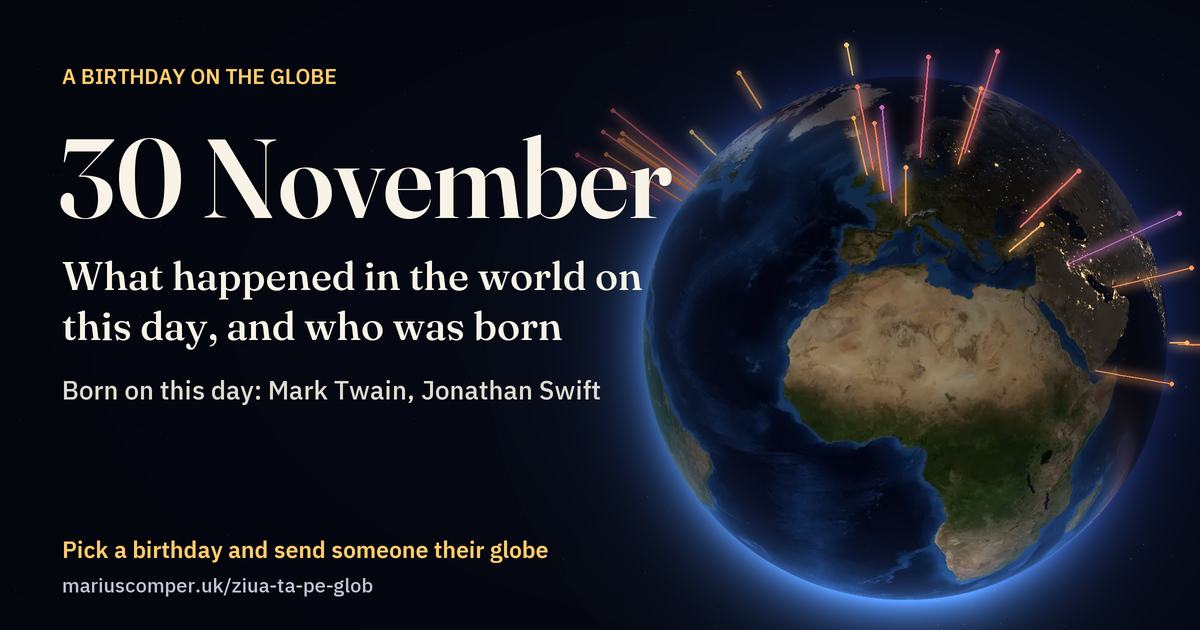
For 30 November, the English Wikipedia lists 47 events and 255 births. 26 of the events stand at their places as rays of light; five more are dashed circles, where the sentence links only to a country or a sea. The taller the ray, the longer ago it happened. The people born that day come further down, as blue points.
A birthday, yours or someone else’s:
Turn it into a greetingScroll: the globe turns to each place
The day you were born, on the globe.
Three things from your day
Scroll: your day first, then 30 November through the years
The Earth on 30 November
The picture on the globe was assembled by NASA from satellite photographs taken in November 2004: the snow, the ice and the green are those of the month.
On 30 November the Sun passes straight overhead at noon along the parallel of 21.6° south. In London, the day lasts about 8 hours 15 minutes.
Beyond 68° south the Sun no longer sets; beyond 68° north it no longer rises.
The line between day and night is tilted on the globe exactly as on this day of the year. On the dark side you can see the lights of towns.
Britain & Ireland · Hamilton Crescent
1872
The first-ever international football match takes place at Hamilton Crescent, Glasgow, between Scotland and England.
On the map: Hamilton Crescent.
Also on the day’s list of Wikipedia in Spanish and Chinese.
Britain & Ireland · Belfast City Hall
1995
U.S. President Bill Clinton visits Northern Ireland and speaks in favor of the "Northern Ireland peace process" to a huge rally at Belfast City Hall; he calls IRA fighters "yesterday's men".
On the map: Belfast City Hall.
North America · Louisiana Territory
1803
In New Orleans, Spanish representatives officially transfer the Louisiana Territory to the French First Republic.
On the map: Louisiana Territory.
North America · Amon G. Carter Stadium
1935
A college football game between the SMU Mustangs and the TCU Horned Frogs became the first game in Texas to be broadcast nationally on radio.
On the map: Amon G. Carter Stadium.
30 November
What the other Wikipedias remember#
For these years the English list has nothing on this day. The events below come from the same day’s lists on Wikipedia in Chinese and were translated for this page.
From Wikipedia in Chinese · Niagara Falls
1829
The Welland Canal, linking Lake Erie and Lake Ontario in Canada, officially opens, allowing ships to avoid Niagara Falls.
On the map: Niagara Falls.
Translated from the list on Wikipedia in Chinese.
30 November
Born on 30 November#
The English Wikipedia lists 255 births for this day. The blue points are the birthplaces of 60 of these people: those written about in the most Wikipedia editions, where Wikidata gives a place of birth.
Born on 30 November
1835
Mark Twain, American novelist, humorist, and critic (died 1910)
Place of birth: Florida.
Born on 30 November
1667
Jonathan Swift, Irish satirist and essayist (died 1745)
Place of birth: Dublin.
Born on 30 November
1935
Woody Allen, American actor, director, and screenwriter
Place of birth: The Bronx.
Born on 30 November
1817
Theodor Mommsen, German jurist, historian, and scholar, Nobel Prize laureate (died 1903)
Place of birth: Garding.
Born on 30 November
1982
Elisha Cuthbert, Canadian actress
Place of birth: Calgary.
Born in Britain and Ireland
1937
Ridley Scott, English director, producer, and production designer
Place of birth: South Shields.
Born in Britain and Ireland
1960
Gary Lineker, English footballer and sportscaster
Place of birth: Leicester.
Born in Britain and Ireland
1955
Billy Idol, English singer-songwriter, guitarist, and actor
Place of birth: Stanmore.
30 November
Number one in the charts that week
At the cinema
An animal recorded that day
The record can be seen in GBIF, which brings together wildlife records from around the world.
All your birthdays
The weather that day
Data: Met Office Hadley Centre (HadCET); NOAA (GHCN-Daily, Mauna Loa).
Above the Earth
Sources: Jonathan McDowell, GCAT (launches); GFZ Potsdam (Kp index). Days are counted in Universal Time.
Football that day
International matches played that day:
Source: the “International football results” dataset kept by Mart Jürisoo (CC0).
Also that day
The earthquake’s page at the USGS
Source: the USGS catalogue. The day is counted in Universal Time (UTC).
In those days
Make a link for someone
Type the name, pick the day and the year of birth. The link opens straight on their day, with their name in the greeting.
The link carries the name, date and place typed here; anyone who gets it can see them.
Put another birthday beside it
Your mother’s, your child’s, a friend’s: the two days appear side by side.
Below: 30 November through the years.
The whole globe of the day
Drag the globe to turn it. Touch a ray or a point to read what happened there.
Everything Wikipedia lists for 30 November
The list is the English Wikipedia’s, in its own wording, as it stood in October 2026. 16 events have no place on the map: the sentence links to no place with coordinates, only to places too wide to mark, or to several countries.
- 883
Abu al Abbas celebrates a victory parade in Bagdhad following the suppression of the Zanj Rebellion, the largest slave revolt in the Arab world.
Asia · BaghdadWikipedia: Zanj Rebellion - 978
Franco-German war of 978–980: Holy Roman Emperor Otto II lifts the siege of Paris and withdraws.
Europe · ParisWikipedia: Franco-German war of 978–980 - 1700
Great Northern War: Swedish forces led by King Charles XII defeated the Russian army at the Battle of Narva.
Europe · Battle of NarvaWikipedia: Battle of Narva - 1707
Queen Anne's War: The second Siege of Pensacola comes to end with the failure of the British Empire and their Creek allies to capture Pensacola, Spanish Florida.
North America · Siege of PensacolaWikipedia: Queen Anne's War - 1718
Great Northern War: King Charles XII of Sweden dies during a siege of the fortress of Fredriksten in Norway.
Europe · Siege of FredrikstenWikipedia: Siege of Fredriksten - 1782
American Revolutionary War: Treaty of Paris: In Paris, representatives from the United States and Great Britain sign preliminary peace articles (later formalized as the 1783 Treaty of Paris).
no place on the mapWikipedia: Treaty of Paris - 1786
The Grand Duchy of Tuscany, under Pietro Leopoldo I, becomes the first modern state to abolish the death penalty (later commemorated as Cities for Life Day).
Europe · Grand Duchy of TuscanyWikipedia: Grand Duchy of Tuscany - 1803
In New Orleans, Spanish representatives officially transfer the Louisiana Territory to the French First Republic.
North America · Louisiana TerritoryWikipedia: Louisiana Territory - 1803
The Balmis Expedition starts in Spain with the aim of vaccinating millions against smallpox in Spanish America and Philippines.
no place on the mapWikipedia: Balmis Expedition - 1853
Crimean War: Battle of Sinop: The Imperial Russian Navy under Pavel Nakhimov destroys the Ottoman fleet under Osman Pasha at Sinop, a sea port in northern Turkey.
Asia · Battle of SinopWikipedia: Battle of Sinop - 1864
American Civil War: The Confederate Army of Tennessee led by General John Bell Hood suffers heavy losses in an attack on the Union Army of the Ohio under General John Schofield in the Battle of Franklin.
North America · Battle of FranklinWikipedia: American Civil War - 1872
The first-ever international football match takes place at Hamilton Crescent, Glasgow, between Scotland and England.
Britain & Ireland · Hamilton CrescentWikipedia: 1872 Scotland v England football match - 1916
Costa Rica signs the Buenos Aires Convention, a copyright treaty.
Latin America · Costa RicaWikipedia: Buenos Aires Convention - 1934
Flying Scotsman became the first steam locomotive officially to exceed 100 miles per hour (161 km/h).
no place on the mapWikipedia: LNER Class A3 4472 Flying Scotsman - 1935
A college football game between the SMU Mustangs and the TCU Horned Frogs became the first game in Texas to be broadcast nationally on radio.
North America · Amon G. Carter StadiumWikipedia: 1935 SMU vs. TCU football game - 1936
English mathematician Alan Turing published the first details of the Turing machine, an abstract device that can simulate the logic of any computer algorithm by manipulating symbols.
no place on the mapWikipedia: Alan Turing - 1936
In London, the Crystal Palace is destroyed by fire.
Britain & Ireland · The Crystal PalaceWikipedia: The Crystal Palace - 1939
World War II: The Soviet Red Army crosses the Finnish border in several places, bombing Helsinki and several other Finnish cities, starting the Winter War.
no place on the mapWikipedia: World War II - 1940
World War II: Signing of the Sino-Japanese Treaty of 1940 between the Empire of Japan and the newly formed Wang Jingwei-led Reorganized National Government of the Republic of China. This treaty was considered so unfair to China that it was compared to the Twenty-One Demands.
no place on the mapWikipedia: Empire of Japan - 1941
The Holocaust: The SS-Einsatzgruppen round up roughly 25,000 Jews from the Riga Ghetto and kill them in the Rumbula massacre.
Europe · Riga GhettoWikipedia: The Holocaust - 1942
World War II: Battle of Tassafaronga; A smaller squadron of Imperial Japanese Navy destroyers led by Raizō Tanaka defeats a U.S. Navy cruiser force under Carleton H. Wright.
Oceania · Battle of TassafarongaWikipedia: Battle of Tassafaronga - 1947
Civil War in Mandatory Palestine begins, leading up to the creation of the State of Israel and the 1948 Arab–Israeli War.
- 1953
Edward Mutesa II, the kabaka (king) of Buganda is deposed and exiled to London by Sir Andrew Cohen, Governor of Uganda.
no place on the mapWikipedia: Mutesa II of Buganda - 1954
In Sylacauga, Alabama, United States, the Hodges meteorite crashes through a roof and hits a woman taking an afternoon nap; this is the only documented case in the Western Hemisphere of a human being hit by a rock from space.
North America · SylacaugaWikipedia: Sylacauga - 1957
President Sukarno of Indonesia escapes a grenade attack that kills multiple bystanders.
Asia · Cikini IncidentWikipedia: Cikini Incident - 1962
Eastern Air Lines Flight 512 crashes at Idlewild Airport, killing 25 people.
North America · Eastern Air Lines Flight 512Wikipedia: Eastern Air Lines Flight 512 - 1966
Decolonization: Barbados becomes independent from the United Kingdom.
Latin America · BarbadosWikipedia: Decolonization - 1967
Pro-Soviet communists in the Philippines establish Malayang Pagkakaisa ng Kabataan Pilipino as its new youth wing.
no place on the mapWikipedia: Partido Komunista ng Pilipinas-1930 - 1967
The Pakistan Peoples Party is founded by Zulfikar Ali Bhutto, who becomes its first chairman.
no place on the mapWikipedia: Pakistan People's Party - 1967
The People's Republic of Southern Yemen gains its independence from the United Kingdom
Asia · AdenWikipedia: Withdrawal from Aden - 1971
Iran seizes the Greater and Lesser Tunbs from the Emirates of Sharjah and Ras Al Khaimah.
Asia · Greater Tunb IslandWikipedia: Seizure of Abu Musa and the Greater and Lesser Tunbs - 1972
Vietnam War: White House Press Secretary Ron Ziegler tells the press that there will be no more public announcements concerning American troop withdrawals from Vietnam because troop levels are now down to 27,000.
North America · White HouseWikipedia: Vietnam War - 1979
The Wall, a rock opera and concept album by the English band Pink Floyd, was first released.
no place on the mapWikipedia: The Wall - 1981
Cold War: In Geneva, representatives from the United States and the Soviet Union begin to negotiate intermediate-range nuclear weapon reductions in Europe. (The meetings end inconclusively on December 17.)
Europe · GenevaWikipedia: Cold War - 1995
Official end of Operation Desert Storm.
no place on the mapWikipedia: Gulf War - 1995
U.S. President Bill Clinton visits Northern Ireland and speaks in favor of the "Northern Ireland peace process" to a huge rally at Belfast City Hall; he calls IRA fighters "yesterday's men".
Britain & Ireland · Belfast City HallWikipedia: Belfast City Hall - 1999
British Aerospace and Marconi Electronic Systems merge to form BAE Systems, Europe's largest defense contractor and the fourth largest aerospace firm in the world.
no place on the mapWikipedia: British Aerospace - 1999
Exxon and Mobil sign a US$73.7 billion agreement to merge, thus creating ExxonMobil, the world's largest company.
no place on the mapWikipedia: ExxonMobil - 1999
In Seattle, United States, demonstrations against a World Trade Organization meeting by anti-globalization protesters catch police unprepared and force the cancellation of opening ceremonies.
North America · Seattle Convention CenterWikipedia: 1999 Seattle WTO protests - 2000
NASA launches STS-97, the 101st Space Shuttle mission.
no place on the mapWikipedia: STS-97 - 2004
A McDonnell Douglas MD-82, operating as Lion Air Flight 538, overran the runway at Adisoemarmo Airport and crashed, killing 25 people.
Asia · Adi Soemarmo International AirportWikipedia: Lion Air Flight 538 - 2005
John Sentamu becomes the first black archbishop in the Church of England with his enthronement as the 97th Archbishop of York.
no place on the mapWikipedia: Church of England - 2007
Atlasjet Flight 4203 crashes in Keçiborlu while on approach to Isparta Süleyman Demirel Airport, killing 57.
Asia · Atlasjet Flight 4203Wikipedia: Atlasjet Flight 4203 - 2018
A magnitude 7.1 earthquake with its epicenter only 24 km from Anchorage, Alaska causes significant property damage but no deaths.
North America · 2018 Anchorage earthquakeWikipedia: 2018 Anchorage earthquake - 2021
A 15-year-old gunman murders four students and injures seven people, including a teacher, in a mass shooting at Oxford High School in Oxford Township, Michigan.
North America · 2021 Oxford High School shootingWikipedia: 2021 Oxford High School shooting - 2021
Barbados becomes a republic.
Latin America · BarbadosWikipedia: Barbados - 2022
The generative AI chatbot ChatGPT is launched by OpenAI.
no place on the mapWikipedia: ChatGPT
What the other Wikipedias remember
For these years the English list has nothing on this day. The events below come from the same day’s lists on Wikipedia in Chinese and were translated for this page.
- 1829
The Welland Canal, linking Lake Erie and Lake Ontario in Canada, officially opens, allowing ships to avoid Niagara Falls.
Who was born on 30 November
In order of how many Wikipedia editions have an article about each. The first 60 of 255 are shown.
- 1874
Winston Churchill, English colonel, journalist, and politician, Prime Minister of the United Kingdom, Nobel Prize laureate (died 1965)
Blenheim PalaceWikipedia: Winston Churchill - 1835
Mark Twain, American novelist, humorist, and critic (died 1910)
FloridaWikipedia: Mark Twain - 1667
Jonathan Swift, Irish satirist and essayist (died 1745)
- 1935
Woody Allen, American actor, director, and screenwriter
The BronxWikipedia: Woody Allen - 1817
Theodor Mommsen, German jurist, historian, and scholar, Nobel Prize laureate (died 1903)
GardingWikipedia: Theodor Mommsen - 1982
Elisha Cuthbert, Canadian actress
CalgaryWikipedia: Elisha Cuthbert - 1990
Magnus Carlsen, Norwegian chess player
TønsbergWikipedia: Magnus Carlsen - 1937
Ridley Scott, English director, producer, and production designer
South ShieldsWikipedia: Ridley Scott - 1960
Gary Lineker, English footballer and sportscaster
LeicesterWikipedia: Gary Lineker - 1965
Ben Stiller, American actor, director, producer and screenwriter
New York CityWikipedia: Ben Stiller - 1869
Gustaf Dalén, Swedish physicist and engineer, Nobel Prize laureate (died 1937)
- 1508
Andrea Palladio, Italian architect and theoretician, designed the Church of San Giorgio Maggiore and Teatro Olimpico (died 1580)
- 1985
Kaley Cuoco, American actress
CamarilloWikipedia: Kaley Cuoco - 1874
Lucy Maud Montgomery, English-Canadian author and poet (died 1942)
Prince Edward IslandWikipedia: Lucy Maud Montgomery - 1825
William-Adolphe Bouguereau, French painter and educator (died 1905)
La RochelleWikipedia: William-Adolphe Bouguereau - 1889
Edgar Adrian, 1st Baron Adrian, English physiologist and academic, Nobel Prize laureate (died 1977)
HampsteadWikipedia: Edgar Adrian - 1924
Shirley Chisholm, American activist, educator and politician (died 2005)
BrooklynWikipedia: Shirley Chisholm - 1554
Philip Sidney, English soldier, courtier, and poet (died 1586)
PenshurstWikipedia: Philip Sidney - 1858
Jagadish Chandra Bose, Indian physicist, biologist, botanist, and archaeologist (died 1937)
BikrampurWikipedia: Jagadish Chandra Bose - 1915
Henry Taube, Canadian-American chemist and academic, Nobel Prize laureate (died 2005)
NeudorfWikipedia: Henry Taube - 1943
Terrence Malick, American director, producer, and screenwriter
- 1952
Mandy Patinkin, American actor and singer
ChicagoWikipedia: Mandy Patinkin - 1978
Gael García Bernal, Mexican actor and producer
GuadalajaraWikipedia: Gael García Bernal - 1987
Daniel Noboa, Politician and businessman, President of Ecuador
GuayaquilWikipedia: Daniel Noboa - 539
Gregory of Tours, French bishop and saint (probable; (died 594)
Clermont-FerrandWikipedia: Gregory of Tours - 1926
Andrew Schally, Polish-American endocrinologist (died 2024)
VilniusWikipedia: Andrew Schally - 1955
Billy Idol, English singer-songwriter, guitarist, and actor
StanmoreWikipedia: Billy Idol - 1984
Nigel de Jong, Dutch footballer
AmsterdamWikipedia: Nigel de Jong - 1427
Casimir IV Jagiellon, King of Poland (died 1492)
- 1699
King Christian VI of Denmark (died 1746)
Copenhagen CastleWikipedia: Christian VI - 1965
Aldair, Brazilian footballer
IlhéusWikipedia: Aldair - 1965
Fumihito, Prince Akishino, Japanese royal (younger brother of Emperor Naruhito and first in line to the Chrysanthemum Throne)
- 1670
John Toland, Irish philosopher and author (died 1722)
ArdaghWikipedia: John Toland - 1756
Ernst Chladni, German physicist and author (died 1827)
Lutherstadt WittenbergWikipedia: Ernst Chladni - 1863
Andrés Bonifacio, Filipino activist and politician, co-founded Katipunan (died 1897)
- 1813
Charles-Valentin Alkan, French pianist and composer (died 1888)
- 1945
Roger Glover, Welsh bass player, songwriter, and producer
BreconWikipedia: Roger Glover - 1847
Afonso Pena, Brazilian lawyer and politician, 6th President of Brazil (died 1909)
Santa BárbaraWikipedia: Afonso Pena - 1969
Marc Forster, German-Swiss director, producer, and screenwriter
IllertissenWikipedia: Marc Forster - 1926
Richard Crenna, American actor, director, and producer (died 2003)
Los AngelesWikipedia: Richard Crenna - 1947
Sergio Badilla Castillo, Chilean-Swedish poet and translator
ValparaísoWikipedia: Sergio Badilla Castillo - 1947
David Mamet, American playwright, screenwriter, and director
ChicagoWikipedia: David Mamet - 1989
Vladimír Weiss, Slovak footballer
BratislavaWikipedia: Vladimír Weiss - 1466
Andrea Doria, Italian admiral (died 1560)
OnegliaWikipedia: Andrea Doria - 1918
Efrem Zimbalist, Jr., American actor (died 2014)
New York CityWikipedia: Efrem Zimbalist Jr. - 1927
Robert Guillaume, American actor and singer (died 2017)
St. LouisWikipedia: Robert Guillaume - 1966
Mika Salo, Finnish racing driver
HelsinkiWikipedia: Mika Salo - 1977
Steve Aoki, American DJ and producer, founded Dim Mak Records
- 1984
Olga Rypakova, Kazakhstani triple jumper
OskemenWikipedia: Olga Rypakova - 1719
Princess Augusta of Saxe-Gotha, Princess of Wales (died 1772)
- 1920
Virginia Mayo, American actress (died 2005)
St. LouisWikipedia: Virginia Mayo - 1642
Andrea Pozzo, Jesuit Brother, architect and painter (died 1709)
TrentoWikipedia: Andrea Pozzo - 1973
Christian Cage, Canadian wrestler, actor, and podcaster
KitchenerWikipedia: Christian Cage - 1912
Gordon Parks, American photographer and director (died 2006)
Fort ScottWikipedia: Gordon Parks - 1954
Lawrence Summers, American economist and academic
New HavenWikipedia: Larry Summers - 1984
Alan Hutton, Scottish footballer
GlasgowWikipedia: Alan Hutton - 1929
Dick Clark, American television host and producer, founded Dick Clark Productions (died 2012)
Mount VernonWikipedia: Dick Clark - 1972
Abel Xavier, Portuguese footballer and manager
NampulaWikipedia: Abel Xavier - 1978
Clay Aiken, American singer
RaleighWikipedia: Clay Aiken - 1813
Louise-Victorine Ackermann, French poet and author (died 1890)
What is celebrated on 30 November
- Bonifacio Day (Philippines)
- Christian feast day: Andrew and its related observances.
- Christian feast day: Joseph Marchand (one of Vietnamese Martyrs)
- Christian feast day: Cuthbert Mayne
- Christian feast day: Thaddeus Liu
- Christian feast day: November 30 (Eastern Orthodox liturgics)
- Commemoration Day (United Arab Emirates)
- Day to Mark the Departure and Expulsion of Jews from the Arab Countries and Iran (Israel)
- Independence Day, celebrates the independence of Barbados from the United Kingdom in 1966
- National Day (Benin)
- Regina Mundi Day (South Africa)
- Saint Andrew's Day (Scotland)
- Day of Remembrance for All Victims of Chemical Warfare (United Nations)
A greeting link for someone
Type a name and, if you like, the year of birth. The link opens with a greeting, and beside each event it says how old the person turned that day, or how many years before their birth it happened.
The name and the year go only into the link you send.
All 366 days
How the globe is made
Where the events come from
Each edition of this page uses the day’s list from Wikipedia in its own language: Romanian, English, Spanish, Chinese. The lists are written by volunteers and differ from one edition to the next; the text of each event is Wikipedia’s, with a link to the article. A row that appears twice in a list is shown once. The lists have not been checked event by event: they are Wikipedia’s, mistakes included.
For events before 1582, and for countries that moved to the Gregorian calendar later (Britain in 1752, Russia in 1918), the same day may be counted Old Style in one list and New Style in another.
The chapter “What the other Wikipedias remember” adds up to five events a day from the lists of the other three editions, only for years in which the English list has nothing on that day. They were translated for this page, passed the same filters as the tour, and are not counted among the events of the English list.
How an event gets onto the map
The place comes from Wikidata. If the sentence links to the article about the event itself (a battle, an opening, an earthquake), dated to the same year, the ray stands on its coordinates or on those of its location. Otherwise it stands on the first place the sentence links to: a town, a building, a mountain, an island. This second step can be wrong: sometimes the sentence only mentions the place. That is why the page says, under each event, which place the ray stands on.
When the sentence links to a single state or province, or to a single sea, lake or desert larger than 5,000 km², the globe shows a dashed circle, not a ray. The circle has the area Wikidata gives, with its radius kept between 1.2° and 16°, or a radius of 4.5° when Wikidata gives no area; it says only that the sentence links to that place. Organisations, ships, spacecraft, museum objects, rivers, mountain ranges, languages and continents are never used as places. When a sentence names several states and no exact place, the event stays in the list only.
What the height means
The height of a ray shows how many years have passed, on a logarithmic scale: 10 years, 100 years and 1,000 years are equal steps apart; anything older than about 2,600 years has the tallest ray. The colour runs from pale yellow for recent years to violet for antiquity.
Where the tour stops
In each region the tour stops at up to three events (five in Britain and Ireland), chosen mainly by three things: whether Wikipedia’s editors put the event in the “On this day” box of their main page (the English, Spanish and Chinese editions), how many Wikipedia editions have an article about it, and how many of the four lists include it. Events whose sentence or article is about a war, an attack, a crime or a disaster are left out of the tour; they stay in the whole list, in Wikipedia’s wording. The filter is a list of words and a list of Wikidata types, so it can miss some.
The tour of births names the people with articles in the most editions and leaves aside those whom the list or Wikidata describes as rulers, politicians, commanders, leaders of movements or criminals; they stay in the list.
The Earth and the Sun
The daytime images are NASA’s Blue Marble Next Generation mosaics, one for each month of 2004; the night side is Black Marble 2016. The tilt of the line between day and night is computed for the day; the hour is chosen so that the place being read is in daylight. The latitude where the Sun stands overhead is the average of the four years of the leap cycle; in a given year it can differ by up to 0.4°.
The day you were born
The number ones come from the weekly lists on Wikipedia: Billboard for the United States (from 1940; the Hot 100 from August 1958), the UK Singles Chart (from November 1952), Los 40 Principales for Spain (from July 1966) and, for Romania, the Romanian Top 100 and Airplay 100 (2001–2021, with missing weeks). The page shows the chart of the week in which the day of birth falls, with its date; Billboard and the UK chart are dated at the end of their week. For Romania before 2001 and for China these sources have no weekly chart.
The films are those that reached cinemas in the United States up to ten days before or three days after that day (some of them in a few cinemas at first), from the English Wikipedia’s yearly lists (from 1968), in order of how many editions have an article about them. The events “in those days” are the ones on the neighbouring days’ lists that carry the year of birth, passed through the same filter as the tour.
The day of birth, year included
The Moon, the star sign and the constellation are worked out by the page itself, for noon Universal Time on the day. The lit part of the Moon is rounded and can differ by a few per cent from that at the hour of birth. The sign follows the usual zodiac of twelve equal parts starting at the March equinox; the constellation is the one the Sun actually stood in front of, by the borders set by the International Astronomical Union, and within a day of a border the page does not name it. When the Sun changes sign while it is that day anywhere on Earth, the page gives the moment of crossing, rounded to ten minutes and accurate to within about a quarter of an hour, and the clock time in a few cities, with the time zone and summer time of that year.
The year in the Chinese calendar is the one your device’s own calendar gives for the date, checked against the Hong Kong Observatory’s tables. “All your birthdays” uses the same sources as the rest of the chapter for the same day in every year since the birth: the temperature, well-known launches that took place on that very day, matches of the teams the edition follows, snow deeper than 10 cm and strong geomagnetic storms. The three things at the top and the four on the picture are chosen in a fixed order (the song, the animal, a full Moon, a well-known launch before an ordinary earthquake); on the picture you can change them.
When the link carries a year of birth, the page adds a few things about that exact day. The weather is the Met Office’s Central England temperature record and the readings from New York’s Central Park; the “usual high” is the average of the daily highs of 1961–1990 for that date, with two days either side. The carbon dioxide figure is the monthly mean at the Mauna Loa observatory, where measurements begin in March 1958.
The earthquake is the one with the largest magnitude in the USGS catalogue for that day, counted in Universal Time. Before the 1960s the catalogue has gaps even above magnitude 5.5, so in the older years many days have no earthquake. The page gives only the magnitude and the place: the country the epicentre falls in or, when the epicentre is at sea within 300 km of a coast, the nearest country; farther out, only the ocean.
The launches are those that reached orbit or left for the Moon and the planets, from Jonathan McDowell’s GCAT catalogue. If nothing left that day, the page shows the nearest launch within three days before or after, and says how many days away it was. The geomagnetic storm appears only when the Kp index reached at least 5 in one of the day’s eight three-hour intervals.
The animal comes from GBIF: an observation made by a person (the animal seen or heard, or its tracks), dated to that exact day, with coordinates and a CC0 or CC BY licence. Only a few hundred well-known species are searched (mammals, birds, turtles, butterflies); of those noted that day, mammals and species with articles in many Wikipedia editions come first; birds noted almost every day, and species used recently, wait their turn. Observations dated 1 January are left out, because records without a day are often filed there. An observation shows that the animal was recorded there, not how many animals there were.
The matches are those between national teams. Only matches of England, Scotland, Wales, Northern Ireland, the Republic of Ireland, the United States, Canada and Australia are shown, along with those at the big final tournaments. The picture to send is drawn in the page from the day’s globe and the facts above, and stays on your device until you send it.
Sources
- Events, births and holidays: the day’s page on Wikipedia, text under CC BY-SA 4.0.
- Coordinates, places of birth and the number of editions: Wikidata (CC0).
- The Earth by day: NASA Blue Marble Next Generation. The Earth by night: NASA Black Marble 2016.
- Borders and regions: Natural Earth.
- World population and births per year: UN World Population Prospects 2024.
- Charts and films: Wikipedia’s lists for Billboard, the UK Singles Chart, Los 40 Principales, Romanian Top 100, Airplay 100 and American films by year (CC BY-SA 4.0).
- Weather: Met Office Hadley Centre, HadCET (Open Government Licence) and NOAA GHCN-Daily, New York Central Park. Carbon dioxide: NOAA Global Monitoring Laboratory, Mauna Loa.
- Earthquakes: the USGS catalogue. Launches: Jonathan McDowell, GCAT (CC BY). Kp index: GFZ Potsdam (CC BY 4.0). Matches: International football results, Mart Jürisoo (CC0).
- Animal observations: GBIF, with a link to each record; species names come from Wikidata.