A birthday on the globe
14 January on the globe: what happened in the world on this day, and who was born
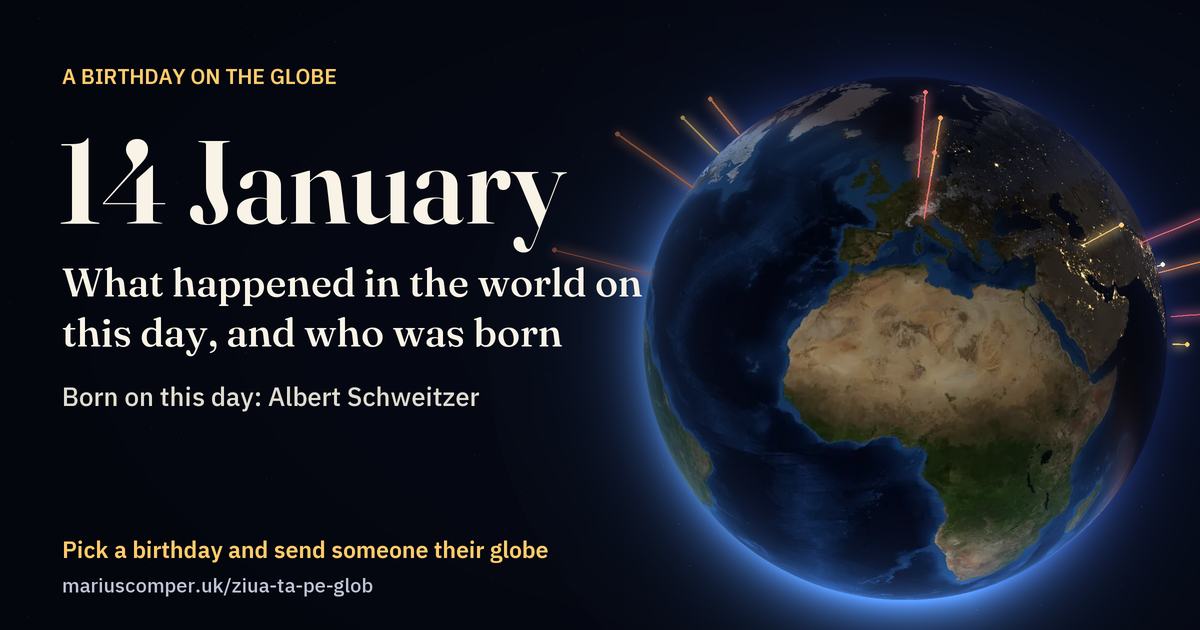
For 14 January, the English Wikipedia lists 37 events and 255 births. 15 of the events stand at their places as rays of light; three more are dashed circles, where the sentence links only to a country or a sea. The taller the ray, the longer ago it happened. The people born that day come further down, as blue points.
A birthday, yours or someone else’s:
Turn it into a greetingScroll: the globe turns to each place
The day you were born, on the globe.
Three things from your day
Scroll: your day first, then 14 January through the years
The Earth on 14 January
The picture on the globe was assembled by NASA from satellite photographs taken in January 2004: the snow, the ice and the green are those of the month.
On 14 January the Sun passes straight overhead at noon along the parallel of 21.4° south. In London, the day lasts about 8 hours 15 minutes.
Beyond 69° south the Sun no longer sets; beyond 69° north it no longer rises.
The line between day and night is tilted on the globe exactly as on this day of the year. On the dark side you can see the lights of towns.
Europe · Kiel
1814
Treaty of Kiel: Frederick VI of Denmark cedes the Kingdom of Norway to Charles XIII of Sweden in return for Pomerania.
On the map: Kiel.
Also on the day’s list of Wikipedia in Spanish and Chinese.
North America · Golden Gate Park
1967
Counterculture of the 1960s: The Human Be-In takes place in San Francisco, California's Golden Gate Park, launching the Summer of Love.
On the map: Golden Gate Park.
Also on the day’s list of Wikipedia in Chinese.
North America · U.S. Bank Stadium
2018
In the "Minneapolis Miracle", American football player Stefon Diggs caught a 61-yard (56 m) touchdown pass that secured the Minnesota Vikings' victory in the National Football Conference divisional playoff game.
On the map: U.S. Bank Stadium.
14 January
What the other Wikipedias remember#
For these years the English list has nothing on this day. The events below come from the same day’s lists on Wikipedia in Spanish and were translated for this page.
From Wikipedia in Spanish · Rome
1506
In Rome, the famous sculpture of classical Greek antiquity, Laocoön and His Sons, is discovered.
On the map: Rome.
Translated from the list on Wikipedia in Spanish.
From Wikipedia in Spanish · Vienna
1989
In Vienna, the NATO and Warsaw Pact countries agree to begin negotiations on conventional disarmament in Europe.
On the map: Vienna.
Translated from the list on Wikipedia in Spanish.
14 January
Born on 14 January#
The English Wikipedia lists 255 births for this day. The blue points are the birthplaces of 60 of these people: those written about in the most Wikipedia editions, where Wikidata gives a place of birth.
Born on 14 January
1875
Albert Schweitzer, French-German physician and philosopher, Nobel Prize laureate (died 1965)
Place of birth: Kaysersberg.
Born on 14 January
1925
Yukio Mishima, Japanese author, poet, and playwright (died 1970)
Place of birth: Tokyo.
Born on 14 January
1969
Jason Bateman, American actor, director, and producer
Place of birth: Rye.
Born on 14 January
1963
Steven Soderbergh, American director, producer, and screenwriter
Place of birth: Atlanta.
Born on 14 January
1969
Dave Grohl, American singer-songwriter, guitarist, and drummer
Place of birth: Warren.
Born in Britain and Ireland
1999
Declan Rice, English footballer
Place of birth: Kingston upon Thames.
Born in Britain and Ireland
1967
Emily Watson, English actress
Place of birth: Islington.
Born in Britain and Ireland
1992
Robbie Brady, Irish footballer
Place of birth: Dublin.
14 January
Number one in the charts that week
At the cinema
An animal recorded that day
The record can be seen in GBIF, which brings together wildlife records from around the world.
All your birthdays
The weather that day
Data: Met Office Hadley Centre (HadCET); NOAA (GHCN-Daily, Mauna Loa).
Above the Earth
Sources: Jonathan McDowell, GCAT (launches); GFZ Potsdam (Kp index). Days are counted in Universal Time.
Football that day
International matches played that day:
Source: the “International football results” dataset kept by Mart Jürisoo (CC0).
Also that day
The earthquake’s page at the USGS
Source: the USGS catalogue. The day is counted in Universal Time (UTC).
In those days
Make a link for someone
Type the name, pick the day and the year of birth. The link opens straight on their day, with their name in the greeting.
The link carries the name, date and place typed here; anyone who gets it can see them.
Put another birthday beside it
Your mother’s, your child’s, a friend’s: the two days appear side by side.
Below: 14 January through the years.
The whole globe of the day
Drag the globe to turn it. Touch a ray or a point to read what happened there.
Everything Wikipedia lists for 14 January
The list is the English Wikipedia’s, in its own wording, as it stood in October 2026. 19 events have no place on the map: the sentence links to no place with coordinates, only to places too wide to mark, or to several countries.
- 1236
King Henry III of England marries Eleanor of Provence.
no place on the mapWikipedia: Henry III of England - 1301
Andrew III of Hungary dies, ending the Árpád dynasty in Hungary.
no place on the mapWikipedia: Andrew III of Hungary - 1641
Dutch–Portuguese War: The Dutch siege of Malacca against the Portuguese ended when Dutch troops seized the city's citadel.
Asia · Siege of MalaccaWikipedia: Dutch–Portuguese War - 1724
Philip V, the first Bourbon king of Spain, abdicated in favour of his seventeen-year-old eldest son, who became Louis I.
no place on the mapWikipedia: Philip V of Spain - 1761
The Third Battle of Panipat, the largest battle of the 18th century, is fought in India between the Afghan Durrani Empire under Ahmad Shah Durrani, and the Maratha Empire under Sadashivrao Bhau.
Asia · Third Battle of PanipatWikipedia: Third Battle of Panipat - 1784
American Revolutionary War: Ratification Day, United States: Congress ratifies the Treaty of Paris with Great Britain.
Britain & Ireland · Kingdom of Great BritainWikipedia: Treaty of Paris - 1797
The Battle of Rivoli is fought with a decisive French victory by Napoleon Bonaparte, marking the beginning of the end of the War of the First Coalition and the start of French hegemony over Italy for two decades.
Europe · Battle of RivoliWikipedia: Battle of Rivoli - 1814
Treaty of Kiel: Frederick VI of Denmark cedes the Kingdom of Norway to Charles XIII of Sweden in return for Pomerania.
Europe · KielWikipedia: Treaty of Kiel - 1858
Napoleon III of France escapes an assassination attempt made by Felice Orsini and his accomplices in Paris.
no place on the mapWikipedia: Napoleon III - 1899
RMS Oceanic, the largest ship afloat since SS Great Eastern, is launched.
no place on the mapWikipedia: RMS Oceanic - 1900
Giacomo Puccini's Tosca opens in Rome.
no place on the mapWikipedia: Giacomo Puccini - 1907
An earthquake in Kingston, Jamaica kills more than 1,000 people.
Latin America · 1907 Kingston earthquakeWikipedia: 1907 Kingston earthquake - 1911
Roald Amundsen's South Pole expedition makes landfall on the eastern edge of the Ross Ice Shelf.
no place on the mapWikipedia: Amundsen's South Pole expedition - 1939
Norway claims Queen Maud Land in Antarctica.
Oceans · Queen Maud LandWikipedia: Queen Maud Land - 1943
World War II: Franklin D. Roosevelt and Winston Churchill begin the Casablanca Conference to discuss strategy and study the next phase of the war.
no place on the mapWikipedia: Casablanca Conference - 1943
World War II: Japan begins Operation Ke, the successful operation to evacuate its forces from Guadalcanal during the Guadalcanal campaign.
Oceania · Operation KeWikipedia: World War II - 1951
National Airlines Flight 83 crashes during landing at Philadelphia International Airport, killing seven passengers and crew.
North America · National Airlines Flight 83Wikipedia: National Airlines Flight 83 - 1952
NBC's long-running morning news program Today debuts, with host Dave Garroway.
no place on the mapWikipedia: NBC - 1953
Josip Broz Tito is elected the first President of Yugoslavia.
no place on the mapWikipedia: Josip Broz Tito - 1954
The Hudson Motor Car Company merges with Nash-Kelvinator Corporation forming the American Motors Corporation.
no place on the mapWikipedia: Hudson Motor Car Company - 1957
Kripalu Maharaj is named fifth Jagadguru (world teacher) after giving seven days of speeches before 500 Hindu scholars.
no place on the mapWikipedia: Kripalu Maharaj - 1960
The Reserve Bank of Australia, the country's central bank and banknote issuing authority authorized by the 1959 Reserve Bank Act, is established.
no place on the mapWikipedia: Reserve Bank of Australia - 1966
Vietnam War: United States and Australian troops ended Operation Crimp; during the military operation, troops discovered an extensive tunnel network used by the Viet Cong.
Asia · Operation CrimpWikipedia: Vietnam War - 1967
Counterculture of the 1960s: The Human Be-In takes place in San Francisco, California's Golden Gate Park, launching the Summer of Love.
North America · Golden Gate ParkWikipedia: Counterculture of the 1960s - 1969
USS Enterprise fire: An accidental explosion aboard the USS Enterprise near Hawaii kills 28 people.
North America · 1969 USS Enterprise fireWikipedia: 1969 USS Enterprise fire - 1970
The self-proclaimed Republic of Biafra in southeastern Nigeria surrendered to the federal government less than three years after declaring independence, ending the Nigerian Civil War.
Africa · BiafraWikipedia: Biafra - 1972
Queen Margrethe II of Denmark ascends the throne, the first Queen of Denmark since 1412 and the first Danish monarch not named Frederik or Christian since 1513.
no place on the mapWikipedia: Margrethe II - 1973
Elvis Presley's concert Aloha from Hawaii is broadcast live via satellite, and sets the record as the most watched broadcast by an individual entertainer in television history.
no place on the mapWikipedia: Elvis Presley - 1978
Austrian logician Kurt Gödel, who suffered from an obsessive fear of being poisoned, died of starvation after his wife was hospitalized and unable to cook for him.
no place on the mapWikipedia: Logic - 1993
Sinking of the MS Jan Heweliusz: In Poland's worst peacetime maritime disaster, ferry MS Jan Heweliusz sinks off the coast of Rügen, drowning 55 passengers.
Europe · Sinking of the MS Jan HeweliuszWikipedia: Sinking of the MS Jan Heweliusz - 2010
Yemen declares an open war against the terrorist group al-Qaeda.
no place on the mapWikipedia: Al-Qaeda insurgency in Yemen - 2011
Arab Spring: Tunisian president Zine El Abidine Ben Ali fled the country after several violent protests.
no place on the mapWikipedia: Arab Spring - 2016
Multiple explosions reported near the Sarinah Building, Jakarta, followed by shootout between perpetrators and the police, killing seven people. The Islamic State of Iraq and the Levant claimed responsibility.
Asia · 2016 Jakarta attacksWikipedia: 2016 Jakarta attacks - 2018
In the "Minneapolis Miracle", American football player Stefon Diggs caught a 61-yard (56 m) touchdown pass that secured the Minnesota Vikings' victory in the National Football Conference divisional playoff game.
North America · U.S. Bank StadiumWikipedia: Minneapolis Miracle - 2019
A Saha Airlines Boeing 707 crashes at Fath Air Base near Karaj in Alborz Province, Iran, killing 15 people.
Asia · 2019 Saha Airlines Boeing 707 crashWikipedia: 2019 Saha Airlines Boeing 707 crash - 2024
Queen Margrethe II abdicates as Queen of Denmark and is succeeded by her son, Frederik X.
no place on the mapWikipedia: Abdication of Margrethe II - 2026
Thirty-two people are killed when a crane falls onto a passenger train in Sikhio district, Thailand.
Asia · Sikhio districtWikipedia: Sikhio train disaster
What the other Wikipedias remember
For these years the English list has nothing on this day. The events below come from the same day’s lists on Wikipedia in Spanish and were translated for this page.
- 1506
In Rome, the famous sculpture of classical Greek antiquity, Laocoön and His Sons, is discovered.
- 1989
In Vienna, the NATO and Warsaw Pact countries agree to begin negotiations on conventional disarmament in Europe.
Who was born on 14 January
In order of how many Wikipedia editions have an article about each. The first 60 of 255 are shown.
- 1875
Albert Schweitzer, French-German physician and philosopher, Nobel Prize laureate (died 1965)
KaysersbergWikipedia: Albert Schweitzer - 1925
Yukio Mishima, Japanese author, poet, and playwright (died 1970)
- 1969
Jason Bateman, American actor, director, and producer
- 83 BC
Mark Antony, Roman general and politician (died 30 BC)
- 1919
Giulio Andreotti, Italian journalist and politician, 41st Prime Minister of Italy (died 2013)
- 1861
Mehmed VI, Ottoman sultan (died 1926)
IstanbulWikipedia: Mehmed VI - 1963
Steven Soderbergh, American director, producer, and screenwriter
AtlantaWikipedia: Steven Soderbergh - 1969
Dave Grohl, American singer-songwriter, guitarist, and drummer
WarrenWikipedia: Dave Grohl - 1841
Berthe Morisot, French painter (died 1895)
BourgesWikipedia: Berthe Morisot - 1892
Martin Niemöller, German pastor and theologian (died 1984)
LippstadtWikipedia: Martin Niemöller - 1941
Faye Dunaway, American actress and producer
BascomWikipedia: Faye Dunaway - 1982
Víctor Valdés, Spanish footballer
L'Hospitalet de LlobregatWikipedia: Víctor Valdés - 1999
Declan Rice, English footballer
Kingston upon ThamesWikipedia: Declan Rice - 1896
John Dos Passos, American novelist, poet, and playwright (died 1970)
ChicagoWikipedia: John Dos Passos - 1850
Pierre Loti, French captain and author (died 1923)
RochefortWikipedia: Pierre Loti - 1967
Emily Watson, English actress
IslingtonWikipedia: Emily Watson - 1273
Joan I of Navarre, queen regnant of Navarre, queen consort of France (died 1305)
Bar-sur-SeineWikipedia: Joan I of Navarre - 1973
Giancarlo Fisichella, Italian race car driver
- 1901
Alfred Tarski, Polish-American mathematician and philosopher (died 1983)
WarsawWikipedia: Alfred Tarski - 1986
Yohan Cabaye, French footballer
TourcoingWikipedia: Yohan Cabaye - 1921
Murray Bookchin, American author and philosopher (died 2006)
The BronxWikipedia: Murray Bookchin - 1941
Milan Kučan, Slovenian politician, 1st President of Slovenia
KriževciWikipedia: Milan Kučan - 1905
Takeo Fukuda, Japanese politician, 67th Prime Minister of Japan (died 1995)
TakasakiWikipedia: Takeo Fukuda - 1938
Morihiro Hosokawa, Japanese journalist and politician, 79th Prime Minister of Japan
- 1968
LL Cool J, American rapper and actor
QueensWikipedia: LL Cool J - 1990
Grant Gustin, American actor and singer
NorfolkWikipedia: Grant Gustin - 1836
Henri Fantin-Latour, French painter and lithographer (died 1904)
GrenobleWikipedia: Henri Fantin-Latour - 1948
Carl Weathers, American football player and actor (died 2024)
New OrleansWikipedia: Carl Weathers - 1131
Valdemar I of Denmark (died 1182)
SchleswigWikipedia: Valdemar I of Denmark - 1952
Călin Popescu-Tăriceanu, Romanian engineer and politician, 60th Prime Minister of Romania
BucharestWikipedia: Călin Popescu-Tăriceanu - 1977
Narain Karthikeyan, Indian race car driver
CoimbatoreWikipedia: Narain Karthikeyan - 1741
Benedict Arnold, American-British general (died 1801)
NorwichWikipedia: Benedict Arnold - 1943
Shannon Lucid, American biochemist and astronaut
ShanghaiWikipedia: Shannon Lucid - 1943
Angelo Bagnasco, Italian cardinal
PontevicoWikipedia: Angelo Bagnasco - 2000
Jonathan David, Canadian soccer player
BrooklynWikipedia: Jonathan David - 1818
Zachris Topelius, Finnish author and journalist (died 1898)
NykarlebyWikipedia: Zachris Topelius - 1507
Catherine of Austria, Queen of Portugal (died 1578)
- 1798
Johan Rudolph Thorbecke, Dutch historian, jurist, and politician, 3rd Prime Minister of the Netherlands (died 1872)
- 1887
Hugo Steinhaus, Polish mathematician and academic (died 1972)
- 1943
Mariss Jansons, Latvian conductor (died 2019)
- 1943
Holland Taylor, American actress and playwright
PhiladelphiaWikipedia: Holland Taylor - 1971
Antonios Nikopolidis, Greek footballer and manager
- 1551
Abu'l-Fazl ibn Mubarak, Grand vizier of emperor Akbar (died 1602)
- 1897
Hasso von Manteuffel, German general and politician (died 1978)
- 1914
Harold Russell, Canadian-American soldier and actor (died 2002)
- 1966
Marko Hietala, Finnish singer-songwriter, bass player, and producer
KuopioWikipedia: Marko Hietala - 1994
Kai, South Korean singer, model, actor and dancer
SuncheonWikipedia: Kai - 1992
Robbie Brady, Irish footballer
DublinWikipedia: Robbie Brady - 1702
Emperor Nakamikado of Japan (died 1737)
- 1931
Caterina Valente, Italian-French singer and dancer (died 2024)
12th arrondissement of ParisWikipedia: Caterina Valente - 1966
Dan Schneider, American TV producer
MemphisWikipedia: Dan Schneider - 1909
Joseph Losey, American director, producer, and screenwriter (died 1984)
La CrosseWikipedia: Joseph Losey - 1705
Jean-Baptiste Charles Bouvet de Lozier, French sailor, explorer, and politician (died 1786)
Pleudihen-sur-RanceWikipedia: Jean-Baptiste Charles Bouvet de Lozier - 1886
Hugh Lofting, English author and poet, created Doctor Dolittle (died 1947)
MaidenheadWikipedia: Hugh Lofting - 1999
Emerson Royal, Brazilian footballer
São PauloWikipedia: Emerson Royal - 1911
Anatoly Rybakov, Russian-American author (died 1998)
DerzhanivkaWikipedia: Anatoly Rybakov - 1949
Lawrence Kasdan, American director, producer, and screenwriter
- 1967
Zakk Wylde, American guitarist and singer
BayonneWikipedia: Zakk Wylde - 1974
Kevin Durand, Canadian actor
Thunder BayWikipedia: Kevin Durand - 1904
Cecil Beaton, English photographer, painter, and costume designer (died 1980)
HampsteadWikipedia: Cecil Beaton
What is celebrated on 14 January
- Christian feast day: Barba'shmin
- Christian feast day: Devasahayam Pillai (Catholic Church)
- Christian feast day: Divina Pastora (Barquisimeto)
- Christian feast day: Eivind Berggrav (Lutheran)
- Christian feast day: Felix of Nola
- Christian feast day: Macrina the Elder
- Christian feast day: Odoric of Pordenone
- Christian feast day: January 14 (Eastern Orthodox liturgics)
- Defender of the Motherland Day (Uzbekistan)
- Feast of the Ass (Medieval Christianity)
- Flag Day (Georgia)
- National Forest Conservation Day (Thailand)
- Old New Year, and its related observance: Azhyrnykhua (Abkhazia)
- Old New Year, and its related observance: Yennayer (Berbers)
A greeting link for someone
Type a name and, if you like, the year of birth. The link opens with a greeting, and beside each event it says how old the person turned that day, or how many years before their birth it happened.
The name and the year go only into the link you send.
All 366 days
How the globe is made
Where the events come from
Each edition of this page uses the day’s list from Wikipedia in its own language: Romanian, English, Spanish, Chinese. The lists are written by volunteers and differ from one edition to the next; the text of each event is Wikipedia’s, with a link to the article. A row that appears twice in a list is shown once. The lists have not been checked event by event: they are Wikipedia’s, mistakes included.
For events before 1582, and for countries that moved to the Gregorian calendar later (Britain in 1752, Russia in 1918), the same day may be counted Old Style in one list and New Style in another.
The chapter “What the other Wikipedias remember” adds up to five events a day from the lists of the other three editions, only for years in which the English list has nothing on that day. They were translated for this page, passed the same filters as the tour, and are not counted among the events of the English list.
How an event gets onto the map
The place comes from Wikidata. If the sentence links to the article about the event itself (a battle, an opening, an earthquake), dated to the same year, the ray stands on its coordinates or on those of its location. Otherwise it stands on the first place the sentence links to: a town, a building, a mountain, an island. This second step can be wrong: sometimes the sentence only mentions the place. That is why the page says, under each event, which place the ray stands on.
When the sentence links to a single state or province, or to a single sea, lake or desert larger than 5,000 km², the globe shows a dashed circle, not a ray. The circle has the area Wikidata gives, with its radius kept between 1.2° and 16°, or a radius of 4.5° when Wikidata gives no area; it says only that the sentence links to that place. Organisations, ships, spacecraft, museum objects, rivers, mountain ranges, languages and continents are never used as places. When a sentence names several states and no exact place, the event stays in the list only.
What the height means
The height of a ray shows how many years have passed, on a logarithmic scale: 10 years, 100 years and 1,000 years are equal steps apart; anything older than about 2,600 years has the tallest ray. The colour runs from pale yellow for recent years to violet for antiquity.
Where the tour stops
In each region the tour stops at up to three events (five in Britain and Ireland), chosen mainly by three things: whether Wikipedia’s editors put the event in the “On this day” box of their main page (the English, Spanish and Chinese editions), how many Wikipedia editions have an article about it, and how many of the four lists include it. Events whose sentence or article is about a war, an attack, a crime or a disaster are left out of the tour; they stay in the whole list, in Wikipedia’s wording. The filter is a list of words and a list of Wikidata types, so it can miss some.
The tour of births names the people with articles in the most editions and leaves aside those whom the list or Wikidata describes as rulers, politicians, commanders, leaders of movements or criminals; they stay in the list.
The Earth and the Sun
The daytime images are NASA’s Blue Marble Next Generation mosaics, one for each month of 2004; the night side is Black Marble 2016. The tilt of the line between day and night is computed for the day; the hour is chosen so that the place being read is in daylight. The latitude where the Sun stands overhead is the average of the four years of the leap cycle; in a given year it can differ by up to 0.4°.
The day you were born
The number ones come from the weekly lists on Wikipedia: Billboard for the United States (from 1940; the Hot 100 from August 1958), the UK Singles Chart (from November 1952), Los 40 Principales for Spain (from July 1966) and, for Romania, the Romanian Top 100 and Airplay 100 (2001–2021, with missing weeks). The page shows the chart of the week in which the day of birth falls, with its date; Billboard and the UK chart are dated at the end of their week. For Romania before 2001 and for China these sources have no weekly chart.
The films are those that reached cinemas in the United States up to ten days before or three days after that day (some of them in a few cinemas at first), from the English Wikipedia’s yearly lists (from 1968), in order of how many editions have an article about them. The events “in those days” are the ones on the neighbouring days’ lists that carry the year of birth, passed through the same filter as the tour.
The day of birth, year included
The Moon, the star sign and the constellation are worked out by the page itself, for noon Universal Time on the day. The lit part of the Moon is rounded and can differ by a few per cent from that at the hour of birth. The sign follows the usual zodiac of twelve equal parts starting at the March equinox; the constellation is the one the Sun actually stood in front of, by the borders set by the International Astronomical Union, and within a day of a border the page does not name it. When the Sun changes sign while it is that day anywhere on Earth, the page gives the moment of crossing, rounded to ten minutes and accurate to within about a quarter of an hour, and the clock time in a few cities, with the time zone and summer time of that year.
The year in the Chinese calendar is the one your device’s own calendar gives for the date, checked against the Hong Kong Observatory’s tables. “All your birthdays” uses the same sources as the rest of the chapter for the same day in every year since the birth: the temperature, well-known launches that took place on that very day, matches of the teams the edition follows, snow deeper than 10 cm and strong geomagnetic storms. The three things at the top and the four on the picture are chosen in a fixed order (the song, the animal, a full Moon, a well-known launch before an ordinary earthquake); on the picture you can change them.
When the link carries a year of birth, the page adds a few things about that exact day. The weather is the Met Office’s Central England temperature record and the readings from New York’s Central Park; the “usual high” is the average of the daily highs of 1961–1990 for that date, with two days either side. The carbon dioxide figure is the monthly mean at the Mauna Loa observatory, where measurements begin in March 1958.
The earthquake is the one with the largest magnitude in the USGS catalogue for that day, counted in Universal Time. Before the 1960s the catalogue has gaps even above magnitude 5.5, so in the older years many days have no earthquake. The page gives only the magnitude and the place: the country the epicentre falls in or, when the epicentre is at sea within 300 km of a coast, the nearest country; farther out, only the ocean.
The launches are those that reached orbit or left for the Moon and the planets, from Jonathan McDowell’s GCAT catalogue. If nothing left that day, the page shows the nearest launch within three days before or after, and says how many days away it was. The geomagnetic storm appears only when the Kp index reached at least 5 in one of the day’s eight three-hour intervals.
The animal comes from GBIF: an observation made by a person (the animal seen or heard, or its tracks), dated to that exact day, with coordinates and a CC0 or CC BY licence. Only a few hundred well-known species are searched (mammals, birds, turtles, butterflies); of those noted that day, mammals and species with articles in many Wikipedia editions come first; birds noted almost every day, and species used recently, wait their turn. Observations dated 1 January are left out, because records without a day are often filed there. An observation shows that the animal was recorded there, not how many animals there were.
The matches are those between national teams. Only matches of England, Scotland, Wales, Northern Ireland, the Republic of Ireland, the United States, Canada and Australia are shown, along with those at the big final tournaments. The picture to send is drawn in the page from the day’s globe and the facts above, and stays on your device until you send it.
Sources
- Events, births and holidays: the day’s page on Wikipedia, text under CC BY-SA 4.0.
- Coordinates, places of birth and the number of editions: Wikidata (CC0).
- The Earth by day: NASA Blue Marble Next Generation. The Earth by night: NASA Black Marble 2016.
- Borders and regions: Natural Earth.
- World population and births per year: UN World Population Prospects 2024.
- Charts and films: Wikipedia’s lists for Billboard, the UK Singles Chart, Los 40 Principales, Romanian Top 100, Airplay 100 and American films by year (CC BY-SA 4.0).
- Weather: Met Office Hadley Centre, HadCET (Open Government Licence) and NOAA GHCN-Daily, New York Central Park. Carbon dioxide: NOAA Global Monitoring Laboratory, Mauna Loa.
- Earthquakes: the USGS catalogue. Launches: Jonathan McDowell, GCAT (CC BY). Kp index: GFZ Potsdam (CC BY 4.0). Matches: International football results, Mart Jürisoo (CC0).
- Animal observations: GBIF, with a link to each record; species names come from Wikidata.