A birthday on the globe
4 August on the globe: what happened in the world on this day, and who was born
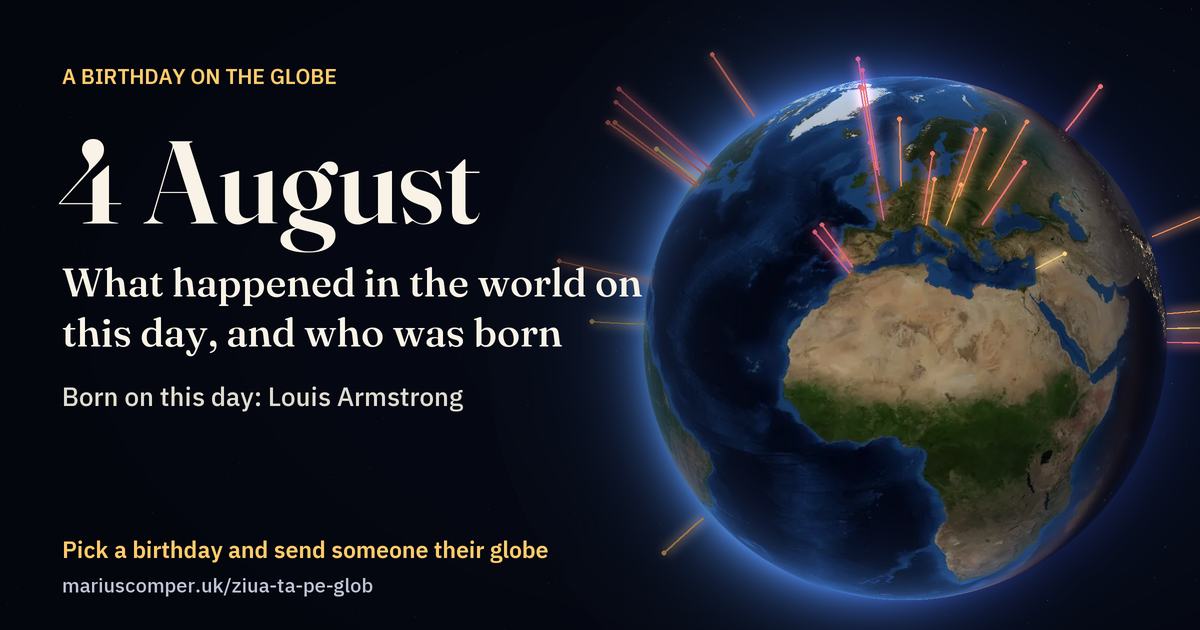
For 4 August, the English Wikipedia lists 60 events and 210 births. 31 of the events stand at their places as rays of light; eight more are dashed circles, where the sentence links only to a country or a sea. The taller the ray, the longer ago it happened. The people born that day come further down, as blue points.
A birthday, yours or someone else’s:
Turn it into a greetingScroll: the globe turns to each place
The day you were born, on the globe.
Three things from your day
Scroll: your day first, then 4 August through the years
The Earth on 4 August
The picture on the globe was assembled by NASA from satellite photographs taken in August 2004: the snow, the ice and the green are those of the month.
On 4 August the Sun passes straight overhead at noon along the parallel of 17.2° north. In London, the day lasts about 15 hours 15 minutes.
Beyond 73° north the Sun no longer sets; beyond 73° south it no longer rises.
The line between day and night is tilted on the globe exactly as on this day of the year. On the dark side you can see the lights of towns.
Britain & Ireland · Scone Palace
1320
The so-called Black Parliament at Scone tries William II de Soules and other nobles who had plotted against Robert I of Scotland and intended to place William on the Scottish throne.
On the map: Scone Palace.
Europe · Martin, Slovakia
1863
Matica slovenská, Slovakia's public-law cultural and scientific institution focusing on topics around the Slovak nation, is established in Martin.
On the map: Martin, Slovakia.
North America · Montreal
1701
Great Peace of Montreal between New France and First Nations is signed.
On the map: Montreal.
4 August
What the other Wikipedias remember#
For these years the English list has nothing on this day. The events below come from the same day’s lists on Wikipedia in Spanish and Romanian and were translated for this page.
From Wikipedia in Spanish · Santo Domingo
1496
On the island of Hispaniola, the Spaniard Bartholomew Columbus, brother of Christopher Columbus, founds the city of Santo Domingo, the first permanent European city in the Americas and today the capital of the Dominican Republic.
On the map: Santo Domingo.
Translated from the list on Wikipedia in Spanish.
From Wikipedia in Romanian · St. Stephen's Cathedral
1782
In Vienna, at St Stephen's Cathedral, Wolfgang Amadeus Mozart marries Constanze Weber.
On the map: St. Stephen's Cathedral.
Translated from the list on Wikipedia in Romanian.
The article on Wikipedia in Romanian: Catedrala Sfântul Ștefan din Viena
From Wikipedia in Spanish · Seville
1881
In Seville (Spain), the highest temperature record in Europe is registered: 50.0 °C.
On the map: Seville.
Translated from the list on Wikipedia in Spanish.
From Wikipedia in Spanish · Atlanta
1996
In the city of Atlanta, the 1996 Olympic Games end.
On the map: Atlanta.
Translated from the list on Wikipedia in Spanish.
The article on Wikipedia in Spanish: Juegos Olímpicos de Atlanta 1996
4 August
Born on 4 August#
The English Wikipedia lists 210 births for this day. The blue points are the birthplaces of 60 of these people: those written about in the most Wikipedia editions, where Wikidata gives a place of birth.
Born on 4 August
1901
Louis Armstrong, American trumpet player and singer (died 1971)
Place of birth: New Orleans.
Born on 4 August
1792
Percy Bysshe Shelley, English poet and playwright (died 1822)
Place of birth: Horsham.
Born on 4 August
1859
Knut Hamsun, Norwegian novelist, poet, and playwright, Nobel Prize laureate (died 1952)
Place of birth: Vågå.
Born on 4 August
1981
Meghan, Duchess of Sussex, American member of British royal family, media personality and actress
Place of birth: Canoga Park.
Born on 4 August
1805
William Rowan Hamilton, Irish physicist, astronomer, and mathematician (died 1865)
Place of birth: Dublin.
Born in Britain and Ireland
1834
John Venn, English mathematician and philosopher (died 1923)
Place of birth: Kingston upon Hull.
Born in Britain and Ireland
1952
Moya Brennan, Irish singer-songwriter and harp player (died 2026)
Place of birth: Gaoth Dobhair.
Born in Britain and Ireland
1725
John Newton, slaver turned Christian evangelist and author of “Amazing Grace”
Place of birth: London.
4 August
Number one in the charts that week
At the cinema
An animal recorded that day
The record can be seen in GBIF, which brings together wildlife records from around the world.
All your birthdays
The weather that day
Data: Met Office Hadley Centre (HadCET); NOAA (GHCN-Daily, Mauna Loa).
Above the Earth
Sources: Jonathan McDowell, GCAT (launches); GFZ Potsdam (Kp index). Days are counted in Universal Time.
Football that day
International matches played that day:
Source: the “International football results” dataset kept by Mart Jürisoo (CC0).
Also that day
The earthquake’s page at the USGS
Source: the USGS catalogue. The day is counted in Universal Time (UTC).
In those days
Make a link for someone
Type the name, pick the day and the year of birth. The link opens straight on their day, with their name in the greeting.
The link carries the name, date and place typed here; anyone who gets it can see them.
Put another birthday beside it
Your mother’s, your child’s, a friend’s: the two days appear side by side.
Below: 4 August through the years.
The whole globe of the day
Drag the globe to turn it. Touch a ray or a point to read what happened there.
Everything Wikipedia lists for 4 August
The list is the English Wikipedia’s, in its own wording, as it stood in October 2026. 21 events have no place on the map: the sentence links to no place with coordinates, only to places too wide to mark, or to several countries.
- 70 BC
The trial against Gaius Verres for corruption is opened, with Marcus Tullius Cicero as prosecutor and renowned orator Quintus Hortensius as defending lawyer.
no place on the mapWikipedia: Gaius Verres - 598
Goguryeo-Sui War: In response to a Goguryeo (Korean) incursion into Liaoxi, Emperor Wéndi of Sui orders his youngest son, Yang Liang (assisted by the co-prime minister Gao Jiong), to conquer Goguryeo during the Manchurian rainy season, with a Chinese army and navy.
Asia · GoguryeoWikipedia: Goguryeo–Sui War - 1265
Second Barons' War: Battle of Evesham: The army of Prince Edward (the future king Edward I of England) defeats the forces of rebellious barons led by Simon de Montfort, 6th Earl of Leicester, killing de Montfort and many of his allies.
Britain & Ireland · Battle of EveshamWikipedia: Battle of Evesham - 1320
The so-called Black Parliament at Scone tries William II de Soules and other nobles who had plotted against Robert I of Scotland and intended to place William on the Scottish throne.
Britain & Ireland · Scone PalaceWikipedia: Scone Palace - 1327
First War of Scottish Independence: James Douglas leads a raid into Weardale and almost kills Edward III of England.
Britain & Ireland · Weardale campaignWikipedia: First War of Scottish Independence - 1356
Hundred Years' War: A large-scale mounted raid by Anglo-Gascon forces began under the command of Edward the Black Prince.
Europe · PérigordWikipedia: Black Prince's chevauchée of 1356 - 1578
Battle of Al Kasr al Kebir: The Moroccans defeat the Portuguese but both the Moroccan king Abd al-Malik and the Portuguese king Sebastian die. Ahmad al-Mansur follows Abd al-Malik as sultan of Morocco while the death of Sebastian leads to a succession crisis in Portugal.
Africa · Battle of Alcácer QuibirWikipedia: Battle of Alcácer Quibir - 1693
Date traditionally ascribed to Dom Perignon's invention of champagne; it is not clear whether he actually invented champagne, however he has been credited as an innovator who developed the techniques used to perfect sparkling wine.
no place on the mapWikipedia: Dom Pérignon - 1701
Great Peace of Montreal between New France and First Nations is signed.
North America · MontrealWikipedia: Great Peace of Montreal - 1704
War of the Spanish Succession: Gibraltar is captured by an English and Dutch fleet, commanded by Admiral Sir George Rooke and allied with Archduke Charles.
Europe · GibraltarWikipedia: War of the Spanish Succession - 1781
Fourth Anglo-Dutch War, a fleet of six East India Company ships sets sail from Fort Marlborough to raid the Dutch VOC factories on the West coast of Sumatra including the major port of Padang.
Asia · Fort MarlboroughWikipedia: Fourth Anglo-Dutch War - 1783
Mount Asama erupts in Japan, killing about 1,400 people (Tenmei eruption). The eruption causes a famine, which results in an additional 20,000 deaths.
Asia · Tenmei eruptionWikipedia: Tenmei eruption - 1789
France: abolition of feudalism by the National Constituent Assembly.
Europe · FranceWikipedia: Abolition of feudalism in France - 1790
A newly passed tariff act creates the Revenue Cutter Service (the forerunner of the United States Coast Guard).
no place on the mapWikipedia: Tariff - 1791
The Treaty of Sistova is signed, ending the Ottoman–Habsburg wars.
Europe · SvishtovWikipedia: Treaty of Sistova - 1796
French Revolutionary Wars: Napoleon leads the French Army of Italy to victory in the Battle of Lonato.
Europe · Battle of LonatoWikipedia: French Revolutionary Wars - 1814
War of 1812: The ultimately unsuccessful Siege of Fort Erie begins as British forces attempt to recapture the fort and drive American forces out of Canada.
North America · Siege of Fort ErieWikipedia: War of 1812 - 1821
The Saturday Evening Post is published for the first time as a weekly newspaper.
no place on the mapWikipedia: The Saturday Evening Post - 1830
American surveyor James Thompson produced the first plat of Chicago for the Illinois and Michigan Canal Commissioners.
no place on the mapWikipedia: James Thompson - 1854
The Hinomaru is established as the official flag to be flown from Japanese ships.
no place on the mapWikipedia: Flag of Japan - 1862
In Brooklyn, a mob composed largely of Irish Americans attacked a group of African Americans in a riot.
North America · 1862 Brooklyn riotWikipedia: 1862 Brooklyn riot - 1863
Matica slovenská, Slovakia's public-law cultural and scientific institution focusing on topics around the Slovak nation, is established in Martin.
Europe · Martin, SlovakiaWikipedia: Matica slovenská - 1873
American Indian Wars: While protecting a railroad survey party in Montana, the United States 7th Cavalry, under Lieutenant Colonel George Armstrong Custer clashes for the first time with the Cheyenne and Lakota people near the Tongue River; only one man on each side is killed.
North America · MontanaWikipedia: American Indian Wars - 1887
Granny, a sea anemone, died in Edinburgh after nearly 60 years in captivity. Her death was reported in The Scotsman and The New York Times.
Britain & Ireland · EdinburghWikipedia: Granny - 1889
The Great Fire of Spokane, Washington destroys some 32 blocks of the city, prompting a mass rebuilding project.
North America · Great Spokane FireWikipedia: Great Spokane Fire - 1892
The father and stepmother of Lizzie Borden are found murdered in their Fall River, Massachusetts home. She will be tried and acquitted for the crimes a year later.
North America · Fall River, MassachusettsWikipedia: Lizzie Borden - 1914
World War I: In response to the German invasion of Belgium, Belgium and the British Empire declare war on Germany. The United States declares its neutrality.
Britain & Ireland · British EmpireWikipedia: World War I - 1915
World War I: The German 12th Army occupies Warsaw during the Gorlice–Tarnów Offensive and the Great Retreat of 1915.
Europe · Gorlice–Tarnów offensiveWikipedia: Gorlice–Tarnów offensive - 1921
Bolshevik–Makhnovist conflict: Mikhail Frunze declares victory over the Makhnovshchina.
Europe · Bolshevik–Makhnovist conflictWikipedia: Bolshevik–Makhnovist conflict - 1922
Enver Pasha dies in a skirmish between the Bolshevik Red Army and Basmachi troops, to whom he had defected earlier.
no place on the mapWikipedia: Basmachi movement - 1924
Diplomatic relations between Mexico and the Soviet Union are established.
no place on the mapWikipedia: Mexico–Russia relations - 1936
Prime Minister of Greece Ioannis Metaxas suspends parliament and the Constitution and establishes the 4th of August Regime.
no place on the mapWikipedia: Constitution of Greece - 1944
The Holocaust: A tip from a Dutch informer leads the Gestapo to a sealed-off area in an Amsterdam warehouse, where they find and arrest Jewish diarist Anne Frank, her family, and four others.
Europe · AmsterdamWikipedia: The Holocaust - 1944
Under the state of emergency law, the Finnish Parliament elects Marshal C. G. E. Mannerheim as the President of Finland to replace the resigned Risto Ryti.
no place on the mapWikipedia: Parliament of Finland - 1946
An earthquake of magnitude 8.0 hits northern Dominican Republic. One hundred are killed and 20,000 are left homeless.
Latin America · 1946 Dominican Republic earthquakeWikipedia: 1946 Dominican Republic earthquake - 1947
The Supreme Court of Japan is established.
no place on the mapWikipedia: Supreme Court of Japan - 1953
Alfred C. Glassell Jr. caught a black marlin weighing 1,560 lb (710 kg) off the coast of Peru, setting the record for the largest bony fish caught by hand.
no place on the mapWikipedia: Alfred C. Glassell Jr. - 1964
Civil rights movement: Civil rights workers Michael Schwerner, Andrew Goodman and James Chaney are found dead in Mississippi after disappearing on June 21.
North America · MississippiWikipedia: Civil rights movement - 1964
Second Gulf of Tonkin Incident: U.S. destroyers USS Maddox and USS Turner Joy mistakenly report coming under attack in the Gulf of Tonkin.
Asia · Gulf of Tonkin incidentWikipedia: Gulf of Tonkin incident - 1965
The Constitution of the Cook Islands comes into force, giving the Cook Islands self-governing status within New Zealand.
Oceania · Cook IslandsWikipedia: Politics of the Cook Islands - 1969
Vietnam War: At the apartment of French intermediary Jean Sainteny in Paris, American representative Henry Kissinger and North Vietnamese representative Xuân Thuỷ begin secret peace negotiations. The negotiations will eventually fail.
Asia · North VietnamWikipedia: Vietnam War - 1972
Ugandan President Idi Amin announces that Uganda is no longer responsible for the care of British subjects of Asian origin, beginning the expulsions of Ugandan Asians.
Africa · UgandaWikipedia: Expulsion of Asians from Uganda - 1974
A bomb explodes in the Italicus Express train at San Benedetto Val di Sambro, Italy, killing 12 people and wounding 22.
Europe · Italicus Express bombingWikipedia: Italicus Express bombing - 1975
The Japanese Red Army takes more than 50 hostages at the AIA Building housing several embassies in Kuala Lumpur, Malaysia. The hostages include the U.S. consul and the Swedish Chargé d'affaires. The gunmen win the release of five imprisoned comrades and fly with them to Libya.
Asia · 1975 AIA building hostage crisisWikipedia: 1975 AIA building hostage crisis - 1977
U.S. President Jimmy Carter signs legislation creating the United States Department of Energy.
no place on the mapWikipedia: President of the United States - 1983
Jean-Baptiste Ouédraogo, president of the military government of Upper Volta, is ousted from power in a coup d'état led by Captain Thomas Sankara.
no place on the mapWikipedia: 1983 Upper Voltan coup d'état - 1984
The Ariane 3 rocket is launched for the first time, carrying the Eutelsat I F-2 and Télécom 1A satellites into geosynchronous transfer orbit.
no place on the mapWikipedia: Ariane 3 - 1984
The Republic of Upper Volta changes its name to Burkina Faso.
no place on the mapWikipedia: Republic of Upper Volta - 1987
The Federal Communications Commission rescinds the Fairness Doctrine which had required radio and television stations to give equal time to opposing views.
no place on the mapWikipedia: Federal Communications Commission - 1991
An explosion on the Greek cruise ship MTS Oceanos ruptured its hull, causing it to sink off the east coast of South Africa, with all 571 people on board rescued.
no place on the mapWikipedia: MTS Oceanos - 1995
Operation Storm, the last major battle of the Croatian War of Independence begins.
Europe · Operation StormWikipedia: Croatian War of Independence - 1997
French supercentenarian Jeanne Calment died at the age of 122 years, 164 days, with the longest confirmed human lifespan in history.
no place on the mapWikipedia: Supercentenarian - 2006
A massacre is carried out by Sri Lankan government forces, killing 17 employees of the French INGO Action Against Hunger (known internationally as Action Contre la Faim, or ACF).
Asia · 2006 Trincomalee massacre of NGO workersWikipedia: 2006 Trincomalee massacre of NGO workers - 2007
An airport police officer discovered a suitcase containing approximately US$800,000 as it passed through security at Jorge Newbery Airfield in Buenos Aires, sparking an international scandal involving Venezuela and Argentina.
Latin America · Aeroparque Jorge NewberyWikipedia: María del Luján Telpuk - 2007
NASA's Phoenix Mars lander is launched.
no place on the mapWikipedia: NASA - 2014
Julieka Ivanna Dhu, an Aboriginal Australian woman, died in police custody after her deteriorating condition was mocked and ignored.
Oceania · South HedlandWikipedia: Death of Ms Dhu - 2018
Crisis in Venezuela: Seven people are injured when two drones detonate explosives on Avenida Bolívar, Caracas while president Nicolás Maduro is giving a speech to the Venezuelan National Guard.
Latin America · CaracasWikipedia: Crisis in Venezuela - 2018
Syrian civil war: The Syrian Democratic Forces (SDF) expel the Islamic State of Iraq and the Levant (ISIL) from the Iraq–Syria border, concluding the second phase of the Deir ez-Zor campaign.
no place on the mapWikipedia: Deir ez-Zor campaign - 2019
Nine people are killed and 26 injured in a shooting in Dayton, Ohio. This comes only 13 hours after another mass shooting in El Paso, Texas, where 23 people were killed.
North America · 2019 Dayton shootingWikipedia: 2019 Dayton shooting - 2020
Beirut Port explosion: At least 220 people are killed and over 5,000 are wounded when 2,700 tons of ammonium nitrate explodes in Beirut, Lebanon.
Asia · 2020 Beirut explosionWikipedia: 2020 Beirut explosion
What the other Wikipedias remember
For these years the English list has nothing on this day. The events below come from the same day’s lists on Wikipedia in Spanish and Romanian and were translated for this page.
- 1496
On the island of Hispaniola, the Spaniard Bartholomew Columbus, brother of Christopher Columbus, founds the city of Santo Domingo, the first permanent European city in the Americas and today the capital of the Dominican Republic.
- 1782
In Vienna, at St Stephen's Cathedral, Wolfgang Amadeus Mozart marries Constanze Weber.
Europe · St. Stephen's CathedralTranslated from the list on Wikipedia in RomanianWikipedia: Catedrala Sfântul Ștefan din Viena - 1881
In Seville (Spain), the highest temperature record in Europe is registered: 50.0 °C.
- 1996
In the city of Atlanta, the 1996 Olympic Games end.
North America · AtlantaTranslated from the list on Wikipedia in SpanishWikipedia: Juegos Olímpicos de Atlanta 1996
Who was born on 4 August
In order of how many Wikipedia editions have an article about each. The first 60 of 210 are shown.
- 1961
Barack Obama, American lawyer and politician, 44th President of the United States, Nobel Prize laureate
Kapiolani Medical Center for Women and ChildrenWikipedia: Barack Obama - 1901
Louis Armstrong, American trumpet player and singer (died 1971)
New OrleansWikipedia: Louis Armstrong - 1792
Percy Bysshe Shelley, English poet and playwright (died 1822)
- 1859
Knut Hamsun, Norwegian novelist, poet, and playwright, Nobel Prize laureate (died 1952)
- 1960
José Luis Rodríguez Zapatero, Spanish academic and politician, 5th Prime Minister of Spain
ValladolidWikipedia: José Luis Rodríguez Zapatero - 1981
Meghan, Duchess of Sussex, American member of British royal family, media personality and actress
Canoga ParkWikipedia: Meghan, Duchess of Sussex - 1900
Queen Elizabeth the Queen Mother, Queen Consort of King George VI of the United Kingdom, Empress Consort of India (died 2002)
- 1805
William Rowan Hamilton, Irish physicist, astronomer, and mathematician (died 1865)
- 1521
Pope Urban VII (died 1590)
- 1965
Fredrik Reinfeldt, Swedish soldier and politician, 42nd Prime Minister of Sweden
Österhaninge church parishWikipedia: Fredrik Reinfeldt - 1983
Greta Gerwig, American actress, producer, and screenwriter
SacramentoWikipedia: Greta Gerwig - 1955
Billy Bob Thornton, American actor, director, and screenwriter
Hot SpringsWikipedia: Billy Bob Thornton - 1971
Jeff Gordon, American race car driver and actor
VallejoWikipedia: Jeff Gordon - 1985
Antonio Valencia, Ecuadorean footballer
Nueva LojaWikipedia: Antonio Valencia - 1912
Raoul Wallenberg, Swedish architect and diplomat, savior of thousands of Jews from The Holocaust (died ~1947)
LidingöWikipedia: Raoul Wallenberg - 1904
Witold Gombrowicz, Polish author and playwright (died 1969)
Małoszyce, Świętokrzyskie VoivodeshipWikipedia: Witold Gombrowicz - 1985
Mark Milligan, Australian footballer
SydneyWikipedia: Mark Milligan - 1834
John Venn, English mathematician and philosopher (died 1923)
Kingston upon HullWikipedia: John Venn - 1953
Hiroyuki Usui, Japanese footballer and manager
FujiedaWikipedia: Hiroyuki Usui - 1932
Frances E. Allen, American computer scientist and academic (died 2020)
- 1930
Ali al-Sistani, Iranian-Iraqi cleric and scholar
MashhadWikipedia: Ali al-Sistani - 1952
Moya Brennan, Irish singer-songwriter and harp player (died 2026)
Gaoth DobhairWikipedia: Moya Brennan - 1968
Daniel Dae Kim, South Korean-American actor
- 1725
John Newton, slaver turned Christian evangelist and author of “Amazing Grace”
LondonWikipedia: John Newton - 1929
Kishore Kumar, Indian singer-songwriter and actor (died 1987)
KhandwaWikipedia: Kishore Kumar - 1992
Cole Sprouse, American actor
ArezzoWikipedia: Cole Sprouse - 1920
Helen Thomas, American journalist and author (died 2013)
WinchesterWikipedia: Helen Thomas - 1942
Don S. Davis, American actor (died 2008)
AuroraWikipedia: Don S. Davis - 1965
Dennis Lehane, American author, screenwriter, and producer
DorchesterWikipedia: Dennis Lehane - 1839
Walter Pater, English author, critic, and academic (died 1894)
ShadwellWikipedia: Walter Pater - 1969
Max Cavalera, Brazilian singer-songwriter and guitarist
Belo HorizonteWikipedia: Max Cavalera - 1973
Marcos Roberto Silveira Reis, Brazilian footballer
OrienteWikipedia: Marcos - 1989
Jessica Mauboy, Australian singer-songwriter and actress
- 1992
Dylan Sprouse, American actor
ArezzoWikipedia: Dylan Sprouse - 1921
Maurice Richard, Canadian ice hockey player and coach (died 2000)
MontrealWikipedia: Maurice Richard - 1974
Kily González, Argentine footballer
RosarioWikipedia: Kily González - 1947
Klaus Schulze, German keyboard player and songwriter (died 2022)
BerlinWikipedia: Klaus Schulze - 1281
Külüg Khan, Emperor Wuzong of Yuan (died 1311)
KhanbaliqWikipedia: Külüg Khan - 1942
David Lange, New Zealand lawyer and politician, 32nd Prime Minister of New Zealand (died 2005)
ŌtāhuhuWikipedia: David Lange - 1955
Alberto Gonzales, American soldier, lawyer, and politician, 80th United States Attorney General
San AntonioWikipedia: Alberto Gonzales - 1963
Keith Maurice Ellison, 30th Attorney General of Minnesota
DetroitWikipedia: Keith Ellison - 1910
Anita Page, American actress (died 2008)
FlushingWikipedia: Anita Page - 1975
Nikos Liberopoulos, Greek footballer
FiliatraWikipedia: Nikos Liberopoulos - 1975
Jutta Urpilainen, Finnish politician, Deputy Prime Minister of Finland
- 1977
Luís Boa Morte, Portuguese footballer and manager
- 1884
Béla Balázs, Hungarian poet and critic (died 1949)
SzegedWikipedia: Béla Balázs - 1704
Louis d'Orléans, Duke of Orléans (died 1752)
VersaillesWikipedia: Louis, Duke of Orléans - 1821
Louis Vuitton, French fashion designer, founded Louis Vuitton (died 1892)
Lavans-sur-ValouseWikipedia: Louis Vuitton - 1884
Henri Cornet, French cyclist (died 1941)
DesvresWikipedia: Henri Cornet - 1989
Wang Hao, Chinese chess grandmaster
HarbinWikipedia: Wang Hao - 1290
Leopold I, Duke of Austria (died 1326)
- 1957
John Wark, Scottish footballer and sportscaster
GlasgowWikipedia: John Wark - 1909
Saunders Mac Lane, American mathematician (co-founded category theory) (died 2005)
NorwichWikipedia: Saunders Mac Lane - 1944
Richard Belzer, American actor (died 2023)
BridgeportWikipedia: Richard Belzer - 1958
Mary Decker, American runner
BunnvaleWikipedia: Mary Decker - 1988
Kelley O'Hara, American soccer player
- 1954
Anatoliy Kinakh, Ukrainian engineer and politician, 11th Prime Minister of Ukraine
BrătușeniWikipedia: Anatoliy Kinakh - 1992
Daniele Garozzo, Italian fencer
CataniaWikipedia: Daniele Garozzo - 1995
Bruna Marquezine, Brazilian actress
Duque de CaxiasWikipedia: Bruna Marquezine - 1905
Abeid Karume, 1st President of Zanzibar (died 1972)
What is celebrated on 4 August
- Christian feast day: Aristarchus
- Christian feast day: Blessed Cecilia Cesarini
- Christian feast day: Euphronius
- Christian feast day: Blessed Frédéric Janssoone
- Christian feast day: John Vianney
- Christian feast day: Molua (or Lua)
- Christian feast day: Raynerius of Split
- Christian feast day: Sithney, patron saint of mad dogs
- Christian feast day: August 4 (Eastern Orthodox liturgics)
- Coast Guard Day (United States)
- Constitution Day (Cook Islands); first Monday in August
- Matica slovenská Day (Slovakia)
- Barack Obama Day in Illinois in the United States
- 2020 Beirut explosion commemoration day in Lebanon
A greeting link for someone
Type a name and, if you like, the year of birth. The link opens with a greeting, and beside each event it says how old the person turned that day, or how many years before their birth it happened.
The name and the year go only into the link you send.
All 366 days
How the globe is made
Where the events come from
Each edition of this page uses the day’s list from Wikipedia in its own language: Romanian, English, Spanish, Chinese. The lists are written by volunteers and differ from one edition to the next; the text of each event is Wikipedia’s, with a link to the article. A row that appears twice in a list is shown once. The lists have not been checked event by event: they are Wikipedia’s, mistakes included.
For events before 1582, and for countries that moved to the Gregorian calendar later (Britain in 1752, Russia in 1918), the same day may be counted Old Style in one list and New Style in another.
The chapter “What the other Wikipedias remember” adds up to five events a day from the lists of the other three editions, only for years in which the English list has nothing on that day. They were translated for this page, passed the same filters as the tour, and are not counted among the events of the English list.
How an event gets onto the map
The place comes from Wikidata. If the sentence links to the article about the event itself (a battle, an opening, an earthquake), dated to the same year, the ray stands on its coordinates or on those of its location. Otherwise it stands on the first place the sentence links to: a town, a building, a mountain, an island. This second step can be wrong: sometimes the sentence only mentions the place. That is why the page says, under each event, which place the ray stands on.
When the sentence links to a single state or province, or to a single sea, lake or desert larger than 5,000 km², the globe shows a dashed circle, not a ray. The circle has the area Wikidata gives, with its radius kept between 1.2° and 16°, or a radius of 4.5° when Wikidata gives no area; it says only that the sentence links to that place. Organisations, ships, spacecraft, museum objects, rivers, mountain ranges, languages and continents are never used as places. When a sentence names several states and no exact place, the event stays in the list only.
What the height means
The height of a ray shows how many years have passed, on a logarithmic scale: 10 years, 100 years and 1,000 years are equal steps apart; anything older than about 2,600 years has the tallest ray. The colour runs from pale yellow for recent years to violet for antiquity.
Where the tour stops
In each region the tour stops at up to three events (five in Britain and Ireland), chosen mainly by three things: whether Wikipedia’s editors put the event in the “On this day” box of their main page (the English, Spanish and Chinese editions), how many Wikipedia editions have an article about it, and how many of the four lists include it. Events whose sentence or article is about a war, an attack, a crime or a disaster are left out of the tour; they stay in the whole list, in Wikipedia’s wording. The filter is a list of words and a list of Wikidata types, so it can miss some.
The tour of births names the people with articles in the most editions and leaves aside those whom the list or Wikidata describes as rulers, politicians, commanders, leaders of movements or criminals; they stay in the list.
The Earth and the Sun
The daytime images are NASA’s Blue Marble Next Generation mosaics, one for each month of 2004; the night side is Black Marble 2016. The tilt of the line between day and night is computed for the day; the hour is chosen so that the place being read is in daylight. The latitude where the Sun stands overhead is the average of the four years of the leap cycle; in a given year it can differ by up to 0.4°.
The day you were born
The number ones come from the weekly lists on Wikipedia: Billboard for the United States (from 1940; the Hot 100 from August 1958), the UK Singles Chart (from November 1952), Los 40 Principales for Spain (from July 1966) and, for Romania, the Romanian Top 100 and Airplay 100 (2001–2021, with missing weeks). The page shows the chart of the week in which the day of birth falls, with its date; Billboard and the UK chart are dated at the end of their week. For Romania before 2001 and for China these sources have no weekly chart.
The films are those that reached cinemas in the United States up to ten days before or three days after that day (some of them in a few cinemas at first), from the English Wikipedia’s yearly lists (from 1968), in order of how many editions have an article about them. The events “in those days” are the ones on the neighbouring days’ lists that carry the year of birth, passed through the same filter as the tour.
The day of birth, year included
The Moon, the star sign and the constellation are worked out by the page itself, for noon Universal Time on the day. The lit part of the Moon is rounded and can differ by a few per cent from that at the hour of birth. The sign follows the usual zodiac of twelve equal parts starting at the March equinox; the constellation is the one the Sun actually stood in front of, by the borders set by the International Astronomical Union, and within a day of a border the page does not name it. When the Sun changes sign while it is that day anywhere on Earth, the page gives the moment of crossing, rounded to ten minutes and accurate to within about a quarter of an hour, and the clock time in a few cities, with the time zone and summer time of that year.
The year in the Chinese calendar is the one your device’s own calendar gives for the date, checked against the Hong Kong Observatory’s tables. “All your birthdays” uses the same sources as the rest of the chapter for the same day in every year since the birth: the temperature, well-known launches that took place on that very day, matches of the teams the edition follows, snow deeper than 10 cm and strong geomagnetic storms. The three things at the top and the four on the picture are chosen in a fixed order (the song, the animal, a full Moon, a well-known launch before an ordinary earthquake); on the picture you can change them.
When the link carries a year of birth, the page adds a few things about that exact day. The weather is the Met Office’s Central England temperature record and the readings from New York’s Central Park; the “usual high” is the average of the daily highs of 1961–1990 for that date, with two days either side. The carbon dioxide figure is the monthly mean at the Mauna Loa observatory, where measurements begin in March 1958.
The earthquake is the one with the largest magnitude in the USGS catalogue for that day, counted in Universal Time. Before the 1960s the catalogue has gaps even above magnitude 5.5, so in the older years many days have no earthquake. The page gives only the magnitude and the place: the country the epicentre falls in or, when the epicentre is at sea within 300 km of a coast, the nearest country; farther out, only the ocean.
The launches are those that reached orbit or left for the Moon and the planets, from Jonathan McDowell’s GCAT catalogue. If nothing left that day, the page shows the nearest launch within three days before or after, and says how many days away it was. The geomagnetic storm appears only when the Kp index reached at least 5 in one of the day’s eight three-hour intervals.
The animal comes from GBIF: an observation made by a person (the animal seen or heard, or its tracks), dated to that exact day, with coordinates and a CC0 or CC BY licence. Only a few hundred well-known species are searched (mammals, birds, turtles, butterflies); of those noted that day, mammals and species with articles in many Wikipedia editions come first; birds noted almost every day, and species used recently, wait their turn. Observations dated 1 January are left out, because records without a day are often filed there. An observation shows that the animal was recorded there, not how many animals there were.
The matches are those between national teams. Only matches of England, Scotland, Wales, Northern Ireland, the Republic of Ireland, the United States, Canada and Australia are shown, along with those at the big final tournaments. The picture to send is drawn in the page from the day’s globe and the facts above, and stays on your device until you send it.
Sources
- Events, births and holidays: the day’s page on Wikipedia, text under CC BY-SA 4.0.
- Coordinates, places of birth and the number of editions: Wikidata (CC0).
- The Earth by day: NASA Blue Marble Next Generation. The Earth by night: NASA Black Marble 2016.
- Borders and regions: Natural Earth.
- World population and births per year: UN World Population Prospects 2024.
- Charts and films: Wikipedia’s lists for Billboard, the UK Singles Chart, Los 40 Principales, Romanian Top 100, Airplay 100 and American films by year (CC BY-SA 4.0).
- Weather: Met Office Hadley Centre, HadCET (Open Government Licence) and NOAA GHCN-Daily, New York Central Park. Carbon dioxide: NOAA Global Monitoring Laboratory, Mauna Loa.
- Earthquakes: the USGS catalogue. Launches: Jonathan McDowell, GCAT (CC BY). Kp index: GFZ Potsdam (CC BY 4.0). Matches: International football results, Mart Jürisoo (CC0).
- Animal observations: GBIF, with a link to each record; species names come from Wikidata.