A birthday on the globe
31 July on the globe: what happened in the world on this day, and who was born
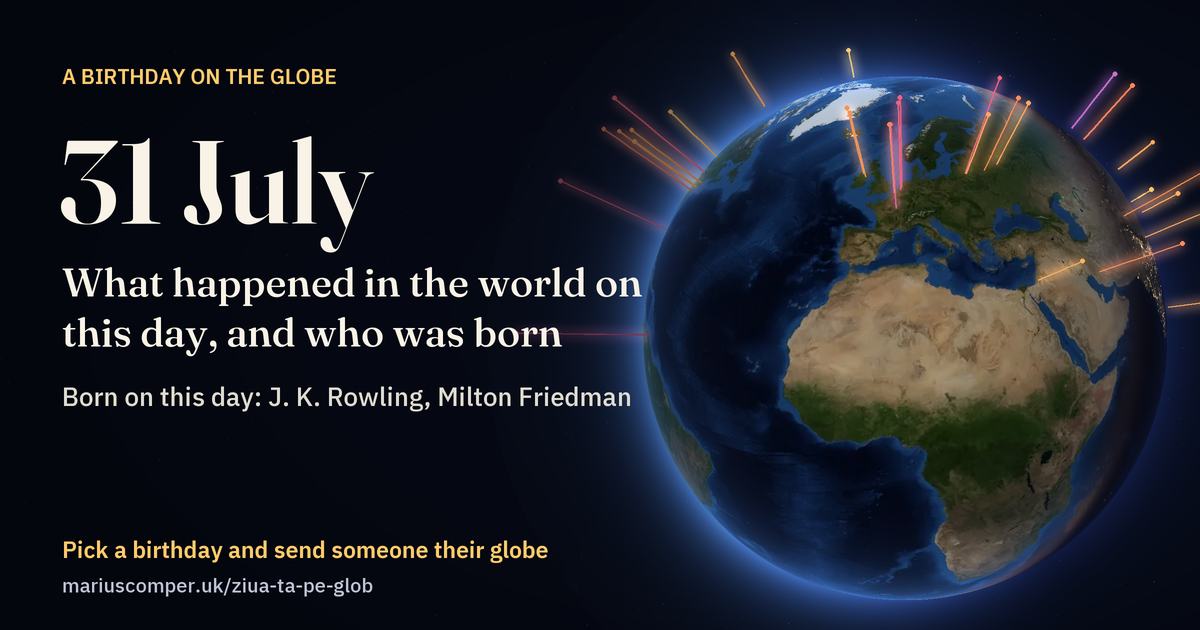
For 31 July, the English Wikipedia lists 61 events and 216 births. 32 of the events stand at their places as rays of light; five more are dashed circles, where the sentence links only to a country or a sea. The taller the ray, the longer ago it happened. The people born that day come further down, as blue points.
A birthday, yours or someone else’s:
Turn it into a greetingScroll: the globe turns to each place
The day you were born, on the globe.
Three things from your day
Scroll: your day first, then 31 July through the years
The Earth on 31 July
The picture on the globe was assembled by NASA from satellite photographs taken in July 2004: the snow, the ice and the green are those of the month.
On 31 July the Sun passes straight overhead at noon along the parallel of 18.2° north. In London, the day lasts about 15 hours 30 minutes.
Beyond 72° north the Sun no longer sets; beyond 72° south it no longer rises.
The line between day and night is tilted on the globe exactly as on this day of the year. On the dark side you can see the lights of towns.
Europe · Utrecht
1618
Maurice, Prince of Orange disbands the waardgelders militia in Utrecht, a pivotal event in the Remonstrant/Counter-Remonstrant tensions.
On the map: Utrecht.
Europe · Moscow
1991
The United States and Soviet Union both sign the START I Strategic Arms Reduction Treaty, the first to reduce (with verification) both countries' stockpiles.
On the map: Moscow.
Asia · Persepolis
1938
Archaeologists discover engraved gold and silver plates from King Darius the Great in Persepolis.
On the map: Persepolis.
Asia · K2
1954
A team of Italian climbers became the first to reach the summit of K2, the world's second-highest mountain.
On the map: K2.
Also on the day’s list of Wikipedia in Romanian and Chinese.
Asia · Ten Thousand Buddhas Monastery
2000
Three years after being hit by a mudslide, the Ten Thousand Buddhas Monastery in Hong Kong fully reopened.
On the map: Ten Thousand Buddhas Monastery.
Oceania · Christchurch
1856
Christchurch, New Zealand, is chartered as a city.
On the map: Christchurch.
Also on the day’s list of Wikipedia in Chinese.
Oceania · Grandchester, Queensland
1865
The first narrow-gauge mainline railway in the world opens at Grandchester, Queensland, Australia.
On the map: Grandchester, Queensland.
Latin America · Trinidad
1498
On his third voyage to the Western Hemisphere, Christopher Columbus becomes the first European to discover the island of Trinidad.
On the map: Trinidad.
Also on the day’s list of Wikipedia in Spanish.
North America · Georgetown University
1874
Patrick Francis Healy becomes the first African-American inaugurated as president of a predominantly white university, Georgetown University.
On the map: Georgetown University.
Also on the day’s list of Wikipedia in Chinese.
North America · John F. Kennedy International Airport
1948
At Idlewild Field in New York, New York International Airport (later renamed John F. Kennedy International Airport) is dedicated.
On the map: John F. Kennedy International Airport.
31 July
What the other Wikipedias remember#
For these years the English list has nothing on this day. The events below come from the same day’s lists on Wikipedia in Chinese and were translated for this page.
From Wikipedia in Chinese · Weimar
1919
The German National Assembly convenes in Weimar, Thuringia, to draw up a constitution, and adopts the constitution of the Weimar Republic, the Constitution of the German Reich.
On the map: Weimar.
Translated from the list on Wikipedia in Chinese.
31 July
Born on 31 July#
The English Wikipedia lists 216 births for this day. The blue points are the birthplaces of 59 of these people: those written about in the most Wikipedia editions, where Wikidata gives a place of birth.
Born on 31 July
1965
J. K. Rowling, English author and film producer
Place of birth: Yate.
Born on 31 July
1912
Milton Friedman, American economist and academic, Nobel Prize laureate (died 2006)
Place of birth: Brooklyn.
Born on 31 July
1914
Louis de Funès, French actor and screenwriter (died 1983)
Place of birth: Courbevoie.
Born on 31 July
1919
Primo Levi, Italian chemist and author (died 1987)
Place of birth: Turin.
Born on 31 July
1880
Premchand, Indian author and playwright (died 1936)
Place of birth: Varanasi.
Born in Britain and Ireland
1947
Richard Griffiths, English actor (died 2013)
Place of birth: Thornaby-on-Tees.
Born in Britain and Ireland
1963
Norman Cook (Fatboy Slim), English DJ and musician
Place of birth: London Borough of Bromley.
Born in Britain and Ireland
1974
Emilia Fox, English actress
Place of birth: Hammersmith.
31 July
Number one in the charts that week
At the cinema
An animal recorded that day
The record can be seen in GBIF, which brings together wildlife records from around the world.
All your birthdays
The weather that day
Data: Met Office Hadley Centre (HadCET); NOAA (GHCN-Daily, Mauna Loa).
Above the Earth
Sources: Jonathan McDowell, GCAT (launches); GFZ Potsdam (Kp index). Days are counted in Universal Time.
Football that day
International matches played that day:
Source: the “International football results” dataset kept by Mart Jürisoo (CC0).
Also that day
The earthquake’s page at the USGS
Source: the USGS catalogue. The day is counted in Universal Time (UTC).
In those days
Make a link for someone
Type the name, pick the day and the year of birth. The link opens straight on their day, with their name in the greeting.
The link carries the name, date and place typed here; anyone who gets it can see them.
Put another birthday beside it
Your mother’s, your child’s, a friend’s: the two days appear side by side.
Below: 31 July through the years.
The whole globe of the day
Drag the globe to turn it. Touch a ray or a point to read what happened there.
Everything Wikipedia lists for 31 July
The list is the English Wikipedia’s, in its own wording, as it stood in October 2026. 24 events have no place on the map: the sentence links to no place with coordinates, only to places too wide to mark, or to several countries.
- 398
End of the Gildonic rebellion after Gildo's forces are defeated by forces loyal to Western Roman Emperor Honorius under Gildo's brother Mascezel and Gildo's subsequent death.
no place on the mapWikipedia: Gildonic War - 432
Election of pope Sixtus III following the death of pope Celestine I four days prior.
no place on the mapWikipedia: Pope Sixtus III - 768
Antipope Constantine II is arrested by primicerius Christopher and Lombard troops sent to aid him by king Desiderius.
no place on the mapWikipedia: Antipope Constantine II - 781
The oldest recorded eruption of Mount Fuji (Traditional Japanese date: Sixth day of the seventh month of the first year of the Ten'o (天応) era).
Asia · Mount FujiWikipedia: Mount Fuji - 1009
Pope Sergius IV becomes the 142nd pope, succeeding Pope John XVIII.
no place on the mapWikipedia: Pope Sergius IV - 1201
Attempted usurpation by John Komnenos the Fat for the throne of Alexios III Angelos.
no place on the mapWikipedia: John Komnenos the Fat - 1423
Hundred Years' War: Battle of Cravant: A Franco-Scottish army is defeated by the Anglo-Burgundians at Cravant on the banks of the river Yonne.
Europe · Battle of CravantWikipedia: Battle of Cravant - 1451
Jacques Cœur is arrested by order of Charles VII of France.
no place on the mapWikipedia: Jacques Cœur - 1492
All remaining Jews are expelled from Spain when the Alhambra Decree takes effect.
no place on the mapWikipedia: Alhambra Decree - 1498
On his third voyage to the Western Hemisphere, Christopher Columbus becomes the first European to discover the island of Trinidad.
Latin America · TrinidadWikipedia: Christopher Columbus - 1618
Maurice, Prince of Orange disbands the waardgelders militia in Utrecht, a pivotal event in the Remonstrant/Counter-Remonstrant tensions.
Europe · UtrechtWikipedia: Maurice, Prince of Orange - 1655
Russo-Polish War (1654–67): The Russian army enters the capital of the Grand Duchy of Lithuania, Vilnius, which it holds for six years.
Europe · VilniusWikipedia: Polish–Russian War - 1658
Aurangzeb is proclaimed Mughal emperor of India.
no place on the mapWikipedia: Aurangzeb - 1667
The treaty of Breda ends the second Anglo-Dutch War and grants England in possession of New Amsterdam.
Europe · BredaWikipedia: Treaty of Breda - 1703
Daniel Defoe is placed in a pillory for the crime of seditious libel after publishing a politically satirical pamphlet, but is pelted with flowers.
no place on the mapWikipedia: Daniel Defoe - 1715
Seven days after a Spanish treasure fleet of 12 ships left Havana, Cuba for Spain, 11 of them sink in a storm off the coast of Florida. A few centuries later, treasure is salvaged from these wrecks.
North America · 1715 Treasure FleetWikipedia: 1715 Treasure Fleet - 1741
Charles Albert of Bavaria invades Upper Austria and Bohemia.
Europe · Upper AustriaWikipedia: Charles VII, Holy Roman Emperor - 1763
Odawa Chief Pontiac's forces defeat British troops at the Battle of Bloody Run during Pontiac's War.
North America · Battle of Bloody RunWikipedia: Battle of Bloody Run - 1777
The U.S. Second Continental Congress passes a resolution that the services of Gilbert du Motier, Marquis de Lafayette "be accepted, and that, in consideration of his zeal, illustrious family and connexions, he have the rank and commission of major-general of the United States."
no place on the mapWikipedia: Second Continental Congress - 1790
The first U.S. patent is issued, to inventor Samuel Hopkins for a potash process.
no place on the mapWikipedia: Patent - 1856
Christchurch, New Zealand, is chartered as a city.
Oceania · ChristchurchWikipedia: Christchurch - 1865
The first narrow-gauge mainline railway in the world opens at Grandchester, Queensland, Australia.
Oceania · Grandchester, QueenslandWikipedia: Narrow-gauge railway - 1874
Patrick Francis Healy becomes the first African-American inaugurated as president of a predominantly white university, Georgetown University.
North America · Georgetown UniversityWikipedia: Georgetown University - 1904
Russo-Japanese War: Battle of Hsimucheng: Units of the Imperial Japanese Army defeat units of the Imperial Russian Army in a strategic confrontation.
Asia · Battle of HsimuchengWikipedia: Battle of Hsimucheng - 1917
World War I: The Battle of Passchendaele begins near Ypres in West Flanders, Belgium.
Europe · Battle of PasschendaeleWikipedia: World War I - 1924
A private senator's bill by Herbert Payne to introduce compulsory voting in Australia became law.
no place on the mapWikipedia: Private member's bill - 1932
The NSDAP (Nazi Party) wins more than 38% of the vote in German elections.
no place on the mapWikipedia: July 1932 German federal election - 1938
Archaeologists discover engraved gold and silver plates from King Darius the Great in Persepolis.
Asia · PersepolisWikipedia: Gold - 1938
Bulgaria signs a non-aggression pact with Greece and other states of Balkan Antanti (Turkey, Romania, Yugoslavia).
no place on the mapWikipedia: Bulgaria - 1941
The Holocaust: Under instructions from Adolf Hitler, Nazi official Hermann Göring orders SS General Reinhard Heydrich to "submit to me as soon as possible a general plan of the administrative material and financial measures necessary for carrying out the desired Final Solution of the Jewish question."
no place on the mapWikipedia: The Holocaust - 1941
World War II: The Battle of Smolensk concludes with Germany capturing about 300,000 Soviet Red Army prisoners.
Europe · Battle of SmolenskWikipedia: Battle of Smolensk - 1945
Pierre Laval, the fugitive former leader of Vichy France, surrenders to Allied soldiers in Austria.
Europe · Vichy FranceWikipedia: Vichy France - 1948
At Idlewild Field in New York, New York International Airport (later renamed John F. Kennedy International Airport) is dedicated.
North America · John F. Kennedy International AirportWikipedia: John F. Kennedy International Airport - 1948
USS Nevada is sunk by an aerial torpedo after surviving hits from two atomic bombs (as part of post-war tests) and being used for target practice by three other ships.
no place on the mapWikipedia: USS Nevada - 1954
A team of Italian climbers became the first to reach the summit of K2, the world's second-highest mountain.
- 1964
Ranger program: Ranger 7 sends back the first close-up photographs of the moon, with images 1,000 times clearer than anything ever seen from earth-bound telescopes.
no place on the mapWikipedia: Ranger program - 1966
The pleasure cruiser MV Darlwyne disappears off the Cornwall coast with the loss of all 31 aboard.
Britain & Ireland · CornwallWikipedia: Loss of MV Darlwyne - 1970
Black Tot Day: The last day of the officially sanctioned rum ration in the Royal Navy.
no place on the mapWikipedia: Rum ration - 1971
Apollo program: The Apollo 15 astronauts become the first to ride in a lunar rover.
no place on the mapWikipedia: Apollo program - 1972
The Troubles: In Operation Motorman, the British Army re-takes the urban no-go areas of Northern Ireland. It is the biggest British military operation since the Suez Crisis of 1956, and the biggest in Ireland since the Irish War of Independence. Later that day, nine civilians are killed by car bombs in the village of Claudy.
Britain & Ireland · Claudy bombingWikipedia: The Troubles - 1973
A Delta Air Lines jetliner, flight DL 723, crashes while landing in fog at Logan International Airport, Boston, Massachusetts, killing 89.
North America · Delta Air Lines Flight 723Wikipedia: Delta Air Lines Flight 723 - 1975
The Troubles: Three members of a popular cabaret band and two gunmen are killed during a botched paramilitary attack in Northern Ireland.
Britain & Ireland · Miami Showband killingsWikipedia: Miami Showband killings - 1987
A tornado occurs in Edmonton, Alberta, killing 27 people.
North America · Edmonton tornadoWikipedia: Edmonton tornado - 1988
Thirty-two people are killed and 1,674 injured when a bridge at the Sultan Abdul Halim ferry terminal collapses in Butterworth, Penang, Malaysia.
Asia · Sultan Abdul Halim ferry terminal bridge collapseWikipedia: Sultan Abdul Halim ferry terminal bridge collapse - 1991
Soviet Special Purpose Police Unit troops killed seven Lithuanian customs officials in Medininkai in the most serious attack of their campaign against Lithuanian border posts.
Europe · MedininkaiWikipedia: Soviet OMON assaults on Lithuanian border posts - 1991
The United States and Soviet Union both sign the START I Strategic Arms Reduction Treaty, the first to reduce (with verification) both countries' stockpiles.
Europe · MoscowWikipedia: START I - 1992
China General Aviation Flight 7552 crashes during takeoff from Nanjing Dajiaochang Airport, killing 108.
Asia · China General Aviation Flight 7552Wikipedia: China General Aviation Flight 7552 - 1992
Space Shuttle program: Atlantis is launched on STS-46 to deploy the European Retrievable Carrier and the Tethered Satellite System.
no place on the mapWikipedia: Space Shuttle program - 1992
Thai Airways International Flight 311 crashes into a mountain north of Kathmandu, Nepal, killing all 113 people on board.
Asia · Thai Airways International Flight 311Wikipedia: Thai Airways International Flight 311 - 1992
The nation of Georgia joins the United Nations.
Asia · GeorgiaWikipedia: Georgia - 1997
FedEx Express Flight 14 crashes at Newark International Airport, injuring five.
North America · FedEx Express Flight 14Wikipedia: FedEx Express Flight 14 - 1999
Discovery Program: Lunar Prospector: NASA intentionally crashes the spacecraft into the Moon, thus ending its mission to detect frozen water on the Moon's surface.
no place on the mapWikipedia: Discovery Program - 2000
Three years after being hit by a mudslide, the Ten Thousand Buddhas Monastery in Hong Kong fully reopened.
Asia · Ten Thousand Buddhas MonasteryWikipedia: Mudflow - 2002
Hamas attackers detonated a bomb at the Mount Scopus campus of the Hebrew University of Jerusalem, killing nine students and injuring about 100 more.
Asia · Hebrew University bombingWikipedia: Hebrew University bombing - 2006
Fidel Castro hands over power to his brother, Raúl.
no place on the mapWikipedia: Fidel Castro - 2007
Operation Banner, the presence of the British Army in Northern Ireland, and the longest-running British Army operation ever, comes to an end.
Britain & Ireland · Northern IrelandWikipedia: Operation Banner - 2008
East Coast Jets Flight 81 crashes near Owatonna Degner Regional Airport in Owatonna, Minnesota, killing all eight people on board.
North America · East Coast Jets Flight 81Wikipedia: East Coast Jets Flight 81 - 2012
Michael Phelps breaks the record set in 1964 by Larisa Latynina for the most medals won at the Olympics.
no place on the mapWikipedia: Michael Phelps - 2012
The largest power outage in history occurred across 22 Indian states, affecting more than 620 million people, or about 9 percent of the world's population.
no place on the mapWikipedia: 2012 India blackouts - 2014
Gas explosions in the southern Taiwanese city of Kaohsiung kill at least 20 people and injure more than 270.
Asia · 2014 Kaohsiung gas explosionsWikipedia: 2014 Kaohsiung gas explosions - 2020
A De Havilland Canada DHC-2 Beaver and Piper PA-12 Super Cruiser collide over Soldotna, Alaska, killing all seven people on board both aircraft, including state representative Gary Knopp.
North America · 2020 Alaska mid-air collisionWikipedia: 2020 Alaska mid-air collision
What the other Wikipedias remember
For these years the English list has nothing on this day. The events below come from the same day’s lists on Wikipedia in Chinese and were translated for this page.
- 1919
The German National Assembly convenes in Weimar, Thuringia, to draw up a constitution, and adopts the constitution of the Weimar Republic, the Constitution of the German Reich.
Who was born on 31 July
In order of how many Wikipedia editions have an article about each. The first 60 of 216 are shown.
- 1965
J. K. Rowling, English author and film producer
- 1912
Milton Friedman, American economist and academic, Nobel Prize laureate (died 2006)
BrooklynWikipedia: Milton Friedman - 1914
Louis de Funès, French actor and screenwriter (died 1983)
CourbevoieWikipedia: Louis de Funès - 1919
Primo Levi, Italian chemist and author (died 1987)
- 1880
Premchand, Indian author and playwright (died 1936)
VaranasiWikipedia: Premchand - 1929
Oriana Fallaci, Italian journalist and writer (died 2006)
FlorenceWikipedia: Oriana Fallaci - 1947
Richard Griffiths, English actor (died 2013)
Thornaby-on-TeesWikipedia: Richard Griffiths - 1989
Victoria Azarenka, Belarusian tennis player
- 1962
Wesley Snipes, American actor and producer
OrlandoWikipedia: Wesley Snipes - 1800
Friedrich Wöhler, German chemist and academic (died 1882)
EschersheimWikipedia: Friedrich Wöhler - 1901
Jean Dubuffet, French painter and sculptor (died 1985)
Le HavreWikipedia: Jean Dubuffet - 1527
Maximilian II, Holy Roman Emperor (died 1576)
- 1969
Antonio Conte, Italian footballer and manager
- 1396
Philip III, Duke of Burgundy (died 1467)
- 1944
Geraldine Chaplin, American actress and screenwriter
Santa MonicaWikipedia: Geraldine Chaplin - 1918
Paul D. Boyer, American biochemist and academic, Nobel Prize laureate (died 2018)
- 1932
John Searle, American philosopher and academic (died 2025)
DenverWikipedia: John Searle - 1979
Carlos Marchena, Spanish footballer
SevilleWikipedia: Carlos Marchena - 1923
Stephanie Kwolek, American chemist and engineer, invented Kevlar (died 2014)
New KensingtonWikipedia: Stephanie Kwolek - 1926
Hilary Putnam, American mathematician, computer scientist, and philosopher (died 2016)
ChicagoWikipedia: Hilary Putnam - 1933
Cees Nooteboom, Dutch journalist, author, and poet (died 2026)
The HagueWikipedia: Cees Nooteboom - 1956
Michael Biehn, American actor, director, producer, and screenwriter
AnnistonWikipedia: Michael Biehn - 1976
Paulo Wanchope, Costa Rican footballer and manager
HerediaWikipedia: Paulo Wanchope - 1944
Robert C. Merton, American economist and academic, Nobel Prize laureate
New York CityWikipedia: Robert C. Merton - 1951
Evonne Goolagong Cawley, Australian tennis player
- 1987
Michael Bradley, American soccer player
PrincetonWikipedia: Michael Bradley - 1992
Kyle Larson, American race car driver
Elk GroveWikipedia: Kyle Larson - 1963
Norman Cook (Fatboy Slim), English DJ and musician
London Borough of BromleyWikipedia: Fatboy Slim - 1921
Peter Benenson, English lawyer and activist, founded Amnesty International (died 2005)
- 1947
Mumtaz, Indian actress
MumbaiWikipedia: Mumtaz - 1974
Emilia Fox, English actress
HammersmithWikipedia: Emilia Fox - 1995
Lil Uzi Vert, American hip hop artist
PhiladelphiaWikipedia: Lil Uzi Vert - 1704
Gabriel Cramer, Swiss mathematician and physicist (died 1752)
- 1843
Peter Rosegger, Austrian poet and author (died 1918)
KluppeneggerhofWikipedia: Peter Rosegger - 1966
Dean Cain, American actor, producer, and screenwriter
Mount ClemensWikipedia: Dean Cain - 1598
Alessandro Algardi, Italian sculptor (died 1654)
- 1958
Mark Cuban, American businessman and television personality
PittsburghWikipedia: Mark Cuban - 1982
Anabel Medina Garrigues, Spanish tennis player
- 1956
Deval Patrick, American lawyer and politician, 71st Governor of Massachusetts
ChicagoWikipedia: Deval Patrick - 1979
B. J. Novak, American actor, director, producer, and screenwriter
NewtonWikipedia: B. J. Novak - 2000
Kim Sae-ron, South Korean actress (died 2025)
- 1914
Mario Bava, Italian director and screenwriter (died 1980)
SanremoWikipedia: Mario Bava - 1929
José Santamaría, Uruguayan footballer and manager (died 2026)
MontevideoWikipedia: José Santamaría - 1970
Ben Chaplin, English actor
WindsorWikipedia: Ben Chaplin - 1884
Carl Friedrich Goerdeler, Polish-German economist and politician (died 1945)
- 1988
Charlie Carver, American actor and writer
San FranciscoWikipedia: Charlie Carver - 1923
Ahmet Ertegun, Turkish-American songwriter and producer, founded Atlantic Records (died 2006)
IstanbulWikipedia: Ahmet Ertegun - 1929
Don Murray, American actor (died 2024)
HollywoodWikipedia: Don Murray - 1935
Geoffrey Lewis, American actor and screenwriter (died 2015)
San DiegoWikipedia: Geoffrey Lewis - 1143
Emperor Nijō of Japan (died 1165)
- 1686
Charles of France, Duke of Berry (died 1714)
VersaillesWikipedia: Charles, Duke of Berry - 1835
Paul Du Chaillu, French-American anthropologist and explorer (died 1903)
Saint-DenisWikipedia: Paul Du Chaillu - 1945
William Weld, American lawyer and politician, 68th Governor of Massachusetts
SmithtownWikipedia: Bill Weld - 1981
Titus Bramble, English footballer
IpswichWikipedia: Titus Bramble - 1986
Evgeni Malkin, Russian ice hockey player
MagnitogorskWikipedia: Evgeni Malkin - 1998
Rico Rodriguez, American actor
College StationWikipedia: Rico Rodriguez - 1803
John Ericsson, Swedish-American engineer, designed the USS Monitor, the first ironclad warship of the US Navy (died 1889).
Färnebo församlingWikipedia: John Ericsson - 1835
Henri Brisson, French lawyer and politician, 50th Prime Minister of France (died 1912)
BourgesWikipedia: Henri Brisson - 1854
José Canalejas, Spanish academic and politician, Prime Minister of Spain (died 1912)
- 1958
Bill Berry, American drummer and songwriter
DuluthWikipedia: Bill Berry
What is celebrated on 31 July
- Christian feast day: Abanoub
- Christian feast day: Blessed Cecília Schelingová
- Christian feast day: Blessed Solanus Casey
- Christian feast day: Fabius
- Christian feast day: Germanus of Auxerre
- Christian feast day: Giustino de Jacobis
- Christian feast day: Helena of Skövde
- Christian feast day: Ignatius of Loyola
- Christian feast day: Neot
- Christian feast day: July 31 (Eastern Orthodox liturgics)
- Earliest day on which the Feast of Kamál (Perfection) can fall, while August 1 is the latest; observed on the first day of the eighth month of the Baháʼí calendar. (Baháʼí Faith)
- End of the Trinity term (sitting of the High Court of Justice of England)
- Lā Hae Hawaiʻi Day (Hawaii, United States), and its related observance: Sovereignty Restoration Day (Hawaiian sovereignty movement)
- Martyrdom Day of Shahid Udham Singh (Haryana and Punjab, India)
A greeting link for someone
Type a name and, if you like, the year of birth. The link opens with a greeting, and beside each event it says how old the person turned that day, or how many years before their birth it happened.
The name and the year go only into the link you send.
All 366 days
How the globe is made
Where the events come from
Each edition of this page uses the day’s list from Wikipedia in its own language: Romanian, English, Spanish, Chinese. The lists are written by volunteers and differ from one edition to the next; the text of each event is Wikipedia’s, with a link to the article. A row that appears twice in a list is shown once. The lists have not been checked event by event: they are Wikipedia’s, mistakes included.
For events before 1582, and for countries that moved to the Gregorian calendar later (Britain in 1752, Russia in 1918), the same day may be counted Old Style in one list and New Style in another.
The chapter “What the other Wikipedias remember” adds up to five events a day from the lists of the other three editions, only for years in which the English list has nothing on that day. They were translated for this page, passed the same filters as the tour, and are not counted among the events of the English list.
How an event gets onto the map
The place comes from Wikidata. If the sentence links to the article about the event itself (a battle, an opening, an earthquake), dated to the same year, the ray stands on its coordinates or on those of its location. Otherwise it stands on the first place the sentence links to: a town, a building, a mountain, an island. This second step can be wrong: sometimes the sentence only mentions the place. That is why the page says, under each event, which place the ray stands on.
When the sentence links to a single state or province, or to a single sea, lake or desert larger than 5,000 km², the globe shows a dashed circle, not a ray. The circle has the area Wikidata gives, with its radius kept between 1.2° and 16°, or a radius of 4.5° when Wikidata gives no area; it says only that the sentence links to that place. Organisations, ships, spacecraft, museum objects, rivers, mountain ranges, languages and continents are never used as places. When a sentence names several states and no exact place, the event stays in the list only.
What the height means
The height of a ray shows how many years have passed, on a logarithmic scale: 10 years, 100 years and 1,000 years are equal steps apart; anything older than about 2,600 years has the tallest ray. The colour runs from pale yellow for recent years to violet for antiquity.
Where the tour stops
In each region the tour stops at up to three events (five in Britain and Ireland), chosen mainly by three things: whether Wikipedia’s editors put the event in the “On this day” box of their main page (the English, Spanish and Chinese editions), how many Wikipedia editions have an article about it, and how many of the four lists include it. Events whose sentence or article is about a war, an attack, a crime or a disaster are left out of the tour; they stay in the whole list, in Wikipedia’s wording. The filter is a list of words and a list of Wikidata types, so it can miss some.
The tour of births names the people with articles in the most editions and leaves aside those whom the list or Wikidata describes as rulers, politicians, commanders, leaders of movements or criminals; they stay in the list.
The Earth and the Sun
The daytime images are NASA’s Blue Marble Next Generation mosaics, one for each month of 2004; the night side is Black Marble 2016. The tilt of the line between day and night is computed for the day; the hour is chosen so that the place being read is in daylight. The latitude where the Sun stands overhead is the average of the four years of the leap cycle; in a given year it can differ by up to 0.4°.
The day you were born
The number ones come from the weekly lists on Wikipedia: Billboard for the United States (from 1940; the Hot 100 from August 1958), the UK Singles Chart (from November 1952), Los 40 Principales for Spain (from July 1966) and, for Romania, the Romanian Top 100 and Airplay 100 (2001–2021, with missing weeks). The page shows the chart of the week in which the day of birth falls, with its date; Billboard and the UK chart are dated at the end of their week. For Romania before 2001 and for China these sources have no weekly chart.
The films are those that reached cinemas in the United States up to ten days before or three days after that day (some of them in a few cinemas at first), from the English Wikipedia’s yearly lists (from 1968), in order of how many editions have an article about them. The events “in those days” are the ones on the neighbouring days’ lists that carry the year of birth, passed through the same filter as the tour.
The day of birth, year included
The Moon, the star sign and the constellation are worked out by the page itself, for noon Universal Time on the day. The lit part of the Moon is rounded and can differ by a few per cent from that at the hour of birth. The sign follows the usual zodiac of twelve equal parts starting at the March equinox; the constellation is the one the Sun actually stood in front of, by the borders set by the International Astronomical Union, and within a day of a border the page does not name it. When the Sun changes sign while it is that day anywhere on Earth, the page gives the moment of crossing, rounded to ten minutes and accurate to within about a quarter of an hour, and the clock time in a few cities, with the time zone and summer time of that year.
The year in the Chinese calendar is the one your device’s own calendar gives for the date, checked against the Hong Kong Observatory’s tables. “All your birthdays” uses the same sources as the rest of the chapter for the same day in every year since the birth: the temperature, well-known launches that took place on that very day, matches of the teams the edition follows, snow deeper than 10 cm and strong geomagnetic storms. The three things at the top and the four on the picture are chosen in a fixed order (the song, the animal, a full Moon, a well-known launch before an ordinary earthquake); on the picture you can change them.
When the link carries a year of birth, the page adds a few things about that exact day. The weather is the Met Office’s Central England temperature record and the readings from New York’s Central Park; the “usual high” is the average of the daily highs of 1961–1990 for that date, with two days either side. The carbon dioxide figure is the monthly mean at the Mauna Loa observatory, where measurements begin in March 1958.
The earthquake is the one with the largest magnitude in the USGS catalogue for that day, counted in Universal Time. Before the 1960s the catalogue has gaps even above magnitude 5.5, so in the older years many days have no earthquake. The page gives only the magnitude and the place: the country the epicentre falls in or, when the epicentre is at sea within 300 km of a coast, the nearest country; farther out, only the ocean.
The launches are those that reached orbit or left for the Moon and the planets, from Jonathan McDowell’s GCAT catalogue. If nothing left that day, the page shows the nearest launch within three days before or after, and says how many days away it was. The geomagnetic storm appears only when the Kp index reached at least 5 in one of the day’s eight three-hour intervals.
The animal comes from GBIF: an observation made by a person (the animal seen or heard, or its tracks), dated to that exact day, with coordinates and a CC0 or CC BY licence. Only a few hundred well-known species are searched (mammals, birds, turtles, butterflies); of those noted that day, mammals and species with articles in many Wikipedia editions come first; birds noted almost every day, and species used recently, wait their turn. Observations dated 1 January are left out, because records without a day are often filed there. An observation shows that the animal was recorded there, not how many animals there were.
The matches are those between national teams. Only matches of England, Scotland, Wales, Northern Ireland, the Republic of Ireland, the United States, Canada and Australia are shown, along with those at the big final tournaments. The picture to send is drawn in the page from the day’s globe and the facts above, and stays on your device until you send it.
Sources
- Events, births and holidays: the day’s page on Wikipedia, text under CC BY-SA 4.0.
- Coordinates, places of birth and the number of editions: Wikidata (CC0).
- The Earth by day: NASA Blue Marble Next Generation. The Earth by night: NASA Black Marble 2016.
- Borders and regions: Natural Earth.
- World population and births per year: UN World Population Prospects 2024.
- Charts and films: Wikipedia’s lists for Billboard, the UK Singles Chart, Los 40 Principales, Romanian Top 100, Airplay 100 and American films by year (CC BY-SA 4.0).
- Weather: Met Office Hadley Centre, HadCET (Open Government Licence) and NOAA GHCN-Daily, New York Central Park. Carbon dioxide: NOAA Global Monitoring Laboratory, Mauna Loa.
- Earthquakes: the USGS catalogue. Launches: Jonathan McDowell, GCAT (CC BY). Kp index: GFZ Potsdam (CC BY 4.0). Matches: International football results, Mart Jürisoo (CC0).
- Animal observations: GBIF, with a link to each record; species names come from Wikidata.