A birthday on the globe
28 September on the globe: what happened in the world on this day, and who was born
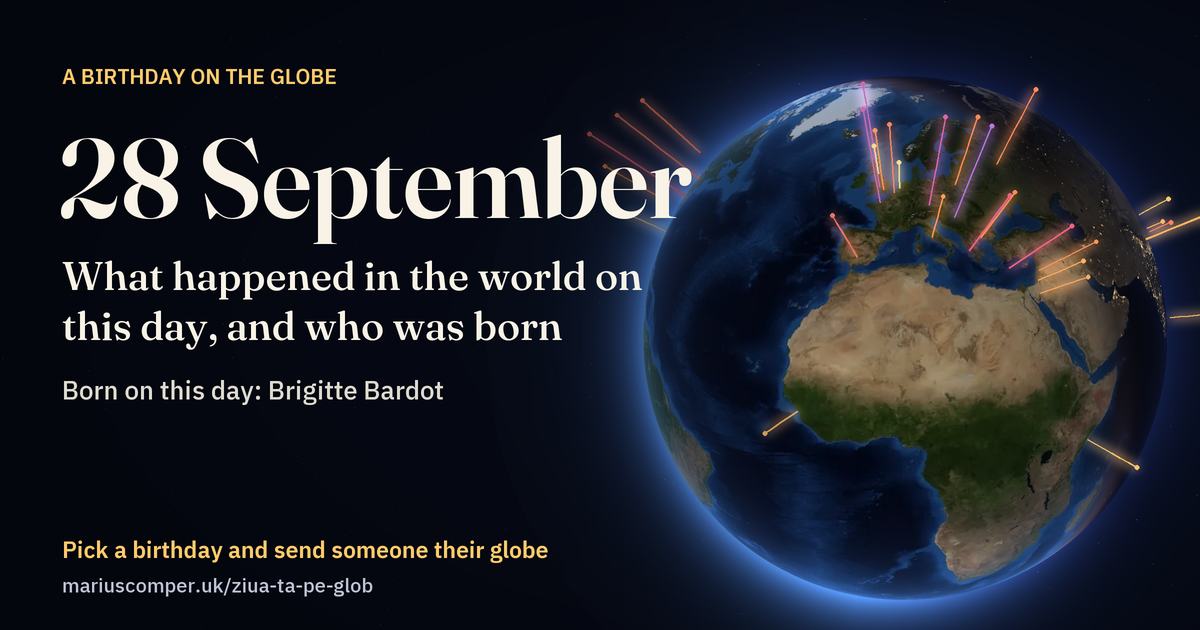
For 28 September, the English Wikipedia lists 64 events and 273 births. 33 of the events stand at their places as rays of light; two more are dashed circles, where the sentence links only to a country or a sea. The taller the ray, the longer ago it happened. The people born that day come further down, as blue points.
A birthday, yours or someone else’s:
Turn it into a greetingScroll: the globe turns to each place
The day you were born, on the globe.
Three things from your day
Scroll: your day first, then 28 September through the years
The Earth on 28 September
The picture on the globe was assembled by NASA from satellite photographs taken in September 2004: the snow, the ice and the green are those of the month.
On 28 September the Sun passes straight overhead at noon along the parallel of 2.0° south. In London, the day lasts about 11 hours 50 minutes.
The line between day and night is tilted on the globe exactly as on this day of the year. On the dark side you can see the lights of towns.
Britain & Ireland · Sycamore Gap tree
2023
The Sycamore Gap tree in Northumberland, England, was illegally felled.
On the map: Sycamore Gap tree.
Also on the day’s list of Wikipedia in Chinese.
Africa · Taba
1995
Israeli Prime Minister Yitzhak Rabin and PLO Chairman Yasser Arafat sign the Interim Agreement on the West Bank and the Gaza Strip.
On the map: Taba.
Asia · Temple Mount
2000
Al-Aqsa Intifada: Ariel Sharon visits Al-Aqsa Mosque known to Jews as the Temple Mount in Jerusalem.
On the map: Temple Mount.
Also on the day’s list of Wikipedia in Spanish.
North America · Mansfield
1892
The first night game for American football takes place in a contest between Wyoming Seminary and Mansfield State Normal.
On the map: Mansfield.
Wikipedia: 1892 Wyoming Seminary vs. Mansfield Normal football game
28 September
What the other Wikipedias remember#
For these years the English list has nothing on this day. The events below come from the same day’s lists on Wikipedia in Spanish and were translated for this page.
From Wikipedia in Spanish · Liverpool
1884
In Liverpool, Anfield stadium, now the home of Liverpool Football Club, is opened.
On the map: Liverpool.
Translated from the list on Wikipedia in Spanish.
28 September
Born on 28 September#
The English Wikipedia lists 273 births for this day. The blue points are the birthplaces of 60 of these people: those written about in the most Wikipedia editions, where Wikidata gives a place of birth.
Born on 28 September
1934
Brigitte Bardot, French actress and animal rights activist (died 2025)
Place of birth: 15th arrondissement of Paris.
Born on 28 September
1924
Marcello Mastroianni, Italian-French actor and singer (died 1996)
Place of birth: Fontana Liri.
Born on 28 September
1803
Prosper Mérimée, French archaeologist, historian, and author (died 1870)
Place of birth: Paris.
Born on 28 September
1968
Naomi Watts, English-Australian actress and producer
Place of birth: Shoreham.
Born on 28 September
1987
Hilary Duff, American singer-songwriter and actress
Place of birth: Houston.
Born in Britain and Ireland
1916
Peter Finch, English-Australian actor (died 1977)
Place of birth: South Kensington.
28 September
Number one in the charts that week
At the cinema
An animal recorded that day
The record can be seen in GBIF, which brings together wildlife records from around the world.
All your birthdays
The weather that day
Data: Met Office Hadley Centre (HadCET); NOAA (GHCN-Daily, Mauna Loa).
Above the Earth
Sources: Jonathan McDowell, GCAT (launches); GFZ Potsdam (Kp index). Days are counted in Universal Time.
Football that day
International matches played that day:
Source: the “International football results” dataset kept by Mart Jürisoo (CC0).
Also that day
The earthquake’s page at the USGS
Source: the USGS catalogue. The day is counted in Universal Time (UTC).
In those days
Make a link for someone
Type the name, pick the day and the year of birth. The link opens straight on their day, with their name in the greeting.
The link carries the name, date and place typed here; anyone who gets it can see them.
Put another birthday beside it
Your mother’s, your child’s, a friend’s: the two days appear side by side.
Below: 28 September through the years.
The whole globe of the day
Drag the globe to turn it. Touch a ray or a point to read what happened there.
Everything Wikipedia lists for 28 September
The list is the English Wikipedia’s, in its own wording, as it stood in October 2026. 29 events have no place on the map: the sentence links to no place with coordinates, only to places too wide to mark, or to several countries.
- 48 BC
Pompey disembarks at Pelusium upon arriving in Egypt, whereupon he is assassinated by order of King Ptolemy XIII.
no place on the mapWikipedia: Pompey - 235
Pope Pontian resigns. He is exiled to the mines of Sardinia, along with Hippolytus of Rome.
no place on the mapWikipedia: Pope Pontian - 351
Constantius II defeats the usurper Magnentius.
Europe · Battle of Mursa MajorWikipedia: Battle of Mursa Major - 365
Roman usurper Procopius bribes two legions passing by Constantinople, and proclaims himself emperor.
no place on the mapWikipedia: Procopius - 935
Duke Wenceslaus I of Bohemia is murdered by a group of nobles led by his brother Boleslaus I, who succeeds him.
no place on the mapWikipedia: Wenceslaus I, Duke of Bohemia - 995
Boleslaus II, Duke of Bohemia, kills most members of the rival Slavník dynasty.
no place on the mapWikipedia: Boleslaus II of Bohemia - 1066
William the Conqueror lands in England, beginning the Norman conquest.
Britain & Ireland · Norman ConquestWikipedia: William the Conqueror - 1106
King Henry I of England defeats his brother Robert Curthose at the Battle of Tinchebray.
Europe · Battle of TinchebrayWikipedia: Battle of Tinchebray - 1213
Queen consort Gertrude of Merania is assassinated by a group of Hungarian lords.
no place on the mapWikipedia: Gertrude of Merania - 1238
King James I of Aragon conquers Valencia from the Moors. Shortly thereafter, he proclaims himself king of Valencia.
Europe · Kingdom of ValenciaWikipedia: James I of Aragon - 1322
Louis IV, Holy Roman Emperor, defeats Frederick I of Austria in the Battle of Mühldorf.
Europe · Battle of MühldorfWikipedia: Battle of Mühldorf - 1538
Ottoman–Venetian War: The Ottoman Navy scores a decisive victory over a Holy League fleet in the Battle of Preveza.
Europe · Battle of PrevezaWikipedia: Battle of Preveza - 1542
Juan Rodríguez Cabrillo of Portugal arrives at what is now San Diego, California. He is the first European in California.
no place on the mapWikipedia: Juan Rodríguez Cabrillo - 1644
A Hospitaller galley squadron defeats an Ottoman convoy in the action of 28 September 1644.
Asia · Action of 28 September 1644Wikipedia: Action of 28 September 1644 - 1779
American Revolution: Samuel Huntington is elected President of the Continental Congress, succeeding John Jay.
no place on the mapWikipedia: American Revolution - 1781
American Revolutionary War: French and American forces backed by a French fleet begin the siege of Yorktown.
North America · Siege of YorktownWikipedia: Siege of Yorktown - 1787
The Congress of the Confederation votes to send the newly written United States Constitution to the state legislatures for approval.
no place on the mapWikipedia: History of the United States Constitution - 1821
The Declaration of Independence of the Mexican Empire is drafted. It will be made public on 13 October.
no place on the mapWikipedia: Declaration of Independence - 1844
Oscar I of Sweden–Norway is crowned king of Sweden.
no place on the mapWikipedia: Oscar I of Sweden - 1867
Toronto becomes the capital of Ontario, having also been the capital of Ontario's predecessors since 1796.
no place on the mapWikipedia: History of Toronto - 1868
The Battle of Alcolea causes Queen Isabella II of Spain to flee to France.
Europe · Battle of AlcoleaWikipedia: Battle of Alcolea - 1871
The Brazilian Parliament passes a law that frees all children thereafter born to slaves, and all government-owned slaves.
no place on the mapWikipedia: Rio Branco Law - 1889
The General Conference on Weights and Measures (CGPM) defines the length of a metre.
no place on the mapWikipedia: General Conference on Weights and Measures - 1892
The first night game for American football takes place in a contest between Wyoming Seminary and Mansfield State Normal.
North America · MansfieldWikipedia: 1892 Wyoming Seminary vs. Mansfield Normal football game - 1901
Philippine–American War: Filipino guerrillas kill more than forty American soldiers while losing 28 of their own.
Asia · Balangiga massacreWikipedia: Philippine–American War - 1912
Corporal Frank S. Scott of the United States Army becomes the first enlisted man to die in an airplane crash.
no place on the mapWikipedia: Frank S. Scott - 1912
The Ulster Covenant is signed by some 500,000 Ulster Unionists in opposition to the Third Irish Home Rule Bill.
no place on the mapWikipedia: Ulster Covenant - 1918
World War I: The Fifth Battle of Ypres begins.
Europe · Fifth Battle of YpresWikipedia: World War I - 1919
Race riots begin in Omaha, Nebraska, United States.
North America · OmahaWikipedia: Omaha race riot of 1919 - 1924
The first aerial circumnavigation is completed by a team from the US Army.
no place on the mapWikipedia: First aerial circumnavigation - 1928
Alexander Fleming notices a bacteria-killing mold growing in his laboratory, discovering what later became known as penicillin.
no place on the mapWikipedia: Alexander Fleming - 1939
World War II: Nazi Germany and the Soviet Union agree on a division of Poland.
Europe · MoscowWikipedia: German–Soviet Boundary and Friendship Treaty - 1939
World War II: The siege of Warsaw comes to an end.
Europe · Siege of WarsawWikipedia: Siege of Warsaw - 1941
Ted Williams achieves a .406 batting average for the season, and becomes the last major league baseball player to bat .400 or better.
no place on the mapWikipedia: Ted Williams - 1941
World War II: The Drama uprising against the Bulgarian occupation in northern Greece begins.
Europe · DramaWikipedia: Drama uprising - 1944
World War II: Soviet Army troops liberate Klooga concentration camp in Estonia.
no place on the mapWikipedia: Klooga concentration camp - 1951
CBS makes the first color televisions available for sale to the general public, but the product is discontinued less than a month later.
no place on the mapWikipedia: Color television - 1958
Fernando Rios, a Mexican tour guide in New Orleans, dies of injuries sustained in an incident of gay bashing.
North America · Killing of Fernando RiosWikipedia: Killing of Fernando Rios - 1961
A military coup in Damascus effectively ends the United Arab Republic, the union between Egypt and Syria.
Asia · 1961 Syrian coup d'étatWikipedia: 1961 Syrian coup d'état - 1963
Whaam!, now considered one of Roy Lichtenstein's most important works, debuted at an exhibition held at the Leo Castelli Gallery, New York City.
no place on the mapWikipedia: Whaam! - 1970
Egyptian President Gamal Abdel Nasser dies of a heart attack in Cairo.
no place on the mapWikipedia: Death and state funeral of Gamal Abdel Nasser - 1972
Against the backdrop of the Cold War, the Canadian ice hockey team defeated the Soviet team in the Summit Series.
no place on the mapWikipedia: Summit Series - 1973
The ITT Building in New York City is bombed in protest at ITT's alleged involvement in the coup d'état in Chile.
Latin America · ChileWikipedia: 1973 Chilean coup d'état - 1975
The Spaghetti House siege, in which nine people are taken hostage, takes place in London.
Britain & Ireland · Spaghetti House siegeWikipedia: Spaghetti House siege - 1978
Pope John Paul I died only 33 days after his papal election due to an apparent myocardial infarction, resulting in the first year of three popes since 1605.
Europe · August 1978 conclaveWikipedia: August 1978 conclave - 1983
John Pat, a 16-year old Aboriginal Australian boy, dies of injuries sustained by four off-duty police officers in Roebourne, a catalyst to the Royal Commission into Aboriginal Deaths in Custody.
Oceania · Roebourne, Western AustraliaWikipedia: Death of John Pat - 1986
The Democratic Progressive Party becomes the first opposition party in Taiwan.
no place on the mapWikipedia: Democratic Progressive Party - 1992
A Pakistan International Airlines flight crashes into a hill in Nepal, killing all 167 passengers and crew.
Asia · Pakistan International Airlines Flight 268Wikipedia: Pakistan International Airlines Flight 268 - 1994
The cruise ferry MS Estonia sinks in the Baltic Sea, killing 852 people.
no place on the mapWikipedia: MS Estonia - 1995
Bob Denard and a group of mercenaries take the islands of the Comoros in a coup.
no place on the mapWikipedia: Bob Denard - 1995
Israeli Prime Minister Yitzhak Rabin and PLO Chairman Yasser Arafat sign the Interim Agreement on the West Bank and the Gaza Strip.
Africa · TabaWikipedia: Oslo II Accord - 2000
Al-Aqsa Intifada: Ariel Sharon visits Al-Aqsa Mosque known to Jews as the Temple Mount in Jerusalem.
Asia · Temple MountWikipedia: Second Intifada - 2006
Typhoon Xangsane passes over Manila after impacting parts of Southern Luzon and Eastern Visayas, becoming the strongest to affect the Philippine capital in 11 years.
Asia · Metro ManilaWikipedia: Typhoon Xangsane - 2008
Falcon 1 becomes the first privately developed liquid-fuel ground-launched vehicle to put a payload into orbit by the RatSat mission.
no place on the mapWikipedia: Falcon 1 - 2008
The Singapore Grand Prix is held as Formula One's inaugural night race, with Fernando Alonso winning the event. Almost a year later it was revealed that Alonso's team-mate Nelson Piquet Jr. had been ordered to crash his car to help bring out the safety car and give Alonso the advantage and win.
Asia · 2008 Singapore Grand PrixWikipedia: 2008 Singapore Grand Prix - 2009
The military junta leading Guinea attacks a protest rally, killing or wounding 1,400 people.
Africa · 2009 Guinean protestsWikipedia: 2009 Guinean protests - 2012
Sita Air Flight 601 crashes in Madhyapur Thimi, Nepal, killing all 19 passengers and crew.
Asia · Sita Air Flight 601Wikipedia: Sita Air Flight 601 - 2012
Somali and African Union forces launch a coordinated assault on the Somali port of Kismayo to take back the city from al-Shabaab militants.
Africa · Battle of KismayoWikipedia: Battle of Kismayo - 2014
The 2014 Hong Kong protests begin in response to restrictive political reforms imposed by the NPC in Beijing.
Asia · Hong KongWikipedia: 2014 Hong Kong protests - 2016
The 2016 South Australian blackout occurs, lasting up to three days in some areas.
no place on the mapWikipedia: 2016 South Australian blackout - 2018
The 7.5 Mw 2018 Sulawesi earthquake, which triggered a large tsunami, leaves 4,340 dead and 10,679 injured.
Asia · 2018 Sulawesi earthquake and tsunamiWikipedia: 2018 Sulawesi earthquake and tsunami - 2022
Hurricane Ian makes landfall in Cayo Costa State Park, Florida as a category four hurricane, killing 169 and doing $113 billion in damage, becoming Florida's costliest hurricane and the deadliest in 89 years.
North America · Cayo Costa State ParkWikipedia: 1935 Labor Day hurricane - 2023
The 2023 Rotterdam shootings occurred, during which two people were killed in a shooting and arson incident at a residence in Delfshaven, Rotterdam. Additionally, one person lost their life in a classroom at the Erasmus University Medical Center.
Europe · RotterdamWikipedia: 2023 Rotterdam shootings - 2023
The Sycamore Gap tree in Northumberland, England, was illegally felled.
Britain & Ireland · Sycamore Gap treeWikipedia: Sycamore Gap tree
What the other Wikipedias remember
For these years the English list has nothing on this day. The events below come from the same day’s lists on Wikipedia in Spanish and were translated for this page.
- 1884
In Liverpool, Anfield stadium, now the home of Liverpool Football Club, is opened.
Who was born on 28 September
In order of how many Wikipedia editions have an article about each. The first 60 of 273 are shown.
- 551 BC
Confucius, Chinese teacher, editor, politician, and philosopher of the Spring and Autumn period of Chinese history. (died 479 BC)
- 1934
Brigitte Bardot, French actress and animal rights activist (died 2025)
15th arrondissement of ParisWikipedia: Brigitte Bardot - 1947
Sheikh Hasina, Bangladeshi politician, 10th Prime Minister of Bangladesh
Tungipara UpazilaWikipedia: Sheikh Hasina - 1841
Georges Clemenceau, French journalist, physician, and politician, 85th Prime Minister of France (died 1929)
Mouilleron-en-ParedsWikipedia: Georges Clemenceau - 1924
Marcello Mastroianni, Italian-French actor and singer (died 1996)
Fontana LiriWikipedia: Marcello Mastroianni - 1803
Prosper Mérimée, French archaeologist, historian, and author (died 1870)
- 1968
Naomi Watts, English-Australian actress and producer
ShorehamWikipedia: Naomi Watts - 1987
Hilary Duff, American singer-songwriter and actress
HoustonWikipedia: Hilary Duff - 1929
Lata Mangeshkar, Indian playback singer and composer (died 2022)
- 1852
Henri Moissan, French chemist and academic, Nobel Prize laureate (died 1907)
- 1967
Mira Sorvino, American actress
TenaflyWikipedia: Mira Sorvino - 1968
Mika Häkkinen, Finnish race car driver
VantaaWikipedia: Mika Häkkinen - 1982
Ranbir Kapoor, Indian actor and director
MumbaiWikipedia: Ranbir Kapoor - 1746
William Jones, English-Welsh philologist and scholar (died 1794)
LondonWikipedia: William Jones - 1932
Víctor Jara, Chilean singer-songwriter, poet, and director (died 1973)
San IgnacioWikipedia: Víctor Jara - 1916
Peter Finch, English-Australian actor (died 1977)
South KensingtonWikipedia: Peter Finch - 1952
Sylvia Kristel, Dutch model and actress (died 2012)
UtrechtWikipedia: Sylvia Kristel - 1972
Dita Von Teese, American model and dancer
RochesterWikipedia: Dita Von Teese - 1907
Bhagat Singh, Indian activist (died 1931)
British RajWikipedia: Bhagat Singh - 1984
Mathieu Valbuena, French footballer
- 1938
Ben E. King, American singer-songwriter and producer (died 2015)
HendersonWikipedia: Ben E. King - 1988
Marin Čilić, Croatian tennis player
MedjugorjeWikipedia: Marin Čilić - 1910
Diosdado Macapagal, Filipino lawyer and politician, 9th President of the Philippines (died 1997)
- 1986
Andrés Guardado, Mexican footballer
GuadalajaraWikipedia: Andrés Guardado - 1976
Fedor Emelianenko, Russian mixed martial artist and politician
RubizhneWikipedia: Fedor Emelianenko - 1930
Immanuel Wallerstein, American sociologist, author, and academic (died 2019)
New York CityWikipedia: Immanuel Wallerstein - 1954
Margot Wallström, Swedish politician and diplomat, 42nd Swedish Minister for Foreign Affairs
- 1981
Willy Caballero, Argentine footballer
Santa ElenaWikipedia: Willy Caballero - 1982
Aleksandr Anyukov, Russian footballer
- 1901
Ed Sullivan, American television host (died 1974)
- 1925
Seymour Cray, American computer scientist, founded the CRAY Computer Company (died 1996)
Chippewa FallsWikipedia: Seymour Cray - 1823
Alexandre Cabanel, French painter and educator (died 1889)
MontpellierWikipedia: Alexandre Cabanel - 1905
Max Schmeling, German boxer (died 2005)
Klein LuckowWikipedia: Max Schmeling - 1964
Janeane Garofalo, American comedian, actress, and screenwriter
- 1735
Augustus FitzRoy, 3rd Duke of Grafton, English academic and politician, Prime Minister of Great Britain (died 1811)
- 1941
Edmund Stoiber, German lawyer and politician, Minister President of Bavaria
OberaudorfWikipedia: Edmund Stoiber - 1887
Avery Brundage, American businessman, 5th President of the International Olympic Committee (died 1975)
DetroitWikipedia: Avery Brundage - 1981
José Calderón, Spanish basketball player
Villanueva de la SerenaWikipedia: José Calderón - 1982
Nolwenn Leroy, French singer-songwriter and actress
Saint-RenanWikipedia: Nolwenn Leroy - 2004
Isack Hadjar, French-Algerian racing driver
- 1977
Young Jeezy, American rapper
ColumbiaWikipedia: Jeezy - 1982
Abhinav Bindra, Indian target shooter
DehradunWikipedia: Abhinav Bindra - 1865
Amélie of Orléans, Queen Consort of Carlos I of Portugal (died 1951)
TwickenhamWikipedia: Amélie of Orléans - 1867
Hiranuma Kiichirō, Japanese lawyer and politician, 35th Prime Minister of Japan (died 1952)
TsuyamaWikipedia: Hiranuma Kiichirō - 1982
St. Vincent, American singer-songwriter and guitarist
- 1982
Emeka Okafor, American basketball player
HoustonWikipedia: Emeka Okafor - 1946
Jeffrey Jones, American actor
BuffaloWikipedia: Jeffrey Jones - 1970
Kimiko Date, Japanese tennis player
Kamigyō-kuWikipedia: Kimiko Date - 1979
Bam Margera, American skateboarder, actor, and stuntman
West ChesterWikipedia: Bam Margera - 1681
Johann Mattheson, German composer, lexicographer, and diplomat (died 1764)
HamburgWikipedia: Johann Mattheson - 1852
John French, 1st Earl of Ypres, British Army officer (died 1925)
- 1957
Bill Cassidy, American politician and physician
Highland ParkWikipedia: Bill Cassidy - 1966
Maria Canals-Barrera, Cuban-American actress
- 1964
Claudio Borghi, Argentinian footballer and manager
CastelarWikipedia: Claudio Borghi - 1984
Melody Thornton, American singer-songwriter and dancer
PhoenixWikipedia: Melody Thornton - 1860
Paul Ulrich Villard, French chemist and physicist (died 1934)
Saint-Germain-au-Mont-d'OrWikipedia: Paul Ulrich Villard - 1918
Ángel Labruna, Argentinian footballer and manager (died 1983)
Buenos AiresWikipedia: Ángel Labruna - 1941
David Lewis, American philosopher and academic (died 2001)
OberlinWikipedia: David Lewis - 1950
Christina Hoff Sommers, American author and philosopher
- 1960
Jennifer Rush, American singer-songwriter
AstoriaWikipedia: Jennifer Rush
What is celebrated on 28 September
- Christian feast day: Aaron of Auxerre
- Christian feast day: Amalia Abad Casasempere
- Christian feast day: Annemund
- Christian feast day: Chariton the Confessor
- Christian feast day: Conval
- Christian feast day: Eustochium
- Christian feast day: Exuperius
- Christian feast day: Faustus of Riez
- Christian feast day: Leoba
- Christian feast day: Lorenzo Ruiz
- Christian feast day: Nykyta Budka
- Christian feast day: Paternus of Auch
- Christian feast day: Richard Rolle, Walter Hilton and Margery Kempe (Episcopal Church (USA))
- Christian feast day: Simón de Rojas
A greeting link for someone
Type a name and, if you like, the year of birth. The link opens with a greeting, and beside each event it says how old the person turned that day, or how many years before their birth it happened.
The name and the year go only into the link you send.
All 366 days
How the globe is made
Where the events come from
Each edition of this page uses the day’s list from Wikipedia in its own language: Romanian, English, Spanish, Chinese. The lists are written by volunteers and differ from one edition to the next; the text of each event is Wikipedia’s, with a link to the article. A row that appears twice in a list is shown once. The lists have not been checked event by event: they are Wikipedia’s, mistakes included.
For events before 1582, and for countries that moved to the Gregorian calendar later (Britain in 1752, Russia in 1918), the same day may be counted Old Style in one list and New Style in another.
The chapter “What the other Wikipedias remember” adds up to five events a day from the lists of the other three editions, only for years in which the English list has nothing on that day. They were translated for this page, passed the same filters as the tour, and are not counted among the events of the English list.
How an event gets onto the map
The place comes from Wikidata. If the sentence links to the article about the event itself (a battle, an opening, an earthquake), dated to the same year, the ray stands on its coordinates or on those of its location. Otherwise it stands on the first place the sentence links to: a town, a building, a mountain, an island. This second step can be wrong: sometimes the sentence only mentions the place. That is why the page says, under each event, which place the ray stands on.
When the sentence links to a single state or province, or to a single sea, lake or desert larger than 5,000 km², the globe shows a dashed circle, not a ray. The circle has the area Wikidata gives, with its radius kept between 1.2° and 16°, or a radius of 4.5° when Wikidata gives no area; it says only that the sentence links to that place. Organisations, ships, spacecraft, museum objects, rivers, mountain ranges, languages and continents are never used as places. When a sentence names several states and no exact place, the event stays in the list only.
What the height means
The height of a ray shows how many years have passed, on a logarithmic scale: 10 years, 100 years and 1,000 years are equal steps apart; anything older than about 2,600 years has the tallest ray. The colour runs from pale yellow for recent years to violet for antiquity.
Where the tour stops
In each region the tour stops at up to three events (five in Britain and Ireland), chosen mainly by three things: whether Wikipedia’s editors put the event in the “On this day” box of their main page (the English, Spanish and Chinese editions), how many Wikipedia editions have an article about it, and how many of the four lists include it. Events whose sentence or article is about a war, an attack, a crime or a disaster are left out of the tour; they stay in the whole list, in Wikipedia’s wording. The filter is a list of words and a list of Wikidata types, so it can miss some.
The tour of births names the people with articles in the most editions and leaves aside those whom the list or Wikidata describes as rulers, politicians, commanders, leaders of movements or criminals; they stay in the list.
The Earth and the Sun
The daytime images are NASA’s Blue Marble Next Generation mosaics, one for each month of 2004; the night side is Black Marble 2016. The tilt of the line between day and night is computed for the day; the hour is chosen so that the place being read is in daylight. The latitude where the Sun stands overhead is the average of the four years of the leap cycle; in a given year it can differ by up to 0.4°.
The day you were born
The number ones come from the weekly lists on Wikipedia: Billboard for the United States (from 1940; the Hot 100 from August 1958), the UK Singles Chart (from November 1952), Los 40 Principales for Spain (from July 1966) and, for Romania, the Romanian Top 100 and Airplay 100 (2001–2021, with missing weeks). The page shows the chart of the week in which the day of birth falls, with its date; Billboard and the UK chart are dated at the end of their week. For Romania before 2001 and for China these sources have no weekly chart.
The films are those that reached cinemas in the United States up to ten days before or three days after that day (some of them in a few cinemas at first), from the English Wikipedia’s yearly lists (from 1968), in order of how many editions have an article about them. The events “in those days” are the ones on the neighbouring days’ lists that carry the year of birth, passed through the same filter as the tour.
The day of birth, year included
The Moon, the star sign and the constellation are worked out by the page itself, for noon Universal Time on the day. The lit part of the Moon is rounded and can differ by a few per cent from that at the hour of birth. The sign follows the usual zodiac of twelve equal parts starting at the March equinox; the constellation is the one the Sun actually stood in front of, by the borders set by the International Astronomical Union, and within a day of a border the page does not name it. When the Sun changes sign while it is that day anywhere on Earth, the page gives the moment of crossing, rounded to ten minutes and accurate to within about a quarter of an hour, and the clock time in a few cities, with the time zone and summer time of that year.
The year in the Chinese calendar is the one your device’s own calendar gives for the date, checked against the Hong Kong Observatory’s tables. “All your birthdays” uses the same sources as the rest of the chapter for the same day in every year since the birth: the temperature, well-known launches that took place on that very day, matches of the teams the edition follows, snow deeper than 10 cm and strong geomagnetic storms. The three things at the top and the four on the picture are chosen in a fixed order (the song, the animal, a full Moon, a well-known launch before an ordinary earthquake); on the picture you can change them.
When the link carries a year of birth, the page adds a few things about that exact day. The weather is the Met Office’s Central England temperature record and the readings from New York’s Central Park; the “usual high” is the average of the daily highs of 1961–1990 for that date, with two days either side. The carbon dioxide figure is the monthly mean at the Mauna Loa observatory, where measurements begin in March 1958.
The earthquake is the one with the largest magnitude in the USGS catalogue for that day, counted in Universal Time. Before the 1960s the catalogue has gaps even above magnitude 5.5, so in the older years many days have no earthquake. The page gives only the magnitude and the place: the country the epicentre falls in or, when the epicentre is at sea within 300 km of a coast, the nearest country; farther out, only the ocean.
The launches are those that reached orbit or left for the Moon and the planets, from Jonathan McDowell’s GCAT catalogue. If nothing left that day, the page shows the nearest launch within three days before or after, and says how many days away it was. The geomagnetic storm appears only when the Kp index reached at least 5 in one of the day’s eight three-hour intervals.
The animal comes from GBIF: an observation made by a person (the animal seen or heard, or its tracks), dated to that exact day, with coordinates and a CC0 or CC BY licence. Only a few hundred well-known species are searched (mammals, birds, turtles, butterflies); of those noted that day, mammals and species with articles in many Wikipedia editions come first; birds noted almost every day, and species used recently, wait their turn. Observations dated 1 January are left out, because records without a day are often filed there. An observation shows that the animal was recorded there, not how many animals there were.
The matches are those between national teams. Only matches of England, Scotland, Wales, Northern Ireland, the Republic of Ireland, the United States, Canada and Australia are shown, along with those at the big final tournaments. The picture to send is drawn in the page from the day’s globe and the facts above, and stays on your device until you send it.
Sources
- Events, births and holidays: the day’s page on Wikipedia, text under CC BY-SA 4.0.
- Coordinates, places of birth and the number of editions: Wikidata (CC0).
- The Earth by day: NASA Blue Marble Next Generation. The Earth by night: NASA Black Marble 2016.
- Borders and regions: Natural Earth.
- World population and births per year: UN World Population Prospects 2024.
- Charts and films: Wikipedia’s lists for Billboard, the UK Singles Chart, Los 40 Principales, Romanian Top 100, Airplay 100 and American films by year (CC BY-SA 4.0).
- Weather: Met Office Hadley Centre, HadCET (Open Government Licence) and NOAA GHCN-Daily, New York Central Park. Carbon dioxide: NOAA Global Monitoring Laboratory, Mauna Loa.
- Earthquakes: the USGS catalogue. Launches: Jonathan McDowell, GCAT (CC BY). Kp index: GFZ Potsdam (CC BY 4.0). Matches: International football results, Mart Jürisoo (CC0).
- Animal observations: GBIF, with a link to each record; species names come from Wikidata.