A birthday on the globe
18 September on the globe: what happened in the world on this day, and who was born
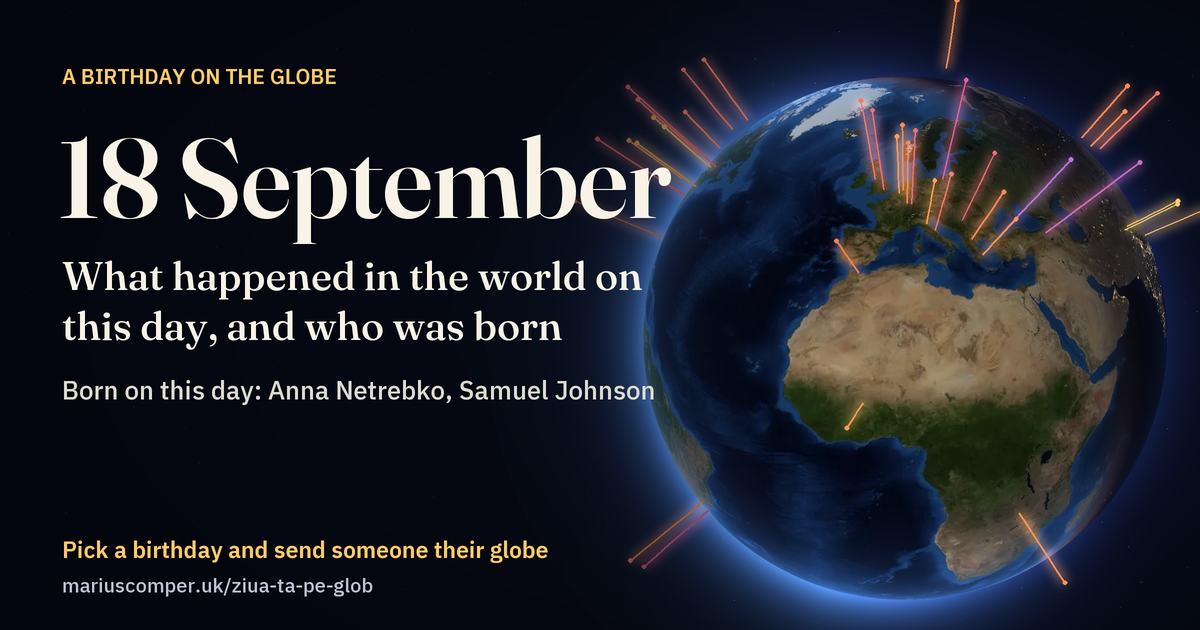
For 18 September, the English Wikipedia lists 83 events and 239 births. 37 of the events stand at their places as rays of light; eight more are dashed circles, where the sentence links only to a country or a sea. The taller the ray, the longer ago it happened. The people born that day come further down, as blue points.
A birthday, yours or someone else’s:
Turn it into a greetingScroll: the globe turns to each place
The day you were born, on the globe.
Three things from your day
Scroll: your day first, then 18 September through the years
The Earth on 18 September
The picture on the globe was assembled by NASA from satellite photographs taken in September 2004: the snow, the ice and the green are those of the month.
On 18 September the Sun passes straight overhead at noon along the parallel of 1.9° north. In London, the day lasts about 12 hours 30 minutes.
The line between day and night is tilted on the globe exactly as on this day of the year. On the dark side you can see the lights of towns.
Britain & Ireland · Royal Opera House
1809
The Royal Opera House in Covent Garden, London, opens.
On the map: Royal Opera House.
Also on the day’s list of Wikipedia in Spanish and Chinese.
Britain & Ireland · Blackpool
1879
The Blackpool Illuminations in the English seaside town of Blackpool were switched on for the first time.
On the map: Blackpool.
Europe · Treaty of Belgrade
1739
The Treaty of Belgrade is signed, whereby Austria cedes lands south of the Sava and Danube rivers to the Ottoman Empire.
On the map: the coordinates Wikidata gives for the article “Treaty of Belgrade”.
Also on the day’s list of Wikipedia in Spanish.
Europe · Metropolitan Cathedral of Athens
1964
The wedding of Constantine II of Greece and Princess Anne-Marie of Denmark takes place in Athens.
On the map: Metropolitan Cathedral of Athens.
Wikipedia: Wedding of Constantine II and Princess Anne-Marie
Europe · Bologna
1988
The Magna Charta Universitatum, asserting key principles essential to the free operation of universities, is signed in Bologna by the rectors of 388 institutions of higher learning, to commemorate the 900th anniversary of the University of Bologna.
On the map: Bologna.
Latin America · San Pedro Bay
1544
The expedition of Juan Bautista Pastene makes landfall in San Pedro Bay, southern Chile, claiming the territory for Spain.
On the map: San Pedro Bay.
Latin America · São Paulo
1950
TV Tupi Difusora, the first television station to broadcast in Brazil, begins transmissions on Channel 3 in São Paulo.
On the map: São Paulo.
North America · Thanksgiving
1862
The Confederate States celebrate for the first and only time a Thanksgiving Day.
On the map: Thanksgiving.
North America · Old Faithful
1870
During an expedition to the Wyoming Territory, Henry D. Washburn observes and names the Old Faithful Geyser.
On the map: Old Faithful.
Also on the day’s list of Wikipedia in Chinese.
North America · Ottawa
1997
The Anti-Personnel Mine Ban Convention is adopted.
On the map: Ottawa.
18 September
What the other Wikipedias remember#
For these years the English list has nothing on this day. The events below come from the same day’s lists on Wikipedia in Romanian and were translated for this page.
From Wikipedia in Romanian · United States Capitol
1793
George Washington lays the first foundation stone of the United States Capitol.
On the map: United States Capitol.
Translated from the list on Wikipedia in Romanian.
The article on Wikipedia in Romanian: Capitoliul Statelor Unite ale Americii
18 September
Born on 18 September#
The English Wikipedia lists 239 births for this day. The blue points are the birthplaces of 60 of these people: those written about in the most Wikipedia editions, where Wikidata gives a place of birth.
Born on 18 September
1971
Anna Netrebko, Russian-Austrian soprano and actress
Place of birth: Krasnodar.
Born on 18 September
1709
Samuel Johnson, English lexicographer and poet (died 1784)
Place of birth: Lichfield.
Born on 18 September
1905
Greta Garbo, Swedish-American actress (died 1990)
Place of birth: Katarina church parish.
Born on 18 September
1971
Lance Armstrong, American cyclist
Place of birth: Plano.
Born in Britain and Ireland
1949
Peter Shilton, English footballer and manager
Place of birth: Leicester.
Born in Britain and Ireland
1958
John Aldridge, English-Irish footballer and manager
Place of birth: Liverpool.
Born in Britain and Ireland
1995
Matt Targett, English footballer
Place of birth: Winchester.
18 September
Number one in the charts that week
At the cinema
An animal recorded that day
The record can be seen in GBIF, which brings together wildlife records from around the world.
All your birthdays
The weather that day
Data: Met Office Hadley Centre (HadCET); NOAA (GHCN-Daily, Mauna Loa).
Above the Earth
Sources: Jonathan McDowell, GCAT (launches); GFZ Potsdam (Kp index). Days are counted in Universal Time.
Football that day
International matches played that day:
Source: the “International football results” dataset kept by Mart Jürisoo (CC0).
Also that day
The earthquake’s page at the USGS
Source: the USGS catalogue. The day is counted in Universal Time (UTC).
In those days
Make a link for someone
Type the name, pick the day and the year of birth. The link opens straight on their day, with their name in the greeting.
The link carries the name, date and place typed here; anyone who gets it can see them.
Put another birthday beside it
Your mother’s, your child’s, a friend’s: the two days appear side by side.
Below: 18 September through the years.
The whole globe of the day
Drag the globe to turn it. Touch a ray or a point to read what happened there.
Everything Wikipedia lists for 18 September
The list is the English Wikipedia’s, in its own wording, as it stood in October 2026. 38 events have no place on the map: the sentence links to no place with coordinates, only to places too wide to mark, or to several countries.
- 96
Emperor Domitian is assassinated as a result of a plot by his wife Domitia and two Praetorian prefects. Nerva is then proclaimed as his successor.
no place on the mapWikipedia: Domitian - 324
Constantine the Great decisively defeats Licinius in the Battle of Chrysopolis, establishing Constantine's sole control over the Roman Empire.
Asia · Battle of ChrysopolisWikipedia: Battle of Chrysopolis - 1048
Battle of Kapetron between a combined Byzantine-Georgian army and a Seljuq army.
Asia · Battle of KapetronWikipedia: Battle of Kapetron - 1066
Norwegian king Harald Hardrada lands with Tostig Godwinson at the mouth of the Humber River and begins his invasion of England.
no place on the mapWikipedia: Harald Hardrada - 1180
Philip Augustus becomes king of France at the age of fifteen.
no place on the mapWikipedia: Philip II of France - 1454
Thirteen Years' War: In the Battle of Chojnice, the Polish army is defeated by the Teutonic knights.
Europe · Battle of ChojniceWikipedia: Battle of Chojnice - 1544
The expedition of Juan Bautista Pastene makes landfall in San Pedro Bay, southern Chile, claiming the territory for Spain.
Latin America · San Pedro BayWikipedia: Juan Bautista Pastene - 1618
The twelfth baktun in the Mesoamerican Long Count calendar begins.
no place on the map - 1739
The Treaty of Belgrade is signed, whereby Austria cedes lands south of the Sava and Danube rivers to the Ottoman Empire.
Europe · Treaty of BelgradeWikipedia: Treaty of Belgrade - 1759
French and Indian War: The Articles of Capitulation of Quebec are signed.
North America · Quebec CityWikipedia: Articles of Capitulation of Quebec - 1796
War of the First Coalition: General Franz Petrasch's Austrian and Imperial troops stormed the French-held bridgehead over the Rhine river.
Europe · Second Battle of KehlWikipedia: Second Battle of Kehl - 1809
The Royal Opera House in Covent Garden, London, opens.
Britain & Ireland · Royal Opera HouseWikipedia: Royal Opera House - 1810
First Government Junta in Chile. Though supposed to rule only during the Peninsular War in Spain, it is in fact the first step towards independence from Spain, and is commemorated as such.
no place on the mapWikipedia: Government Junta of Chile - 1837
Tiffany & Co. (first named Tiffany & Young) is founded by Charles Lewis Tiffany and Teddy Young in New York City. The store is called a "stationery and fancy goods emporium".
no place on the mapWikipedia: Tiffany & Co. - 1838
The Anti-Corn Law League is established by Richard Cobden.
no place on the mapWikipedia: Anti–Corn Law League - 1850
The U.S. Congress passes the Fugitive Slave Act of 1850.
no place on the mapWikipedia: Fugitive Slave Act of 1850 - 1851
The New York Times, the largest metropolitan newspaper in the United States, was founded.
no place on the mapWikipedia: The New York Times - 1860
Second Opium War: Battle of Zhangjiawan: Now heading towards Beijing after having recently occupied Tianjin, the allied Anglo-French force engages and defeats a larger Qing Chinese army at Zhangjiawan.
Asia · Tongzhou DistrictWikipedia: Second Opium War - 1860
Wars of Italian Unification: Battle of Castelfidardo: Royal Sardinian Army defeats forces of the Papal States, resulting in the conquest of Umbria and Marche by the Kingdom of Italy.
Europe · Battle of CastelfidardoWikipedia: Unification of Italy - 1862
The Confederate States celebrate for the first and only time a Thanksgiving Day.
North America · ThanksgivingWikipedia: Thanksgiving - 1863
American Civil War: The Battle of Chickamauga begins between Confederate and Union forces. It involves the second highest amount of casualties for any American Civil War battle apart from Gettysburg.
North America · Battle of ChickamaugaWikipedia: American Civil War - 1864
American Civil War: John Bell Hood begins the Franklin–Nashville Campaign in an unsuccessful attempt to draw William Tecumseh Sherman back out of Georgia.
North America · GeorgiaWikipedia: Franklin–Nashville campaign - 1867
The first provincial election for the Nova Scotia Legislative Assembly after Canada's Confederation returns a large majority for the Anti-Confederation Party, led by William Annand, who becomes Premier.
no place on the mapWikipedia: Nova Scotia House of Assembly - 1867
The fourth and current State Constitution of Maryland is ratified by voters.
no place on the mapWikipedia: Constitution of Maryland - 1870
During an expedition to the Wyoming Territory, Henry D. Washburn observes and names the Old Faithful Geyser.
North America · Old FaithfulWikipedia: Washburn–Langford–Doane Expedition - 1873
The U.S. bank Jay Cooke & Company declares bankruptcy, contributing to the Panic of 1873.
no place on the mapWikipedia: Panic of 1873 - 1875
The Indianola hurricane dissipated over Mississippi after killing around eight hundred people in Texas.
no place on the mapWikipedia: 1875 Indianola hurricane - 1879
The Blackpool Illuminations in the English seaside town of Blackpool were switched on for the first time.
Britain & Ireland · BlackpoolWikipedia: Blackpool Illuminations - 1882
The Pacific Stock Exchange opens.
no place on the mapWikipedia: Pacific Exchange - 1885
Five Chinese people were lynched outside of Pierce City in the Idaho Territory of the United States.
North America · Pierce, IdahoWikipedia: 1885 Pierce City lynching - 1898
The Fashoda Incident triggers the last war scare between Britain and France.
no place on the mapWikipedia: Fashoda Incident - 1906
The 1906 Hong Kong typhoon kills an estimated 10,000 people.
no place on the mapWikipedia: 1906 Hong Kong typhoon - 1910
In Washington, D.C., George Owen Squier demonstrated the first system to allow multiplexing of telephone transmissions, sending a message between two laboratories of the U.S. Signal Corps.
no place on the mapWikipedia: United States Army Signal Corps - 1914
The Irish Home Rule Act becomes law, but is delayed until after World War I.
no place on the mapWikipedia: Government of Ireland Act 1914 - 1915
The Saturday Evening Post publishes the short story "Extricating Young Gussie" by P.G. Wodehouse, featuring the first appearance of Bertie Wooster and his valet Jeeves.
no place on the mapWikipedia: The Saturday Evening Post - 1918
World War I: The Central Powers' defeat at the Battle of Dobro Pole played a role in the Bulgarian withdrawal from the war and led to the subsequent liberation of Vardar Macedonia.
Europe · Battle of Dobro PoleWikipedia: World War I - 1919
Fritz Pollard becomes the first African American to play professional football for a major team, the Akron Pros.
no place on the mapWikipedia: Fritz Pollard - 1919
In the Netherlands, a law granting full voting rights to women is granted royal assent by Queen Wilhelmina.
Europe · NetherlandsWikipedia: Netherlands - 1921
Rif War: In Ajdir, Spanish Morocco, a secessionist group of Berbers led by Abd el-Krim proclaim the Republic of the Rif, in rebellion against the Sultan of Morocco and the Spanish Army. French and Spanish forces suppress the Republic by May 1926.
Africa · AjdirWikipedia: Rif War - 1922
The Kingdom of Hungary is admitted to the League of Nations.
Europe · Kingdom of HungaryWikipedia: Kingdom of Hungary - 1924
The U.S. ends its military occupation of the Dominican Republic, after invading in May 1916 to force the Dominican government to pay its debts to European creditors.
Latin America · Dominican RepublicWikipedia: Military Government of Santo Domingo - 1926
A hurricane devastates Miami, Florida, killing 372 people.
North America · MiamiWikipedia: 1926 Miami hurricane - 1927
The Columbia Broadcasting System goes on the air.
no place on the mapWikipedia: CBS - 1928
Juan de la Cierva makes the first Autogyro crossing of the English Channel.
no place on the mapWikipedia: Juan de la Cierva - 1931
Imperial Japan instigates the Mukden incident as a pretext to invade and occupy Manchuria.
Asia · Mukden incidentWikipedia: Mukden incident - 1932
The body of actress Peg Entwistle is discovered by police, two days after her suicide by jumping off of the Hollywoodland sign.
North America · Hollywood SignWikipedia: Peg Entwistle - 1934
The Soviet Union is admitted to the League of Nations.
Asia · Soviet UnionWikipedia: Soviet Union - 1939
World War II: The Polish government of Ignacy Mościcki flees to Romania.
no place on the mapWikipedia: World War II - 1939
World War II: The radio show Germany Calling begins transmitting Nazi propaganda.
no place on the mapWikipedia: Germany Calling - 1941
World War II: The Soviet Union introduces conscription for all males between the ages of 16 and 50.
no place on the map - 1943
World War II: Adolf Hitler orders the deportation of Danish Jews.
no place on the mapWikipedia: History of the Jews in Denmark - 1944
World War II: Operation Market Garden results in the liberation of Eindhoven.
Europe · Operation Market GardenWikipedia: Operation Market Garden - 1944
World War II: The Battle of Arracourt begins.
Europe · Battle of ArracourtWikipedia: Battle of Arracourt - 1944
World War II: The British submarine HMS Tradewind torpedoes Jun'yō Maru, killing 5,600, mostly slave labourers and POWs.
no place on the mapWikipedia: HMS Tradewind - 1945
General Douglas MacArthur moves his general headquarters from Manila to Tokyo.
no place on the mapWikipedia: Douglas MacArthur - 1947
The National Security Act reorganizes the United States government's military and intelligence services.
no place on the mapWikipedia: National Security Act of 1947 - 1948
Margaret Chase Smith of Maine becomes the first woman elected to the United States Senate without completing another senator's term.
no place on the mapWikipedia: 1948 United States Senate election in Maine - 1948
Operation Polo is terminated after the Indian Army accepts the surrender of the army of Hyderabad.
no place on the mapWikipedia: Indian annexation of Hyderabad - 1948
The Australian cricket team's Invincibles tour of England concluded; they had played 34 matches, including five Tests, without defeat.
no place on the mapWikipedia: Australian cricket team in England in 1948 - 1950
Korean War: U.S. Eighth Army and United Nations forces break out of the Pusan Perimeter in southeast Korea.
Asia · Battle of the Pusan PerimeterWikipedia: Korean War - 1950
TV Tupi Difusora, the first television station to broadcast in Brazil, begins transmissions on Channel 3 in São Paulo.
Latin America · São PauloWikipedia: Rede Tupi - 1954
Finnish president J. K. Paasikivi becomes the first Western head of state to be awarded the highest honor of the Soviet Union, the Order of Lenin.
Asia · Soviet UnionWikipedia: Juho Kusti Paasikivi - 1961
United Nations Secretary-General Dag Hammarskjöld dies in an air crash while attempting to negotiate peace in the Katanga region of the Democratic Republic of the Congo.
Africa · 1961 Ndola Transair Sweden Douglas DC-6 crashWikipedia: 1961 Ndola Transair Sweden Douglas DC-6 crash - 1962
Aeroflot Flight 213 crashes into a mountain near Chersky Airport, killing 32 people.
Asia · Chersky AirportWikipedia: Aeroflot Flight 213 - 1962
Burundi, Jamaica, Rwanda and Trinidad and Tobago are admitted to the United Nations.
no place on the mapWikipedia: Burundi - 1964
The first television adaptation of Charles Addams's "The Addams Family" premieres on ABC Television.
no place on the mapWikipedia: The Addams Family - 1964
The wedding of Constantine II of Greece and Princess Anne-Marie of Denmark takes place in Athens.
Europe · Metropolitan Cathedral of AthensWikipedia: Wedding of Constantine II and Princess Anne-Marie - 1974
Hurricane Fifi strikes Honduras with 110 mph winds, killing 5,000 people.
no place on the mapWikipedia: Hurricane Fifi - 1980
A fuel leak from a Titan II intercontinental ballistic missile at a USAF base near Damascus, Arkansas, results in an explosion in a missile silo, killing one person and injuring 21 others.
North America · Damascus, ArkansasWikipedia: LGM-25C Titan II - 1981
While posing as an aristocrat, Belgian serial killer Nestor Pirotte murdered an antiques dealer in Brussels, for which crime he was sentenced to death.
Europe · BrusselsWikipedia: Nestor Pirotte - 1988
General Henri Namphy, president of Haiti, is ousted from power in a coup d'état led by General Prosper Avril.
no place on the mapWikipedia: September 1988 Haitian coup d'état - 1988
The 8888 Uprising in Myanmar comes to an end.
no place on the mapWikipedia: 8888 Uprising - 1988
The Magna Charta Universitatum, asserting key principles essential to the free operation of universities, is signed in Bologna by the rectors of 388 institutions of higher learning, to commemorate the 900th anniversary of the University of Bologna.
Europe · BolognaWikipedia: University of Bologna - 1989
An attempted coup d'état against Burkina Faso president Blaise Compaoré is uncovered and foiled.
Africa · OuagadougouWikipedia: 1989 Burkina Faso coup attempt - 1990
Liechtenstein becomes a member of the United Nations.
Europe · LiechtensteinWikipedia: Liechtenstein - 1997
The Anti-Personnel Mine Ban Convention is adopted.
North America · OttawaWikipedia: Ottawa Treaty - 2001
First mailing of anthrax letters from Trenton, New Jersey in the 2001 anthrax attacks.
North America · New York CityWikipedia: 2001 anthrax attacks - 2007
Buddhist monks join anti-government protesters in Myanmar, starting what some call the Saffron Revolution.
no place on the mapWikipedia: Saffron Revolution - 2011
The 2011 Sikkim earthquake is felt across northeastern India, Nepal, Bhutan, Bangladesh and southern Tibet.
Asia · 2011 Sikkim earthquakeWikipedia: 2011 Sikkim earthquake - 2013
A VIA Rail train crashes into a double-decker bus at a train station in Ottawa, Canada, killing six people and injuring 35 others.
North America · OttawaWikipedia: 2013 Ottawa bus–train crash - 2014
Scotland votes against independence from the United Kingdom, by 55% to 45%.
Britain & Ireland · ScotlandWikipedia: 2014 Scottish independence referendum - 2015
Two security personnel, 17 worshippers in a mosque, and 13 militants are killed during a Tehrik-i-Taliban Pakistan attack on a Pakistan Air Force base on the outskirts of Peshawar.
Asia · 2015 Camp Badaber attackWikipedia: 2015 Camp Badaber attack - 2016
The 2016 Uri attack in Jammu and Kashmir, India by terrorist group Jaish-e-Mohammed results in the deaths of nineteen Indian Army soldiers and all four attackers.
Asia · 2016 Uri attackWikipedia: 2016 Uri attack
What the other Wikipedias remember
For these years the English list has nothing on this day. The events below come from the same day’s lists on Wikipedia in Romanian and were translated for this page.
- 1793
George Washington lays the first foundation stone of the United States Capitol.
North America · United States CapitolTranslated from the list on Wikipedia in RomanianWikipedia: Capitoliul Statelor Unite ale Americii
Who was born on 18 September
In order of how many Wikipedia editions have an article about each. The first 60 of 239 are shown.
- 1971
Anna Netrebko, Russian-Austrian soprano and actress
KrasnodarWikipedia: Anna Netrebko - 1709
Samuel Johnson, English lexicographer and poet (died 1784)
LichfieldWikipedia: Samuel Johnson - 1976
Ronaldo, Brazilian footballer
ItaguaíWikipedia: Ronaldo - 1905
Greta Garbo, Swedish-American actress (died 1990)
Katarina church parishWikipedia: Greta Garbo - 53
Trajan, Roman emperor (died 117)
ItalicaWikipedia: Trajan - 1971
Lance Armstrong, American cyclist
- 1765
Pope Gregory XVI (died 1846)
BellunoWikipedia: Pope Gregory XVI - 1961
James Gandolfini, American actor and producer (died 2013)
WestwoodWikipedia: James Gandolfini - 1819
Léon Foucault, French physicist and academic (died 1868)
- 1973
Mark Shuttleworth, South African-English businessman
- 1908
Victor Ambartsumian, Georgian-Armenian astrophysicist, astronomer, and academic (died 1996)
- 1907
Edwin McMillan, American physicist and chemist, Nobel Prize laureate (died 1991)
Redondo BeachWikipedia: Edwin McMillan - 1954
Steven Pinker, Canadian-American psychologist, linguist, and author
MontrealWikipedia: Steven Pinker - 1971
Jada Pinkett Smith, American actress
BaltimoreWikipedia: Jada Pinkett Smith - 1973
James Marsden, American actor
StillwaterWikipedia: James Marsden - 1998
Christian Pulisic, American soccer player
HersheyWikipedia: Christian Pulisic - 1752
Adrien-Marie Legendre, French mathematician and theorist (died 1833)
- 1786
Christian VIII of Denmark (died 1848)
Christiansborg PalaceWikipedia: Christian VIII - 1949
Peter Shilton, English footballer and manager
LeicesterWikipedia: Peter Shilton - 1974
Sol Campbell, English footballer and politician
PlaistowWikipedia: Sol Campbell - 1885
Uzeyir Hajibeyov, Azerbaijani composer, conductor, and playwright (died 1948)
AghjabadiWikipedia: Uzeyir Hajibeyov - 1939
Jorge Sampaio, Portuguese lawyer and politician, 18th President of Portugal (died 2021)
LisbonWikipedia: Jorge Sampaio - 1895
John Diefenbaker, Canadian lawyer and politician, 13th Prime Minister of Canada (died 1979)
NeustadtWikipedia: John Diefenbaker - 1974
Xzibit, American rapper, actor, and television host
DetroitWikipedia: Xzibit - 1975
Jason Sudeikis, American actor and comedian
FairfaxWikipedia: Jason Sudeikis - 1951
Ben Carson, American neurosurgeon, author, and politician
DetroitWikipedia: Ben Carson - 1933
Fred Willard, American actor and comedian (died 2020)
ClevelandWikipedia: Fred Willard - 1968
Toni Kukoč, Croatian basketball player
- 1945
John McAfee, British-American computer programmer and businessman, founded McAfee (died 2021)
CinderfordWikipedia: John McAfee - 1989
Serge Ibaka, Congolese-Spanish basketball player
BrazzavilleWikipedia: Serge Ibaka - 1434
Eleanor of Portugal, Holy Roman Empress (died 1467)
Torres VedrasWikipedia: Eleanor of Portugal, Holy Roman Empress - 1876
James Scullin, Australian journalist and politician, 9th Prime Minister of Australia (died 1953)
TrawallaWikipedia: James Scullin - 1970
Aisha Tyler, American actress, television host, and author
San FranciscoWikipedia: Aisha Tyler - 1973
Mário Jardel, Brazilian footballer
FortalezaWikipedia: Mário Jardel - 1990
Lewis Holtby, German footballer
ErkelenzWikipedia: Lewis Holtby - 1993
Patrick Schwarzenegger, American-Austrian actor and model
Los AngelesWikipedia: Patrick Schwarzenegger - 1995
Max Meyer, German footballer
OberhausenWikipedia: Max Meyer - 1838
Anton Mauve, Dutch painter and educator (died 1888)
ZaandamWikipedia: Anton Mauve - 1920
Jack Warden, American actor (died 2006)
NewarkWikipedia: Jack Warden - 1940
Frankie Avalon, American singer and actor
PhiladelphiaWikipedia: Frankie Avalon - 1958
John Aldridge, English-Irish footballer and manager
LiverpoolWikipedia: John Aldridge - 1979
Daniel Aranzubia, Spanish footballer
LogroñoWikipedia: Dani Aranzubia - 1946
Gailard Sartain, American actor (died 2025)
- 1951
Dee Dee Ramone, American singer-songwriter and bass player (died 2002)
Fort LeeWikipedia: Dee Dee Ramone - 1973
Aitor Karanka, Spanish footballer and manager
Vitoria-GasteizWikipedia: Aitor Karanka - 1982
Alfredo Talavera, Mexican footballer
La BarcaWikipedia: Alfredo Talavera - 1587
Francesca Caccini, Italian singer-songwriter and lute player (died 1640)
FlorenceWikipedia: Francesca Caccini - 1872
Adolf Schmal, Austrian fencer and cyclist (died 1919)
DortmundWikipedia: Adolf Schmal - 1923
Queen Anne of Romania (died 2016)
16th arrondissement of ParisWikipedia: Anne of Romania - 1947
Drew Gilpin Faust, American historian and academic
New York CityWikipedia: Drew Gilpin Faust - 1987
Marwin Hitz, Swiss footballer
St. GallenWikipedia: Marwin Hitz - 1933
Robert Blake, American actor, producer, and screenwriter (died 2023)
NutleyWikipedia: Robert Blake - 1981
Jennifer Tisdale, American actress and singer
Neptune TownshipWikipedia: Jennifer Tisdale - 1995
Matt Targett, English footballer
WinchesterWikipedia: Matt Targett - 1900
Seewoosagur Ramgoolam, Mauritian philanthropist and politician, 1st Prime Minister of Mauritius (died 1985)
Flacq DistrictWikipedia: Seewoosagur Ramgoolam - 1914
Jack Cardiff, English director, cinematographer, and photographer (died 2009)
Great YarmouthWikipedia: Jack Cardiff - 1985
Mirza Teletović, Bosnian basketball player
- 1917
June Foray, American actress and voice artist (died 2017)
SpringfieldWikipedia: June Foray - 1954
Dennis Johnson, American basketball player and coach (died 2007)
San PedroWikipedia: Dennis Johnson - 2003
Aidan Gallagher, American actor and musician
Los AngelesWikipedia: Aidan Gallagher
What is celebrated on 18 September
- Christian feast day: Ariadne of Phrygia
- Christian feast day: Constantius (Theban Legion)
- Christian feast day: Edward Bouverie Pusey (Episcopal Church)
- Christian feast day: Eustorgius I
- Christian feast day: Joseph of Cupertino
- Christian feast day: Józef Kut
- Christian feast day: Methodius of Olympus
- Christian feast day: Richardis
- Christian feast day: September 18 (Eastern Orthodox liturgics)
- Day of National Music (Azerbaijan)
- Island Language Day (Okinawa Prefecture, Japan)
- National Day or Dieciocho (Chile)
- National HIV/AIDS and Aging Awareness Day (United States)
- Navy Day (Croatia)
A greeting link for someone
Type a name and, if you like, the year of birth. The link opens with a greeting, and beside each event it says how old the person turned that day, or how many years before their birth it happened.
The name and the year go only into the link you send.
All 366 days
How the globe is made
Where the events come from
Each edition of this page uses the day’s list from Wikipedia in its own language: Romanian, English, Spanish, Chinese. The lists are written by volunteers and differ from one edition to the next; the text of each event is Wikipedia’s, with a link to the article. A row that appears twice in a list is shown once. The lists have not been checked event by event: they are Wikipedia’s, mistakes included.
For events before 1582, and for countries that moved to the Gregorian calendar later (Britain in 1752, Russia in 1918), the same day may be counted Old Style in one list and New Style in another.
The chapter “What the other Wikipedias remember” adds up to five events a day from the lists of the other three editions, only for years in which the English list has nothing on that day. They were translated for this page, passed the same filters as the tour, and are not counted among the events of the English list.
How an event gets onto the map
The place comes from Wikidata. If the sentence links to the article about the event itself (a battle, an opening, an earthquake), dated to the same year, the ray stands on its coordinates or on those of its location. Otherwise it stands on the first place the sentence links to: a town, a building, a mountain, an island. This second step can be wrong: sometimes the sentence only mentions the place. That is why the page says, under each event, which place the ray stands on.
When the sentence links to a single state or province, or to a single sea, lake or desert larger than 5,000 km², the globe shows a dashed circle, not a ray. The circle has the area Wikidata gives, with its radius kept between 1.2° and 16°, or a radius of 4.5° when Wikidata gives no area; it says only that the sentence links to that place. Organisations, ships, spacecraft, museum objects, rivers, mountain ranges, languages and continents are never used as places. When a sentence names several states and no exact place, the event stays in the list only.
What the height means
The height of a ray shows how many years have passed, on a logarithmic scale: 10 years, 100 years and 1,000 years are equal steps apart; anything older than about 2,600 years has the tallest ray. The colour runs from pale yellow for recent years to violet for antiquity.
Where the tour stops
In each region the tour stops at up to three events (five in Britain and Ireland), chosen mainly by three things: whether Wikipedia’s editors put the event in the “On this day” box of their main page (the English, Spanish and Chinese editions), how many Wikipedia editions have an article about it, and how many of the four lists include it. Events whose sentence or article is about a war, an attack, a crime or a disaster are left out of the tour; they stay in the whole list, in Wikipedia’s wording. The filter is a list of words and a list of Wikidata types, so it can miss some.
The tour of births names the people with articles in the most editions and leaves aside those whom the list or Wikidata describes as rulers, politicians, commanders, leaders of movements or criminals; they stay in the list.
The Earth and the Sun
The daytime images are NASA’s Blue Marble Next Generation mosaics, one for each month of 2004; the night side is Black Marble 2016. The tilt of the line between day and night is computed for the day; the hour is chosen so that the place being read is in daylight. The latitude where the Sun stands overhead is the average of the four years of the leap cycle; in a given year it can differ by up to 0.4°.
The day you were born
The number ones come from the weekly lists on Wikipedia: Billboard for the United States (from 1940; the Hot 100 from August 1958), the UK Singles Chart (from November 1952), Los 40 Principales for Spain (from July 1966) and, for Romania, the Romanian Top 100 and Airplay 100 (2001–2021, with missing weeks). The page shows the chart of the week in which the day of birth falls, with its date; Billboard and the UK chart are dated at the end of their week. For Romania before 2001 and for China these sources have no weekly chart.
The films are those that reached cinemas in the United States up to ten days before or three days after that day (some of them in a few cinemas at first), from the English Wikipedia’s yearly lists (from 1968), in order of how many editions have an article about them. The events “in those days” are the ones on the neighbouring days’ lists that carry the year of birth, passed through the same filter as the tour.
The day of birth, year included
The Moon, the star sign and the constellation are worked out by the page itself, for noon Universal Time on the day. The lit part of the Moon is rounded and can differ by a few per cent from that at the hour of birth. The sign follows the usual zodiac of twelve equal parts starting at the March equinox; the constellation is the one the Sun actually stood in front of, by the borders set by the International Astronomical Union, and within a day of a border the page does not name it. When the Sun changes sign while it is that day anywhere on Earth, the page gives the moment of crossing, rounded to ten minutes and accurate to within about a quarter of an hour, and the clock time in a few cities, with the time zone and summer time of that year.
The year in the Chinese calendar is the one your device’s own calendar gives for the date, checked against the Hong Kong Observatory’s tables. “All your birthdays” uses the same sources as the rest of the chapter for the same day in every year since the birth: the temperature, well-known launches that took place on that very day, matches of the teams the edition follows, snow deeper than 10 cm and strong geomagnetic storms. The three things at the top and the four on the picture are chosen in a fixed order (the song, the animal, a full Moon, a well-known launch before an ordinary earthquake); on the picture you can change them.
When the link carries a year of birth, the page adds a few things about that exact day. The weather is the Met Office’s Central England temperature record and the readings from New York’s Central Park; the “usual high” is the average of the daily highs of 1961–1990 for that date, with two days either side. The carbon dioxide figure is the monthly mean at the Mauna Loa observatory, where measurements begin in March 1958.
The earthquake is the one with the largest magnitude in the USGS catalogue for that day, counted in Universal Time. Before the 1960s the catalogue has gaps even above magnitude 5.5, so in the older years many days have no earthquake. The page gives only the magnitude and the place: the country the epicentre falls in or, when the epicentre is at sea within 300 km of a coast, the nearest country; farther out, only the ocean.
The launches are those that reached orbit or left for the Moon and the planets, from Jonathan McDowell’s GCAT catalogue. If nothing left that day, the page shows the nearest launch within three days before or after, and says how many days away it was. The geomagnetic storm appears only when the Kp index reached at least 5 in one of the day’s eight three-hour intervals.
The animal comes from GBIF: an observation made by a person (the animal seen or heard, or its tracks), dated to that exact day, with coordinates and a CC0 or CC BY licence. Only a few hundred well-known species are searched (mammals, birds, turtles, butterflies); of those noted that day, mammals and species with articles in many Wikipedia editions come first; birds noted almost every day, and species used recently, wait their turn. Observations dated 1 January are left out, because records without a day are often filed there. An observation shows that the animal was recorded there, not how many animals there were.
The matches are those between national teams. Only matches of England, Scotland, Wales, Northern Ireland, the Republic of Ireland, the United States, Canada and Australia are shown, along with those at the big final tournaments. The picture to send is drawn in the page from the day’s globe and the facts above, and stays on your device until you send it.
Sources
- Events, births and holidays: the day’s page on Wikipedia, text under CC BY-SA 4.0.
- Coordinates, places of birth and the number of editions: Wikidata (CC0).
- The Earth by day: NASA Blue Marble Next Generation. The Earth by night: NASA Black Marble 2016.
- Borders and regions: Natural Earth.
- World population and births per year: UN World Population Prospects 2024.
- Charts and films: Wikipedia’s lists for Billboard, the UK Singles Chart, Los 40 Principales, Romanian Top 100, Airplay 100 and American films by year (CC BY-SA 4.0).
- Weather: Met Office Hadley Centre, HadCET (Open Government Licence) and NOAA GHCN-Daily, New York Central Park. Carbon dioxide: NOAA Global Monitoring Laboratory, Mauna Loa.
- Earthquakes: the USGS catalogue. Launches: Jonathan McDowell, GCAT (CC BY). Kp index: GFZ Potsdam (CC BY 4.0). Matches: International football results, Mart Jürisoo (CC0).
- Animal observations: GBIF, with a link to each record; species names come from Wikidata.