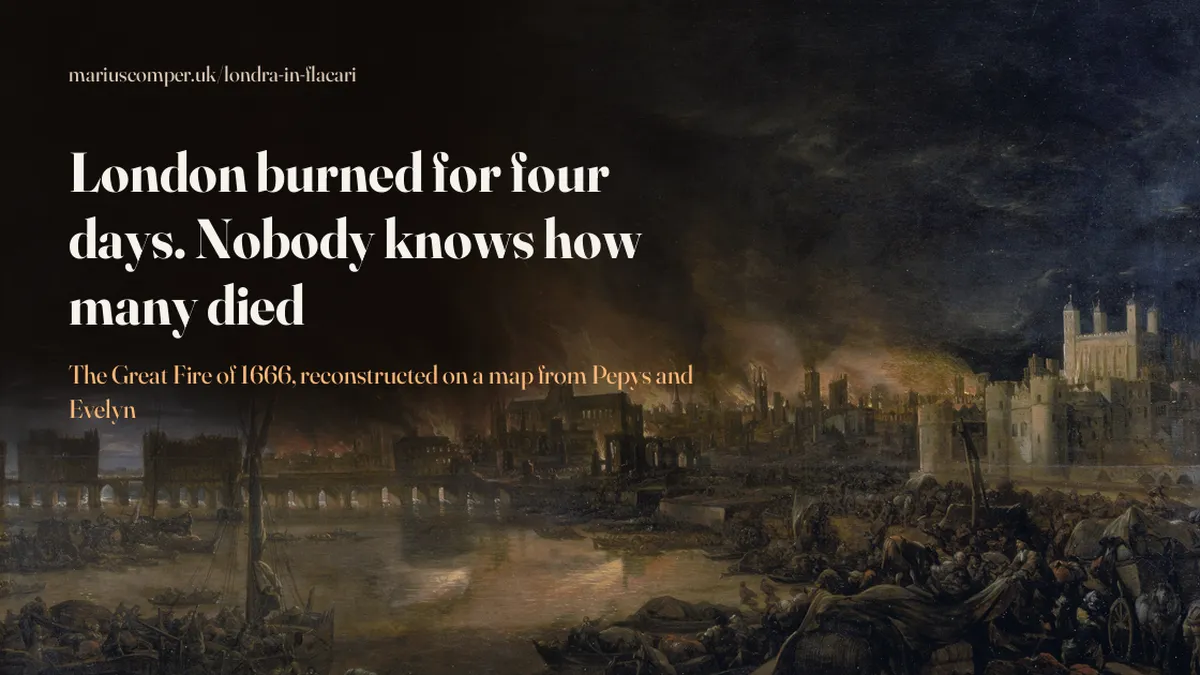
The Great Fire of London, 1666, hour by hour on a map
The 1666 fire spreads across today's City, day by day, from the diaries of Pepys and Evelyn. The losses were counted carefully; the dead were not.
Marius Comper · History
Dacians and Romans, kings and revolutions, wars and coins, cathedrals and earthquakes. Each work starts from one question about the past and follows it through the documents to the end.
Start here
London, 2–6 September 1666, hour by hour on a map: where the fire started, what burned and how it stopped. If you open a single history work, open this one.
The 1666 fire spreads across today's City, day by day, from the diaries of Pepys and Evelyn. The losses were counted carefully; the dead were not.
Masterpieces
Six works chosen for visual power, depth and finish: maps, atlases and stories showing everything this page can do.
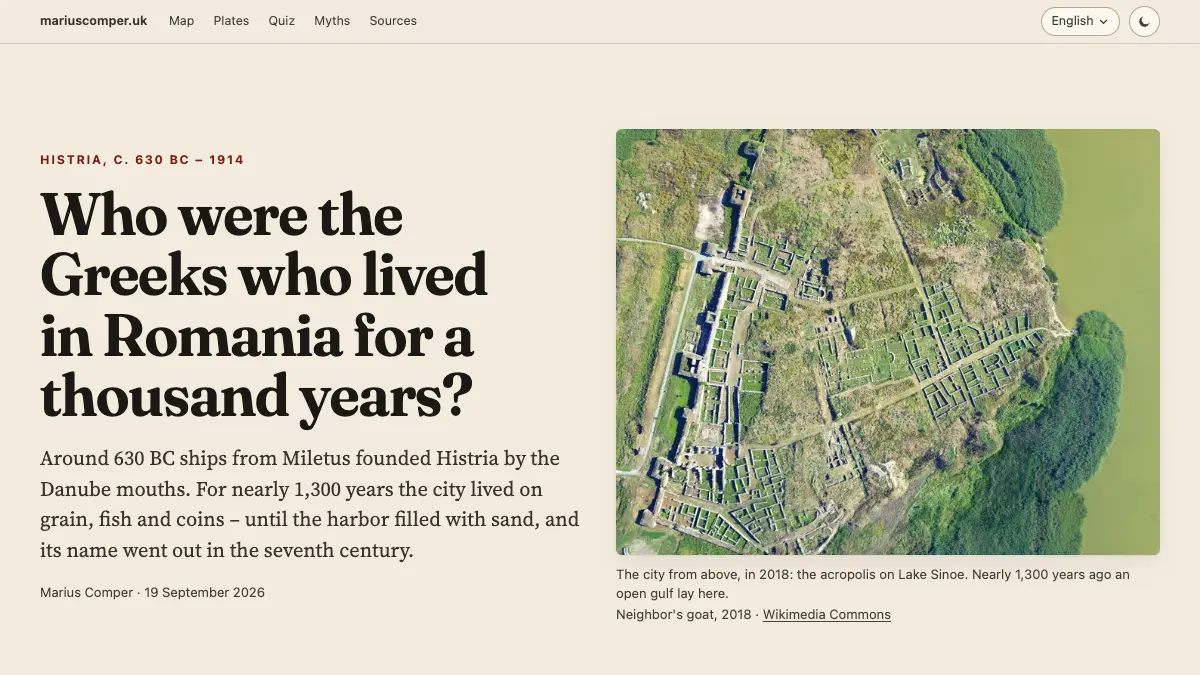
Miletus, the silver drachma, the AD 100 boundary. Four chapters and a map that silts as you read.
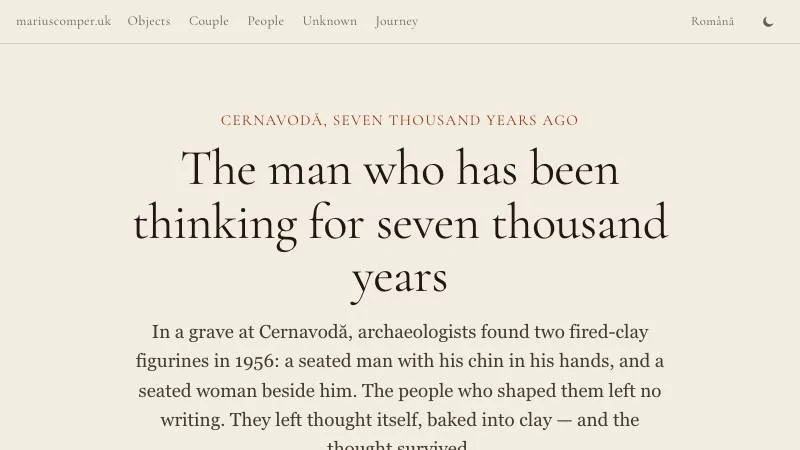
The Thinker of Hamangia and the Sitting Woman: two fired-clay figurines, seven millennia old, found in a grave at Cernavodă. What we know, what we guess, and what we will never know about them.
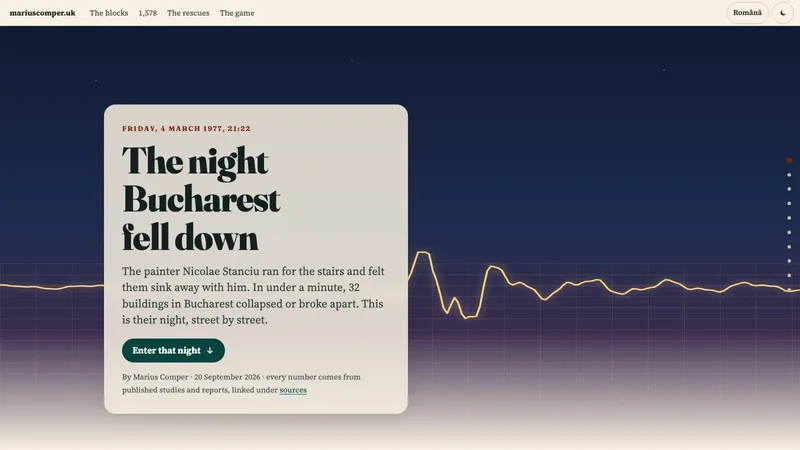
4 March 1977, 21:22: 56 seconds, 32 fallen buildings, 1,578 dead. The map of the night street by street, the ledger of the blocks and the engineer's board that condemns or spares.
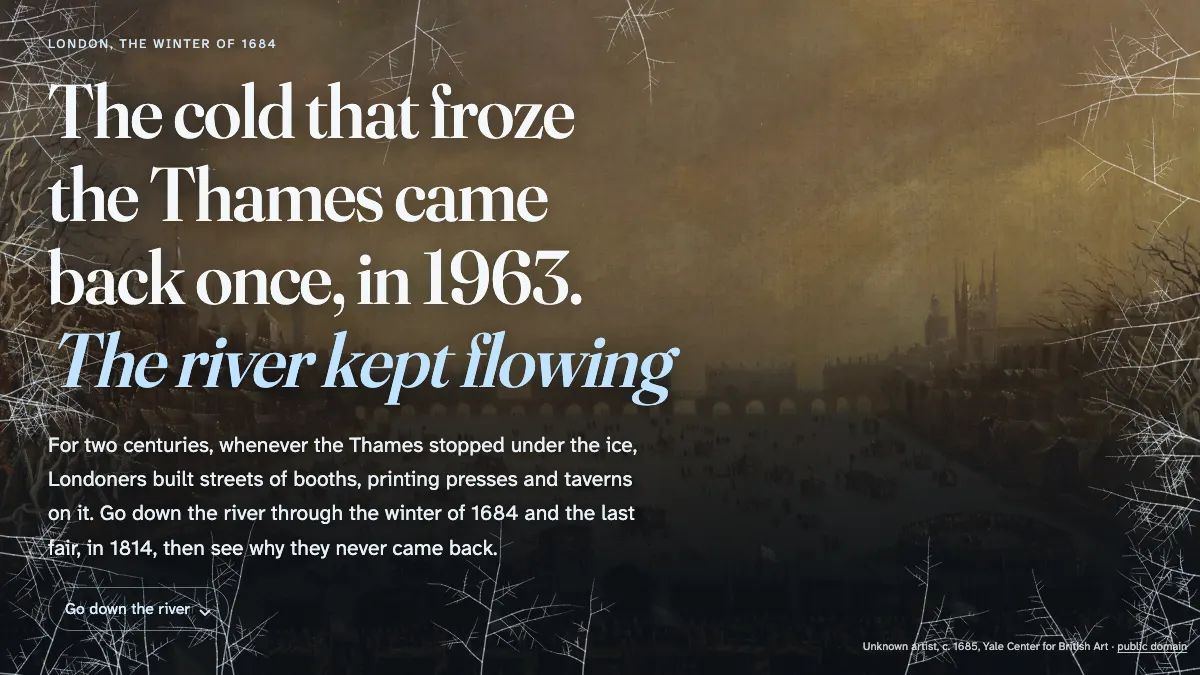
Streets of booths, printing presses and taverns on the frozen river, from Evelyn's diary and the accounts of 1814. The cold that froze the Thames came back once, in 1963; with the old bridge gone, the river kept flowing.
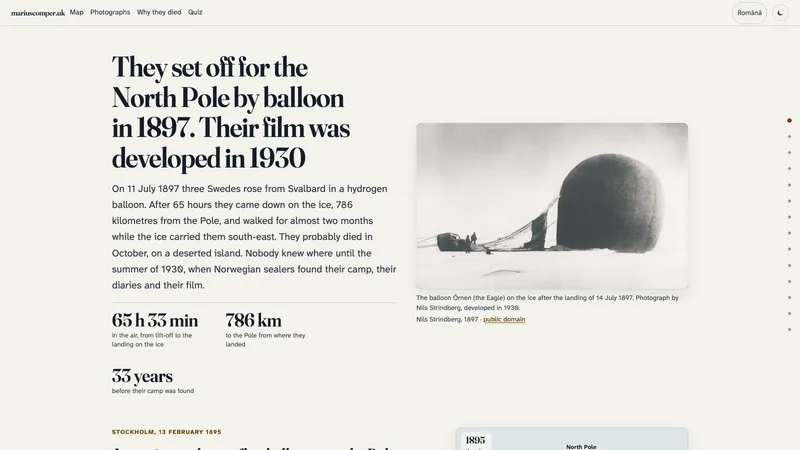
Andrée, Strindberg and Frænkel flew for 65 hours, came down on the ice 786 kilometres from the Pole and walked for almost two months while the ice carried them south-east. Their route on the map, from the diaries found in 1930, Strindberg's photographs developed 33 years later, and what is and is not known about how they died.
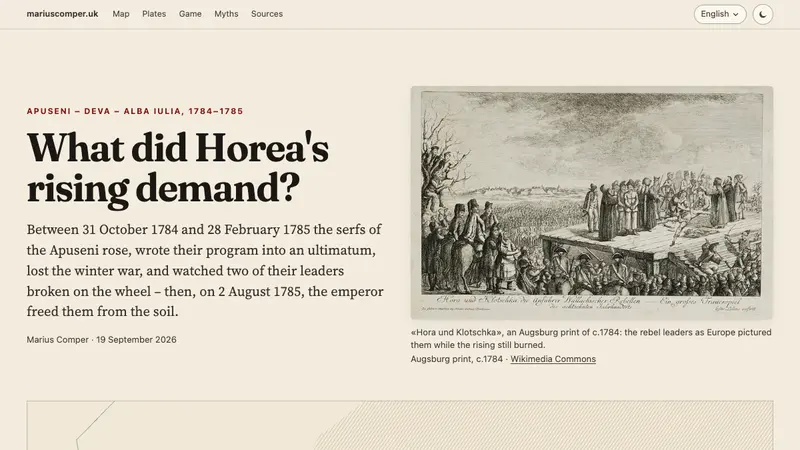
The 11 November ultimatum, the winter war, the 28 February wheel and the 2 August 1785 patent: what the rising demanded, week by week.
Selected
A game, a coin, a calendar, a world map, a night and a revolution.
A timeline game: place 20 moments from Bucharest's history in order, from the first document of 1459 to the metro and the Revolution. Three mistakes allowed.
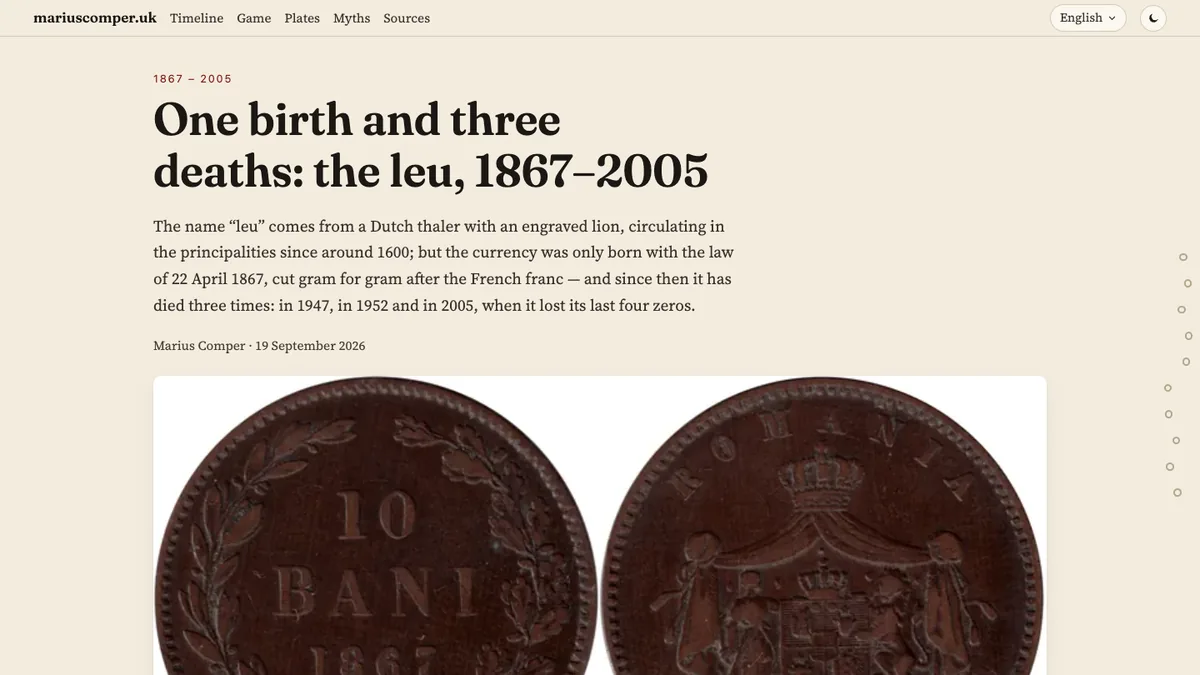
The lion thaler, the law of 22 April 1867 and three deaths: a currency's life in 17 stops and eight loaves.
1 April old style = 14 April new style. Decree-Law 1053, the 13 days that never existed, a 1900–1925 converter, and the Church that kept its own time until 1924.
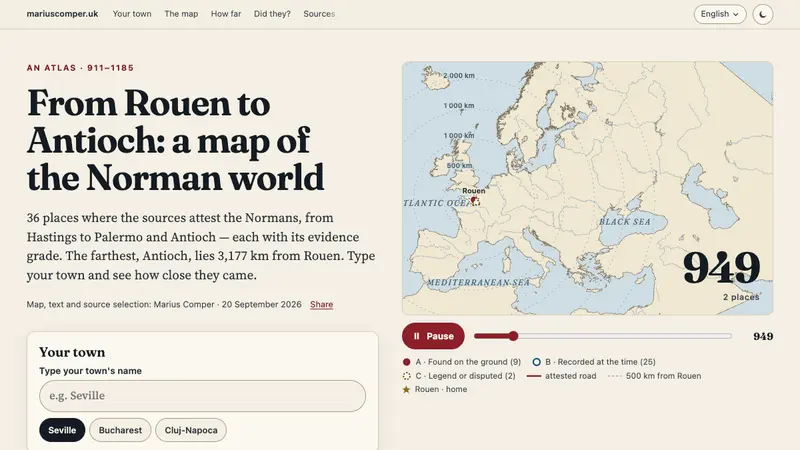
36 places where the sources attest the Normans, from Hastings to Palermo and Antioch — each with its evidence grade. The farthest, Antioch, lies 3,177 km from Rouen. Type your town and see how close they came.
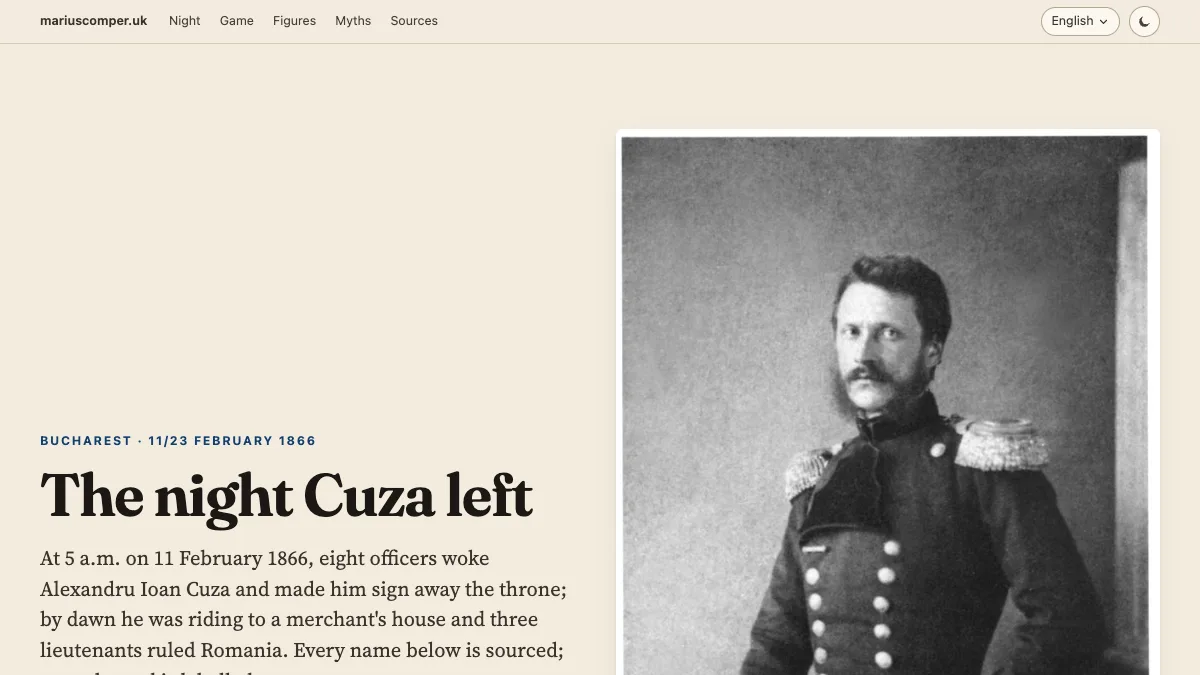
Eight officers enter the palace at 5 a.m., the abdication is signed, and by dawn three lieutenants rule. 6 stations from evening to dawn.
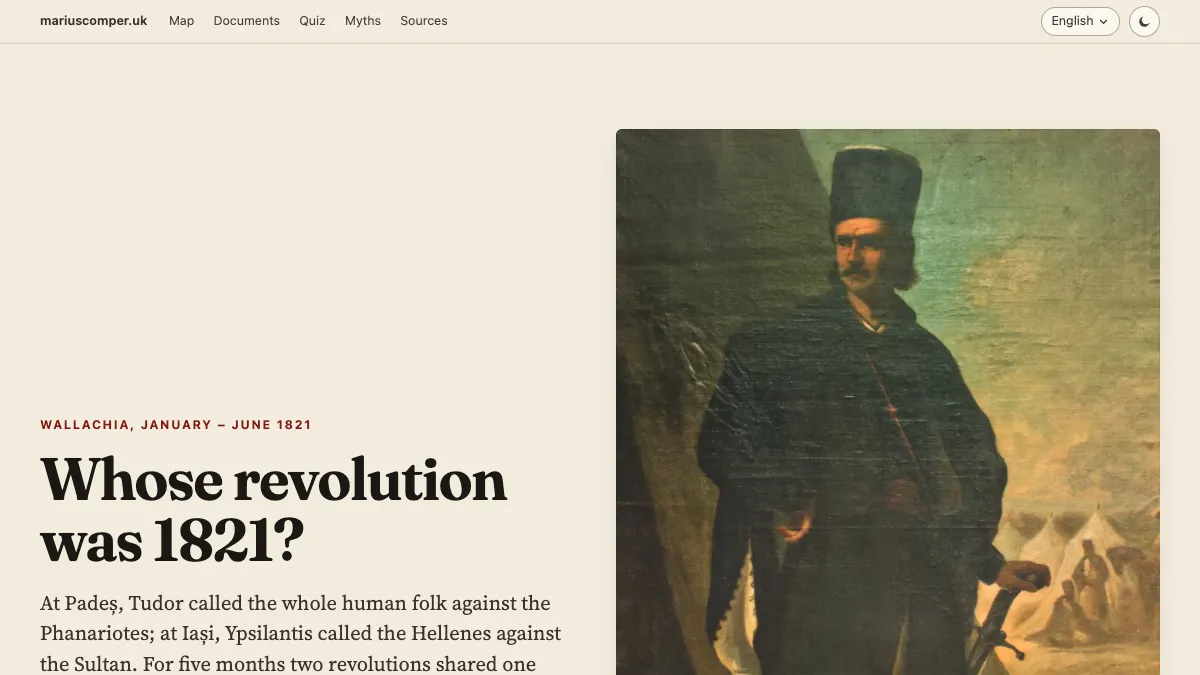
Pades in January, Bucharest in March, Golesti in May. Two proclamations, one country, and five months that ended the Phanariote century.
Themes
Each shelf shows the theme's four finest works, hand-picked. Open any shelf to see the full list in the library.
From Histria to 1989: citadels, wars, unions and laws.
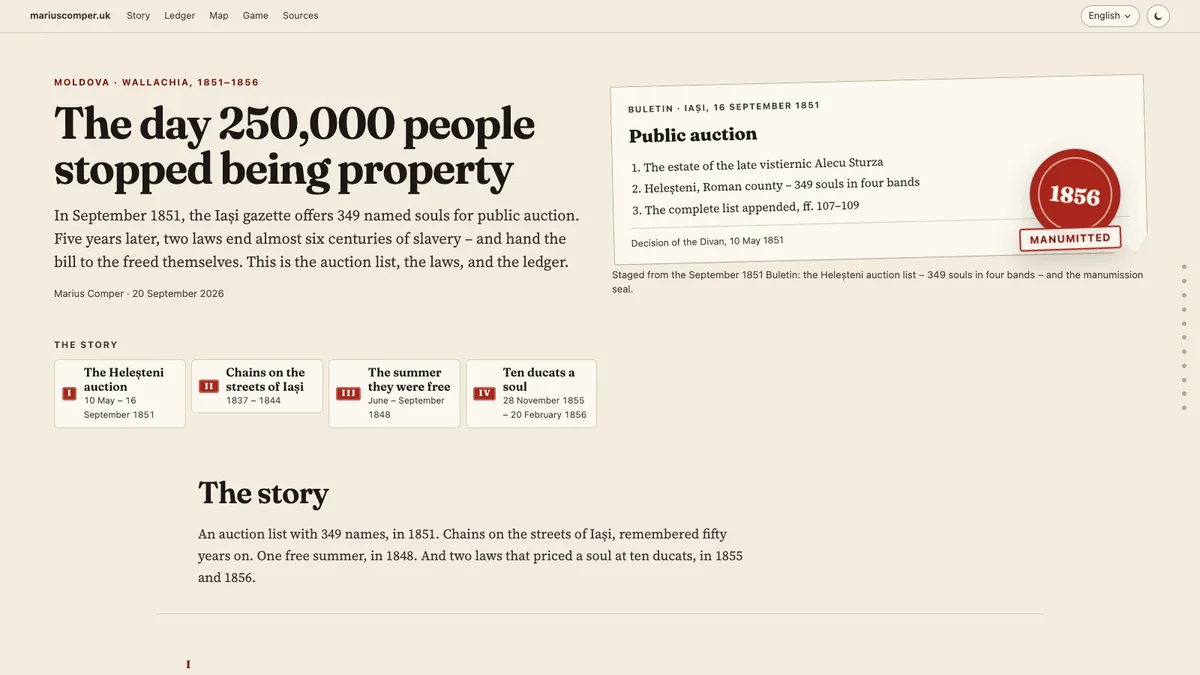
The Heleșteni auction of 349 souls, the laws of December 1855 and February 1856, and the compensation ledger: 10, 8 or 4 ducats a soul, paid from the taxes of the freed themselves.
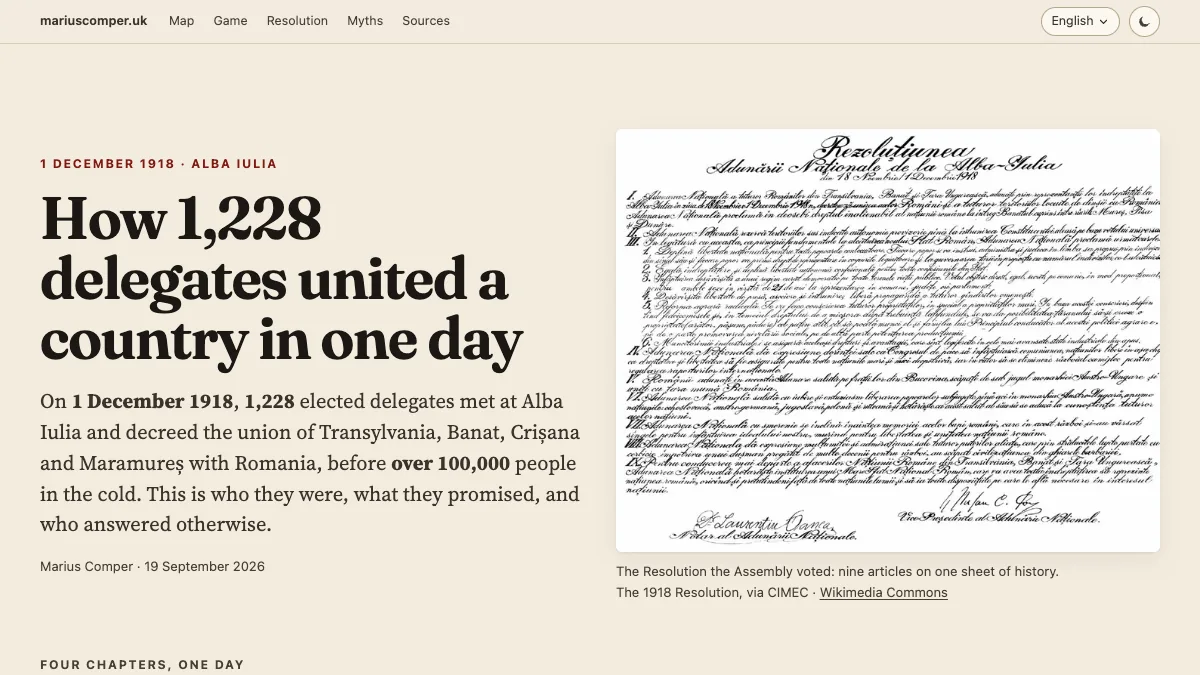
1 December 1918: 1,228 credentials, the nine-article Resolution, and over 100,000 people in the cold. The delegations map, the credential journey, and the answers from Cluj and Mediaș.
Mărăști, Mărășești, Oituz: the summer of 1917 on one map, day by day. Grigorescu's order, the reserves game, and the documented story of Ecaterina Teodoroiu.
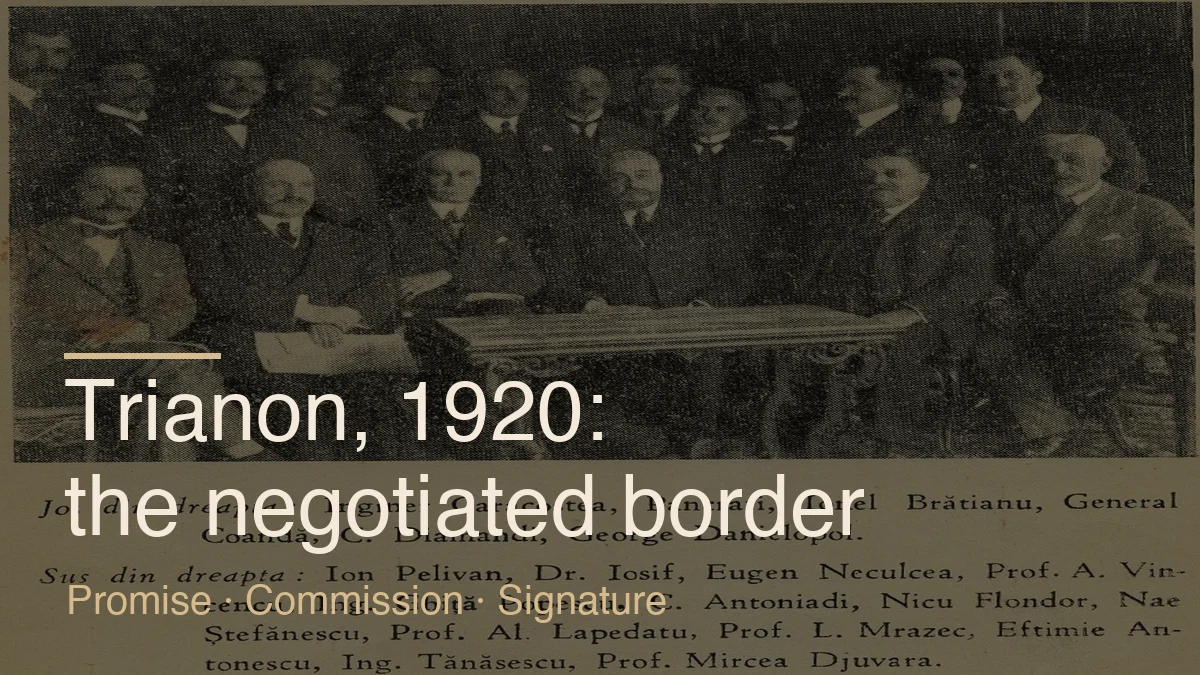
1 December 1918 – 4 June 1920: the 1916 promise, the 1919 commission lines, the walkout over the minorities treaty, and the signature in the Grand Trianon — with Hungarian historiography on the table.
History on a map: battles, crowns, coins and decisive nights.
The 11 November ultimatum, the winter war, the 28 February wheel and the 2 August 1785 patent: what the rising demanded, week by week.
36 places where the sources attest the Normans, from Hastings to Palermo and Antioch — each with its evidence grade. The farthest, Antioch, lies 3,177 km from Rouen. Type your town and see how close they came.
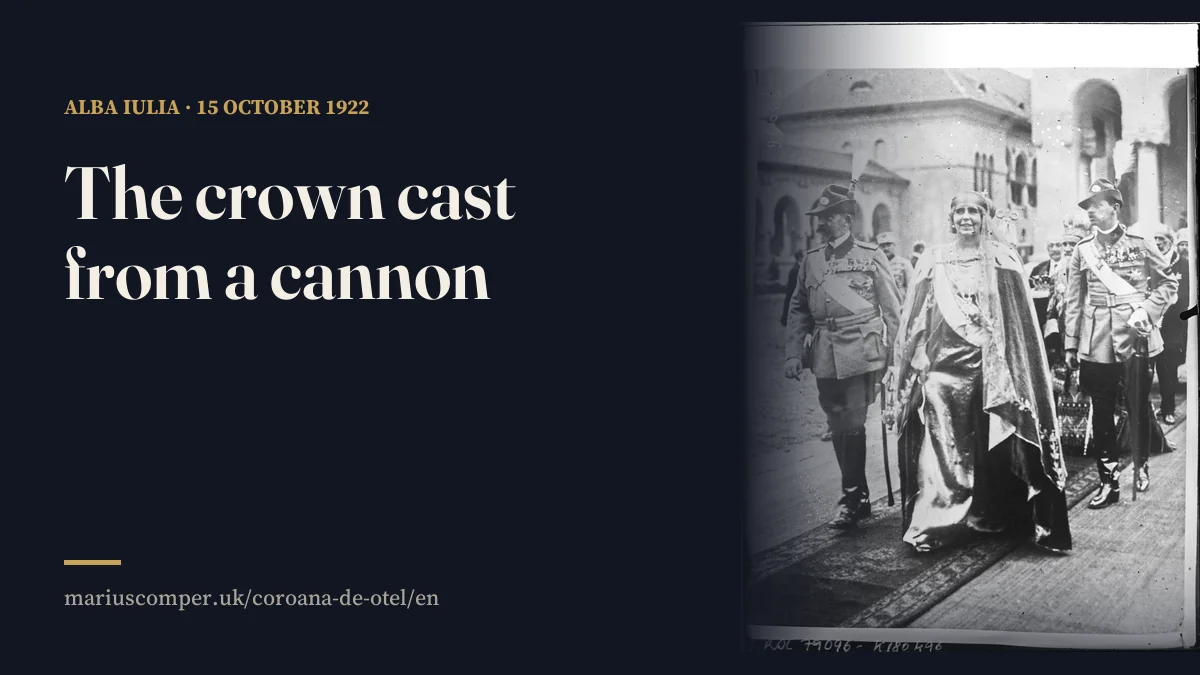
An Ottoman gun taken at Plevna becomes the kings’ 1,115-gram crown: 1881, Alba Iulia 1922, today’s treasury.
Eight officers enter the palace at 5 a.m., the abdication is signed, and by dawn three lieutenants rule. 6 stations from evening to dawn.
Where to go to touch history: museums, towns, castles and monasteries.
Six museums with official fares: Village, Antipa, Ceausescu House, MNAR, MNIR, Parliament. Hours and measured access.
Which medieval city: Sibiu with ASTRA 50 and Brukenthal 50, Brasov with the Black Church 20 RON and Art 12, Sighisoara UNESCO with no official fares. Measured access.
Bran, Peleș, Corvin, Râșnov, Făgăraș, Cantacuzino: adult tickets, official hours, closed days and the best day trip from Brașov, Sibiu or Sinaia, with measured road distances.
Voronet, Humor, Moldovita, Sucevita, Arbore: what to see at each, published hours, service times to avoid, and the optimal route with measured driving distances from Gura Humorului or Suceava.
Decipher, order, guess: history as a game.
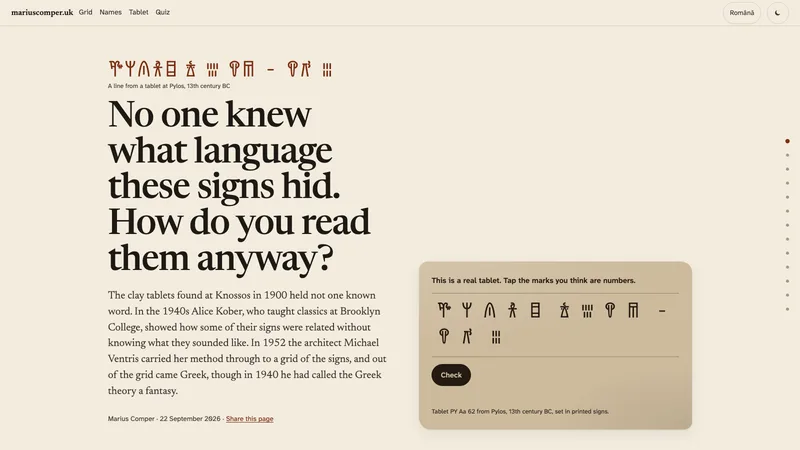
The clay tablets of Knossos held not one known word. Alice Kober, who taught at Brooklyn College, showed how their signs were related without knowing their sounds; in 1952 Michael Ventris got Greek out of the grid, though he had once called it a fantasy. Solve the three town names that opened Linear B.
A timeline game: place 20 moments from Bucharest's history in order, from the first document of 1459 to the metro and the Revolution. Three mistakes allowed.

Of the 799 medieval chivalric works that have reached us, 326 are attested by a single manuscript.

A sound change does not depend on what a word means; it happens wherever the phonetic conditions are met. Twenty-four of them rebuild forty Romanian words out of Latin, one step at a time.
What the documents say when legends go quiet: myths checked file by file.
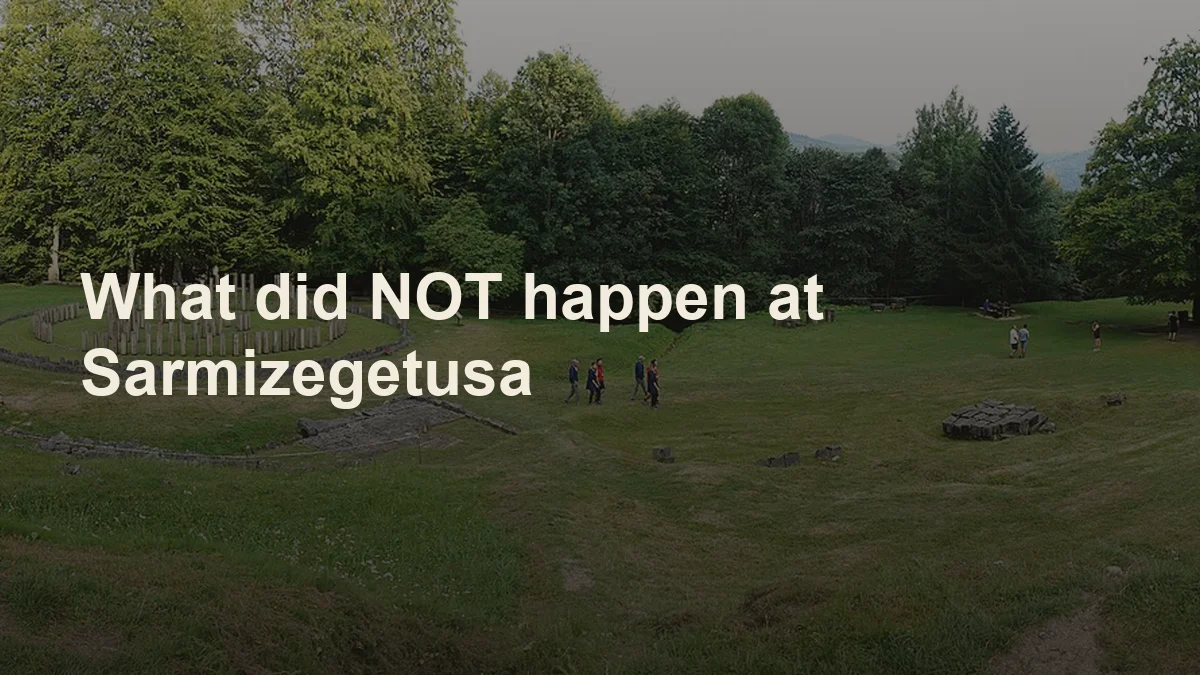
The 30-metre circle, the 6.98-metre andesite disc, ten rays: six famous claims go through the excavation record, and the calendar, the observatory and the aliens do not survive.
A viral comment says Golescu was Greek and turned Romanian to save his skin. We test all 7 claims, document by document, with pages from his 1826 book.
Pliny the Elder wrote about elephants and the moon in AD 77. An American psychologist cited the story as scientific evidence in 1977 — exactly nineteen hundred years later. Along the way, someone added a branch that appears in neither source.
How much leaders sleep — and how much of the story survives scrutiny.
Approaches
The numbers show how many history works each approach holds.
All
The complete list in publication order, 25 at a time.
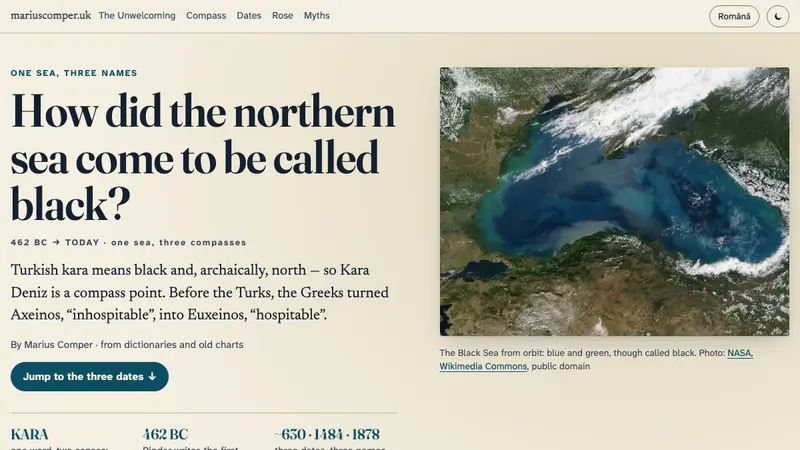
Turkish kara means black and, archaically, north — so Kara Deniz is a compass point. The Greeks turned Axeinos into Euxeinos. A word-journey from Histria (~630 BC) to the Romanian shore (1878).
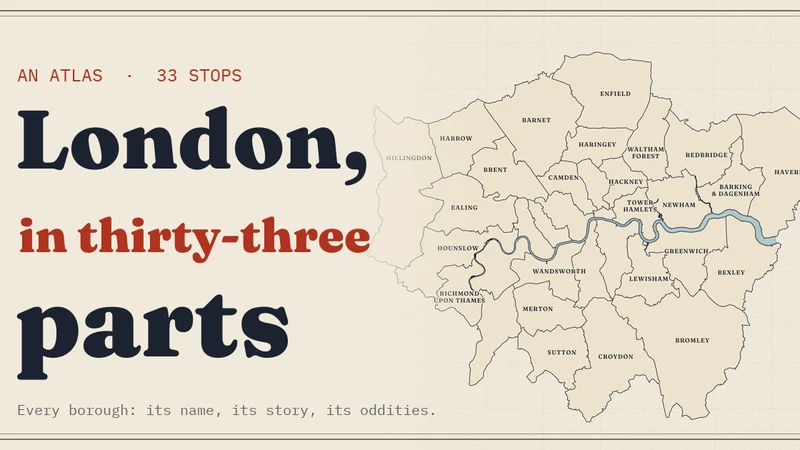
Ride a fictional Tube line through all 32 boroughs and the City: what each name meant in Old English, who built it, and the oddities it keeps — from Croydon's Mayday to Stamford Bridge being in Fulham.
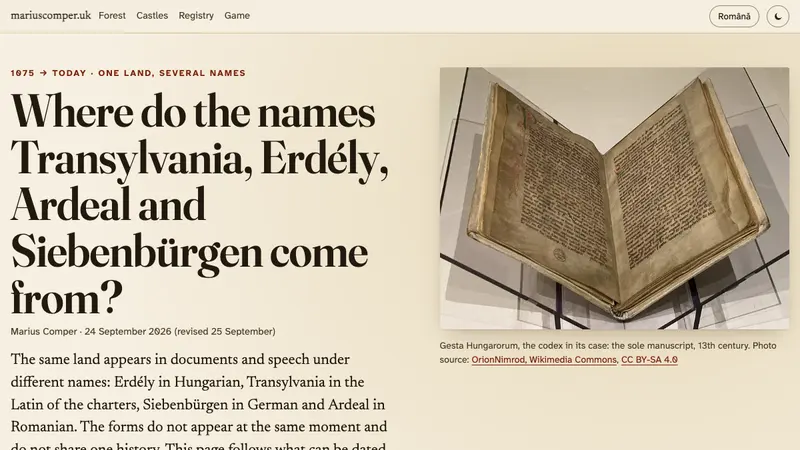
Where do Transylvania, Erdély, Ardeal and Siebenbürgen come from? A documented chronology of the region’s names, with sources, hypotheses and their limits.
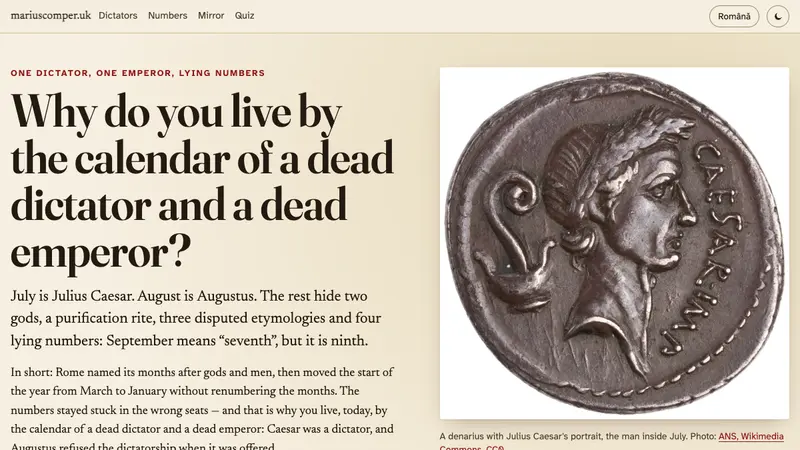
July comes from Julius Caesar, August from Augustus — one dictator, one emperor. The gods, the rite, the lying numbers and the failed renames behind the 12 months — with the Year Machine, from Romulus to today.
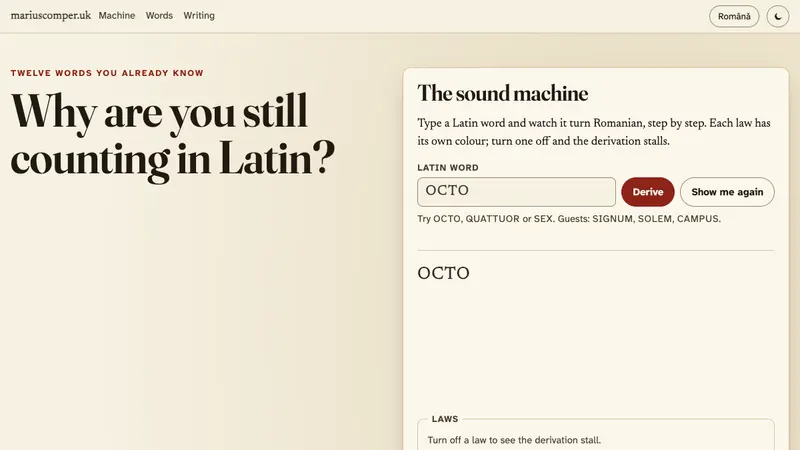
Type OCTO, get OPT: eleven numerals inherited from Latin, six sound laws you can turn off and on, one intruder, and three ways of writing a number, from wax tablets to comma-below ș.
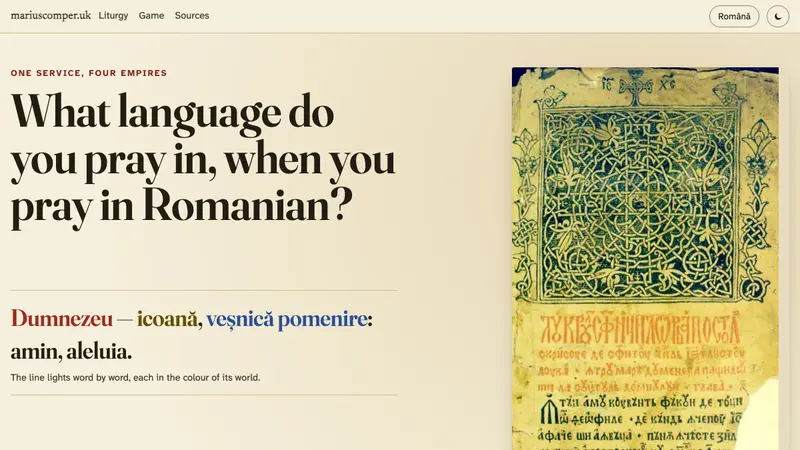
A Romanian service speaks four languages at once: Latin, Greek arrived via Slavonic, Slavic, and Hebrew arrived via Greek and Slavonic. Thirteen words with dictionary passports, a service to hear, and a game to solve.
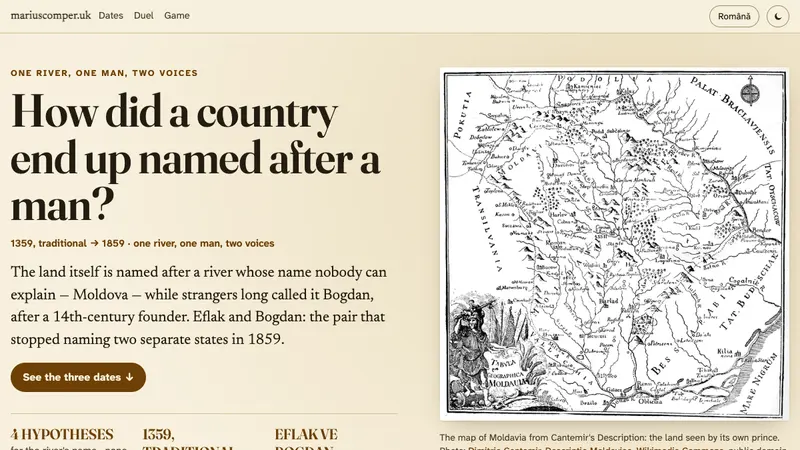
An unexplained river-name, a 14th-century founder, and the Ottoman pair Eflak ve Bogdan: two voices of one land, from 1359 to 1859 — with dated documents.
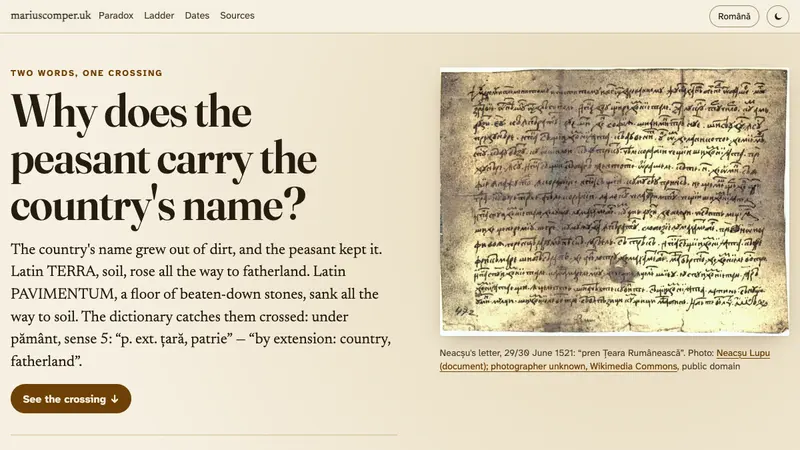
Țara grew out of soil (Latin terra) while pământ sank out of a beaten floor (Latin pavimentum): two crossed words, three dates — 1521, 1848, 1926 — and the Ladder of Senses.
Why the same place is piață, târg, iarmaroc and bazar at once: seven words, four empires, three dates — with the dictionaries on the table and a game at the end.
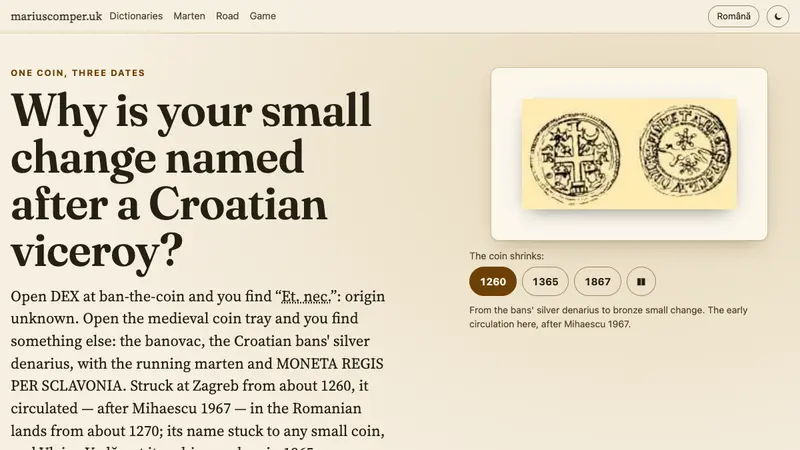
The dictionary says the ban's origin is unknown. The coins say otherwise: the Croatian marten banovac (~1260), Vlaicu's ban (1365) and the 1867 law.
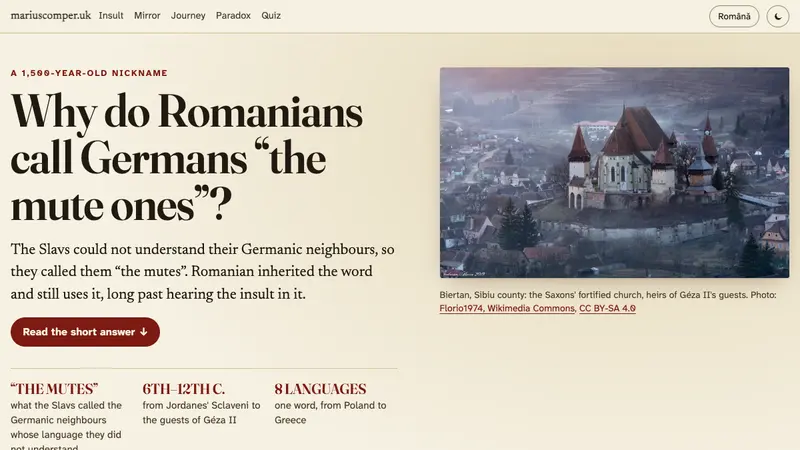
The Slavs could not understand their Germanic neighbours, so they called them “the mutes”, and Romanian kept the word to this day. The story of němьcь, the barbaros–walhaz mirror, and the witnesses from Jordanes to the Transylvanian Saxons.
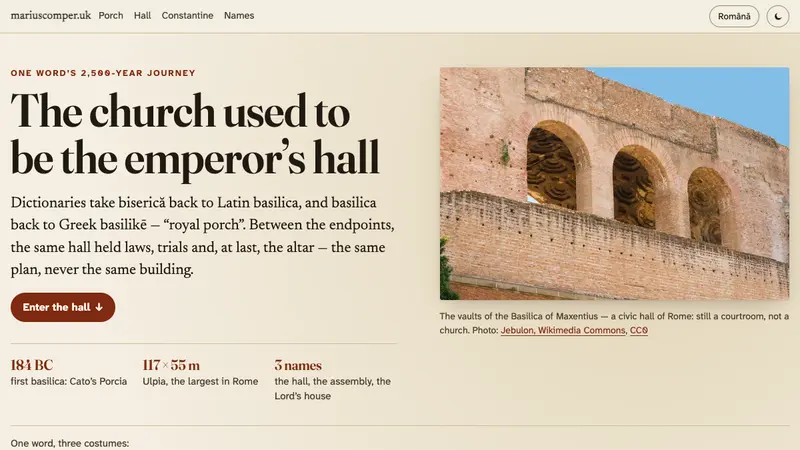
Romanian biserică descends from Latin basilica — but the word's history and the building's history run on different tracks. With the Word/Building visual, plans that actually change, and a quiz.
Streets of booths, printing presses and taverns on the frozen river, from Evelyn's diary and the accounts of 1814. The cold that froze the Thames came back once, in 1963; with the old bridge gone, the river kept flowing.
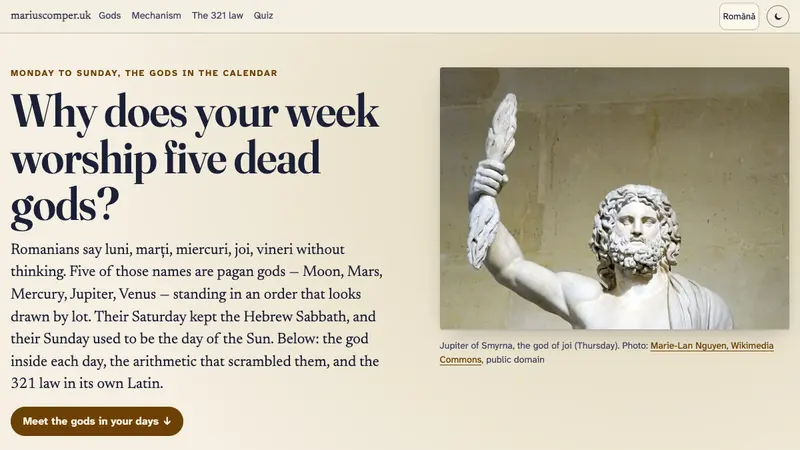
Luni comes from the Moon, marți from Mars, miercuri from Mercury, joi from Jupiter, vineri from Venus. Why the gods stand scrambled, why Saturday kept the Sabbath, and who renamed Sunday.
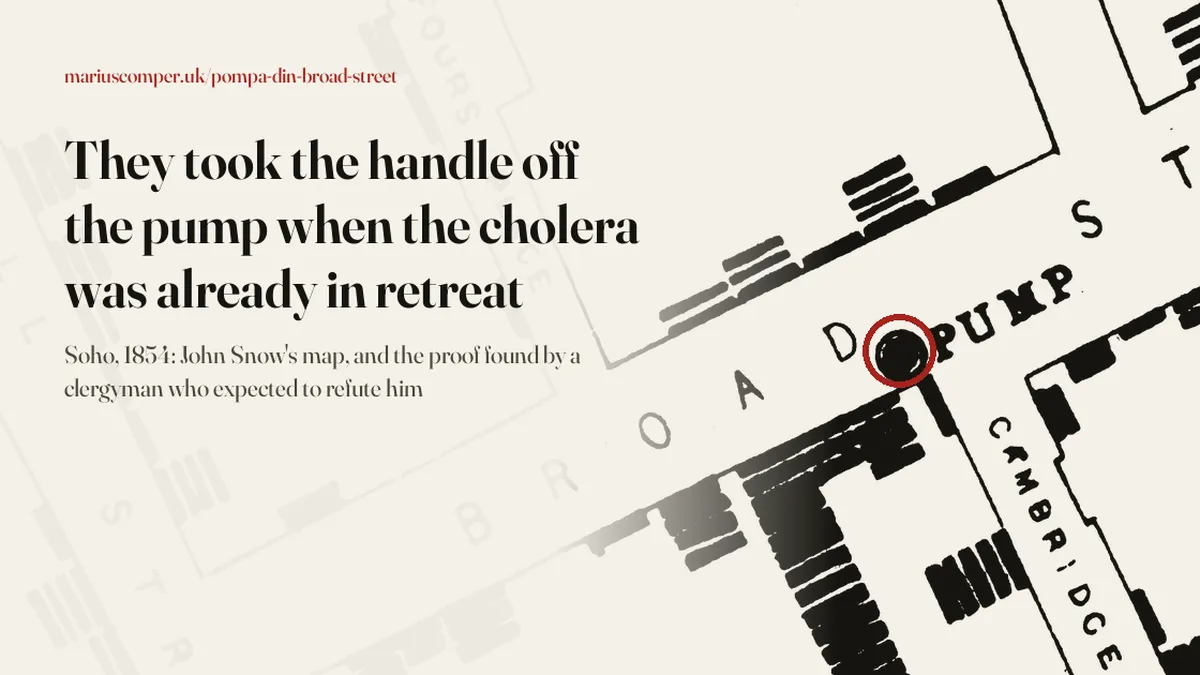
Soho, 1854: 616 cholera deaths around one pump. The handle came off when new cases had fallen from 143 a day to 12; the proof came from a clergyman who expected to prove Snow wrong.
The 1666 fire spreads across today's City, day by day, from the diaries of Pepys and Evelyn. The losses were counted carefully; the dead were not.
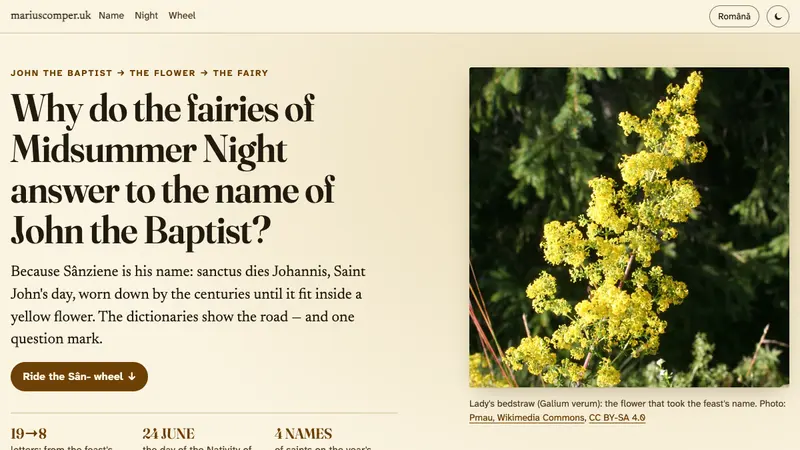
From SANCTUS DIES JOHANNIS, Saint John's day, to the Sânziene: the Sân- wheel with four saints (Sânziene, Sânpetru, Sântilie, Sâmedru), the three living senses — feast, flower, fairies — and the night of 23 June with bonfires, wreaths on water and the Drăgaica fair. With the etymology chain, the wheel-walk and quotes from DEX, MDA2, Șăineanu and Scriban.
Masă, pâine, sare, vin, lingură: six Latin inheritances on the Romanian table, three newcomers and the Roman receipt of AD 301. With the table that sets itself, the etymological chains and the claims table.
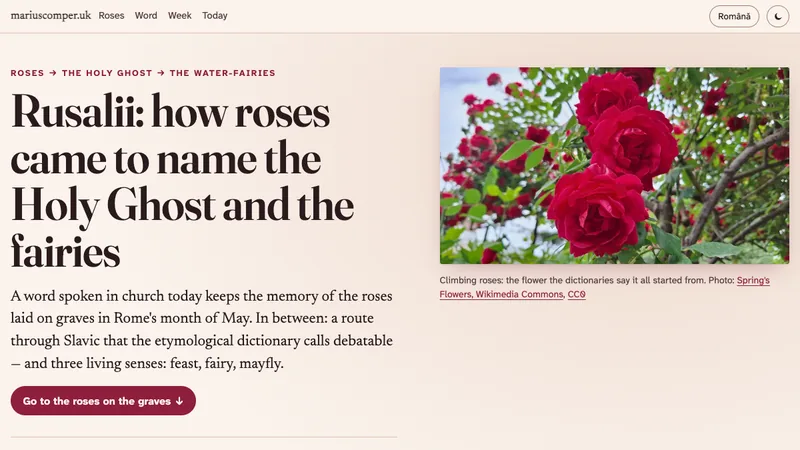
From ROSALIA, the Roman rose-feast on graves, to Rusalii: the debatable Slavic route, the three living senses — feast, fairy, mayfly — and the week between worlds, with the Saturday of the dead, walnut-branch Sunday, the healing călușari (UNESCO 2008) and the water rusalkas. With the ROSALIA→RUSALII etymology chain, the week-walk and quotes from DEX, DER, Șăineanu and Scriban.
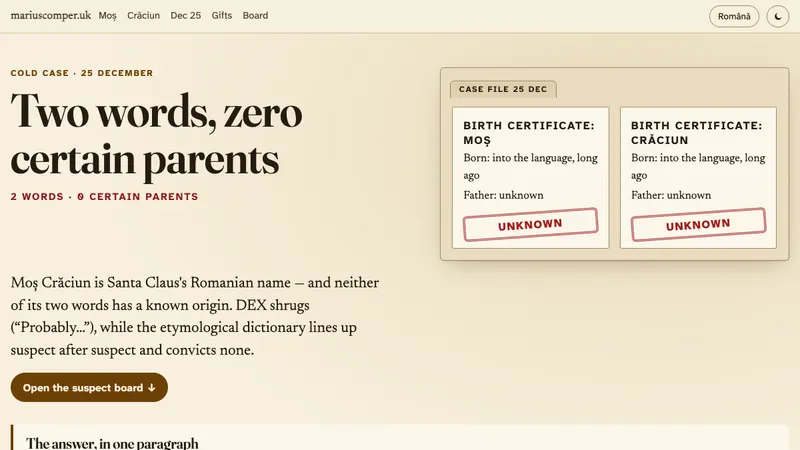
Neither moș nor Crăciun has a known origin: DEX shrugs, and the etymological dictionary lines up 18 suspects and convicts none. A cold-case file with the interactive suspect board, word/status/language-family filters, birth certificates stamped UNKNOWN and quotes from DEX, DER and Scriban.
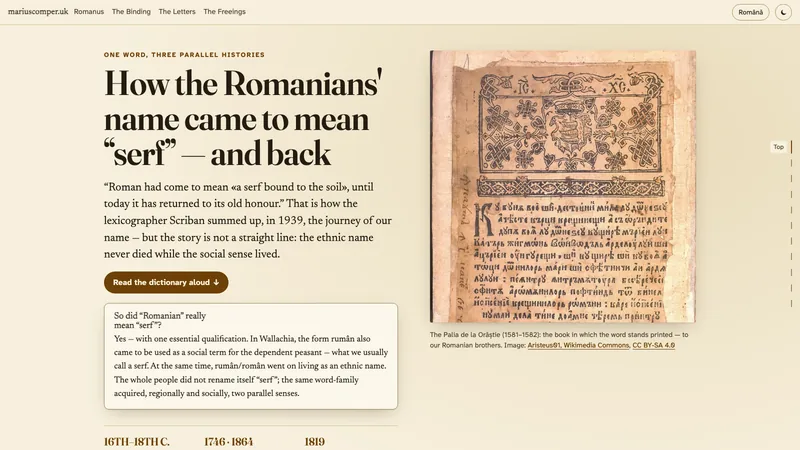
Romanus becomes rumân: an ethnic name and, in Wallachia, a social term for the dependent peasant. The ethnonym, the social status and the spelling — three parallel histories, with the 1613 deed and the 1746/1749 and 1864 thresholds. With the three-track Name Engine, the 100–1900 year finder and the “Serf or Roman?” quiz.
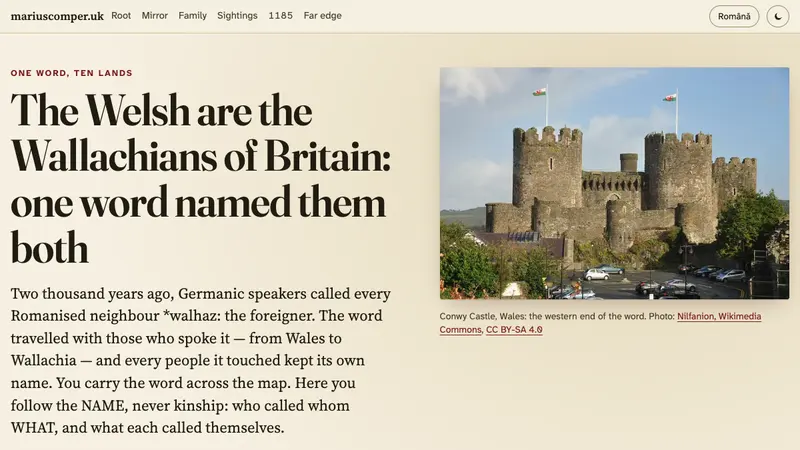
A reconstructed word — *walhaz, “the foreigner, the Roman” — named Wales, the Walloons, the Vlachs, the Oláh, Eflak and Wallachia: the story of the name, with the first Byzantine sightings, the 1185 revolt and the last valley still called Wallachia. With the sightings atlas that lights up as you scrub it, ten exonyms on the map and the word morphing across languages.
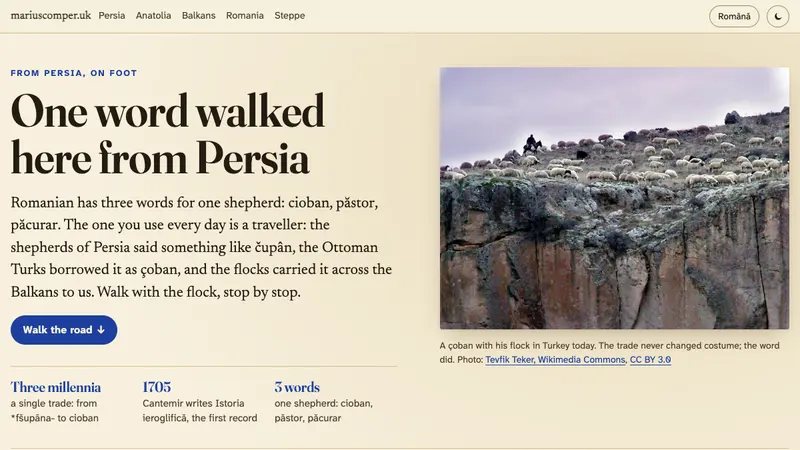
Cioban is Persian čupân, keeper of flocks, arrived via Turkish çoban and kept as the everyday word beside Latin-derived păstor and regional păcurar; three millennia of road from Persia to the sheepfold, with attestations and a living map. With the road that draws itself, the stop finder and a quiz.
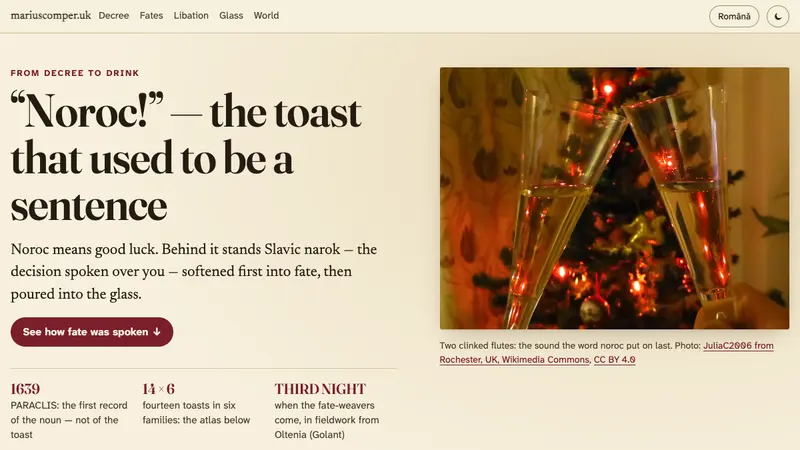
Noroc is Slavic narok, "that which was spoken", softened into good luck and then into the toast itself; the clinked glass runs from Greek libations to Prost, Şerefe and cin cin. With an atlas of the world's toasts and a quiz.
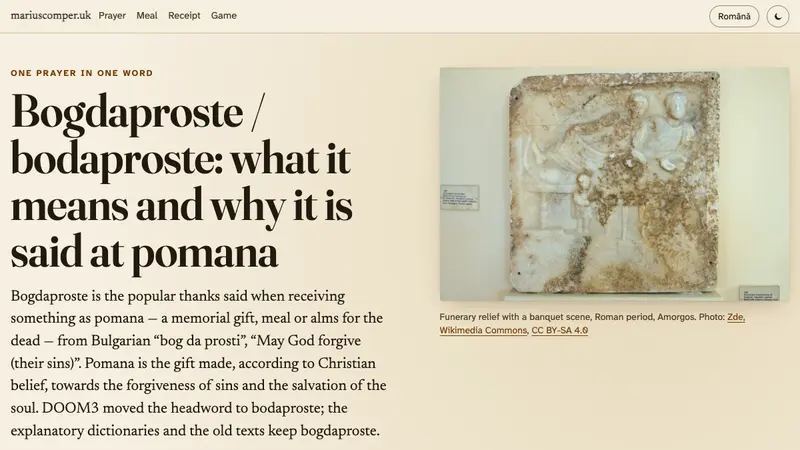
Bogdaproste is the thanks said when receiving pomana, memorial alms for the dead, from Bulg. «bog da prosti», «May God forgive»; DOOM3 moved the headword to bodaproste. Meaning, norm, stress, the 1746 attestation, today's Bulgarian formula, and a receipt engine with two scenes — Rome and the pomana.
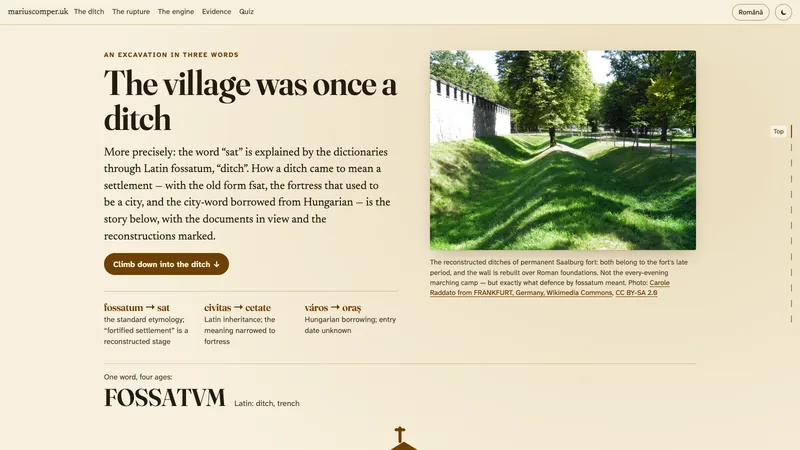
The word “sat” comes from Latin fossatum, “ditch” — but the road to “settlement” is reconstructed, not a birth certificate. With old fsat, the fortress that used to be a city, the city-word from Hungarian and the French twin fossé: an excavation in three words, documents in view.
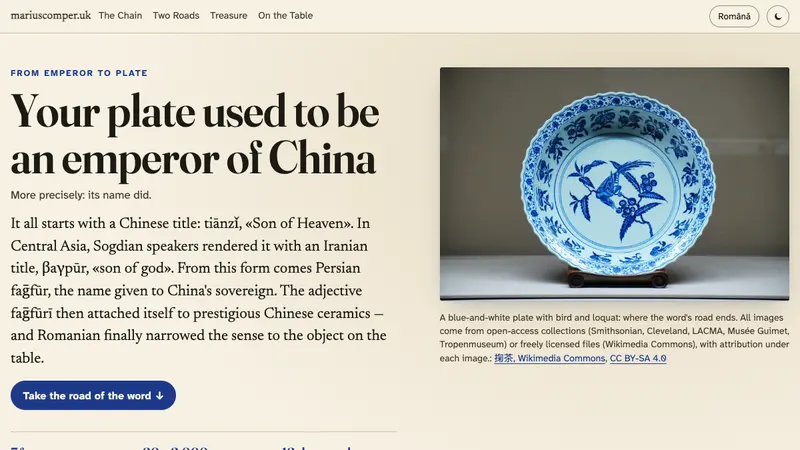
How a Chinese imperial title landed on your table: «Son of Heaven» became βaγpūr in Sogdian, faghfur in Persian, fağfurî for the Ottomans and farfurie in Romanian. With the map of the two roads — of the word and of the vessels —, Harun's gift, the Topkapi treasure, a riddle and a quiz.
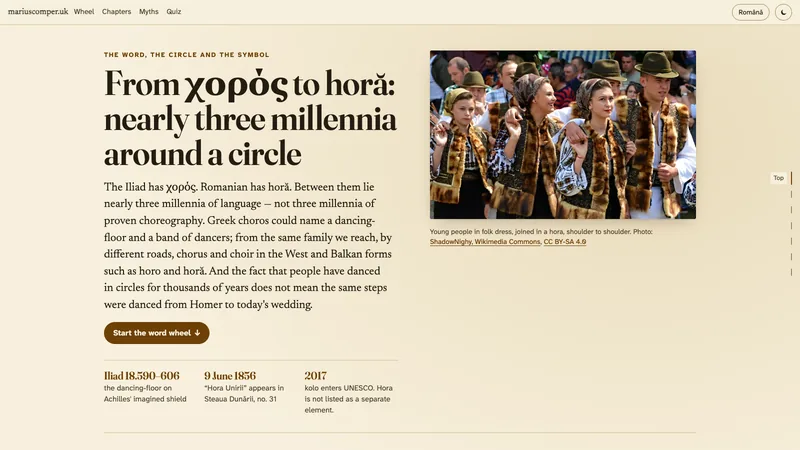
Three histories meeting in the hora — the word, the circle, the symbol — from choros on Achilles' shield through the Balkans, Hora Unirii and the horah, to 1989. With the three-thread wheel, six chapters and a quiz.
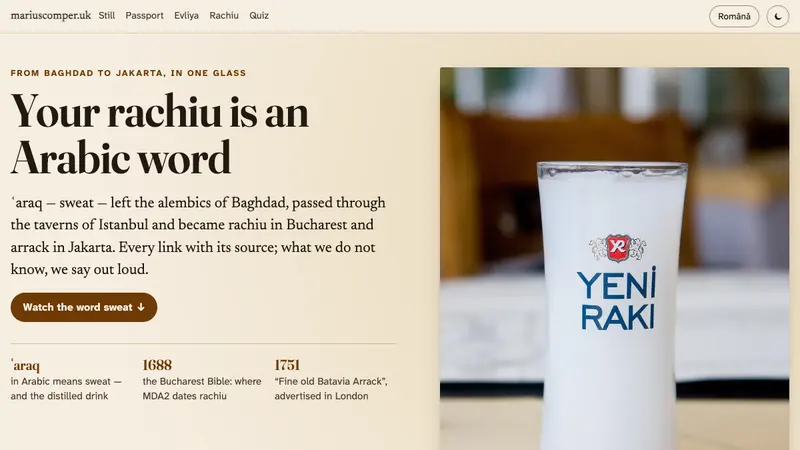
Rachiu comes from Turkish rakı — possibly via Serbian rakija —, from Arabic ʿaraq — sweat —: eight documented stops, from the 1688 Bible to Batavian arrack, a flying map, a form finder and a game about words and drinks.
Strigoi inherits Latin through striga, while vampire is a Slavic word of disputed origin that crossed Europe inside the Austrian reports on the 1725 and 1732 exhumations and through the European press, returning to Romanian as a French and German neologism. A five-chapter map, side-by-side definitions and an eight-quotation quiz.
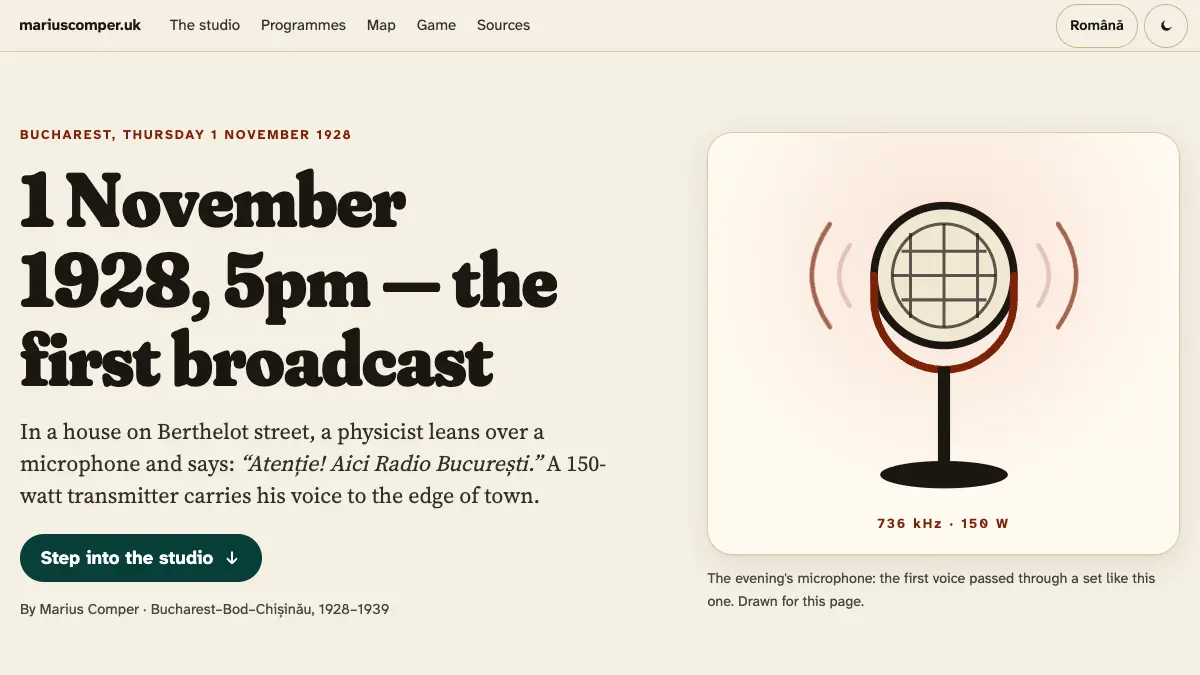
150 watts, and ten years to 274,314 registered owners.
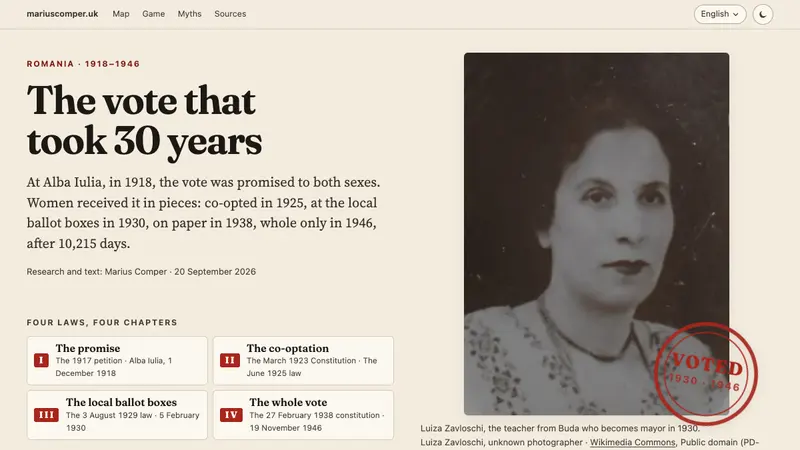
Women first voted in 1930, locally.
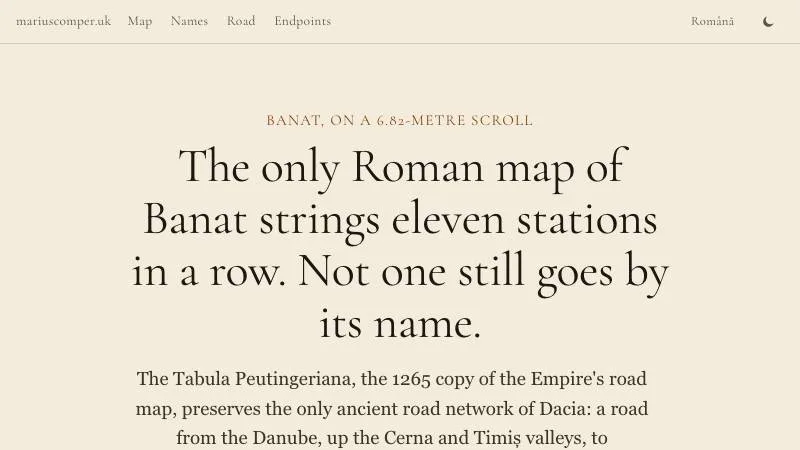
The Tabula Peutingeriana, the 1265 copy of the Empire's road map, preserves the only ancient road network of Dacia. Eleven names from the Danube to Sarmizegetusa, taken one by one: none survived untouched.
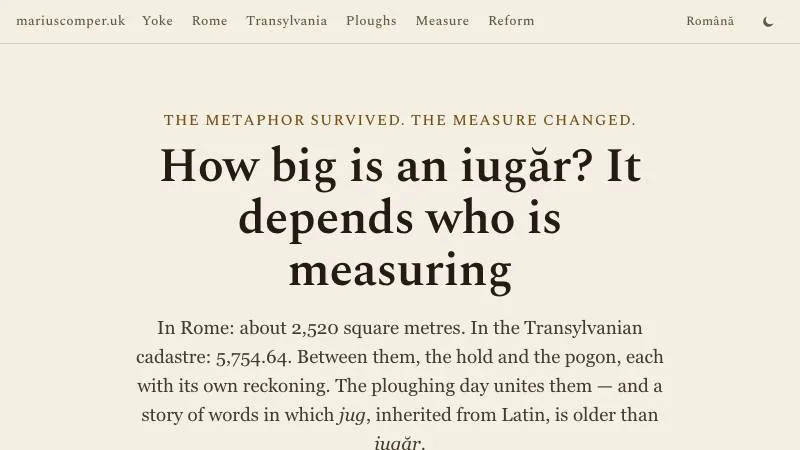
In Rome: about 2,520 m². In the Transylvanian cadastre: 5,754.64. The ploughing day unites them — and a word story in which jug, inherited from Latin, is older than iugăr, re-borrowed late.
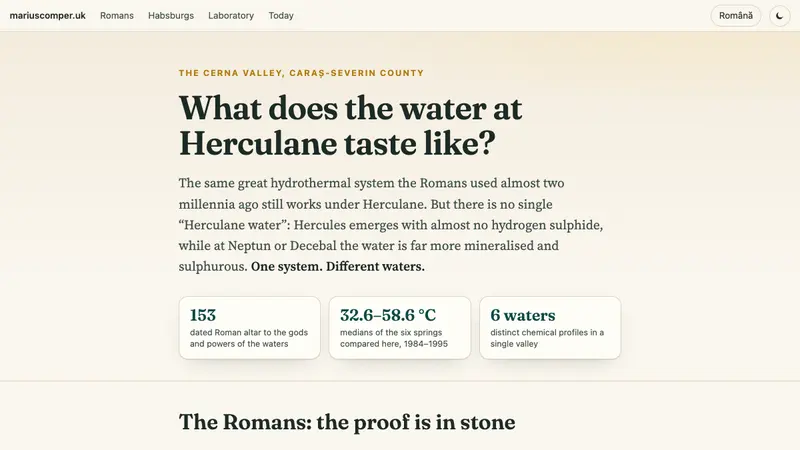
The same hydrothermal system for two millennia — but different waters spring by spring: Hercules without hydrogen sulphide, Neptun and Decebal strongly sulphurous. Two Roman stones, a 1773 analysis, and the modern lab.
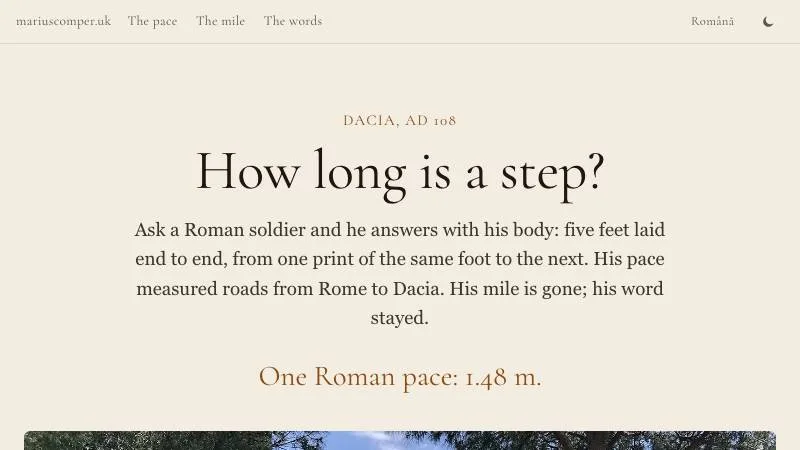
The Roman pace, the passus: five standard feet, ≈1.48 m. The body named the measure; the standard gave its length. At Aiton, the AD 108 stone stands ten miles from Potaissa; pas, milă and zece stayed in the language.
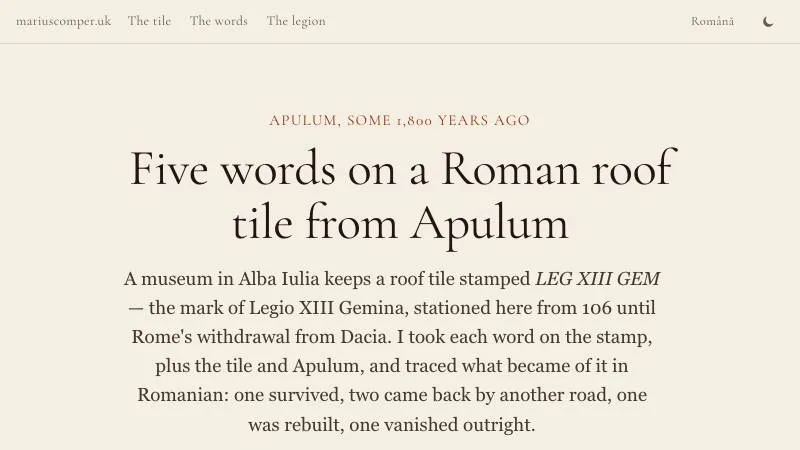
A roof tile stamped LEG XIII GEM in the Alba Iulia museum: the mark of Legio XIII Gemina. Five words traced into Romanian — one survived, two came back by another road, one was rebuilt, one vanished.
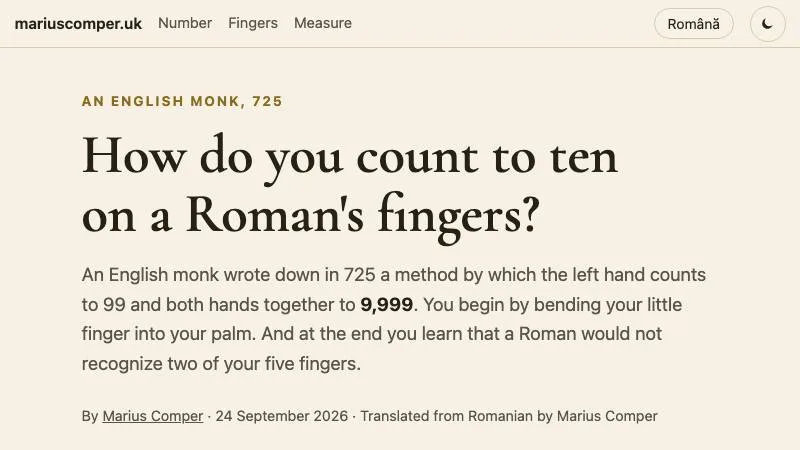
The left hand counts to 99 and both hands together to 9,999, by the method Bede wrote down in 725. But a Roman would not recognize two of your five fingers.
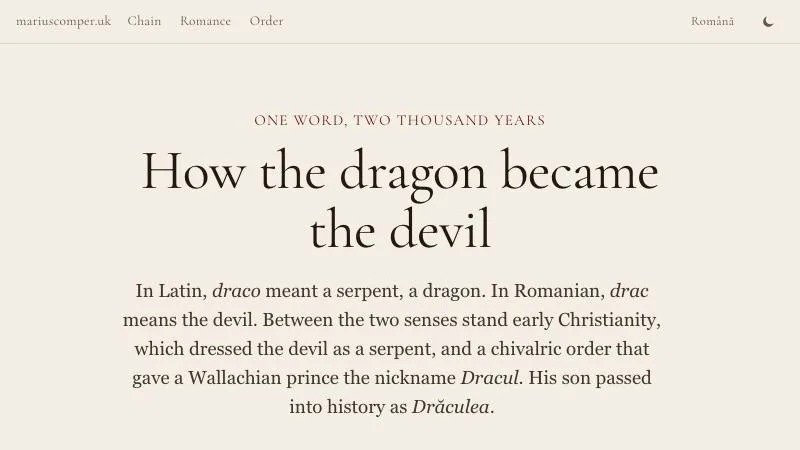
In Latin, draco meant dragon. In Romanian, drac means devil. The shift happened in Christian Latin, and Romanian is the only major Romance language in which the new sense erased the old one. The same word produced Dracul and Draculea.
Tricule means “three towers”. Near Svinița two still rise straight out of the Danube; the third has stayed underwater since the Iron Gates lake arrived.
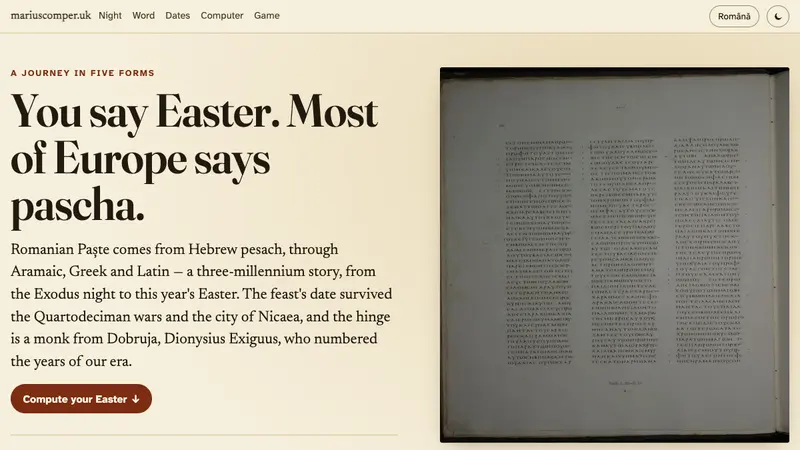
Paște comes from Hebrew pesach, through Aramaic, Greek and Latin; the feast's date survived the Quartodeciman wars and Nicaea, and the hinge is a monk from Dobruja. With a working Easter computer and a quiz.
The Biertan donarium: a 4th-century bronze tablet found in 1775 near Biertan, Romania, inscribed EGO ZENOVIVS VOTVM POSVI. Four Latin words, two of which still live in Romanian.
Romanian păgân (heathen) comes from Latin paganus, 'villager': the DER evidence, the Romance cognates, the two theories of the change of sense, and the Christian layer from Latin.
The Thinker of Hamangia and the Sitting Woman: two fired-clay figurines, seven millennia old, found in a grave at Cernavodă. What we know, what we guess, and what we will never know about them.
The Getic helmet of Coțofenești, some 2,400 years old, stolen with explosives from the Drents Museum in Assen in January 2025 and returned to Bucharest in April 2026, slightly dented. Its apotropaic eyes saw everything.
In 1961, three inscribed clay tablets came out of the ground at Tărtăria, Romania. Some call them the world's oldest writing, two millennia before Sumer. Others say the dating does not hold, the signs are no script, and the discovery story has holes.
Near Murfatlar, Romania, monks carved churches into a chalk hill a thousand years ago, and the walls filled with inscriptions in several scripts. Most were never deciphered. And the chalk is flaking.
For centuries, the story written on church walls was told in Church Slavonic. In the summer of 1636, on the freshly raised wall of the princely church in Câmpulung, the foundation story was written in Romanian. One of the first Romanian-language inscriptions.
Five surviving lines, a Roman date and the name Alburnus Maior: what the wax tablet written on 6 February 131 really tells us.

The history of the word intelligence: Latin intellegere, inherited in Romanian a înțelege and borrowed back from French; the angels that turned Dante's heavens; spies' secret news; Binet's tests, the g factor in Spearman's own table, eugenics and the Flynn effect; working memory, with a 2-back game; Turing's machines. And how other languages name the mind: waking, hearing, a camel's tether.
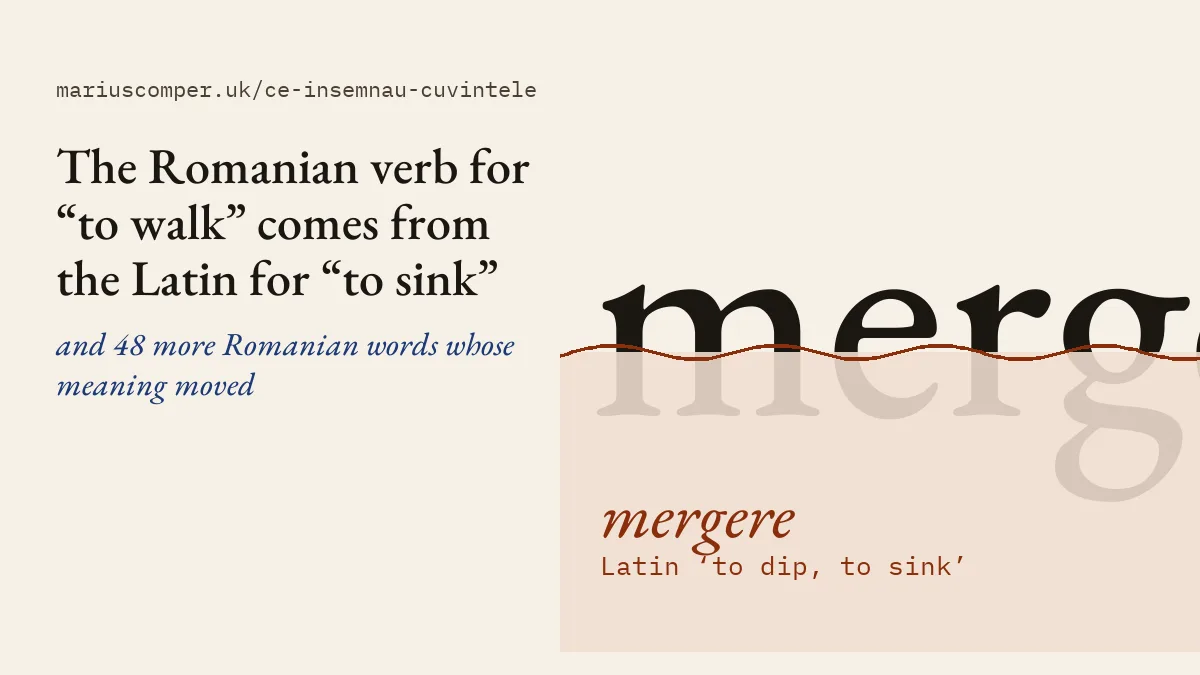
What 49 Romanian words first meant: the verb for caress (to clean), research (to go round), leave (to fold), earn (to punish), and the nouns for woman (the whole household), forest (marsh) and work (torment). Each with its dictionary source, reconstructed forms and disputed etymologies marked. Plus a guessing game and an index.
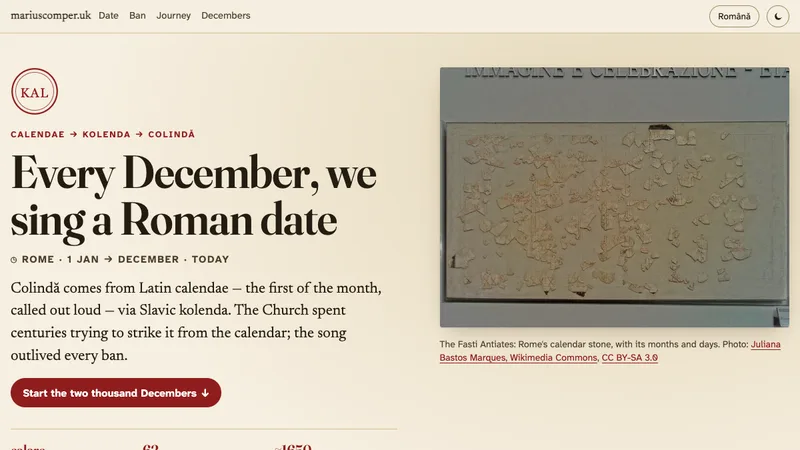
Colindă comes from Latin calendae, via Slavic kolenda: a Roman 1 January date, banned by synods for centuries and still sung every December.
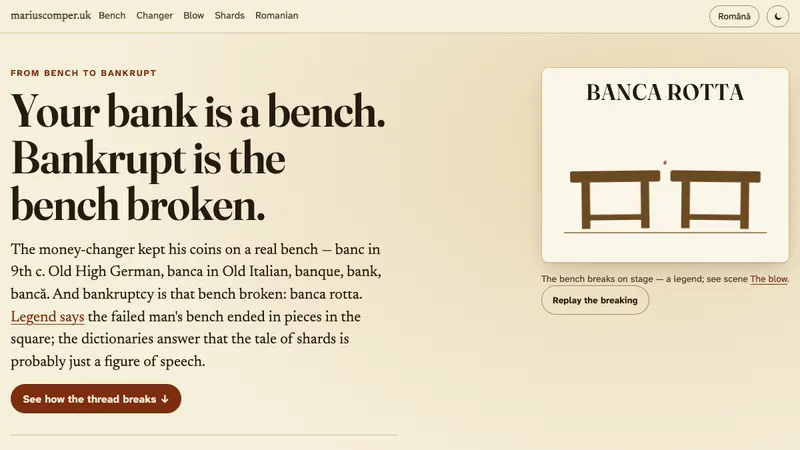
The money-changer's banca was a real bench, and bancruta is that bench broken: Italian banca rotta. Six dated European forms, from 9th-century Germanic banc to 18th-century Romanian bancă, an ordering game, and the smashing legend dictionaries file as pseudo-etymology.
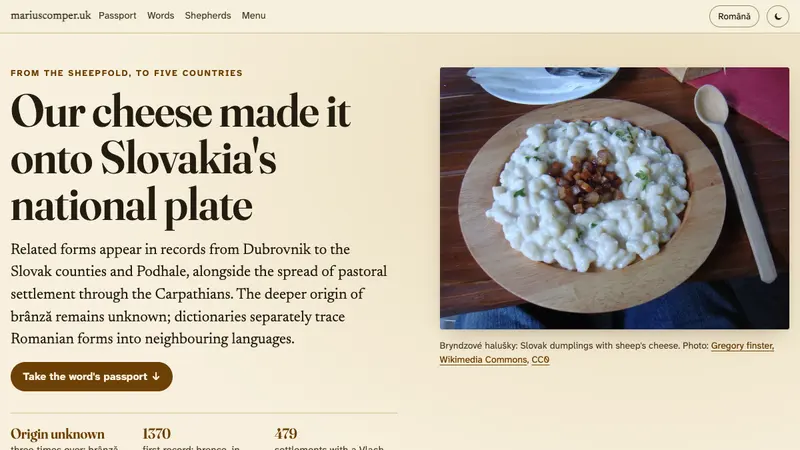
How Vlach shepherds carried three Romanian words over the Carpathians: brânză, turned bryndza in halušky, baci, the head shepherd from Poland to Moravia, and urdă, with five etymologies and no winner. Three dated attestations, six dishes, sheep climbing to 2,000 metres.
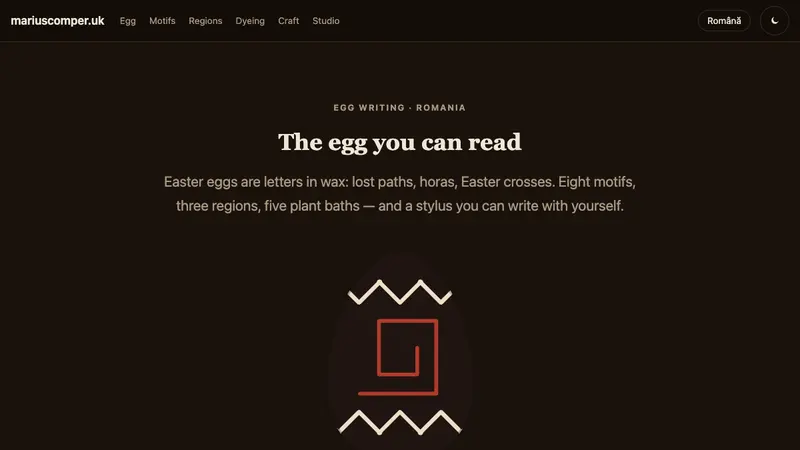
Romanian Easter eggs as a visual alphabet: the lost path, the hora, the Easter cross. Eight motifs, three regions, five plant baths — and a wax stylus to write, dip and melt with yourself.
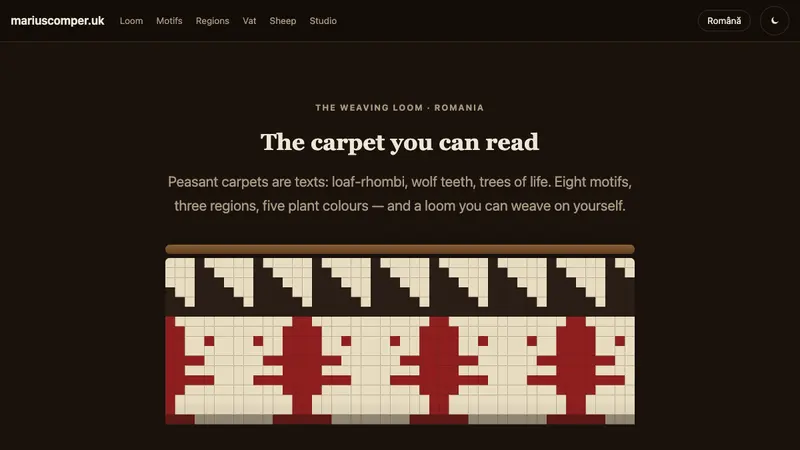
Eight motifs from Romanian pileless carpets — bread rhombi, wolf teeth, trees of life — three regions with their palettes, five plant dyes, and a working loom to weave on yourself, from sheep to wall.
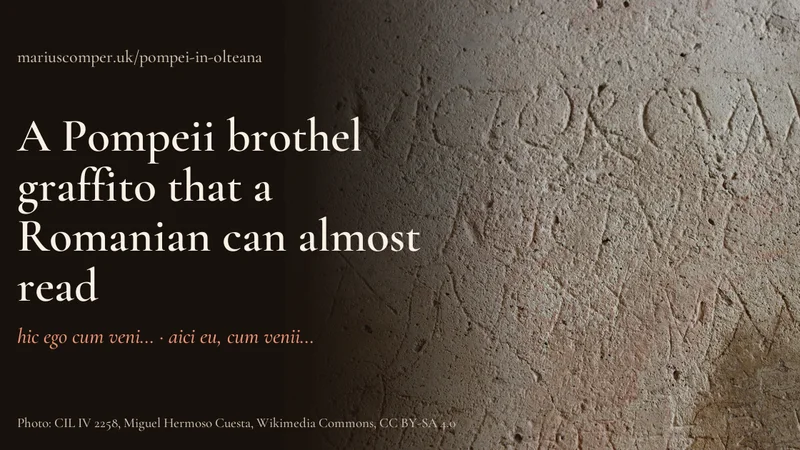
A line scratched on the wall of Pompeii's brothel, hic ego cum veni futui, taken word by word into Romanian: four words survived, one only looks alike, three were lost. How the Latin perfect became the Romanian simple past, and where people still say venii for what they did the same day.
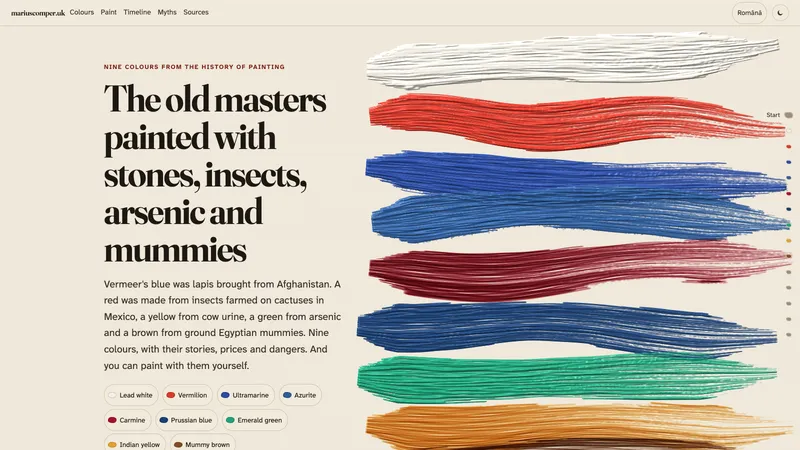
Where nine painters' colours came from: ultramarine from Afghan lapis, carmine from Mexican insects, arsenic green, Indian yellow from cow urine and mummy brown from Egyptian mummies. What they cost, what they poisoned, which myths do not hold, and a canvas to paint on with them and watch them age.
Since May 1939: the storm, the map, the numbers — and what stayed undocumented.
The last sentence on the Tabula Traiana, word by word: two survived into Romanian, two shifted, two vanished. Then the dam came.
Andrée, Strindberg and Frænkel flew for 65 hours, came down on the ice 786 kilometres from the Pole and walked for almost two months while the ice carried them south-east. Their route on the map, from the diaries found in 1930, Strindberg's photographs developed 33 years later, and what is and is not known about how they died.
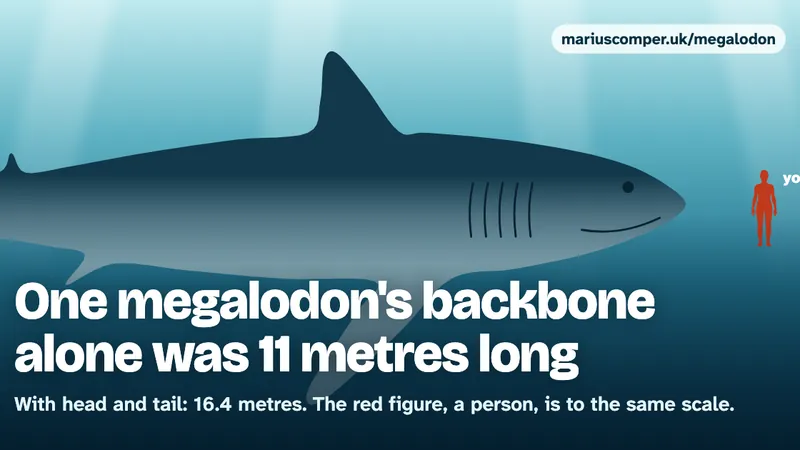
A megalodon backbone found in Belgium is about 11 metres long on its own. With head and tail the shark was 16.4 metres, and slimmer than a giant great white. Let it swim past you at true scale, see its tooth at real size, and the teeth found in Transylvania.
The clay tablets of Knossos held not one known word. Alice Kober, who taught at Brooklyn College, showed how their signs were related without knowing their sounds; in 1952 Michael Ventris got Greek out of the grid, though he had once called it a fantasy. Solve the three town names that opened Linear B.
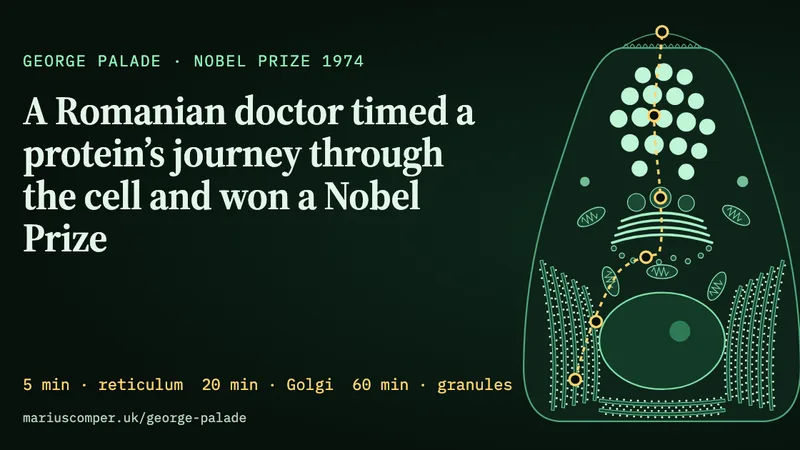
In 1953 George Palade described the grains on the cell's membranes, the ribosomes, and with Lucien Caro and James Jamieson he measured how many minutes new proteins take from the ribosome to the granules. The name ribosome was proposed at a 1958 meeting, and the year he left for America depends on the source. The story, in nine chapters, with games.
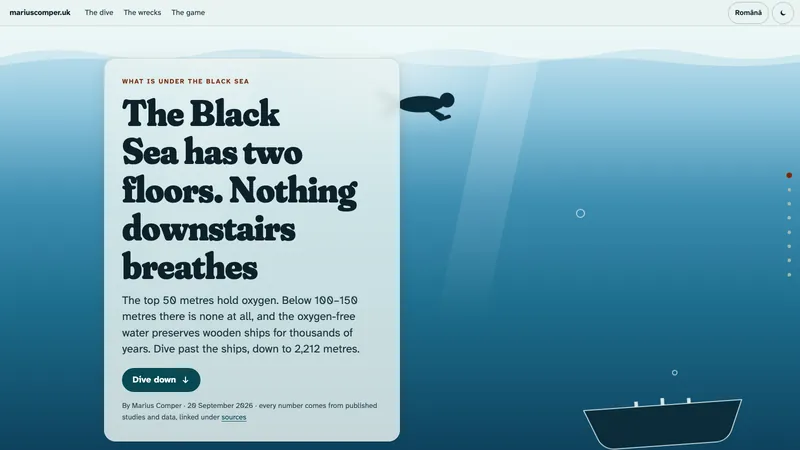
The top 50 metres hold oxygen. Below 100–150 metres there is none at all, and the oxygen-free water preserves wooden ships for thousands of years. Dive past the ships, down to 2,212 metres.
A timeline game: place 20 moments from Bucharest's history in order, from the first document of 1459 to the metro and the Revolution. Three mistakes allowed.
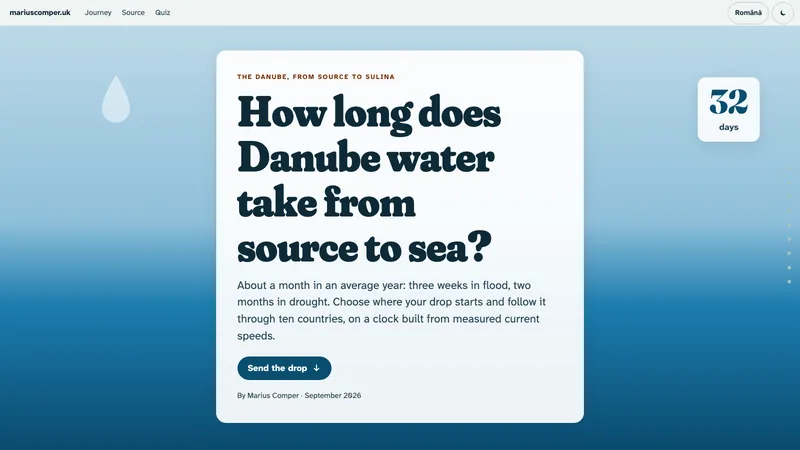
About a month in an average year: three weeks in flood, two months in drought. Send a drop down the Danube, from the Black Forest to Sulina, on a clock built from measured current speeds.
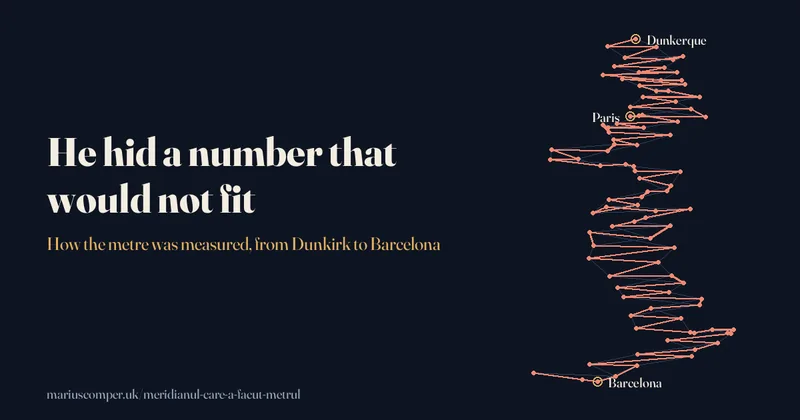
The metre came out of a 1,075-kilometre line measured tower by tower between Dunkirk and Barcelona, through the years of war and the Terror. At the southern end Pierre Méchain read the latitude from two places less than two kilometres apart and got two different answers. Follow the chain of 96 stations, drawn from Delambre's own printed table.
One Friday in February 1882, a fireball broke into thousands of pieces above a few villages in Cluj, and the stones came down on snow. The fall map drawn in 1882, the stones set to scale beside your hand and the museums where they sit today, plus the true reckoning of the biggest stone.
At Colți, in Buzău, people dig amber with insects millions of years old out of the ground. Their DNA has long been gone, and the amber itself is Baltic amber's cousin. Drag the clock back and play eight questions.
Males weighed 400–500 kilograms and stood 1.7 metres at the shoulder, and their bones say they ate only plants. Stand next to them, to scale, and see what researchers found in Bears' Cave and three other Romanian caves.
29 April–27 May 1986: the cloud, the readings, the rules — and four days of silence.
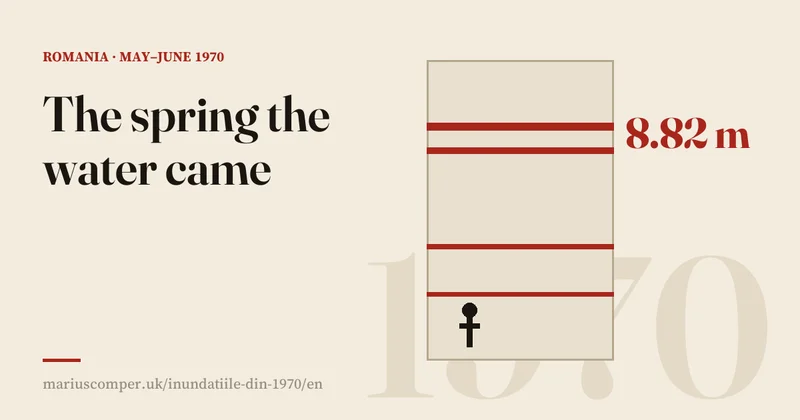
The rain, the drowned counties, the rebuild — and the dead have no single number.
36 places where the sources attest the Normans, from Hastings to Palermo and Antioch — each with its evidence grade. The farthest, Antioch, lies 3,177 km from Rouen. Type your town and see how close they came.
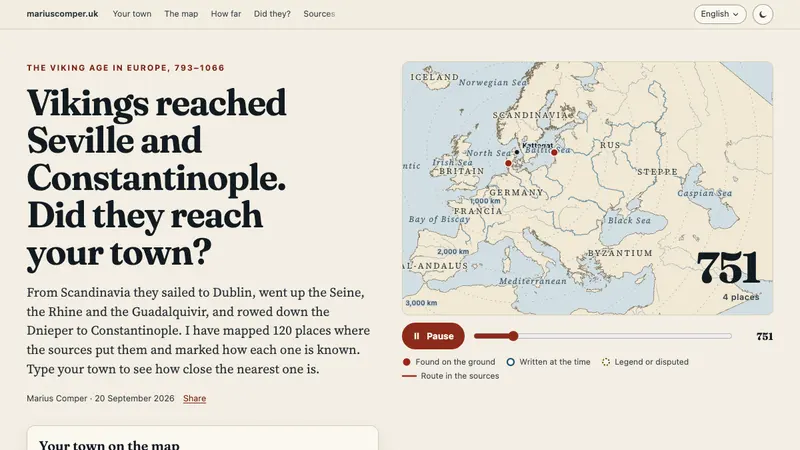
A map of 120 places where Scandinavians are placed by the sources, from Dublin to Seville and from Kyiv to the Caspian. Each is graded by how we know. Type your town to see the nearest.
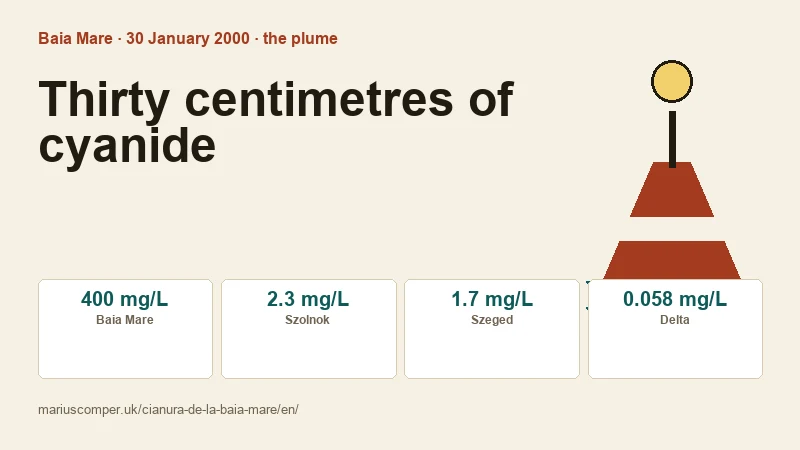
One hundred thousand cubic metres, 2,000 kilometres, four weeks of plume.
Rejected by Moscow in 1952, opened with 6 stations in 1979: the decision, the digging, the first train, today's network.
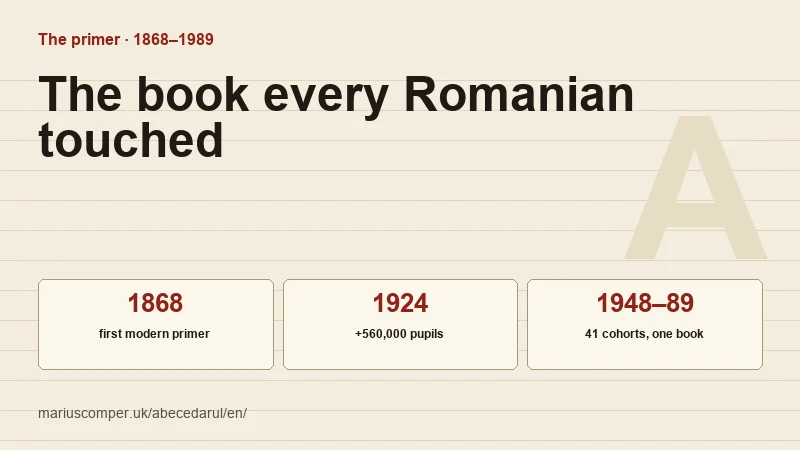
41 years, one book on every desk — and three books before it.
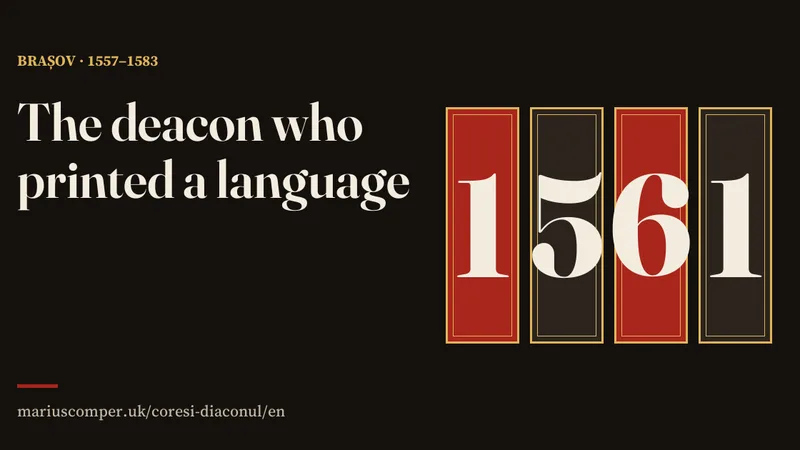
Deacon Coresi's Brașov press (1557–1583) put Romanian into print: the shop, the ten Romanian books with BRV numbers, and the shelves where the surviving copies sit today, shelfmark by shelfmark.
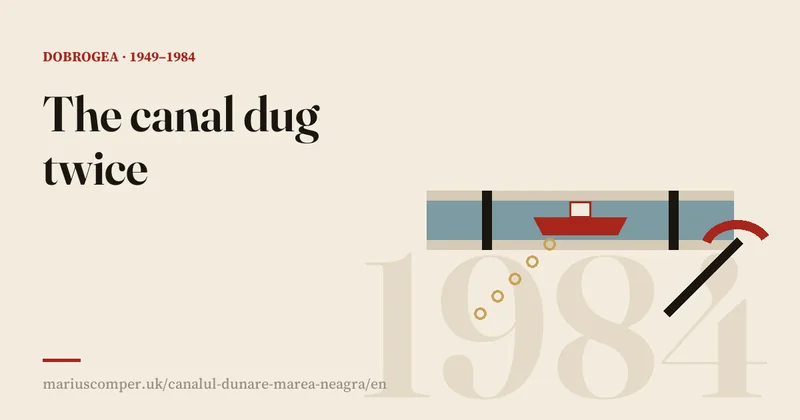
Once with prisoners, once with engineers — and the first dig's dead have no single number.
The Heleșteni auction of 349 souls, the laws of December 1855 and February 1856, and the compensation ledger: 10, 8 or 4 ducats a soul, paid from the taxes of the freed themselves.
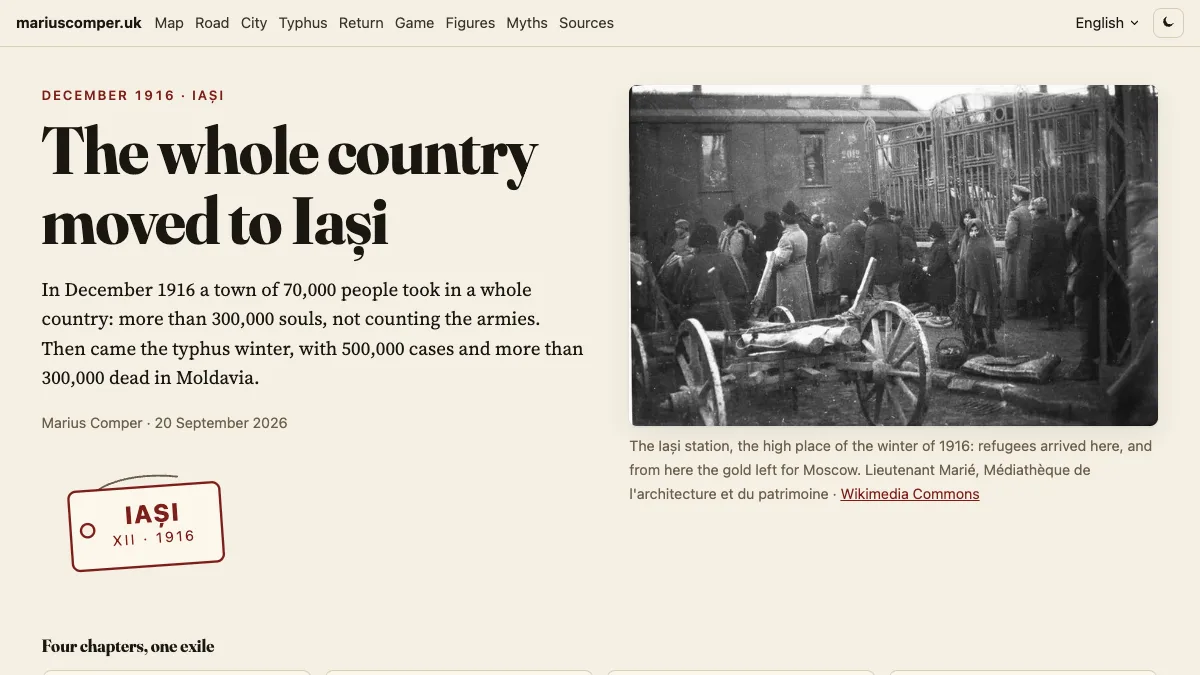
December 1916: the capital moves to Iași, the town grows from 70,000 to over 300,000, and typhus kills over 300,000 across Moldavia. A day-by-day map, a stationmaster game, and sources.
4 March 1977, 21:22: 56 seconds, 32 fallen buildings, 1,578 dead. The map of the night street by street, the ledger of the blocks and the engineer's board that condemns or spares.
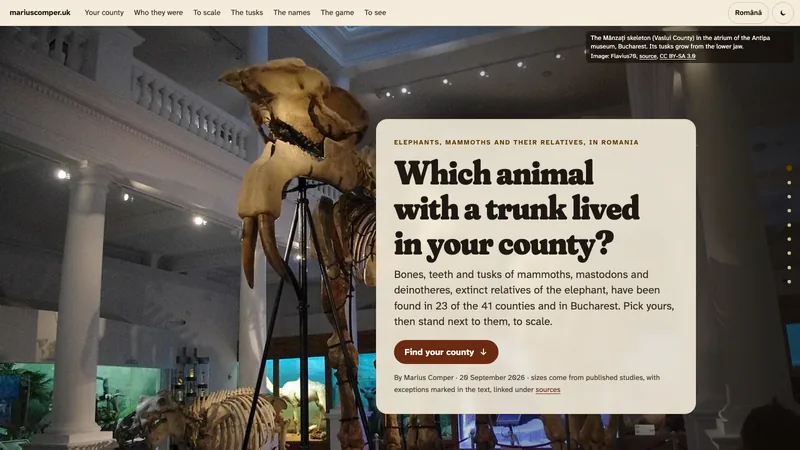
Bones, teeth and tusks of mammoths, mastodons and deinotheres have been found in 23 of the 41 counties. Pick yours, stand next to them to scale, and read what the original paper actually says about the skeleton in the Antipa museum's atrium.
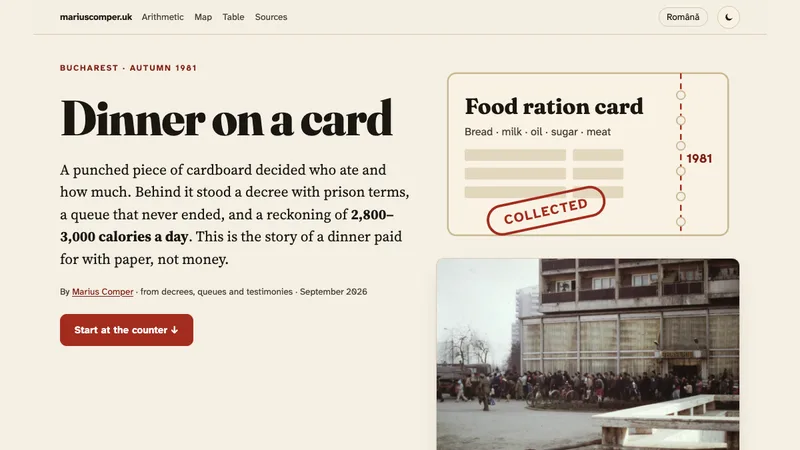
One card, one decree, one queue: a family dinner in 1981 Romania.
A 250-gram ration, trains guarded by gendarmes, and a famine with no death toll.
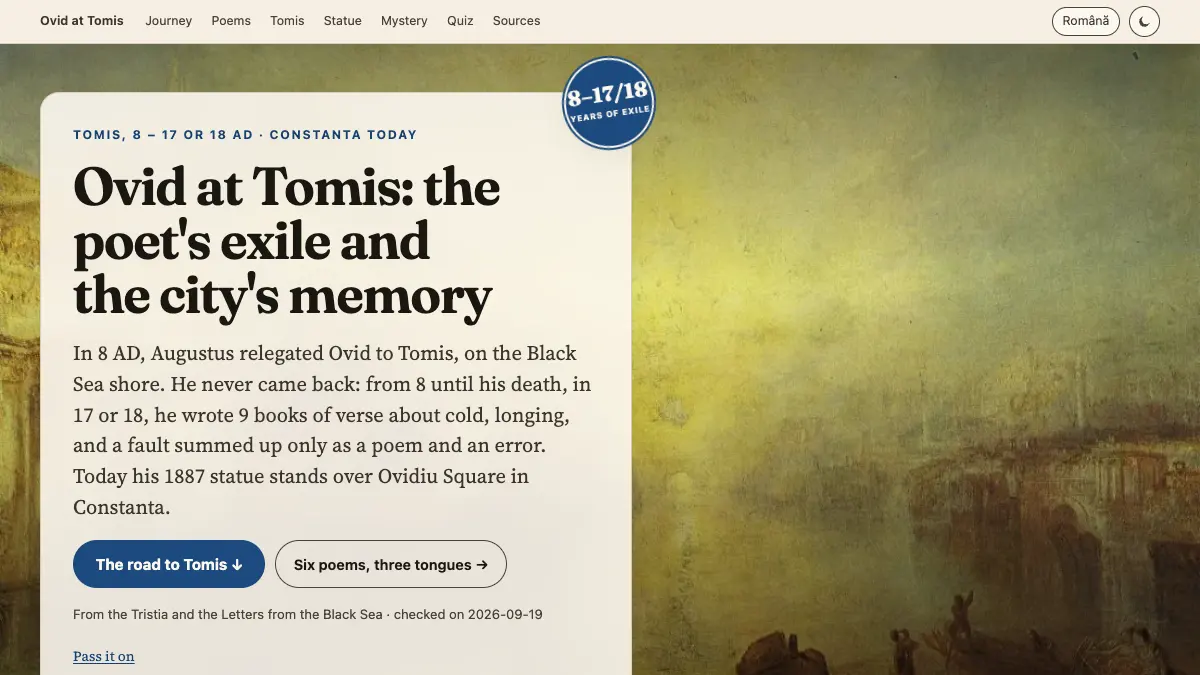
Ovid, relegated by Augustus to Tomis in 8 AD, died there in 17 or 18. Nine books of exile verse and the Constanta statue.
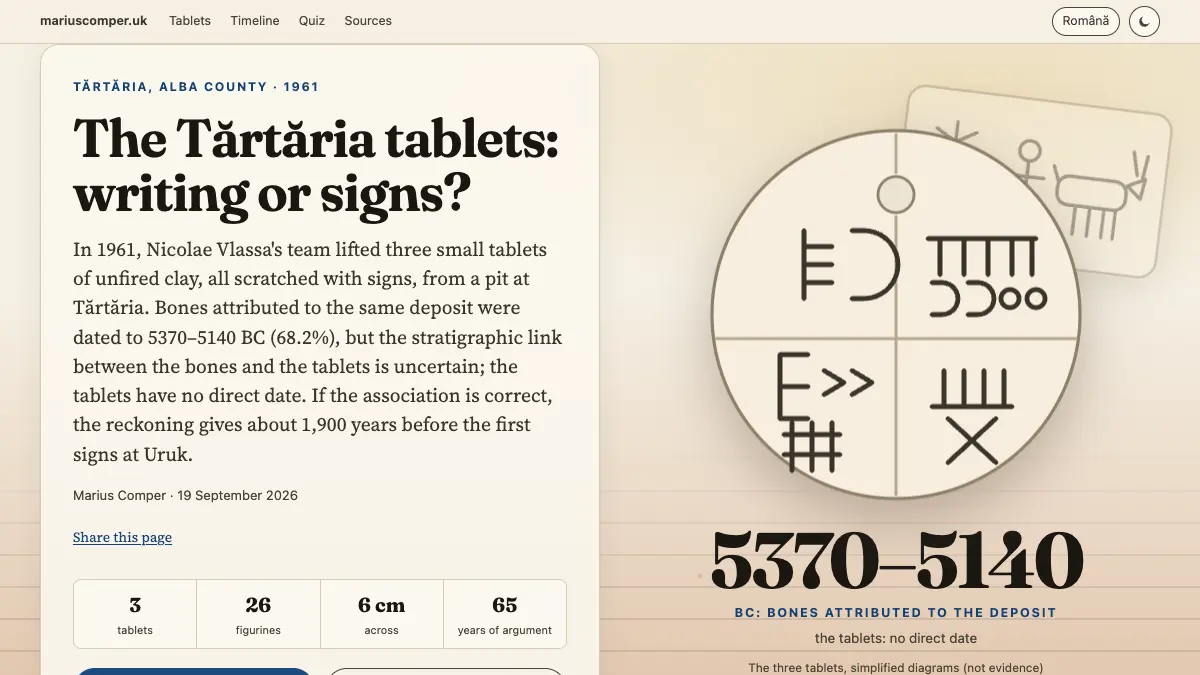
Three clay tablets from Tărtăria, with no direct date. Bones attributed to the deposit: 5370–5140 BC. The find, the signs, the five questions.
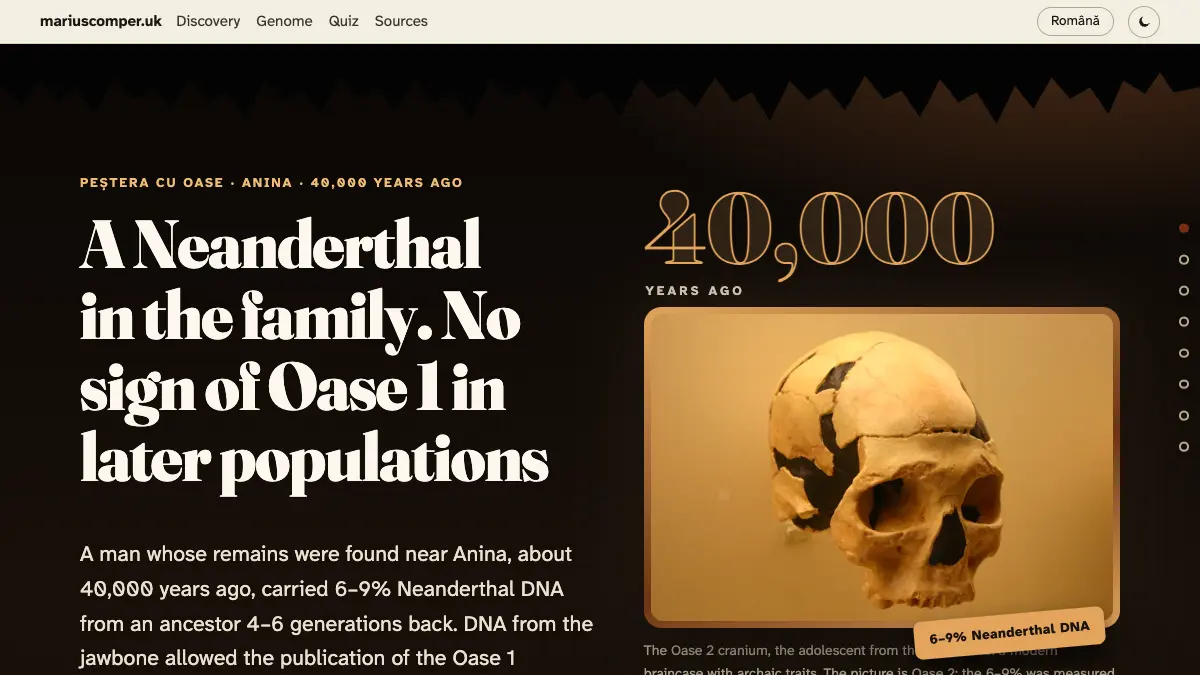
The remains of a man from about 40,000 years ago, found near Anina: 6–9% Neanderthal DNA from an ancestor 4–6 generations back. The Oase 1 genome, published in 2015.
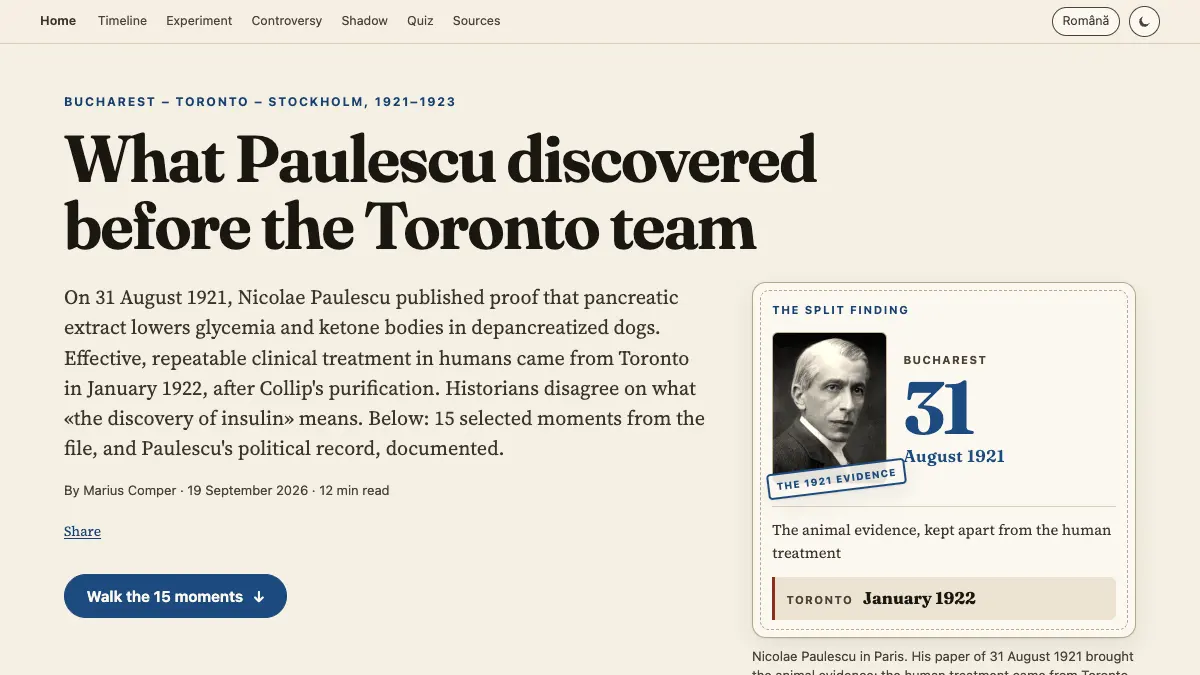
Paulescu published the animal evidence in 1921; Toronto achieved effective clinical treatment in January 1922. The day-by-day record, documented.
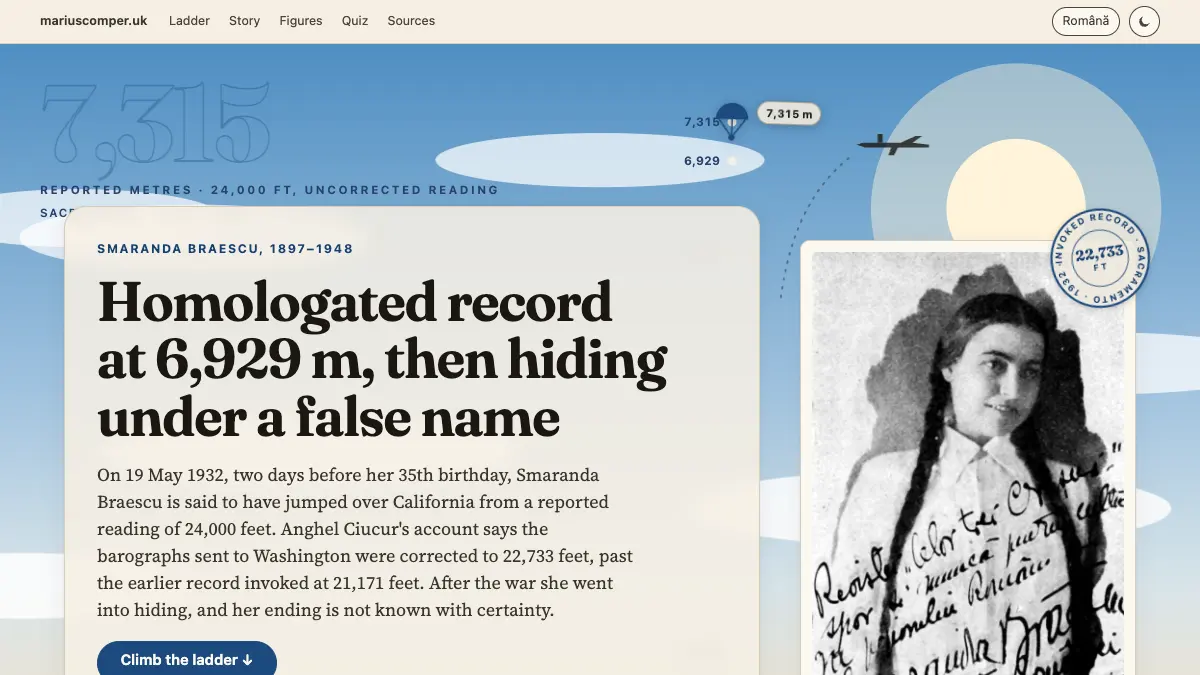
Sacramento, 19 May 1932: a reported 24,000 ft reading, a 22,733 ft value claimed as homologated. The ladder, story and arithmetic as a synthesis.
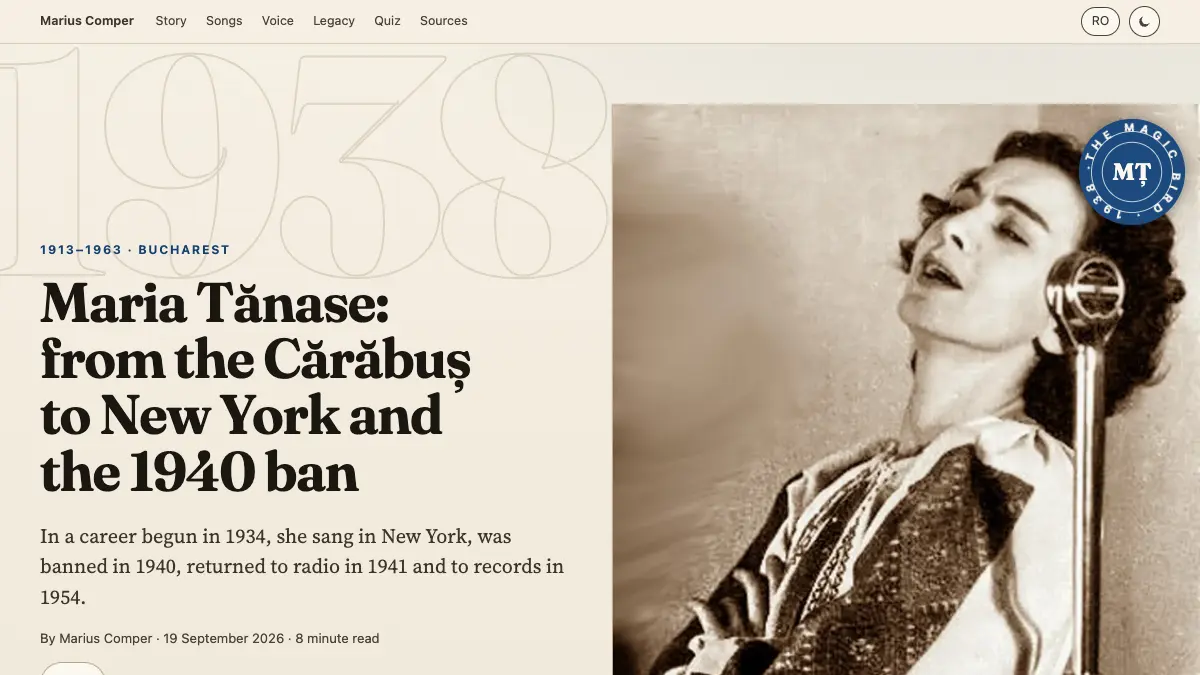
From the Cărăbuș to New York 1939 and the 1940 ban: Maria Tănase's life in 12 stops and 12 songs, with years as attributed by the cited discography.
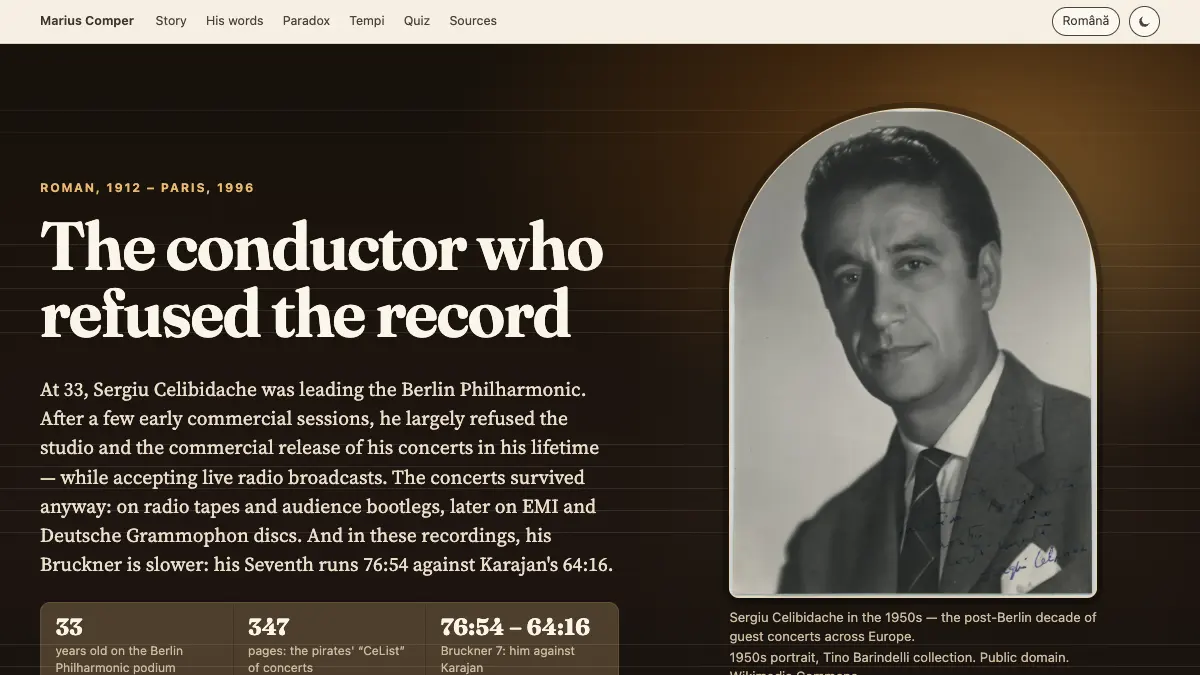
Sergiu Celibidache led the Berlin Philharmonic at 33, then largely refused the studio and the commercial record after a few early sessions — while accepting radio. Why, how his concerts survived, and how slow his Bruckner is in these recordings.
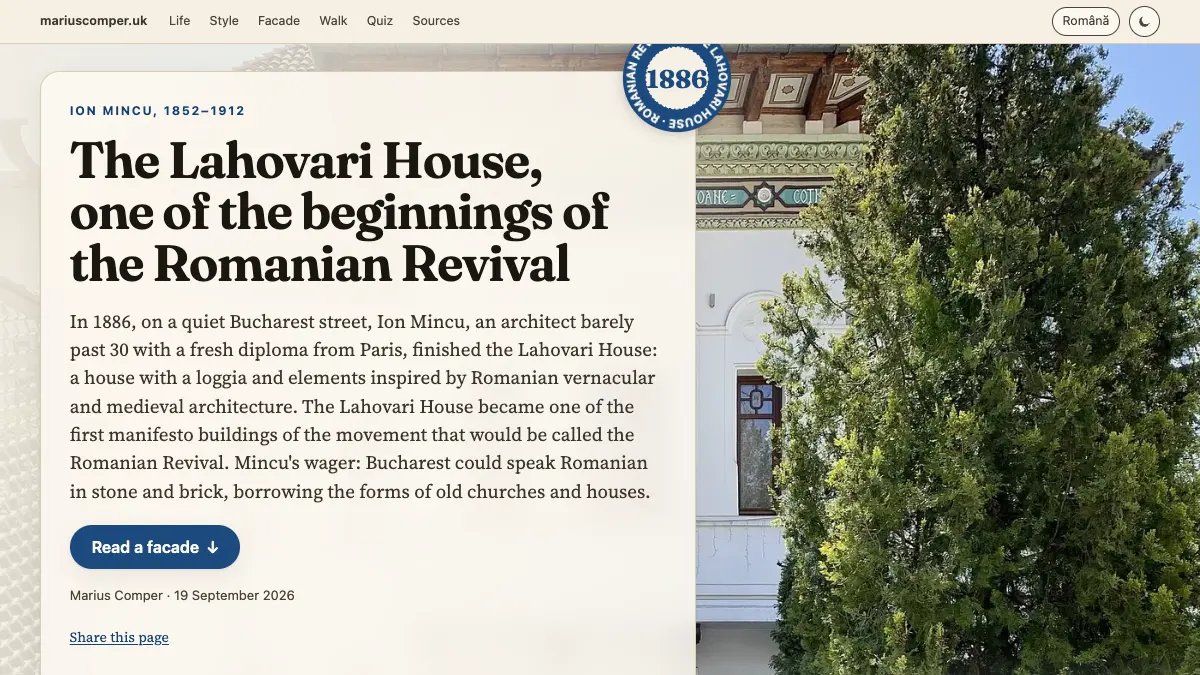
Ion Mincu (1852–1912) and the beginnings of the Romanian Revival: the 1886 Lahovari House, five elements to spot, a six-stop walk.
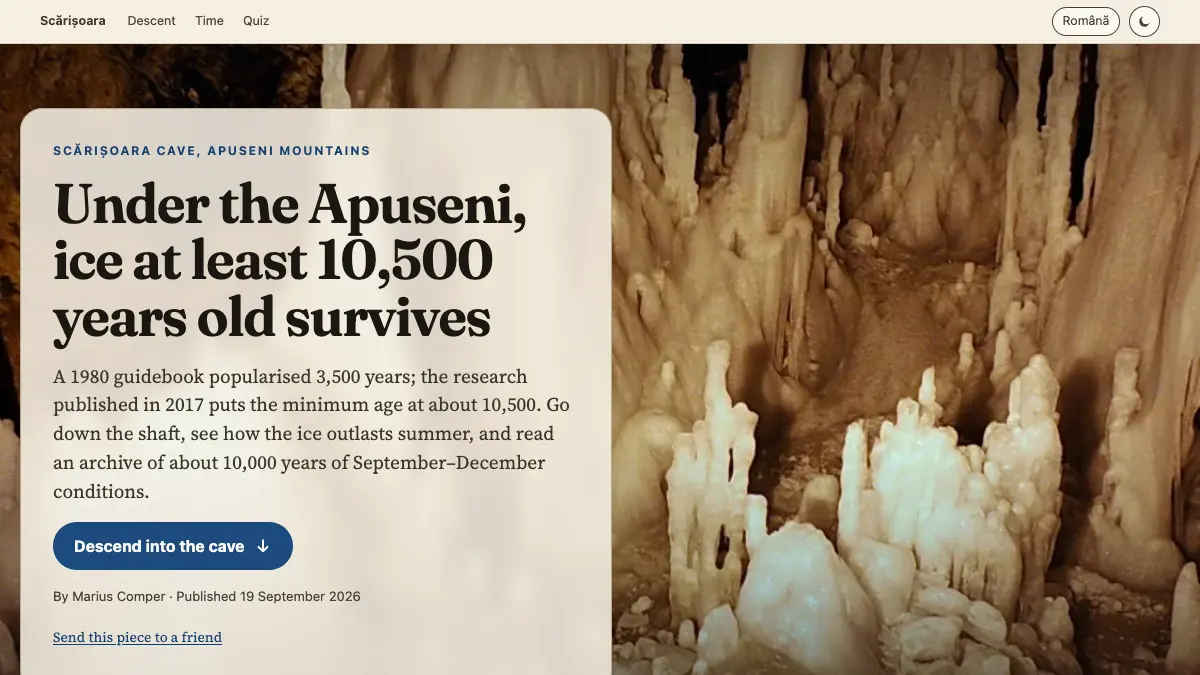
A 1980 guidebook popularised 3,500 years; the 2017 research puts the minimum age at about 10,500. Map, cold trap, chronology.
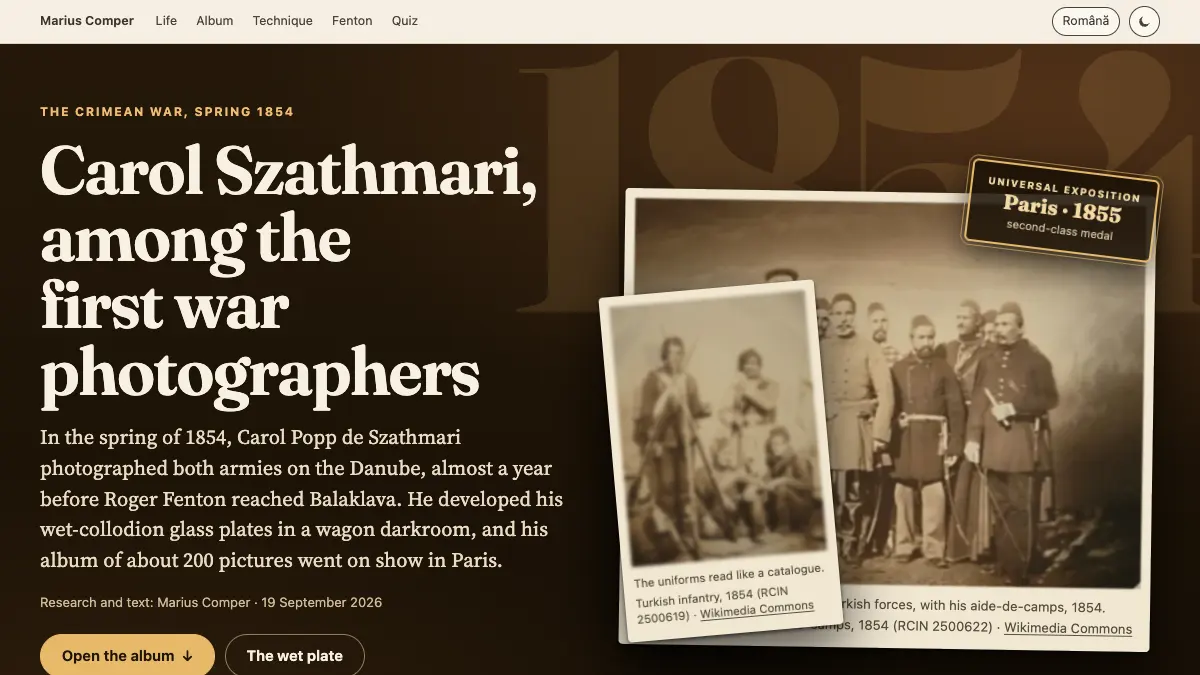
In the spring of 1854 the Bucharest painter Carol Popp de Szathmari photographed both armies on the Danube, almost a year ahead of Fenton: the Paris album, the dark wagon and the surviving pictures.
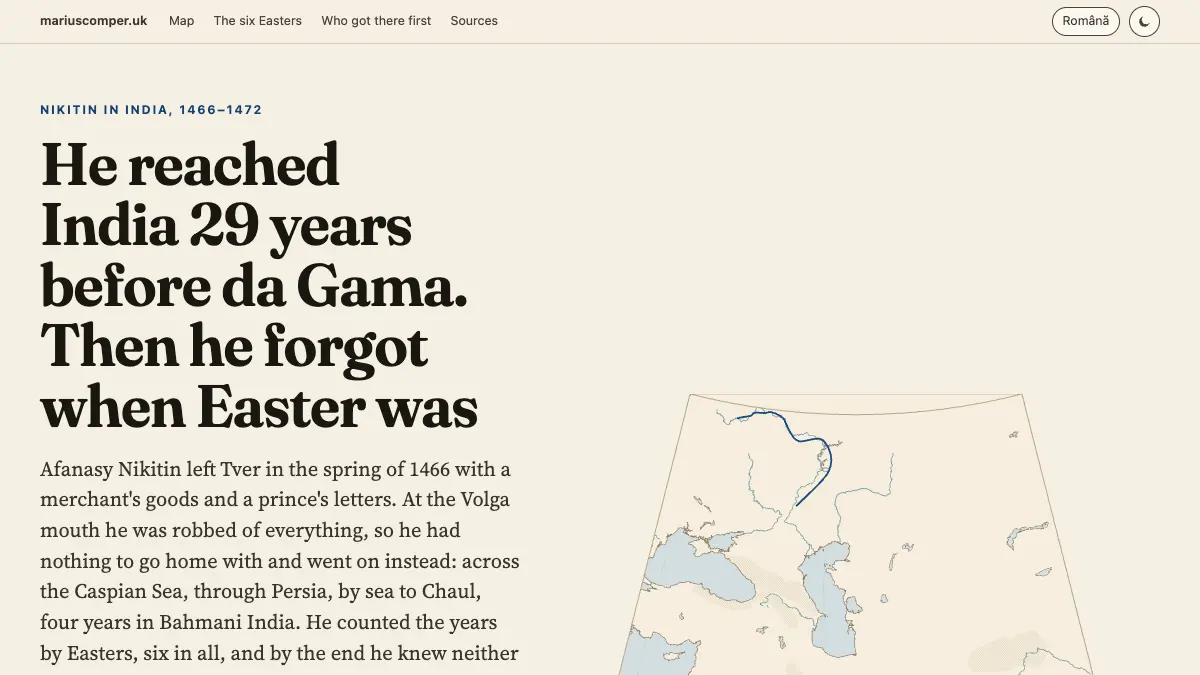
Afanasy Nikitin left Tver in 1466 and reached India 29 years before da Gama. His route mapped, his six Easters, what he saw, chapter by chapter.
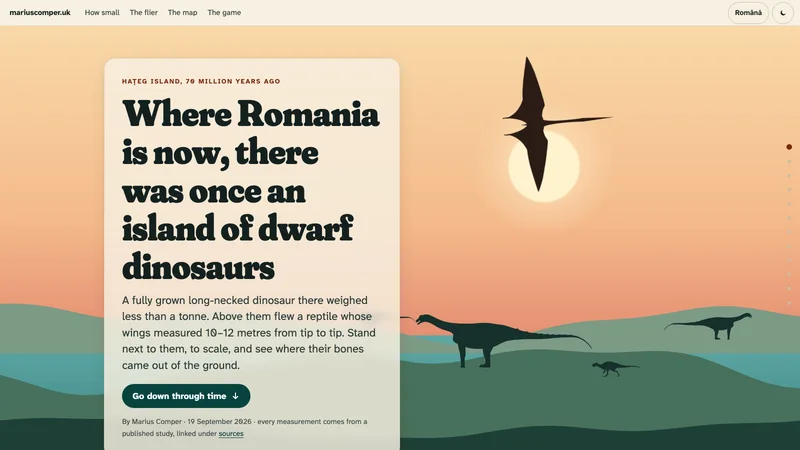
Seventy million years ago Hațeg was an island. A fully grown long-necked dinosaur there weighed under a tonne, and a reptile with 10–12 metre wings flew overhead. Stand next to them, to scale, and see on the map where the bones came from.
The 11 November ultimatum, the winter war, the 28 February wheel and the 2 August 1785 patent: what the rising demanded, week by week.
Pades in January, Bucharest in March, Golesti in May. Two proclamations, one country, and five months that ended the Phanariote century.
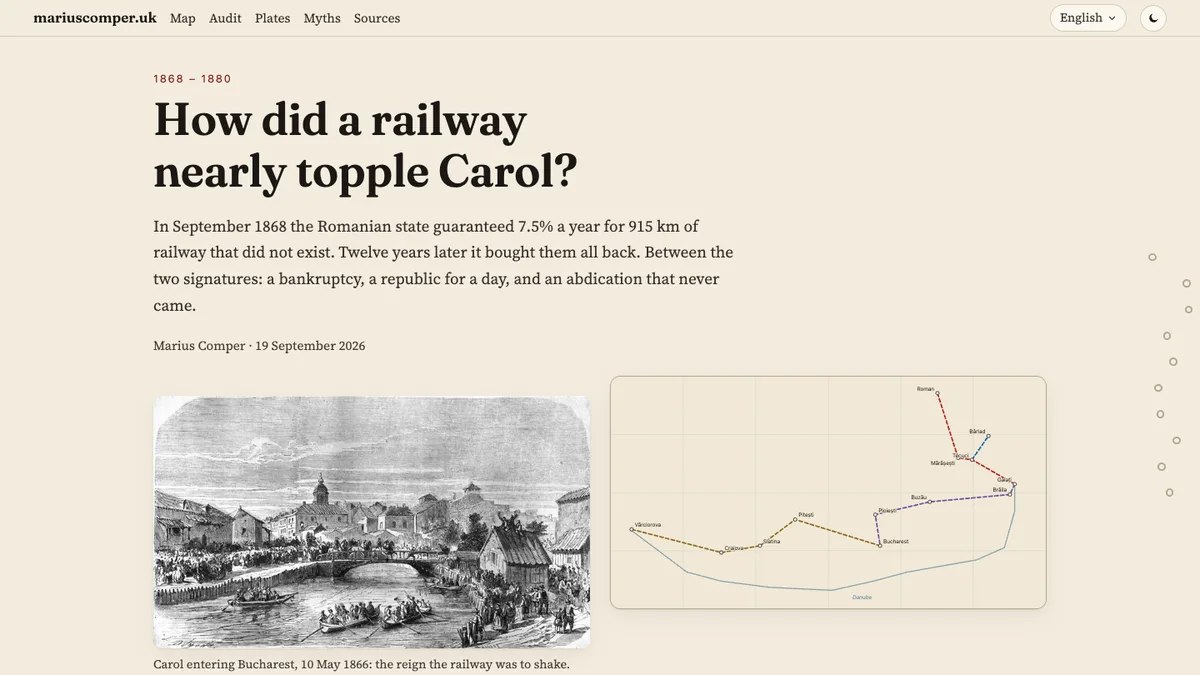
915 km promised, 7.5% state-guaranteed, a bankruptcy and an abdication that never came. The concession map and its audit, 1868–1880.
The lion thaler, the law of 22 April 1867 and three deaths: a currency's life in 17 stops and eight loaves.
Miletus, the silver drachma, the AD 100 boundary. Four chapters and a map that silts as you read.
Loans, hirings, slave sales and a dissolved college: 25 documents from 139–167, clause by clause.
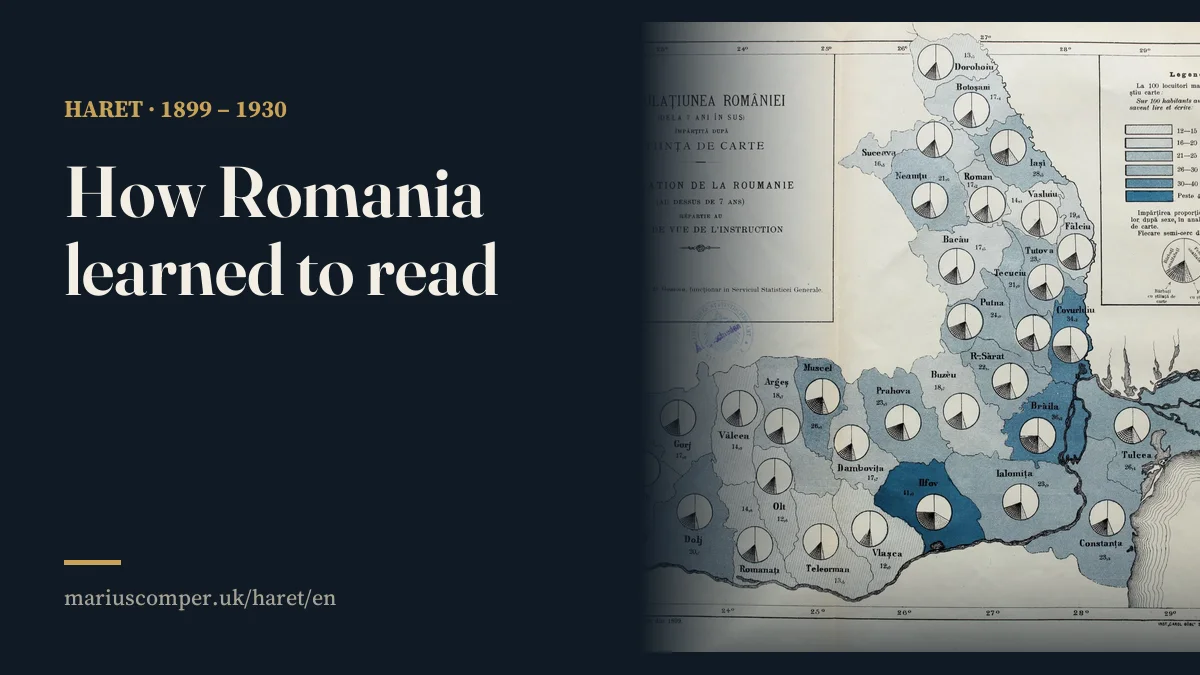
From 22 to 56 literates in 100, county by county, across three censuses. Haret's laws, the village school and the Abecedar exam.
1 April old style = 14 April new style. Decree-Law 1053, the 13 days that never existed, a 1900–1925 converter, and the Church that kept its own time until 1924.
Mărăști, Mărășești, Oituz: the summer of 1917 on one map, day by day. Grigorescu's order, the reserves game, and the documented story of Ecaterina Teodoroiu.
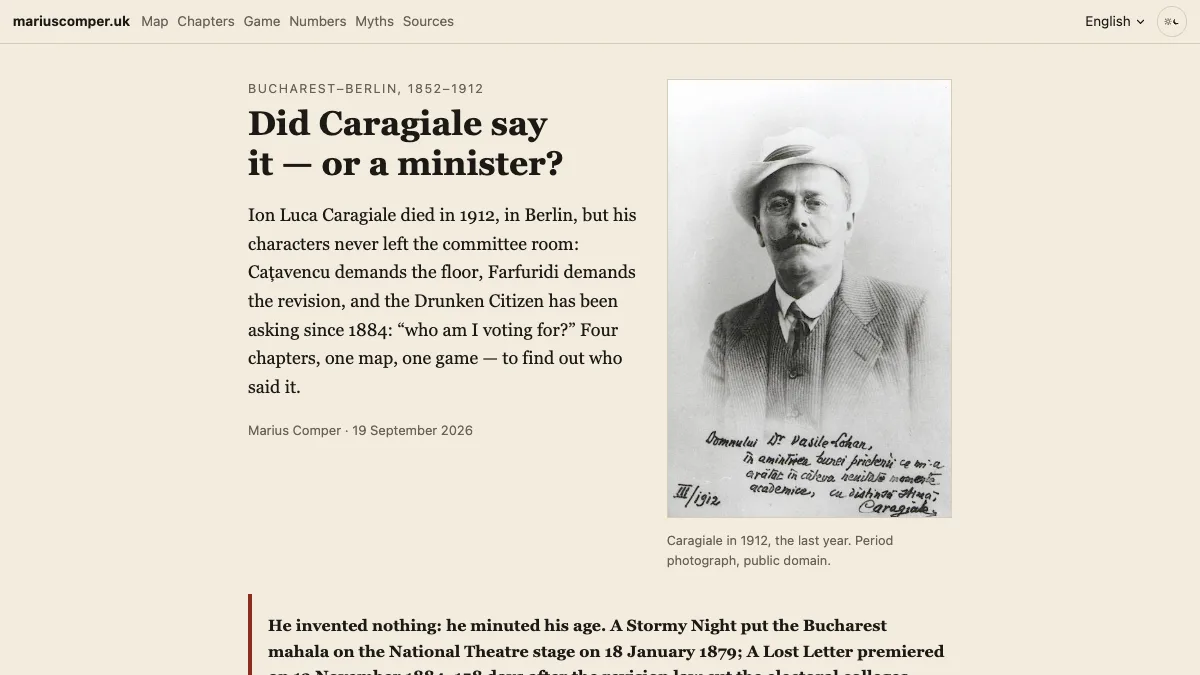
The 1884 Letter, 158 days after the real revision. Mitică’s Bucharest mapped, and the quote game: Caragiale or the politician?
1 December 1918: 1,228 credentials, the nine-article Resolution, and over 100,000 people in the cold. The delegations map, the credential journey, and the answers from Cluj and Mediaș.
1 December 1918 – 4 June 1920: the 1916 promise, the 1919 commission lines, the walkout over the minorities treaty, and the signature in the Grand Trianon — with Hungarian historiography on the table.
The 2 May coup, the plebiscite and the August rural law: 406,429 dependent peasants endowed by oxen category — fruntași, mijlocași, codași — redeemed until 1884.
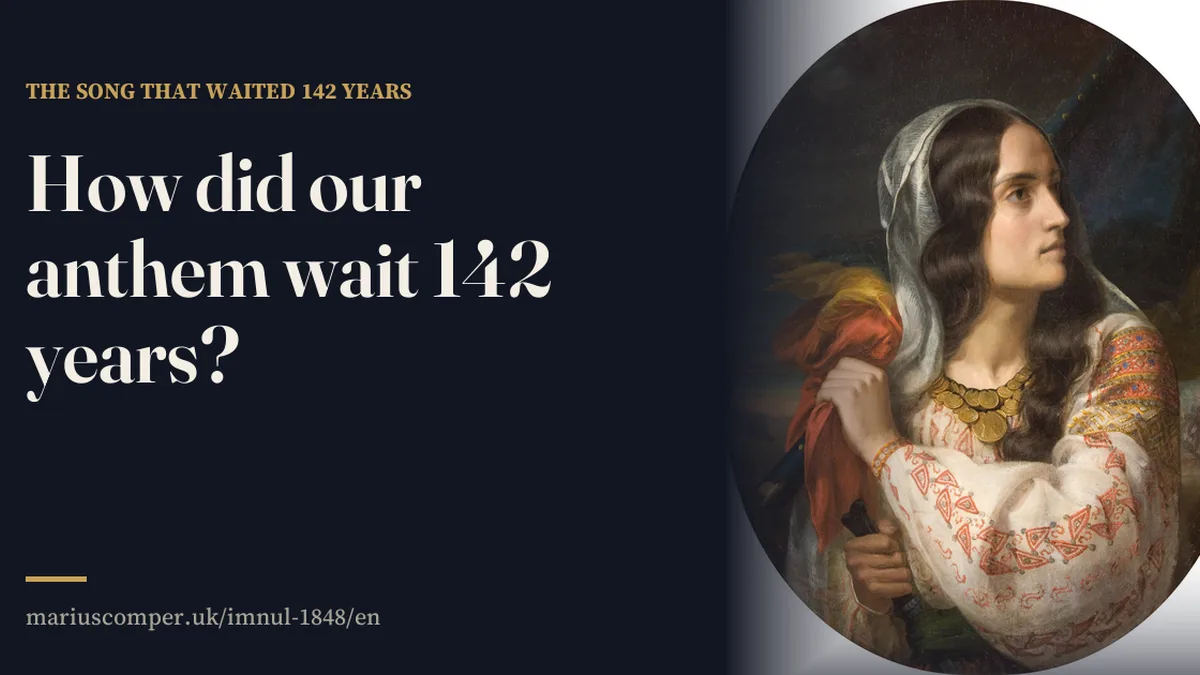
“Un răsunet” at Brașov in June 1848, six official anthems, two bans and 24 January 1990: the song that waited 142 years.
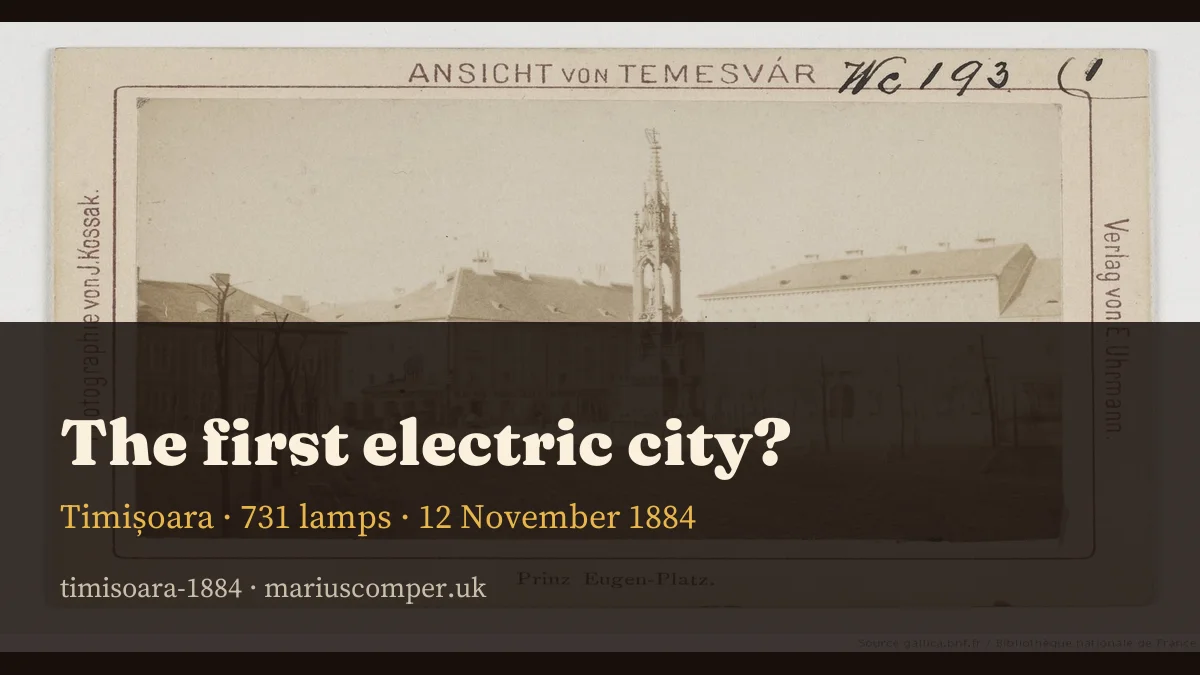
731 incandescent lamps, 59 kilometres of cable and the Brush company of Vienna: the night of 12 November 1884 and the asterisk on “Europe's first electric city”.
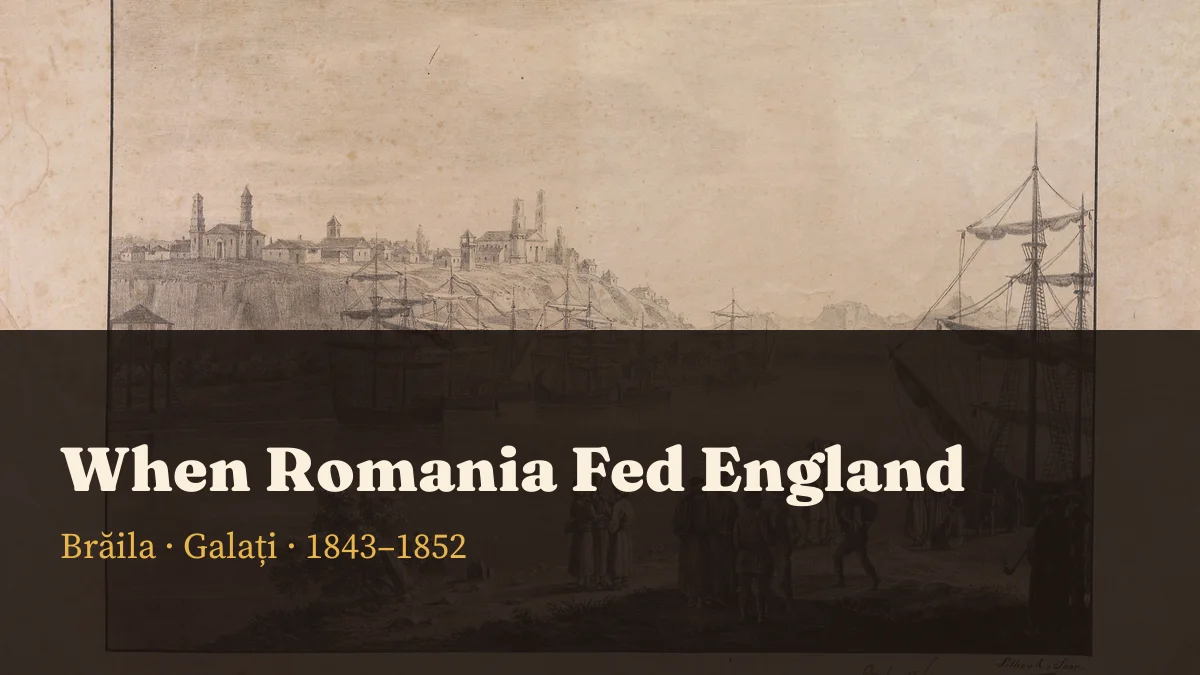
Ten harvests, two free ports and the 9-foot Sulina bar: how Brăila and Galați came to send hundreds of thousands of quarters of wheat to 1840s London.
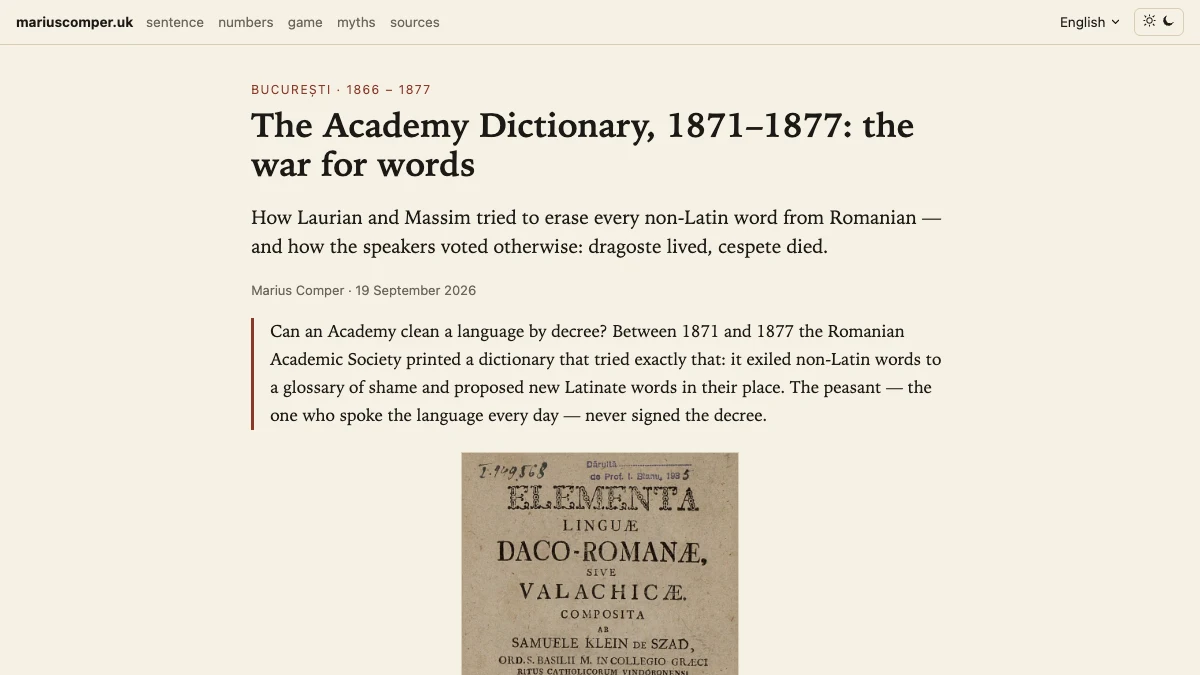
Laurian and Massim tried to erase every non-Latin word from Romanian. Dragoste lived, cespete died — one sentence, two languages, nine verdicts.
Eight officers enter the palace at 5 a.m., the abdication is signed, and by dawn three lieutenants rule. 6 stations from evening to dawn.
An Ottoman gun taken at Plevna becomes the kings’ 1,115-gram crown: 1881, Alba Iulia 1922, today’s treasury.
The 30-metre circle, the 6.98-metre andesite disc, ten rays: six famous claims go through the excavation record, and the calendar, the observatory and the aliens do not survive.
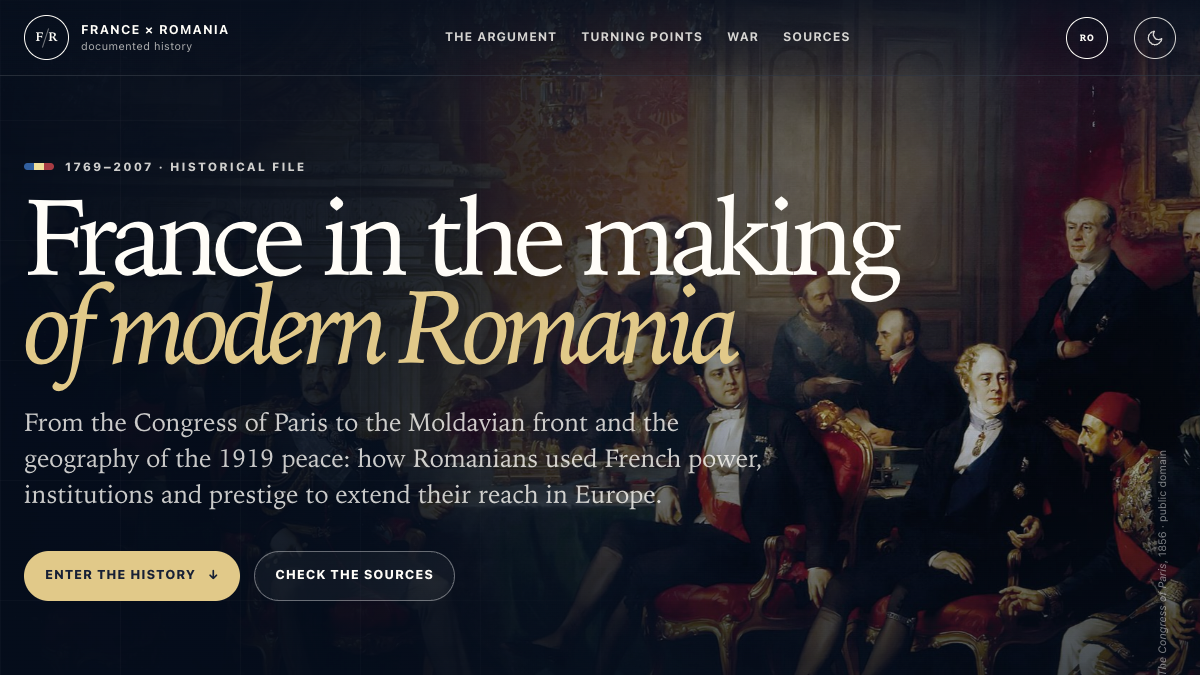
Romanian initiative and French leverage, traced through documents and turning points.
«Rost» once meant mouth, «codru» once meant mountain. 19 words from the Scheian Psalter, with their then-meaning, now-meaning and evidence on show.
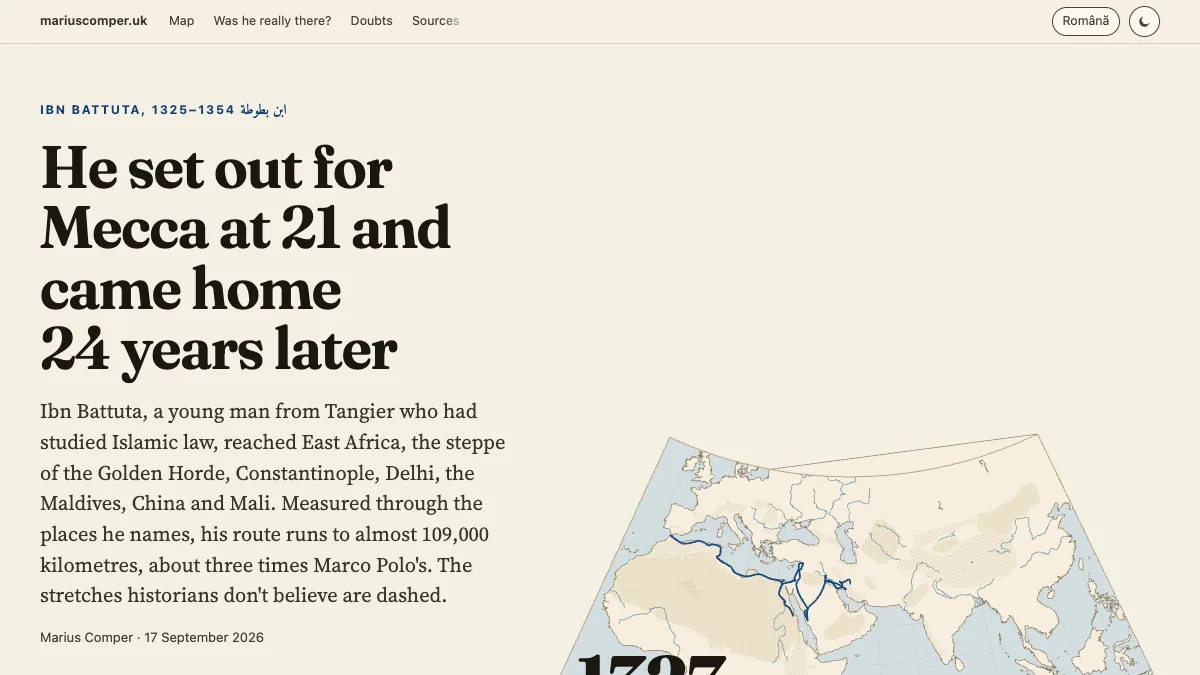
Ibn Battuta, from Tangier to Kilwa, Constantinople, Delhi, the Maldives, China and Mali: 108,800 kilometres, measured on the map.
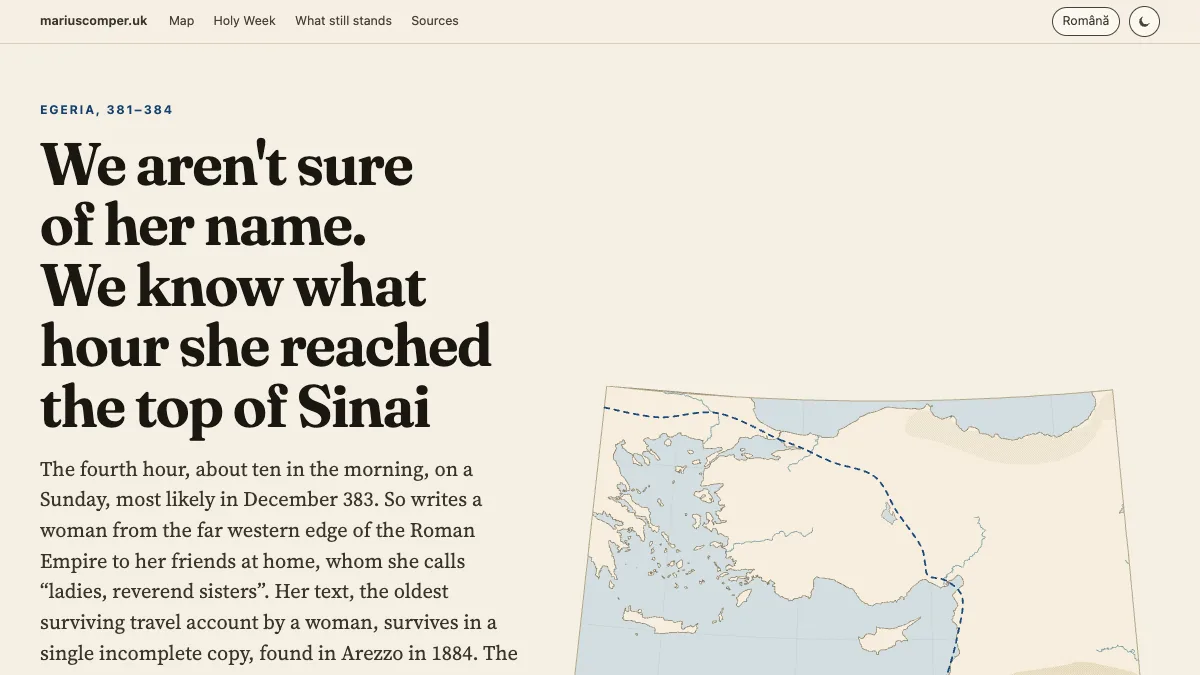
Egeria, a woman from the far west of the Empire, wrote home to her friends about three years in the Holy Land. The text, found in Arezzo in 1884, on the map.
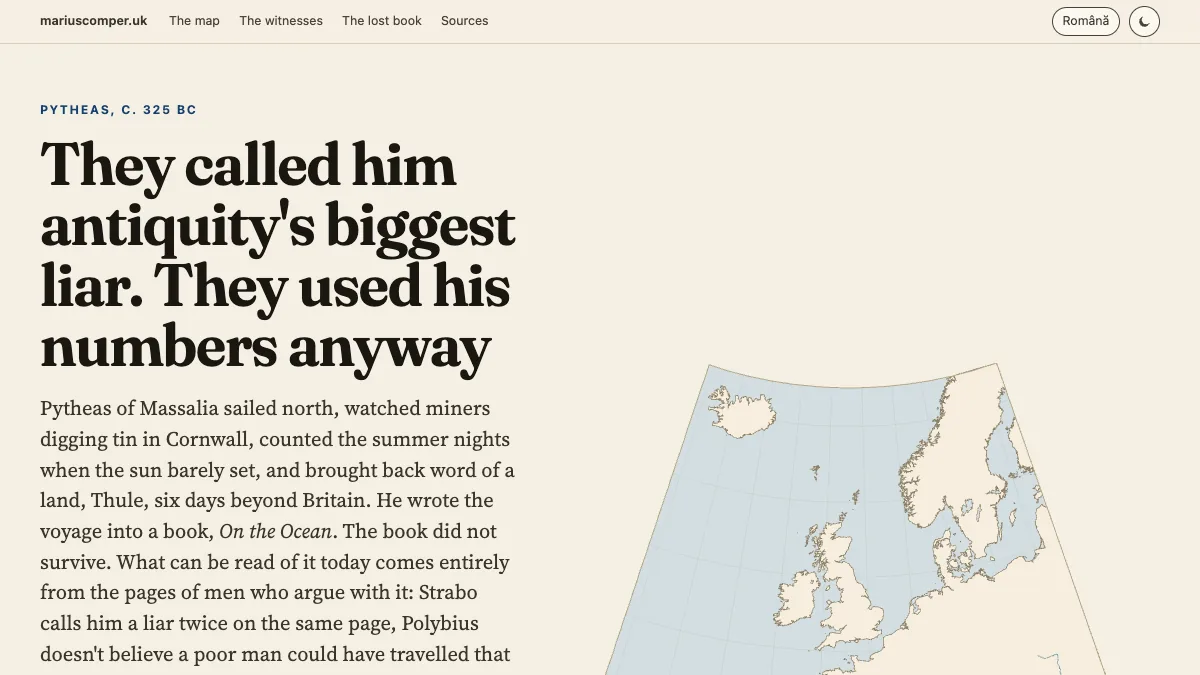
Pytheas's book on Britain and Thule was lost more than 2,000 years ago. What survives of it comes only from the quotations of the people who argued with him.
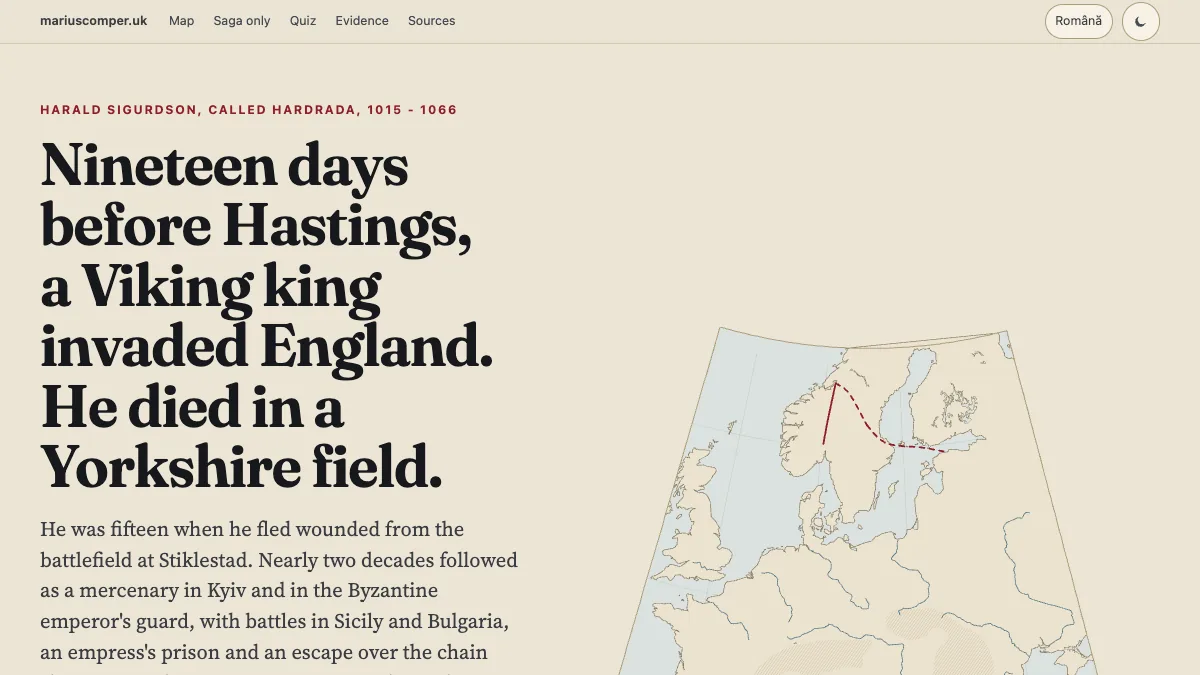
The 1030-1066 route on the map: from Stiklestad to Kyiv, the Byzantine guard in Sicily, an escape over an iron chain, and the throne of Norway, to the field at Stamford Bridge.
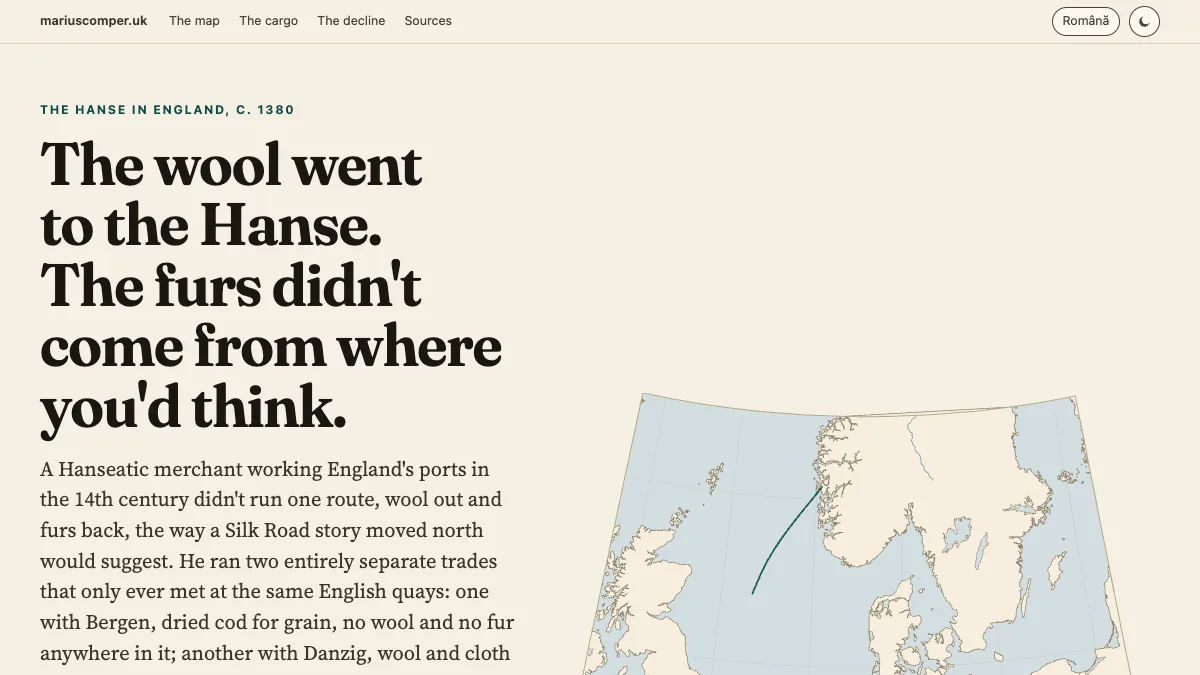
Bergen, London's Steelyard, King's Lynn and Boston: four stops of a 14th-century Hanseatic trade through England. The real cargo, stop by stop, isn't what you'd guess.
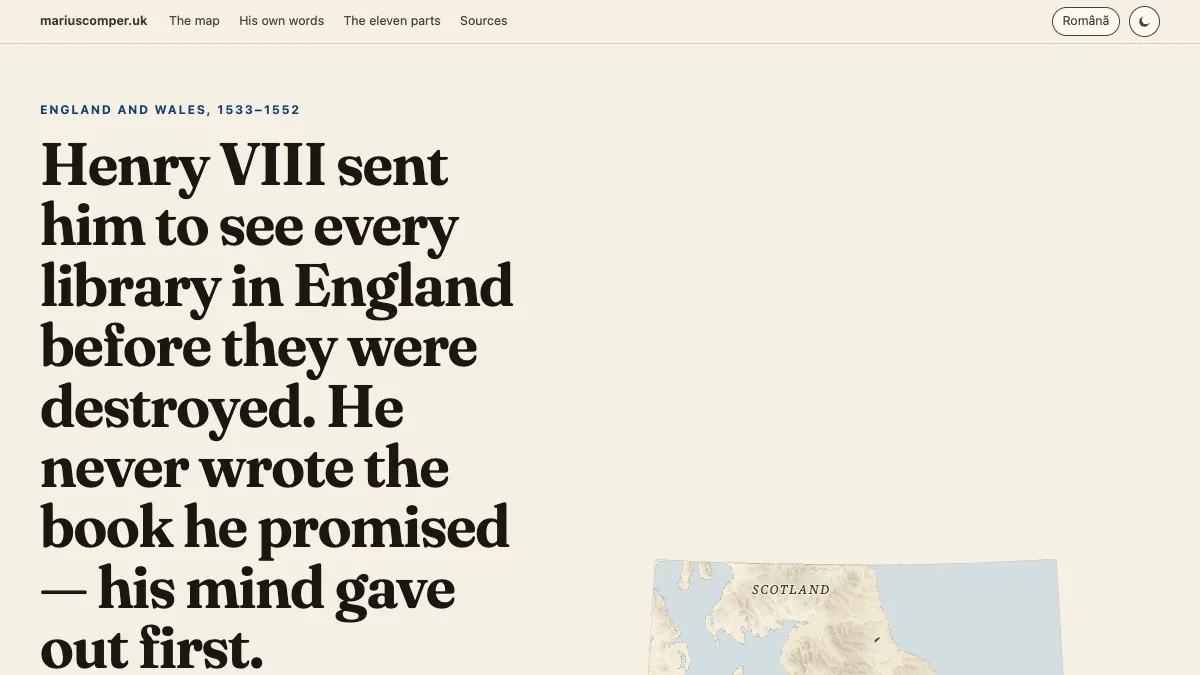
John Leland spent a decade travelling England and Wales on a royal commission and a thousand questions. He filled 11 notebook Parts. His mind was failing by 1547, and the promised book was never written.
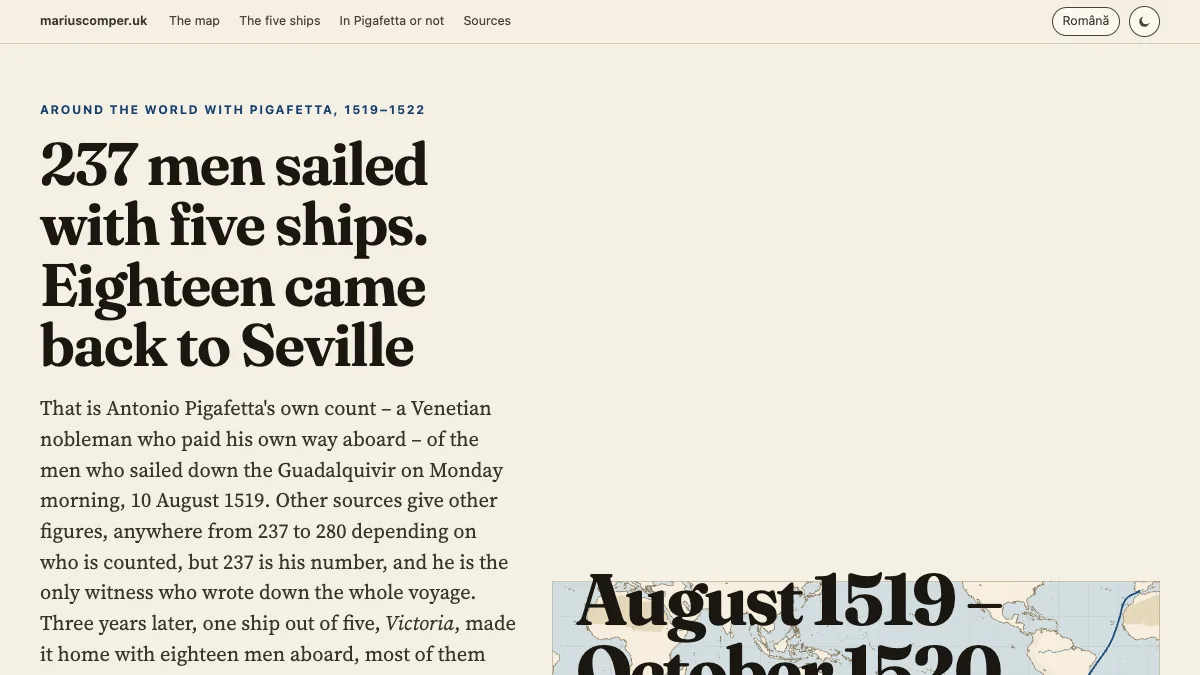
Antonio Pigafetta wrote down the whole voyage: the strait, the starvation in the Pacific, Magellan's death at Mactan, the day lost at the date line. The only complete eyewitness account of the first circumnavigation, on the map.
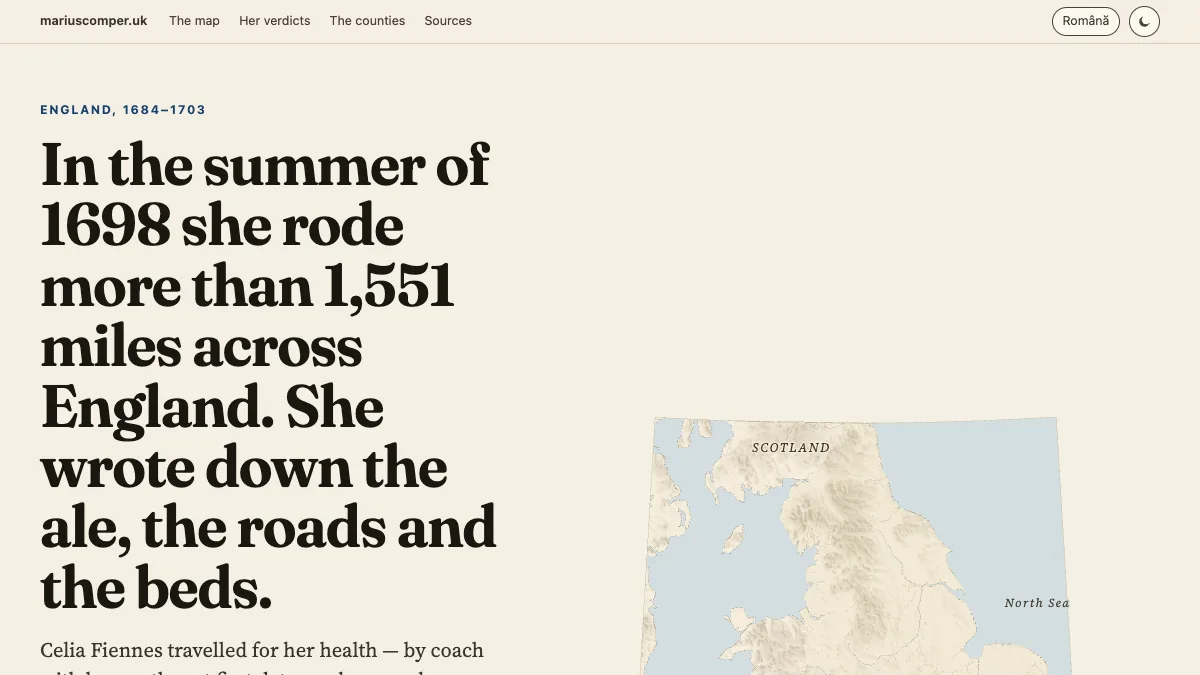
Celia Fiennes travelled for her health, by coach at first and later on her own horses. Her own journal puts her in 39 of England's 40 historic counties, all but Monmouthshire.
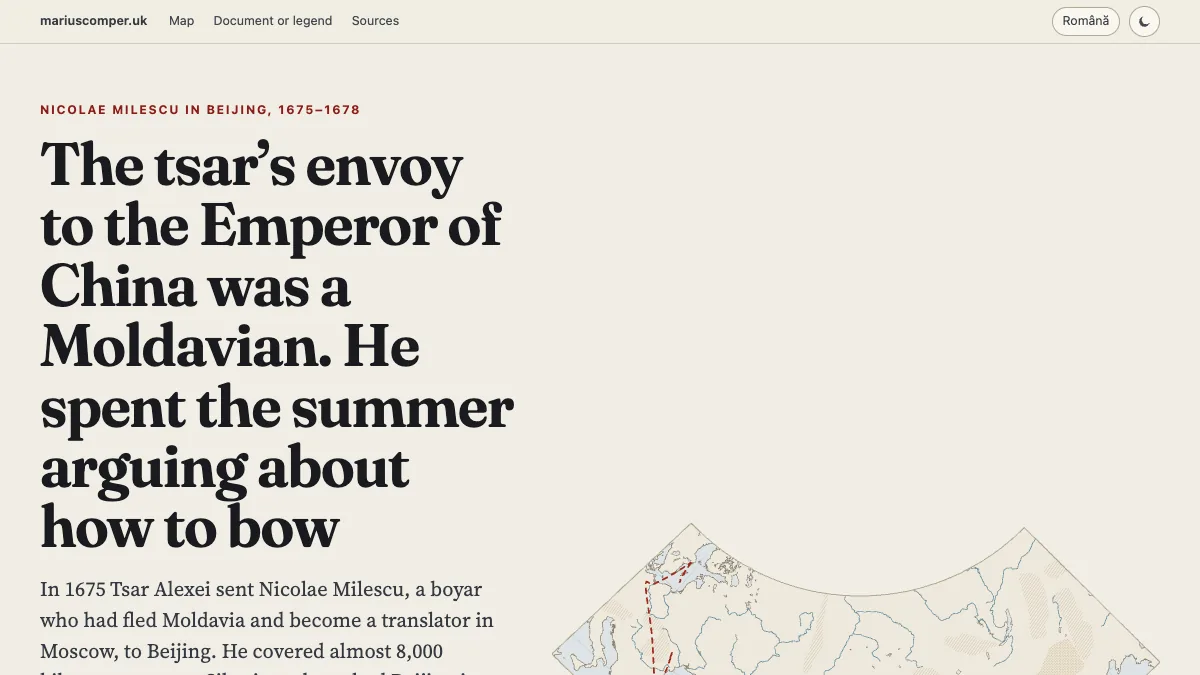
Nicolae Milescu crossed Siberia and reached Beijing in 1676. He spent the summer arguing about how to bow, and went home without the emperor's letter.
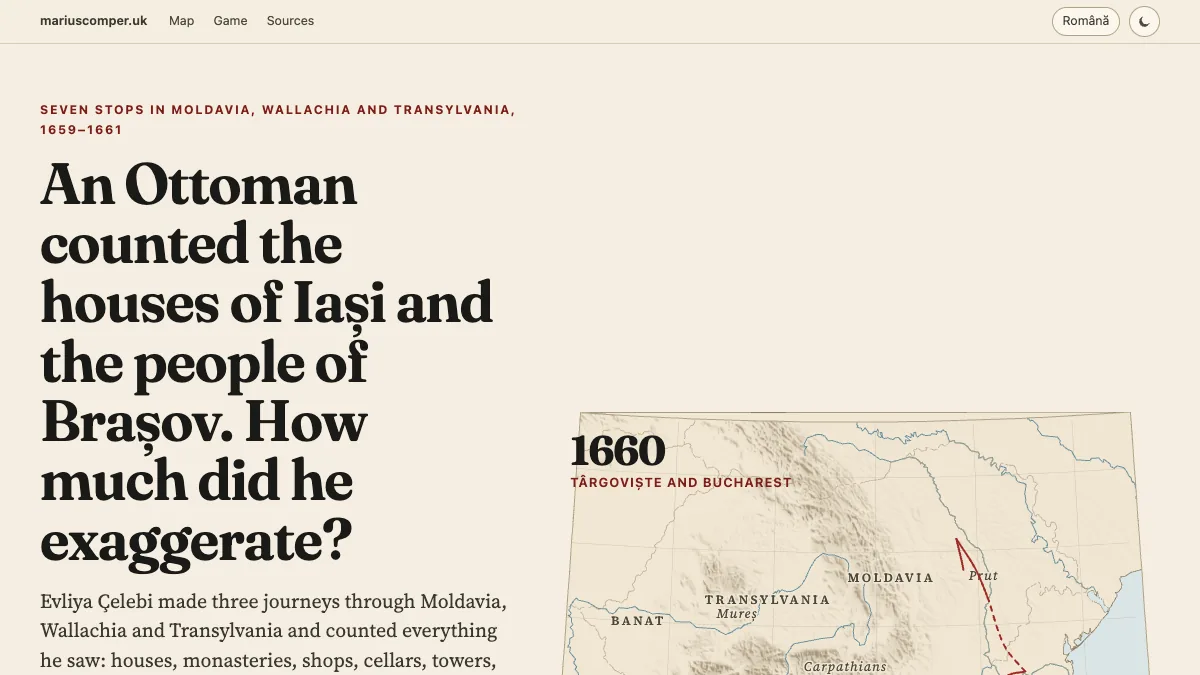
Evliya Çelebi wrote 20,000 houses in Iași and 100,000 people inside Brașov. Here is what the other counts say.
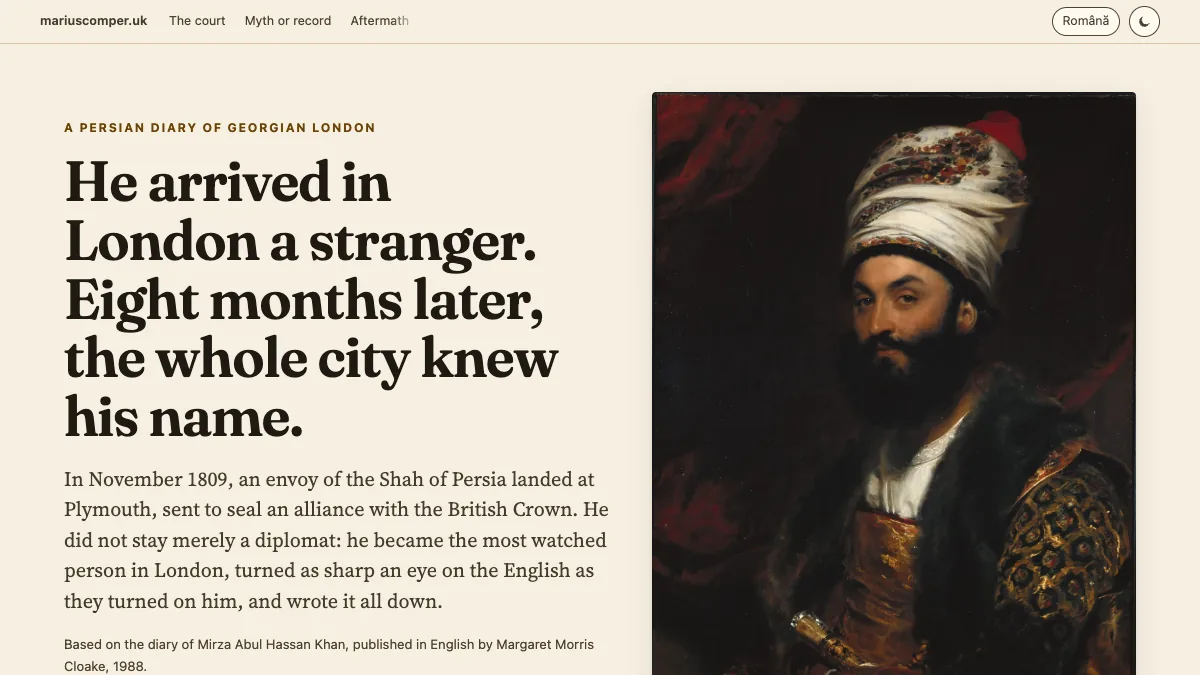
The diary of Mirza Abul Hassan Khan, the Persian envoy who conquered — and sharply judged — London in 1810.
15 December: the parish vigil in Timișoara; 25 December: the firing squad in the Târgoviște barracks. Twelve days, each with an archival citation. Six death tolls side by side, three episodes in two versions, Romania only.
5 October 1949, the third recognition; 2 August 1969, Nixon talks China in Bucharest; 2004, the Ample Partnership; 2013, the joint declaration and the 16+1 summit. Eleven markers, each with a source; trade totals live on the Dashboard.
A viral comment says Golescu was Greek and turned Romanian to save his skin. We test all 7 claims, document by document, with pages from his 1826 book.
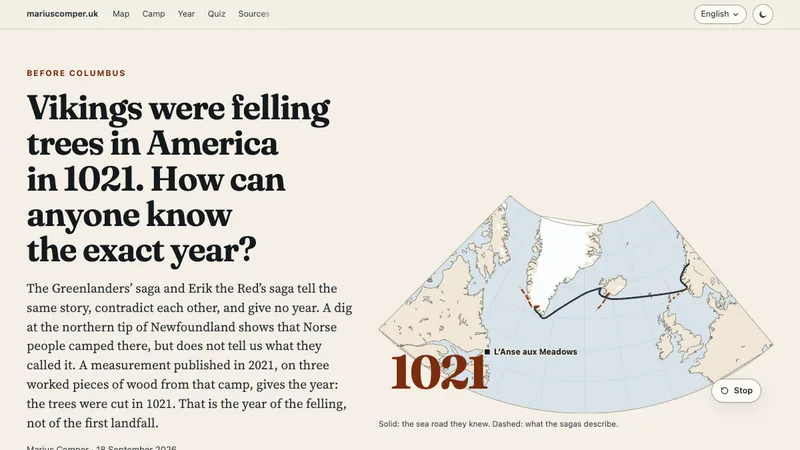
The Greenlanders' saga and Erik the Red's saga tell the same story, contradict each other, and give no year. A dig at the northern tip of Newfoundland shows that Norse people camped there, but does not tell us what they called it. A measurement published in 2021, on three worked pieces of wood from that camp, gives the year: the trees were cut in 1021.
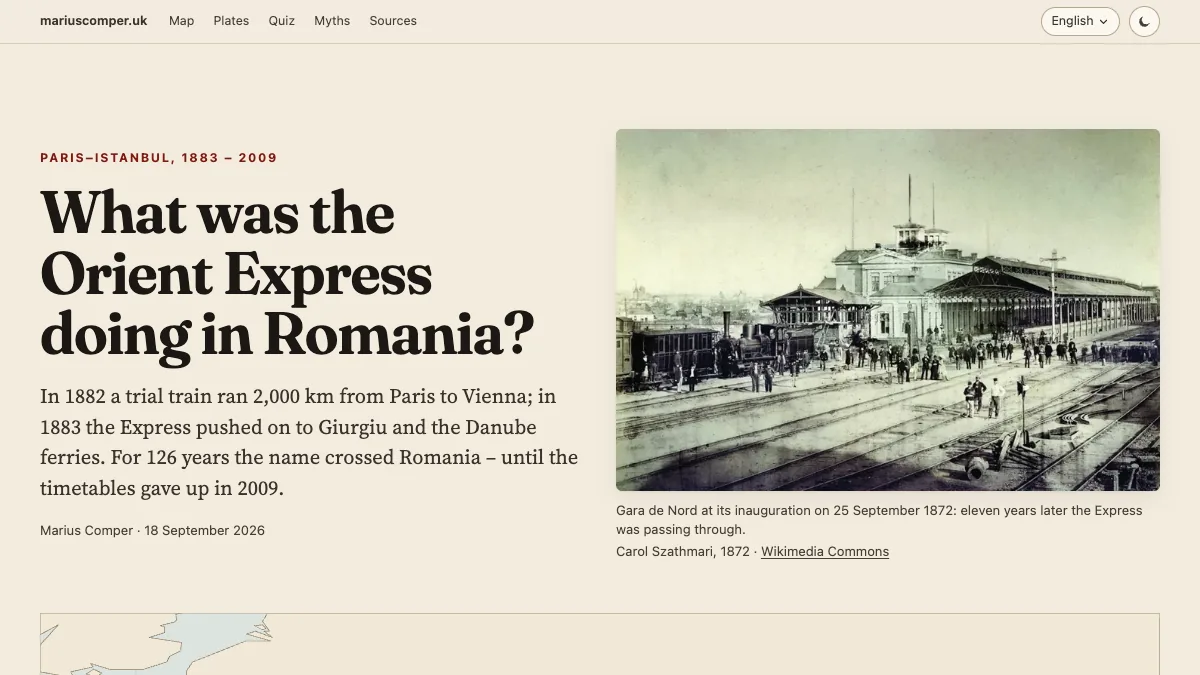
Giurgiu 1883, Bucharest sleepers, the 1977 farewell. Three lines to Istanbul and the Express's Romanian century.
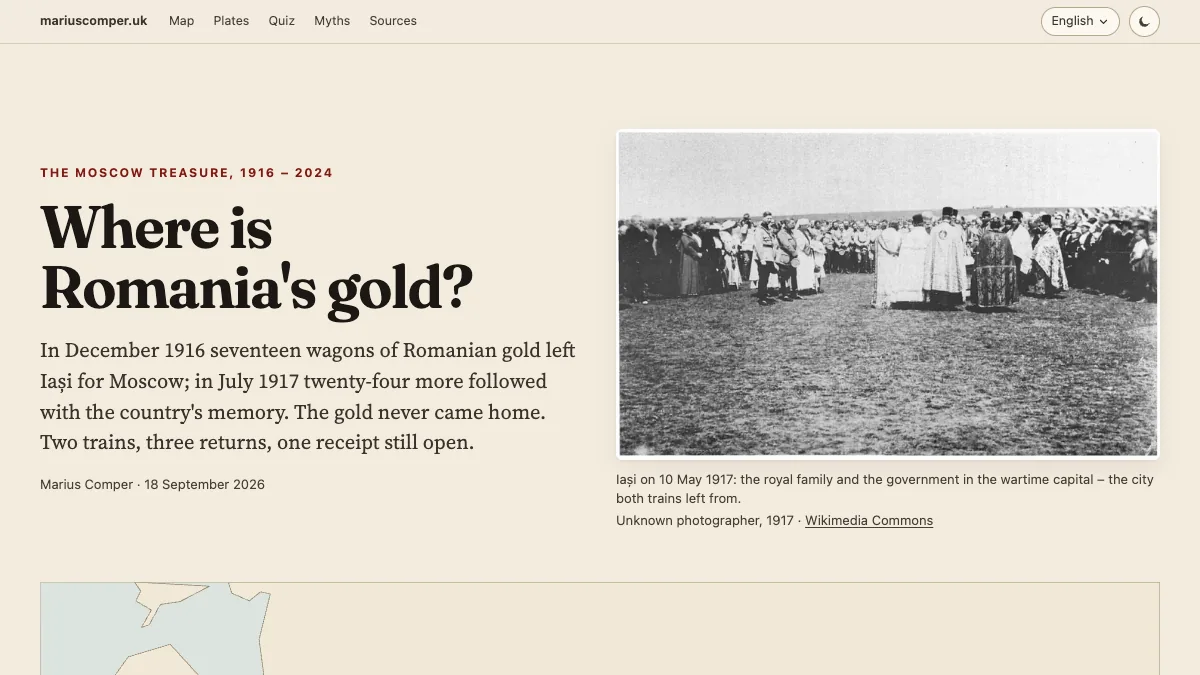
Two trains east in 1916–1917, three returns, none with gold. The treasure story with the protocols on the table.
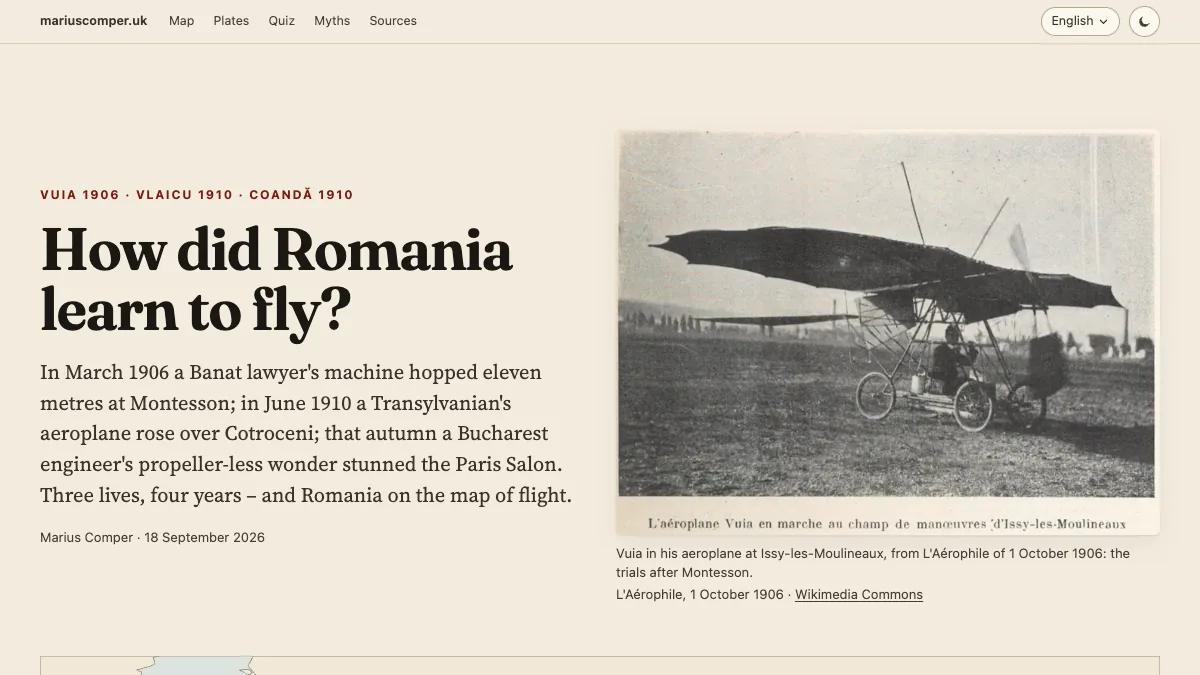
The Montesson hop, the Cotroceni flights and the propeller-less Salon machine. Three lives, four years – Romania on the map of flight.
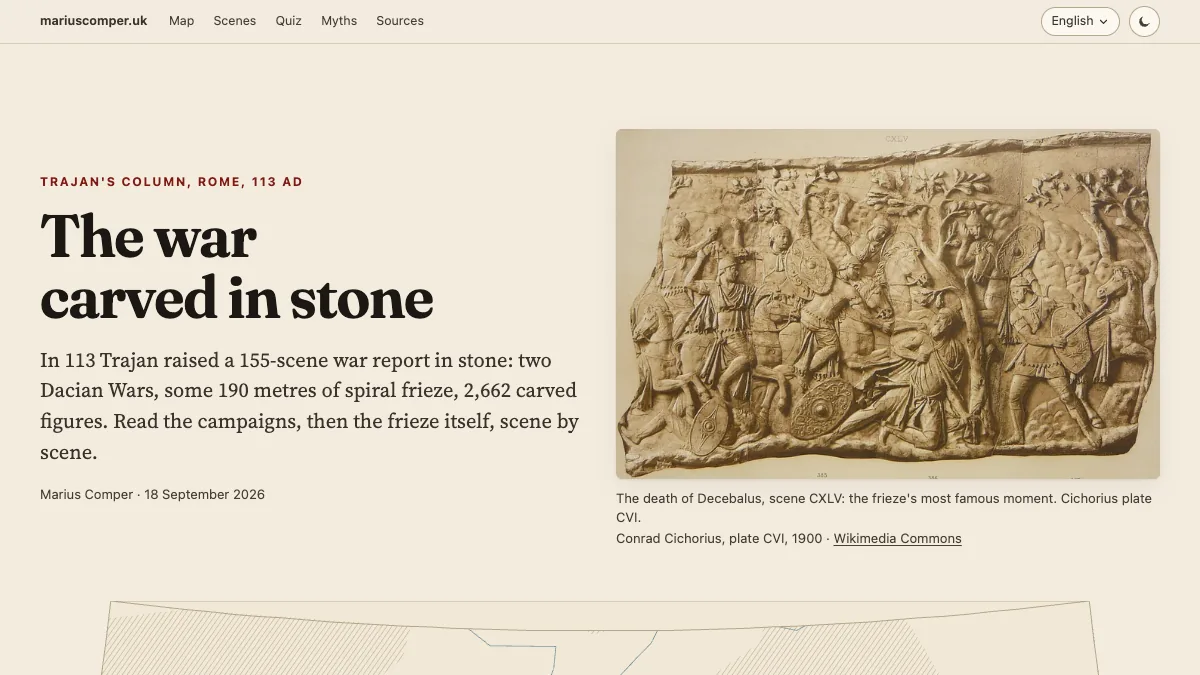
155 scenes of the Dacian Wars in a 190-metre spiral. Read the campaigns, then the frieze itself, scene by scene.
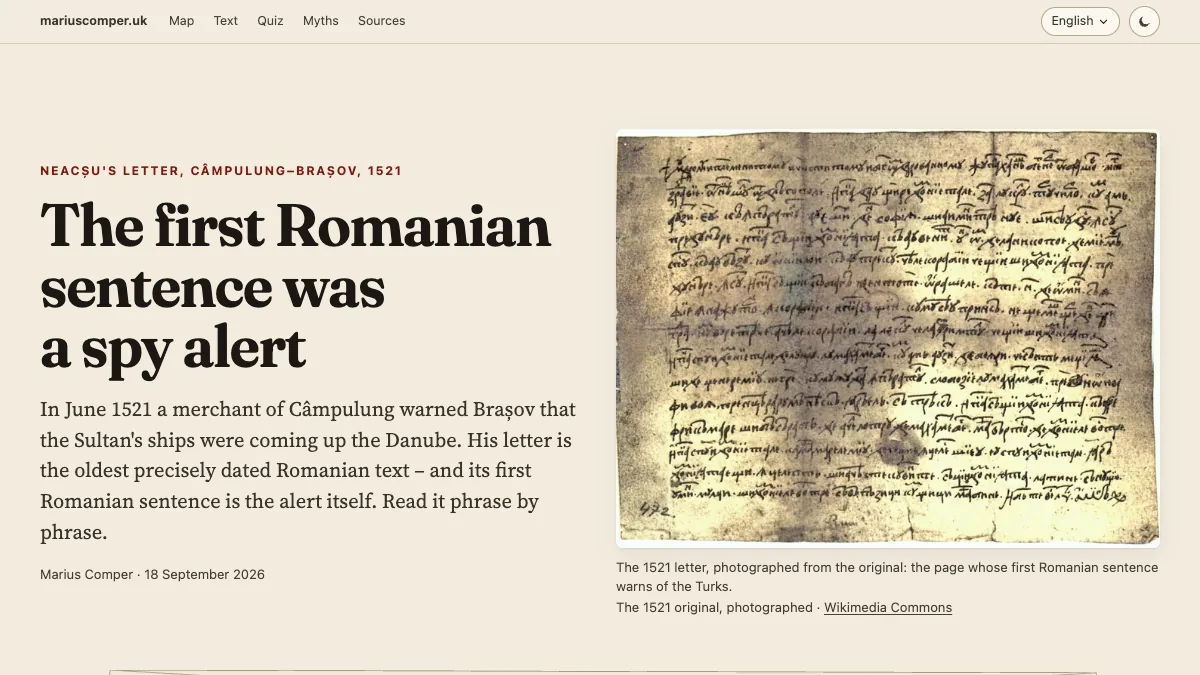
The oldest precisely dated Romanian text is a spy warning from Câmpulung to Brașov. Read it phrase by phrase, with renderings.
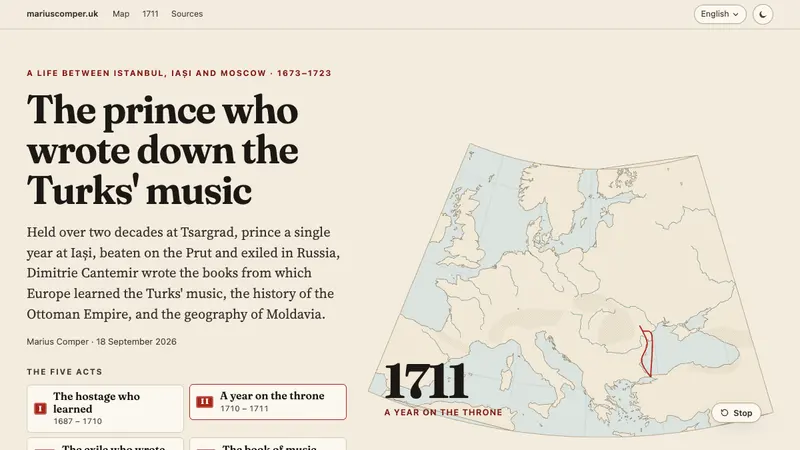
Hostage at Tsargrad, prince one year at Iași, beaten at Stănilești, exiled in Russia: Dimitrie Cantemir's life, with his music notation to try and a game of the 1711 decisions.
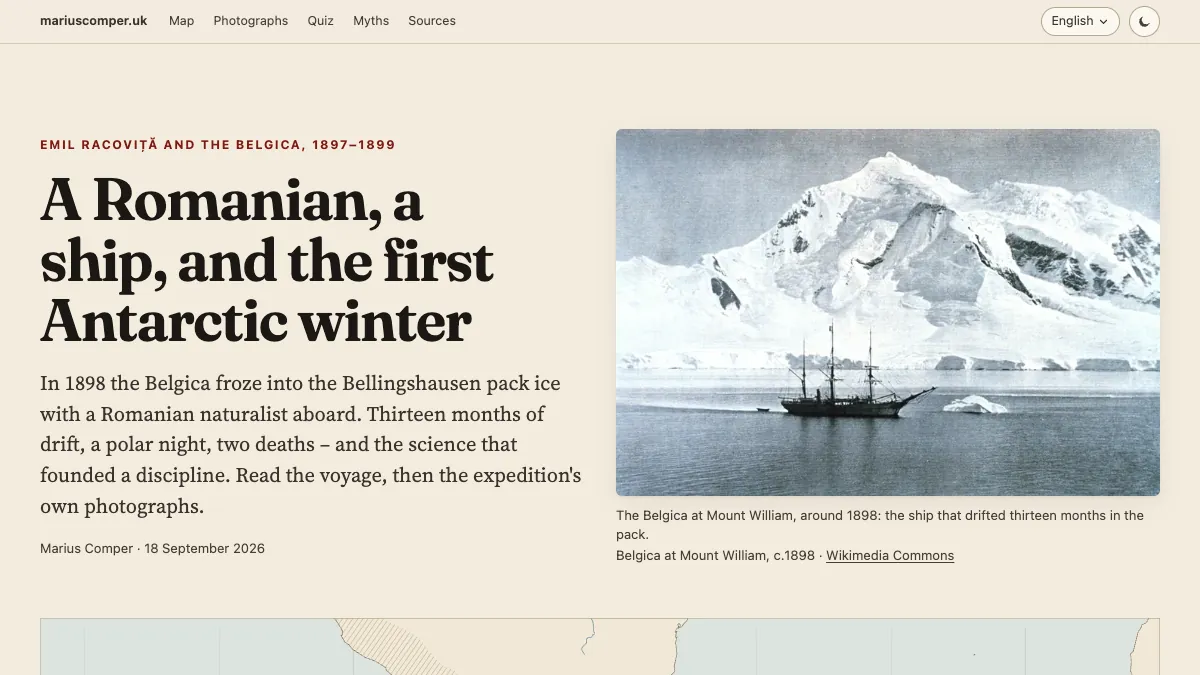
Thirteen months frozen in Antarctic ice. Read the Belgica voyage, then the expedition's photographs.
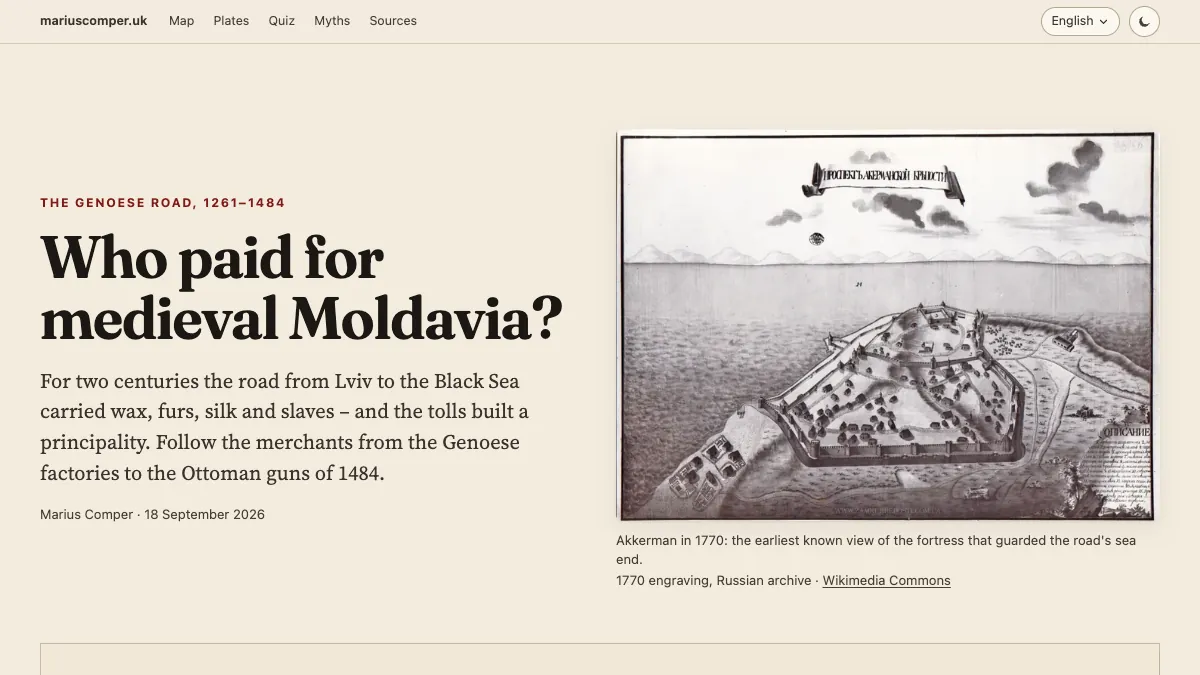
Two centuries of tolls from Lviv to Caffa. Read the road, then its period plates.
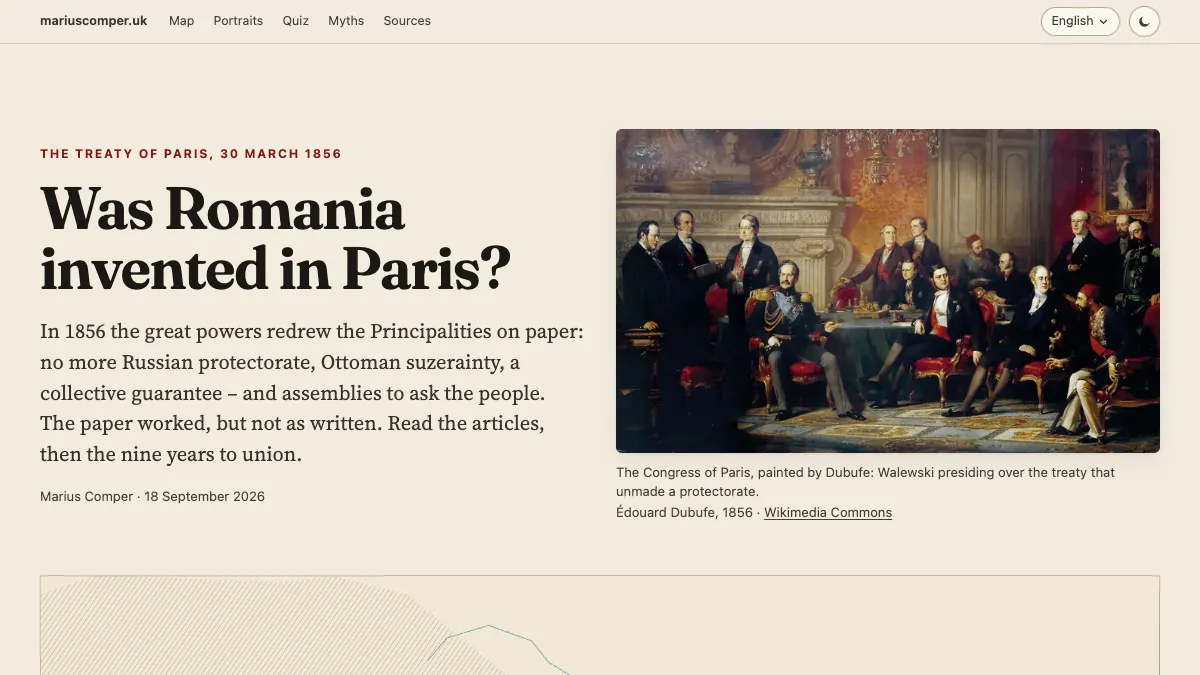
The articles that unmade a protectorate and started a union. Read the treaty, then the portraits.
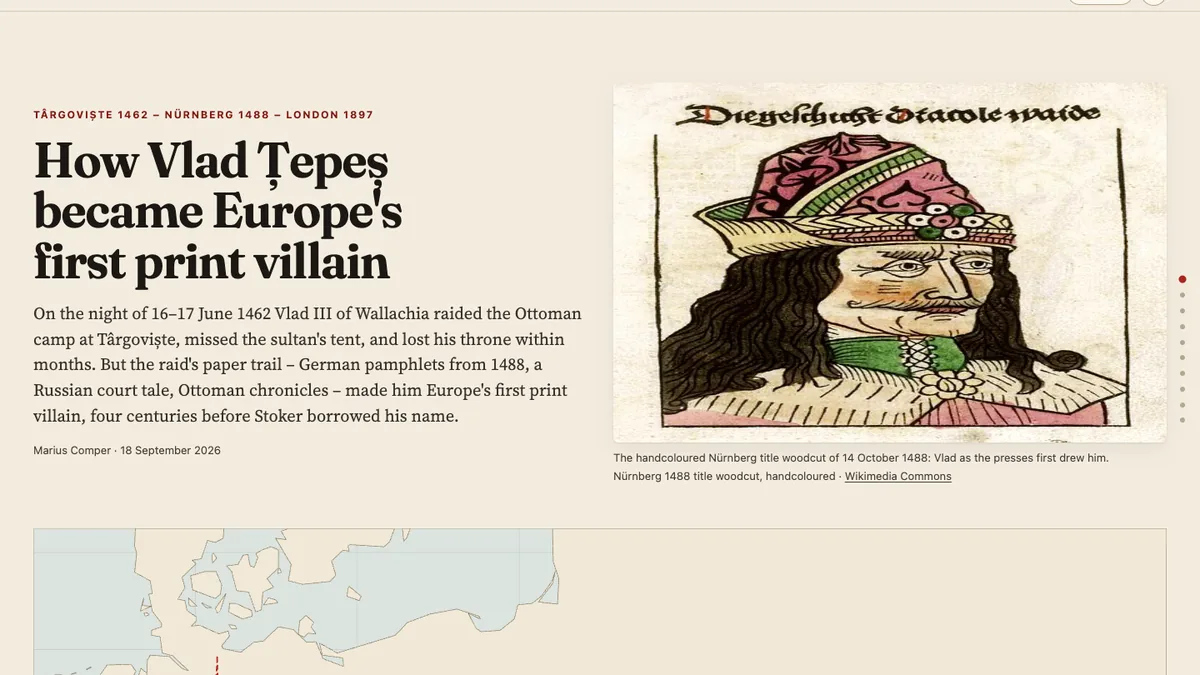
The 1462 Night Attack, the 1488 German pamphlets, the Russian tale and the Ottoman chronicles. The raid and the paper trail of Europe's first print villain.
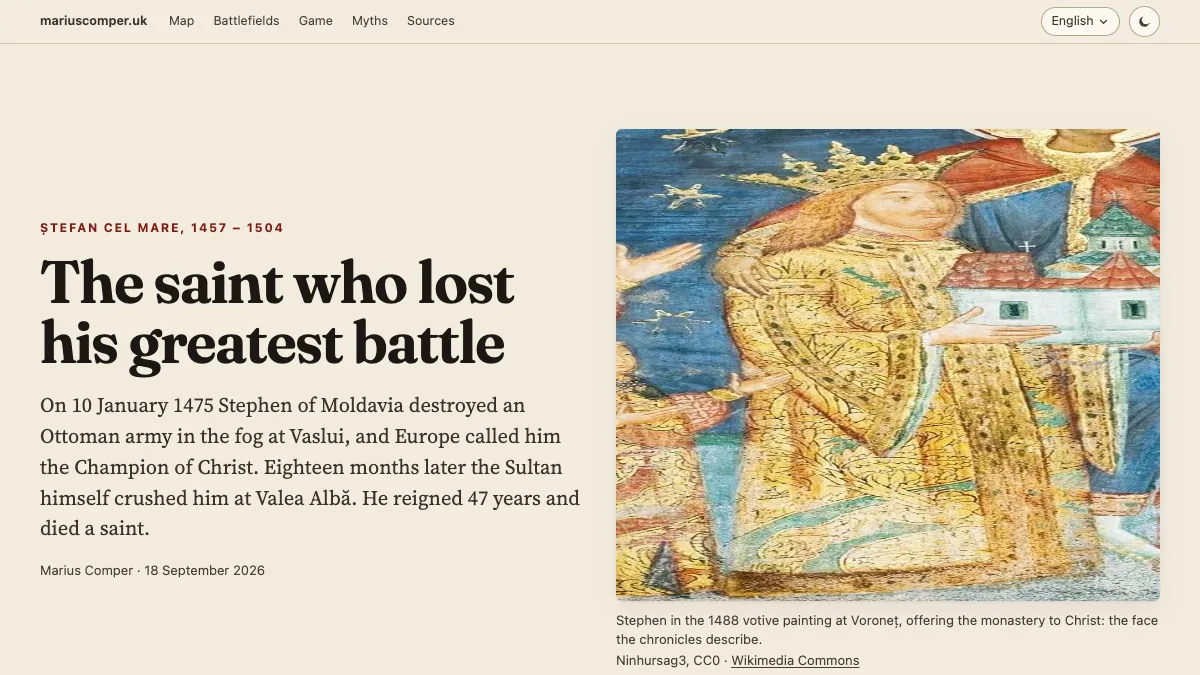
Vaslui 1475, Valea Albă 1476, Putna 1504. Two battlefields at the same scale and the saint who reigned 47 years.
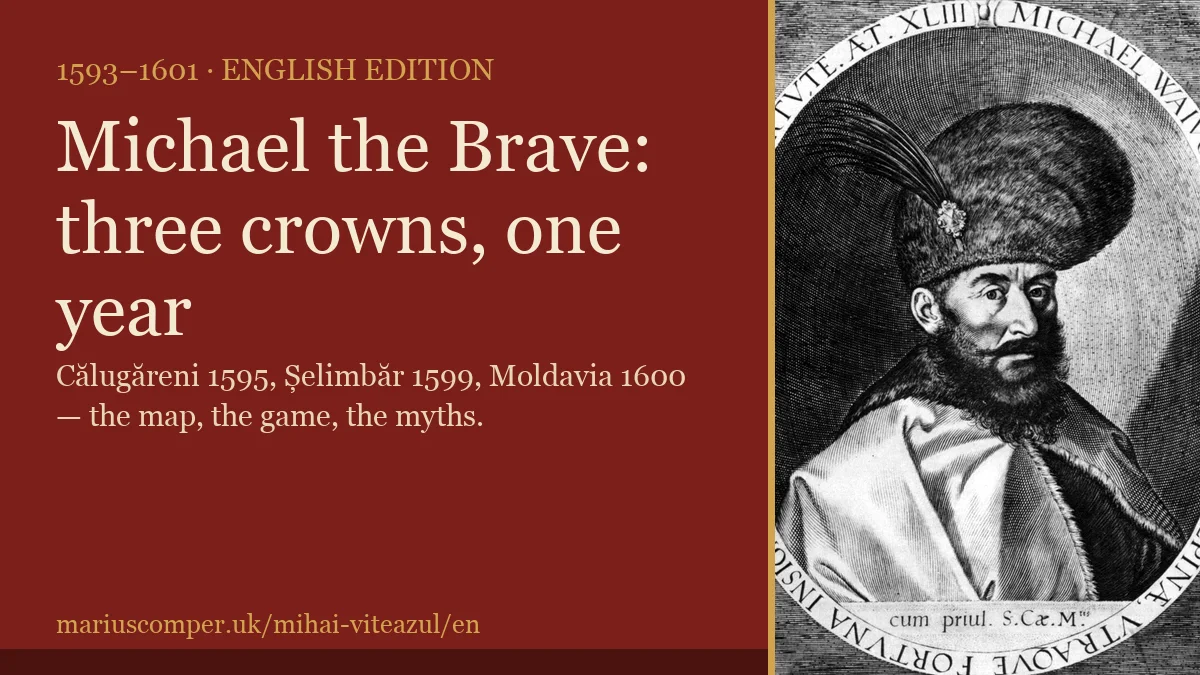
Călugăreni 1595, Șelimbăr 1599, Moldavia 1600. Three campaigns on one map, and the treasury that emptied first.
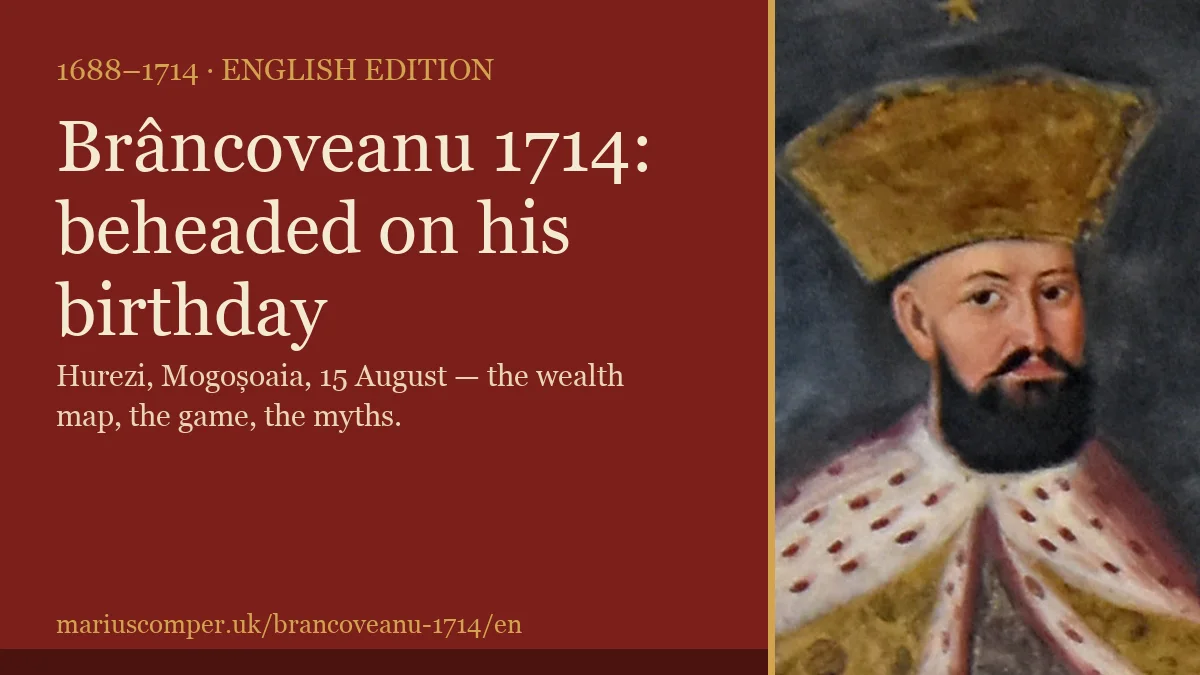
Hurezi 1697, Mogoșoaia 1702, the 1714 scaffold. 26 years of building and the fortune that killed him, on one map.
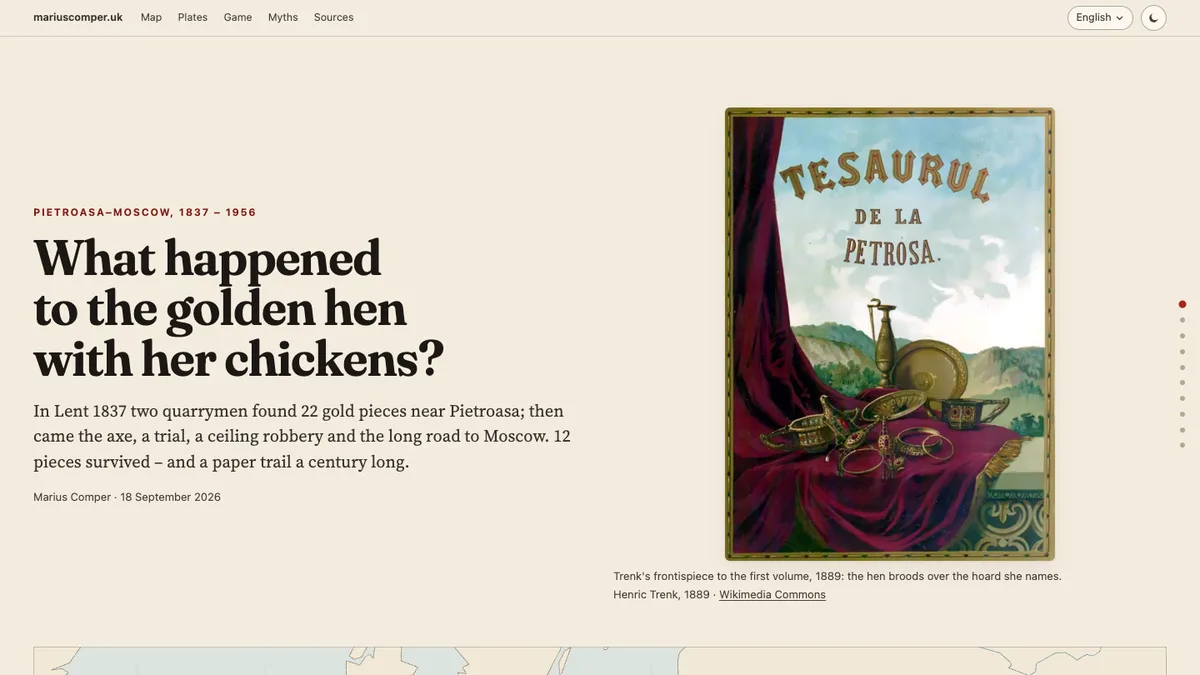
Lent 1837, the 1875 ceiling robbery, Moscow 1917–1956. Twelve pieces survived of twenty-two – and a paper trail a century long.
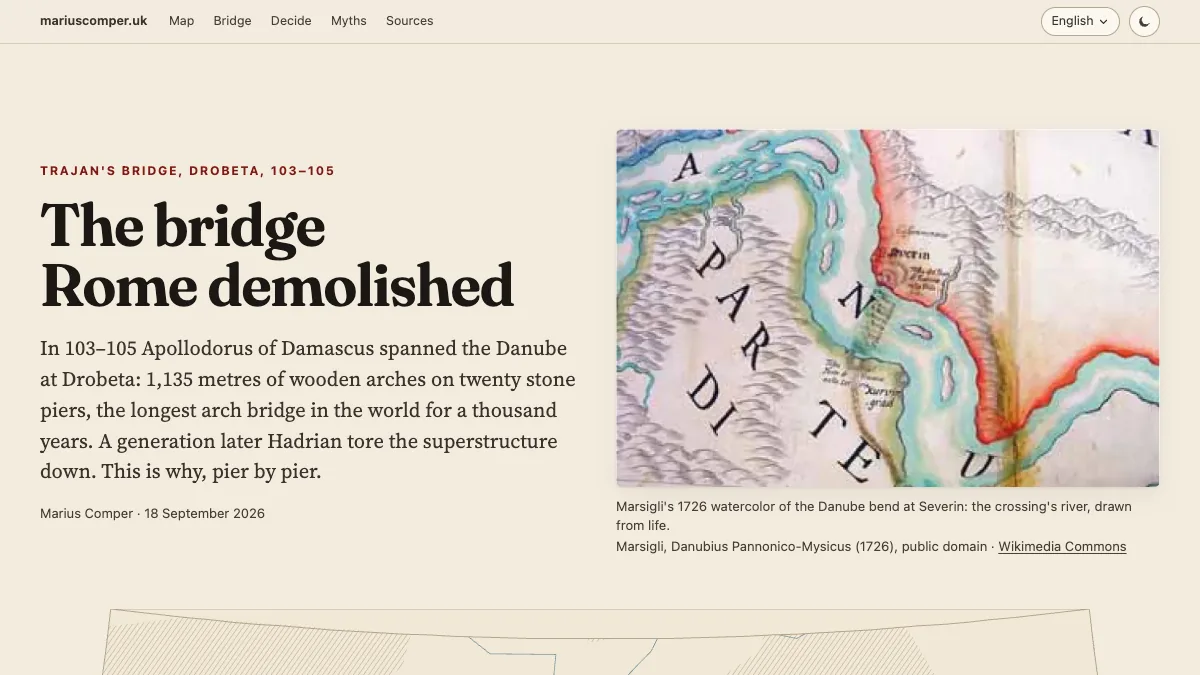
Apollodorus spans the Danube at Drobeta: 1,135 metres on twenty piers, the world's longest arch bridge. A generation later Hadrian removes the timber superstructure.
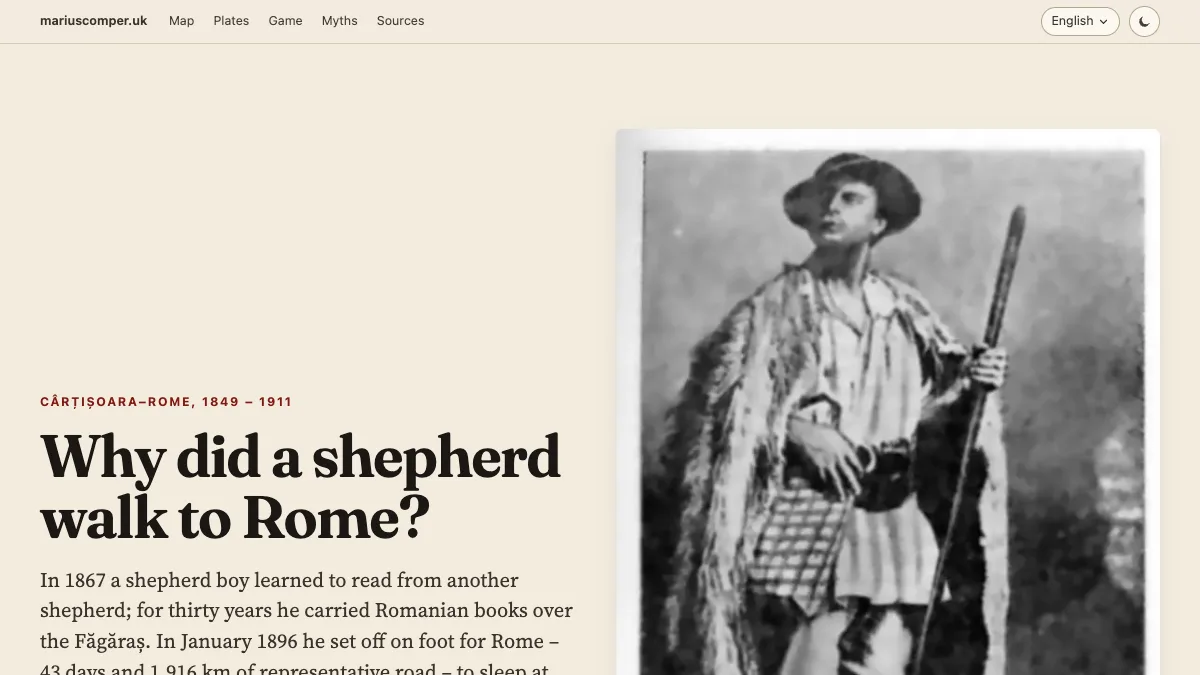
Cârțișoara 1849, Rome 1896, Sinaia 1911: the shepherd who carried a library over the mountains, then walked 43 days to Trajan's Column.
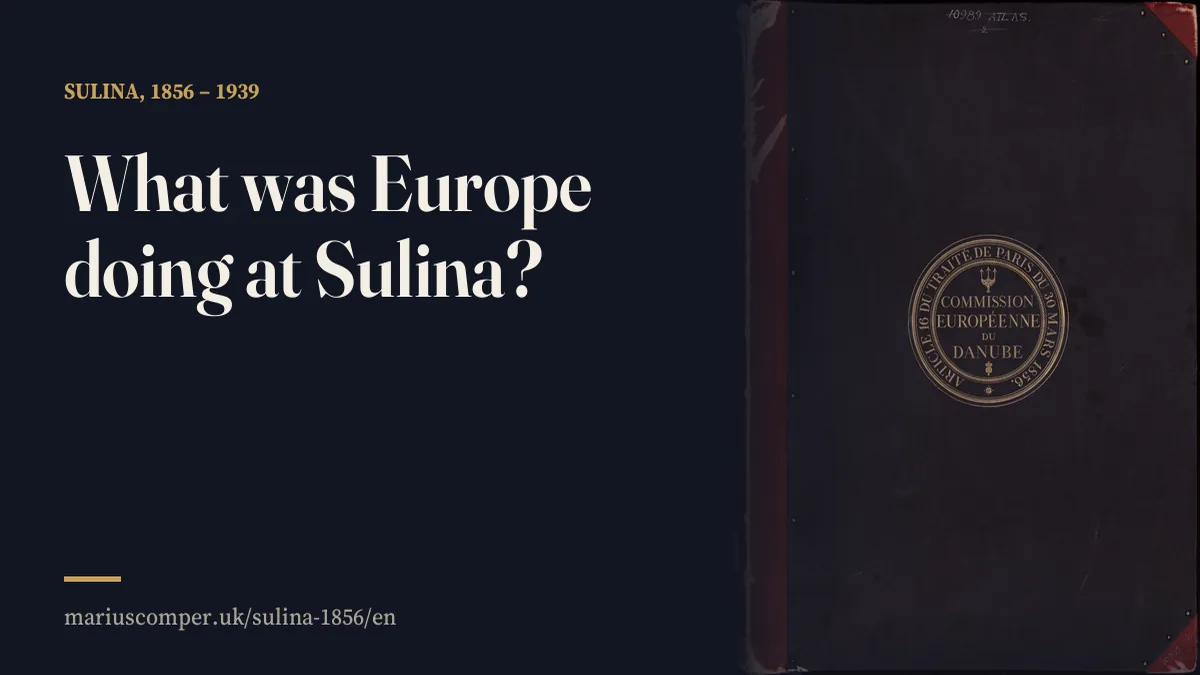
Seven powers, 82 years, the bar from 9 to 24 feet. The European Commission of the Danube and its Sulina enclave.
Dacia 106, the 587 shout, Neacșu 1521, Vienna 1780. A Romance language 1,137 km from Rome.
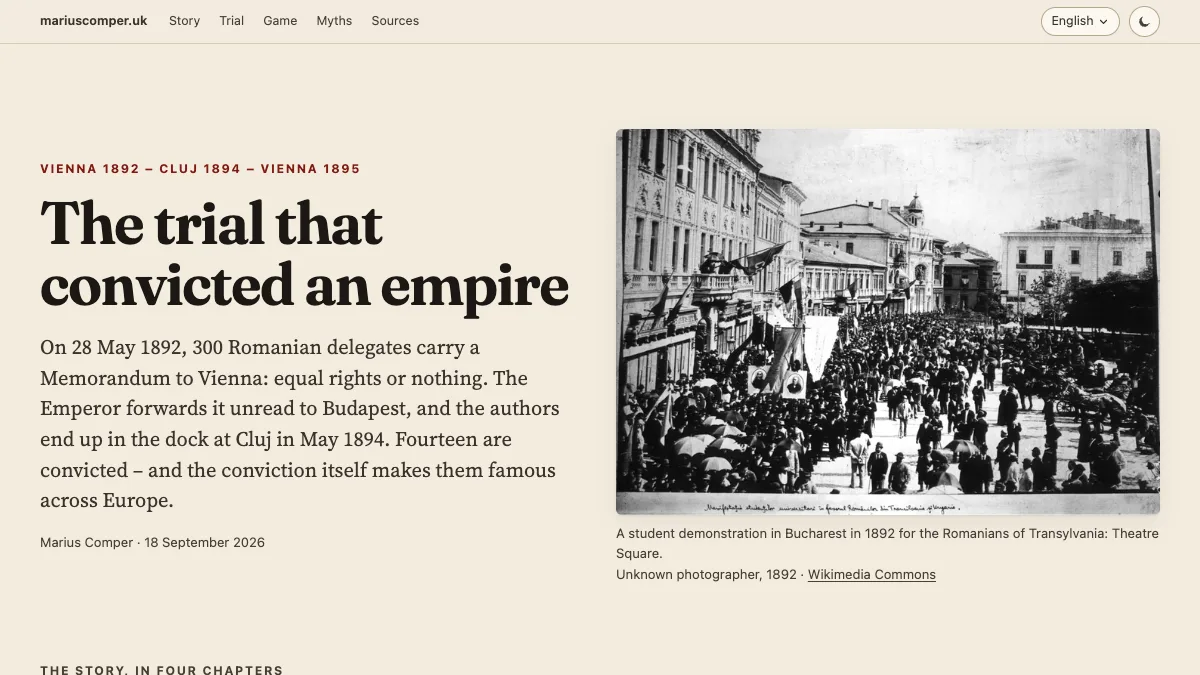
300 delegates in Vienna, an unopened envelope, 14 convictions in Cluj: the petition that lost in court and won in Europe's press.
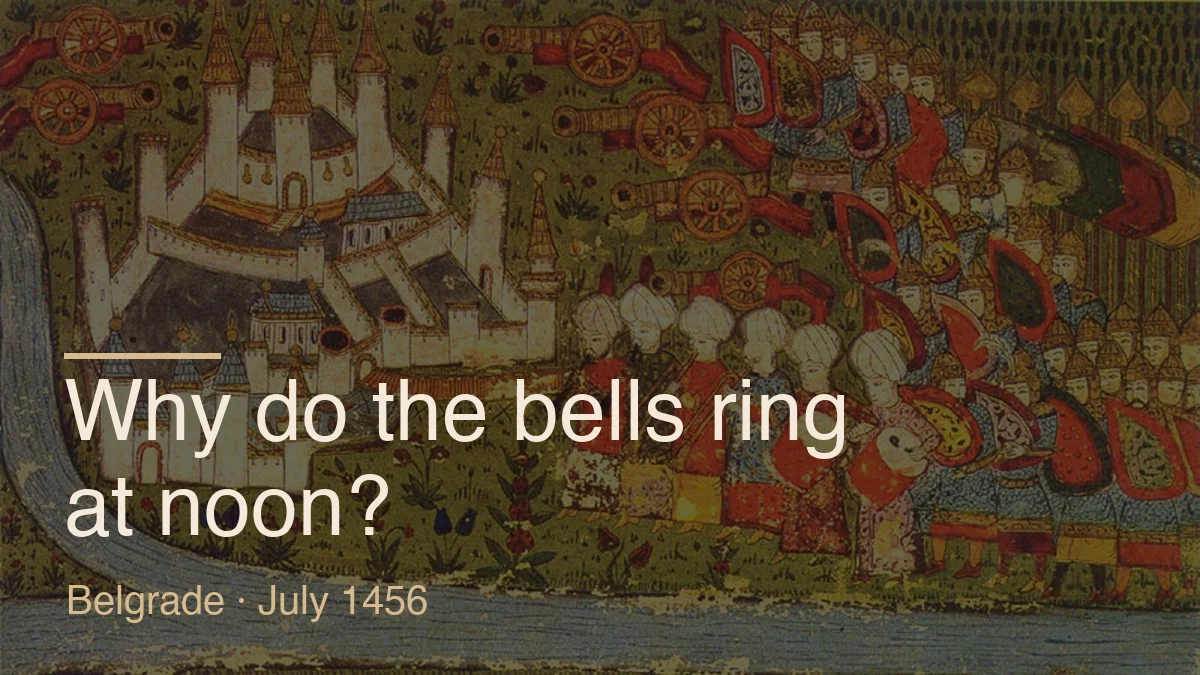
July 1456: Hunyadi and Capistrano hold Belgrade against Mehmed II — and the noon bells had already been ordered.
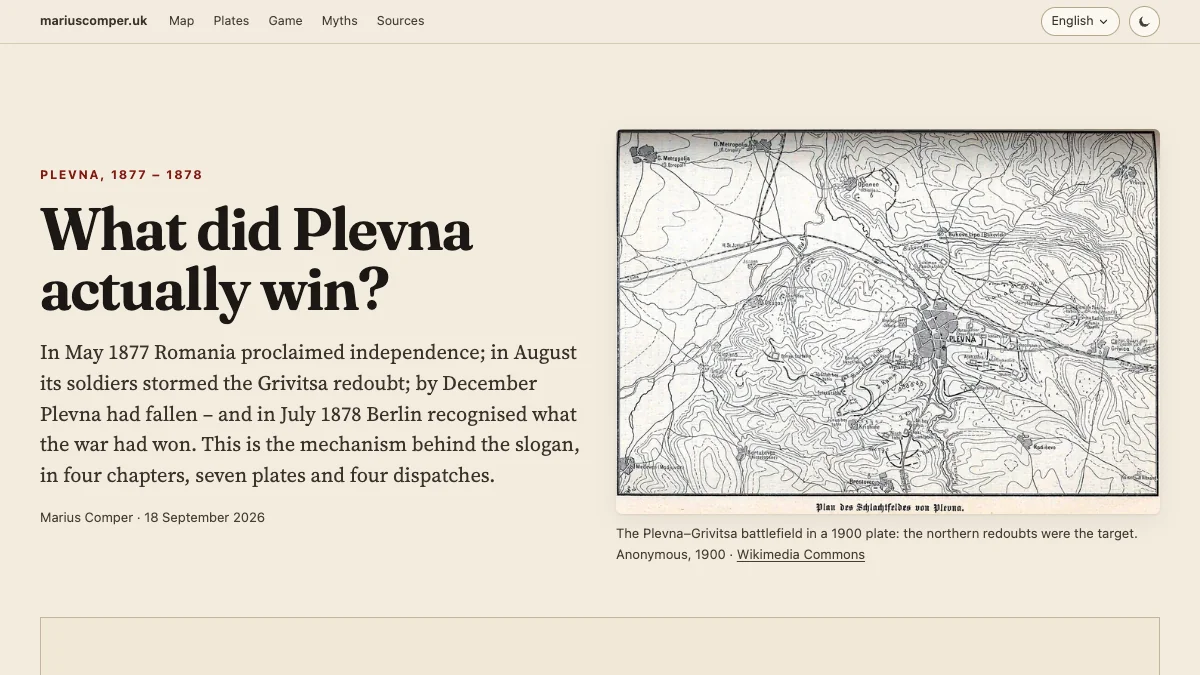
May 1877, Grivitsa 30 August, MacGahan's dispatches, Berlin 13 July 1878: the mechanism behind the independence slogan.
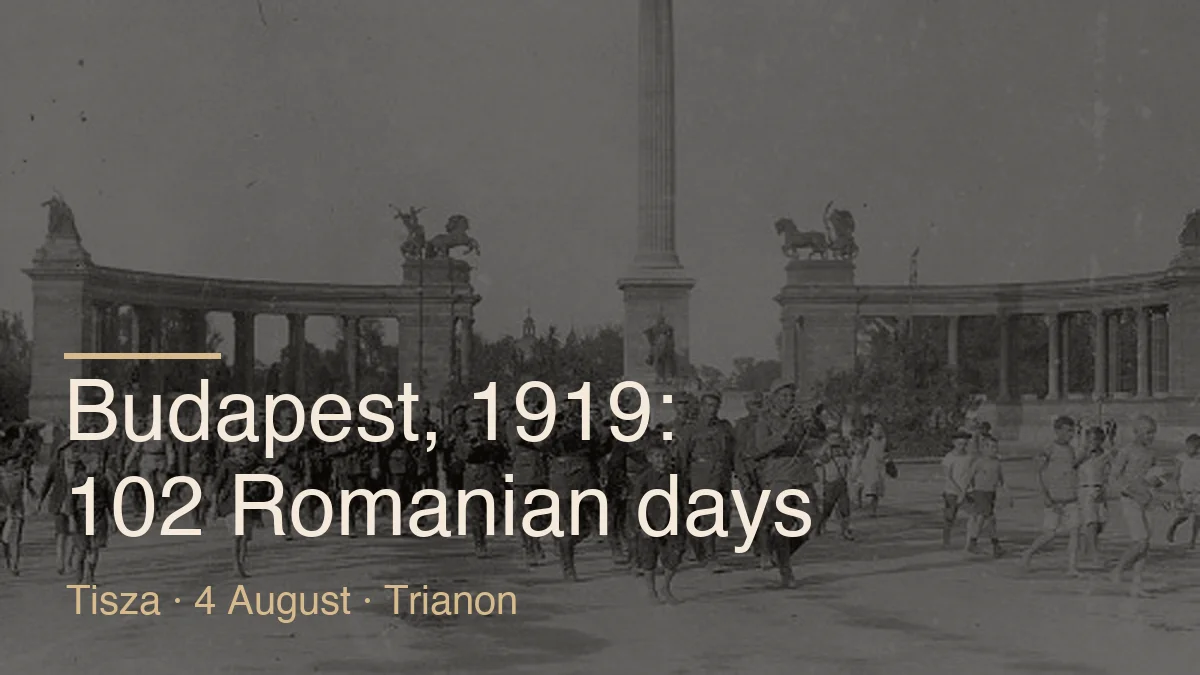
4 August – 14 November 1919: the Tisza crossing, the entry into Budapest, governing the city under Entente eyes, and the requisition ledger — the museum stopped, the palace checked, 3,000 wagons still owed in 1923.
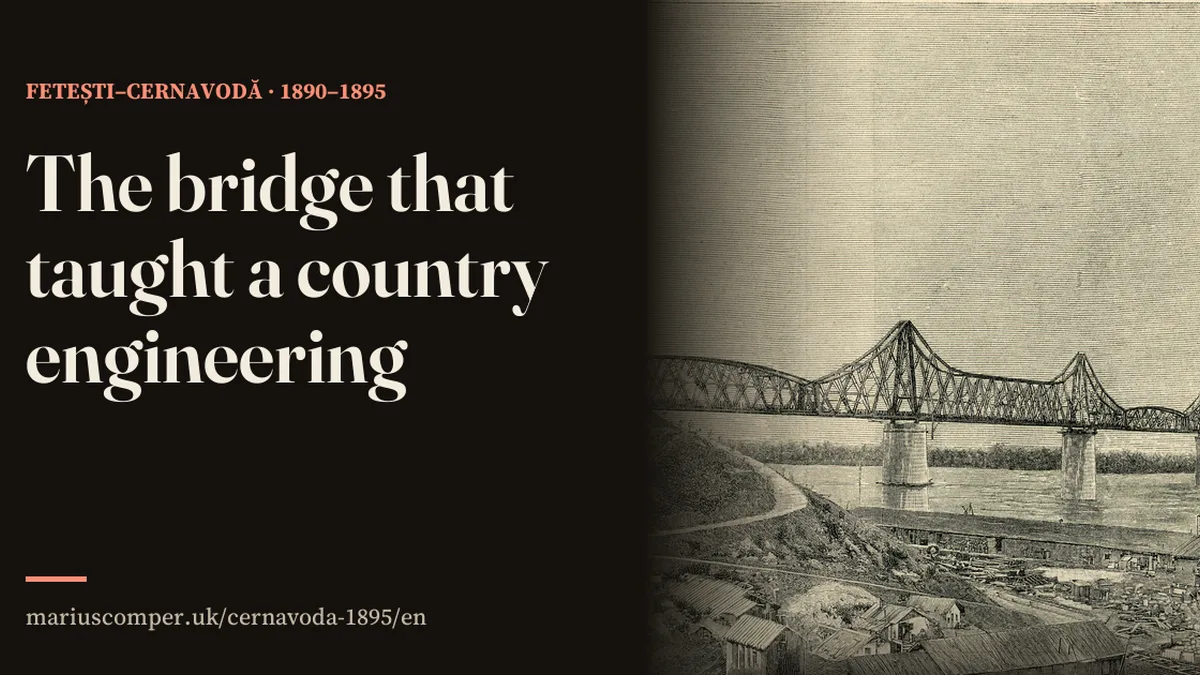
Fetești–Cernavodă 1890–95: Saligny, 4,087.95 metres, the longest bridge complex in Europe. Caissons, Gerber consoles, the silver rivet and the 15-locomotive test.
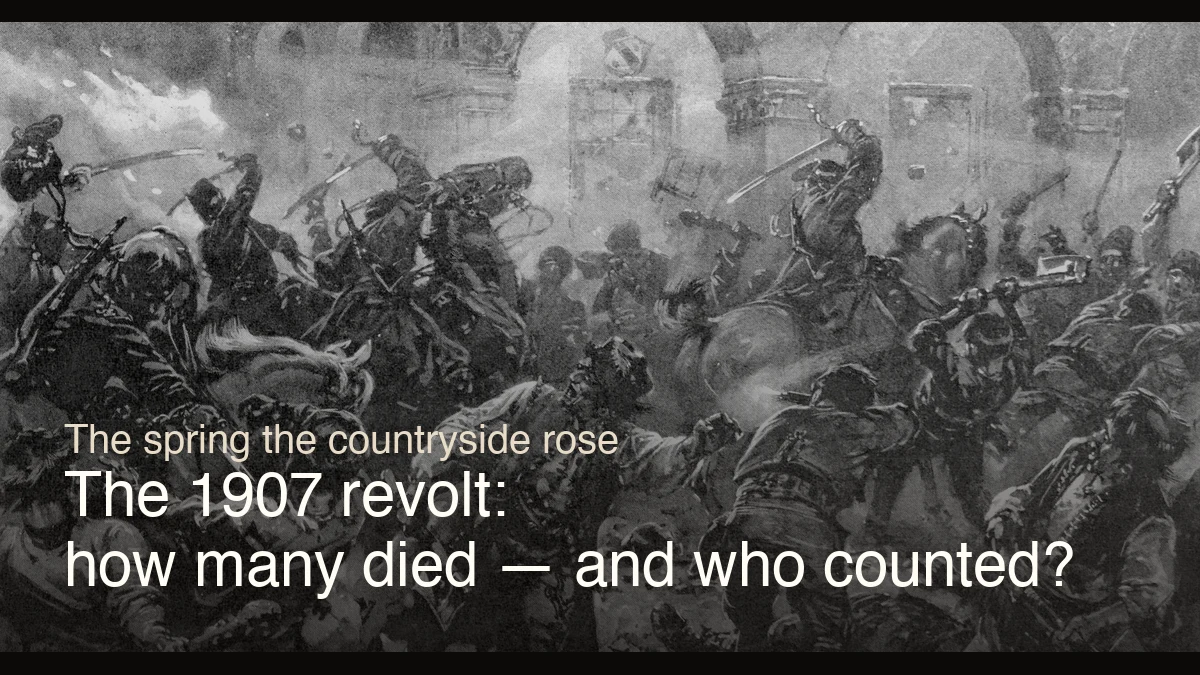
Flămânzi 8 February, the March wave, the April fire. A week-by-week spread map and the weighing of the numbers: where the 11,000 dead come from.
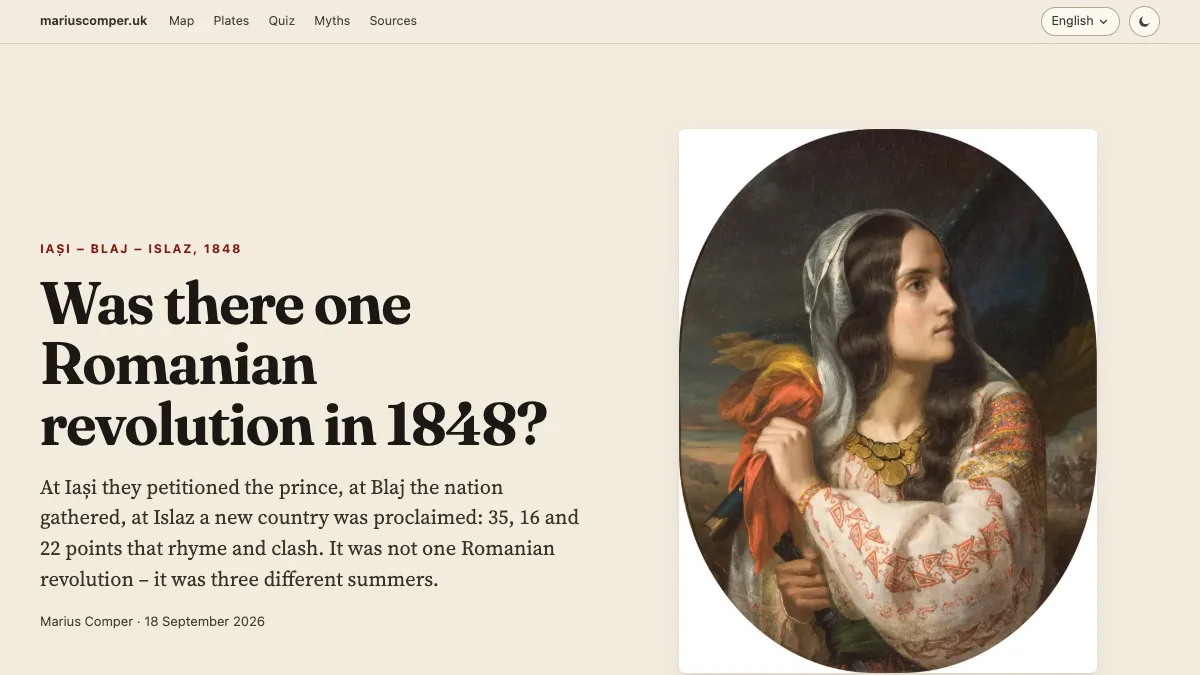
At Iași they petitioned the prince, at Blaj the nation gathered, at Islaz a new country was proclaimed: 35, 16 and 22 points face to face, on one map.
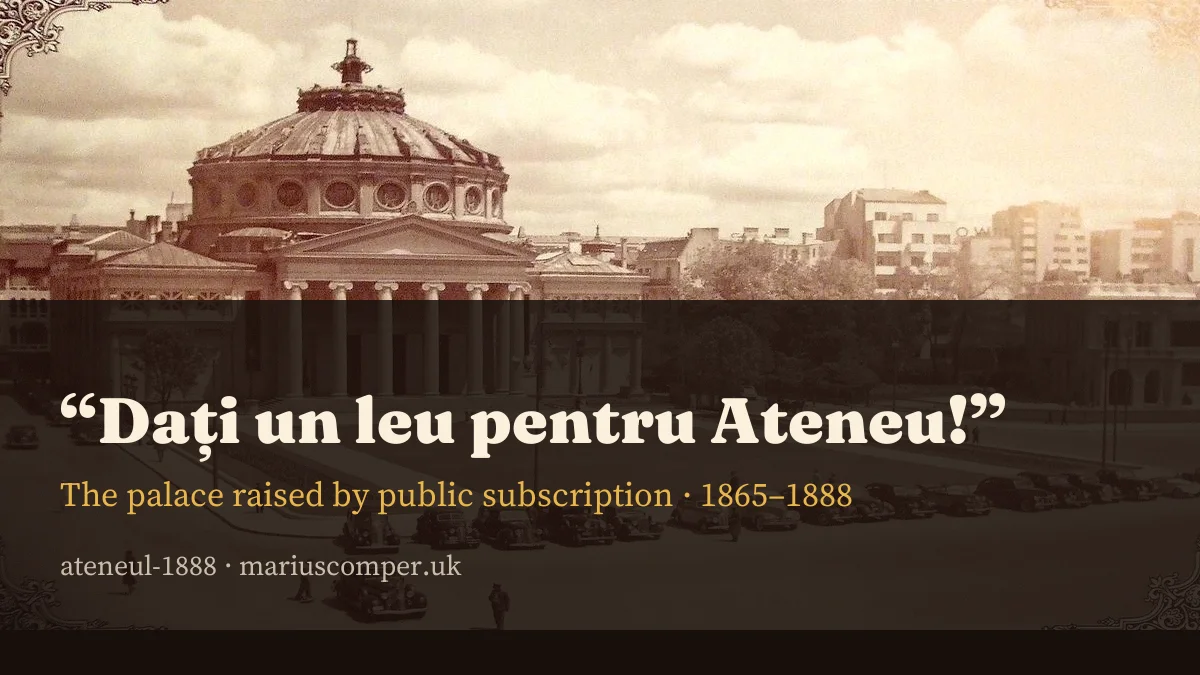
The palace raised by subscription: the 467,427.35-lei lottery, 221,858.65 lei of donations, and the 1887 accounts showing what the leu paid for.
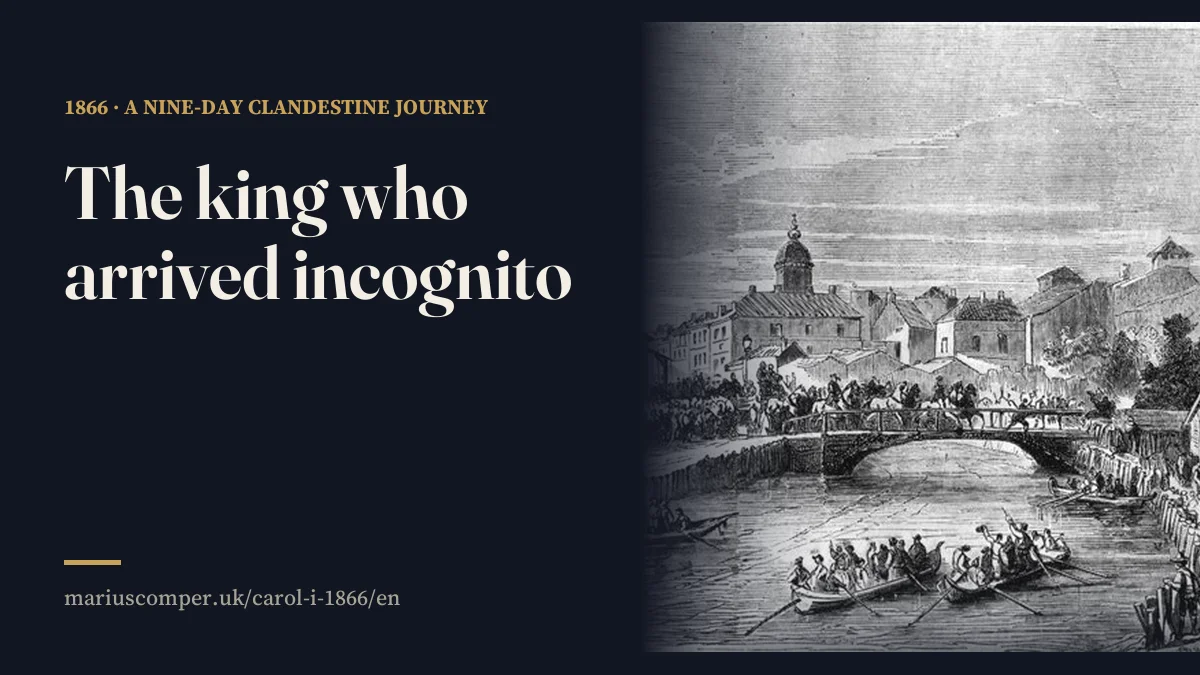
The Karl Hettingen passport, Salzburg customs, the 2 days stuck at Bazias. 17 checkpoints from Düsseldorf to the 22 May oath.
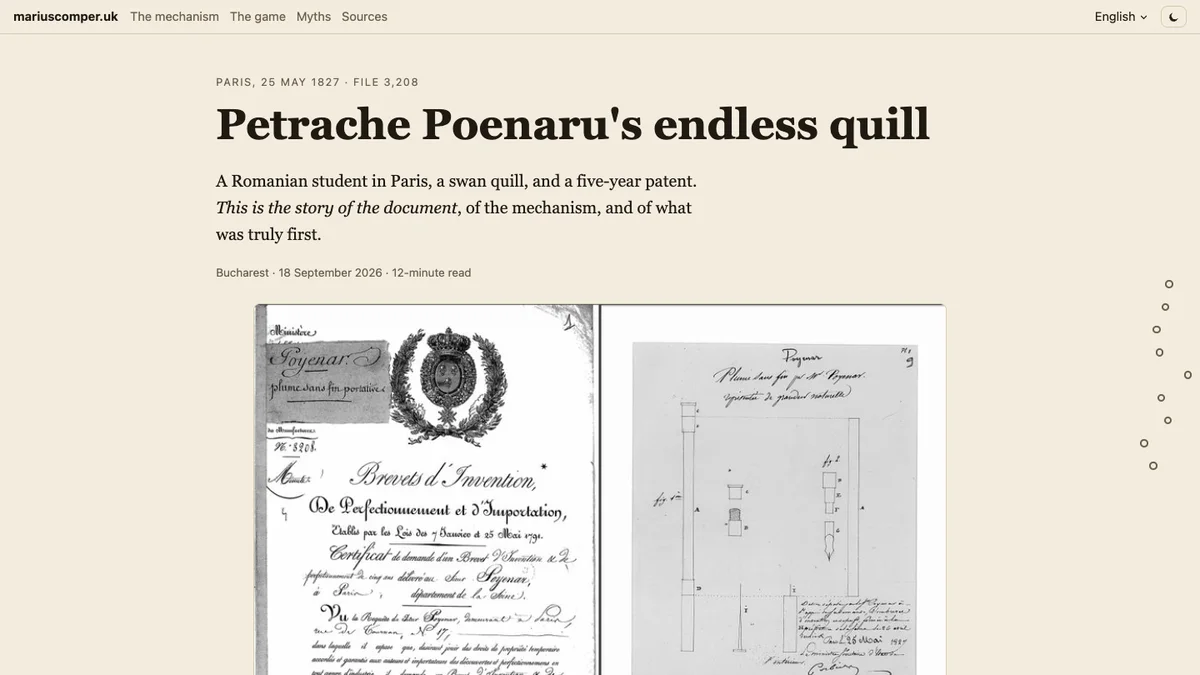
File 3208, 25 May 1827: the certificate, the plate, and the swan-quill pen mechanism, line by line.
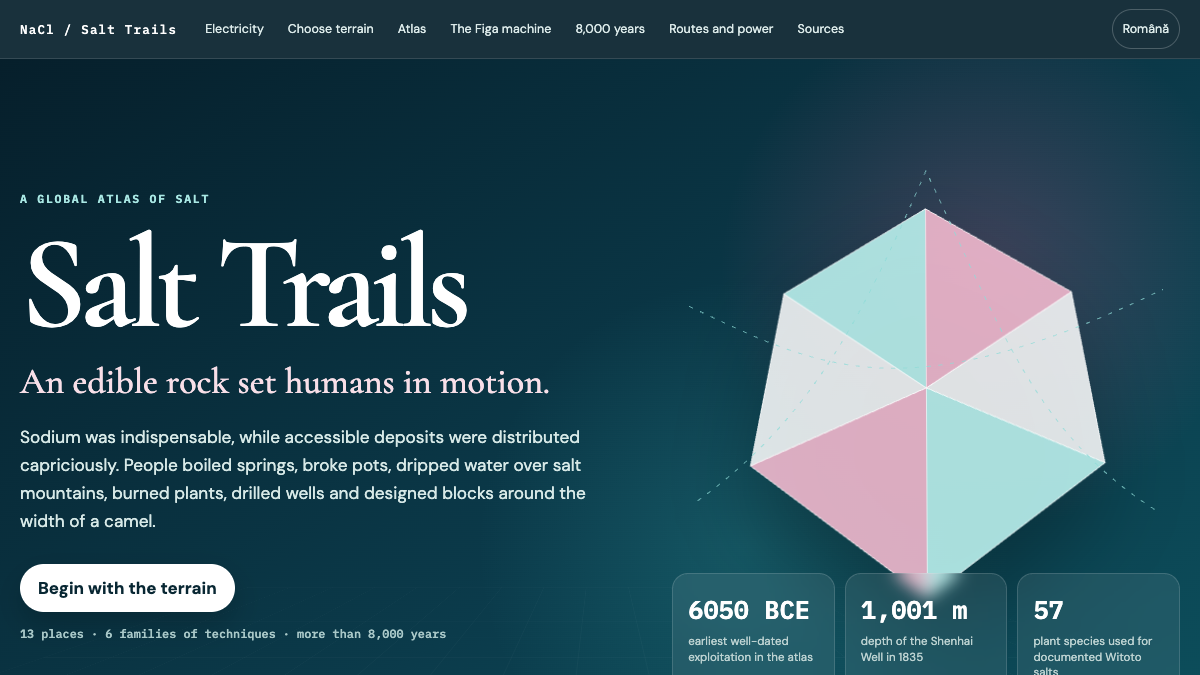
An edible rock set humans in motion.
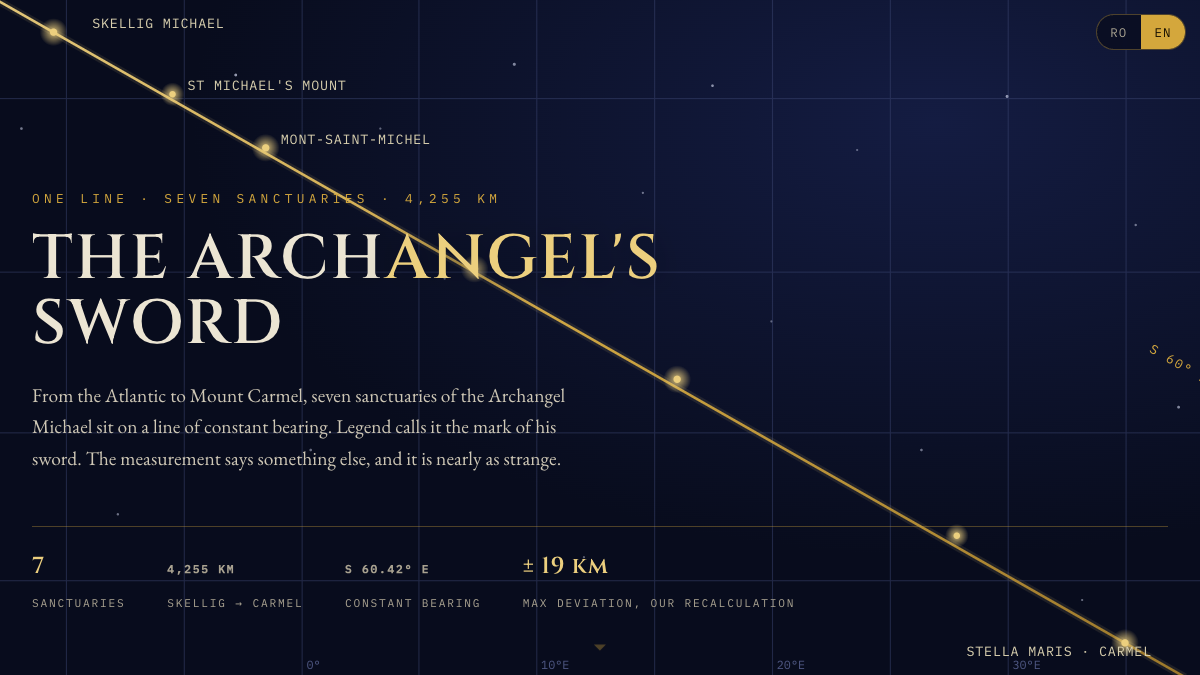
Seven sanctuaries, a geographic legend and a line that can be measured.
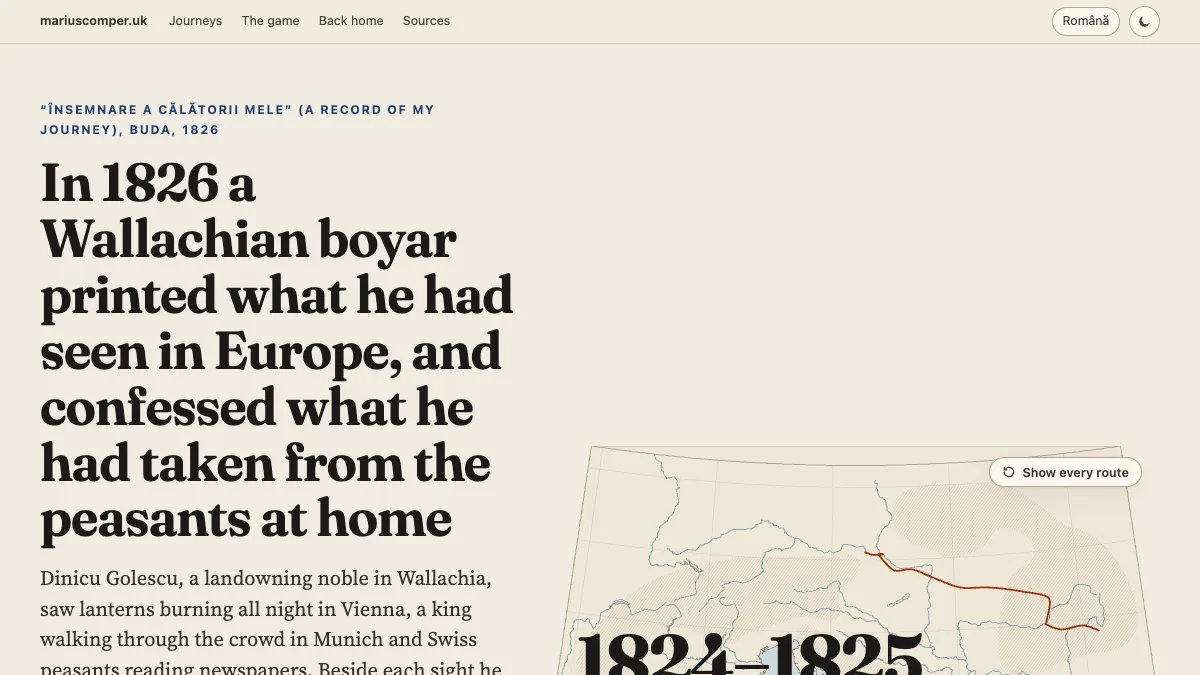
Lanterns burning all night in Vienna, Swiss peasants reading newspapers and, at home, men held in the sun under a beam over taxes. Dinicu Golescu's travel book, on a map.
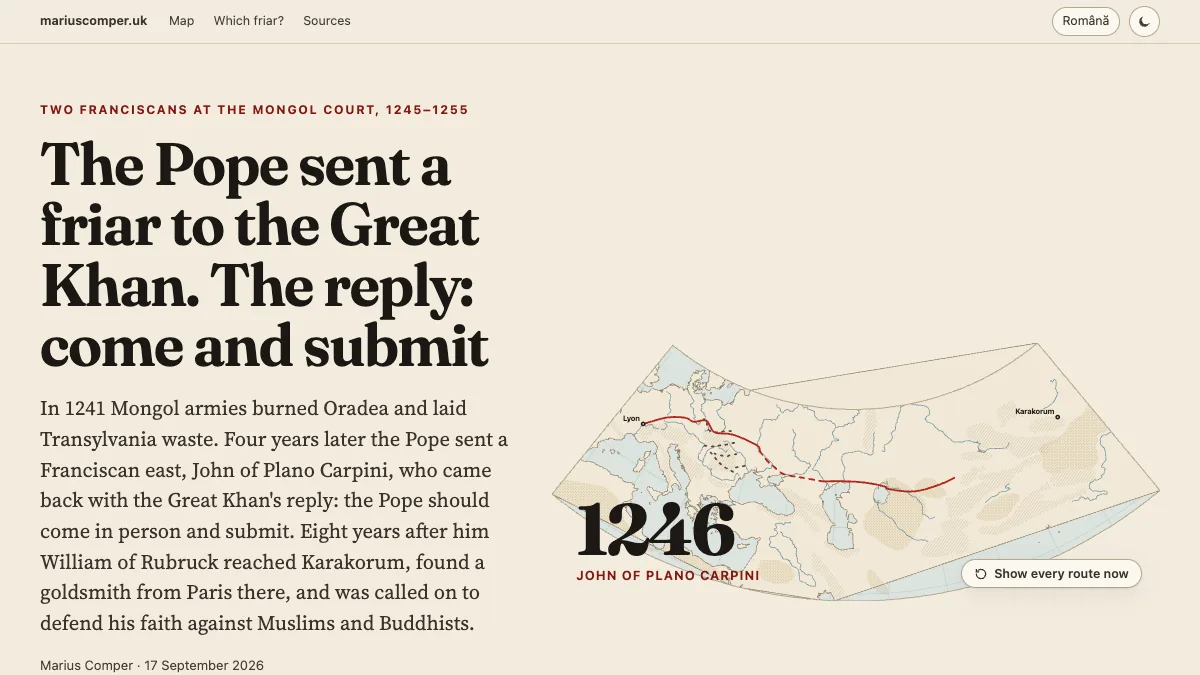
Carpini and Rubruck, two Franciscans at the Mongol court after the 1241 invasion: Güyük's letter, Karakorum, the Parisian goldsmith and the debate held on the khan's orders.
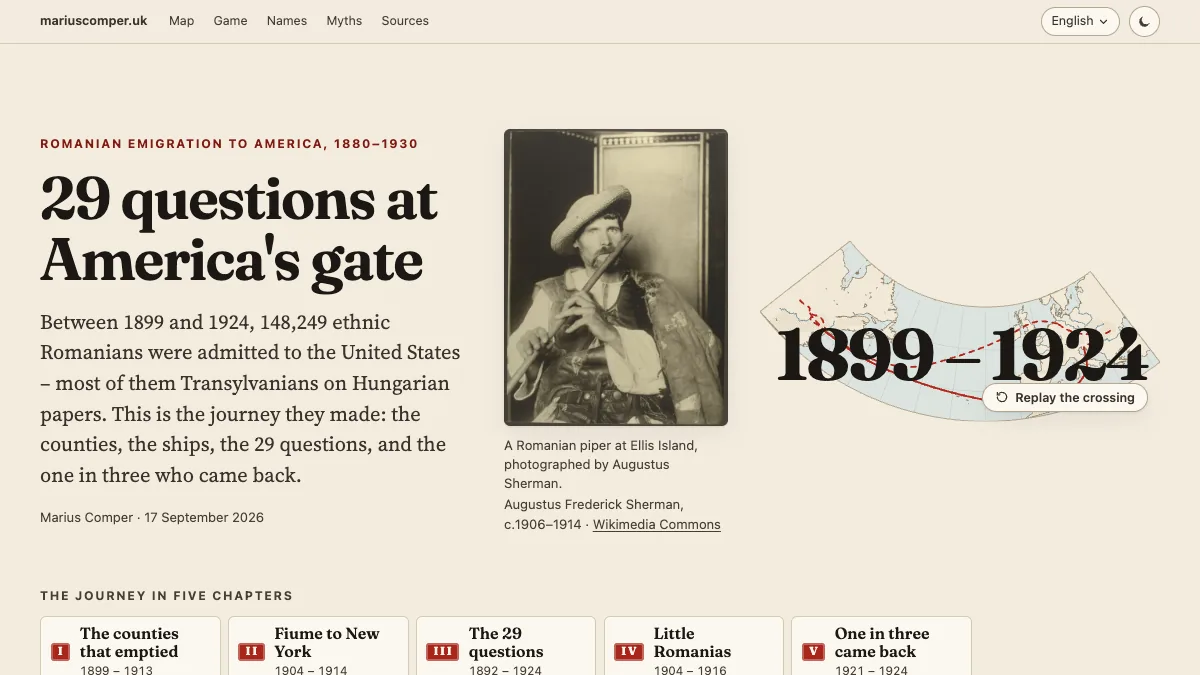
148,249 Romanians admitted between 1899 and 1924, the Fiume sailings, the Ellis Island inspection to try yourself, and nine real passengers to search by name.
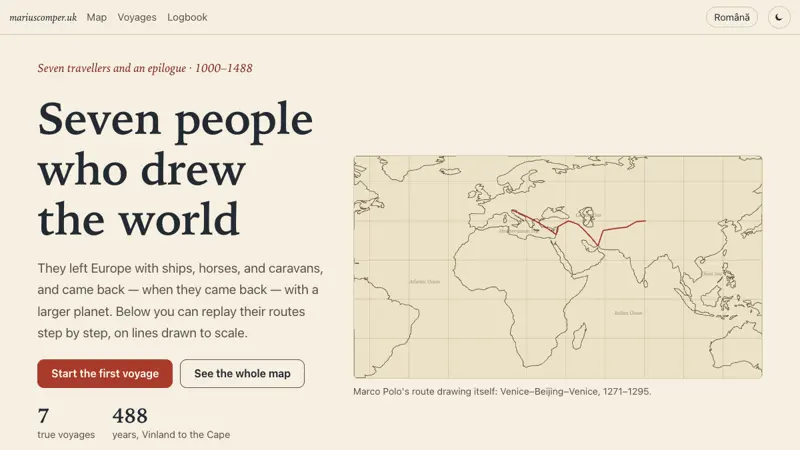
From Vinland to Beijing and Karakorum to the Cape of Good Hope: seven true medieval journeys, drawn on the map step by step. Replay their routes and stamp your logbook.
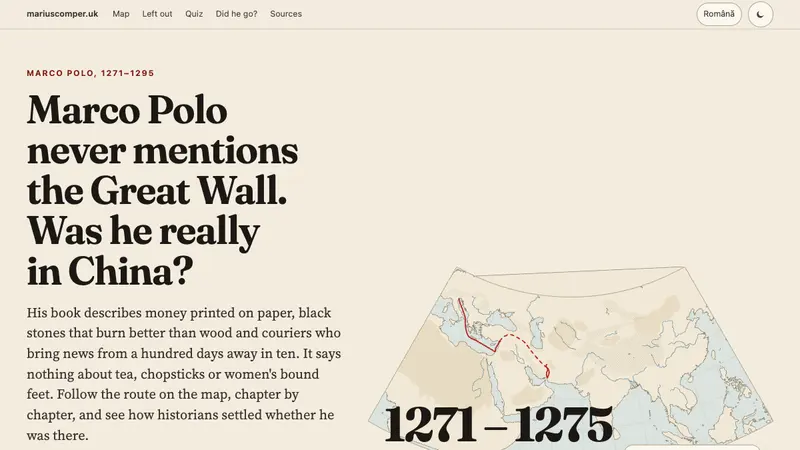
The 1271 to 1295 route on the map, chapter by chapter: the paper money, coal and postal relays the book describes, the tea and the Great Wall it leaves out, and the evidence that convinced historians he was there.
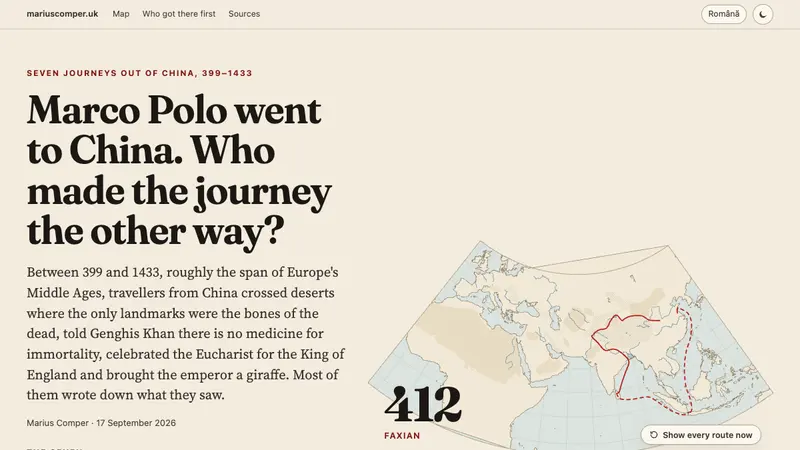
Faxian, Xuanzang, Du Huan, Changchun, Rabban Bar Sauma, Zhou Daguan and Zheng He: seven journeys out of China between 399 and 1433, on one map, with what they wrote about what they saw.
Steam compared: Viseu de Sus (136 lei, 6 h), Sovata (80 lei, 2 h), Moldovita–Argel (60 lei) and Vatra (30 lei). 2026 programs and measured drives.
Six museums with official fares: Village, Antipa, Ceausescu House, MNAR, MNIR, Parliament. Hours and measured access.
Which medieval city: Sibiu with ASTRA 50 and Brukenthal 50, Brasov with the Black Church 20 RON and Art 12, Sighisoara UNESCO with no official fares. Measured access.

Is Bran worth it? Stoker never visited Romania, and the novel never names Bran. Six places graded by evidence — archive (Targoviste), disputed tradition (Snagov), late materialization (Borgo) — with a visit router.
Ceaușescu's House, Revolution Square and the Palace of Parliament in one day: booking rules, official tariffs, leg distances, four December 1989 dates and a trilingual glossary.
The Strigoi Atlas: 19 protection practices, 10 context records, 5 term USE-reports, 5 documentation-history nodes — every quotation checked to a scanned page. Romanian lore of the dead beyond the Dracula myth.
Voronet, Humor, Moldovita, Sucevita, Arbore: what to see at each, published hours, service times to avoid, and the optimal route with measured driving distances from Gura Humorului or Suceava.
Bran, Peleș, Corvin, Râșnov, Făgăraș, Cantacuzino: adult tickets, official hours, closed days and the best day trip from Brașov, Sibiu or Sinaia, with measured road distances.
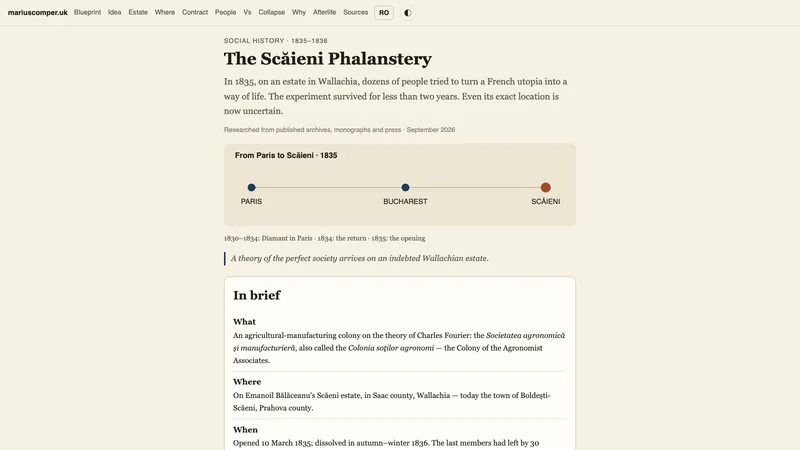
In 1835, on an estate in Wallachia, dozens of people tried to live by the French theory of Charles Fourier. What the Scăieni Phalanstery was, who built it, why it failed — and why even its exact site is uncertain.
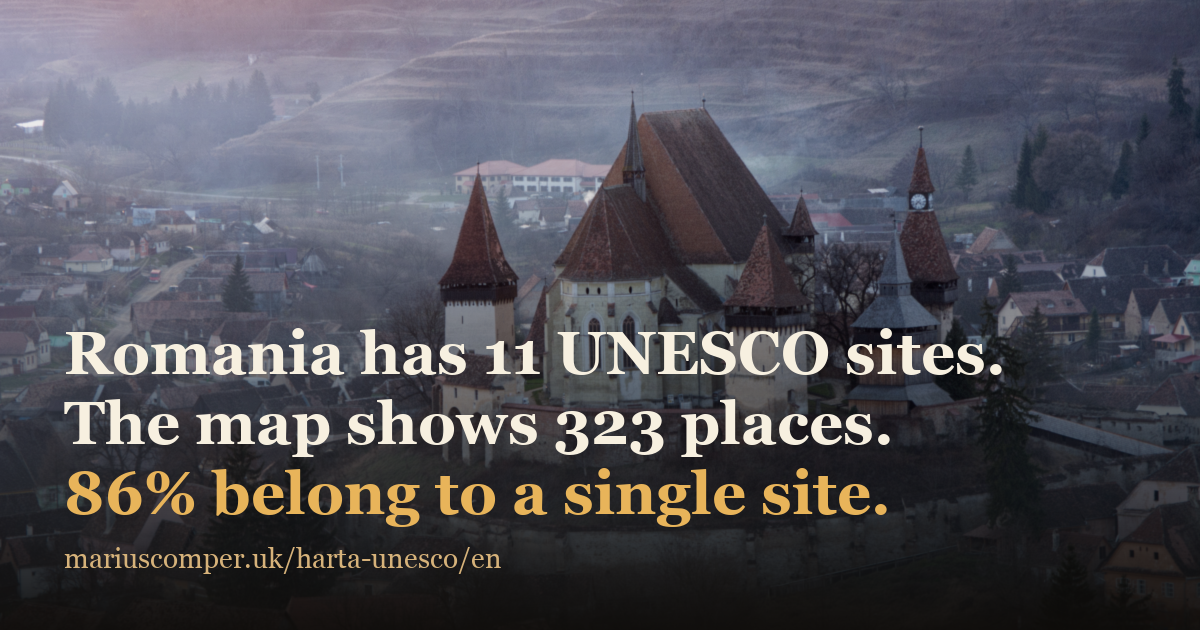
A map of Romania's UNESCO World Heritage brings together all 11 sites and their 323 places, with inscription year, criteria, area and conservation status.
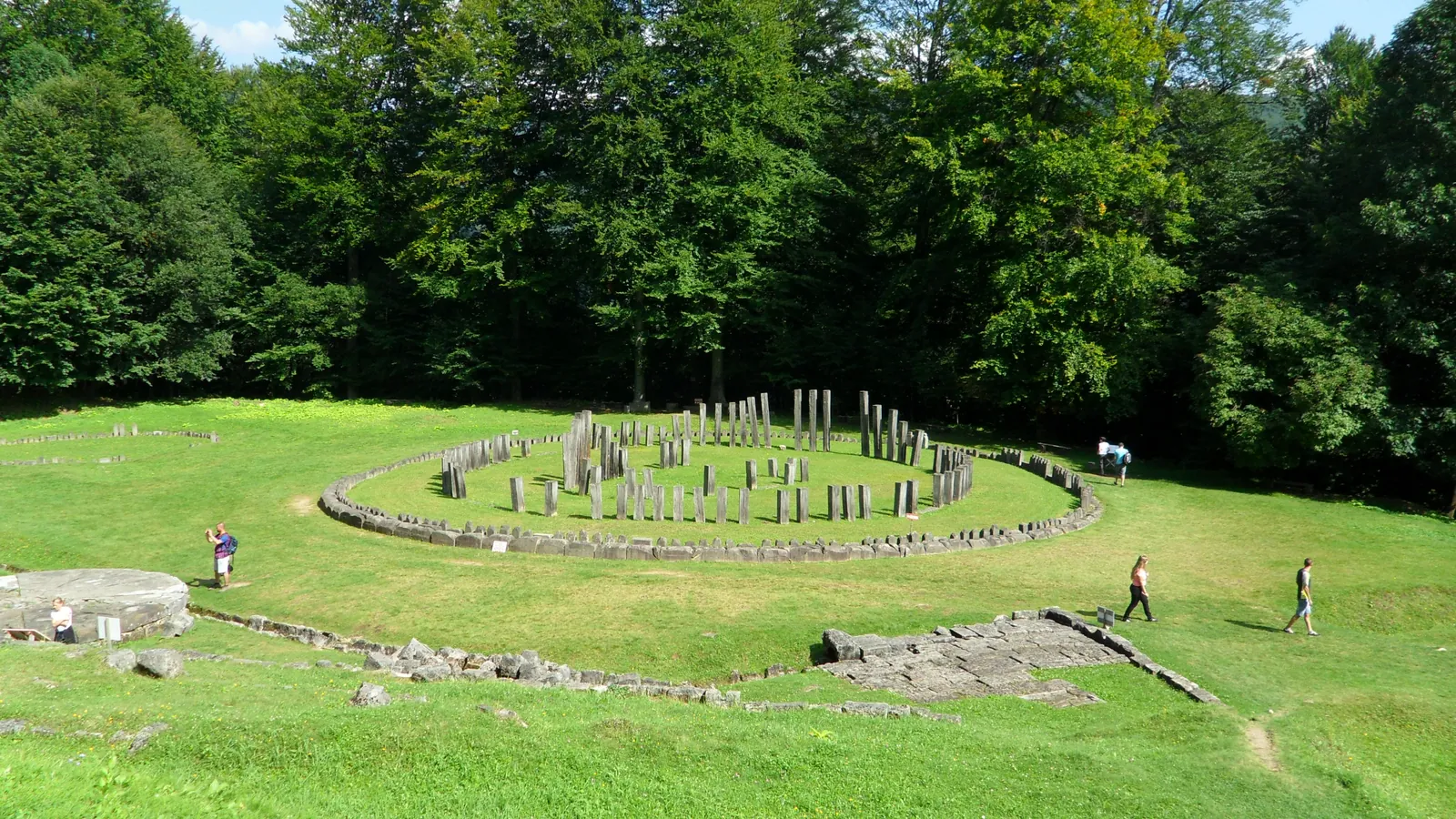
A map of the six Dacian fortresses in the Orăștie Mountains shows road and walking access, elevation gain, time needed, opening hours, tickets and each site's condition.
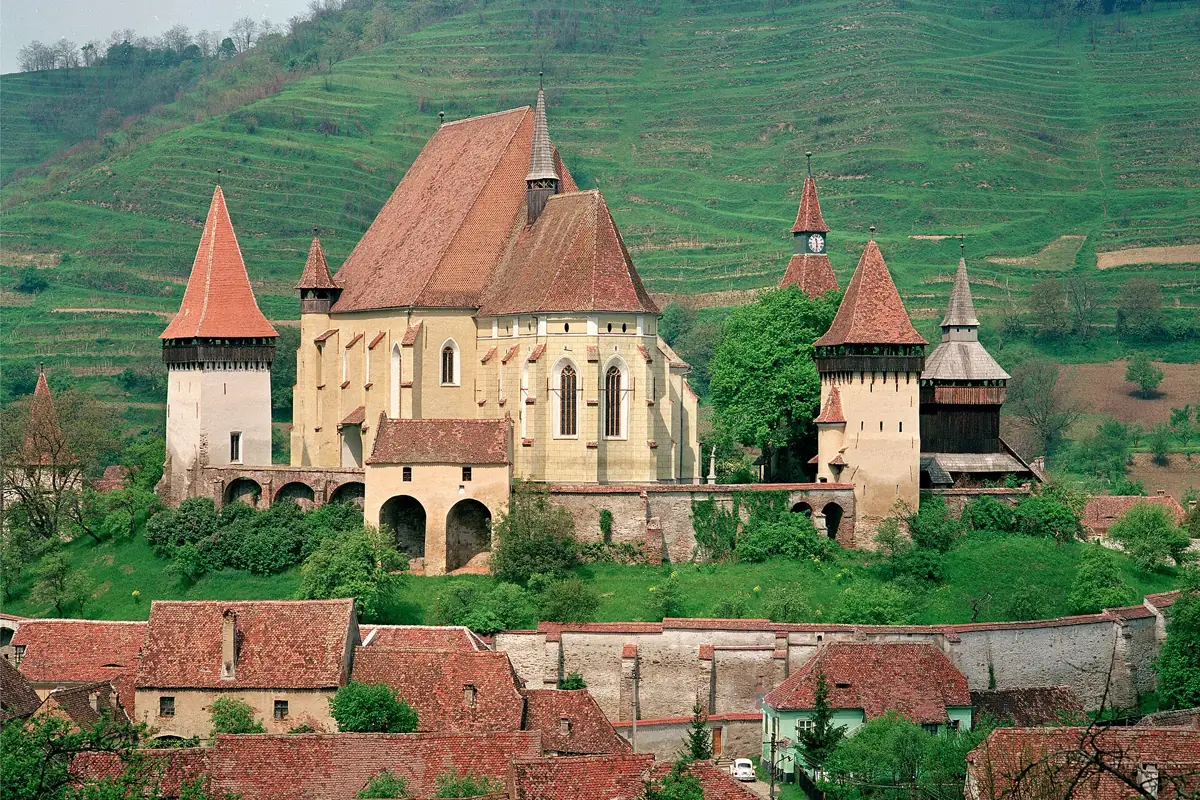
A map of Transylvania's 162 fortified churches includes the seven UNESCO villages, heritage class, published opening hours, keyholder contact and damaged buildings.
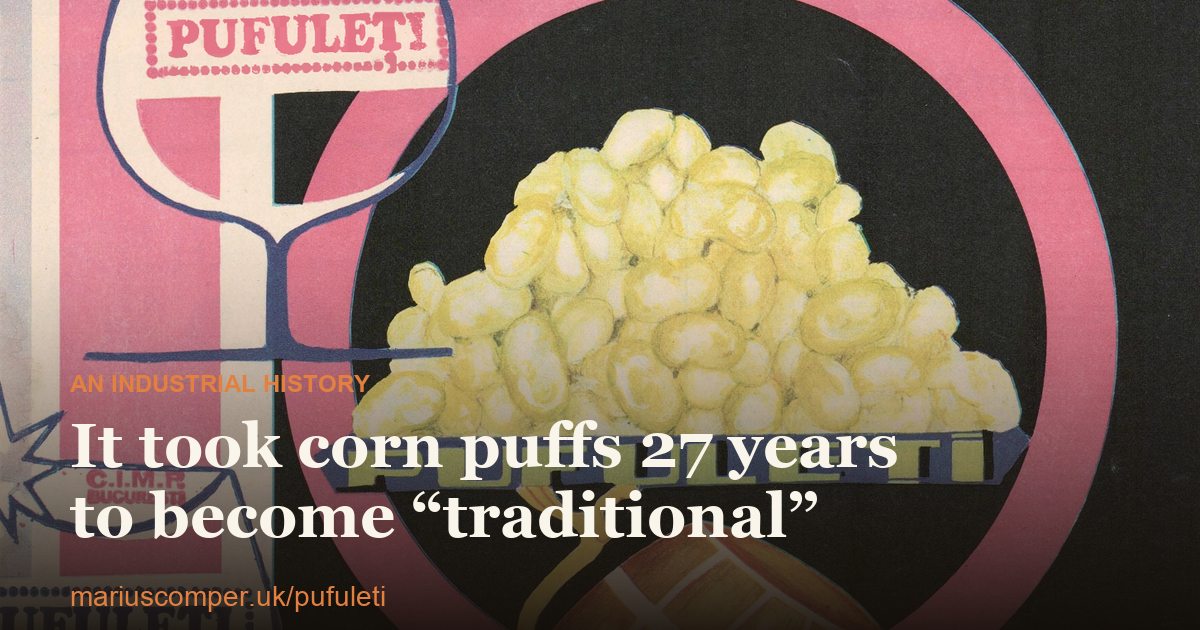
In 1971, Romanian corn puffs were launched as a new item with pecorino cheese. By 1998, the press called them traditional. A history of factories, patents and the Baia Mare production cluster, reconstructed from the archive.
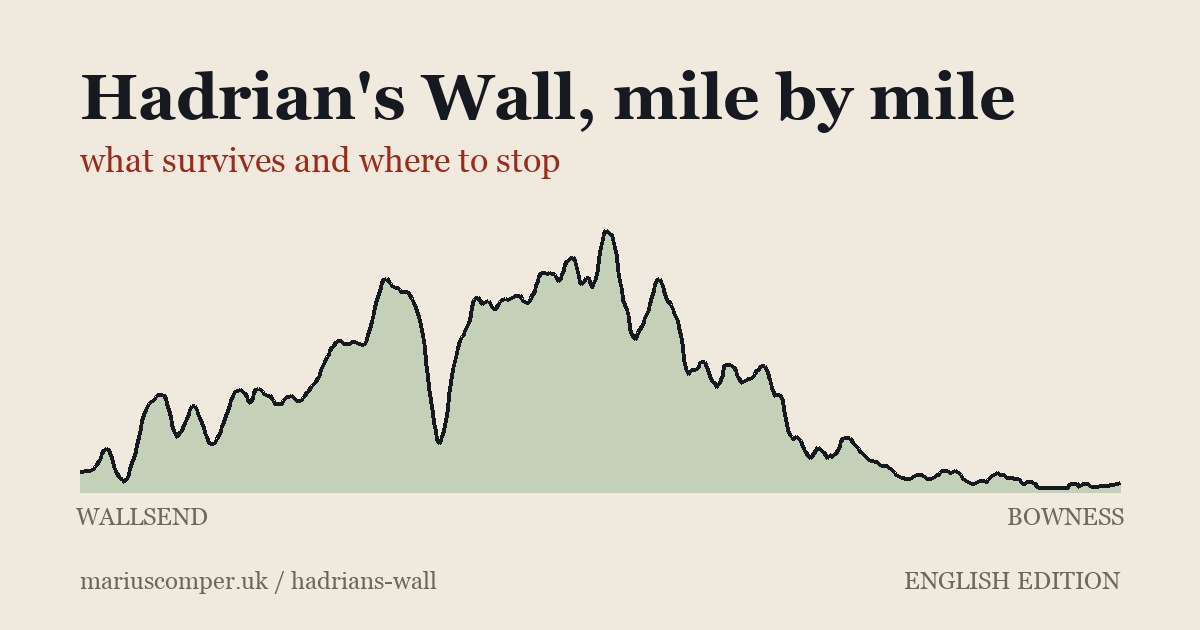
An end-to-end guide to Hadrian's Wall with its measured elevation profile, forts, milecastles, turrets and car-free connections, together with the limits of the available data.
Bucharest was already pickling cucumbers in vinegar in 1865. The atlas traces Romanian pickling through salt, vessels, agriculture, factories, communities and gaps in the record.
A map of Roman archaeological sites open to the public in Romania, including Porolissum, Drobeta and Ulpia Traiana Sarmizegetusa, with opening hours, tickets and sources.
Compare Romania's 1930 counties, 1938 ținuturi, 1960–1968 regions and present-day counties on one map. Search for a commune and see the four units it belonged to.
Three words for one landowning class: castel from the Latin castellum by way of Hungarian kastély, conac from the Turkish konak, culă from the Turkish kula and before that the Arabic kulle, a tower. The castle stops at the mountains; the conac crosses; the culă never leaves Oltenia.
None of the 99 societies with all twelve explanations coded puts misfortune down to natural causes alone; 157 of 166 shield an infant both with charms and with washing or medicine; and in 2025 worry runs above experience of harm in 137 of 140 countries.
Seven of the eight monastic sites older than the year 1200 are in the Banat, Crișana and Transylvania. The eighth is in Dobruja. In Moldavia and Wallachia there is not one.
The oldest ruins in the country are neither Dacian nor Roman: they are Neolithic and Bronze Age fortified settlements. And the most heavily re-settled place in the list is a hill in Buzău county, with five villages and five cemeteries stacked on it.

The dead person's name is restricted in 21 of 40 coded societies; a widow's mourning equals a widower's in 20 of 27; on the question of the name, 146 of 186 societies have no coded answer.

In 657 of 1,272 societies with a record, the groom or his kin made a substantial payment to the bride's family. Dowry appears in 43.
Of the 799 medieval chivalric works that have reached us, 326 are attested by a single manuscript.

The Carpathians are usually treated as the border between two building worlds. Wooden churches ignore it: their density rises the same way on both flanks and falls where the hills end.
A sound change does not depend on what a word means; it happens wherever the phonetic conditions are met. Twenty-four of them rebuild forty Romanian words out of Latin, one step at a time.
One hundred and twenty-five titles and places mapped across Romanian cinema: from the Buftea studio lot to the Danube Delta and contemporary Cluj. A real, county-level map.
Romanian's basic food words trace to Latin. The heavy medieval wheeled plow's parts are mostly Slavic or Hungarian. An interactive diagram shows where the farming vocabulary splits.
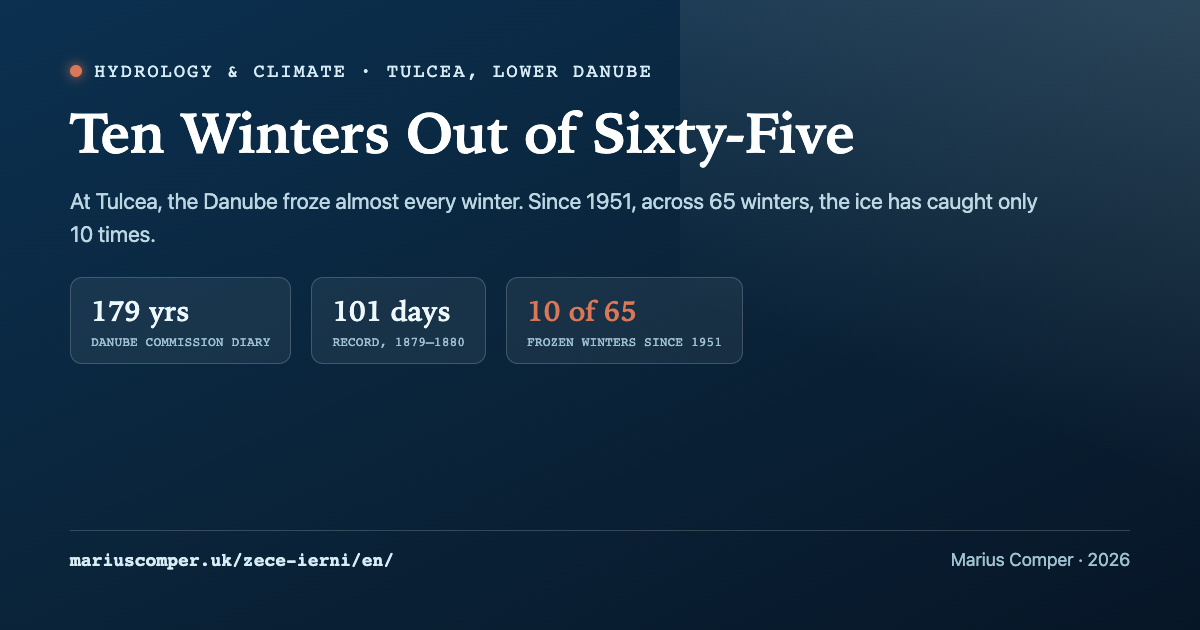
At Tulcea, the Danube froze almost every winter for a century. Since 1951, across 65 winters, the ice has caught only ten times. A 179-year diary, and a tool where you pick the year.
Moscopole (Moschopolis, today Voskopoja) was a major Aromanian-speaking commercial and educational centre in the 18th-century Ottoman Balkans. Trade, schooling and languages: the story of the city and its links with Romania.

The combinatorial explosion of ancestors, a famous genetic study revised twice, and a tool that turns your grandparents' origins into a distribution of generations — not a verdict.
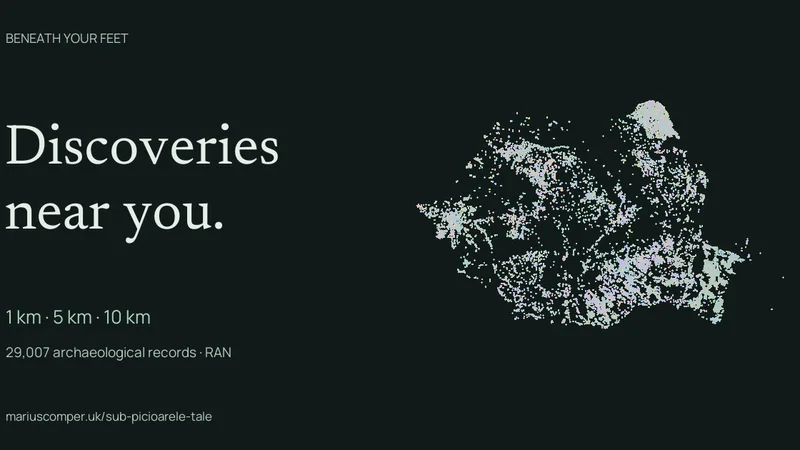
Choose a Romanian town or village to find archaeological discoveries recorded within 1, 5 and 10 km of its reference point. Explore their periods and open the evidence in Romania’s National Archaeological Record.
Pliny the Elder wrote about elephants and the moon in AD 77. An American psychologist cited the story as scientific evidence in 1977 — exactly nineteen hundred years later. Along the way, someone added a branch that appears in neither source.

Seventeen million years on one slider: the Badenian sea, the giant lake, the drying that emptied it and today's Black Sea, over a faintly visible Romania, with every county cut along the maps.

Drag the clock through the last 20,000 years: shoreline, glaciers, steppe and forest, a Danube without a delta, dated human sites and vanished megafauna, with your town pinned.

A thousand years of buildings on one map, with a time slider, and the oldest thing still standing in each of the 5,672 localities on the list.

A map of the Bârsa basin with 102 places, each classified by toponymic root (German, Hungarian, Romanian, uncertain). A movable waterline between 300 and 1800 m shows how the roots split by elevation; the attestation years show which villages have a real year and which microtoponyms never had a founding act.

A reader asked for a list of deduced truths about Romanians. One hundred survived, in ten chapters of ten. Each carries its deduction underneath, a map links the propositions to their 134 sources, and the result sits at the end.

A map of Romania made of 18,214 settlement points and 127 rivers, on which the name strata are laid down in turn: ancient, Slavic, Turkic, Hungarian, German, Romanian. A time slider, a length ranking of rivers and a core sample for any name.

Four thousand folk beliefs printed by the Romanian Academy under the name of an entire people, reconstructed from OCR and scan. One in four is a prohibition, a third of the entries with a locality attribution comes from one village, and six labels are missing from the printed numbering.
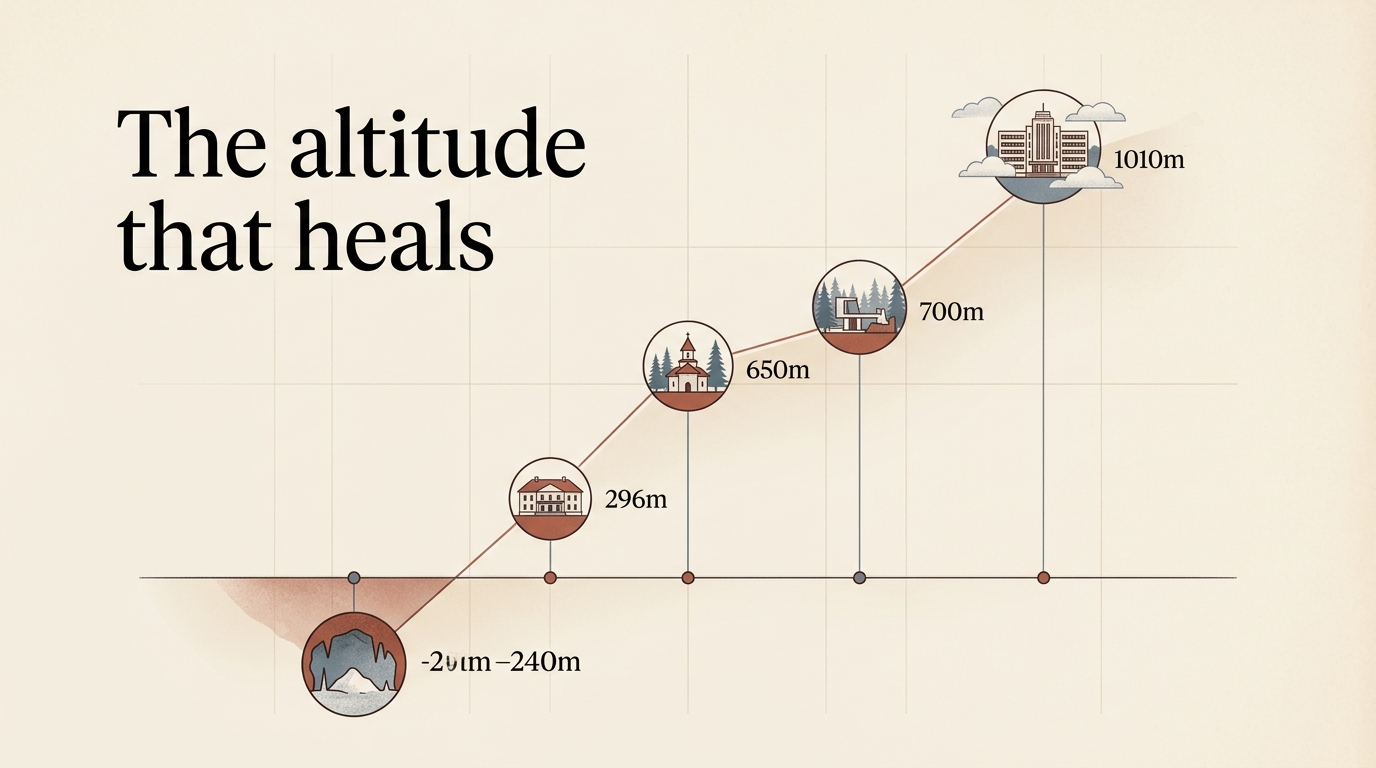
In the 1930s, when tuberculosis had no chemical cure, Romania erected a network of machine-like buildings across the Carpathian Mountains and deep underground. From −240 metres underground to +1,010 metres on the ridge, five monumental structures rendered obsolete by a single molecule.
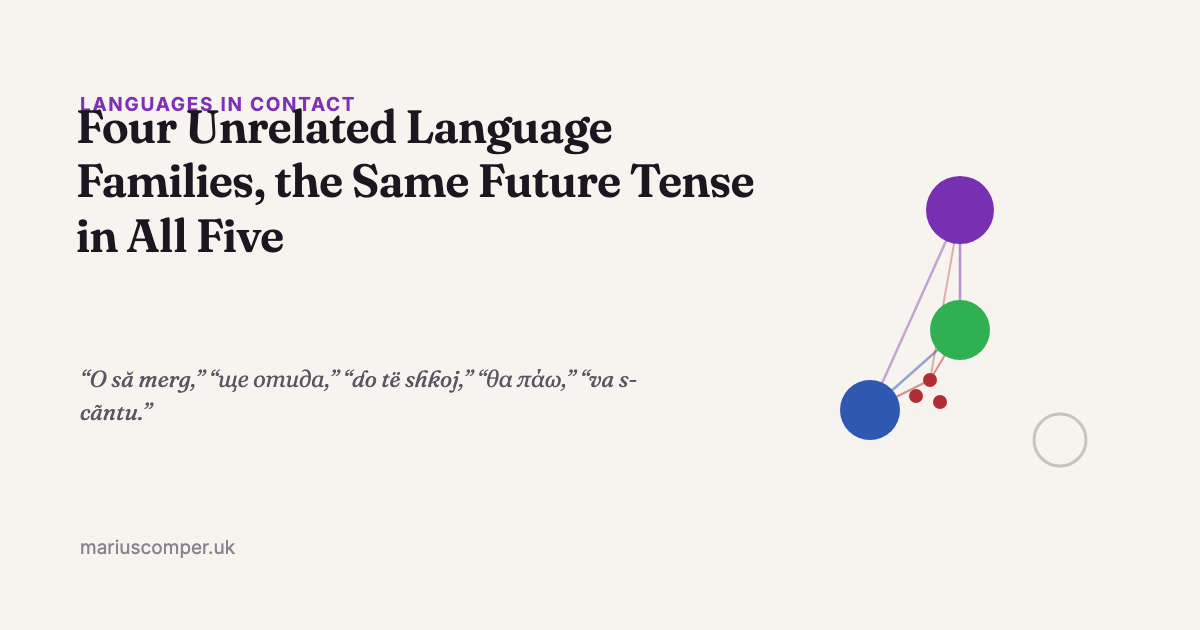
Romanian, Bulgarian, Albanian, Greek and Aromanian build their future tense with the same grammatical mechanism, from a verb meaning to want, despite coming from four unrelated language families. An interactive map of the Balkan sprachbund, exceptions included.

Nineteenth-century crude carts, the 1943 low-level air war, and historical pipeline webs cutting through family yards in Prahova Valley.

All 1,583 Romanian passenger stations coloured by how long the train takes from Bucharest, next to the 1939, 1948 and 1977 timetables and the state of the lines that explains the difference.
One-eyed Pazvante, Prince Reed, a flea shod in iron. A journey through Romanian sayings that kept their characters and stories while muddling the calendar.

The priest sprinkles the house. Then anyone may enter. Marian’s 1892 book on birth, read as the unlocking of the house.

Village wool turns red only after it has been yellowed. Marian’s reception speech of 12 March 1882, read as a system of baths.

The family lays cloth on the doorstep. The coffin passes. The cloth is taken up and given as pomană. Marian’s 1892 book, read as an itinerary.
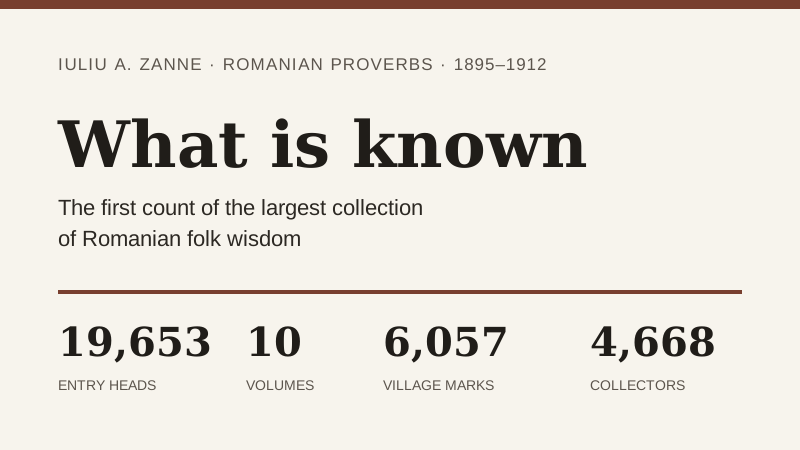
19,653 entry heads from «Proverbele românilor», the ten volumes Iuliu A. Zanne published between 1895 and 1912, counted for the first time: the bestiary, the body, God and the devil, the collectors’ map.

The same 20,000-to-one rate produced four maximum outcomes: 75, 150, 250 or 375 stabilised lei.
For eight centuries, Carpathian communities governed property, homicide and boundaries through an oral legal algorithm. An anthropological deconstruction of customary law.

A shopper's chance to win made the sale harder to hide.
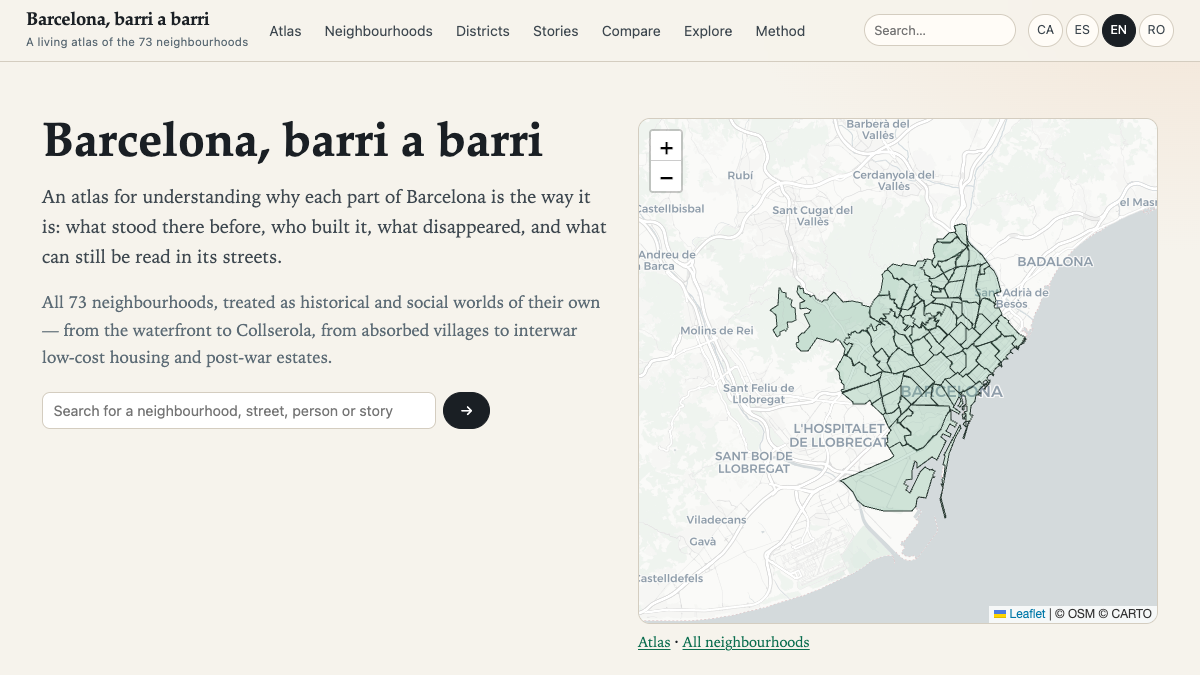
Seventy-three neighbourhoods read through maps, memory and data.

For 59 years, a red tent has appeared overnight in a Shinjuku shrine courtyard, staged a play, and vanished. Riot police surrounded it in 1969; its founder died in 2024. The tent keeps returning anyway, more often than the official revival of itinerant kabuki.

A leaderboard of documented survivors, ranked by incident-conditioned paper micromorts.
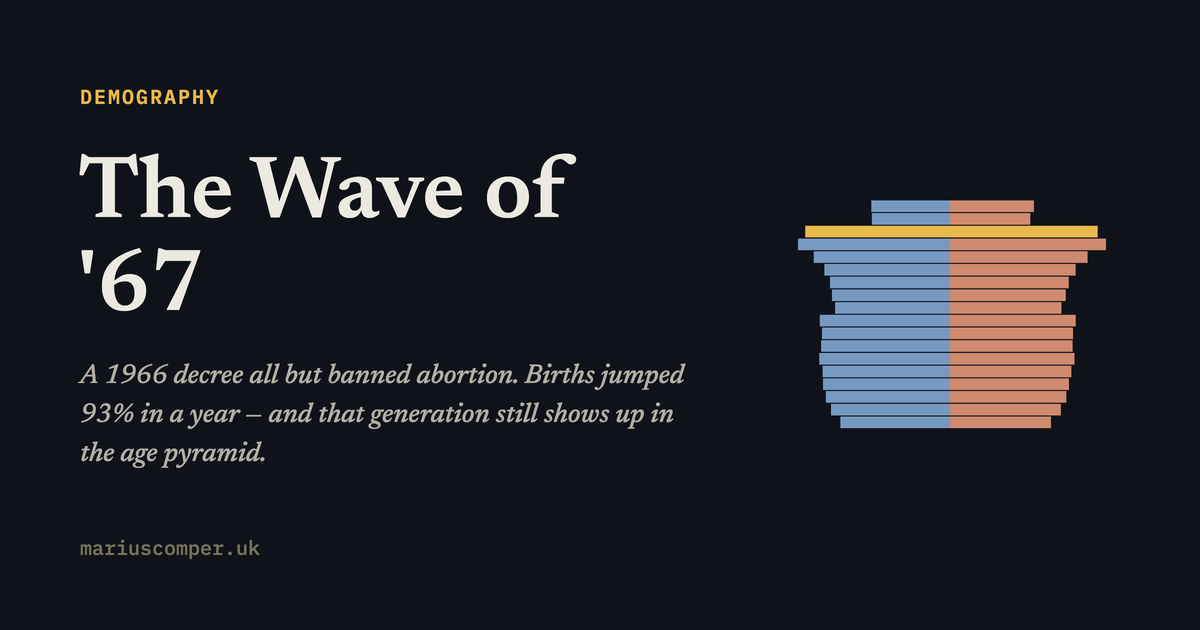
A 1966 decree all but banned abortion in Romania. Births jumped 93% in a single year, and that generation still dominates the country's age pyramid.

Follow a 1541–42 descent from the Andes to the Atlantic, then switch between a conquistador's testimony and the archaeological traces of Amazonian roads, earthworks and settlements.

In 1920, in Cluj, Romania founded the world's first institute of speleology — thirty-seven years before anyone found the cave that would become the country's longest, and a century before it learned how far down it could go.

A rock the size of a park decided the fate of 12,200 km² of sea. Drag the slider through 144 years, 1878–2022, along the real ICJ ruling line.

An Ottoman island sat forgotten by treaties for 45 years in the middle of the Danube, then a dam drowned it under thirty metres of water.

In 1857, two years before the Titusville well, Bucharest was lighting its streets with kerosene.

A Wallachian pogon, a Moldavian falce, a Transylvanian yoke and a Dobrujan donum measured different areas under one word: land. A tool for translating old land measures into real square metres.

The gap between the two feasts clicks between four stops: zero, seven, 28 or 35 days, 854 years running.

A secure language, a lost voice. Names and one witness from 386 make up the surviving archive.

A vanished country takes shape through sediment, buried rivers, objects and the traces of the people who lived there.

The eclipse was total in Bucharest on 15 February 1961, but cloud hid totality from the ground. Newspapers, scientific reports and Romanian archives preserve observations made on the ground and from the aircraft.

A local story about bricks becomes a civic invitation, then a grammar other towns translate in their own way.

The documented story of Palmares: communities, Macaco, the figure 21,000 and the split of 1678.
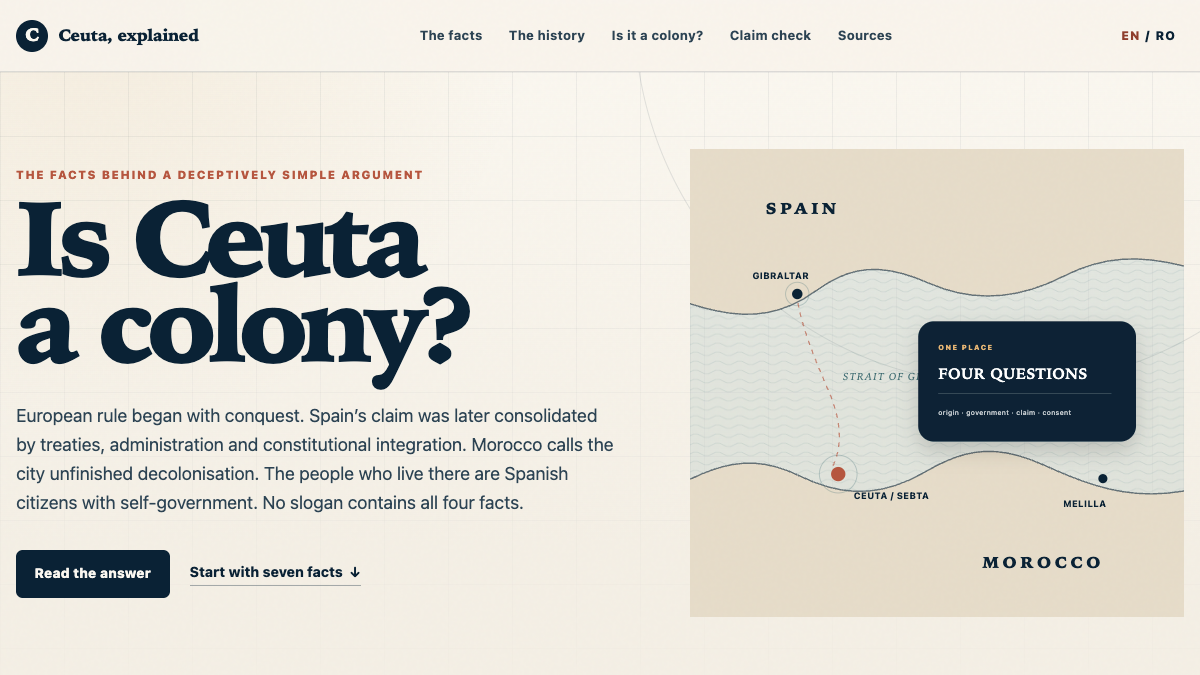
Four facts change the question about Ceuta.
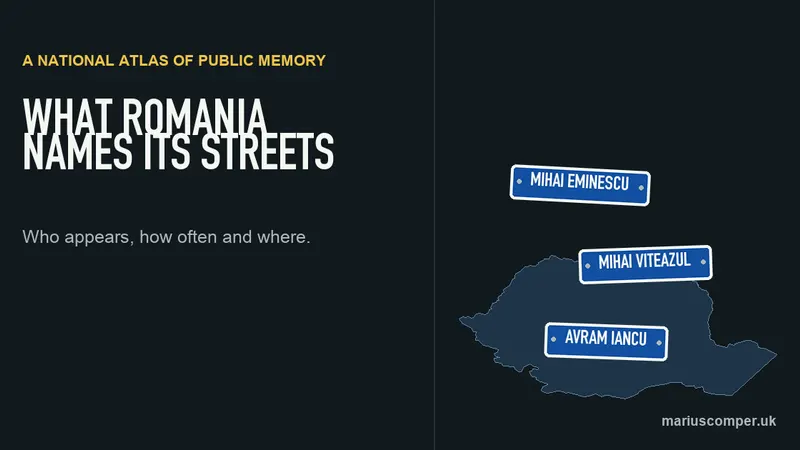
A country’s street map also shows whom it chooses to remember.
How much leaders sleep — and how much of the story survives scrutiny.
How settlements, houses, food, pottery and rituals changed between c. 5050 and 2950 BCE.
One address, a hidden garden and the city history around it.
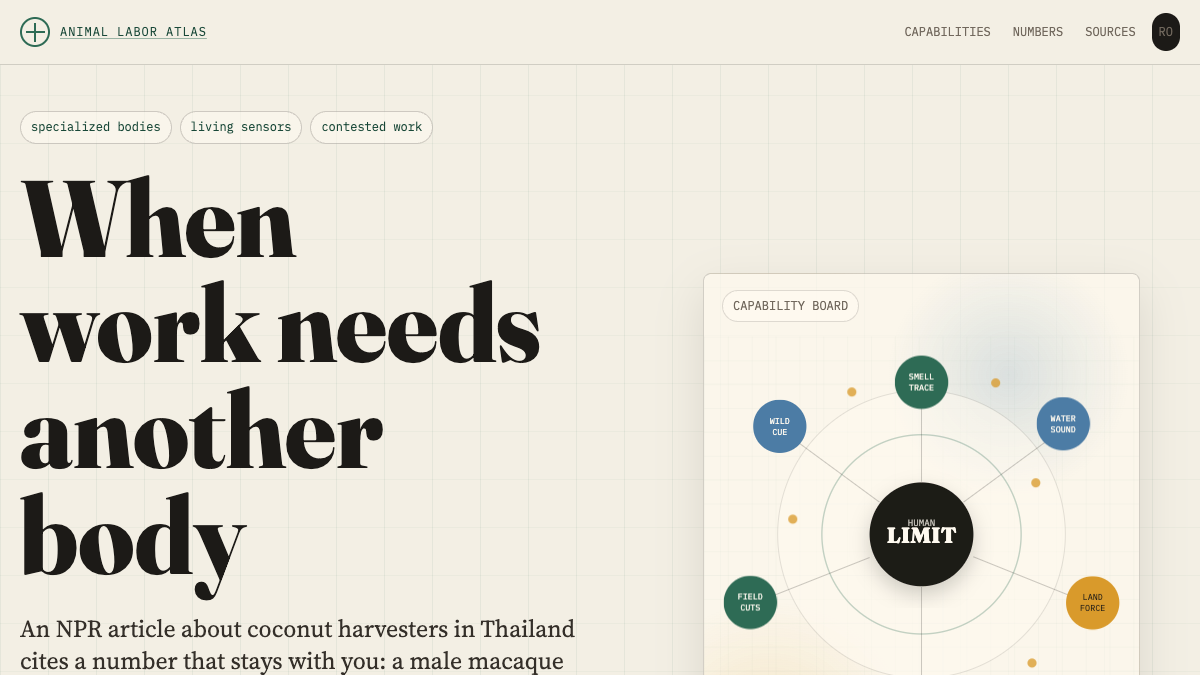
A visual dossier about animals people have used as sensors, engines, divers, agricultural workers, medical systems and search partners.
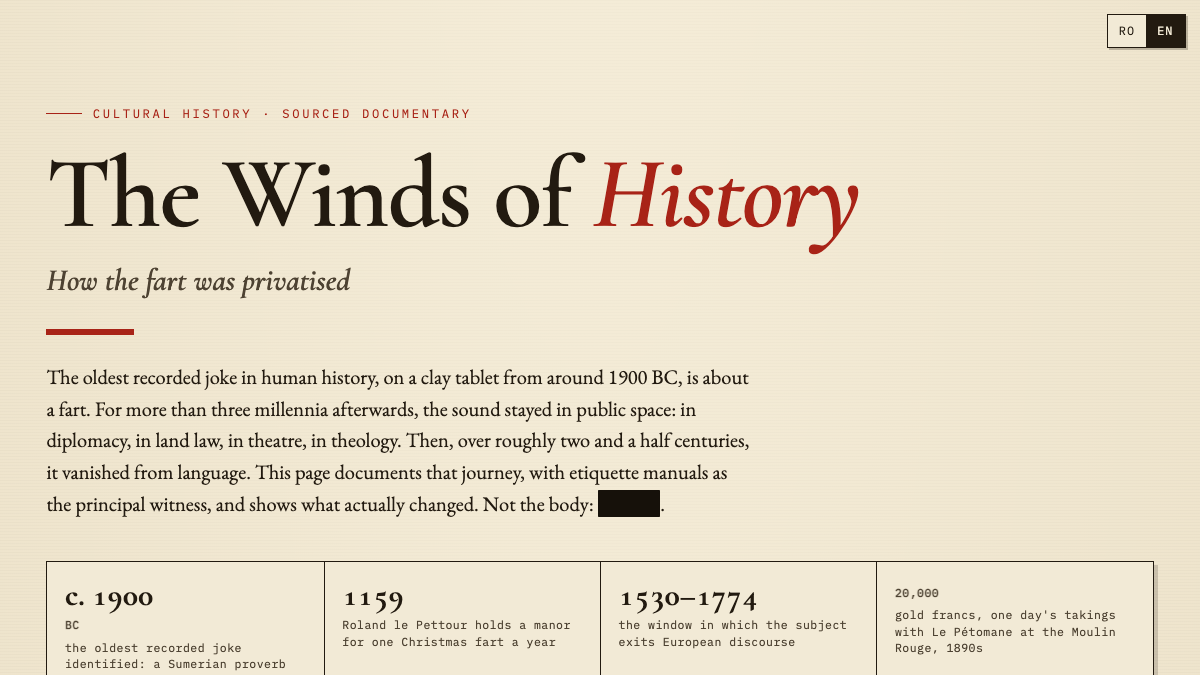
A documented cultural history of farting, from Sumerian jokes to modern patents.